Should I Get Tested for HIV, Hepatitis B, and Hepatitis C?
HIV, hepatitis B and hepatitis C travel by overlapping routes and can stay silent for years. This guide works out which of the three you need to test for, how soon after an exposure a test can find anything, and when an at-home screen or a clinic lab panel is the better tool for the question you're asking.
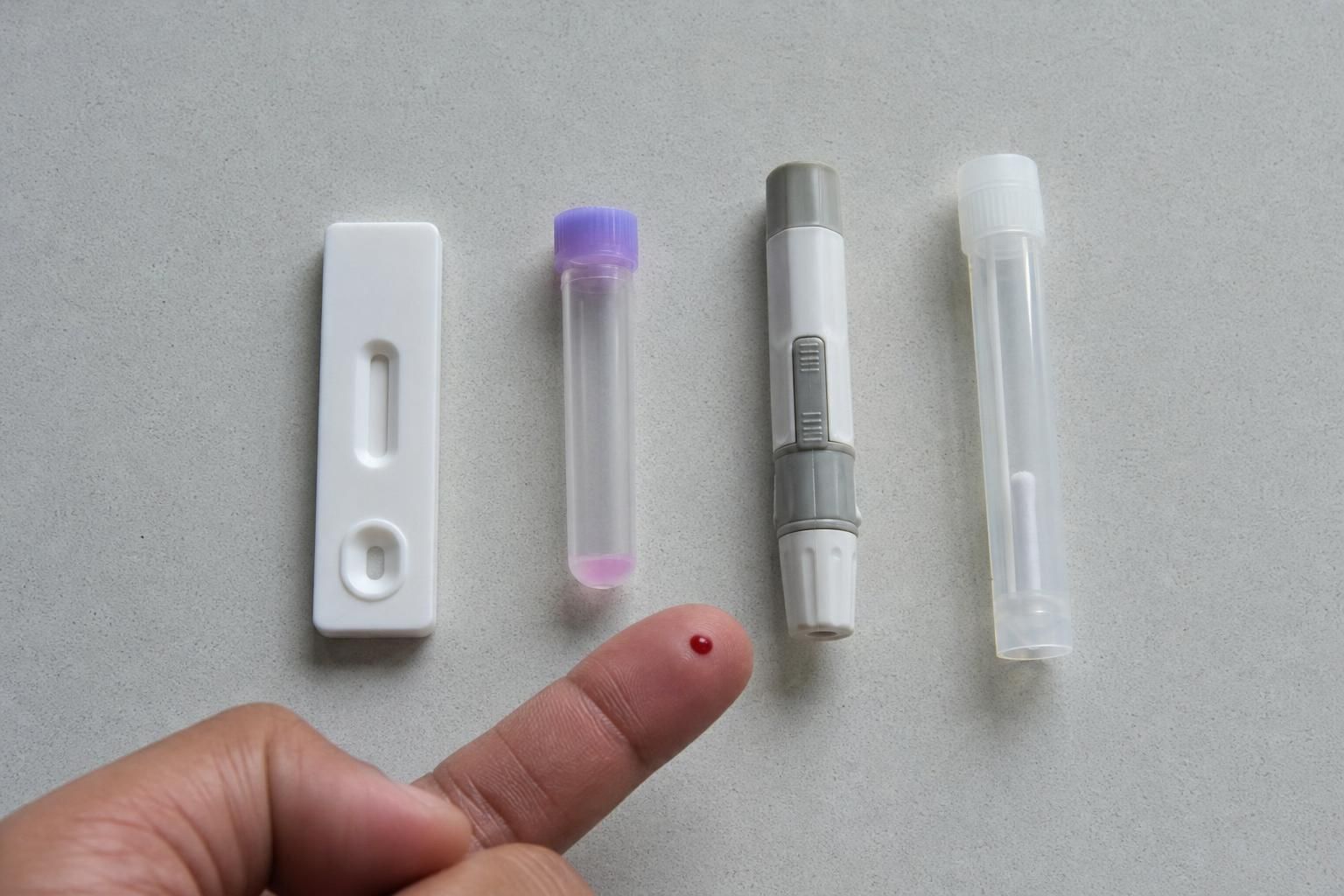



- CDC advises a one-time hepatitis B and hepatitis C screen for every adult 18 and older, and at least one HIV test for everyone aged 13 to 64.
- Timing decides which test fits. Soon after an exposure, clinic tests that detect earlier are the better tool, and an HIV exposure within 72 hours calls for PEP. A home antibody screen is only preliminary: a reactive result needs confirmation, and a negative does not rule infection out.
Published: October 2026 | Last updated: October 2026 | Editorial review and quality control: Martina N.
Should I get tested for HIV, hepatitis B and hepatitis C?
Most adults should, at least once. CDC recommends one hepatitis B and one hepatitis C screen for everyone 18 and older, and an HIV test for everyone aged 13 to 64. Repeat testing is for people with ongoing risk, such as new partners or shared drug equipment. An HIV exposure in the last 72 hours needs a clinic for PEP first.
For most adults the answer is yes, at least once, and for some people on a schedule. HIV, hepatitis B and hepatitis C spread through blood, and HIV and hepatitis B also spread through sex. Each can go years without symptoms while it wears down the immune system or the liver. Because the routes overlap, a risk for one of these infections is often a risk for the others too.
Why the three are checked together
The overlap is biological, as the NIH quote below sets out for HIV and hepatitis B. Hepatitis C is a blood-borne infection; WHO lists unsafe health-care injections and procedures, unscreened transfusions and shared injection equipment as its most common routes (WHO hepatitis C fact sheet). That shared ground is why CDC recommends hepatitis B testing for every person with HIV (NIH HIVinfo), and why CDC also lists people with HIV for one-time hepatitis C testing (CDC hepatitis C testing). For how each spreads during sex specifically, see how HBV and HCV spread through casual sex.
Many infections go undiagnosed. WHO estimates that 240 million people worldwide were living with chronic hepatitis B in 2024 and that only 27% of them knew it (WHO hepatitis B fact sheet). It puts the global count for chronic hepatitis C at about 47 million. These are global population estimates, and they say nothing about your own odds. What matters for you is your own history.
Both HIV and HBV spread from person to person in semen, blood, or other body fluids. For this reason, the main risk factors for HIV and HBV are the same: having sex without a condom and sharing injection drug needles or works.
Who should test, and how often
Each infection has its own baseline rule, and all three set a lower bar than most people expect. For HIV, CDC says everyone between 13 and 64 should be tested at least once. People with certain risk factors, such as a man who has had sex with another man, should test at least once a year, and sexually active gay or bisexual men may benefit from testing every 3 to 6 months (CDC HIV testing).
For hepatitis B, CDC recommends screening all adults 18 and older at least once with a triple panel, plus HBsAg screening in every pregnancy, plus periodic testing for anyone with ongoing exposure risk (CDC hepatitis B testing guidance). Hepatitis C follows the same once-in-a-lifetime rule for adults, with testing in each pregnancy and periodic testing for people who inject drugs and share needles or other equipment (CDC hepatitis C testing).
So if you have never been tested for any of the three as an adult, the recommendation applies to you for all three. You don't need to have taken a risk to qualify.
Screening Rules at a Glance
| Question | HIV | Hepatitis B | Hepatitis C |
|---|---|---|---|
| Baseline screen | At least once, ages 13 to 64 | At least once, adults 18 and older | At least once, adults 18 and older |
| In pregnancy | Test during each pregnancy | HBsAg test in every pregnancy | Test in every pregnancy |
| With ongoing risk | At least yearly; every 3 to 6 months may help some gay and bisexual men | Periodically while the risk continues | Periodically, for example when sharing drug equipment |
| What the first test looks for | Antibodies, antigen or viral RNA, depending on the test | Triple panel: HBsAg, anti-HBs and total anti-HBc | Antibodies, which show past or current infection |
| What a positive needs next | Laboratory confirmation before any diagnosis | Laboratory confirmation and further markers | An RNA test to show whether infection is current |
Recommendations from CDC for HIV, hepatitis B and hepatitis C.
After a specific exposure, timing comes first
Routine screening can happen any time. After a specific event, such as a condom break, a new partner of unknown status or a shared needle, what you need to know first is how long ago it happened.
Within 72 hours of a possible HIV exposure, go to a sexual health clinic or emergency room and ask about post-exposure prophylaxis (PEP), the medicine that may stop an infection taking hold (NHS HIV and AIDS). A test taken that week cannot pick up an infection from the same exposure. If you are not vaccinated against hepatitis B, ask about it at the same visit. CDC advises that unvaccinated people get hepatitis B immune globulin and a dose of hepatitis B vaccine as soon as possible after an exposure, preferably within 24 hours, and notes that the window for this protection is unlikely to exceed 7 days after a needle exposure or 14 days after a sexual one (CDC Pink Book, hepatitis B).
After that, how soon an HIV test can see anything depends on what it detects. CDC gives these windows: a nucleic acid test (NAT) usually detects HIV 10 to 33 days after exposure, a lab antigen/antibody test 18 to 45 days, a fingerstick rapid antigen/antibody test 18 to 90 days, and an antibody test 23 to 90 days. For hepatitis C, CDC advises that anyone who may have been exposed within the past 6 months get a NAT for HCV RNA rather than an antibody test. Those early tests are clinic tests, so a recent exposure is a reason to go to a clinic rather than wait for a home kit to catch up.
Decide which test fits you
Answer the questions below in order and stop at the first yes. The early questions cover the cases a home test can't handle; the last one covers the routine screen most readers came for.
Which Test Should I Take?
Was there a possible HIV exposure in the last 72 hours?
Yes: Go to a sexual health clinic or emergency room now and ask about PEP. If you are not vaccinated against hepatitis B, also ask about hepatitis B vaccine and immune globulin. Don't wait to test at home; no test can see an infection that recent.
Do you have symptoms (yellow skin or eyes, dark urine, fever or rash after an exposure), are you pregnant, or has a partner been diagnosed with HIV, hepatitis B or hepatitis C?
Yes: See a clinician for laboratory testing rather than a home kit. Lab tests can detect infection earlier, stage it and guide care.
Was there a single specific exposure (a condom break, a shared needle) within the last 3 months, or within 6 months for hepatitis C?
Yes: A negative antibody result now may simply be too early. A clinic can offer earlier tests (HIV NAT or antigen/antibody, HCV RNA); otherwise retest once the window has passed (for hepatitis B, the kit's manufacturer lists a retest at 12 weeks). If symptoms appear, you are pregnant, or a partner has been diagnosed with HIV, hepatitis B or hepatitis C, don't wait: see a clinician now.
Have you never been screened for these as an adult, or are you due a routine test because of ongoing risk (new partners, shared drug equipment)?
Yes: Screen now. At-home kits can serve as a private preliminary screen: a reactive result needs confirmation by a clinician, and a negative does not rule infection out. A home hepatitis B kit checks HBsAg only and does not replace the triple panel CDC recommends for the baseline screen, so ask a clinic for that panel too.
No: You have likely already had the baseline screen. Retest if your risk changes, and check that your hepatitis B vaccination is up to date.
Guidance only. A clinician can advise on your own situation and history.
Testing for HIV at home
This article is published by stdrapidtestkits.com, which sells at-home STI testing kits; we recommend products on fit for the reader's concern, not commercial benefit.
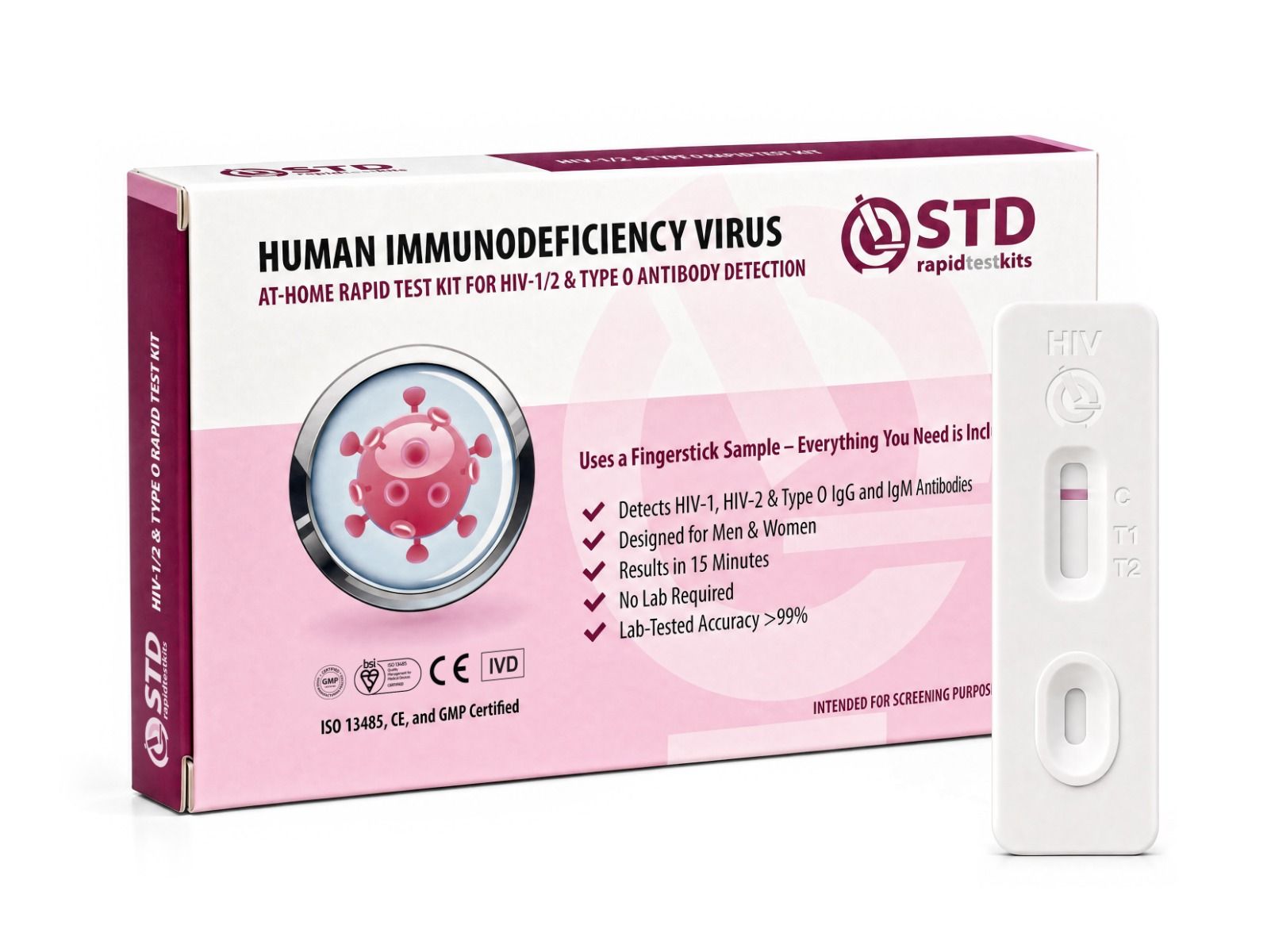
Our at-home HIV test uses a drop of fingerstick blood to look for antibodies to HIV-1, HIV-2 and HIV-1 group O, and you read it at 10 minutes. It detects antibodies only. It is not a fourth-generation antigen/antibody test or an RNA test, so it belongs in the slowest row of the window chart above: it can miss an infection picked up in the last 90 days or so.
In the manufacturer's insert, the test agreed with a commercial HIV antibody ELISA on 187 of 187 positive and 699 of 702 negative clinical specimens. That is agreement with another antibody test, not proof of accuracy in early infection. The insert does not say how the study specimens were collected, and the manufacturer publishes no figure for self-collected or home-read results.
The kit is a preliminary screen. A reactive line needs laboratory confirmation; clinicians use the CDC/APHL laboratory algorithm, which includes an antigen/antibody test, an HIV-1/HIV-2 differentiation test and, where needed, an RNA test. A nonreactive result inside the window does not rule HIV out. The kit also cannot check viral load or whether treatment is working; that is a clinic lab test.
Hepatitis B: a home kit answers one of three questions
CDC's triple panel asks three different questions. HBsAg (surface antigen) shows whether you have a current infection. Anti-HBs shows whether you are immune, usually from vaccination. Total anti-HBc shows whether you were ever infected (CDC). Many standard STI panels skip hepatitis B altogether, as covered in why hep B testing should be part of every STD panel.
Our at-home hepatitis B test detects HBsAg only. It can flag a possible current infection, but a negative result tells you nothing about immunity or whether you need the vaccine, and it does not replace the triple panel for the baseline screen. CDC recommends hepatitis B vaccination for all adults 19 to 59, and for adults 60 and older with risk factors (CDC hepatitis B vaccination).
Against a commercial HBsAg EIA, the insert reports agreement on 820 of 821 positive and 2,134 of 2,135 negative clinical specimens. Agreement with another test is not sensitivity in early infection, and no self-collection or home-reading figure is published. For timing, the product information recorded in our catalog puts detection at 1 to 9 weeks after exposure, with a retest at 12 weeks. A reactive result needs laboratory confirmation and further markers to tell an acute infection from a chronic one.
Ask for the hepatitis B triple panel (HBsAg, anti-HBs and total anti-HBc), not just “a hepatitis test.” To check whether a past panel covered it, see <a href="/blog/post/does-your-std-test-really-include-everything-check-for-hep-b">does your STD test really include hep B</a>.
Hepatitis C: antibodies first, then RNA
Hepatitis C testing comes in two steps. The first test looks for antibodies, which show exposure at some point. WHO estimates that around 30% (15% to 45%) of infected people clear the virus on their own within 6 months, and antibodies stay after the virus has gone (WHO). So after a reactive antibody result, a lab runs an RNA test to see whether the virus is still there. Testing matters because CDC notes that treatment can cure most people with hepatitis C in 8 to 12 weeks (CDC).
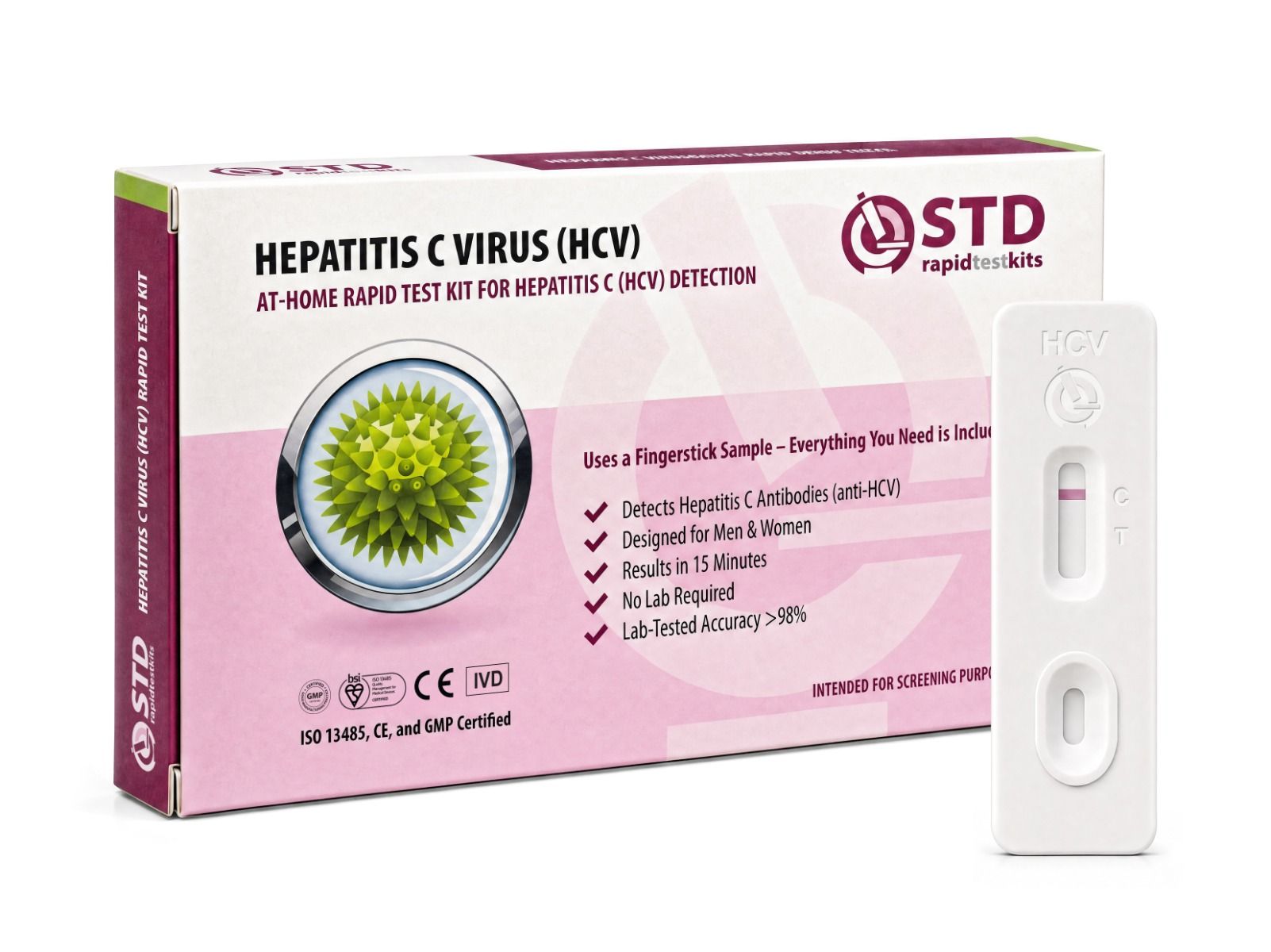
Our at-home hepatitis C test covers that first step only. It looks for anti-HCV antibodies in fingerstick blood and is read at 10 minutes. Its insert compares it with a commercial HCV EIA: the two agreed on 565 of 566 positive and 2,543 of 2,545 negative clinical specimens. That measures agreement, not current infection, and the manufacturer publishes no self-collection or home-reading figure. The manufacturer's product information gives detection at 8 to 11 weeks and a 12-week retest, but CDC's guidance for a possible hepatitis C exposure covers the past 6 months, so a negative at 12 weeks may need a repeat. If your exposure was within the last 6 months, the clinic RNA test described above is the better tool.
Reading your results without overreading them
What a home result means depends on you as well as on the test. A reactive line is more likely to be real when you have had a known exposure or symptoms, and more likely to be a false alarm in someone at very low risk. If an infection is confirmed, living with hepatitis B and C covers what follows a diagnosis.
Results People Commonly Misread
Myth: A negative HIV test the week after sex means I'm in the clear.
Fact: Antibody tests usually need 23 to 90 days to detect HIV, per CDC. A negative inside that window is not a clearance; within 72 hours of the exposure, PEP is the priority.
Myth: My hepatitis B home test was negative, so I'm protected.
Fact: An HBsAg test looks for current infection only. Immunity is a separate marker (anti-HBs), checked in the clinic's triple panel.
Myth: A reactive hepatitis C antibody result means I have hepatitis C right now.
Fact: Antibodies show exposure at some point. Some people clear the virus on their own, so an RNA test is needed to show a current infection.
FAQs
- Do I still need all three tests if I've only had one partner?
- Yes, for the baseline screen. The adult baseline recommendations for all three apply regardless of partner count. For hepatitis B, CDC describes screening every adult as a simpler and less stigmatizing approach than risk-based screening, noting that many people might be reluctant to disclose stigmatizing risks. Repeat testing is what depends on ongoing risk.
- Can I test for all three at home in one sitting?
- Yes. Each test cassette takes its own drop of fingerstick blood, and results are read in 10 to 15 minutes depending on the test. Each is a preliminary screen: a reactive result needs confirmation by a clinician, and a negative does not rule infection out, especially inside the window period.
- Should my partner test if one of my results is reactive?
- Get lab confirmation first, and until you know, avoid sex without a condom and don't share needles. If a partner may have been exposed to HIV in the last 72 hours, they should contact a sexual health clinic about PEP now. If an infection is confirmed, a clinician will usually advise partners to test, and partners who are not vaccinated against hepatitis B can get the vaccine, which CDC recommends for all adults 19 to 59.
This article summarizes current guidance from the U.S. Centers for Disease Control and Prevention (CDC), the World Health Organization (WHO), NIH HIVinfo and the NHS. Each specific figure or recommendation links to the page that states it, and every page used is listed under Sources with what it supports. It is general health information written by our editorial staff, not a diagnosis or a treatment plan; how we choose topics and use sources is described in our editorial policy.
- U.S. Centers for Disease Control and Prevention. Getting tested for HIV: testing everyone 13 to 64 at least once, yearly testing with risk factors, 3-to-6-month testing for some gay and bisexual men, testing during each pregnancy, and window periods by test type (NAT 10-33, lab antigen/antibody 18-45, rapid antigen/antibody 18-90, antibody 23-90 days). Reviewed September 2026.
- U.S. Centers for Disease Control and Prevention. Hepatitis B clinical testing and diagnosis: one-time triple-panel screening for adults 18 and older, the rationale for universal screening, HBsAg screening in every pregnancy, periodic testing with ongoing risk, and what each panel marker measures. Reviewed August 2026.
- U.S. Centers for Disease Control and Prevention. Hepatitis C testing: one-time screening for adults and for people with HIV, testing in each pregnancy, periodic testing for people who inject drugs, RNA follow-up after a reactive antibody result, NAT within 6 months of exposure, and cure in 8 to 12 weeks.
- U.S. Centers for Disease Control and Prevention. Hepatitis B vaccine recommendations, including all adults 19 to 59 and adults 60 and older with risk factors.
- World Health Organization. Hepatitis B fact sheet: 240 million people living with chronic hepatitis B in 2024, 27% of them aware of their infection.
- World Health Organization. Hepatitis C fact sheet: most common transmission routes, about 47 million people with chronic infection worldwide, and around 30% (15-45%) of infected people clearing the virus without treatment within 6 months.
- NIH HIVinfo. HIV and Hepatitis B fact sheet: shared transmission routes and CDC's recommendation that all people with HIV be tested for hepatitis B. Last reviewed March 2025.
- NHS. HIV and AIDS: emergency HIV medicine (PEP) after an exposure in the last 72 hours, which may stop infection.
- U.S. Centers for Disease Control and Prevention. Pink Book, chapter 10, hepatitis B: post-exposure hepatitis B immune globulin and vaccine for unvaccinated people, preferably within 24 hours, with an effective interval unlikely to exceed 7 days after percutaneous or 14 days after sexual exposure.