
Published: August 2025 | Last updated: April 2026 | Editorial review and quality control: Martina N.
Noticing a red itchy spot, or several, on the penis is the kind of thing that sends most men's heads straight to the worst case. Sexually transmitted infection? Cancer? Some condition nobody talks about? The honest answer is calmer than that. The majority of red itchy patches on the penis trace back to skin-level causes: contact irritation from a new soap or laundry detergent, low-grade yeast overgrowth, friction from clothing or sex, or balanitis (inflammation of the head of the penis). A smaller share come from sexually transmitted infections, and those tend to have specific visual signatures (painless ulcers, clusters of small blisters, firm cauliflower-like growths) worth knowing on sight. This guide walks through what each common cause looks like, when basic hygiene fixes the problem on its own, and when testing or a clinic visit is the right next move.
Are itchy red spots on the penis always an STI?
Most aren't. Common skin causes (contact dermatitis from soaps or detergents, candidal yeast overgrowth, balanitis, and friction irritation) cause similar symptoms and resolve within a week or two of basic hygiene changes. STIs that present this way include genital herpes (clustered blisters), syphilis (single painless ulcer), HPV (firm flesh-colored growths), scabies, and molluscum contagiosum. If symptoms last beyond 7 to 10 days, recur, or include a single painless ulcer, test or see a clinician.
Key takeaways
- Most red itchy spots on the penis come from non-STI causes: contact irritation, yeast overgrowth, balanitis, or friction. STIs are a smaller share with distinctive patterns worth recognizing.
- If symptoms last beyond 7 to 10 days of basic hygiene measures, recur, or include a painless ulcer or clustered blisters, get tested or see a clinician.
What red spots and itching usually look like
Red spots on the penis don't all look the same. The color, shape, count, distribution, and what surrounds them all carry diagnostic information. Reading those features against your timeline (when did it start, has it changed, what came before it) narrows the list of likely causes faster than guessing from one feature in isolation.
Five visual patterns cover the majority of cases:
- Diffuse pink-to-red flush, often itchy: usually contact dermatitis or balanitis. The skin looks generally inflamed rather than dotted with discrete spots. Itching is often the loudest symptom.
- Small red patches with a white satellite scale or curd-like film: classic candidal yeast pattern, especially under the foreskin in uncircumcised men. Itching, soreness, and a slight burning sensation are common.
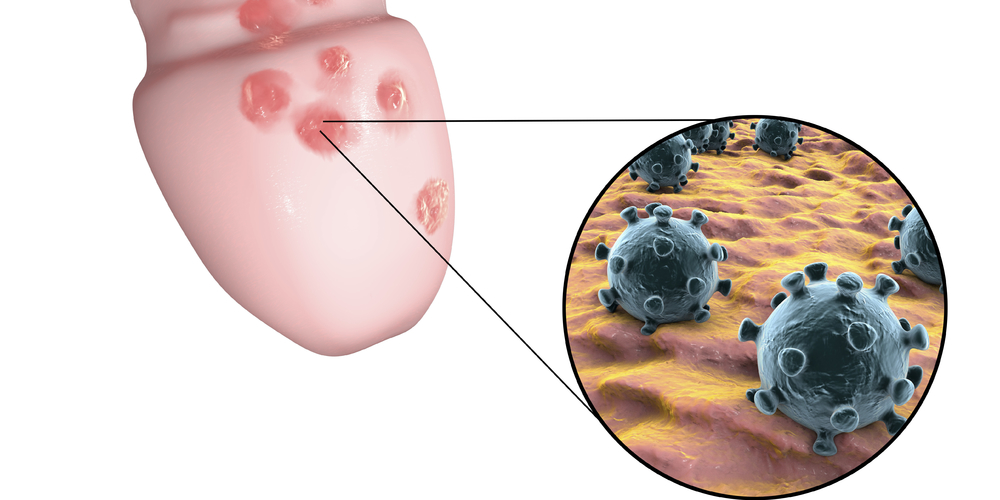
- Cluster of small fluid-filled blisters that crust over: the herpes pattern. Lesions appear in groups of 3 to 10, often preceded by a tingling or burning prodrome 12 to 24 hours before the blisters become visible.
- Single round firm painless ulcer with a clean base and raised border: the syphilitic chancre. Painlessness is the key feature; if it hurts, syphilis is less likely.
- Firm flesh-colored raised growths, sometimes cauliflower-shaped: genital warts caused by certain HPV strains. These are typically not itchy or painful, and the texture (firm, raised, dry) is the giveaway.
Conditions that don't fit any of the above (a single dark mole that has changed, a hard nodule, a persistent ulcer that won't heal beyond two weeks, or any growth that bleeds without trauma) deserve a clinician's eyes within days, not weeks. Most are still benign, though the cancer-of-the-penis differential is rare enough that ruling it out by clinical exam is straightforward and worth doing.
STI causes worth ruling out
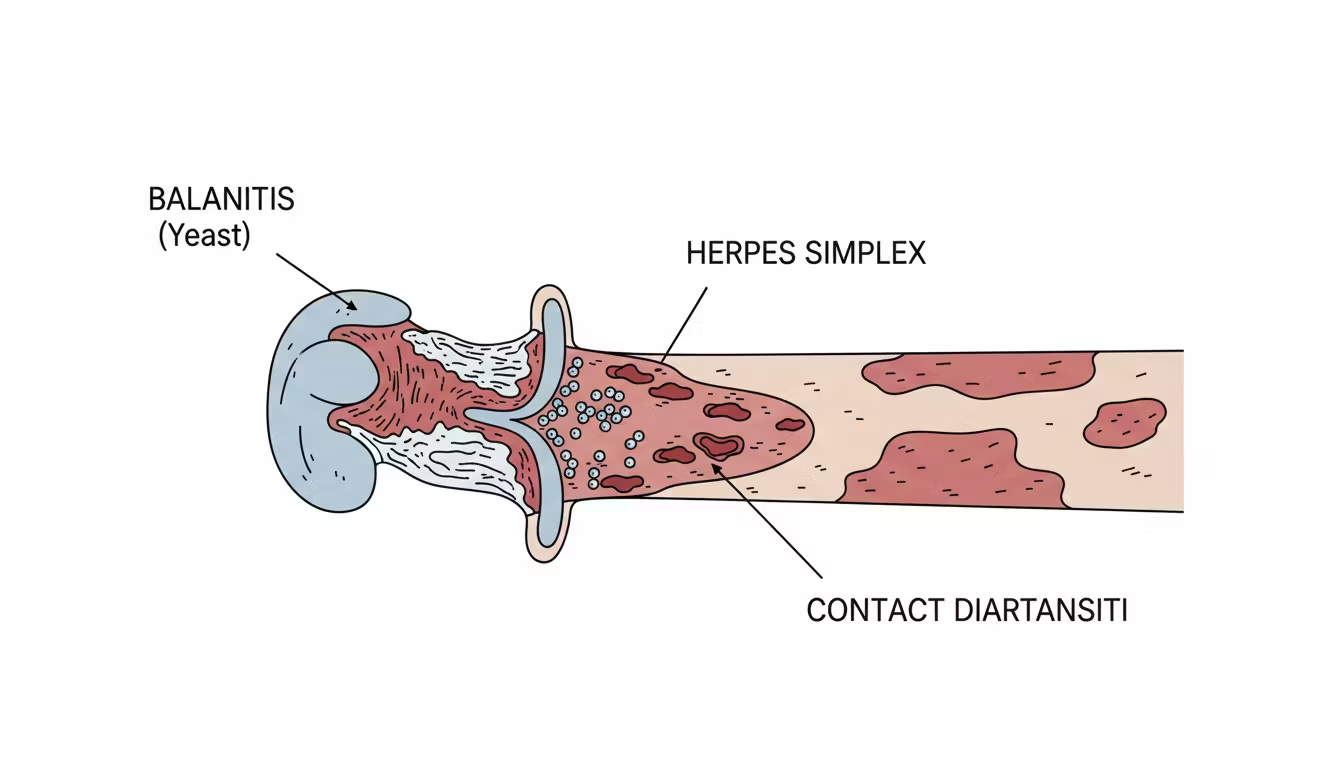
Five sexually transmitted infections account for the majority of STI-driven red spots and itching on the penis. Each has a recognizable signature.
Genital herpes (HSV-2, sometimes HSV-1)
Genital herpes presents as clustered small blisters that erupt over hours, then break, weep, and crust over within several days. Outbreaks often start with a 12 to 24 hour tingling, burning, or itching sensation in the area before any visible lesions appear. The whole cycle takes 2 to 4 weeks for a first outbreak; recurrent outbreaks are typically shorter and milder. According to the CDC's genital herpes information, many people with genital herpes have mild or no symptoms and don't realize they are infected. Asymptomatic viral shedding is the reason herpes spreads as widely as it does.
Primary syphilis (the chancre stage)
The first visible sign of syphilis is the chancre: a single, round, firm, painless ulcer at the site where the bacterium entered the body. On the penis, that is most often the glans, foreskin, or shaft. Chancres typically appear within 10 to 90 days of exposure. Per the CDC's syphilis information, the sore heals on its own in 3 to 6 weeks even without treatment, though the underlying infection continues progressing. Syphilis moves on to a secondary stage (rash, fatigue, lymph swelling) and beyond if untreated. The painlessness of the chancre is what makes it easy to miss; many men never see a clinician until the secondary-stage rash appears.
Genital HPV warts
Low-risk HPV strains (typically HPV-6 and HPV-11) cause genital warts: firm, flesh-colored or slightly darker growths that can be flat, raised, or cauliflower-shaped. They tend to be painless and only mildly itchy if at all. Texture (firm and dry) is the most reliable visual cue. Time from exposure to visible warts varies from a few weeks to several months. The high-risk HPV strains that drive cervical and oropharyngeal cancers don't cause visible warts; those high-risk strains are a separate concern not relevant to a penile-spot work-up.
Scabies
Scabies (Sarcoptes scabiei mite infestation) shows up as intense itching that's worst at night, with thin reddish lines, small raised bumps, or vesicles on the penis, scrotum, fingers, or genital fold. The itching is typically out of proportion to how the rash looks. If a sexual partner or household member also has unexplained intense itching, scabies climbs the differential list quickly. It is treated with topical permethrin or oral ivermectin and resolves cleanly with a single round of treatment in most cases.
Molluscum contagiosum
Molluscum produces small pearly dome-shaped bumps with a tiny dimple in the center, usually 2 to 5 millimeters across. They are not painful and only mildly itchy. Spread happens via direct skin contact, and lesions can persist for months before resolving on their own. They are often clustered on the lower abdomen, pubic area, inner thighs, or genitals.
If your spots match one of these signatures, the next step is a test (or a clinician visit for direct visual diagnosis of warts or molluscum). A blood antibody test from home covers herpes and syphilis. Testing for HPV, scabies, and molluscum is done clinically: HPV by visual diagnosis or tissue biopsy, scabies by skin scraping, molluscum by visual examination.
Non-STI causes (the more likely answer)
For most men presenting with red itchy spots, the cause is non-infectious. The four conditions below cover the majority of cases.
Contact dermatitis
Contact dermatitis is a skin reaction to something the area has touched. The usual suspects: a new laundry detergent, fabric softener, body wash, lubricant, condom material (often latex), spermicide, or even a recent change in toilet paper or wet wipes. The reaction shows up as diffuse pink-to-red flush, sometimes with small bumps, and almost always with itching. It typically appears within hours to days of exposure and resolves within a week or two of removing the trigger. The reaction is not contagious. If you switched anything in your routine in the last month (a new partner's body wash counts), start there.
Candidal balanitis (yeast overgrowth)
Yeast (Candida albicans) lives on most skin and in most genital tracts. It only becomes a problem when it overgrows, which happens after antibiotics, after sex with a partner who has a vaginal yeast infection, in uncircumcised men with poor under-foreskin drying, in men with poorly controlled diabetes, or after a stretch of damp clothing. The pattern is small red patches with a white scaly or curd-like coating, often on the glans and under the foreskin, with itching, burning, and sometimes a faint yeasty smell. NHS guidance on balanitis recommends an antifungal cream and improved hygiene as first-line treatment; in practice, candidal balanitis usually clears within 7 to 14 days of an over-the-counter antifungal cream (clotrimazole or miconazole) and rigorous after-shower drying.
Non-specific balanitis
Balanitis is the umbrella term for inflammation of the glans and foreskin. Candidal yeast is one cause; bacterial overgrowth, irritant build-up under a tight foreskin, soap residue, and chronic friction are others. Non-specific balanitis tends to be more diffuse than candidal balanitis and may not respond to antifungals. Improving hygiene (warm water rinses, no soap on the glans, careful drying, loose breathable underwear) clears most cases within a week or two. Recurring balanitis in uncircumcised men sometimes points to a tight foreskin (phimosis) that needs clinical evaluation.
Friction irritation and folliculitis
Mechanical irritation from sex, masturbation, or running causes localized redness and tenderness without the satellite scale of yeast or the cluster pattern of herpes. It is typically a single inflamed area that resolves in 2 to 4 days once the source is removed. Folliculitis, inflammation of pubic-area hair follicles after shaving or waxing, looks like small raised pimple-like bumps centered on a hair shaft, often slightly tender. Letting the area heal without re-shaving for a week resolves most cases.
Eczema and psoriasis
Pre-existing skin conditions can affect the penile and pubic area. Eczema produces dry, itchy, sometimes scaly patches. Inverse psoriasis (the variant that prefers skin folds) produces sharply defined red shiny patches without the silvery scale of classic plaque psoriasis. If you have eczema or psoriasis elsewhere on the body, the genital area can be affected too. Topical treatment usually mirrors what works for you elsewhere, with extra caution on the more delicate genital skin.
The non-STI causes share a useful diagnostic feature: a clear trigger (new soap, recent antibiotic, vigorous sex), no fever or systemic symptoms, and improvement within a week of basic measures. If those features don't fit your case, the differential shifts toward the STI list.
If you have a leftover steroid cream from another condition, or a partner does, don't apply it to penile red spots without a diagnosis. Topical steroids suppress the inflammation that helps a clinician identify what's actually wrong, and they can worsen yeast or herpes infections by dampening the immune response in the area. Plain warm-water hygiene and an over-the-counter antifungal (if the yeast pattern fits) are safer first steps.
Red flags: when this isn't watch-and-wait
Most red itchy spots warrant a week or two of careful observation and basic measures before further action. A handful of features push the timeline forward.
Get medical attention within 24 to 48 hours if any of the following apply:
- A single painless ulcer that has appeared in the last week (the syphilis pattern). Earlier treatment is dramatically simpler.
- Clustered blisters with intense pain, fever, swollen lymph nodes in the groin, or difficulty urinating (consistent with a first herpes outbreak, which can be severe).
- Rapid spread of the rash to other body areas, especially palms, soles, mouth, or trunk (raises the possibility of secondary syphilis or other systemic involvement).
- Any growth that bleeds without trauma, has changed color or grown rapidly over weeks, or has a hard fixed feel against the underlying tissue.
- Severe swelling, heat, increasing pain, or pus, especially with a fever (raises the possibility of bacterial cellulitis).
- A foreskin that has retracted and won't return forward (paraphimosis is a urological emergency).
For everything else, a 7 to 10 day window of basic measures (loose breathable underwear, no soap on the glans, antifungal cream if the yeast pattern fits, removing any new product or chemical exposure) is the standard first step. Day 10 with no improvement is the cue to test or see a clinician.
The syphilis chancre doesn't hurt. Many men miss it for that exact reason and don't seek care until weeks later when the secondary-stage rash appears. The chancre itself heals on its own in 3 to 6 weeks even though the underlying infection continues progressing. A single round firm painless ulcer is not a watch-and-wait situation. One important caveat: if the ulcer appeared in the last 2 to 3 weeks, a home blood antibody test taken right now may still be inside its window period and return a falsely reassuring negative. The more reliable urgent step is a clinic visit for direct examination, with a follow-up home antibody test at 4 to 6 weeks if you cannot see a clinician immediately.
Testing from home: what each kit can and can't tell you
At-home rapid STI tests are useful screening tools, with limits worth understanding before you order. Two technologies cover almost everything we sell.
Lateral-flow blood antibody tests (fingerstick)
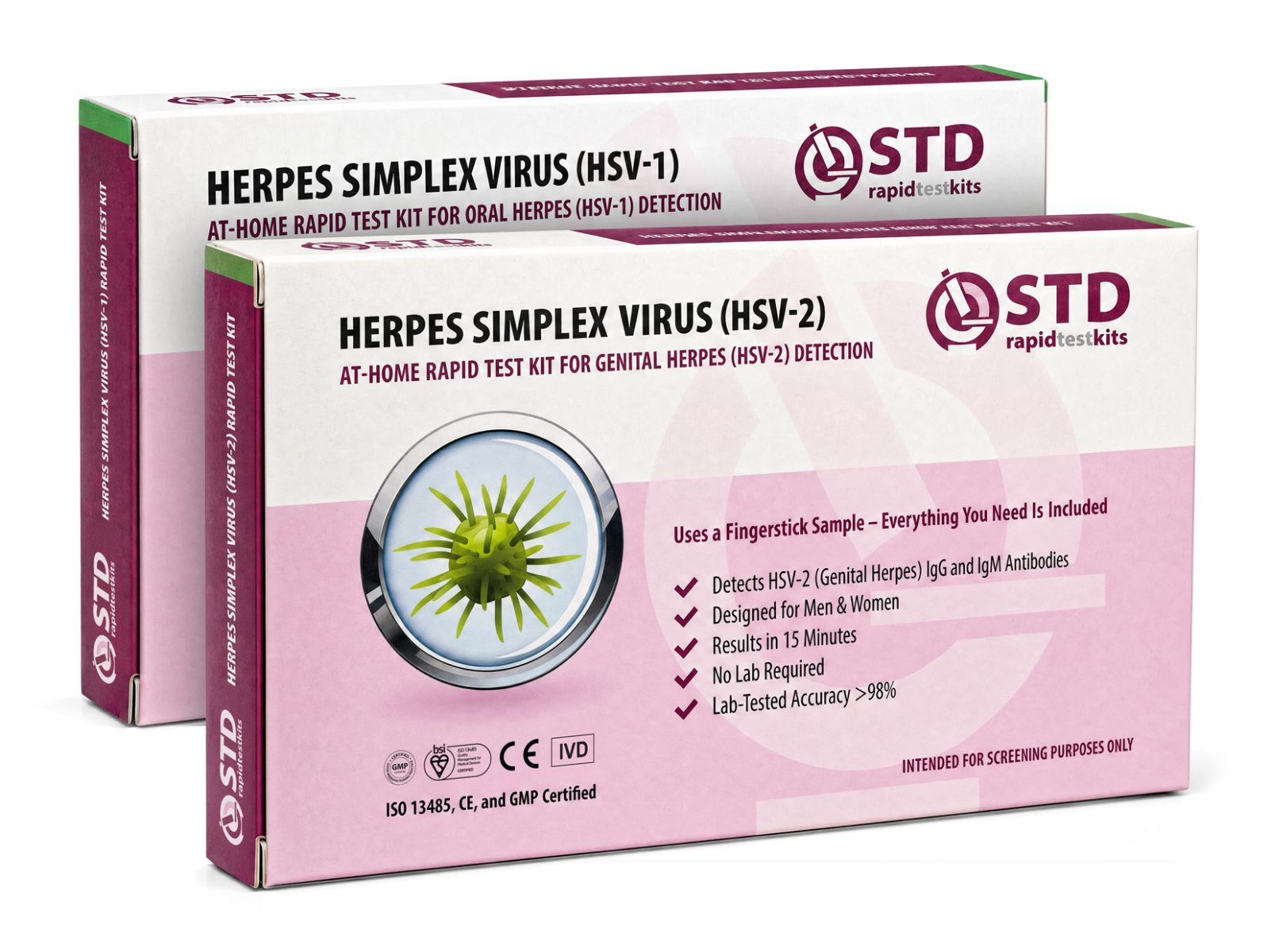
HIV, syphilis, hepatitis B, hepatitis C, HSV-1, and HSV-2 home rapid tests are all blood-based lateral-flow antibody tests. You prick a fingertip, drop blood onto the cassette, and the test detects antibodies your immune system has produced against the infection. They are useful for confirming whether you've ever been exposed and have seroconverted; they do not detect a current active outbreak of herpes (a swab from a fresh lesion is the right tool for that). Results are typically ready in 10 to 20 minutes.
Lateral-flow swab tests
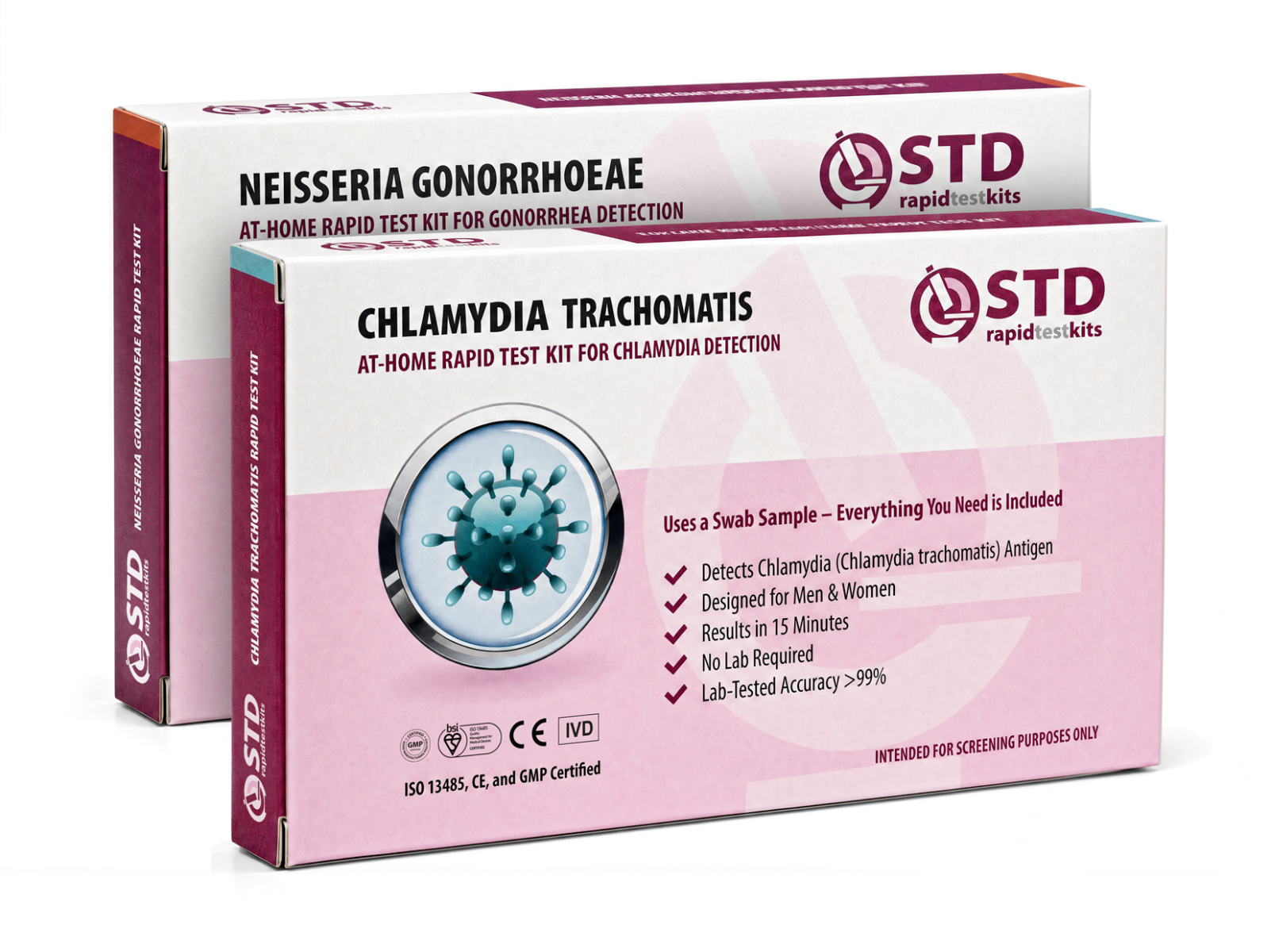
Chlamydia and gonorrhea home rapid tests use a self-collected swab from the urethra (men) or vagina (women). The test detects bacterial antigens directly. Trichomoniasis and HPV at-home swab kits are validated for vaginal self-swab only; we do not sell a male-compatible trichomoniasis or HPV home test, so a man wanting either of those should see a clinic for a urethral or anorectal swab.
What home rapid tests don't replace
For men with visible penile lesions actively present, a clinic-administered swab with PCR (NAAT) testing is the diagnostic gold standard for an active herpes outbreak, and clinical visual diagnosis is the standard for warts and molluscum. Home rapid tests give you a fast yes/no on systemic infection (have you been exposed and seroconverted?), which is genuinely useful but answers a different question. Lab NAAT tests for chlamydia and gonorrhea also have higher analytical sensitivity than the home rapid swab, so a positive home result is worth confirming with a lab test, and a negative home result with persistent symptoms is worth reconfirming clinically.
Choosing the right kit
If your concern is a single specific infection (a partner disclosed they have herpes, for example), a single-infection kit is the cheapest path to an answer. If you've had unprotected exposure with a new partner and want a broad screen, a 6-in-1 or 7-in-1 combination kit covers the most common bacterial and viral STIs in one go. Read each kit's accuracy data on its product page, and check the testing window (covered in the next section).
Testing windows: when each test becomes reliable
Every STI test has a window period: the gap between exposure and the moment a test can reliably detect infection. Testing too early returns a falsely reassuring negative. The windows below align with current guidance from the CDC's STI homepage and individual manufacturer instructions for use.
| Infection | Test type | When the test becomes reliable |
|---|---|---|
| HIV (rapid antibody) | Fingerstick blood antibody | About 23 to 90 days after exposure; most reliable at 90 days |
| HIV (4th-gen lab Ag/Ab) | Lab venous blood | About 18 to 45 days after exposure |
| Syphilis | Fingerstick blood antibody | About 3 to 6 weeks after exposure; rescreen at 12 weeks if negative with ongoing concern |
| HSV-1 / HSV-2 | Fingerstick blood antibody (IgG) | About 6 to 12 weeks for most people; up to 16 weeks for some |
| Hepatitis B | Fingerstick blood antibody (HBsAg) | About 4 to 10 weeks after exposure |
| Hepatitis C | Fingerstick blood antibody | About 6 to 12 weeks after exposure |
| Chlamydia | Self-collected urethral swab (rapid LFA) | About 1 to 2 weeks after exposure |
| Gonorrhea | Self-collected urethral swab (rapid LFA) | About 1 to 2 weeks after exposure |
How to apply the testing windows
If your potential exposure was last week, a test today reliably catches chlamydia and gonorrhea but won't yet catch HIV, syphilis, herpes, or hepatitis. The most cost-effective testing strategy after a high-concern exposure is a chlamydia and gonorrhea swab at 2 weeks, plus a comprehensive blood panel at 6 weeks (with a rescreen at 12 weeks for HIV and syphilis if symptoms or concern continue). For visible lesions present right now, the timeline doesn't matter: the lesion itself can be tested clinically without waiting for an antibody window.
The window clock starts at the date of exposure, not when symptoms appear. A negative result taken while still inside the window period does not reliably rule out infection; it only clears you at the moment a fully resolved test would have detected it. If symptoms continue past your test date, retest at the longer end of the window.
What to do while you wait for clarity
Whether you're waiting on a test result, watching to see if symptoms resolve on their own, or sitting in the gap before a clinician appointment, a few practical measures help.
Hygiene without overdoing it
Wash the genital area daily with warm water and either no soap or a fragrance-free, pH-neutral wash. Avoid scrubbing, antibacterial soaps, and any product that lists fragrance, parabens, or sulfates near the top of the ingredient list. After washing or showering, dry the area gently and thoroughly, especially under the foreskin in uncircumcised men. Damp skin under the foreskin is the single most common driver of yeast overgrowth.
Clothing and friction
Switch to loose-fitting, breathable cotton underwear. Avoid synthetic athletic underwear or tight jeans for the duration. Sleeping without underwear gives the area extended airing time, which speeds resolution of yeast and balanitis. Pause new vigorous sexual activity until the area calms.
Trial-and-removal of likely triggers
Run through the last month: did you switch laundry detergent, fabric softener, body wash, lubricant, or condom brand? Did a new sexual partner introduce a different soap or product? Did you finish a course of antibiotics in the last few weeks? Discontinuing the most likely trigger and switching to fragrance-free unscented alternatives often clears contact dermatitis within a week.
Over-the-counter options that are reasonable to try
For a clear yeast pattern (red patches with white satellite scale, especially under the foreskin), an over-the-counter antifungal cream (clotrimazole or miconazole) applied twice daily for 7 to 14 days is a reasonable trial; the NHS balanitis page covers this same antifungal-and-hygiene first-line approach. For a clear contact-dermatitis pattern with severe itching, a short course of low-potency over-the-counter hydrocortisone cream (1 percent) for a few days can ease symptoms while the trigger is removed. Avoid stronger steroid creams, especially without a diagnosis.
Sex during the wait
Pause penetrative sex while symptoms are present and you don't have a diagnosis. If the cause turns out to be infectious (herpes, scabies, molluscum), unprotected sex during this window passes the infection along.
While you wait: what helps and what doesn't
- Stick to warm-water hygiene with fragrance-free products. Thorough drying matters more than aggressive washing.
- Loose breathable cotton underwear and a pause on new vigorous sex give the area room to recover.
- Trial-and-removal of likely triggers (new soap, new partner's products, recent antibiotics) clears most contact-driven cases.
- Avoid prescription steroid creams without a diagnosis; they can worsen yeast and herpes infections.
Many people who have herpes have very mild symptoms or no symptoms at all. You may not notice mild symptoms or you might mistake them for another skin condition, such as a pimple or ingrown hair.
FAQs about red itchy spots on the penis
- How can I tell the difference between herpes and a yeast infection?
- The visual patterns are different. Herpes appears as clustered small fluid-filled blisters that erupt over hours and crust over within several days. Yeast (candidal balanitis) shows up as red patches with white satellite scale or a curd-like film, especially under the foreskin in uncircumcised men. Herpes outbreaks often start with a tingling or burning prodrome 12 to 24 hours before blisters appear; yeast tends to itch and burn without that signal. If the pattern is genuinely unclear, a clinic-administered swab settles it definitively.
- How long should I wait before seeing a clinician?
- For typical low-risk red spots and itching with no fever or other systemic symptoms, give basic measures (warm-water hygiene, fragrance-free products, breathable underwear, antifungal cream if the yeast pattern fits) about 7 to 10 days. If symptoms haven't improved or have worsened by then, see a clinician. For red flags (a single painless ulcer, severe pain, fever with rash, growth that bleeds, paraphimosis), seek care within 24 to 48 hours.
- Can a yeast infection on the penis go away on its own?
- Mild candidal balanitis often improves with strict hygiene measures alone (warm-water rinses, no soap on the glans, thorough drying, breathable underwear) within 1 to 2 weeks. An over-the-counter antifungal cream (clotrimazole or miconazole) speeds resolution and reduces recurrence risk. If yeast keeps recurring, that's a reason to see a clinician. Recurrent candidal balanitis can flag underlying issues like undiagnosed diabetes.
- Are red spots on the glans always an STI?
- No. The majority of red spots on the glans come from non-infectious causes: contact dermatitis, candidal yeast, non-specific balanitis, or friction. STIs that present as red spots have specific patterns (clustered blisters, a single painless ulcer, firm flesh-colored growths) that are recognizable on close inspection. Spots that don't fit any STI pattern, that arose right after switching a product, or that resolve quickly with hygiene measures are unlikely to be infectious.
- Can a new soap or detergent really cause this?
- Yes, it's one of the most common causes. Genital skin is thinner and more reactive than skin on most other parts of the body. A new laundry detergent, fabric softener, scented soap, body wash, lubricant, condom material, or even wet wipes can trigger contact dermatitis within hours to days of first exposure. Switching to fragrance-free, dye-free, pH-neutral products usually clears the reaction within a week.
- What's the difference between a syphilis chancre and other ulcers?
- Painlessness is the single most distinguishing feature. The syphilis chancre is round, firm, and painless, with a clean base and a raised rolled border; if a genital ulcer hurts (typical of herpes), syphilis is less likely. A chancre can take anywhere from 10 days to 3 months to appear after exposure, and it heals on its own in a few weeks even though the underlying infection keeps progressing. Any single painless ulcer is reason to get a syphilis blood test or see a clinician this week.
- Does an at-home STI test detect a current outbreak?
- It depends on the test. At-home blood antibody tests (HIV, syphilis, hepatitis B, hepatitis C, HSV-1, HSV-2) detect antibodies your immune system has produced after exposure. They confirm whether you've ever been infected and seroconverted, not whether you're currently shedding virus or have an active lesion. For an active herpes outbreak with visible lesions, a clinic-administered swab with PCR testing is the right diagnostic. At-home swab tests for chlamydia and gonorrhea detect bacterial antigens directly, so a positive result reflects a current infection.
- How often should sexually active men get tested for STIs?
- Per CDC guidance, sexually active men should test at least annually for HIV. Men who have sex with men, men with multiple partners, and men with new partners should test more frequently, every 3 to 6 months for chlamydia, gonorrhea, syphilis, and HIV. Testing after any unprotected exposure with a new partner is a reasonable additional check. Symptom-driven testing (red spots, discharge, ulcers) is independent of the routine schedule.
- U.S. Centers for Disease Control and Prevention. Genital herpes information page covering symptoms, transmission, asymptomatic shedding, and antibody testing.
- U.S. Centers for Disease Control and Prevention. Syphilis information page covering chancre presentation, healing timeline, and stage progression.
- U.S. Centers for Disease Control and Prevention. Sexually transmitted infections homepage covering routine annual testing recommendations and overview guidance.
- National Health Service (UK). Balanitis: causes, candidal versus non-specific patterns, antifungal treatment, and hygiene measures.
