Published: November 2025 | Last updated: May 2026 | Editorial review and quality control: Martina N.
A sudden bump, blister, or ulcer on your penis is one of the most stressful sights in adult life. The first thought is almost always the worst case: an STI you will have to live with, conversations you do not want to have, a result that changes things.
Here is the part nobody starts with. Most penile lesions are not STIs. Across dermatology and primary-care surveys, the majority of "I found a bump" visits turn out to be folliculitis, ingrown hairs, friction irritation, or normal anatomy that has always been there. A meaningful minority are STIs, and a few of those (genital herpes, primary syphilis, occasionally HPV-related warts) genuinely do show up first as a sore.
This article walks through both ends of that distribution. How the three STI lesions look and behave, what the common non-STI imitators are, when home testing actually answers your question, and when you need a clinic visit instead. The goal is pragmatic: test where it makes sense, reserve the urgent-care visit for the cases where it is the right tool, and skip the panic in between.
Key Takeaways
- Most penile bumps and blisters are not STIs. The most common imitators are ingrown hairs, folliculitis, friction irritation, pearly penile papules, and Fordyce spots.
- If your sore appeared within 2 to 90 days of unprotected sex, three STIs deserve immediate ruling-out: genital herpes (HSV-1 or HSV-2), primary syphilis, and HPV-related warts. A clinic swab beats home testing for an active lesion; home blood tests work after the relevant window period.
Why a sore on your penis is unsettling, and what is actually causing it
The shortlist of things that produce a visible mark on the penile shaft, glans, foreskin, or scrotum is longer than most people expect. STIs make up part of it. So do dozens of dermatological conditions that have nothing to do with sex.
Three STIs to take seriously when a new sore appears within the past three months:
- Genital herpes (HSV-1 or HSV-2): clusters of small painful blisters that crust over.
- Primary syphilis: a single firm round painless ulcer (the chancre).
- HPV-related genital warts: skin-colored, cauliflower-like growths often mistaken for a sore.
The non-STI imitators that show up most often:
- Folliculitis or ingrown hairs, especially after shaving or trimming.
- Friction blisters from rough sex, masturbation without enough lubrication, or tight clothing.
- Pearly penile papules: small flesh-colored dome-shaped bumps in regular rows around the corona of the glans, common in adult men of any age and completely benign.
- Fordyce spots (visible sebaceous glands, also normal anatomy).
- Sebaceous cysts and lipomas.
- Balanitis (inflammation of the glans, often from yeast or hygiene issues, more common in uncircumcised men).
- Contact dermatitis from latex, soap, or laundry detergent.
The visual gallery below shows the four patterns you are most likely trying to distinguish between. Use them as a starting point, not a final answer. Definitive identification of an active genital lesion is a clinical job, and a side-by-side photo comparison cannot replace one.
Should I get an STD test if I have a sore on my penis?
Yes, get tested if the sore appeared within roughly 2 to 90 days of unprotected sexual contact, especially if it is painless (possible primary syphilis) or appeared as a cluster of small painful blisters (possible herpes). Most penile bumps are non-STI in origin: ingrown hairs, folliculitis, friction blisters, and benign anatomy account for the majority. For an active visible lesion, a clinic swab tested by PCR is the most accurate diagnosis. At-home antibody blood tests for HIV, syphilis, hepatitis B and C, and HSV-1 and HSV-2 become reliable 3 to 12 weeks after exposure (depending on the infection) to confirm whether infection took hold systemically. They do not test the lesion itself.
Genital herpes: clusters of blisters that come back
Genital herpes is the STI most commonly mistaken for "just a friction sore" and the most common STI cause of recurring penile blisters. Two viruses cause it. HSV-1 has historically been more associated with cold sores around the mouth but increasingly causes genital outbreaks via oral contact. HSV-2 is the classic genital herpes virus. CDC estimates show roughly 572,000 new genital herpes infections each year in the U.S. among people aged 14 to 49 (2018, the most recent CDC estimate), and most carriers do not know they have the virus because transmission can occur from a partner who has no visible sore (CDC genital herpes overview).
What a first outbreak looks like on the penis:
- One to several small fluid-filled blisters, often grouped in a cluster on the shaft, glans, or foreskin.
- Painful or itchy, especially when touched.
- Blisters break, leaving small shallow ulcers that crust over within a week.
- Sometimes accompanied by tender swollen lymph nodes in the groin, low fever, headache, body aches.
- First outbreak typically appears within roughly two weeks of the exposure that caused it (clinical timing range 2 to 12 days).
Recurrent outbreaks are usually milder: fewer blisters, smaller area, no systemic symptoms, faster healing (3 to 7 days). Many people with HSV-2 have asymptomatic shedding for long stretches and only realize they are carriers when a partner tests positive.
How testing works for active herpes:
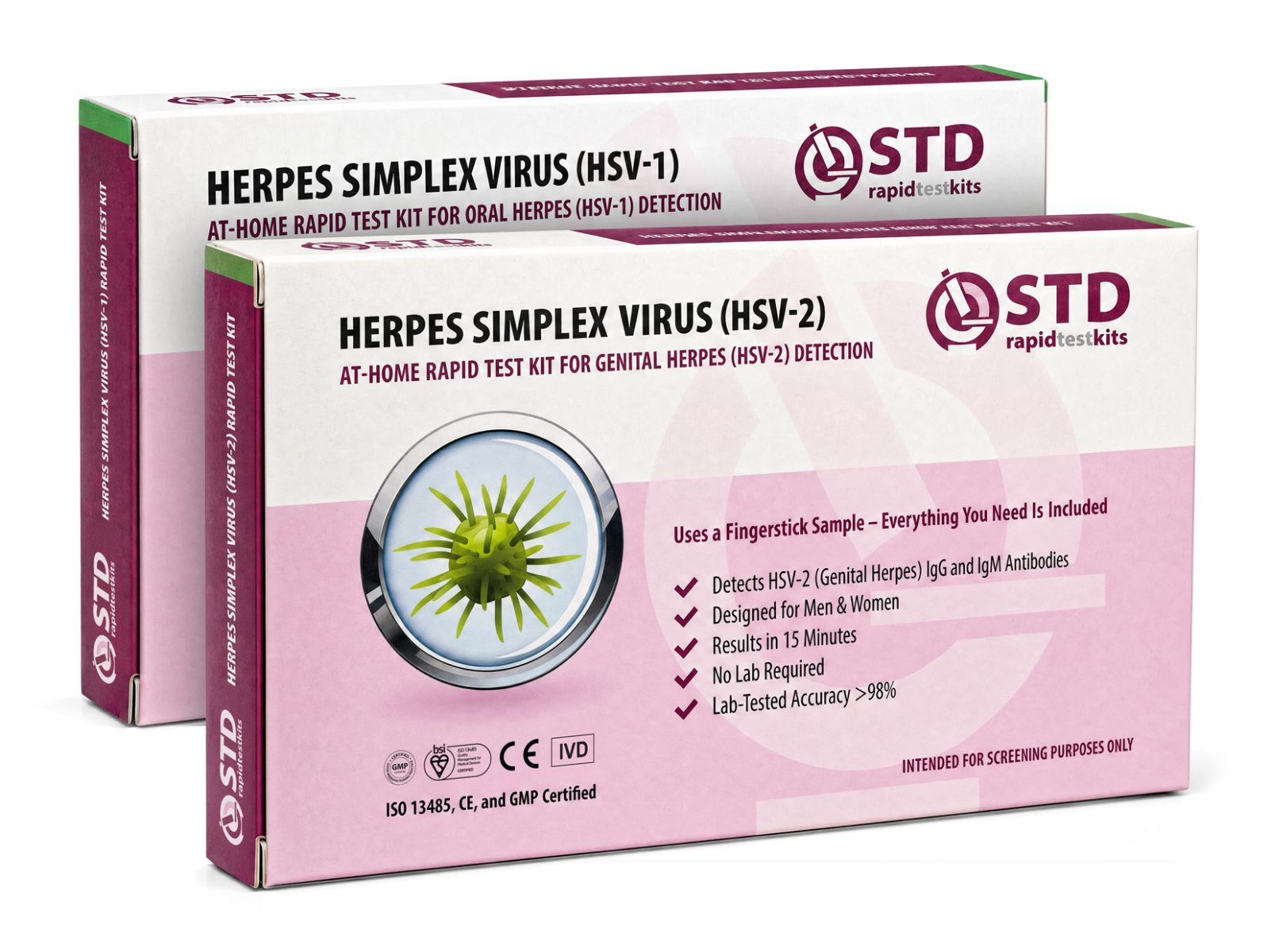
For a current visible blister, the most accurate test is a clinical swab of the lesion fluid sent for PCR or viral culture. This identifies the virus directly and distinguishes HSV-1 from HSV-2. We do not sell PCR swab kits; this is a clinic procedure. For exposure that happened weeks or months ago, an at-home blood antibody test detects HSV-1 and HSV-2 IgG antibodies. The catch is the window period. HSV antibodies typically take 12 weeks to become reliably detectable after the exposure that caused infection, with HSV-2 specifically requiring up to 16 weeks in some people.
If you have a visible blister right now, the most accurate test is a clinical swab of the lesion sent for PCR. At-home blood tests detect antibodies, which only appear weeks after the exposure that caused infection. A blood test taken in the first weeks of an outbreak can come back negative even when the visible blister is genuinely herpes. Use the clinic swab for the active lesion; for systemic confirmation, use a blood test at 12 weeks or later, with a re-test at 16 weeks for HSV-2 if any anxiety remains after a 12-week negative.
Disclosure: this article is published by stdrapidtestkits.com, which sells the at-home test kits described below. Recommendations follow fit-for-purpose for the reader's concern, not commercial benefit.
Primary syphilis: the painless chancre that can disappear on its own
Syphilis is the STI most likely to be misdiagnosed because its first sign is so easy to dismiss. Primary syphilis presents as a single painless ulcer called a chancre. The CDC notes that the sore usually lasts 3 to 6 weeks and heals on its own regardless of whether you receive treatment, and that this is what makes it dangerous to dismiss (CDC primary syphilis overview). Clinically, the chancre most often appears around 21 days after exposure with a possible range of 10 to 90 days. It is firm to the touch, round, with a clean indurated border, and it sits where the bacterium first entered the body: usually the penile shaft, glans, foreskin, or anus, but possibly the mouth, lips, or fingers depending on the exposure.
The dangerous feature, again: the chancre heals on its own within 3 to 6 weeks even without treatment. People often interpret this as the problem resolving. It has not. The bacterium (Treponema pallidum) has migrated systemically and the infection is now in its latent or secondary stage, where it produces a body-wide rash, mucous patches, and fever weeks to months later. Untreated syphilis can progress over years to neurological and cardiovascular damage.
U.S. syphilis rates climbed for more than a decade before recent surveillance showed a turn. CDC's most recent STI surveillance reports primary and secondary syphilis cases declined 22% from the prior year, the second consecutive year of declines, although the longer five-year trend remains essentially flat at elevated levels (CDC STI annual surveillance). A single painless penile ulcer still deserves a test regardless of perceived risk profile.
How testing works for syphilis:
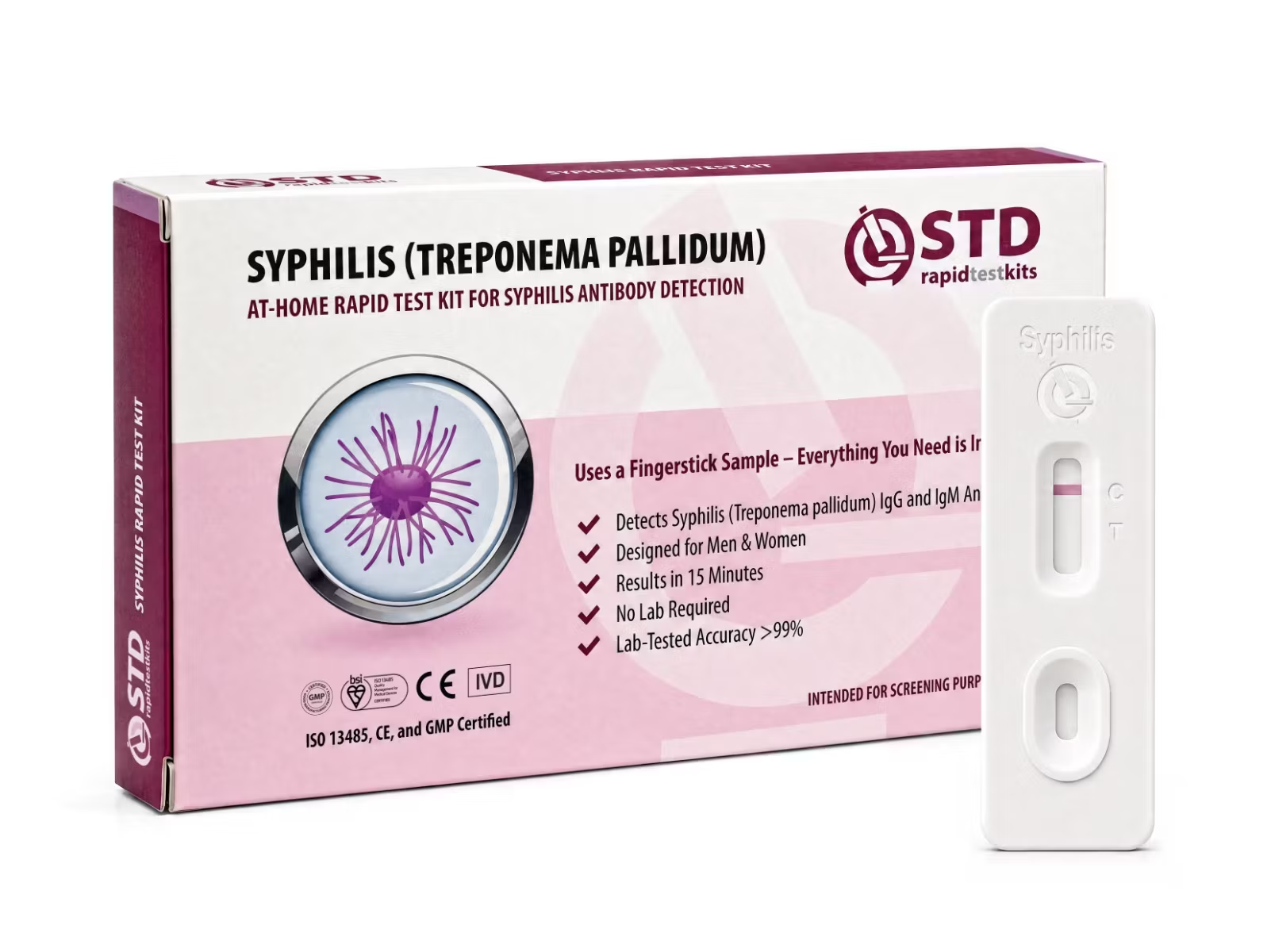
The standard at-home and clinic test for syphilis is a blood antibody test (rapid plasma reagin, RPR, or a treponemal test). Antibodies typically become detectable 3 to 6 weeks after exposure. A swab of the chancre itself for darkfield microscopy is also possible at a clinic, but blood testing is more widely available. Treatment is a single intramuscular dose of benzathine penicillin G for primary syphilis, which is highly effective at the early stage. Diagnosis and treatment within the first 90 days prevents progression to the systemic stages, which is the entire point of testing early when a painless ulcer appears.
A primary syphilis sore heals on its own within 3 to 6 weeks even without treatment. The visible problem goes away. The infection does not. Once the chancre disappears, the bacterium has already spread systemically and the disease moves into its latent and secondary stages, where it can cause body-wide rash, organ damage, and, over years, neurological injury. If a painless ulcer appeared on your penis at any point in the past three months, get a syphilis blood test even if the sore is gone.
HPV and genital warts: the wart that often gets mistaken for a sore
Human papillomavirus is the most common STI in the world. Most sexually active adults will acquire at least one HPV strain in their lifetime, and most clear it without symptoms. A subset of low-risk, wart-causing HPV strains produce genital warts, the visible HPV manifestation that often gets mistaken for a sore (CDC HPV overview).
What genital warts look like on men:
- Skin-colored or slightly darker raised growths.
- Surface texture ranges from smooth domes to a cauliflower-like cluster.
- Painless in most cases (the main giveaway versus herpes, which is painful).
- Common locations: penile shaft, scrotum, groin, around the anus, sometimes inside the urethra.
- Can appear as a single growth or in clusters.
- Typical incubation period is weeks to months after exposure, sometimes up to a year.
Distinguishing warts from common look-alikes:
- Pearly penile papules are evenly spaced rows of identical small dome-shaped bumps along the corona of the glans. They are anatomical, not infectious, and present from puberty.
- Molluscum contagiosum produces small flesh-colored bumps with a central dimple ("umbilication"). It is contagious but is not classically considered an STI.
- Skin tags can resemble small warts but lack the cauliflower texture.
A note on testing for men:
There is no FDA-approved blood test for HPV in men, and no CDC-recommended HPV screening test for asymptomatic men. Diagnosis of visible warts is clinical: a doctor identifies them by appearance, sometimes with magnification. At-home HPV swab kits exist, but our HPV self-swab kit is validated for vaginal self-collection only and is not appropriate for male anatomy. Men with visible genital warts should see a clinic for confirmation and treatment options (cryotherapy, topical imiquimod, or podophyllin).
Prevention works. Routine HPV vaccination is recommended through age 26, and adults aged 27 to 45 may decide to get the vaccine after a conversation with their doctor about their personal risk for new HPV infections (CDC HPV vaccination guidance). The vaccine prevents the strains responsible for most genital warts and most HPV-driven cancers.
We do not sell an HPV test kit validated for male anatomy; our HPV self-swab is for vaginal collection only. Men with visible warts need a clinic for diagnosis and treatment. The bigger payoff for men is prevention: HPV vaccination is recommended through age 26, with shared clinical decision-making for ages 27 to 45, and it covers the strains responsible for most genital warts and HPV-driven cancers.
Non-STI causes: the everyday explanations behind most penile bumps
A new bump on the penis is far more often dermatological or mechanical than infectious. The differential is wide enough that ruling out STIs is only the first step.
- Folliculitis and ingrown hairs. A red bump or pus-filled pimple at the base of a hair, often after shaving, waxing, or close trimming. Painful when pressed, usually resolves within a week.
- Friction blisters. Rough sex without enough lubrication, prolonged masturbation, or aggressive use of a sex toy can blister the skin of the shaft or glans. Resembles a clear or blood-filled blister, usually heals within days.
- Pearly penile papules. Small dome-shaped bumps in regular rows around the corona of the glans. Lifelong, painless, present in many men, no treatment needed. Often "discovered" when someone starts looking carefully.
- Fordyce spots. Tiny pale yellowish-white spots on the shaft or scrotum, representing visible sebaceous glands. Normal, harmless, present in most adults.
- Sebaceous cysts. Soft round movable lumps just under the skin. Painless unless infected. Sometimes drained or excised for cosmetic reasons.
- Balanitis. Inflammation of the glans, often presenting as redness, swelling, itching, and white patches. More common in uncircumcised men and often caused by Candida (yeast) or hygiene issues. Treated with topical antifungal or antibiotic creams.
- Contact dermatitis. Red itchy patches from a new soap, laundry detergent, lubricant, or latex condom. Resolves once the trigger is removed.
- Lichen planus and lichen sclerosus. Chronic dermatological conditions that can cause penile lesions, usually managed by a dermatologist.
- Penile cancer. Rare, usually in men over 60, presents as a non-healing ulcer, lump, or thickened patch that does not respond to standard treatment. Any persistent unexplained lesion in this demographic is a reason for prompt clinical evaluation.
If your sore matches one of these descriptions and you have not had recent unprotected sex, the probability that it is an STI drops considerably. That said, visual diagnosis from a list is unreliable. The table below summarizes the cues that point one direction versus the other.
| Feature | STI cause more likely | Non-STI cause more likely |
|---|---|---|
| Pain on touching the lesion | Painful for herpes; painless for syphilis chancre and HPV warts | Variable; folliculitis tender, friction blisters tender, papules and Fordyce spots painless |
| Number of lesions | Cluster of small blisters (herpes); single ulcer (syphilis); single or cluster (HPV) | Often single isolated bump (folliculitis, cyst); rows of identical bumps (papules) |
| Onset relative to sex | 2 to 12 days (herpes); 10 to 90 days (syphilis); weeks to months (HPV) | Often unrelated to sex; correlates with shaving, friction, soap or detergent change |
| Surface texture | Fluid blister then crust (herpes); firm clean ulcer (syphilis); cauliflower (HPV) | Smooth dome (papules); pus-filled (folliculitis); flat (Fordyce) |
| Healing on its own | Herpes blisters crust within 1 week; syphilis chancre disappears in 3 to 6 weeks (deceptively) | Most resolve within days to 2 weeks once the trigger is removed |
| Recurrence | Common for herpes; uncommon for syphilis or HPV warts | Folliculitis recurs with shaving; papules and Fordyce spots are permanent (normal anatomy) |
| Definitive test | Clinic PCR swab of lesion plus blood antibody test at 6 to 12 weeks post-exposure (3 to 6 weeks for syphilis alone; 16 weeks for HSV-2 retest) | Clinical exam by a dermatologist or primary-care provider |
When to test, and what to test for
The right testing strategy depends on three things: how long ago the exposure was, what the lesion looks like right now, and what you can realistically access.
If you have a visible active sore right now:
A clinic visit is the gold standard. The provider can examine the lesion, swab it for PCR (the most accurate test for active herpes), perform a darkfield microscopy or treponemal blood test for syphilis, and identify warts on sight. Most local sexual-health clinics, urgent cares, and primary-care offices can do this within 24 to 48 hours. Cost varies; many U.S. cities have free or low-cost clinics through Planned Parenthood or local health departments.
If your exposure was within the past two weeks and you have no symptoms yet:
It is too early for most blood antibody tests to be reliable. Watch for symptoms over the next 2 to 12 weeks. Photograph anything new. Consider a clinic visit if anything appears.
If your exposure was 4 to 12 weeks ago and you have a sore (active or healed):
Both options are open. A clinic visit identifies an active lesion by direct exam. An at-home blood antibody panel works for systemic STIs (HIV, syphilis, hepatitis B, hepatitis C, HSV-1, HSV-2). We sell at-home tests for all of those. None of them test the visible lesion itself; they confirm whether infection took hold in your bloodstream.
If your exposure was more than 12 weeks ago:
Antibodies for HIV, syphilis, hepatitis B, hepatitis C, HSV-1, and HSV-2 should all be detectable by then, and a home blood panel is reliable from this point on.
Most people with the herpes virus do not have symptoms. Even without signs of the disease, herpes can still be spread to sex partners.
At-home testing for men: what we sell, and what you will need a clinic for
We sell rapid lateral-flow at-home test kits with results in 15 to 20 minutes. Each kit uses either a fingerstick blood draw (for systemic infections) or a self-collected swab (for chlamydia and gonorrhea, where the genital site is the primary infection location).
What works at home for a man with a penile sore:
- HSV-1 and HSV-2 antibody blood tests. For a reliable negative, test at 12 weeks post-exposure; HSV-2 antibodies can take up to 16 weeks in some people, so re-test at 16 weeks if anxiety remains after a 12-week negative.
- Syphilis antibody blood test. Reliable from about 3 to 6 weeks after exposure.
- HIV 4th-generation antigen-antibody blood test. Reliable from about 18 to 45 days after exposure.
- Hepatitis B and C antibody blood tests. Useful as part of a full STI panel.
- Chlamydia and gonorrhea swab tests. Self-collected penile swab. These usually do not cause visible sores, but they are worth ruling out as part of a thorough panel after unprotected sex.
What you will need a clinic for:
- Active lesion PCR or culture. For an open visible sore right now, a clinic swab tested by PCR is the most accurate way to identify the cause.
- HPV testing for men. Our HPV at-home kit is validated for vaginal self-swab only; men with visible warts should see a clinic for confirmation and treatment.
- Pharyngeal or rectal screening. If your exposure included oral or anal contact, those sites are screened by clinic swab. We do not sell pharyngeal or rectal swab kits.
- Treatment. All STIs above are treatable, but treatment requires a prescription. Clinics handle that step.
Our at-home rapid tests are lateral-flow immunoassays. They share the same swab sample type as lab NAAT tests for chlamydia and gonorrhea, and the same antibody targets as lab antibody tests for HIV, syphilis, hepatitis, and HSV. Lab NAAT and lab antibody assays carry slightly higher analytical sensitivity. The two are complementary screening and confirmation tools, not the same technology, and a positive at-home result is worth confirming at a clinic before treatment.
Home kit handles: HIV, syphilis, hepatitis B, hepatitis C, HSV-1, and HSV-2 by fingerstick blood; chlamydia and gonorrhea by self-collected swab. Reliable after the relevant window period has passed.
Clinic handles: PCR or viral culture on an active visible lesion, HPV evaluation for men, pharyngeal or rectal swabs, and the prescription treatment for any positive result.
Window periods: when your at-home test result becomes reliable
Window period is the gap between exposure and the moment a test can detect infection. Test too early and a negative result does not rule anything out. Test inside the window and the result is meaningful.
Practical takeaways:
- Test once at the relevant window for each infection. A negative HIV test at 45 days is reliable; a negative syphilis test at 6 weeks is reliable; a negative HSV-2 test deserves a re-test at 16 weeks if concern remains.
- A positive at-home result is a screening signal, not a final diagnosis. Confirm at a clinic with a lab-grade NAAT (for chlamydia, gonorrhea) or a treponemal-plus-non-treponemal sequence (for syphilis).
- Lateral-flow rapid tests are not the same technology as lab NAAT or PCR. Labs run higher-sensitivity molecular assays. Home tests trade some sensitivity for speed and privacy, and they work as a first line that you can run on your own timeline (CDC STI treatment guidelines).
The table below shows the detection window and test type for each common STI covered by our at-home kits and standard clinic panels.
| Infection | Window period | Test type and notes |
|---|---|---|
| HIV | 18 to 45 days | 4th-generation antigen-antibody (fingerstick blood) |
| Syphilis | 3 to 6 weeks | Treponemal antibody (fingerstick blood) |
| HSV-1 | 12 weeks | IgG antibody (fingerstick blood) |
| HSV-2 | 12 to 16 weeks | IgG antibody; re-test at 16 weeks if a 12-week result is negative and concern remains |
| Hepatitis B | 4 to 12 weeks | Surface antigen + antibody (fingerstick blood) |
| Hepatitis C | 8 to 11 weeks | Antibody (fingerstick blood) |
| Chlamydia | 7 to 14 days | Swab; lateral-flow at home or NAAT in lab |
| Gonorrhea | 5 to 14 days | Swab; lateral-flow at home or NAAT in lab |
What to do tonight, this week, and three months from now
A practical timeline removes the "what should I be doing right now" panic.
Tonight (within 24 hours of finding the sore):
- Photograph it with your phone in good light. Track changes day by day; a healing chancre can disappear inside three weeks.
- No sex (any kind, including oral) until you know what it is. Active herpes lesions and primary syphilis are highly transmissible.
- Note the timing of any unprotected exposures in the past 90 days. This narrows the window-period math.
- Skip alcohol scrubs, harsh soaps, friction. Let the skin recover while you figure out next steps.
Days 1 to 3:
- If the sore is visible and active, schedule a clinic visit for swab testing. Same-day or next-day appointments are usually available at sexual health clinics, urgent care, or primary care.
- If the sore is healed or healing and you would rather start at home, order an at-home rapid test kit appropriate to your exposure timeline.
Weeks 1 to 4:
- Most acute STI symptoms (herpes blisters, syphilis chancre) appear in this window. Symptom-watch matters.
- A negative early test does not rule out infection if the window period has not elapsed.
Weeks 4 to 12:
- The reliability window opens for most blood antibody tests (HIV, syphilis, hepatitis B and C). HSV-1 and HSV-2 specifically need a full 12 weeks for reliability.
Three months out:
- Confirmatory testing if any earlier result was positive or borderline. HSV-2 specifically deserves a re-test at 16 weeks if concern remains after a 12-week negative.
- Notify partners if any positive result was confirmed. Most U.S. states offer anonymous partner notification through local health departments.
The right call for most men with a new penile sore is a layered one. Clinic swab early if there is something visible to test, at-home blood panel at the right window to rule out systemic infections, and a re-test at the long end of the HSV-2 window if anxiety remains. A comprehensive multi-infection home panel is a reasonable single-purchase option for men who want to cover the systemic picture in one go.
Tonight: photograph the sore, no sex, log the timing of any unprotected exposures in the past 90 days.
Days 1 to 3: clinic swab if there is something visible to test; home kit if the lesion is already healing.
Weeks 1 to 4: watch for new symptoms; early negative blood tests are not yet conclusive.
Weeks 4 to 12: reliable home blood antibody window opens for HIV, syphilis, hepatitis B, and hepatitis C.
Three months out: confirm any earlier positive, re-test HSV-2 at 16 weeks if needed, and notify partners.
Frequently asked questions
- Should I still get tested if my sore is already gone?
- Yes. A primary syphilis chancre heals on its own within 3 to 6 weeks even when untreated, and the infection continues silently in the body afterwards. A herpes blister also crusts and resolves within about a week, but the virus stays in the body. A blood antibody test taken at 12 weeks or more after the exposure that caused the sore can detect both, regardless of whether the lesion is still visible.
- How long after exposure does primary syphilis show up?
- 21 days on average, with a possible range of 10 to 90 days. Because the chancre disappears on its own, test if unprotected sex occurred in the past 90 days and a painless ulcer appeared, even if it has already healed.
- Can I have herpes without ever having a visible sore?
- Yes, and it is the norm. A blood antibody test at 12 weeks or more after possible exposure is the only reliable way to confirm carrier status when no blisters have appeared. HSV-2 specifically may need a re-test at 16 weeks if the 12-week result is negative and concern remains.
- Are at-home STD tests as accurate as clinic tests?
- Our at-home rapid tests are lateral-flow immunoassays. Lab tests use NAAT or PCR for swabs and high-sensitivity antibody assays for blood. Lab tests carry slightly higher analytical sensitivity. At-home tests are accurate enough to be useful as a first line, especially after the relevant window period, and a positive result is best confirmed at a clinic before treatment. The two are complementary, not interchangeable.
- How can I tell if my sore is herpes or just an ingrown hair?
- An ingrown hair is usually a single isolated pustule centered around a hair follicle, often after shaving, with a visible hair shaft at the center. Herpes typically appears as a cluster of small fluid-filled blisters, often without a single hair at the center, and is more painful or itchy than a typical ingrown. Visual differentiation is unreliable in borderline cases. A clinic swab tested by PCR is the way to know for certain.
- Should I have sex while waiting for test results?
- No, especially not while a visible sore is present. Active herpes lesions and primary syphilis chancres are highly transmissible. Even after the sore heals, abstain or use a condom for every act of sex until your blood test at the appropriate window period comes back negative.
- What if my partner tested negative but I still have a sore?
- Several explanations are possible. Your partner may have tested too early to seroconvert, may carry an infection that does not always transmit, or your sore may not be from an STI at all. The path forward is to test yourself at the right window and have the visible lesion examined or swabbed at a clinic. Partner-negative results do not change what your own body is showing you.
- Do I need to inform past partners if I test positive?
- Yes, for any positive STI result, partner notification matters for public health and for the partners themselves. Most U.S. states offer anonymous partner notification through local health departments, where the department contacts named partners without revealing the source patient. Treatment for chlamydia, gonorrhea, syphilis, and herpes is straightforward, and earlier treatment generally produces better outcomes.
- U.S. Centers for Disease Control and Prevention. About Genital Herpes overview page. Source for genital herpes new infection estimates among U.S. adults aged 14 to 49, transmission from partners without visible sores, and asymptomatic shedding guidance.
- U.S. Centers for Disease Control and Prevention. About Syphilis overview page. Source for primary syphilis chancre self-healing window (3 to 6 weeks regardless of treatment) and progression to later stages without treatment.
- U.S. Centers for Disease Control and Prevention. STI Annual Surveillance Statistics. Source for the recent primary and secondary syphilis trend (down 22% from prior year, second consecutive annual decline), and the longer-term essentially flat five-year trend at elevated levels.
- U.S. Centers for Disease Control and Prevention. About HPV overview page. Source for HPV strain classification (wart-causing versus cancer-causing) and general HPV background.
- U.S. Centers for Disease Control and Prevention. HPV Vaccination overview page. Source for routine HPV vaccination recommendation through age 26 and shared clinical decision-making for adults aged 27 to 45.
- U.S. Centers for Disease Control and Prevention. STI Treatment Guidelines, 2021. Source for diagnostic test type recommendations (NAAT for chlamydia and gonorrhea, treponemal sequence for syphilis confirmation) and clinical management guidance.
- World Health Organization. Sexually Transmitted Infections fact sheet. Source for global STI burden, transmission routes, and screening recommendations.
