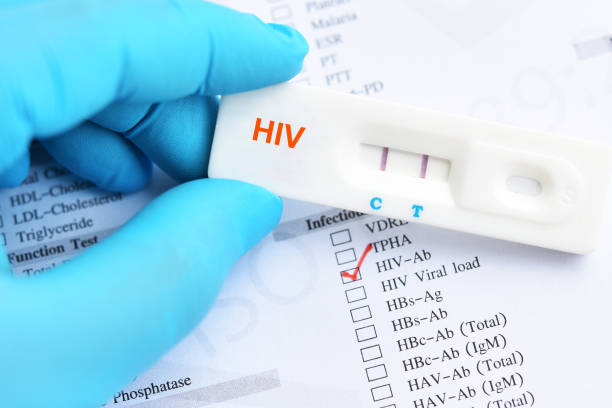
Published: July 2025 | Last updated: May 2026 | Editorial review and quality control: Martina N.
How do at-home STD test kits work?
You collect a sample yourself, a genital swab or a fingerstick drop of blood, then either run a rapid lateral-flow cassette for a result in about 15 minutes, or mail the sample to a CLIA-certified lab for a NAAT result in 1 to 5 days. Lab kits match clinic accuracy because they use the same instruments.
An at-home STD test kit captures a sample from your body and checks it against a known biological signal, the same first job a clinic visit does. What changes is who collects the sample (you, in your bathroom), where it is analyzed (your countertop, or a lab the kit ships to), and how the result reaches you (a colored line on a cassette, or a secure portal a few days later). The diagnostic chemistry behind the scenes is real lab science, just packaged for home use.
This guide covers how both formats work, what each can and cannot detect, the timing rules that decide whether a result is valid, who benefits most, and what to do once you have an answer.
For editorial transparency: this article is published by stdrapidtestkits.com, which sells at-home rapid lateral-flow STD kits. We recommend products based on whether they fit your actual concern, not commercial benefit, and we flag plainly when a clinic or a lab-processed kit is the better choice.
Key Takeaways
- Two formats exist: rapid lateral-flow kits give a result at home in about 15 minutes, while mail-in lab kits return a NAAT result in 1 to 5 days. They use different chemistry and have different sensitivity.
- The window period matters more than which kit you buy. Testing too soon after exposure can return a false negative even with a flawless kit, so check the timing before you swab.
Two ways home kits work: rapid on-site vs mail-in lab
At-home STD kits split into two categories based on where the analysis happens. The choice between them comes down to how fast you want a result and how much absolute sensitivity you need.
Rapid lateral-flow kits contain everything to run the test on your kitchen counter. You collect a sample, mix it with the buffer solution in the kit, drop it onto a small cassette, and a colored line appears (or does not) within about 15 minutes. The chemistry is the same family used by home pregnancy tests: antibodies or antigens in your sample bind to labeled reagents that travel along a paper strip and gather at a control line and a test line. Most home kits for HIV, syphilis, hepatitis B and C, herpes, chlamydia, gonorrhea, trichomoniasis, and HPV work this way. An at-home STI test kit in this format is what we sell.
Mail-in lab kits include a collection tube and a prepaid biohazard mailer. You collect the sample, seal it, drop it in the mail, and a CLIA-certified laboratory runs the analysis on hospital-grade equipment. For chlamydia and gonorrhea that usually means NAAT (nucleic acid amplification testing), which amplifies bacterial DNA directly and is the method the CDC's STI treatment guidelines designate as preferred for these infections. Results arrive in a secure portal in 1 to 5 days.
Rapid kits are faster, fully private, and good enough to screen and to repeat-test. Mail-in lab kits run slightly higher sensitivity on early infections, because NAAT can detect bacterial DNA before antibodies have built up.
Rapid Lateral-Flow vs Mail-In Lab Kits
| Feature | Rapid lateral-flow | Mail-in lab |
|---|---|---|
| Where it is analyzed | Your countertop | CLIA-certified lab |
| Turnaround | About 15 minutes | 1 to 5 days |
| Method | Lateral-flow immunoassay | NAAT or confirmatory blood panel |
| Sensitivity on early infection | High after the window closes | Slightly higher (molecular) |
| Privacy | Result never leaves your home | Secure online portal |
| Best for | Fast, private screening and retesting | Extra confidence after a specific exposure |
Both are valid screening routes; they answer different needs.
What sample type does each infection need?
The sample type is set by where the pathogen lives in your body, not by the brand of kit. A blood-borne virus needs blood. A bacterial infection that colonizes mucous membranes needs a swab from the affected site. Picking the wrong sample type is one of the most common reasons for a false-negative result, so this part matters.
- Genital swab (self-collected vaginal or penile): chlamydia, gonorrhea, trichomoniasis, HPV, and herpes. The swab picks up bacterial cells or viral particles directly from infected tissue.
- Fingerstick blood (a single drop from a lancet): HIV, syphilis, hepatitis B, and hepatitis C. These are blood-borne, so the body's antibody or antigen response shows up in the bloodstream.
- Urine (first-catch sample): some commercial mail-in kits use urine for chlamydia and gonorrhea. Our product line does not include urine kits, because a swab is the recommended specimen type per the CDC's STI treatment guidelines.
At-home rapid swab kits validated for self-collection cover genital sites only. If your exposure was oral, a throat swab is the right test for pharyngeal gonorrhea or chlamydia, and the home market does not offer an FDA-cleared rapid pharyngeal kit. The same goes for rectal swabs after anal exposure. A clinic visit is the right call for those exposures; we do not sell pharyngeal or rectal swab kits, and a genital swab will miss those infections.
Our rapid trichomoniasis and HPV swabs are also validated for vaginal self-swab only. We do not currently offer a male-compatible at-home trich or HPV kit, so male readers concerned about trichomoniasis should see a clinic for a urethral or urine NAAT.
Blood-borne infections (HIV, syphilis, hepatitis B, hepatitis C) need a fingerstick. Mucosal infections (chlamydia, gonorrhea, trichomoniasis, HPV, herpes) need a swab from the affected site. Mixing these up is the single most common cause of a false negative on an at-home kit.
How a rapid lateral-flow test detects an infection
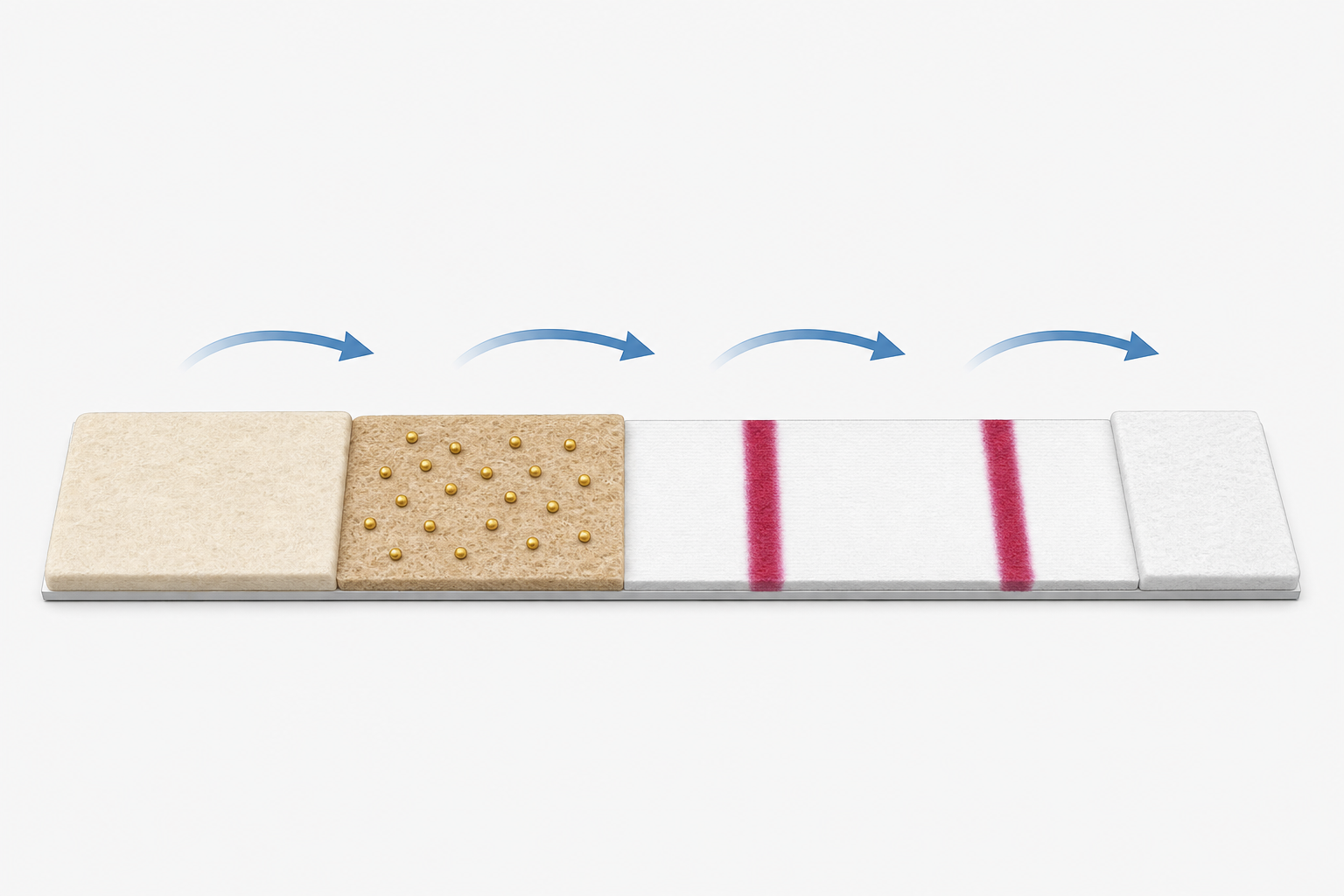
The chemistry inside a rapid cassette is straightforward once you see the strip broken down. It has three working zones plus a control line, arranged so that fluid wicks across them in sequence:
- Sample pad (left edge): receives the buffered fluid and starts the wicking action toward the right.
- Conjugate pad (next along): holds antibodies pre-tagged with a colored marker, a gold or latex particle. As your sample flows through, any target antibodies or antigens bind to the tagged reagent.
- Test line (capture zone): fixed capture antibodies for the target. The tagged complex gathers here and produces a visible colored band when the target is present.
- Control line (far right): fixed antibodies that catch the tagged reagent itself. This line should always appear on a valid run; if it does not, the test is invalid and you repeat it.
That layout is why reading the result is unambiguous: two lines is positive, the control line alone is negative, and no lines or a test line with no control line is invalid. There is no judgment call about how dark the line looks for a valid result, and the FDA clearance process for these devices validates the line-detection threshold.
Mail-in lab kits run on a different platform. NAAT, the most common lab method for chlamydia, gonorrhea, and trichomoniasis, extracts the pathogen's DNA and amplifies it through a polymerase chain reaction, with detection by fluorescent probe. NAAT is more sensitive than lateral-flow, especially for asymptomatic and very early infections, which is why the CDC designates it as the recommended laboratory method for chlamydia and gonorrhea. The trade-off is the 1-to-5-day turnaround. The two technologies are complementary rather than equivalent: the home strip screens quickly and privately, while a lab NAAT confirms with higher analytical sensitivity.
Window periods: when each test becomes reliable
A test cannot detect what is not yet there. Every infection has a window period, the gap between exposure and the point where there is enough biological signal in your blood or swab to register. Testing inside that window can return a false negative even with a perfect kit. For rapid HIV antibody tests the window runs from about 23 to 90 days after exposure per the CDC's HIV testing guidance, with most rapid antibody tests reliably detecting infection by day 90; the fourth-generation antigen-antibody tests run at clinics detect HIV by about day 45. The HSV-2 window is longer: the CDC's STI treatment guidelines note that IgG antibody seroconversion usually completes by about 12 weeks, with some assays advising a confirmatory retest at 16 weeks.
The window depends on the infection and the sample type. These are the practical timing rules to follow before you test:
| Infection | Sample type | Earliest reliable test window |
|---|---|---|
| Chlamydia | Genital swab or NAAT | About 1 to 2 weeks after exposure |
| Gonorrhea | Genital swab or NAAT | About 1 to 2 weeks after exposure |
| Trichomoniasis | Vaginal swab | 5 to 28 days after exposure |
| HIV (rapid antibody) | Fingerstick blood | 23 to 90 days; most rapid antibody tests detect by ~90 days per CDC |
| HIV (lab antigen-antibody) | Venous blood | About 45 days |
| Syphilis | Treponemal antibody (blood) | 3 to 6 weeks after exposure |
| HSV-2 (genital herpes) | Antibody (blood) | About 12 weeks; some assays advise a confirmatory retest at 16 weeks |
| Hepatitis B | Surface antigen / antibody (blood) | 3 to 6 weeks for HBsAg; up to 9 weeks for antibody |
| Hepatitis C | Antibody (blood) | 8 to 11 weeks after exposure |
| HPV | Vaginal swab (DNA) | Once cellular changes are present; not a real-time exposure test |
Step by step: what actually happens with a rapid kit
The leaflet inside any FDA-registered rapid kit is detailed and worth following exactly, but the general flow is the same across products. A typical rapid lateral-flow swab test goes like this:
- Read the leaflet first. Window-period and collection details are kit-specific, and reading them after you have collected the sample is too late.
- Wash your hands and let everything reach room temperature. Cold reagents skew the flow rate on the strip and can produce invalid results.
- Collect the sample. For a vaginal swab, insert the supplied swab about two inches and rotate it firmly against the vaginal wall for 15 to 30 seconds. For a penile swab, insert it just into the urethra and rotate gently for a few seconds. For fingerstick blood, lance the side of a fingertip (less nerve density), wipe away the first drop, and collect the sample with the supplied pipette to the volume the leaflet shows.
- Mix with buffer. Most swab kits include two buffers. Order matters: buffer A first, swab agitated in the tube for about 30 seconds, then buffer B. The buffers release the antigen from the swab head into solution.
- Apply the prepared sample to the cassette. Three or four drops, depending on the kit. The strip turning pink as the sample wicks is normal.
- Wait the full read time. Most kits read at 15 minutes. Reading early can miss a faint positive; reading after 30 minutes risks evaporation artifacts that mimic a false positive.
- Photograph the result before you discard the cassette. If you later share the result with a clinician for confirmation, the photo helps.
For a mail-in lab kit, swap steps 4 through 7 for: seal the tube with the included label, place it in the prepaid biohazard mailer, and drop it in any USPS box. The lab usually notifies you by secure message within 1 to 5 days.
Three timing rules that decide whether your result is valid
- Read the cassette at the labeled time, usually 15 minutes. Earlier reads miss faint positives; later reads risk evaporation artifacts.
- Use the kit before the printed expiry date. Reagents on lateral-flow strips degrade over time and can produce false results in either direction.
- Match the sample to the infection: swab for mucosal infections, fingerstick blood for blood-borne infections. The wrong sample type is the most common cause of an at-home false negative.
How accurate are at-home rapid tests, really?
"Accuracy" hides two separate measurements: sensitivity (the test correctly flags infected samples) and specificity (it correctly clears uninfected samples). Both matter, for different reasons.
Performance varies by infection. A 2024 meta-analysis in Scientific Reports compared self-collected with clinician-collected specimens in female participants. For chlamydia it found pooled sensitivity of about 85 percent and specificity of about 95 percent against the NAAT reference standard; for gonorrhea, sensitivity was noticeably lower at about 59 percent with specificity about 84 percent. The practical read: self-collection is broadly comparable to clinic collection for chlamydia, while a negative home gonorrhea screen is worth confirming with a lab NAAT if your suspicion stays high. For at-home HIV testing, the FDA-cleared OraQuick In-Home oral-fluid test is the longest-standing example and is recognized as a screening tool when used after the window period.
Reported performance for FDA-cleared rapid lateral-flow kits against manufacturer reference panels, used after the correct window period, looks like this:
- Rapid HIV (OraQuick In-Home class): sensitivity around 92 percent and specificity above 99 percent, per the OraQuick Premarket Approval documentation submitted to the U.S. Food and Drug Administration.
- Rapid syphilis (treponemal antibody): FDA-cleared tests generally report sensitivity in the mid-to-high 90s and specificity above 98 percent per their package inserts.
- Rapid chlamydia and gonorrhea swab: lateral-flow versions report 92 to 97 percent sensitivity against manufacturer reference panels, with specificity typically above 99 percent on those panels; see the per-kit figures on our chlamydia and gonorrhea kit page. Lab NAAT reaches above 95 percent sensitivity on the same sample type and is the more sensitive option in real-world screening.
- Rapid trichomoniasis swab: sensitivity around 83 to 95 percent depending on the assay, per the manufacturer package insert.
Manufacturer reference-panel numbers and real-world NAAT-referenced figures measure different things. The first is how the device performs against a curated panel of known-positive and known-negative samples assembled for FDA submission; the second is how it performs against the molecular reference standard in field use. Both are legitimate; they answer different questions, which is why the panel numbers sit higher than the field gonorrhea figure above.
Three factors move accuracy in the real world more than the device itself: timing (a 99 percent specific test still misses an infection inside the window, because the target is not yet detectable), sample quality (under-rotated swabs, contaminated fingertips, or too little sample push results toward false negatives), and storage (kits kept above the labeled temperature or used past the printed expiry can degrade). Rapid kits are screening tools, not confirmatory diagnostics: a negative is good information, and a positive should always be confirmed with a clinic-based assay before treatment.

Privacy and discretion: what the kits actually change
Privacy is the headline reason most people choose home testing over a clinic. For many people the hardest part of getting tested is not the result; it is the waiting room, the receptionist asking what brings you in, and the chance of running into someone you know. Home testing routes around all of that, and for people who genuinely fear being recognized at a clinic, removing that barrier is often the difference between testing and not testing at all.
From a reputable provider you can expect plain shipping with no brand name or medical return address; no insurance billing, which means no Explanation of Benefits (EOB) lands in the mail where a parent or partner on the same plan might see it; optional pickup at lockers or a hold-at-post-office address; account control with a preferred name and a separate email on a HIPAA-compliant platform; and a choice of how the result reaches you, by text, portal, or app.
That privacy carries the most weight for people who face the steepest social cost from being identified: those in tight-knit communities, young adults whose parents share a family doctor, LGBTQ+ people whose nearest clinic is not affirming, trans and nonbinary patients who have met misgendering or refused care, sex workers who have been profiled, and survivors of medical trauma. Removing the front-desk barrier is also why home testing tends to raise overall test completion compared with a clinic referral, which is a public-health gain, not only a private convenience. The trade-off is paying out of pocket; most kits run between 50 and 200 USD depending on panel size, and even a clinic visit in that range still generates an EOB that names what was tested.
Compared with a clinic visit, an at-home kit removes the four most common privacy leak points: an EOB sent to your home, a record on your insurance plan, a check-in conversation at a clinic reception, and a clinic name on your card statement. The kit ships in unbranded packaging, the lab portal is HIPAA-compliant with a login of your choosing, and the charge appears on your statement under a generic merchant name.
Who should test, and how often
If you have had partnered sex of any kind, you are a candidate for routine screening. The CDC's screening recommendations have all sexually active people test at least once a year, more often based on specific risk factors. For a plain-language overview of STI symptoms and which tests exist, the NHS guide to STIs is a useful general reference. A few situations make home testing especially useful: people with new or multiple partners, couples setting a shared baseline before going barrier-free, people in long-term relationships who never tested at the start, those far from a sexual-health clinic, and anyone who has skipped screening because of cost, time, or shame. Couples in long-distance or online relationships sometimes send each other kits and compare results before meeting in person.
Risk tracks less with how recently you had sex than with the number of new partners, the type of contact, and known factors such as a partner's diagnosis. A scheduled cadence (your annual physical, the first of a quarter, your birthday month) beats reactive testing after a scare, because it takes the decision out of an anxious moment. Translate the guide below to your own situation:
| Your situation | Suggested testing cadence |
|---|---|
| Sexually active, one partner, mutually known status | Once a year |
| Multiple or new partners | Every 3 to 6 months |
| Men who have sex with men | Every 3 to 6 months for HIV, syphilis, chlamydia, gonorrhea |
| Pregnant | Early-pregnancy screen for HIV, syphilis, hepatitis B; chlamydia and gonorrhea if under 25 |
| After a known or suspected exposure | Once the relevant window period has closed |
| Starting a new relationship | Both partners test before barrier-free sex |
Common myths about testing at home
Three myths trail at-home STD testing, and each one keeps people from testing. Here is what the evidence actually says.
At-Home Testing: Myth vs Fact
Myth: Home tests are far less accurate than clinic tests.
Fact: For the same sample type and chemistry, results track closely. The 2024 Scientific Reports meta-analysis found self-collected vaginal swabs broadly match clinician-collected samples for chlamydia, and FDA-cleared rapid tests use the same antibody and antigen chemistry as clinic-grade rapid tests. The real variables are user technique, which the leaflet walks through step by step, and testing outside the window. Knockoff tests from unverified marketplaces are a separate problem.
Myth: You can test for absolutely every STI at home.
Fact: You can test at home for chlamydia, gonorrhea, HIV, syphilis, hepatitis B and C, herpes (HSV-2 antibody), trichomoniasis, and HPV. You cannot reliably test pharyngeal (throat) or rectal sites at home, and most home herpes tests detect HSV-2 antibodies without typing HSV-1. Those gaps belong in a clinic conversation.
Myth: Testing is only for people with lots of partners.
Fact: CDC guidance recommends screening for anyone sexually active, with frequency scaled to risk. One condomless encounter, one undisclosed past partner, or one condom failure is enough exposure to warrant a test.
What happens after you get a result
The next step depends on what the cassette or portal shows. Three outcomes, three plans.
Negative, outside the window period: reassuring information. Keep up routine screening at the cadence the CDC recommends, which scales from yearly for most sexually active people to every 3 to 6 months for higher-risk patterns.
Negative, inside the window period: the result is not yet meaningful. Retest once the relevant window has fully closed (use the table above). If you have symptoms now, see a clinician for a sample-based test rather than waiting, because clinics can run NAAT and antigen-antibody tests that pick up infection earlier than a rapid antibody kit.
Positive: do not panic, and do not start treatment off a single rapid screen. Confirm with a clinic-based test first. Most STIs are either curable (chlamydia, gonorrhea, syphilis, trichomoniasis) or manageable for life with effective therapy (HIV, hepatitis B, herpes). Hepatitis C is now curable with 8 to 12 weeks of direct-acting antivirals, and HIV treatment taken as prescribed brings viral load to undetectable, which means untransmittable. A positive home result is the start of a treatment conversation, not a verdict. Notify recent partners; CDC guidance suggests reaching partners from the previous 60 days for most bacterial STIs, and anonymous tools such as TellYourPartner.org let you do that without identifying yourself.
Most providers, including stdrapidtestkits.com partners, offer a free telehealth consultation when you upload a positive result. The consultation routes you to confirmation testing and, for bacterial STIs like chlamydia and gonorrhea, often a same-day prescription called in to your local pharmacy. Treatment for the curable STIs is straightforward: a short course of doxycycline clears most chlamydia infections, and a single ceftriaxone injection clears most gonorrhea infections, per <a href="https://www.cdc.gov/std/treatment-guidelines/" target="_blank" rel="noopener noreferrer">CDC treatment guidelines</a>.
CDC recommends that everyone between the ages of 13 and 64 get tested for HIV at least once as part of routine health care.
What at-home rapid tests cannot replace
Being honest about scope makes the home-testing case stronger, not weaker. A few situations still belong in a clinic.
Pharyngeal and rectal infections. After receptive oral sex with a partner of unknown status, the right test is a throat swab; after receptive anal sex, a rectal swab. Our kits do not include throat or rectal swabs, so those need a clinic. Genital screening still has value here, but it does not substitute for the site-specific swab.
Telling HSV-1 from HSV-2. Most home blood tests detect HSV-2 antibodies and do not reliably distinguish HSV-1, which causes most oral cold sores and a growing share of genital herpes. With an active lesion, a clinic swab of the sore is more informative than any blood antibody test.
Active symptoms that need an exam. A visible lesion, severe pelvic pain, fever with a rash, or a swollen joint after recent unprotected sex is a clinic conversation. Home kits screen for infection; they do not evaluate symptoms or rule out other causes.
Window-period uncertainty. Test before the relevant window has passed and even a flawless kit can miss an early infection. A negative inside the window means "retest later," not "all clear." What we sell is rapid lateral-flow chemistry, not lab NAAT or PCR, so a positive screen still belongs in front of a clinician for confirmation.
A home rapid test is the wrong tool when: you had receptive oral or anal sex with a partner of unknown status (throat or rectal swab needed), you have an active lesion that needs lab typing for HSV-1 vs HSV-2, you have severe symptoms such as pelvic pain or fever with a rash, you are pregnant, or you are testing inside the relevant window period.
Choosing the right kit for your situation
The right kit depends on what you need to rule in or out, and on your budget. As a rough guide, single-target rapid kits run about 25 to 60 USD; 2-in-1 and 3-in-1 combos 50 to 100 USD; the 6- through 10-in-1 panels 120 to 250 USD; and mail-in lab NAAT panels 100 to 300 USD per panel. Most direct-to-consumer kits are HSA or FSA eligible, so keep the receipt for reimbursement. The flow below points you to the route that usually fits.
Which Testing Route Fits You?
Do you have active symptoms (a visible lesion, pelvic pain, or fever with a rash), or was your exposure oral or anal?
Yes: See a clinic. You need a physical exam or a site-specific throat or rectal swab that home kits do not cover.
Do you have one specific concern, such as a known exposure to a single infection or a follow-up retest after treatment?
Yes: A single-target rapid kit is the cheapest, fastest fit.
Are you doing a routine screen, testing after a new partner, or testing with a partner of unknown status?
Yes: A combo panel (6-, 7-, or 8-in-1) covers the common infections in one shipment.
No: If a rapid result came back positive and you want confirmation, use a mail-in lab NAAT or a clinic visit before starting treatment.
Guidance only; a clinician can advise on your specific situation.

Frequently Asked Questions
- Are at-home STD tests as accurate as clinic tests?
- Mail-in lab kits use the same NAAT instrumentation clinics use, so the accuracy is essentially identical. Rapid lateral-flow home kits are slightly less sensitive than lab NAAT (typically 92 to 97 percent sensitivity against manufacturer reference panels for chlamydia and gonorrhea, versus above 95 percent for NAAT). A 2024 meta-analysis in Scientific Reports found self-collected female samples broadly comparable to clinician-collected ones for chlamydia (about 85 percent pooled sensitivity, 95 percent specificity against the NAAT reference standard) while being noticeably lower for gonorrhea (about 59 percent sensitivity, 84 percent specificity). The single biggest variable is whether you tested inside or outside the window period.
- How long do results take?
- Rapid lateral-flow kits read at 15 to 30 minutes after sample application. Mail-in lab kits return results within 1 to 5 days from when the lab receives your sample, which depends on shipping time.
- What if I get a positive result?
- A positive rapid screen is a prompt to confirm, not a final diagnosis. Take it to a clinic or telehealth provider for a confirmatory lab test before any treatment starts. Nearly all STIs are then either cured with antibiotics or controlled long-term with antiviral therapy.
- Can I test for every STI at home?
- The major ones, yes: HIV, syphilis, chlamydia, gonorrhea, trichomoniasis, HPV, herpes, hepatitis B, and hepatitis C. These tests are sold over the counter, so no prescription is needed. The notable gap in the at-home rapid market is pharyngeal (throat) and rectal swab tests, which require a clinic visit. Our trichomoniasis and HPV kits are validated for vaginal self-swab only, and most rapid home herpes tests detect HSV-2 antibodies without typing HSV-1.
- Are at-home test kits covered by insurance?
- Most direct-to-consumer kits are paid out of pocket, which is part of the privacy benefit because no Explanation of Benefits gets sent to your home or insurance plan. Many kits are HSA and FSA eligible, so you can reimburse yourself through those accounts. Confirmation testing at a clinic, if needed after a positive home result, usually does run through normal insurance.
- How will my partner know if I tested?
- Only if you tell them. Home kits do not share results with partners, insurance, or any third party. Everything stays between you and the test provider. If you do test positive, partner notification is recommended for public-health reasons; anonymous services such as TellYourPartner.org let you do this without identifying yourself.
- Can both partners share one kit?
- One kit tests one person's sample, so for couples testing together you need one kit per person. Many couples schedule a shared testing date with two kits as a baseline before going barrier-free.
- How often should I test if I am sexually active?
- The CDC recommends everyone aged 13 to 64 test for HIV at least once in a lifetime regardless of perceived risk. Beyond that: annually for sexually active people, every 3 to 6 months for higher-risk patterns (multiple or new partners, men who have sex with men, a partner with positive status), and after any new exposure once the relevant window has passed.
- U.S. Centers for Disease Control and Prevention. STI treatment guidelines for clinicians, including first-line therapies for the curable bacterial STIs, the designation of NAAT as the recommended laboratory method for chlamydia and gonorrhea, recommended specimen types, screening cadence, and HSV IgG seroconversion timing.
- U.S. Centers for Disease Control and Prevention. HIV testing overview, including the 23-to-90-day rapid antibody window, detection windows for antigen-antibody and NAT tests, and the recommendation that everyone aged 13 to 64 be tested for HIV at least once.
- Jaya et al. (2024). Accuracy of self-collected versus healthcare-worker-collected specimens for diagnosing STIs in females: an updated systematic review and meta-analysis, Scientific Reports. Source for the pooled accuracy figures cited in the accuracy section: chlamydia about 85 percent sensitivity and 95 percent specificity; gonorrhea about 59 percent sensitivity and 84 percent specificity against the NAAT reference standard.
- U.S. Food and Drug Administration. Regulatory pathway for in-vitro diagnostic devices, including the OraQuick In-Home HIV Test Premarket Approval that supports the 92 percent sensitivity and above-99 percent specificity manufacturer-panel figures cited in the body.
- World Health Organization. Sexually transmitted infections fact sheet, including transmission, screening, treatment, curability, and global burden data referenced in the post-result section.
- National Health Service (UK). Sexually transmitted infections overview, symptoms, testing options, and treatment summaries, used as the plain-language general reference linked in the who-should-test section.
