
Published: August 2025 | Last updated: May 2026 | Editorial review and quality control: Martina N.
The first time sex feels strange after having a baby, it is tempting to chalk everything up to healing. New parents are often told the body just needs time, that discomfort is normal, that things will settle. Most of the time, that is true. But postpartum tissue changes, the hormonal cliff after delivery, and a recovering immune system genuinely do make these weeks a higher-vulnerability window for sexually transmitted infections, and the symptoms blur with normal recovery in ways that are easy to dismiss.
This guide walks through what changes inside the body after birth, which symptoms deserve a test rather than another week of waiting, when at-home or clinic testing actually yields a reliable result, and how to handle a positive result or a difficult conversation with a partner. It is written for the majority of postpartum readers whose symptoms turn out to be ordinary healing, and for the smaller group whose body is quietly telling them something else.
Key Takeaways
- Postpartum biology raises STI vulnerability for weeks after birth: the cervix may stay slightly open, vaginal tissue is thinner from low estrogen, and the immune system is still recalibrating. A long-term monogamous relationship is not automatic protection, because latent infections can reactivate.
- Burning, unusual discharge, persistent odor, or spotting that does not fade within two to three days deserves an STI test, not the default explanation of ‘just healing.’ Most postpartum visits do not screen for STIs unless you ask.
Why STI Risk Rises After Birth, Even With the Same Partner
There is a quiet assumption postpartum: that any discomfort is healing, that a long-term partner could not be a source of infection, and that the body is simply doing its work. Sexually transmitted infections do not follow that emotional logic. They follow biology, and postpartum biology is more open to infection than most people realize.
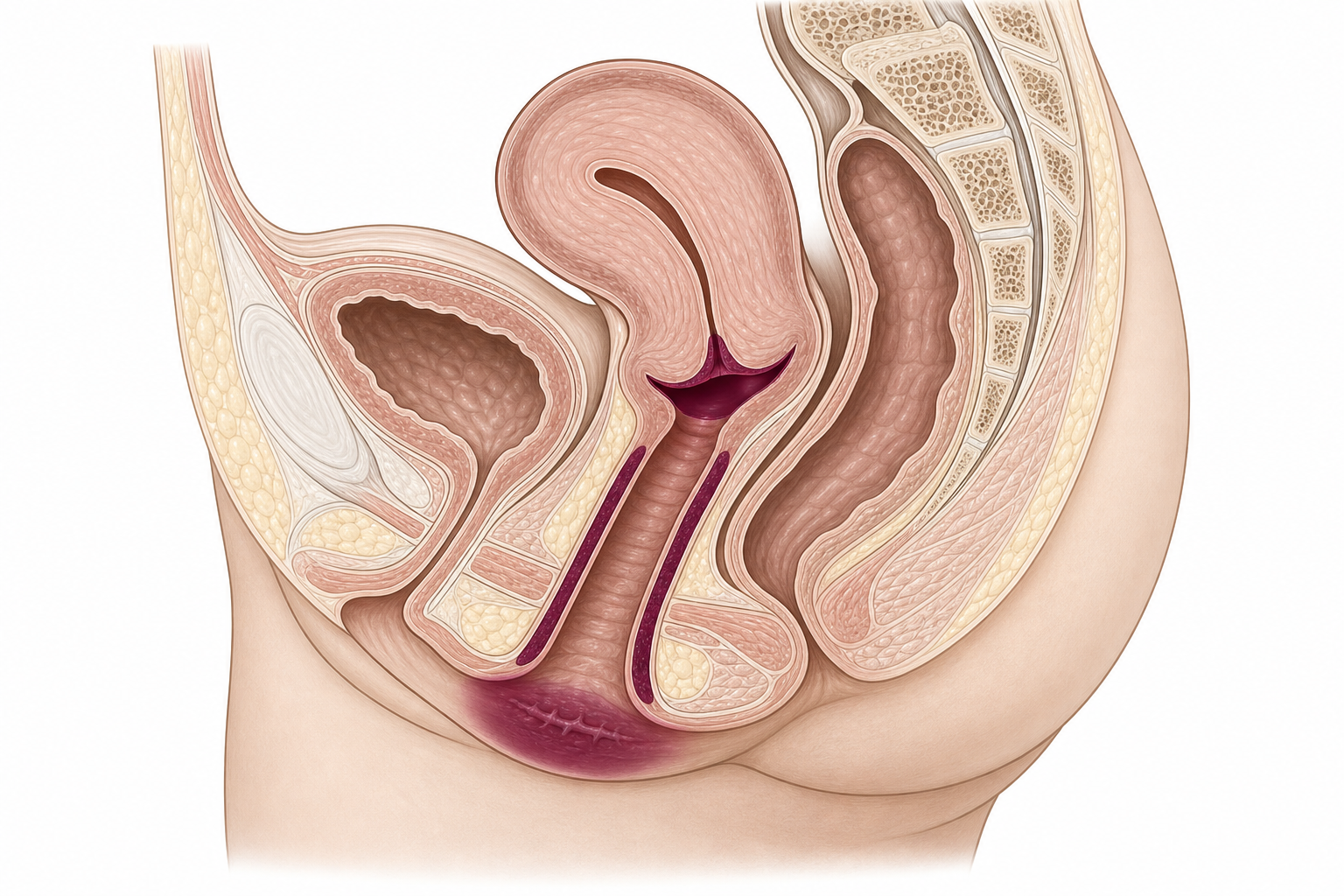
After delivery, the cervix can stay slightly dilated for several weeks while the uterus involutes. Microtears from vaginal delivery, perineal stitches, and the internal trauma that even an uncomplicated birth produces all compromise the mucosal barrier that ordinarily keeps pathogens out. Estrogen drops sharply within days of birth, especially in people who breastfeed, leaving vaginal tissue thinner, drier, and less elastic. Vaginal pH shifts away from its protective lactobacillus-dominant balance. Sleep deprivation and stress reshape the immune system. Add reduced lubrication during early postpartum sex, and friction itself becomes a transmission risk factor.
The other half of the story is reactivation. Latent infections that someone has carried silently for months or years, including herpes simplex virus and human papillomavirus, can flare under the hormonal and immune turbulence of late pregnancy and the postpartum period. CDC guidance lists both viruses among the infections most commonly associated with long stretches of latent carriage between flare-ups. Chlamydia and gonorrhea can persist asymptomatically in either partner for long stretches. None of this requires recent infidelity.
Healing Pain or Hidden Infection? How to Tell the Difference
At two in the morning with a baby on your chest, telling the difference between ordinary postpartum recovery and an infection is genuinely hard. Burning during urination, tightness, cramping, mixed-color discharge, mild spotting, perineal soreness, and pelvic pressure are all common in the first six to twelve weeks after delivery. They are also common signs of a sexually transmitted infection. The overlap is real, and the medical system rarely sorts it out for you.
Most postpartum visits at four to eight weeks check the uterus, the perineum, bleeding, mood, and contraception. They do not include STI screening unless you explicitly ask. The default assumption sitting across from you in the exam room is healing, not infection. ACOG’s Committee Opinion 736 on optimizing postpartum care describes the visit as a comprehensive check-in, but in practice STI testing depends almost entirely on the patient raising the question.
That makes pattern recognition useful. Some symptoms tip toward ordinary recovery: bright then fading lochia, gradual perineal soreness that lessens week over week, mild dryness during sex that improves with lubricant. Other patterns tip toward infection: discharge that intensifies or changes color several weeks after lochia ended, a new fishy or strongly metallic odor, painful bumps or sores that were not there last week, sharp internal pain during sex that feels like a burn rather than friction, or spotting that returns weeks after it stopped. None of these patterns is diagnostic on its own. All of them are reasons to test rather than wait.
| Symptom | Possible STI | Often mistaken for |
|---|---|---|
| Burning or stinging during sex | Herpes, chlamydia | Tear pain, dryness, hormonal change |
| Spotting or bleeding after sex | HPV, chlamydia | Cervical healing, normal irritation |
| Yellow or greenish discharge | Trichomoniasis, gonorrhea | Lingering lochia, yeast infection |
| Strong or fishy odor | Trichomoniasis, bacterial vaginosis | Postpartum sweat, pH imbalance |
| Painful bumps or sores | Herpes, syphilis | Ingrown hair, healing stitches |
| Burning when urinating | Chlamydia, gonorrhea, trichomoniasis | UTI, perineal soreness |
When to Test Postpartum: Timing That Actually Works
Testing too early returns a false sense of safety. Testing too late lets an infection do damage. The window period, meaning the time between exposure and when a test can reliably detect the infection, matters more after birth, because postpartum tissue is unforgiving of an untreated infection that lingers.
A reasonable default: if you have resumed sex and anything feels off, test now and again at the appropriate window. If you have not yet resumed sex but had any new exposure during the third trimester or around delivery, test once you are four to six weeks postpartum. If your partner has any history of untreated infection, test regardless of how you feel. The CDC’s STI screening recommendations outline the standard testing intervals; postpartum is not a separate category, which is part of the problem.
Birth method does not change the timing meaningfully. Whether you had a vaginal delivery or a cesarean, internal mucosa and immune-state recovery follow similar timelines, so the same testing windows apply across birth types.
| Infection | Earliest reliable test | Best accuracy window | Notes for postpartum testing |
|---|---|---|---|
| Chlamydia | 5 to 7 days after exposure | 14 days and beyond | Frequently asymptomatic; co-occurs with gonorrhea |
| Gonorrhea | 5 to 7 days after exposure | 14 days and beyond | Often paired with chlamydia screening |
| Trichomoniasis | 7 to 10 days after exposure | 14 days and beyond | Common postpartum; resembles BV or yeast |
| HSV-2 (genital herpes) | During an active outbreak by swab | 12 weeks and beyond for blood antibody confirmation | Watch for tingling, ulcers, or unusual pain |
| Syphilis | 3 to 6 weeks after exposure | 6 to 12 weeks | Painless sore is easy to miss postpartum |
| HIV (fourth-generation antigen-antibody) | Around 18 to 45 days after exposure | 45 days and beyond | Rapid lateral-flow antibody tests may need 6–12 weeks |
| HPV | Not applicable | Detected via Pap or HPV co-test, not urgent | Wait until the OB clears cervical screening |
What If Your Partner Was Negative Before Pregnancy?
This is the question that comes up most in postpartum forums: how can I have an STI now if we were both negative before the baby? The uncomfortable answer is that a clean test result is a snapshot, not a permanent state, and a long-term partnership does not erase three biological realities.
The first is dormancy. Herpes simplex virus and human papillomavirus can sit silently in a body for months or years between flare-ups. A partner who tested negative on an antibody panel three years ago may still carry a low-level infection that becomes transmissible under stress, hormonal change, or immune shifts. The first postpartum encounter, when your mucosa is at its most vulnerable, is a textbook moment for transmission of a virus that was always there.
The second is asymptomatic carriage. Chlamydia in particular is famous for producing no symptoms in many people who carry it. A partner can have an untreated infection from before the relationship that simply never produced a noticeable problem, until your postpartum tissue creates new conditions for it to take hold or cause symptoms.
The third is honest uncertainty. People sometimes resume sex outside the relationship during pregnancy or postpartum, and they sometimes do not. Testing does not require deciding what happened; it just asks the body what is true now. Asking for a retest is the same kind of basic maintenance as checking blood pressure or thyroid levels at a postpartum visit, not an accusation.
To optimize the health of women and infants, postpartum care should become an ongoing process, rather than a single encounter, with services and support tailored to each woman’s individual needs.
Why Shame Keeps Postpartum People Silent
There is a cruel irony in postpartum health. The body has just done one of the most demanding things a human body can do, and within weeks there is pressure to feel normal, look normal, partner normally, and be sexual normally. When sex hurts, bleeds, or smells different, the first reaction is often self-blame: wondering whether the body is simply not ready, whether the discomfort is being exaggerated, or whether this is just what early parenthood feels like.
STIs rarely make the list of considered explanations. When they do, shame often silences the question entirely. The same shame keeps people from raising it with a clinician, which keeps clinicians from asking, which keeps testing out of routine postpartum care, which keeps everyone in the loop of not asking.
The simpler frame: a postpartum STI is not evidence of infidelity, poor hygiene, or moral failure. It is evidence that the body changed, the immune system shifted, a dormant virus may have reactivated, or a long-standing asymptomatic infection finally surfaced.
Talking to Your Partner About Testing
The conversation can feel like breaking a spell. You have been through labor together, survived weeks of broken sleep, and now there is this awkward sentence to deliver: we should probably both get tested. It can land badly if it sounds like an accusation. It lands better when it sounds like household maintenance.
The framing in the callout below tends to work because it is honest, does not assign blame, and makes the test a shared act rather than a one-sided demand.
What tends not to work: ‘I think you gave me something.’ Even when the underlying suspicion turns out to be correct, opening with blame builds a wall before anyone has tested anything. If a partner refuses testing or becomes defensive about a low-cost, private, at-home test, that response is itself worth paying attention to. The test is not the threat; the refusal often is.
If the conversation is too hard to start in person, a short message that links to an at-home kit and says ‘I want us to do this together’ can work as an opener. The point is to get from suspicion to data without ending the relationship before there is anything to discuss.
‘I have been feeling some things during sex that are bothering me, and postpartum makes everything harder to read. I would feel a lot better if we both ran a test, just so we are not guessing.’
If You Test Positive: What Happens Next
Take a breath. A positive postpartum test can feel like a betrayal of body, partner, or self, and that reaction is normal. The clinical reality is calmer than the emotional one. Most bacterial STIs are curable with a short course of antibiotics. Viral STIs are manageable. None of them, treated, prevents a person from being a parent, a partner, or sexually active again.
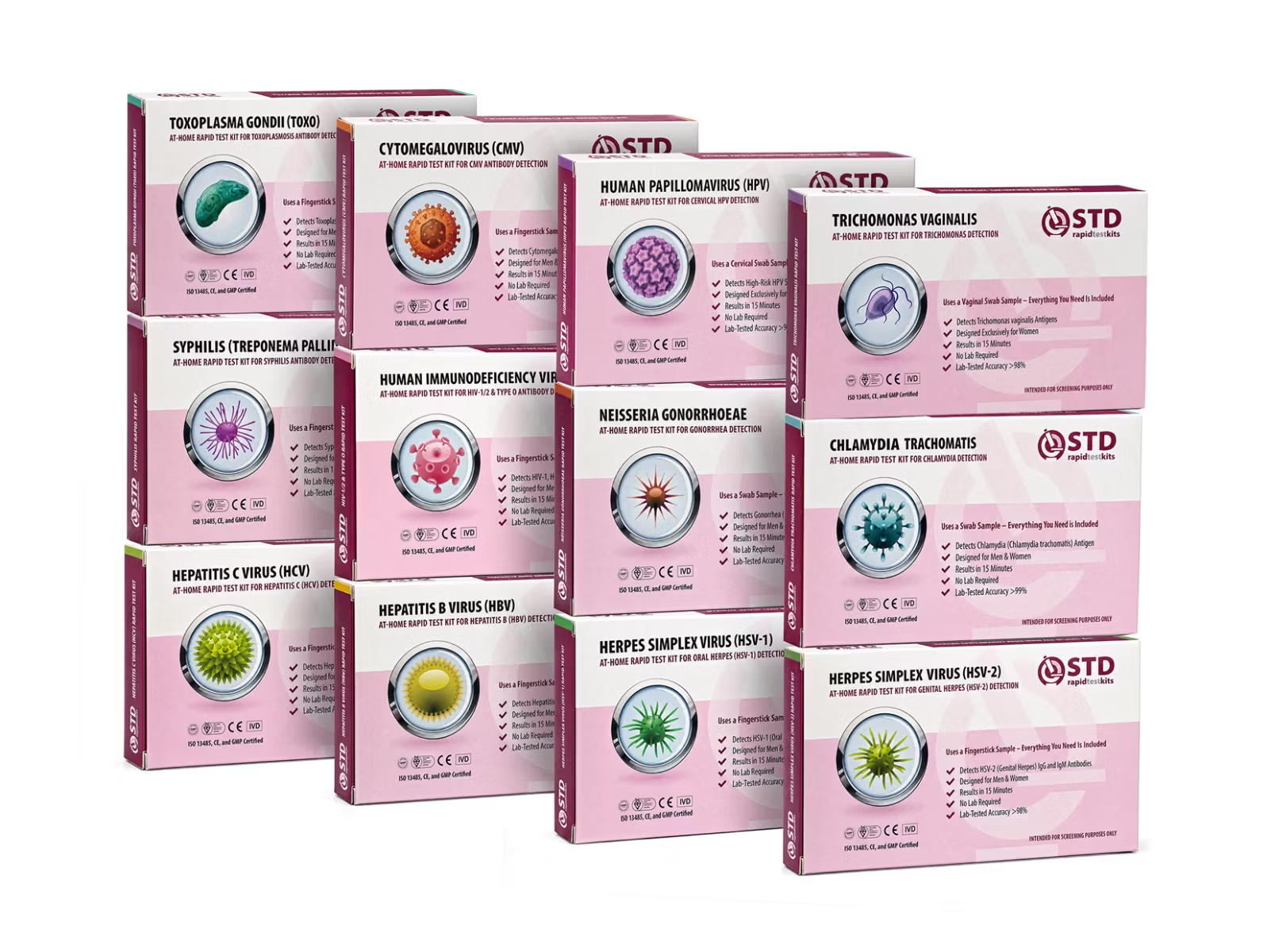
An at-home positive result is a screen, not a final diagnosis. The next step is a confirmatory test through a telehealth visit or a clinic, followed by treatment if the confirmation lines up. Chlamydia and gonorrhea typically resolve with a single targeted antibiotic course; CDC chlamydia treatment guidance outlines the current regimens. Trichomoniasis treats with metronidazole. Syphilis treats with penicillin. Herpes is managed with antivirals that reduce outbreaks and transmission risk. HIV today is a chronic, fully manageable condition with daily medication.
Breastfeeding rarely needs to stop. Most antibiotics and antivirals used for STI treatment are compatible with lactation, and WomensHealth.gov’s guidance on STIs, pregnancy, and breastfeeding covers the common exceptions. Always confirm with the prescribing clinician, who has the full picture of the infection, the drug, and the infant’s age.
Partner notification is usually part of treatment. Many clinics offer expedited partner therapy that supplies medication for a partner without a separate visit. The faster both people in a couple complete treatment, the lower the chance of reinfection during the same postpartum window.
You Deserve Answers, Not Assumptions
When sex hurts after birth, when discharge changes, when the body feels unfamiliar, the answer is not always hormones, and it is never just in your head. Postpartum is not a protected zone. STI risk does not pause for new parenthood, and the symptoms can hide inside ordinary recovery for weeks. The good news is that the path from worry to answer is shorter than it used to be. A test at home, a confirmatory test at a clinic if needed, and a short treatment course resolves most of what postpartum bodies actually face. Asking the question is the hardest part.
Next steps
- Test now if symptoms are present and you have resumed sex postpartum, rather than waiting for the next OB appointment.
- Retest at the appropriate window for each specific infection if your first test was inside the early-detection window (see the table above).
- Confirm any positive at-home result with a clinic NAAT or blood test before starting treatment, and ask about expedited partner therapy.
FAQs
- Can I really get an STI from my partner after having a baby if we have been monogamous for years?
- Yes. Latent infections like HSV and HPV can sit dormant for months or years, then reactivate when postpartum hormones and immune function shift. Asymptomatic chlamydia can persist undetected for long stretches. A long-term relationship is not automatic protection against a virus that was already there.
- Sex hurts after birth. Is that always healing, or could it be an infection?
- It often is healing, especially in the first six to twelve weeks. If the pain feels sharp, burning, or like rubbing on a raw nerve, if it gets worse rather than better week over week, or if it comes with unusual discharge or odor, treat it as worth testing. Chlamydia, trichomoniasis, and gonorrhea all produce sensations that overlap with ordinary postpartum discomfort.
- What does normal postpartum discharge look like, and when should I worry?
- Lochia, the normal healing discharge, starts red and gradually fades through pink to yellow or white over four to six weeks. Worth investigating: a new greenish or grey tinge, a fishy or strong odor, discharge that returns after lochia ended, or persistent itching with the discharge. Those patterns point toward infection rather than recovery.
- Is it too soon to test if I had sex last week?
- Most STIs need a few days to a few weeks to become reliably detectable. A test less than a week after exposure may miss an infection that is present. If symptoms are pushing you to test now, test now, then plan a retest at the appropriate window for the specific infection.
- What if I never had symptoms? Can I still have something?
- Yes. Chlamydia in particular is well known for causing no noticeable symptoms while still being transmissible and capable of causing pelvic inflammatory disease over time. If you have resumed sex postpartum and have not tested since before pregnancy, a screening test is reasonable regardless of how you feel.
- Can an STI affect breastfeeding?
- Most infections themselves do not pass through breast milk in ways that meaningfully affect an infant, and most treatments are compatible with lactation. HIV is the main exception, where current guidance varies by setting and viral suppression status. Always confirm specifics with the prescribing clinician.
- My partner said they were tested a while ago. Is that enough?
- Probably not. A test result is a point-in-time snapshot. If the test was before pregnancy, or if either partner has had any other sexual contact since, the old result no longer reflects current status. A fresh test from each partner is the most useful thing a couple can do.
- I feel fine. Do I really need to test?
- If you have resumed sex postpartum and have not tested since before pregnancy, a single baseline test is sensible even without symptoms. ‘Feeling fine’ does not rule out asymptomatic chlamydia or a latent virus. Testing clears the question so the rest of postpartum can focus on healing rather than overthinking every twinge.
- U.S. Centers for Disease Control and Prevention. STI Screening Recommendations, supporting the article’s guidance on testing timing and windows.
- American College of Obstetricians and Gynecologists. Committee Opinion 736 (2018), Optimizing Postpartum Care, source of the pull-quote and framing for postpartum visit limitations.
- U.S. Centers for Disease Control and Prevention. STI Statistics overview, supporting general background on STI prevalence in U.S. populations.
- U.S. Centers for Disease Control and Prevention. Chlamydial Infections Treatment Guidelines, source for current antibiotic regimens referenced in the ‘if you test positive’ section.
- U.S. Office on Women’s Health. Sexually transmitted infections, pregnancy, and breastfeeding, source for guidance on STI treatment compatibility with lactation.
- U.S. Centers for Disease Control and Prevention. About Pelvic Inflammatory Disease, supporting the article’s claim that untreated chlamydia can cause longer-term reproductive damage.
