

Published: October 2025 | Last updated: May 2026 | Editorial review and quality control: Martina N.
The combination of itching after sex with no obvious discharge is one of the most confusing patterns in vaginal health. Yeast usually shows up with thick white discharge. Bacterial vaginosis (BV) usually carries a faint fishy odor. So when irritation hits without those clues, it's tempting to wave it off as friction or to repeat-treat for the wrong thing.
Trichomoniasis is the parasite that often slips through this gap. Roughly 70% of people with the infection feel nothing or almost nothing, and many of those who do have symptoms report only a mild itch, a sore feeling, or a slight burn during urination. This guide walks through what trich actually looks like without discharge, how to tell it apart from yeast and BV, when to test, and what to do while you wait.
Key Takeaways
- Trichomoniasis can cause itching, soreness, or a slight burn when peeing with little or no discharge. Yeast and BV usually do show changes in discharge, so a clean-feeling itch is more often trich or simple irritation than yeast.
- About 70% of people with trich have no symptoms at all, yet the infection still spreads to partners and raises HIV and pregnancy risks. Testing is the only reliable way to find it (CDC).
Why itching after sex with no discharge often points to trich
The textbook signs of yeast, BV, and trichomoniasis don't always read like a textbook in real life. Yeast classically brings thick, cottage-cheese-like discharge with intense itching. BV brings a thin grayish discharge and a fishy smell that's strongest after sex. Trichomoniasis, in the rare cases when it presents clearly, brings frothy yellow-green discharge and soreness.
That's the textbook version. In real life many people with trich never see any unusual discharge. They notice a vague itch, a sore feeling, or a small burn during urination, days or weeks after sex. The U.S. CDC's trichomoniasis fact sheet notes that about 70% of infected people are completely asymptomatic, and even among those with symptoms, only a fraction get the textbook frothy discharge.
That overlap is the reason so many people misdiagnose themselves. The shortcut answer ("it's probably yeast again") feels obvious. Trichomoniasis is the only sexually transmitted infection of the three. It does not clear on its own, and it remains transmissible during the months when symptoms are absent.
| Condition | Main cause | Discharge? | Common symptoms | Sexually transmitted? |
|---|---|---|---|---|
| Yeast infection | Fungal (Candida) | Yes, thick and white | Itching, redness, swelling, burning | No, not sexually transmitted |
| Bacterial vaginosis (BV) | Imbalance of vaginal bacteria | Yes, thin and grayish | Fishy odor, mild itching, irritation | No, but linked to sex |
| Trichomoniasis | Parasitic protozoan (Trichomonas vaginalis) | Sometimes yellow-green, sometimes none | Itching, burning, soreness, sometimes odor | Yes (STI) |
Why trich hides better than yeast or BV
Trichomoniasis is caused by a single-celled parasite, Trichomonas vaginalis, that lives in the lining of the vagina and urethra. While yeast and BV usually disrupt the vaginal environment in ways you can see and smell, trich often produces a low-level inflammation that the body tolerates for weeks or months. The result is a mild itch, soreness, a slightly raw feeling after sex, or a small burn when peeing, none of which scream "STI."
That subtlety is also why trich gets missed in self-care routines. Anyone who has dealt with yeast knows the playbook: an over-the-counter antifungal cream and a few days of patience. When the itch fades for a day after the cream, it can feel like the treatment worked. Trich won't actually respond to antifungal cream, and the symptoms tend to drift back, often after the next sexual encounter or pH shift.
Per Cleveland Clinic, untreated trich can persist for months or longer, and it remains transmissible even when symptoms are minimal or absent.
Trich often produces only mild irritation that the body tolerates for weeks, with no smell or visible discharge to trigger alarm. The tolerance is what keeps it undetected and what allows the parasite to spread to partners during the silent stretch.
When "just yeast" becomes the wrong relief
It's common to hear yeast described as the "best case" for vaginal symptoms. It's not an STI, it's treatable over the counter, and it usually clears in a few days. That framing holds when the cause actually is yeast. When the cause is trich or BV, repeating the same approach extends the misdiagnosis by weeks at a time.
Repeat use of antifungal creams for a non-fungal problem strips away protective lactobacilli, the good bacteria that keep the vaginal environment stable. With those bacteria reduced, BV and trichomoniasis can settle in more easily. Each round of "just yeast treatment" then hides the real diagnosis a little longer.
This is one of the most common patterns clinicians see: someone has a partial response to over-the-counter antifungals, the itch eases for a day, and then it returns, especially after sex. The cycle can run for months before the underlying cause gets identified through a swab or NAAT panel.
Each round of antifungal cream for a non-fungal problem can deplete protective lactobacilli, making BV and trich easier to establish. A cycle of partial relief and recurrence after sex is a signal to test rather than treat again.
Testing is the only reliable way to tell
You can't reliably tell yeast, BV, and trich apart based on smell, itch, or timing alone. Discharge color and texture are useful clues, not diagnoses. The CDC's STI treatment guidelines recommend a sample-based test rather than relying on clinical exam alone, because physical examination findings for trich are often inconclusive.
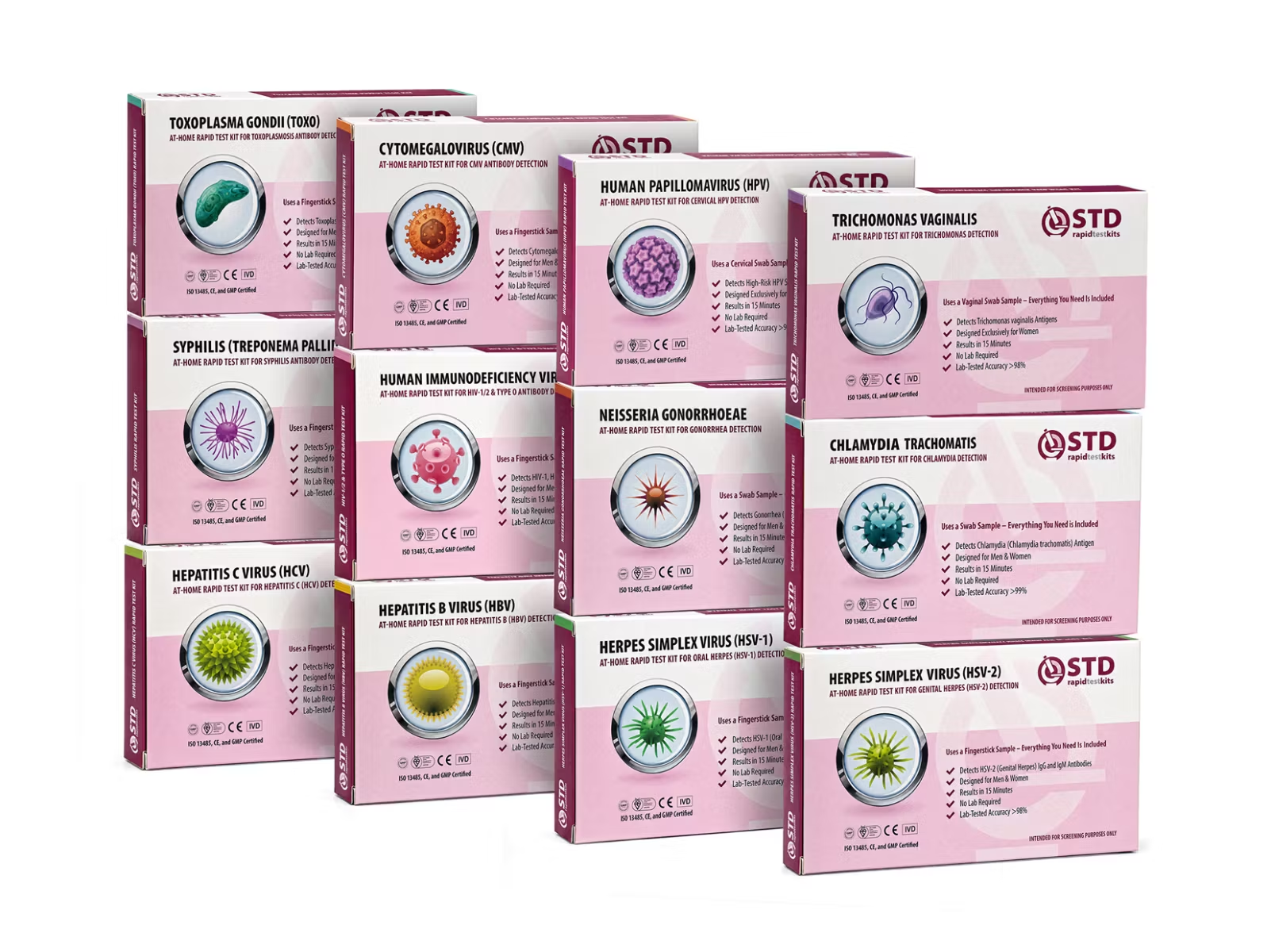
Lab-based testing for trich is typically done with a NAAT (nucleic acid amplification test) on a vaginal swab or urine sample. At-home rapid kits work differently: they use a lateral-flow strip on a self-collected vaginal swab to detect Trichomonas antigen, with a result visible in about 15 minutes. Lateral-flow rapid tests are screening tools rather than lab-grade NAATs. The sensitivity trade-off is real. They return a result in 15 minutes without a clinic visit, which makes them useful for deciding whether to seek treatment. If a rapid test is positive, the standard next step is to confirm with a clinician and start treatment.
The four pieces of information you'd want from any test are: did the sample type match what the test was designed for, was the timing right (more on that below), did you get a positive or negative result, and what does that mean for partner testing. (This article links to a rapid home test available on this site.)
Rapid lateral-flow vs. lab NAAT, side by side
- At-home rapid lateral-flow: detects Trichomonas antigen on a self-collected vaginal swab, result in about 15 minutes, screening-grade sensitivity.
- Lab NAAT (nucleic acid amplification): higher analytical sensitivity, performed on a swab or urine sample processed in a clinical lab, considered the laboratory gold standard.
- Both methods accept the same sample type. The trade-off is convenience and speed versus the highest analytical sensitivity, so a positive rapid result is worth confirming with a NAAT when possible.
How long after sex to wait before testing
Timing matters because each infection has a different incubation window. Test too early and the parasite, bacteria, or fungal overgrowth may not yet be detectable. Wait too long and you may unknowingly pass the infection to a partner.
For trichomoniasis, symptoms typically appear between 5 and 28 days after exposure, per CDC guidance. That's a wide range, and many people never develop symptoms. BV and yeast imbalances can show up much faster, sometimes within 24 to 72 hours, especially after unprotected sex, douching, or a shift in vaginal pH.
One distinction worth making: the 5-to-28-day window describes when symptoms appear, not when the infection becomes detectable. For antigen-based rapid tests and NAATs, testing can be done any time after a potential exposure, and asymptomatic readers do not need to wait for symptoms to start.
The practical guidance: if it's been less than five days since exposure and you have no symptoms, waiting a few more days reduces the chance of a false negative. If it's been 7 to 14 days, you're in a sensible testing window. If it's been more than two weeks and you still feel itching, soreness, or just "off," testing now beats another round of guessing creams.
| Infection | Incubation period | When to test | Best sample type |
|---|---|---|---|
| Yeast infection | 12 to 72 hours after disruption | Once symptoms appear | Vaginal swab |
| Bacterial vaginosis (BV) | 24 to 72 hours post-trigger | As soon as odor or irritation occurs | Vaginal swab |
| Trichomoniasis | 5 to 28 days after sex | After 7 to 14 days post-exposure | Vaginal swab or urine |
Subtle clues that nudge toward testing
While only a test gives certainty, a few clues can move the decision earlier. Trichomoniasis often produces a burning sensation during urination without much smell. BV almost always carries a faint fishy odor that strengthens after sex. Yeast typically produces thick, clumpy discharge and intense itching that gets worse with heat or tight clothes.
Exceptions are common, though. Some people with trich have frothy discharge, others have none. Some yeast infections come with almost no discharge. BV symptoms can come and go with the menstrual cycle, hygiene products, or a new partner. A list of clues can narrow the field, but only a test makes the diagnosis. When the classic yeast or BV signs are absent, that gap is a prompt to test rather than wait.
Symptoms that should prompt testing rather than home treatment: itching that doesn't improve after a complete course of antifungal cream, burning that lingers past a day or two, soreness that returns after sex, or any combination of the above with a new or untreated partner.

Why your partner needs to test too
Trichomoniasis is the only one of the three that ping-pongs between partners. If only one person in a couple gets treated, the untreated partner can re-infect them, and the cycle restarts. The CDC's STI treatment guidelines specifically include partner therapy in the recommendation for trich.
People with penises usually have no symptoms with trich, and they often carry it for months without knowing. The infection sits quietly in the urethra. A normal-feeling exam doesn't rule it out. The only reliable way to know is testing.
Untreated trich is more than an inconvenience. The CDC notes that it's associated with increased risk of HIV acquisition and transmission, pelvic inflammatory disease in some cases, and pregnancy complications including preterm birth and low birth weight. None of those outcomes is inevitable, and the elevated risks are documented in CDC surveillance data.
Trichomoniasis is one of the most common curable sexually transmitted infections, and most people who have it have no symptoms.
Self-care while you wait for results
If you've already tested or you're waiting for the right window, keep things gentle. The basic rules of thumb while symptoms are active:
- Skip internal products like douches or scented soaps; they disrupt vaginal pH and tend to make symptoms worse.
- Avoid sex while you have active itching or burning. This reduces transmission risk and gives the tissue time to heal.
- Use a lukewarm bath or a clean cool compress for itch relief; both are low-risk options.
- Wear cotton underwear and loose-fitting clothes to reduce friction.
- Avoid starting a new antifungal cream blindly unless a clinician has advised it.
If a test comes back positive for trich, the standard treatment is a single course of metronidazole or tinidazole, taken by both you and your partner, per CDC treatment guidelines. Most cases clear with one round. Retesting roughly three weeks after treatment is the typical recommendation to confirm clearance.
Resist starting a new antifungal cream unless a clinician has advised it. The wrong treatment can mask the symptom long enough to delay the actual diagnosis by weeks, and it can deplete the protective bacteria that would otherwise help the body resolve milder irritation.
When recurrent yeast isn't yeast at all
If a "yeast infection" has come back two or three times despite full courses of antifungal treatment, the diagnosis itself deserves a second look. Persistent symptoms don't always mean the original infection is stubborn. They often mean the original label was wrong.
The pattern looks like this: antifungal cream eases symptoms for one or two days, the itch returns (often after sex), another round of cream gets used, and the cycle repeats. Friends and forums say "you must just be prone to yeast." Sometimes that's true; many people genuinely have recurrent candidiasis. Just as often, what looks like recurrent yeast is undiagnosed BV or trich that was never treated correctly in the first place.
A clinician can sort this out with a swab and microscopy, a NAAT panel, or both. At home, a multi-STI rapid kit that includes trich is a reasonable first step before investing in another month of guessing. If trich is clearly negative and the symptoms keep returning, the conversation with a clinician is more focused: hormone-related dryness, allergic reactions to lubricants or detergents, lichen sclerosus, or a recurrent yeast pattern that needs longer-course therapy.
| Feature | Yeast infection | Trichomoniasis |
|---|---|---|
| Discharge | Thick, white, clumpy | Sometimes thin or frothy, often absent |
| Odor | Usually none | Sometimes mild, sometimes strong |
| Itching | Often intense | Mild to moderate, sometimes severe |
| Burning when peeing | Sometimes | Common |
| Partner treatment needed | No | Yes, to prevent reinfection |
| Treatment | Antifungal (OTC or Rx) | Prescription antibiotic (metronidazole or tinidazole) |
You're not alone, and you're not broken
If you're reading this in the middle of a worry spiral, take a breath. This doesn't say anything about your choices or your character; vaginal infections affect a huge share of the population and respond to ordinary treatment.
Most people assigned female at birth deal with BV, yeast, or trichomoniasis at some point. Some have all three within a year. Bodies react to hormones, stress, friction, antibiotics, sex, and exposure in ways that shift the vaginal environment, and infections can settle in when balance shifts.
The shame that surrounds vaginal infections is cultural, not medical. Investigating the symptom rather than ignoring it is exactly what care looks like. Testing answers the question a list of symptoms cannot.
Roughly half of all vaginal-symptom visits to clinicians turn out to be BV or trich rather than yeast. Misdiagnosis from over-the-counter antifungals is the most frequent reason these symptoms recur for months before getting resolved.
What to do next
If you're sitting with itch that won't quit, a partner who tested positive, or just an "off" feeling that the usual home remedies haven't fixed, the next step is straightforward: test specifically for trichomoniasis, ideally as part of a multi-STI panel that also covers chlamydia and gonorrhea.
BV and yeast remain possibilities. They need different treatments and don't require partner therapy. Trich does. Confirming or excluding trich changes the treatment plan and the partner-notification picture, which is why it's the diagnosis you most want to rule in or out before doing anything else.
Most importantly, this is a treatable infection. One round of antibiotics, taken by both partners, clears it for the great majority of people. The hard part is getting from "something feels off" to "I know what it is." A test turns that uncertainty into a clear answer and a specific treatment path.

FAQs
- Can you have trichomoniasis with no discharge?
- Yes. About 7 in 10 people with trich have no symptoms at all. When symptoms do appear, a mild itch or burning when peeing is more common than visible discharge, and many infections never produce the textbook frothy yellow-green pattern.
- How long after sex do trich symptoms appear?
- Between five and 28 days, though many people never develop symptoms at all. If it has been more than a week since a potential exposure and something feels off, test now rather than waiting for a clearer sign.
- What if I keep treating yeast but the itch keeps coming back?
- Recurrent itching that keeps returning despite full antifungal courses is a flag that something else is going on. The pattern often turns out to be misdiagnosed BV or trich. If antifungal cream eases the itch for a day and it returns after sex, switch from treating to testing.
- Do men get trich too?
- Yes, but most have no symptoms. The infection sits in the urethra and can persist for months silently. That's why partners of women diagnosed with trich need treatment too, even when they feel fine. Without joint treatment, partners can reinfect each other.
- I tested negative a few weeks ago. Could I still have it?
- Possibly, depending on timing. Testing within a few days of exposure may miss an early infection. Trich can take a week or more to be reliably detectable. If symptoms persist after a negative test taken too early, retesting after 7 to 14 days is reasonable.
- Does BV always have a fishy smell?
- Not always. The fishy odor is the classic sign and is often noticeable after sex, but BV can also present with mild irritation, watery thin discharge, or no smell at all. If something feels off and pH-balancing products aren't helping, BV is still a possibility worth testing for.
- How long should I wait to retest after trich treatment?
- Most clinicians recommend retesting about three weeks after completing treatment with metronidazole or tinidazole. That window gives the body time to clear the parasite and reduces the risk of a false-positive result from residual antigen. If symptoms return before then, contact your clinician.
- Do condoms prevent trich?
- Mostly. Consistent condom use lowers the risk of trich transmission significantly. However, trich can still spread through skin-to-skin contact in areas not covered by the barrier, so condoms reduce risk rather than eliminate it. Regular testing remains valuable even with consistent condom use.
How we sourced this article: We combined current guidance from leading public-health and clinical organizations to make this guide practical, compassionate, and accurate. The references below were the primary sources for the symptom descriptions, incubation windows, asymptomatic-rate figures, and treatment recommendations cited above. Each URL was verified to resolve before publishing.
- U.S. Centers for Disease Control and Prevention. About Trichomoniasis (asymptomatic-rate figure, incubation window, transmission, partner-treatment guidance).
- U.S. Centers for Disease Control and Prevention. STI Treatment Guidelines: Trichomoniasis (metronidazole and tinidazole regimens, partner therapy, retesting interval).
- NHS. Trichomoniasis (symptom and testing overview from the U.K. National Health Service).
- MedlinePlus (U.S. National Library of Medicine). Trichomoniasis: clinical overview and patient-facing reference.
- Cleveland Clinic. Trichomoniasis (persistence and transmission of asymptomatic infection).
- Planned Parenthood. Trichomoniasis (patient education on transmission, symptoms, and treatment).
