
Published: November 2025 | Last updated: May 2026 | Editorial review and quality control: Martina N.
You had sex a few days ago. Tonight you feel a dull ache deep in your pelvis. Nothing visible. No unusual discharge, no odor, no fever. Just a pulling sensation that will not quit, and a mind that keeps drifting back to the same question. Is this just my body, or is something starting?
This pattern is common, and the answer is rarely obvious. Pelvic pain after sex without discharge can come from friction, deep penetration, mid-cycle ovulation, or pelvic floor muscles that stayed tense. It can also be the quiet face of an early bacterial STI. The U.S. Centers for Disease Control and Prevention notes that most people with chlamydia have no obvious symptoms, which is why a vague pelvic ache without discharge is not the reassurance it sounds like.
What separates a one-off mechanical sore feeling from something that needs testing is rarely how bad the pain is. It is the timing, the persistence, and the context of your last sexual contact. The rest of this guide walks through how to read those three signals, when home testing is the right tool, and when a clinic visit is the safer choice.
Key Takeaways
- Pelvic pain without discharge does not rule out an STI. Early chlamydia and gonorrhea are frequently silent, and CDC data describe both as asymptomatic in most women in the early phase.
- If your last unprotected sex was more than 7 days ago and the pain has lasted longer than two days, a swab-based rapid test at day 14 gives the most reliable read.
This article is published by stdrapidtestkits.com, which sells at-home STI testing kits. Product recommendations match the reader's likely concern and the test technology that fits the question, not commercial benefit. We sell rapid lateral-flow home tests; for more complex cases or severe symptoms, a clinic NAAT remains the gold standard.
Why Pain Without Discharge Is So Hard to Read
The reason this symptom is confusing is that mechanical and infectious causes can overlap in the early hours and days. A bumped cervix from deep penetration, a tense pelvic floor, and an early uterine inflammation from a bacterial STI can all produce the same dull, deep ache. Many people assume discharge marks the line between clear and infected, but that assumption breaks down early in bacterial STIs. The CDC's chlamydia fact sheet specifically warns that women often have no symptoms or only mild ones, which is the same window during which the infection can already start ascending toward the uterus and fallopian tubes.
What does separate the two patterns is the shape of the pain over time. Mechanical soreness usually peaks in the first hour after sex and improves within a day or two. Infection-related pain tends to appear days after exposure, builds rather than fades, and may bring quieter companion signs: spotting between periods, a low-grade pulling on one side, or pain that flares again with the next sexual contact. The table below lays out the side-by-side pattern most clinicians look for.
The takeaway is that the question itself shifts. Instead of asking, “Do I have discharge?” the more useful question is, “What was my exposure, and how long has this pain lasted?” Those two answers do most of the diagnostic work before any test is involved.
| Feature | Mechanical / Friction-Related Pain | Possible Infection-Related Pain |
|---|---|---|
| Onset | Right after deep or vigorous sex | Days later, often after a new exposure |
| Duration | Improves within hours to 1 or 2 days | Persists or gradually worsens |
| Discharge | Usually none | May still be absent, especially in early chlamydia |
| Other symptoms | Tenderness with movement only | Spotting, low-grade fever, nausea, deeper ache |
| Risk context | Rough sex, new position, fatigue | Unprotected sex or a new partner in the last 2 to 3 weeks |
The Silent STI Window: Why Chlamydia and Gonorrhea Hide
Most people picture an STI as something loud. Burning, discharge, a sore. The reality is that the two most common bacterial STIs in the U.S. usually do not announce themselves. The CDC chlamydia fact sheet states that most infections cause no symptoms, and when symptoms do appear, they are often mild enough to be mistaken for routine cycle changes. Gonorrhea behaves similarly. The CDC's gonorrhea overview notes that many women have no symptoms at all, and when they do, the picture is often a vague pelvic ache or spotting rather than the dramatic discharge from older medical illustrations.
This matters for two reasons. First, your pain may be the only signal your body sends before an infection starts to climb. Second, the absence of discharge leaves the question open; it does not close it. A reasonable mental model is this: the cervix is a checkpoint. Bacteria that cross it head into the uterus and fallopian tubes, and that journey can be quiet for days or weeks before producing the heavier symptoms of pelvic inflammatory disease.
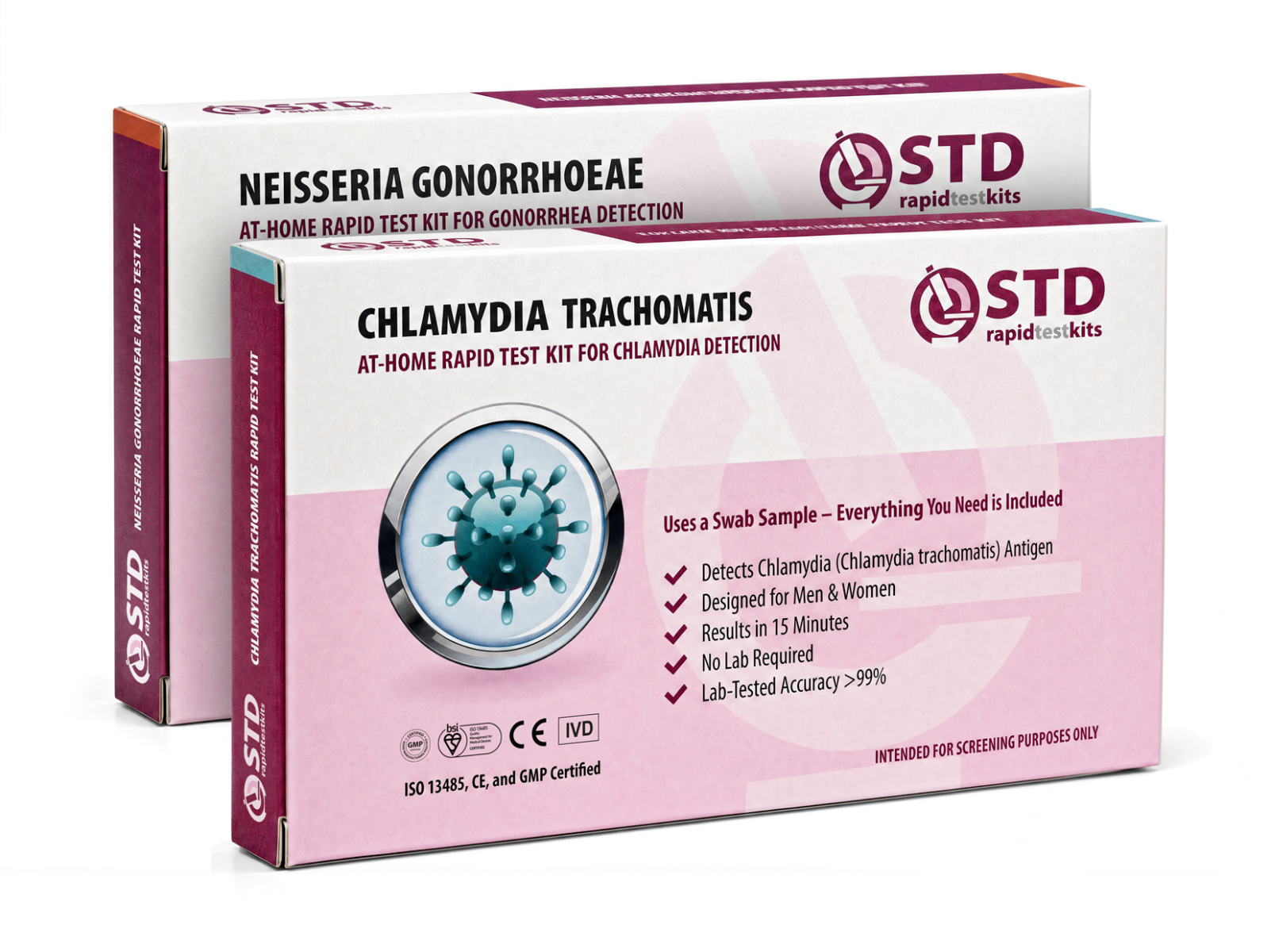
Picture a realistic timeline. You had sex twelve days ago. The first ten days were unremarkable. Tonight after intercourse you notice a deep, low ache that persists into the next morning. That timing fits the detection window for bacterial infections on a swab test, which is enough to make testing the rational next step rather than waiting another week while the exposure window closes.
When Pain Becomes a Red Flag: Early PID Signals
Pelvic inflammatory disease, or PID, is what happens when an untreated bacterial STI travels upward from the cervix into the uterus, fallopian tubes, or surrounding tissue. It does not happen overnight. The CDC's PID page is explicit that many women with PID may not realize they have it because symptoms can be mild or absent.
Early PID can feel almost identical to the normal post-sex ache this article opened with: a dull pull in the lower abdomen, mild discomfort during intercourse, and occasionally a few drops of spotting between periods. There is usually no dramatic discharge, no fever, and no headline symptom. The escalation pattern, when it happens, is the warning sign worth respecting.
The shift from “monitor at home” to “call a provider today” is not subtle. If pain becomes sharper, spreads across both sides of the lower abdomen, or arrives alongside fever, nausea, or new bleeding between periods, that is the moment to stop researching and seek in-person care. The table below summarizes the boundary most clinicians use.
Most pelvic pain after sex is not PID. The point of the table is to lower the threshold for action when the picture is changing rather than improving. The NHS PID page confirms that pelvic inflammatory disease is usually caused by a sexually transmitted infection, and that timely treatment dramatically reduces the long-term risks.
| Symptom Pattern | Monitor at Home | Seek Medical Care Promptly |
|---|---|---|
| Mild ache after sex | Yes, if it improves within 48 hours | Only if it worsens |
| Pain lasting more than 3 days | Consider a swab test at day 14 | Yes, especially with risk exposure |
| Fever above 100.4°F (38°C) | No | Yes |
| Nausea or vomiting with pelvic pain | No | Yes |
| New bleeding between periods | Testing recommended | If heavy or severe, same day |
Window Periods: Why Day Five and Day Fourteen Are Different Worlds
“Window period” is the gap between exposure and the moment a test can reliably detect infection. Test inside that window and a negative result may be a false reassurance, not because you are clear, but because bacterial levels are still climbing toward the test's detection threshold.
For chlamydia and gonorrhea, the practical window is roughly 7 to 14 days using a high-quality screening test. Lab NAAT (nucleic acid amplification testing) detects the genetic material at very low levels and is what the CDC considers the screening gold standard. At-home rapid lateral-flow tests are a different chemistry: faster and private, but with somewhat less analytical sensitivity, which is why they are most reliable at the longer end of the window. The ranges below are a practical reference for both formats.
The practical lesson is timing. A negative result on day five does not guarantee you are clear. A negative result on day fourteen carries much more weight. If your last exposure was very recent and you cannot wait, you can test now for a baseline and repeat at day 14, treating the first result as a preview rather than a verdict.
The same logic explains why some readers test, get a clean result, and then have the same pain return the next week. The test was technically accurate for that day; it just was not the right day. Losing faith in testing is the wrong response. Retesting at the right window is the right one.
| Infection | Typical Detection Window | Most Reliable Testing Time | Common Early Symptom Pattern |
|---|---|---|---|
| Chlamydia | 7 to 14 days | 14+ days after exposure | Mild pelvic ache or no symptoms |
| Gonorrhea | 5 to 14 days | 14+ days after exposure | Pelvic pain, sometimes spotting |
| Trichomoniasis | 5 to 28 days | 2 to 4 weeks | Subtle irritation, may be silent |
| Syphilis | 3 to 6 weeks | 6 weeks and beyond | Painless sore, rarely pelvic pain |
When the Pain Is Not an STI at All
Several non-infectious causes produce the exact same picture: pelvic pain after sex, no discharge, no fever. Recognizing the pattern can save you weeks of unnecessary worry once the test result is in.
Cervical bumping is the most common. The cervix sits at the lower end of the uterus, and during deep penetration it can be hit repeatedly. Some people feel this as a deep, bruised ache lasting up to 48 hours. It is mechanical, not dangerous, and lubrication, position changes, and slower pacing usually resolve it. The NHS pelvic pain overview describes deep-thrust soreness, ovulation pain, and pelvic floor tension among the common non-infectious causes of post-sex discomfort.
Mid-cycle ovulation pain, called mittelschmerz, can also coincide with sex. The ovary releases an egg around day 14 of a typical cycle, and the surrounding tissue stretches briefly. If sex happens around that time, the cramping can feel like post-sex pain even though the trigger is hormonal.
Pelvic floor tension is the third common culprit. The muscles supporting the bladder, uterus, and rectum contract during orgasm and release afterward. If you were anxious, distracted, or guarded during sex, those muscles can stay tight, producing a deep internal ache that lingers for hours. Endometriosis and ovarian cysts are less common but worth considering when pain is recurrent and pattern-based rather than tied to a specific exposure.
None of these mechanical causes rule out an STI from the same encounter. They explain why pain exists; they do not explain whether something else is also happening. If the encounter included a real exposure risk, a swab test at day 14 closes a question these mechanical explanations cannot answer on their own.
| Mechanical Cause | Distinguishing Feature | Usual Resolution |
|---|---|---|
| Cervical bumping | Deep, bruised ache after vigorous or deep penetration | Improves within 24 to 48 hours; helped by lubrication and slower pacing |
| Mid-cycle ovulation (mittelschmerz) | One-sided lower-abdominal pull around day 14 of the cycle | Resolves within a day or two as the cycle moves on |
| Pelvic floor tension | Deep internal aching after anxious or guarded sex | Eases with rest, warmth, or stretching; recurring patterns benefit from pelvic-floor physical therapy |
At-Home Testing vs. Clinic Testing
Both formats have a place. Clinic testing offers same-visit examination, NAAT-grade analytical sensitivity, and immediate prescription if a result is positive. At-home rapid testing offers privacy, control, and a much lower friction cost: no waiting room, no scheduling, no awkward intake conversation. The right choice depends on what your pain is doing and how soon you need clarity.
If your pain is mild, you have no fever, and your last exposure is at or beyond the 14-day mark, an at-home swab kit is a reasonable first step. If pain is severe, accompanied by fever, vomiting, or heavy bleeding, or if you are pregnant or have a known pelvic condition, a clinic is the safer choice. The comparison below sums up the trade-offs.
One detail worth being precise about: a positive at-home rapid result is meaningful and should be acted on, and a clinic NAAT remains the more sensitive confirmation if you want certainty before treatment. Used together, they cover both speed and rigor.
| Factor | At-Home Rapid Test | Clinic NAAT Test |
|---|---|---|
| Privacy | High; no waiting room or chart entry | Visit appears in your medical record |
| Speed of results | About 15 minutes (lateral flow) | 1 to 3 days for lab return |
| Test technology | Lateral-flow immunoassay | NAAT (gold standard for chlamydia and gonorrhea) |
| Treatment if positive | Requires follow-up to obtain prescription | Often same-day prescription on site |
| Best for | Mild symptoms, peace-of-mind screening at the right window | Severe pain, fever, or complex cases |
You may not realize you have PID because your symptoms may be mild, or you may not experience any symptoms.
The Fertility Question Beneath the Search
For many readers, the question that keeps the worry running is not really about tonight's pain. It is about a future they are quietly protecting: future fertility, future pregnancies, future relationships. The fear of having missed something is what turns a mild ache into an all-night search session.
Untreated chlamydia and gonorrhea can ascend to cause PID, and PID is associated with an increased risk of tubal scarring, ectopic pregnancy, and fertility complications. The World Health Organization's STI fact sheet identifies PID and infertility in women as major consequences of untreated gonorrhea and chlamydia. The risk grows with delay; it does not grow with testing.
That framing reverses the anxiety most people feel. Testing is the fertility-protective behavior. Avoiding the test, hoping the symptom fades on its own, is the choice that lets a treatable bacterial infection sit longer than it needs to. Most chlamydia and gonorrhea cases are fully resolved with a short antibiotic course when caught in the first weeks.
Most chlamydia and gonorrhea infections clear completely with a single short antibiotic course when caught in the first weeks. Long-term complications come from delayed diagnosis, not from the infection itself.
When to Stop Researching and Take One Step
If your pelvic pain has lasted more than three days after unprotected or condom-failed sex, testing is the next step. If you have developed fever, severe pain, vomiting, or new heavy bleeding, skip the home test and seek in-person care today.
If the pain is mild, fading, and your encounter was protected with a partner you trust, watchful waiting for 24 to 48 hours is reasonable. The signal to act is not how loud the pain is. It is whether your mind keeps returning to the same question every time you shift in bed. That circling is information too. It is your body's way of saying the uncertainty is the problem, and the uncertainty is solvable with one test at the right window.
Your next step in three lines
- Mild pain, no fever, protected sex with a trusted partner: watchful waiting for 24 to 48 hours.
- Pain lasting more than 3 days after unprotected or condom-failed sex: swab test at day 14 after exposure.
- Fever, severe pain, vomiting, or new heavy bleeding: clinic today, not tomorrow.
Frequently asked questions
- Can you really have chlamydia without any discharge at all?
- Yes. The CDC's chlamydia fact sheet is explicit that most infected women have no obvious symptoms in the early phase, and when symptoms appear, they are often mild. A persistent low pelvic ache without any visible change is one of the patterns clinicians look for.
- If it was just rough sex, would I know right away?
- Usually yes. Mechanical soreness from deep penetration tends to peak immediately and improve within a day or two. Infection-related pain often appears days after exposure, builds rather than fades, and may bring quieter companion signs like spotting or a one-sided pull.
- How do I know if this is pelvic inflammatory disease (PID)?
- PID is a clinical diagnosis, not a self-diagnosis. The pattern that warrants urgent care is escalation: pain spreading across both sides of the lower abdomen, fever above 100.4°F, nausea, or new heavy bleeding. Mild isolated soreness is common; worsening pain with systemic symptoms is the boundary.
- I tested negative on day five. Can I trust it?
- A day-five result sits squarely inside the detection window for both chlamydia and gonorrhea, so a negative there is a starting point rather than a conclusion. Run the swab again at day 14 and treat that result as the meaningful one. If your symptoms have escalated by then, see a clinic instead of repeating the home test.
- What if I feel completely fine except for the pain?
- That is a common pattern. Many early bacterial STIs do not produce discharge, odor, or burning. A vague pelvic ache may be the only signal. The body's volume on this is often low, which is why timing of exposure matters more than intensity of symptoms.
- Could anxiety be making the pain feel worse?
- It can. Stress increases pelvic floor muscle tension, and that tension amplifies post-sex discomfort. Anxiety physically contributes to the symptom but does not cancel out the need to test if you had a real exposure inside the window.
- If it is an STI, will it definitely affect my fertility?
- No. Untreated infections over time increase the risk of complications, but early detection and a short antibiotic course resolve most chlamydia and gonorrhea cases without lasting consequences. WHO and CDC both frame timely testing as the fertility-protective step.
- My partner says they are clean. Do I still need to test?
- Yes if you have symptoms or had a recent exposure. The phrase 'clean' usually means 'no symptoms I notice', not 'tested in the right window for the right infections'. Most chlamydia and gonorrhea infections are silent in their carrier, so the absence of partner symptoms is not evidence either way.
How we sourced this article: Our editorial team summarized current guidance from the U.S. Centers for Disease Control and Prevention, the World Health Organization, and the U.K. National Health Service on the symptoms, window periods, and complications of common bacterial STIs. We do not provide clinical diagnosis. For symptoms that concern you, see a licensed provider.
- U.S. Centers for Disease Control and Prevention. Chlamydia: About the infection, symptoms, and screening recommendations. Used for the asymptomatic prevalence and early-symptom claims.
- U.S. Centers for Disease Control and Prevention. Gonorrhea: Overview of symptoms in women and screening guidance. Used for the silent-symptom claim and window-period framing.
- U.S. Centers for Disease Control and Prevention. About Pelvic Inflammatory Disease. Used for the silent-PID quote and the escalation-warning thresholds.
- U.K. National Health Service. Pelvic inflammatory disease (PID): causes, symptoms, treatment, and long-term consequences. Used for the cause-and-prevention framing of late-treated infections.
- U.K. National Health Service. Pelvic pain: overview of common non-infectious causes including pelvic floor dysfunction, ovulation pain, and ovarian causes of post-sex discomfort.
- World Health Organization. Sexually transmitted infections (STIs) fact sheet: global guidance identifying PID and infertility as consequences of untreated bacterial STIs.
