
Published: October 2025 | Last updated: May 2026 | Editorial review and quality control: Martina N.
Finding out a partner has chlamydia hits in a particular way. There is the medical question (am I infected?), the practical question (what do I do now?), and the quiet relational question that often surfaces at 2 a.m. (does this mean something about us?). All three are real. None have to be answered in the same hour.
Here is the grounding fact. Chlamydia is a common bacterial sexually transmitted infection, and it is curable with a short course of antibiotics (CDC, Chlamydia Basic Information). The catch is that the infection often causes no symptoms at all, which is why what happens in the next few days matters more than how your body feels right now.
Key Takeaways
- If your partner has chlamydia, assume exposure, pause sex, plan a test for 10 to 14 days post-exposure, and have both partners treated to break the back-and-forth loop.
- Feeling fine does not mean you are clear. The CDC notes chlamydia often causes no symptoms at all, so testing, not body cues, is what tells you where you stand.
What To Do in the First Few Days
This is where clarity beats panic. If your partner tested positive, you do not need to wait for symptoms, and you do not need to overanalyze the timeline yet. You need a short, sequenced plan.
Start with these four steps, in this order:
- Assume exposure. Treat the situation as if you may have been infected, even if you feel fine.
- Pause sexual contact. This includes oral sex. Continuing exposes you both to re-passing the bacteria back and forth.
- Plan your test for the right window. Testing on day one is almost always a wasted swab. The reliable window starts around day 10 to 14.
- Talk to a clinician about presumptive treatment. When a partner has confirmed chlamydia, the CDC and many clinics will treat the other partner without waiting for their result, because waiting often means re-infection (CDC STI Treatment Guidelines).
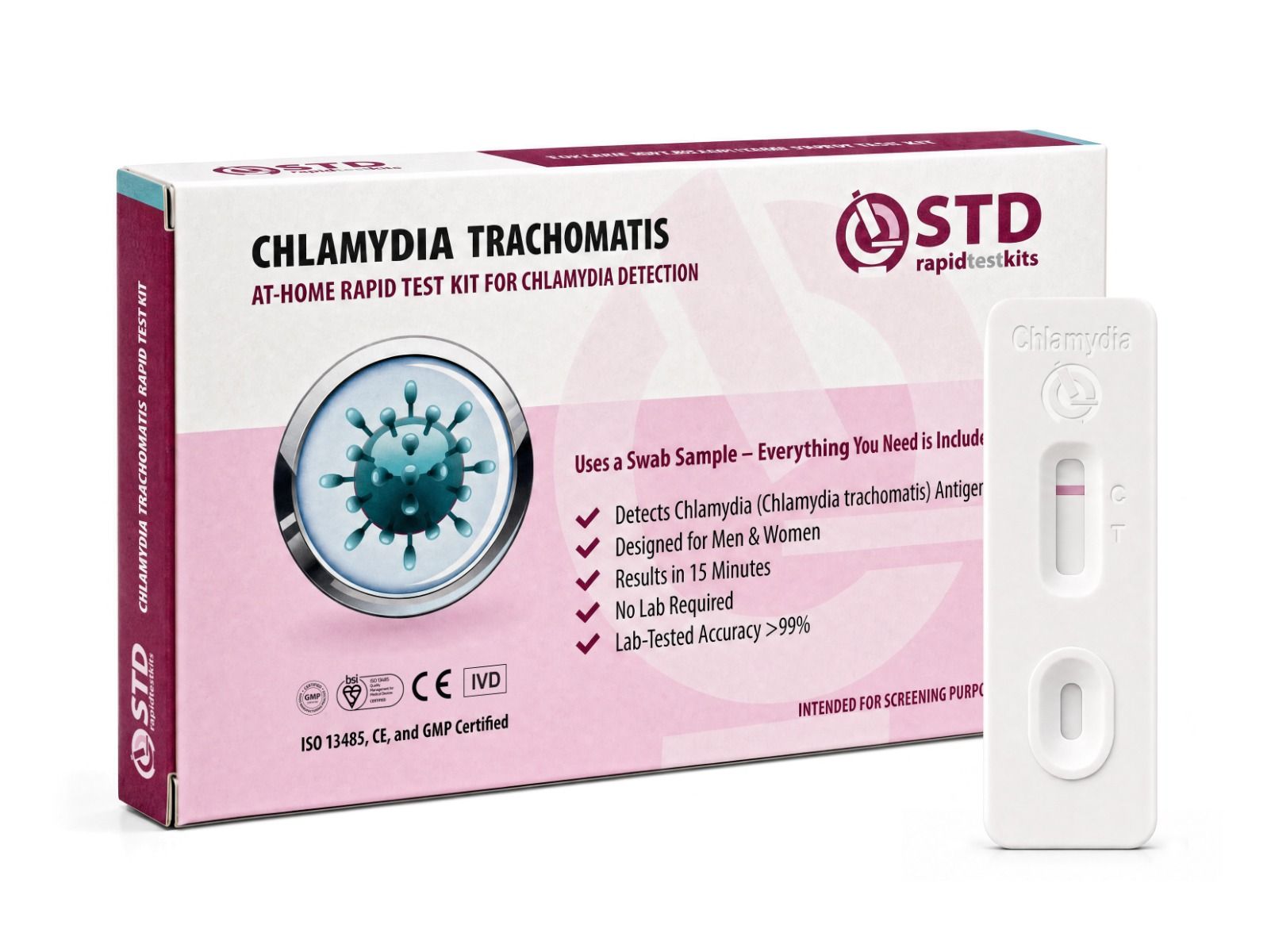
If you want privacy while you sort out the timing, a discreet at-home option like a rapid swab test lets you control when and where the sample is taken, without sitting in a waiting room replaying the conversation in your head.
Mark day 10 to 14 from your most recent exposure on a calendar, and plan to test on that date. Earlier tests during the window period can return a falsely reassuring negative. Sex (including oral) should be on pause until both partners have tested and, where prescribed, completed treatment plus the 7-day post-treatment wait.
When Should You Test? (Most People Get This Wrong)
Testing too early is the single most common mistake after a partner's diagnosis. You can have chlamydia and still get a negative result if the test is run before the bacteria reach detectable levels. That gap between exposure and reliable detection is the window period, and with chlamydia it sits at roughly 1 to 2 weeks for most lab and rapid tests.
Nucleic acid amplification tests (NAATs) are the analytical gold standard for chlamydia per CDC screening guidance. Even with NAATs, reliable detection still requires bacterial load to reach a detectable level, which typically takes 1 to 2 weeks after exposure. Here is what that looks like in practice:
| Time After Exposure | What It Means | Recommended Action |
|---|---|---|
| 1 to 3 days | Too early for reliable detection | Wait. A test now is likely to mislead, not reassure. |
| 5 to 7 days | Early detection possible but not reliable | Test only if symptoms are present, then retest later. |
| 10 to 14 days | High accuracy window for most tests | Best time to test. |
| 3 months after treatment | Reinfection screening window | Retest to confirm you are clear and have not been re-exposed. |
My partner has chlamydia. Do I have it too?
Possibly, and testing is the only way to find out. Exposure does not guarantee infection, but the chance is high enough that guessing is not a safe substitute for a test. A negative result in the first week after exposure is unreliable; wait until day 10 to 14, then test. If your partner has confirmed chlamydia, many clinics will treat you presumptively rather than waiting for your result.
Symptoms, Silence, and Why Your Body May Not Warn You
The detail that catches people off guard: most people with chlamydia have no symptoms. The CDC notes that chlamydia often causes no symptoms at all, which is part of why it spreads so widely (CDC, Chlamydia Basic Information). That does not mean nothing is happening. It means your body is not announcing it.
When symptoms do show up, they tend to look like one of the following:
- Burning or pain when urinating
- Unusual vaginal or penile discharge
- Pelvic pain in women
- Testicular discomfort or swelling in men
- Bleeding between periods or after sex
- Rectal pain, discharge, or bleeding if anal sex was the route of exposure
None of these is specific to chlamydia. Each can be caused by other infections, irritation, or unrelated conditions. The reverse is also true: feeling completely normal does not rule chlamydia out.
Most people who have chlamydia have no symptoms. If symptoms do occur, they may not appear until several weeks after sex with an infected partner.
How Chlamydia Is Treated
Treatment is the simple part of this whole story. Chlamydia is caused by the bacterium Chlamydia trachomatis, and it responds reliably to antibiotics. The CDC's current recommended first-line treatment is doxycycline 100 mg taken twice daily for 7 days. Azithromycin as a single dose is listed as an alternative in specific situations, including pregnancy (CDC STI Treatment Guidelines: Chlamydia).
Two practical points the prescription bottle does not spell out:
- Finish the course. Stopping early because you feel fine is one of the most common ways an apparent cure turns into a stubborn ongoing infection.
- Wait 7 days after finishing treatment before resuming sex, per CDC guidance. This applies even after the single-dose azithromycin option, and it includes oral sex.
That seven-day pause is not a polite suggestion. It is the gap where the antibiotic actually clears the bacteria. Skipping it is the single most common reason couples end up reinfecting each other.
Why Both Partners Need Treatment, Even the Negative One
If your partner has chlamydia, there is a meaningful chance you have been exposed. Even if your test has not come back yet, or even if it comes back negative early, you may still be inside the window period. This is where confusion piles up. People assume a negative result means they are in the clear, but if the test was taken too soon, the result is incomplete information, not an all-clear.
Treating both partners at roughly the same time is the standard public-health approach for exactly this reason. It is sometimes called expedited partner therapy when the partner is treated without a separate appointment, and the CDC recognizes it as an option in many jurisdictions to reduce reinfection (CDC STI Treatment Guidelines).
| Situation | Recommended Approach | Why It Matters |
|---|---|---|
| Partner positive, you have not tested yet | Treat both, then test you at the right window | Prevents silent spread during the window period |
| Partner positive, you tested negative within 7 days | Treat both, retest you at 10 to 14 days | An early negative is not yet conclusive |
| Both positive | Treat both, abstain for 7 days after treatment ends | Avoids the back-and-forth reinfection loop |
| Partner positive, you tested negative at day 14 or later | Discuss treatment with a clinician; many still treat preventively | Window risk is low but not zero, especially with repeated exposure |
The Reinfection Loop and How To Avoid It
One of the most frustrating patterns with chlamydia is reinfection: a couple treats it, feels fine, and a few weeks later it shows up again. The antibiotics did not fail. The timing did.
Reinfection usually happens because sex resumed before the seven-day post-treatment window ended, one partner stopped the antibiotic course early, or only one partner was treated. The CDC recommends retesting roughly 3 months after treatment specifically because reinfection is common enough to make a follow-up screen worthwhile (CDC, Chlamydia Basic Information). Reinfection is not a sign anything went wrong with the medication; it is a sign the bacteria are easy to re-acquire when both partners are not in sync.
The rule most people miss: after treatment, abstain from sex (including oral) for the full 7 days, even if symptoms cleared on day two.
Once the antibiotic course ends, both partners abstain from all sex (including oral) for a full 7 days. The medication is still finishing its work during that window. A single early resumption can restart the loop, even when both partners feel completely fine.
Does a Diagnosis Mean Someone Cheated?
This is the question that sits in the background of most chlamydia conversations, and it deserves a straight answer rather than a vague one.
The short version: not necessarily. Chlamydia can persist in the body without symptoms for many months. That means a new diagnosis can reflect an infection that pre-dated the current relationship, by either partner. The World Health Organization notes that most STIs, including chlamydia, are often asymptomatic, which contributes to missed treatment and ongoing spread worldwide (WHO, Sexually Transmitted Infections).
The timing alone also does not rule infidelity out, and that matters. The honest position is that a chlamydia diagnosis carries medical information about your body and your partner's body. It does not carry a timestamp.
Chlamydia can persist in the body without symptoms for many months, and some cases of asymptomatic infection have been documented lasting a year or more before detection. A new diagnosis may reflect an infection that pre-dated the current relationship, by either partner. Testing answers the medical question. The relational question is separate.
Feeling Fine Does Not Mean You're Clear
One of the most-searched phrasings goes something like: my partner has chlamydia but I feel fine, what now? The honest answer is that feeling fine, in this specific situation, tells you almost nothing.
Asymptomatic infection is the rule with chlamydia, not the exception. That same quiet is exactly what allows the bacteria to circulate; people who feel nothing have no body-cue prompting them to test, so the infection moves to a new partner without anyone realizing. If you are waiting on symptoms to decide what to do next, you are waiting on a signal that may never arrive.
The CDC recommends annual chlamydia screening for sexually active women under 25 and for anyone with new or multiple partners, regardless of symptoms. The recommendation exists precisely because most infections are silent, so symptom-driven testing alone misses a large share of cases.
Clinic Testing vs At-Home Testing
There are two main paths to getting tested, and neither is universally better. The right choice depends on what you need most right now.
Clinic-based testing typically uses a lab nucleic acid amplification test (NAAT), which is the analytical gold standard for chlamydia per CDC screening guidance. The advantage is high analytical sensitivity and immediate access to a prescriber if the result is positive. The trade-off is scheduling, waiting time, and, for some, the privacy cost of a face-to-face conversation.
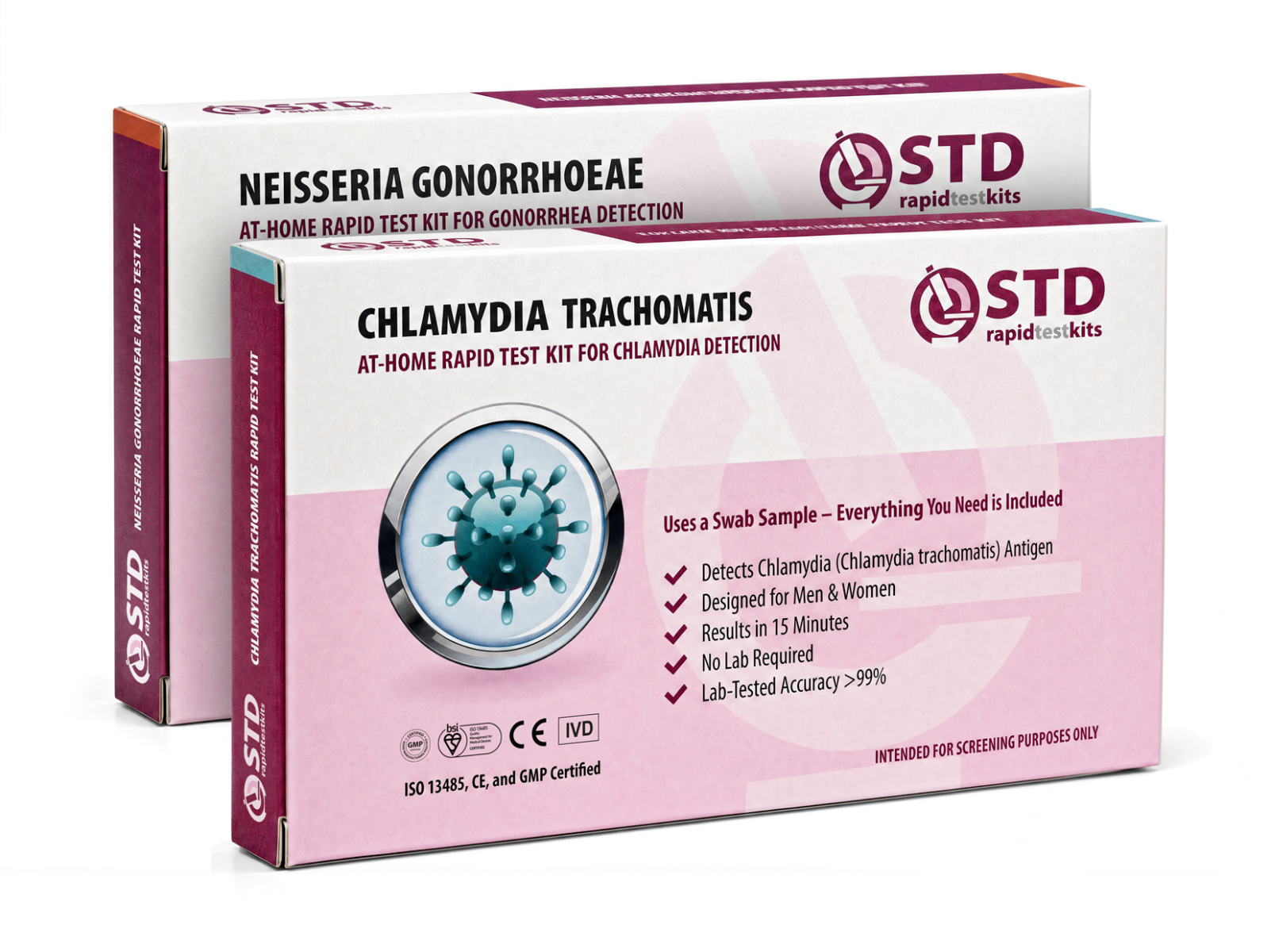
At-home rapid lateral-flow tests use the same self-collected swab sample type as many lab NAATs. They give a result in minutes rather than days. The trade-off is that lateral-flow chemistry is less analytically sensitive than lab NAATs, so a positive result is worth confirming with a clinic test when possible, and a negative result early in the window period should be repeated at day 10 to 14.

| Option | Best For | Trade-Off |
|---|---|---|
| Clinic lab NAAT | Highest analytical sensitivity, immediate prescriber access if positive | Less privacy, scheduling required, slower turnaround |
| At-home rapid lateral-flow test | Privacy, convenience, result in 15 minutes | Lower analytical sensitivity than lab NAAT; positives worth lab-confirming |
| Both, in sequence | Fast screen at home, lab confirmation if needed | Two samples instead of one |
The Window Period Problem (Why Negative Is Not Always Clear)
The window period is the gap between exposure and when a test can reliably detect the infection. During this gap, you can have chlamydia and still test negative. This is exactly why people end up searching late at night for some variant of "partner has chlamydia but I tested negative." The confusion is real, and the answer depends almost entirely on timing.
| When You Tested | Result Reliability | Next Step |
|---|---|---|
| Under 5 days post-exposure | Low | Retest at day 10 to 14 |
| 5 to 10 days | Moderate | Retest if any uncertainty, especially with a known positive partner |
| 10 to 14 days | High | Reliable result |
| 3 months post-treatment | High, for reinfection check | Standard CDC-recommended retest |
False Negatives vs False Positives: What's Actually More Likely?
People often worry about false positives. With chlamydia, false negatives are statistically the bigger concern, particularly when testing happens too soon.
False positives are uncommon because both lab NAATs and rapid lateral-flow tests are designed to detect chlamydia-specific bacterial DNA or antigens, so unrelated infections rarely cross-react. False negatives, on the other hand, can happen for several practical reasons:
- The test was taken before bacterial load was high enough to detect (the window-period issue).
- The sample was collected incorrectly or in the wrong site (vaginal swab when a rectal swab was needed, for example).
- The infection is present at a body site the test was not designed to sample. The at-home rapid tests in this catalog are validated for genital swab samples; throat and rectal infections need clinic-collected pharyngeal or rectal swabs that this product does not cover.
If your exposure may have involved oral or anal contact, talk to a clinic about adding pharyngeal or rectal swabs. Those are not products we sell, but they matter for the right answer.
Wrong timing: test taken inside the window period (under 10 to 14 days post-exposure), before bacterial load is detectable. Wrong sample site: genital swab used when the actual infection is in the throat or rectum from oral or anal exposure. Fix the first with a properly-timed retest. Fix the second by asking a clinic for the right-site swab.
When to Retest (Even If You Already Tested Once)
Retesting is one of the most important and most overlooked steps in this whole process. It is not only for people who test positive. It is for anyone who tested early, had ongoing risk, or wants confirmation after finishing treatment.
The CDC explicitly recommends a retest roughly 3 months after a chlamydia diagnosis and treatment, regardless of whether the original partner was treated, because reinfection within 12 months is common (CDC STI Treatment Guidelines).
| Scenario | Retest Timing | Reason |
|---|---|---|
| Tested early (under 7 days post-exposure) | At 10 to 14 days | Confirm accuracy when window period has cleared |
| After completing treatment | 3 months later (CDC recommendation) | Check for reinfection from any source |
| Ongoing or returning symptoms after treatment | Promptly, with a clinician | Rule out treatment failure or reinfection |
| New partner after treatment | 10 to 14 days after the new exposure | Treat the new exposure as a fresh window |
Common Mistakes That Trip People Up
Most people assume testing and treatment are foolproof. Small mistakes can shift results more than expected, especially in borderline cases. None of the items below mean you did anything wrong. They are usually the result of rushed appointments, vague online answers, or simply not being told upfront. The fix is the same in each case: slow the timing down, follow the full protocol, and confirm with a properly-timed retest.
- Testing too soon after exposure (before day 10 to 14)
- Not following sample-collection instructions exactly, particularly for self-swab tests
- Stopping antibiotics early because symptoms cleared
- Resuming sex before the 7-day post-treatment window ends
- Only one partner getting treated
- Skipping the 3-month CDC-recommended retest
- Ignoring throat or rectal exposure when only a genital swab was done
Closing the Loop: What Done Actually Looks Like
The goal here is not just to get a result. It is to reach a point where you are no longer guessing. That means four things have happened: you tested at the right time, both of you completed treatment if it was prescribed, you waited the full 7 days post-treatment before resuming sex, and you scheduled a 3-month retest to confirm no reinfection.
That is what closure looks like with chlamydia: moving past 'I took a test' to 'I know where I stand, and I have a plan if anything changes.' If you have been exposed and have not yet acted, the next single step is the testing-window calendar: count 10 to 14 days from the most recent exposure and put your test on that day.
The four-part closure checklist
- You tested at the right window (day 10 to 14 post-exposure, or per clinician).
- Both partners completed any treatment that was prescribed.
- You waited the full 7 days after the antibiotic course ended before resuming sex.
- You scheduled a retest at the 3-month mark to confirm no reinfection.
FAQs
- Do I definitely have chlamydia if my partner tested positive?
- Possibly, but not certainly. Per-contact transmission is not 100 percent. Exposure is common enough, and chlamydia is silent often enough, that testing is the only reliable way to know. Many clinics will treat you presumptively when a confirmed partner is positive, rather than waiting for your result.
- When should I get tested after exposure?
- Day 10 to 14 after the exposure. Earlier results are unreliable because bacterial load may not yet be detectable, even with an active infection. If you tested before day 7, plan a retest at the 10 to 14 day mark.
- Can chlamydia go away on its own?
- No. Untreated chlamydia can persist for months without symptoms and increases the risk of pelvic inflammatory disease, infertility, chronic pelvic pain, and ectopic pregnancy in women, and epididymitis in men, per CDC and Mayo Clinic guidance. Treatment is short and effective; waiting is not a strategy.
- How is chlamydia treated?
- Doxycycline 100 mg twice daily for 7 days is the CDC first-line choice. Single-dose azithromycin is an alternative in some situations, including pregnancy. Both partners are treated; both abstain for 7 days after the course ends.
- How long should we wait before having sex again?
- Seven full days after the antibiotic course finishes, oral sex included. Skipping the wait is the leading cause of reinfection in treated couples, because the antibiotic has not yet fully cleared the bacteria.
- If I test negative right after exposure, am I clear?
- Not necessarily. A negative test before day 10 to 14 can simply mean the bacterial load is not yet detectable. The result is incomplete information, not an all-clear. Retest at the right window, especially when a partner is confirmed positive.
- Does a positive test mean my partner cheated?
- Not necessarily. Chlamydia can persist undetected for many months, so a new diagnosis may reflect an older infection neither person knew about. The medical test does not carry a timestamp. Use the testing result for the medical question, and a direct conversation for the relational one.
- Is an at-home rapid test as reliable as a clinic lab test?
- At-home rapid lateral-flow tests use the same self-collected swab sample type as lab NAATs and are useful for screening, particularly when privacy matters. Lab NAATs have higher analytical sensitivity and are the diagnostic gold standard. A positive at-home result is worth confirming with a lab NAAT when possible; a negative result during the window period should be repeated at day 10 to 14.
- U.S. Centers for Disease Control and Prevention. Chlamydia Basic Information, including symptom frequency, transmission, complications, and screening recommendations.
- U.S. Centers for Disease Control and Prevention. Sexually Transmitted Infections Treatment Guidelines: Chlamydial Infections, including first-line doxycycline regimen, 7-day post-treatment abstinence rule, expedited partner therapy, and 3-month retest recommendation.
- UK National Health Service. Chlamydia patient information overview.
- Mayo Clinic. Chlamydia symptoms and causes overview, including long-term complications.
- World Health Organization. Sexually Transmitted Infections fact sheet, including statement that most STIs are often asymptomatic and contribute to ongoing spread.
