Published: September 2025 | Last updated: May 2026 | Editorial review and quality control: Martina N.
Burning when you pee is one of those moments where the body delivers an unmistakable message and the mind starts cycling through worst-case scenarios at the same time. The reassuring news for most women is that painful urination usually traces back to something common and treatable: a urinary tract infection, irritation from a new soap or lubricant, or a yeast infection that has crept into the picture. A smaller share of cases traces back to a sexually transmitted infection like chlamydia or gonorrhea, which is why testing genuinely matters when timing or context raises that possibility.
This guide ranks the seven most common causes of painful urination in adult women, ordered by rough likelihood. Where you fall on that list depends on a few details you can answer quickly: when symptoms started, what changed in your routine in the last few days, whether you have a new sexual partner, and whether the burn feels surface-level or pelvic-deep. Once those clues line up, the path to clarity is short.
Key Takeaways
- UTIs cause the majority of sudden painful urination in women, but chlamydia and gonorrhea can mimic the same burning sensation about one to two weeks after a new sexual partner.
- No discharge does not rule out an STD: many women with chlamydia or gonorrhea have mild or absent discharge, so testing matters even when other symptoms feel subtle.
First, What "Painful" Really Means
When women describe burning urination, they are usually pointing to one of three sensations: a sharp burn at the urethra as urine exits, a deeper achy pressure in the lower pelvis or just above the pubic bone, or a raw surface-level sting that feels like irritated skin meeting urine.
Those distinctions narrow the list faster than people expect. Deep internal pressure typically points toward bladder involvement, often a UTI. Sharp surface burning suggests urethral inflammation. Raw external stinging, especially the kind that stops once you have wiped and dried, often comes from irritated vulvar or vaginal tissue rather than the urinary tract at all. Painful urination is one symptom that can come from several different parts of the lower urinary and genital tract.
Sharp internal burn at the urethra: often urethral inflammation, classic with UTIs.
Deep ache or pressure above the pubic bone: bladder involvement, also classic with UTIs.
Raw external sting that fades after wiping and drying: usually vulvar or vaginal tissue irritation, not the urinary tract at all.
Ranked Causes of Painful Urination in Women (Most to Least Likely)
The list below reflects rough likelihood in otherwise healthy adult women. Personal risk factors shift this ranking. Recent unprotected sex with a new partner moves STDs higher on the list. A recent course of antibiotics or hormonal change moves yeast higher. A chronic pattern of UTI-like symptoms with negative cultures moves interstitial cystitis higher. Use the table as a starting point, then read the section that fits your timeline.
| Rank | Condition | Typical Clues | How Quickly Symptoms Start | Testing Needed? |
|---|---|---|---|---|
| 1 | Urinary Tract Infection (UTI) | Burning, urgency, frequent urination, cloudy urine | 1 to 3 days after bacteria enter urethra | Yes, urine test |
| 2 | Vaginal Irritation or Chemical Sensitivity | External stinging, recent new soap, lube, or tight clothing | Within hours to 48 hours | Usually no |
| 3 | Chlamydia | Mild burning, sometimes no discharge, recent new partner | 7 to 14 days after exposure | Yes, STD test |
| 4 | Gonorrhea | Burning, possible discharge, pelvic discomfort | 5 to 14 days after exposure | Yes, STD test |
| 5 | Yeast Infection | Itching, thick discharge, external irritation | Variable, often after antibiotics | Sometimes |
| 6 | Genital Herpes | Severe burning, sores, pain even between bathroom visits | 2 to 12 days after exposure | Yes, lesion swab or blood test |
| 7 | Interstitial Cystitis | Chronic bladder pain, repeatedly negative UTI tests | Ongoing pattern | Diagnosis of exclusion |
#1 Most Likely: Urinary Tract Infection
UTIs are the heavyweight cause of painful urination in women. The female urethra is shorter than the male urethra, so bacteria from the rectal area have less distance to travel into the bladder. That anatomical reality is why UTIs are far more common in women than in men, and why a small triggering event (sex, dehydration, a wiping pattern) can lead to a full-blown infection within a couple of days. The classic picture is sudden burning paired with urgency: that feeling of needing to go again right after you went, even though almost nothing comes out.
A common pattern looks like this. A 26-year-old has sex Saturday night; by Tuesday morning she is in the bathroom every twenty minutes, with a deep ache above the pubic bone building from a faint sting that started the afternoon before. That timeline fits a UTI almost perfectly.
Sex is a frequent trigger because of friction and proximity, not because anything went wrong. Hydration, peeing after sex, and front-to-back wiping reduce risk but do not eliminate it. If symptoms are primarily internal, escalate quickly, and bring frequency or cloudy urine, UTI sits firmly at the top of the list. A urine culture from a clinic or telehealth visit confirms it, and most uncomplicated UTIs respond to a short course of antibiotics within a few days.
Urgency: a constant feeling of needing to go, even right after you went.
Frequency: small amounts of urine, many trips per hour.
Cloudy or strong-smelling urine: a sign the bladder is fighting bacteria.
#2 Very Common: Irritation, Friction, or Chemical Sensitivity
Vulvar tissue is delicate and reacts quickly to anything new in the routine: a scented body wash, a fragranced laundry detergent, a different lubricant, a latex condom in someone with mild sensitivity, or a long workout in tight synthetic leggings. The burn shows up the same way most of the time. It feels external. It stings when urine flows over inflamed skin. There is usually no urgency, no deep pelvic ache, and no discharge.
A typical example: someone switches to a fragranced bubble bath over the weekend, and by Monday she feels sharp surface stinging when she pees. She stops the product, drinks more water, and the discomfort fades within forty-eight hours. Vulval irritation from scented soaps, deodorants, fragranced laundry detergents, lubricants, or douches is well-recognized in patient education materials as a non-infectious cause of urinary stinging that resolves once the trigger is removed.
If symptoms appear quickly after a product change and stay localized to the vulvar area, irritation climbs high on the ranking list. Plain-water washing, breathable underwear, and avoiding the suspected trigger usually resolve symptoms in a day or two without further treatment.
Topical products: fragranced soaps, bubble baths, douches, scented feminine wipes, fragranced laundry detergents.
Sexual-activity products: a new lubricant (especially flavored or warming varieties), spermicide, or latex condoms in someone with mild latex sensitivity.
Clothing and friction: tight synthetic leggings worn during a sweaty workout, prolonged time in damp swimwear, or new underwear fabric.
#3 and #4: When It Might Be Chlamydia or Gonorrhea Instead
This is where anxiety tends to spike and where clarity matters most. Chlamydia and gonorrhea can both cause painful urination in women, and both can mimic UTIs in the early days. The CDC notes that chlamydia often has no symptoms, and when symptoms occur in women they can include burning urination and abnormal discharge (CDC, chlamydia fact sheet). Those signs overlap with UTI symptoms closely enough that many women never seek STD testing and assume the cause is a urinary tract infection. Gonorrhea behaves similarly: a CDC fact sheet describes burning urination and abnormal discharge as common signs in women, but stresses that many infections produce no obvious signs at all (CDC, gonorrhea fact sheet).
Two practical clues help separate these from a UTI. The first is timing. UTIs typically begin within one to three days of a trigger like sex, dehydration, or a wiping pattern that introduced bacteria. Gonorrhea symptoms can appear as early as five days after exposure to a new partner. Chlamydia more commonly takes seven to fourteen days, sometimes longer. The second clue is symptom intensity. UTI burning tends to be sharp and accompanied by frequency. STD-related burning is often milder, with a vague pelvic heaviness and not much urgency.
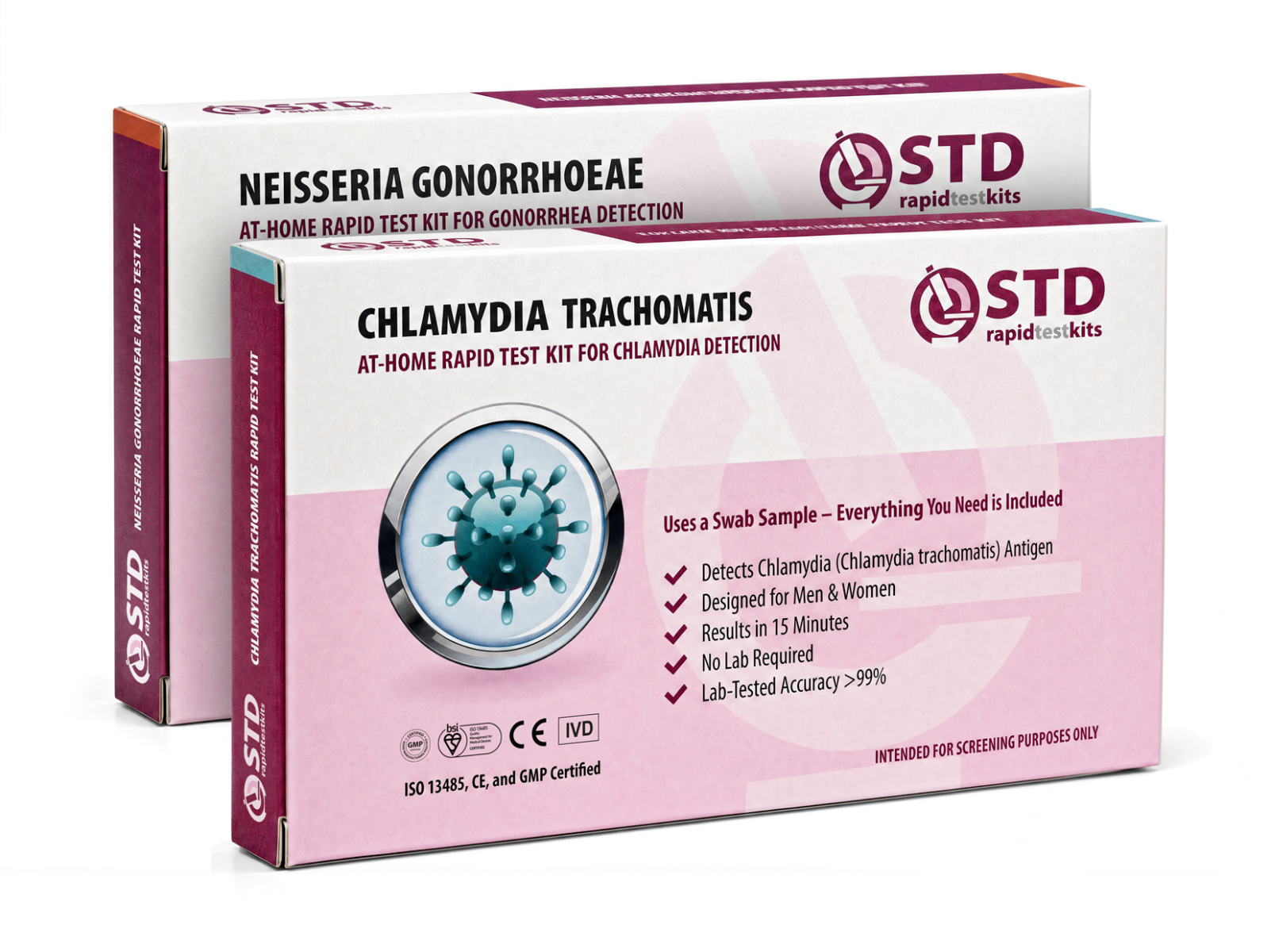
Discharge is an unreliable tiebreaker. Many women with chlamydia or gonorrhea have no obvious discharge at all. The table below shows what clinicians actually weigh when sorting which is which, and the guesswork that a swab-based rapid test removes when symptoms followed a new partner. (One note on commercial context: this article is published by stdrapidtestkits.com, which sells the at-home STI kits linked below; product recommendations are matched to the reader's concern.)
| Feature | UTI | Chlamydia or Gonorrhea |
|---|---|---|
| Onset | 1 to 3 days after trigger | 5 to 14 days after exposure |
| Urgency and frequency | Common | Less common |
| Discharge | Uncommon | Possible, often absent |
| Pelvic pain | Mild bladder pressure | May radiate deeper |
| Risk factor | Sex, dehydration, wiping pattern | New or unprotected sexual partner |
| Requires STD test? | No | Yes |
#5 Yeast Infections: The Itch That Burns
Yeast infections do not technically infect the urinary tract, but they routinely make urination painful. The reason is proximity. When vaginal tissue is inflamed and swollen, urine passing over it stings intensely. The pain is unmistakably external, almost always paired with itching that does not let up, and often comes with a thick white discharge sometimes compared to cottage cheese.
The common backstory is a course of antibiotics for something unrelated, like strep throat or a sinus infection. Antibiotics disrupt the vaginal microbiome and let candida overgrow. Hormonal shifts around the menstrual cycle, pregnancy, or new birth control can do the same. Over-the-counter antifungals work for many women. Persistent or recurrent cases warrant a clinician visit to confirm yeast and rule out other causes that itch the same way.
Yeast moves to the top of the list when burning shows up alongside intense itching, a thick white discharge, and a recent course of antibiotics for an unrelated infection. Hormonal shifts (pregnancy, new birth control, menstrual cycle changes) can trigger the same pattern.
#6 Genital Herpes: When the Pain Is Sharp and Unmistakable
Genital herpes ranks lower in overall probability for painful urination, but when it is the cause, it is rarely subtle. The NHS describes a typical first outbreak as small blisters that burst to leave open red sores around the genitals, anus, thighs, or bottom (NHS, genital herpes). The urine itself does not cause the pain. The sores do, when urine touches them on the way out, which is why women with sores near the urethral opening often describe urination as the sharpest moment of the day.
Women often describe this pain as electric or raw. It can hurt while sitting, while walking, and in between bathroom visits, not only when urinating. A first episode may also bring swollen lymph nodes, body aches, or a low fever, and tingling or itching at the site sometimes precedes the visible blisters by a day or two.
The diagnostic question here is whether visible or felt sores are part of the picture. If urination burns but the skin looks and feels normal, herpes moves down the probability list. If sores are present, swabbing the lesion as early as possible gives the most reliable diagnosis. Blood antibody tests have a role in specific situations but are limited for first-episode cases because antibodies take weeks to develop.
Telling herpes apart from a UTI
- Herpes pain often hurts even between bathroom visits, not only during urination.
- Visible blisters or sores, or a tingling or itching sensation at the site, usually accompany the burning.
- A first outbreak may bring swollen lymph nodes, body aches, or a low fever, none of which are typical of a routine UTI.
#7 Interstitial Cystitis and Chronic Bladder Conditions
Interstitial cystitis is a chronic bladder pain condition that can mimic a UTI without infection. Women with this condition often describe a familiar phrase to clinicians: it feels like a UTI, but the urine cultures keep coming back negative. The pain tends to be ongoing rather than acute, may worsen with certain foods (citrus, caffeine, carbonated drinks, spicy food), and often comes with pelvic floor tension layered in.
Interstitial cystitis is a diagnosis of exclusion, meaning it gets considered after multiple negative cultures and after the more common causes have been ruled out. If your painful urination has been a recurring story for months and tests keep coming back clear, asking a urologist or urogynecologist about interstitial cystitis is a reasonable next step.
Repeatedly negative urine cultures despite UTI-like symptoms over weeks or months.
Flares track with food and stress (citrus, caffeine, carbonated drinks, spicy food, high-stress periods) more than with sexual activity or new products.
Pelvic-floor tension often coexists, and pelvic-floor physical therapy is part of standard treatment.
Timing Is Everything: When Symptoms Start Tells a Story
If there is one detail that consistently narrows the cause of painful urination, it is timing. When did symptoms begin relative to sex, a new product, recent antibiotics, or dehydration? Infections have incubation periods. Irritation happens faster. The table below maps trigger events to typical onset windows and the most likely cause that fits each.

| Trigger event | Typical onset of burning | Most likely cause |
|---|---|---|
| Sex within last 24 to 72 hours | 1 to 3 days | UTI |
| New sexual partner 5 to 14 days ago | 5 to 14 days | Gonorrhea or chlamydia |
| New soap, lube, or detergent | Within hours to 2 days | Chemical irritation |
| Antibiotics completed recently | Several days later | Yeast infection |
| Recurring negative UTI tests | Chronic pattern | Interstitial cystitis |
How Testing Works, and Why the Window Period Matters
One of the most common testing mistakes is checking too early after exposure and reading a negative result as final reassurance. Every infection has a window period: the time between exposure and when a test can reliably detect it. The CDC notes that chlamydia and gonorrhea generally become detectable within one to two weeks after exposure, which is why testing on day three after a new partner can give false reassurance even when an infection is present.
UTI testing works differently. A urine culture detects bacteria as soon as the infection is causing symptoms, so urgent care or telehealth same-day testing is reliable for that question. The window-period concept matters most for STDs.
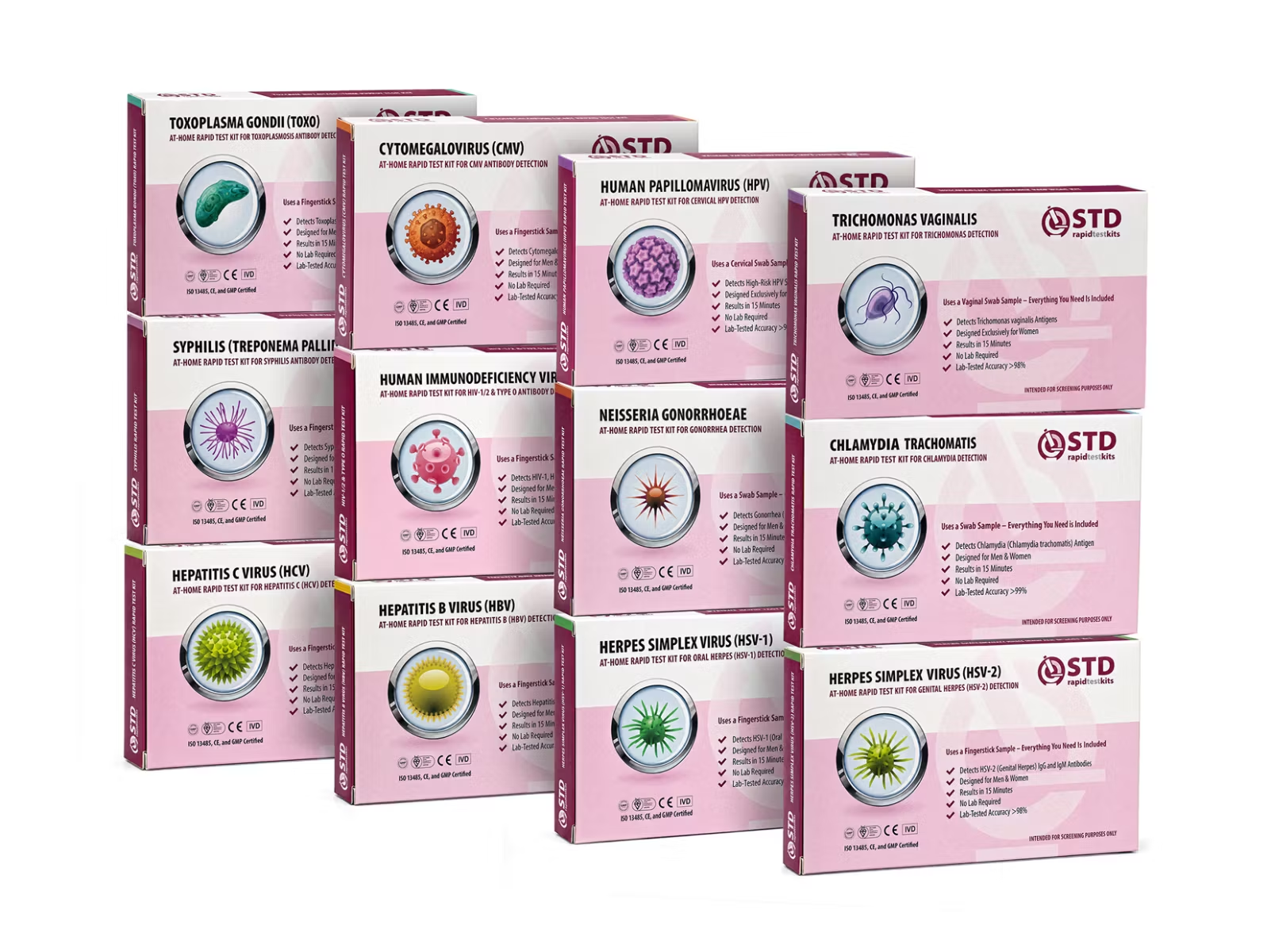
For women weighing whether to test at home, two reasonable paths exist. The first is targeted: when the most plausible cause based on timing and symptoms is chlamydia or gonorrhea, a swab-based rapid test screens those two specifically. The second is broader: when exposure history is uncertain or several STIs could be in play, a multi-infection panel covers more ground in one private session. Lateral-flow rapid tests are designed for screening, and a positive result is always worth confirming with a laboratory nucleic acid amplification test (NAAT) and a clinician who can prescribe treatment.
Chlamydia often has no symptoms [...] If symptoms occur, they may not appear until several weeks after having sex with a partner who has chlamydia. Even when chlamydia has no symptoms, it can damage a woman's reproductive system.
Red Flags You Should Not Ignore
Most causes of painful urination are mild and fixable, but some signs change the calculus. Severe back pain combined with fever can indicate a kidney infection, which needs prompt antibiotic treatment to prevent more serious complications. Intense pelvic pain that does not ease may signal pelvic inflammatory disease, especially if linked to untreated chlamydia or gonorrhea. The CDC notes that untreated chlamydia and gonorrhea can ascend into the upper reproductive tract and cause long-term fertility complications, which is part of why early testing matters even when initial symptoms are mild.
If urination pain is accompanied by nausea, shaking chills, visible blood in urine, or pain that wakes you at night, the right move is same-day medical care rather than waiting. Most cases will not escalate this way. When they do, acting quickly protects long-term health.
Same-day care signals
- Fever, especially with shaking chills, alongside urination pain.
- Severe back pain near the lower ribs (a signal for possible kidney infection).
- Intense pelvic pain that does not ease (a signal for possible pelvic inflammatory disease).
- Visible blood in your urine, nausea, or vomiting.
- Pain bad enough to wake you at night or prevent you from sitting comfortably.
Why Discharge Alone Does Not Tell the Story
One of the more dangerous myths in this space is that an STD always shows up as obvious discharge. It does not. Many women with chlamydia or gonorrhea have mild or absent discharge, so burning may be the only signal the body sends. A UTI can occur without any discharge. Yeast can produce a thick discharge but does not always bring deep bladder pressure the way a UTI does.
The takeaway: symptoms overlap, and visible signs alone are an unreliable filter. Guessing based on what you can see often delays the answer.
Absence of discharge does not rule out chlamydia or gonorrhea. The CDC notes that chlamydia frequently produces no symptoms at all in women, and gonorrhea is similar. If timing fits a recent new partner (5 to 14 days ago) and burning is present, testing is the right move regardless of whether discharge is part of the picture.
Putting It Together: A Practical Decision Path
Here is the short version that fits most situations. If symptoms began within a few days of sex and include urgency and frequency, start with a UTI test. If symptoms began five to fourteen days after a new sexual partner and feel more subtle or pelvic, add STD testing. If itching dominates the experience and a thick white discharge is present, yeast is high on the list. If there are visible sores or pain that hurts even between bathroom visits, ask about herpes testing.
If nothing fits neatly, that is genuinely fine. Medicine often runs on pattern recognition rather than perfection, and testing narrows the field quickly when the pattern is unclear. Two practical triggers for ordering a test rather than waiting are symptoms that fail to improve within 48 hours, and symptoms that follow a recent new sexual partner.
Decision-path cheat sheet
- Symptoms within 1 to 3 days of sex with urgency and frequency: start with a UTI test.
- Symptoms 5 to 14 days after a new partner, milder and more pelvic: add chlamydia and gonorrhea testing.
- Itching plus thick white discharge, especially after antibiotics: yeast is high on the list.
- Visible sores or pain that hurts even between bathroom visits: ask about herpes testing.
- Repeated negative UTI cultures over months: ask a urologist about interstitial cystitis.
FAQs
- Can dehydration alone make it burn when I pee?
- Yes. Concentrated urine can irritate the urethra on the way out, especially if you have not been drinking enough water that day. The discomfort tends to be mild and fades within a day once you rehydrate. If burning persists or worsens despite drinking plenty of fluids, the cause is likely something else and worth investigating with a clinician or a home test.
- If I do not have any discharge, does that rule out an STD?
- No. Many women with chlamydia or gonorrhea have either no discharge or discharge so subtle it goes unnoticed. Burning alone can be the only sign. The CDC explicitly warns that visible discharge is an unreliable filter for whether to test. If you have had unprotected sex with a new partner in the past two weeks and you are now experiencing burning, testing is the safest move regardless of what you can see.
- How can I tell if it is a UTI or an STD?
- If symptoms began within 72 hours of sex, UTI is the far more likely cause. If they started 5 to 14 days after a new partner, test for chlamydia and gonorrhea. When the timeline sits between those two windows, testing for both is the cleanest path: a targeted home swab kit covers the question in about 15 minutes.
- What if my UTI test came back negative but it still hurts?
- A negative UTI test rules out one common cause but not all of them. Other things to consider are vulvar irritation from a recent product change, an early STD that has not been tested for, a yeast infection, or in chronic cases interstitial cystitis. Persistent burning with negative cultures deserves a follow-up with a clinician rather than frustration. Tracking when symptoms appear and what came before helps narrow the cause faster.
- Is some burning after sex normal?
- Mild surface irritation can happen after vigorous sex, particularly without enough lubrication, and usually resolves within twenty-four to forty-eight hours. If burning intensifies, brings urgency, lingers beyond a couple of days, or shows up after a new partner, that crosses out of routine friction and into territory worth testing. A quick check rules out anything more serious in the timeframe when treatment is easiest.
- When should I skip waiting and seek same-day care?
- Fever, back pain near the ribs, nausea, shaking chills, or visible blood in your urine all suggest a possible kidney infection or another serious complication. Severe pelvic pain that does not ease can signal pelvic inflammatory disease. None of these are situations to power through. Most painful urination cases never escalate this way, but knowing the line matters and acting quickly protects long-term reproductive and kidney health.
- Do I really need STD testing if I am in a long-term relationship?
- If both partners are exclusively monogamous and have tested clean since becoming exclusive, the routine answer is no. New partners, open dynamics, or any uncertainty change the calculation. Testing is not an accusation. It is the same kind of routine maintenance as a Pap smear or annual physical, and many infections (including chlamydia and HPV) are asymptomatic for long stretches even between exposed partners.
- Can I test discreetly without going to a clinic?
- Yes. At-home rapid test kits exist for individual infections like chlamydia and gonorrhea, as well as multi-infection panels that screen for several at once. They use self-collected vaginal swabs or fingerstick blood depending on the infection. Lateral-flow rapid tests give a result in about fifteen minutes. A positive result is always worth confirming with a laboratory follow-up, and a clinician can prescribe treatment quickly once a diagnosis is in hand.
How we sourced this article: This guide was built from current public-health and clinical guidance from the U.S. Centers for Disease Control and Prevention, the U.K. National Health Service, and the World Health Organization. We summarize their patient-facing content into plain-English explanations that match the situations women actually describe. We do not provide clinical diagnosis. Symptoms that worry you deserve a conversation with a licensed clinician.
- U.S. Centers for Disease Control and Prevention. Chlamydia basic fact sheet covering symptoms, asymptomatic infection, and recommended testing in women.
- U.S. Centers for Disease Control and Prevention. Gonorrhea basic fact sheet covering symptoms in women, including burning urination and testing windows.
- U.S. Centers for Disease Control and Prevention. Genital herpes fact sheet for the general public.
- U.K. National Health Service. Genital herpes overview including first-outbreak symptoms, sores around the genitals, anus, thighs or bottom, and the role of testing.
- U.K. National Health Service. Urinary tract infections overview covering symptoms, common triggers, and when to seek care.
- World Health Organization. Sexually transmitted infections fact sheet covering global STI burden, asymptomatic infection, and screening guidance.
