
Published: August 2025 | Last updated: April 2026 | Editorial review and quality control: Martina N.
You wake up, walk to the bathroom, and that sharp sting catches you off guard. No discharge. No visible rash. Just a burn that was not there yesterday. Within ten minutes you are scrolling through search results, cycling through every possibility from a urinary tract infection to something you might have caught from a hookup last weekend.
That spiral is normal, and it settles fast once you have a real framework. Painful urination in men, called dysuria in clinical notes, almost always traces to one of about seven causes. Some are common and harmless once treated. A few are urgent. The rest of this guide ranks them by how likely each one is, walks through what tells them apart, and explains when an at-home test answers the question without a clinic visit.
What causes painful urination in men, and when should I worry?
Painful urination in men is most often caused by a urinary tract infection, a sexually transmitted infection such as chlamydia or gonorrhea, non-infectious urethral irritation, or prostatitis. Less common causes include kidney stones and genital herpes lesions. Timing, discharge, urinary frequency, fever, and recent sexual exposure narrow the field. If burning lasts more than 48 hours, comes with discharge, or follows unprotected sex in the last two weeks, get tested.
Key Takeaways
- UTIs and chlamydia are the two most common reasons men experience burning urination, and they can feel almost identical at first.
- If burning persists past 48 hours or follows unprotected sex within the last two weeks, an at-home swab test can rule infection in or out without a clinic visit.
This is not just irritation: why burning when you pee deserves attention
Painful urination is not random. It almost always has a physical explanation. In men, the urethra runs the entire length of the penis, so any inflammation along that pathway can create discomfort. The trigger could be bacteria, a virus, a stone moving through, friction trauma, or prostate swelling. The key is not to guess; the key is to narrow the field logically by matching what you feel against the known patterns.
One useful reframe before reading on: even mild symptoms are still symptoms. Bacterial STIs in particular often whisper rather than shout. A faint, persistent sting is a more common chlamydia presentation than dramatic discharge.
If the burn lasts more than 48 hours, follows unprotected sex within the last two weeks, or comes with any discharge, treat it as a signal worth testing rather than waiting out. Mild infections still spread to partners, and untreated bacterial STIs can quietly inflame deeper structures.
The ranked list: causes of painful urination in men
Not every burn is created equal. Statistically, the top half of the list below covers the majority of cases that show up in primary care and sexual-health clinics. Knowing where each cause sits helps you focus your next step instead of running through every worst-case scenario.
| Rank | Cause | How common | Typical clues |
|---|---|---|---|
| 1 | Urinary tract infection (UTI) | Common | Burning, frequent urination, urgency, cloudy urine |
| 2 | Chlamydia | Very common (STI) | Mild burning, possible thin discharge, often subtle |
| 3 | Gonorrhea | Common (STI) | Sharper burn plus thicker white, yellow, or green discharge |
| 4 | Non-infectious urethritis | Common | Burning without discharge after irritation or friction |
| 5 | Prostatitis | Moderate | Pelvic ache, weak stream, painful ejaculation |
| 6 | Kidney stones | Less common | Severe flank or side pain, blood in urine, sudden onset |
| 7 | Genital herpes lesions | Less common | External burn when urine touches a visible sore |
1. Urinary tract infection: the most overlooked male diagnosis
UTIs are usually framed as a women's issue, but men get them too, and when they do the symptoms are hard to miss. The burn is usually sharp and constant, and it often comes with the feeling that you need to pee again ten minutes after you just went.
A common description sounds like this: "It felt like I had to go every ten minutes, but barely anything came out." That urgency, paired with burning and sometimes cloudy or strong-smelling urine, points toward a UTI. Per the NHS guidance on urinary tract infections, that combination of frequency, urgency, and dysuria is the giveaway.
In men, UTIs sometimes link to incomplete bladder emptying, mild prostate enlargement, dehydration, or bacterial spread from the gut. They are not automatically sexually transmitted, and they do require antibiotics once confirmed since they rarely clear on their own. The key differentiator is volume: if you are running to the bathroom constantly with little urine actually coming out, the pattern fits a UTI more cleanly than an STI.
The pattern that most reliably points at a UTI rather than an STI in men is the combination of three signs together: frequency (running to pee every 10 to 20 minutes), urgency (the feeling that you need to go right now even if you just went), and burning during the stream itself. Cloudy or strong-smelling urine adds a fourth confirming sign. If you have all three, a urine dipstick at a walk-in clinic or pharmacy will usually confirm it the same day.
2. Chlamydia: the quiet burner
If there is one infection that loves subtlety, it is chlamydia. Many men feel only a slight burning sensation, with no dramatic discharge, no fever, and no obvious swelling. Just a persistent irritation that does not fully go away.
Picture this: a hookup two weeks ago. Protection was not perfect. Everything seemed fine afterward. Then one morning there is a mild sting when you pee, you brush it off, and a few days later it is still there. That slow-building discomfort is classic for chlamydia. The CDC chlamydia fact sheet notes that chlamydia often produces no symptoms at all; when men do experience something, it tends to be mild urethral irritation rather than dramatic discharge or fever.
Discharge, if present, can be clear and minimal. But untreated infections can move upward into the epididymis and cause painful inflammation that takes longer to resolve, occasionally with fertility implications down the line.
A urethral swab or urine NAAT becomes reliable from about 14 days after the exposure event. Earlier than that, false negatives are common because the bacterial load has not yet reached detectable levels. If you tested at day 5 and it came back negative but the burn persists, retest at day 14 rather than assuming you are clear.
3. Gonorrhea: louder, faster, harder to ignore
Unlike chlamydia, gonorrhea usually makes a stronger entrance. The burn feels sharper and more immediate, and it is often paired with a thicker discharge that is white, yellow, or green. Many men describe noticing something in their underwear within a day or two of the burn starting.
According to the CDC gonorrhea fact sheet, men with gonorrhea typically notice a burning sensation when urinating along with a noticeable urethral discharge. Some men also develop testicular discomfort or swelling, which can signal that the infection has spread to the epididymis. Treatment-resistant gonorrhea strains are an increasing clinical concern, which is one reason prompt lab confirmation and a prescribed antibiotic regimen matter for this infection rather than home guesswork.
Gonorrhea quick facts for men
- Burning urination plus a thicker white, yellow, or green discharge is the classic presentation in men.
- Testicular pain or swelling alongside the burn can indicate epididymitis and warrants same-day care.
- A clinic-confirmed positive needs a specific antibiotic regimen because of growing resistance to older drugs.
- An at-home swab can screen, but a positive result should be confirmed with a lab NAAT before treatment.
4. Non-infectious urethritis: inflammation without the label
Not every inflamed urethra is tied to an STI. Non-specific urethritis can come from chemical exposure, friction, or minor trauma. Common triggers include a new body wash or harsh soap, a long cycling session, friction from aggressive or unusually prolonged sex, and simple dehydration. Any of these can irritate the urethra without introducing infection.
Context matters here. Did the pain start right after switching soaps? Did it begin after a long bike ride? Sometimes the answer is not infection at all, just irritation. The burn often feels surface-level and improves within a couple of days once the trigger is removed. There is usually no fever, no discharge, and no other systemic symptoms. If pain lasts longer than a few days, though, get tested anyway, since a quiet chlamydia can wear the same surface symptoms.
Before assuming infection, run through this list of recent changes. New body wash, soap, laundry detergent, or fragranced bath product. A long cycling, horseback, or motorcycle session in the past 24 to 48 hours. Sex that was longer than usual, with low lubrication, or with a new condom material or spermicide. Heavy caffeine or alcohol intake combined with low water intake. If any of these line up with the timing of your symptoms and there has been no recent unprotected sex, removing the trigger and hydrating for 48 hours is reasonable before testing.
5. Prostatitis: the deep ache behind the burn
Prostatitis feels different. The pain is not just at the tip. It is deeper. Sometimes a dull ache behind the scrotum. Sometimes pressure in the lower pelvis. Urination may burn, but it may also feel weak or hesitant.
Men often describe it as something just feeling off in the lower pelvis. You may notice discomfort when sitting for long periods. Painful ejaculation can also occur. In acute bacterial prostatitis, fever and chills may show up too, and that combination needs same-day medical attention. Prostatitis can follow an infection, but it can also arise without a clear bacterial cause. It is more common in men under 50 than many people realize, and unlike a simple UTI, it usually requires longer treatment and a clinical exam. (Disclosure: this site sells rapid at-home STI test kits, and the product links throughout this article point to our own catalog. We recommend the kit that fits your symptom pattern and recent exposure history, not the most expensive option.)
6. Kidney stones: when pain explodes
Kidney stones rarely whisper. They shout. The pain usually begins in the flank or lower back and radiates toward the groin. It can be severe enough to stop you mid-sentence. Burning urination shows up once the stone moves lower into the urinary tract.
There may be visible blood in the urine, with nausea and restlessness often accompanying the pain. The intensity often comes in waves rather than holding steady. This is not subtle irritation. If painful urination is accompanied by severe side pain or visible blood, urgent medical care is appropriate; small stones can pass on their own, but the process is rarely something you want to manage without imaging and pain control.
Severe one-sided flank or back pain that comes in waves, vomiting, fever above 38C / 100.4F, or visible blood clots in the urine. Any of these alongside burning urination warrants same-day medical care, not at-home testing. Imaging (CT or ultrasound) is the only way to confirm a stone and judge whether it can pass on its own.
7. Genital herpes lesions: when the burn is external
Most of the causes above produce an internal burn during the urine stream. Genital herpes feels different. If the burn happens when urine hits the outside of your genitals, look for sores, blisters, or raw skin. Urine touching a herpes lesion feels like salt hitting a cut, immediate and sharp.
This is less common than the bacterial causes higher on the list, but it is worth knowing the pattern. External burn plus a visible sore plus tingling or itching beforehand is the classic combination. Antiviral medication shortens outbreak duration and reduces transmission risk to partners.
Internal burn during the urine stream itself usually points to UTI, chlamydia, gonorrhea, prostatitis, or non-infectious urethritis. External burn that happens when urine touches the skin or glans suggests a surface lesion (herpes, an abrasion, or a chemical irritant). The location of the sting alone narrows the cause more than most men realize.
UTI or STI? The pattern recognition table
When anxiety is high, clarity helps. Instead of guessing, compare symptom clusters across causes. Patterns tell stories that single symptoms cannot.
| Symptom | UTI | Chlamydia | Gonorrhea | Prostatitis | Kidney stones |
|---|---|---|---|---|---|
| Burning with urination | Yes | Mild to moderate | Moderate to severe | Yes | Sometimes |
| Frequent urge to urinate | Common | Occasional | Occasional | Common | Rare |
| Discharge | No | Possible (clear, thin) | Common (thick, colored) | No | No |
| Pelvic or deep ache | Rare | No | No | Common | No |
| Severe flank or back pain | No | No | No | No | Common |
| Recent unprotected sex | Not required | Strong risk factor | Strong risk factor | Variable | Not relevant |
When painful urination is a red flag, and when you can wait 24 hours
Most causes are manageable. A few are urgent. The triage rule is straightforward: certain symptom combinations earn same-day medical care, while milder presentations can be observed for a day before testing.
High fever, shaking chills, severe flank or back pain, vomiting, or visible blood in the urine in larger than streak amounts. These can indicate a kidney infection, an obstructing stone, or a more advanced infection that has moved beyond the bladder. They are not wait-and-see symptoms.
Also seek care promptly if you have testicular pain or swelling alongside burning urination, which can signal epididymitis from an untreated STI.
Testing: lab standards versus at-home rapid kits
If sexual exposure is part of the timeline, STI testing belongs on the list. The clinical gold standard for chlamydia and gonorrhea is a urine NAAT (nucleic acid amplification test) processed in a lab. Per the CDC STI treatment guidelines, NAAT is the recommended laboratory testing method for chlamydia and gonorrhea in symptomatic men.
At-home rapid tests use different chemistry. They are lateral-flow immunoassays that read a self-collected swab and return a screening result in around 15 minutes. They are practical when a clinic visit feels like a barrier, and they are most reliable from about two weeks after the suspected exposure. They are screening tools, not lab replacements: a positive result is worth confirming with a lab NAAT before starting treatment, and a negative result with persistent symptoms warrants a retest or a clinic workup.
| Suspected cause | Lab test | At-home option | Timing |
|---|---|---|---|
| Chlamydia or gonorrhea | Urine NAAT (gold standard) | Self-swab lateral-flow rapid kit | From about 14 days post-exposure |
| UTI | Urinalysis and culture | Not available at home | Anytime symptoms are present |
| Prostatitis | Urine test, exam, additional labs | Not available at home | When pelvic symptoms appear |
| Kidney stones | CT or ultrasound imaging | Not available at home | Same day if pain is severe |
| Genital herpes | Lesion swab PCR or blood antibody test | Blood antibody test (12+ weeks for seroconversion) | PCR best from active sore |
Painful urination but no discharge: what that pattern means
This is one of the most searched scenarios for men. Burning when you pee, but no visible discharge. The absence of discharge does not eliminate infection. Many men with chlamydia never notice anything in their underwear at all.
If there is no discharge and no frequent urination, the pattern usually narrows to three categories: an early STI, mild urethral irritation, or prostatitis starting quietly. Timing becomes your compass. If symptoms started within one to two weeks after sex, infection climbs the list. If they began after a long bike ride, a new soap, or unusually rough or prolonged sex, friction-based irritation moves up. Either way, guessing alone will not close the case. A test does.
Roughly half of men with chlamydia never see anything unusual in their underwear, and a smaller but real share of gonorrhea cases also present with burning alone. If burning has lasted more than 48 hours and there is any chance of an exposure event in the prior two weeks, the absence of discharge is not enough to wait it out.
Burning after sex but a negative UTI test
Sex can push bacteria toward the urethra and trigger a UTI. It can also cause friction-based irritation that mimics infection. If lubrication was low, duration was long, or condoms were tight or new, the urethra can stay inflamed for a day or two.
If the burn is mild and fades within 24 to 48 hours, irritation is the likely culprit. If it intensifies, comes with discharge, or persists past two days, testing becomes important. False negatives also happen when STI tests are run too early; some assays begin returning reliable results as early as 10 days after exposure, but the most reliable window is from about 14 days onward, so a negative test at day three with persistent symptoms is worth a retest at day 14.
A friction-based burn after sex usually starts within a few hours of the encounter, peaks the next morning, and fades within 24 to 48 hours as the urethra recovers. An infection-based burn behaves differently: it tends to start a few days to two weeks after the exposure event, holds steady or worsens, and does not respond to hydration alone. If your timeline matches the second pattern, treat it as an STI signal and test rather than wait.
Age and anxiety: the things that shift the picture
Age does not eliminate risk. It shifts probability. A 22-year-old with burning urination and recent unprotected sex should put STI screening front and center. A 58-year-old man with a weak urine stream, pelvic pressure, and gradual onset should think about prostate-related causes first. Younger men statistically experience more sexually transmitted infections; older men more commonly deal with prostatitis or prostate enlargement. Overlap exists in both directions, so age is a probability nudge, not a rule.
Anxiety is the other variable. Once you become hyper-aware of urination, every twinge feels magnified. The nervous system and the urinary tract are closely connected, and stress can tighten pelvic muscles enough to make urination feel strained. That does not mean the pain is in your head. It means your body is reacting to fear. A test result, positive or negative, usually lowers the volume on the anxiety because uncertainty shrinks.
1. Was there an unprotected or partially-protected sexual encounter in the last two weeks? If yes, an STI is on the table regardless of how mild the burn feels.
2. Is there frequent urgency to pee, with little volume actually coming out? If yes, a UTI moves to the top of the list.
If both answers are no and the burn has lasted under 48 hours, hydration plus a 24-hour watch is reasonable. If anything changes, test.
What happens if you ignore it
Sometimes mild irritation does fade on its own. Bacterial infections usually do not. They may quiet down temporarily, then return. An untreated UTI in a man can climb upward toward the kidneys, which brings fever, back pain, and a far more serious clinical picture. Untreated chlamydia or gonorrhea can inflame deeper structures, cause epididymitis, and increase transmission risk to partners well before you feel certain enough to test.
None of this is a panic argument. It is a reason not to normalize persistent symptoms. Burning that lingers past 48 hours is your body asking for clarity, and clarity is much easier to get now than after a complication.
What waiting too long can cost
- An untreated lower UTI can ascend to the kidneys within days, turning a routine antibiotic course into a hospital admission for pyelonephritis.
- Untreated chlamydia in men can spread to the epididymis and cause painful swelling that takes weeks of antibiotics to resolve.
- Untreated gonorrhea is increasingly resistant to older drugs, so prompt lab confirmation matters for choosing an effective regimen.
- Quiet bacterial STIs continue to transmit to sexual partners during the wait, even when symptoms feel too mild to act on.
Privacy, testing, and taking control
For a lot of men, the biggest barrier is not the test itself. It is the clinic waiting room. Explaining symptoms to a receptionist. Wondering who might recognize you. That friction is why a meaningful share of bacterial STIs go untreated longer than they should.
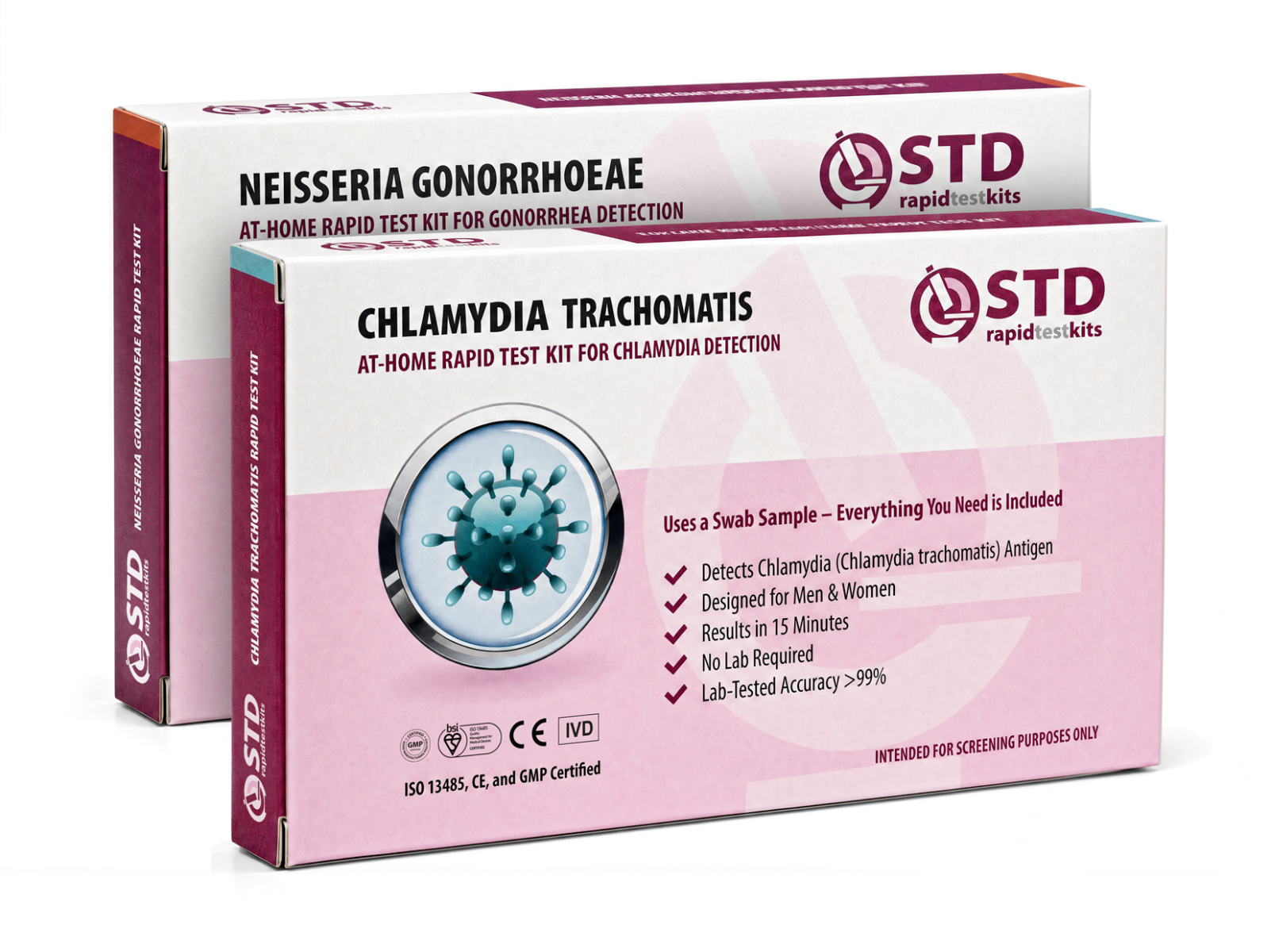
Discreet at-home testing exists for exactly that reason. You self-collect a swab, run the lateral-flow cassette, and read the result in roughly 15 minutes. If the result is positive, you confirm with a lab NAAT and treat. If it is negative and symptoms persist, you retest in a few days or move to a clinical workup. If you are not sure which infection might be responsible, an 8-in-1 panel covers the most common bacterial and viral STIs in one shipment.

The <a href="https://www.nhs.uk/conditions/urinary-tract-infections-utis/" target="_blank" rel="noopener">NHS guidance on urinary tract infections</a> describes the classic UTI symptom set as pain or a burning sensation when urinating, a need to pee suddenly or more often than usual, blood in the urine, and cloudy or dark urine. If your symptom cluster matches that pattern more closely than the STI patterns above, a urine dipstick at a walk-in clinic or pharmacy is usually the fastest path to confirmation.
Before you spiral: rank the risk
If the pain is mild, no discharge is present, and there is no recent sexual exposure, irritation or a UTI is most likely. Hydrate aggressively for 24 hours and watch what happens. If there was unprotected sex in the past two weeks, chlamydia and gonorrhea climb higher and a swab test from day 14 onward is the practical move. If there is pelvic ache and urinary hesitancy, prostatitis deserves a clinical exam. If severe flank pain shows up, kidney stones jump straight to the top and you head in for imaging.
Use the table above to match your symptom cluster, decide whether your timing fits an STI window, and test or seek care accordingly.
The decision in four lines
- Mild burn, no recent sex, no urgency: hydrate aggressively for 24 hours and reassess.
- Frequent urgency with low volume and cloudy urine: get a urine dipstick at a walk-in clinic or pharmacy today.
- Burn within two weeks of unprotected sex, or any discharge: order or visit for an STI test, ideally from day 14 onward.
- Severe flank pain, fever, vomiting, or visible blood in urine: same-day medical care, not at-home testing.
FAQs
- It only burns a little. Do I really need to test?
- Yes, if it is new, persistent past 48 hours, or follows recent unprotected sex. Mild symptoms are still symptoms. Chlamydia in particular often presents as a faint, persistent sting that never fully resolves on its own. Testing early is responsible, not alarmist.
- There is no discharge. Doesn't that rule out an STI?
- No. The absence of discharge lowers the probability of gonorrhea slightly, but it does not rule out chlamydia. Many men with chlamydia never see anything unusual in their underwear. Burning alone can be the only sign.
- Could this just be dehydration?
- Possibly. Concentrated urine from low fluid intake or heavy caffeine can irritate the urethra and produce a temporary mild burn. The test is simple: hydrate aggressively for 24 hours. If the burn fades, dehydration was likely the cause. If it lingers past a day, look for a different explanation.
- How soon after sex would symptoms show up?
- Bacterial STIs typically produce symptoms within a few days to two weeks. UTIs can show up faster, sometimes within 24 to 48 hours. If the timing of a recent encounter lines up with the burn, that is the cue to test rather than wait.
- What if my STI test is negative but it still burns?
- A negative test does not mean the pain is imagined. It may point to a UTI, prostatitis, or non-infectious irritation. It may also mean the test was run too early; reliable detection comes from about 14 days after exposure, so a retest at that window is appropriate. Persistent symptoms always justify follow-up.
- Is this something that can fix itself?
- If the pain fades within 24 to 48 hours without treatment, friction or dehydration was likely the cause. If it persists past 48 hours, assume bacterial and treat. These infections do not reliably self-clear, and quiet ones can keep transmitting to partners while you wait.
- When should I actually worry?
- If you develop fever, shaking chills, severe back or flank pain, nausea, or visible blood in the urine, that is same-day medical care, not a wait-it-out situation. Most cases of painful urination are not emergencies, but those specific combinations are.
- I am embarrassed to go to a clinic. What are my options?
- Order the kit online with discreet packaging, swab at home, and read the cassette in about 15 minutes. If it is positive, take the result printout to a walk-in clinic or urgent care for confirmation and a prescription. You do not need a scheduled appointment for a known STI confirmation, and the clinic visit is briefer when you arrive with a result already in hand.
- U.S. Centers for Disease Control and Prevention. Sexually Transmitted Infections Treatment Guidelines, on NAAT as the recommended laboratory test for chlamydia and gonorrhea in symptomatic men.
- U.S. Centers for Disease Control and Prevention. Chlamydia fact sheet, on the prevalence of asymptomatic infection and the typical mild urethral presentation in men.
- U.S. Centers for Disease Control and Prevention. Gonorrhea fact sheet, on burning urination and urethral discharge as the typical male presentation, plus testicular pain as a complication.
- U.K. National Health Service. Urinary tract infections (UTIs) overview, on symptom patterns including dysuria, frequency, and urgency.
- U.K. National Health Service. Prostatitis overview, on acute and chronic presentations including pelvic pain and urinary symptoms in men.
- National Kidney Foundation. Kidney stones overview, on symptoms including severe pain on either side of the lower back and blood in the urine.
