
Published: August 2025 | Last updated: May 2026 | Editorial review and quality control: Martina N.
The same virus that causes cold sores around the lips can also infect the eye, and the route between the two is far shorter than most people imagine. Herpes simplex virus type 1, the strain behind most oral cold sores, is responsible for one of the leading infectious causes of corneal blindness in high-income countries. A portion of those cases trace back to oral contact during sex, intimate kissing near the eye, or self-inoculation after the hand picks up viral particles from a partner's mouth and then touches the ocular surface.
None of this gets discussed in standard sex-ed, and the silence costs people their sight. The good news is that most ocular herpes responds well to prompt antiviral treatment, especially when caught in the first few days. The harder cases are the ones that get mistaken for ordinary pink eye and treated with the wrong drops for a week or two before someone realizes the cornea is in trouble.
Key Takeaways
- HSV-1 can reach the eye through oral contact during sex, transfer of saliva to the eye via the hand, or reactivation of an existing latent infection in the trigeminal nerve.
- Persistent redness in only one eye, deep pain, or sudden light sensitivity within days of intimate contact with a cold sore warrants urgent evaluation by an eye doctor.
When Pink Eye Isn't Just Pink Eye
In its first 24 to 48 hours, ocular herpes can mimic ordinary conjunctivitis almost perfectly. The white of the eye turns pink or bloodshot. There is tearing, irritation, sometimes a gritty sensation. Some people describe it as itchy. Others describe a sharper, deeper burn that feels like it sits behind the eye rather than on top of it. The watery discharge is usually clear, not the thick yellow-green you would expect with a bacterial infection.
Two clues separate this from common pink eye. First, ocular herpes typically attacks one eye and stays there. Bacterial and viral conjunctivitis usually spread to the second eye within a couple of days, while HSV keratitis tends to remain unilateral. Second, the pain feels disproportionate to what the redness suggests. Light sensitivity is often the loudest symptom, even when the visible irritation looks mild. Some people end up sitting in dark rooms with sunglasses on indoors, simply because every fluorescent bulb feels like a knife behind the eyeball.
Consider a typical pattern reported in ophthalmology clinics: a young person presents with one painful pink eye that started two or three days after a hookup with a new partner. They mention casually that the partner had a small cold sore. They had not connected the two events until the doctor asked.

How HSV-1 Travels From Mouth to Eye
Herpes simplex virus type 1 lives in nerve cells. After a first infection, usually picked up in childhood through casual contact with infected saliva, the virus retreats into the trigeminal nerve and stays dormant there. Periodic stress, illness, sun exposure, fever, or hormonal shifts can wake it up, sending viral particles back down a nerve branch to the lip. That is when a cold sore appears. The same trigeminal nerve has branches that supply the eye, which is why the virus can sometimes travel along an internal nerve route to the cornea instead of out to the lip.
The other route is direct contact. During oral sex, kissing on or near the face, or even sharing a pillow soon after a partner has had a cold sore, viral particles in saliva can reach the surface of the eye. Active cold sores shed huge amounts of virus, but research summarized by the U.S. Centers for Disease Control and Prevention confirms that asymptomatic shedding from healthy-looking lips also happens, so a clean-looking face is not a guarantee.
Self-inoculation is the third path, and probably the most underestimated one. Touching a partner's mouth or genitals during intimacy and then rubbing your own eye later, even hours later, has been documented as a route of transmission. The virus is fragile outside the body, but contact moves it efficiently from skin to skin and from saliva to ocular surface. Contact lens wearers carry an extra risk every time they handle a lens with hands that have not been thoroughly washed.
1. Direct contact during oral sex or face-to-face kissing. Saliva from a partner with active or asymptomatic HSV-1 reaches the surface of the eye.
2. Self-inoculation by hand. You touch a partner's mouth or genitals during intimacy, then rub your own eye later, even hours later.
3. Internal nerve reactivation. The virus already living in your trigeminal nerve travels along an eye-supplying branch instead of out to the lip.
What Eye Doctors See in Real Patient Records
Population studies and clinic-based registries give a picture of how common this is. The American Academy of Ophthalmology describes herpes keratitis as the most common infectious cause of unilateral corneal blindness in the developed world. Roughly half a million people in the United States carry a history of HSV eye disease, and new cases are estimated in the tens of thousands per year. The global burden is in the millions when you add up populations with chronic, recurrent disease.
Among first-time ocular HSV cases, only a fraction come from reactivation of a virus the patient already carried internally. The rest are introductions from outside, including transmission from a partner. Peer-reviewed reviews in ophthalmic epidemiology have repeatedly noted that intimate contact, oral sex, kissing on the face, and direct salivary transfer to the eye appear in case series. The exact percentage attributable to sexual contact is hard to pin down because patient histories often miss the question, but ophthalmologists who probe carefully find this route in a meaningful share of younger first-episode cases.
Once the virus is on the cornea, the visual sign that gives clinicians the diagnosis is a dendritic ulcer. Under a slit lamp microscope with a fluorescein stain, these branching shapes look almost like a tiny tree drawn on the surface of the eye. They are characteristic enough that an experienced eye doctor can identify HSV in seconds. That visual signature is also why a primary care doctor or urgent care nurse, working without a slit lamp, can miss the diagnosis and reach for antibiotic drops by default.
Herpes simplex keratitis is one of the most common infectious causes of corneal blindness in developed countries, and earlier antiviral treatment is consistently linked to better visual outcomes.
Myth #1: You Can't Get Herpes in Your Eye From Oral Sex
This myth survives because we do not connect the dots between sexual health and eye health. Cold sores get filed under "annoying skin thing," herpes gets filed under "below the belt," and the eye gets filed under "ophthalmology, ask your eye doctor." The crossover almost never appears in patient handouts about safer sex.
Peer-reviewed case series have repeatedly documented HSV reaching the eye through oral contact, intimate kissing, and saliva transfer via fingers. The mechanism is not exotic. Saliva touches the genital area or the eye, the virus finds a small abrasion or simply latches onto mucosa, and an infection takes hold within a few days.
The stigma around herpes makes the silence more dangerous. People delay telling their doctor the full story because they feel embarrassed about a recent oral encounter, and that delay can cost vision. The longer HSV stays untreated on the cornea, the higher the chance of scarring, recurrent outbreaks, and complications such as elevated eye pressure or stromal involvement deeper in the cornea. This is why awareness matters: it directly affects whether someone keeps their vision.
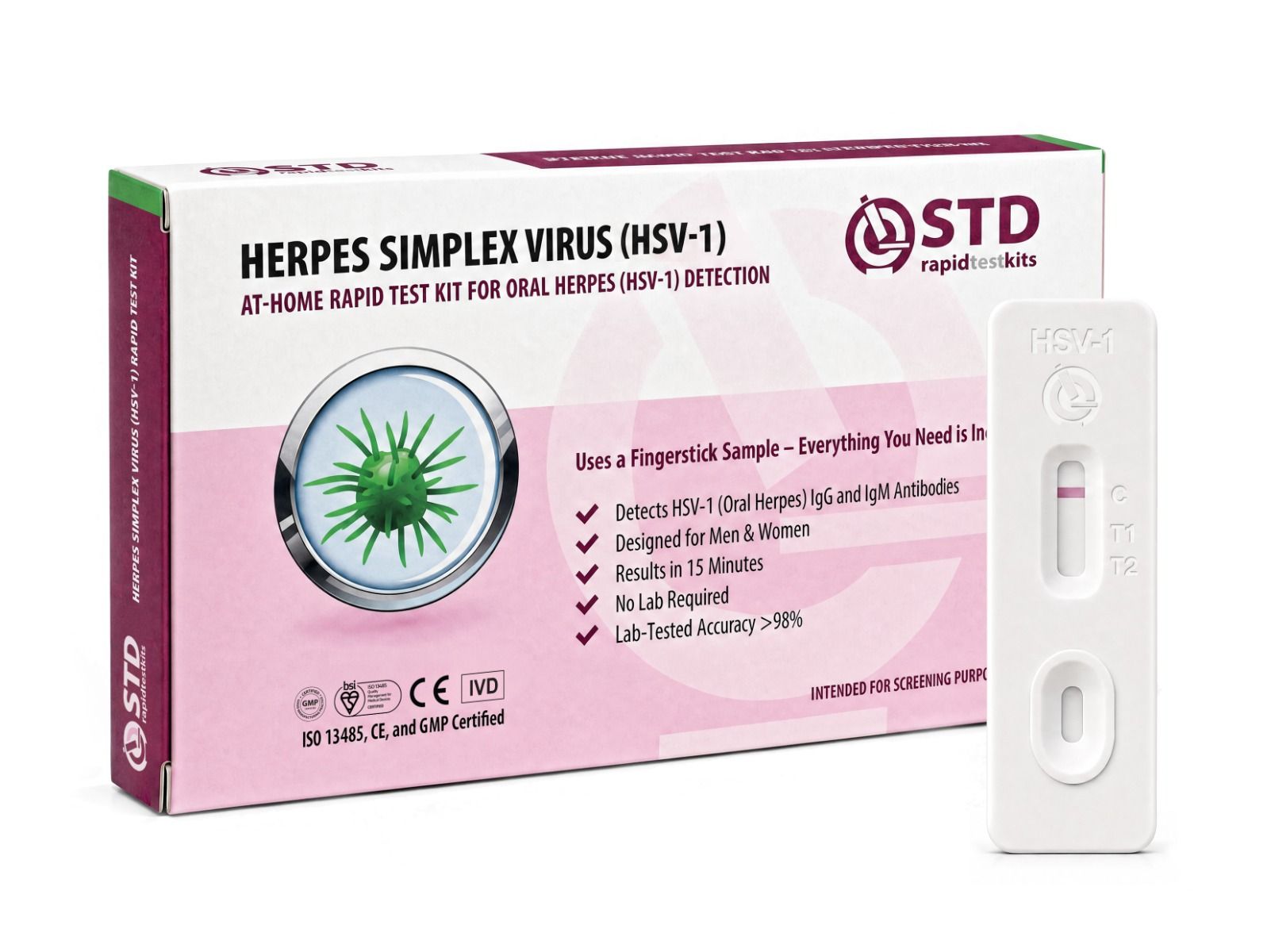
A note before the product card below: stdrapidtestkits.com sells at-home rapid HSV antibody tests, and the kit referenced here is one we carry. We recommend it for confirming exposure status, not as a substitute for an eye doctor's exam when symptoms are active.
When the Diagnosis Comes Too Late
The cases that haunt eye doctors are the ones where the patient bounced through urgent care for two or three weeks, getting a different antibiotic drop on every visit, before finally landing in front of a slit lamp. By that point, dendritic ulcers may have deepened into a stromal infection, where the virus reaches the middle layer of the cornea. Stromal disease scars unevenly. Even after the active infection clears, vision through the affected eye can stay blurred for months, and in some cases the scarring is permanent.
Why does this happen so often? Two reasons stand out. First, primary care and urgent care clinics do not always have the equipment to identify a dendritic ulcer, and the symptoms early on truly resemble a generic conjunctivitis. Second, patients rarely volunteer the sexual history that would make a clinician think of HSV in the first place, especially if they assume the eye is unrelated to anything that happened with a partner.
If you find yourself on a second round of antibiotic drops without improvement, ask for a referral to an ophthalmologist. A simple fluorescein stain in a properly trained pair of eyes can settle the question in minutes.
Skip the next round of antibiotic drops and ask for an ophthalmology referral if any of these apply:
- Eye redness affects only one side and has not improved on antibiotic drops after 5 to 7 days.
- Pain feels deep behind the eye rather than surface-level scratchiness.
- Light sensitivity is severe enough that you are dimming rooms or wearing sunglasses indoors.
- Vision feels patchy, smeared, or shows new halos around lights.
- The redness started within 2 to 12 days of intimate contact involving a partner with cold sores.
Myth #2: No Cold Sore, No Risk
This one is harder to shake because it lines up with how we usually think about contagious illness: visible symptoms equal contagious, no symptoms equal safe. With HSV-1, that intuition fails. A partner can shed virus from completely normal-looking lips. Studies of asymptomatic shedding find that adults with a history of cold sores release detectable virus in their saliva on a meaningful number of days each year, often without any tingling, redness, or sores to warn them.
The risk is highest during a visible outbreak. Active sores are practically dripping with virus. The baseline risk between outbreaks is lower but not zero, and a partner who has not had a visible cold sore in years can still pass the infection.
Prevention cannot rely on visible symptoms alone. Many people who carry HSV-1 have no idea they do, because their primary infection in childhood was mild or unnoticed. A large share of American adults carry HSV-1 antibodies from past exposure, according to CDC herpes surveillance information. Many of those people picked up the virus as children through casual contact with relatives or playmates and never knew.

Why Ocular Herpes Comes Back
Once HSV reaches the eye, it can stay there for life, the same way it stays dormant after a cold sore around the lips. The first infection might clear with antiviral drops, oral acyclovir, or valacyclovir. After the surface heals, the virus retreats into the trigeminal nerve and waits. When the immune system dips, it can reactivate down the nerve branch that supplies the eye instead of the one that supplies the lip.
The landmark Herpetic Eye Disease Study, published in JAMA Ophthalmology, found that daily oral acyclovir reduced the rate of recurrence by about half in patients with a history of repeated HSV eye flare-ups. That is the basis for long-term suppressive therapy in patients who keep relapsing.
Each recurrence carries a small additional risk of corneal scarring. Vision can deteriorate slowly across several flare-ups in ways that are easy to miss until you suddenly cannot read fine print on your phone or notice halos around streetlights at night. With prompt antiviral treatment, the corneal damage from a single recurrence is usually limited, which is why early recognition matters even after the third or fourth episode.
Many people with recurrent HSV keratitis describe a familiar prodrome: a faint pressure or burning behind the affected eye, mild light sensitivity, or a scratchy sensation that does not match how the eye actually looks. If you have had ocular HSV before, treat any of these signs as a reason to call your ophthalmologist the same day. Antiviral therapy works best when started before the cornea shows visible damage on a slit lamp exam.
Talking About Eye Health Without Shame
Intimacy is supposed to be connective, not clinical. Nobody pauses mid-hookup to run through a lecture about viral shedding and corneal ulcers. Part of why the silence around oral-to-eye transmission lasts is that it feels awkward to bring up, and most partners would not know to ask the question even if they wanted to.
People often hesitate to share the full story with their doctor because they are afraid of being judged, or they assume their eye doctor does not need to hear about a recent sexual encounter. The opposite is true. The story matters, because it tells the doctor whether to look for an HSV cause and whether to prescribe an antiviral early. A patient who buries the relevant detail can end up on weeks of useless treatment for the wrong infection.
Stigma also keeps couples from talking honestly with each other. People avoid telling a partner that a recent encounter probably caused an eye infection because they do not want the partner to feel guilty. The result is that the partner, still carrying the virus, may go on to expose someone else without realizing the route is real. A short, blame-neutral conversation with the partner ("I want you to know what happened so we can both learn from it") is sometimes the most useful prevention measure available.
Prevention Without Killing the Mood
Sex-positive prevention starts with the simple observation that desire does not switch off because of medical risk. The realistic goal is weaving safer practices into intimacy, not replacing pleasure with paranoia. A few rules cover most of the relevant risk for ocular HSV.
If a partner has a visible cold sore or feels the telltale tingle that signals one is coming, oral sex and intimate kissing on the face should pause until it heals completely. The cold sore is a vehicle for huge amounts of virus, and a healing or scabbed lesion is still infectious for several days after the obvious sore fades. A two-week pause covers most of that window.
Dental dams and flavored condoms are an option for oral play when a partner is between outbreaks but you would prefer extra protection, especially if you tend to rub your own eye later. Some couples redirect intimacy toward other forms of touch during high-risk windows rather than skip oral entirely.
Basic hand hygiene closes a significant share of self-inoculation cases. If your hand has touched a partner's mouth or genitals during intimacy, washing it before touching your face is a small habit with a real benefit. The same applies to contact lens wearers, who carry an extra route into the eye every time they handle a lens.
Practical prevention habits for HSV-aware intimacy
- Pause oral sex and intimate face kissing for about two weeks after a partner's cold sore appears, including the scabbing phase.
- Wash your hands before touching your eyes or contact lenses any time you have been in contact with a partner's mouth or genitals.
- Consider dental dams or flavored condoms during the asymptomatic window if your partner has a history of cold sores.
- If you wear contact lenses, switch to glasses on days when you suspect a partner is in a prodromal stage of a cold sore.
When to See an Eye Doctor Right Away
The right time to escalate to an eye doctor is the moment any of these red flags appear: persistent redness in only one eye, deep pain that feels worse than the redness looks, sudden light sensitivity that drives you to dim every room, blurry or patchy vision, or a watery discharge that does not improve within 24 to 48 hours. Combine any of those with recent intimate contact involving a partner who has cold sores, and the urgency goes up another notch.
Telehealth and primary care can be useful first stops if a slit lamp examination is not immediately available, but the gold-standard exam for HSV keratitis is the slit lamp with fluorescein stain. Most cities have ophthalmology offices that can fit a same-day urgent visit, and most major eye-health bodies, including the American Academy of Ophthalmology, recommend prompt evaluation for any unilateral red, painful eye that is not clearly resolving on its own.
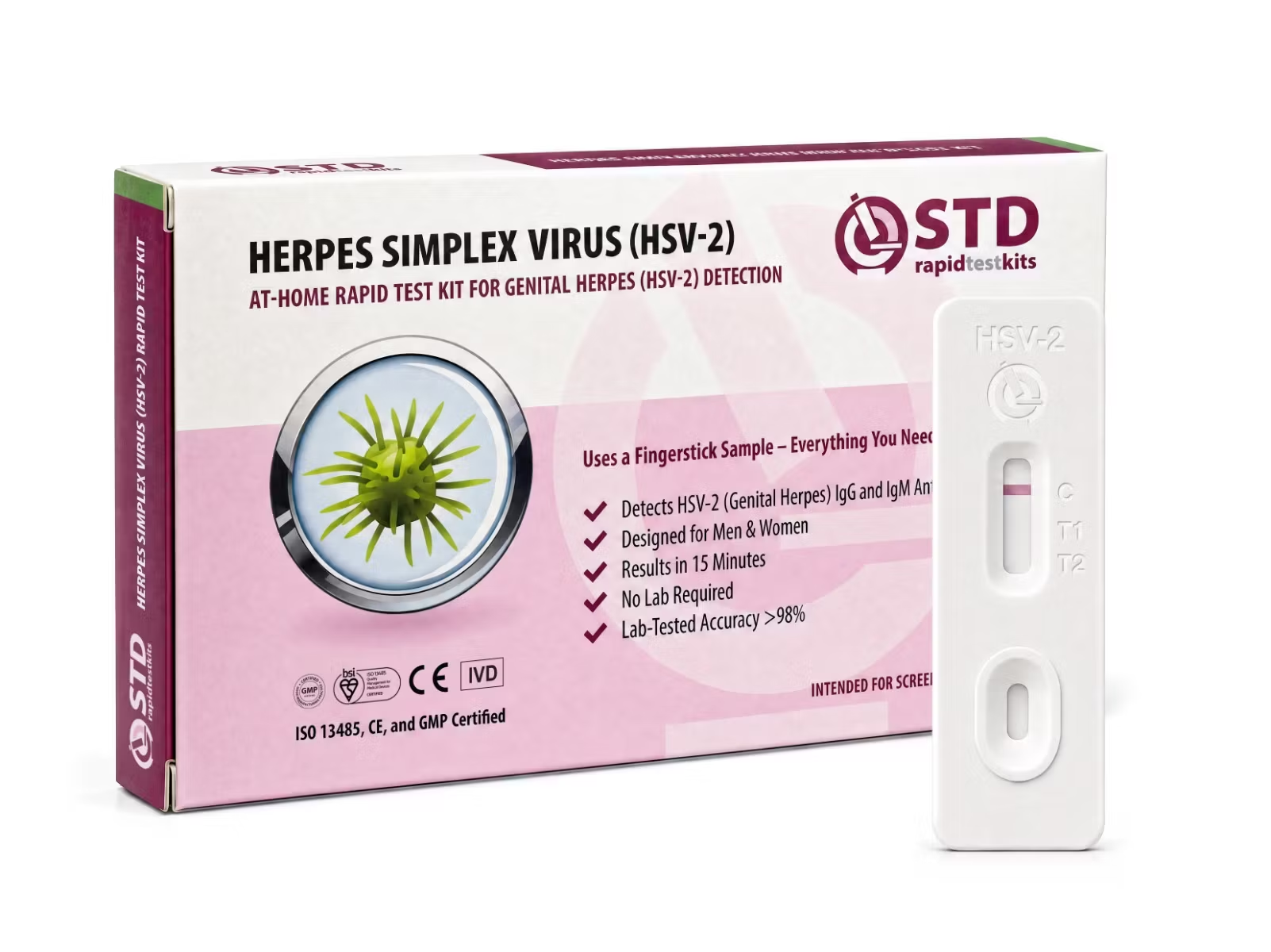
For people who are anxious or embarrassed about explaining the sexual context in person, an at-home STI antibody test can be a useful starting point for a follow-up telehealth conversation. It will not diagnose ocular herpes directly, but a positive HSV-1 or HSV-2 antibody result can give the eye doctor a crucial piece of context that you might otherwise be hesitant to share.
Treatment That Actually Works
For uncomplicated dendritic ulcers caught early, the treatment of choice is an antiviral, either as eye drops (ganciclovir gel or trifluridine drops in some regions) or as oral medication such as acyclovir or valacyclovir. Most epithelial cases clear within one to two weeks of starting treatment. Follow-up exams confirm the ulcer is healing cleanly and that no deeper layer of the cornea is involved.
Cases involving the stroma, the middle layer of the cornea, are managed differently. Steroid drops can play a role in controlling inflammation, but they have to be combined with antiviral coverage and supervised closely. Steroids on their own can make a viral keratitis dramatically worse, which is why this layer of treatment belongs in an ophthalmologist's hands and not in a generic urgent care setting.
For people who experience repeated flare-ups, daily suppressive antiviral therapy is worth a conversation. The Herpetic Eye Disease Study found that long-term oral acyclovir cut the recurrence rate roughly in half in patients with a history of HSV ocular disease.
Epithelial vs stromal HSV keratitis at a glance
- Epithelial disease (the dendritic-ulcer pattern on the surface of the cornea): treated with topical antivirals (ganciclovir gel, trifluridine) or oral acyclovir/valacyclovir, usually clears in 1 to 2 weeks.
- Stromal disease (deeper, in the middle layer of the cornea): treated with antivirals plus carefully supervised topical steroids; recovery takes weeks and follow-up scans monitor for scarring.
- Recurrent disease (multiple episodes in the same eye): often managed with daily suppressive oral acyclovir, which the Herpetic Eye Disease Study found roughly halved recurrence rates.
Living Well After a Diagnosis
An ocular herpes diagnosis does not have to mean the end of intimacy or pleasure. The diagnosis changes how you read your own body and how you respond to early warnings. People with a history of HSV keratitis tend to learn the signs of an oncoming flare quickly, and they get to a doctor faster on the second episode than they did on the first. That speed is the single biggest factor in keeping vision intact across a lifetime.
Sex life adapts. Couples find their way to a balance of honesty about risk, agreed-upon precautions during outbreaks, and full enjoyment of intimacy the rest of the time. The constant shadow of fear that a new diagnosis brings tends to fade once you have lived through the recovery, started a treatment plan you trust, and watched your eye return to baseline.
If you are reading this without ever having had an eye infection like this, simple habits go a long way: pause oral contact when a partner has a visible cold sore, wash your hands before touching your face after intimacy, and ask an eye doctor about anything in or around your eye that does not feel right.
If a recent sexual contact has left you wondering about exposure, an at-home herpes antibody test can give you a starting answer in roughly 15 minutes. Pair the result with an in-person eye exam if any eye symptoms appear, and with a sexual health visit if the test comes back positive.
Frequently Asked Questions
- Can you really get herpes in your eye from oral sex?
- Yes. HSV-1, the strain behind most cold sores, can transfer from a partner's mouth or saliva to the eye during oral sex, intimate kissing on the face, or by touch when you handle the partner's mouth or genitals and then rub your own eye.
- How fast do symptoms appear after exposure?
- Most cases of primary ocular HSV develop within 2 to 12 days of exposure. Redness, light sensitivity, and tearing are usually the earliest signs, and the affected eye is almost always one side rather than both.
- Does ocular herpes always damage vision permanently?
- No. Most early cases caught at the corneal surface respond well to antiviral drops or oral medication and heal without scarring. Permanent damage is more likely when treatment is delayed by a week or two, or when the infection reaches the deeper stromal layer of the cornea.
- What is the difference between pink eye and ocular herpes?
- Common conjunctivitis usually affects both eyes within a couple of days, causes mild discomfort, and clears on its own. Ocular herpes typically attacks one eye, brings deep pain and sharp light sensitivity, and needs antiviral treatment rather than antibiotic drops.
- Can I spread ocular herpes to other people?
- You can spread HSV-1 to others through direct contact with active sores, infected saliva, or the surface of an infected eye. Wash your hands after touching the affected eye, do not share eye drops or towels, and avoid intimate kissing while you have active symptoms.
- Do antiviral medications cure ocular herpes?
- No. Antivirals control the active infection and protect the cornea, but the virus stays latent in nerve cells, which means flare-ups remain possible. For people with repeated episodes, an ophthalmologist may recommend daily suppressive medication; the Herpetic Eye Disease Study found this approach roughly halved recurrence rates.
- How soon should I see a doctor for eye redness after intimate contact?
- Within 24 to 48 hours, especially if only one eye is affected, the pain feels deep, or you have unusual light sensitivity. Antiviral treatment works best when started in the first few days of symptoms.
- Can an at-home test diagnose ocular herpes?
- Not directly. At-home herpes tests detect HSV-1 or HSV-2 antibodies in blood and confirm whether your body has seroconverted. Keep in mind that symptoms appear in 2 to 12 days while antibody tests detect seroconversion at 12 or more weeks, so an in-person eye exam is the right first step when symptoms are active, and an antibody test is most useful for confirming exposure status after the seroconversion window has passed.
- American Academy of Ophthalmology. Patient education and clinical guidance on herpes simplex keratitis, including epidemiology, recurrence patterns, and antiviral treatment.
- U.S. Centers for Disease Control and Prevention. Herpes simplex virus information, including transmission routes and asymptomatic shedding from healthy-looking skin.
- U.S. National Library of Medicine, MedlinePlus. Herpes simplex virus overview: primary infection, latency in nerve cells, and reactivation.
- JAMA Ophthalmology. Herpetic Eye Disease Study, antiviral prophylaxis results showing reduced recurrence in patients with prior HSV ocular disease.
- NHS. Cold sores overview, recurrence triggers, and self-care guidance for HSV-1 outbreaks.
