
Published: October 2025 | Last updated: May 2026 | Editorial review and quality control: Martina N.
You had unprotected sex. Or your partner texted to say they tested positive. Or you noticed something off in the shower last week. Now you're sitting on the couch with no insurance, no doctor on speed dial, and no idea where to start. The fear is loud, and the system feels closed.
Here is the part nobody told you upfront: every barrier you are imagining can be worked around. At-home test kits ship discreetly to any address. Public-health departments test on a sliding scale. Telehealth services prescribe treatment without ever seeing your insurance card. The biology of sexually transmitted infections has nothing to do with whether you are between jobs, between providers, or between health plans. Knowing your status is one online order, one walk-in clinic, or one phone call away.
This article is published by stdrapidtestkits.com, which sells at-home STI testing kits. We recommend products based on fit-for-purpose for the reader's concern, not commercial benefit.
Key Takeaways
- You can test for STIs at home without insurance or a doctor's appointment. Single-infection rapid kits run roughly $20 to $50; multi-infection panel kits run roughly $100 to $200.
- Timing matters more than insurance status. Most infections need 2 to 12 weeks after exposure for accurate results, and a too-early negative test should be confirmed with a follow-up test once you are past the relevant window.
Who This Guide Is For
Maybe you just left a job and your old health plan ran out before the new one kicked in. Maybe you have never had insurance and the marketplace feels like a maze. Maybe you have coverage but the nearest in-network doctor is booked three months out, and you cannot wait that long for answers. Maybe you live somewhere where walking into the local clinic would be a small-town news event by Tuesday.
None of those situations cancel the worry. A potential exposure does not pause itself for open enrollment. A new partner does not wait for your benefits to activate. Symptoms do not check whether you are still under your parents' plan. The good news: you have more options than the system makes obvious.
This guide walks through what at-home STD testing actually looks like in 2026, how rapid tests differ from lab-based tests, what the reliable detection windows are, where to find low-cost or free testing through public-health channels, and how to handle a positive result without traditional insurance. It is written for people who are tired of refreshing the benefits portal and ready to take the next step on their own terms.
If you are reading this in a moment of panic, the rest of this article will not vanish. Take a breath. The next paragraph still applies whether you start tonight or tomorrow.
- Between health plans. Old coverage ended; new plan has not activated yet, or the start date is weeks away.
- Never had insurance. Self-employed, gig work, or a marketplace plan that feels out of reach financially.
- Have insurance, no access. In-network providers are booked out for months, or the nearest covered clinic is hours away.
- Privacy concerns. Small town, shared family plan, conservative workplace, or any reason you do not want a clinic visit on a paper trail.
What Counts as an STD Test (And What Does Not)
"STD test" is a category, not a single thing. Different infections call for different methods, and the method you can do at home is not always the same as the one a clinic would run.
For chlamydia and gonorrhea, the laboratory gold standard is a NAAT (nucleic acid amplification test), which detects bacterial DNA from a self-collected swab or urine sample. Clinics and mail-in lab kits both use this technology, and the CDC's STI treatment guidelines recommend NAAT as the preferred screening test for both infections.
For HIV, you will see two main test families. Antigen/antibody combination tests, including the fingerstick rapid versions, look for both the virus's p24 antigen and your body's antibody response. Antibody-only rapid tests look for the antibody response alone. Lab-based RNA (nucleic acid) tests can detect infection sooner but are usually run only when there is a known recent exposure.
For syphilis, hepatitis B, and hepatitis C, blood tests look for antibodies, antigens, or both. Trichomoniasis, herpes simplex, and HPV each have their own swab-based or blood-based options.
At-home rapid lateral-flow tests use a similar basic chemistry to a pregnancy test: you apply a sample (a fingerstick blood drop or a self-collected swab) to a small cassette and read the result line in roughly 15 to 20 minutes. They are screening tools, not lab-grade molecular tests. A reactive (positive) home result is a signal to confirm with a follow-up lab test, ideally a NAAT for bacterial infections or a confirmatory antibody panel for viral ones. A non-reactive (negative) result is meaningful when you are past the relevant detection window.
You do not need a doctor to access most of these. At-home single-infection rapid tests, multi-infection panel kits, and mail-in lab kits all ship to a residential address without a prescription. The results are yours. What you do with them is also yours.
Window Periods Still Apply, Even Without Insurance
Your immune system has not heard about your insurance situation. The "window period" is the time between exposure and when a test can reliably detect infection. Test too early and you can get a false negative even though you are infected. Test too late and you may have already passed it on or developed complications. The numbers below are pulled from the CDC's HIV testing guidance and current rapid-test product literature.
HIV testing is the area where the version of the test you use matters most. The lab-draw antigen/antibody test (blood from a vein) becomes reliably positive in most people within 18 to 45 days after exposure. The rapid antigen/antibody fingerstick test, the version most at-home users will run, can take longer: per CDC HIV testing guidance, the window for the fingerstick antigen/antibody version is 18 to 90 days. Antibody-only rapid tests can take 23 to 90 days for the antibody response to be detectable in everyone. If you are inside any of those windows and the test is non-reactive, it is reassuring but not yet definitive; plan a retest at the longer end of the window.
Chlamydia and gonorrhea NAATs become reliable around day 7 in many cases, but the most conservative recommendation is to wait two full weeks before relying on a negative result. Syphilis antibody tests detect most infections by 6 weeks but can take up to 12 weeks for some people.
If you tested early and got a non-reactive result, you have not wasted the test. You have a baseline. A second test taken at the appropriate window length confirms what the first one suggested, or catches what it missed.
| Infection | Test Type | Earliest Detection | Most Reliable By |
|---|---|---|---|
| Chlamydia | NAAT (swab or urine) | 5 to 7 days | 14 days |
| Gonorrhea | NAAT (swab or urine) | 5 to 7 days | 14 days |
| Syphilis | Blood antibody | 3 to 6 weeks | 6 to 12 weeks |
| HIV (antigen/antibody, lab draw) | Blood from vein | 18 days | 45 days |
| HIV (antigen/antibody, rapid fingerstick) | Fingerstick | 18 days | 90 days |
| HIV (antibody-only rapid) | Fingerstick | 23 days | 90 days |
| Trichomoniasis | Rapid antigen or NAAT | 5 to 10 days | 2 to 3 weeks |
| Hepatitis B | Blood antigen/antibody | 3 to 6 weeks | 12 weeks |
| Hepatitis C | Blood antibody | 8 to 11 weeks | 12 weeks |

Rapid vs. Lab Testing Without Insurance: What Actually Works
The question changes when you are paying out of pocket. It is no longer "what is best in absolute terms" but "what is best for the version of me who has $40 to spend tonight, or $200 over the next week, or who has to wait until payday." All three are valid frames.
Rapid at-home tests cost roughly $20 to $50 for a single-infection kit and roughly $100 to $200 for a multi-infection panel. Mail-in lab kits, where you collect at home and ship the sample to a lab, run roughly $80 to $300 depending on the panel. Walk-in clinic cash-pay panels run roughly $150 to $300 in most U.S. metros, and urgent-care visits with included treatment can climb higher. Pricing varies widely by city; the CDC's GetTested locator lists low-cost and free clinic options by zip code.
Rapid tests do best when you need a fast answer and the worry is interfering with sleep. They lose ground when an exposure is very recent and you are inside the window period; in that case, a rapid test taken now plus a follow-up test at the right window length is the better combo than relying on either alone.
Mail-in lab kits do best when you are past the window and want NAAT-grade certainty without a clinic visit. They lose ground when you are mid-symptom and need to act fast, since the mail-and-lab cycle takes several days from sample to result.
Walk-in clinics with cash pay do best when you have visible symptoms or need same-day treatment access, since they can prescribe and dispense antibiotics on the spot. They lose ground on price and privacy.
| Method | Privacy | Speed | Sample-to-Lab Standard | Best When |
|---|---|---|---|---|
| At-home rapid lateral-flow | Very high | 15 to 20 minutes | Screening; confirm positives in lab | You need an answer tonight and you are past the window |
| Mail-in lab kit (NAAT) | High | 2 to 5 days | NAAT-grade, lab-processed | You are past the window and want certainty without a clinic visit |
| Walk-in clinic / urgent care (cash pay) | Low to moderate | 1 to 7 days | NAAT-grade, lab-processed | You have visible symptoms or need same-day treatment |
What If Your Symptoms Do Not Seem to Match Anything?
The mind spiral is familiar. Something feels different. Maybe a tingling, maybe an itch, maybe a burn that only shows up after sex or during your period. You search online and every description either reads like a horror film or, somehow, looks nothing like what you are experiencing.
Two things are true at the same time. STI symptoms vary enormously, and many infections produce no symptoms at all. Per CDC STI overview guidance, many STIs cause no symptoms or only mild ones, and people frequently transmit infections like chlamydia, gonorrhea, and herpes without ever knowing they were carriers. You can have an STI with no discharge, no rash, no sores, and no fever, and still test positive.
At the same time, not every twinge means infection. New laundry detergent, a switch in body wash, recent shaving, rough sex, hormonal cycle changes, yeast imbalance, and urinary tract infections can all mimic the early signs of an STI. Without testing, the symptoms only tell you that something deserves attention.
For uninsured readers, this is where decision paralysis hits hardest. Do you spend money you do not have on something that might just be a UTI? Do you wait it out and risk passing on something contagious? The pragmatic answer is usually: test. A $30 single-infection rapid kit costs less than a clinic co-pay, gives you a data point, and either rules out the infection you are most worried about or confirms what to act on next. If the rapid is negative and symptoms continue past a week, escalate to a lab-based test or a walk-in clinic.
Where to Get Tested When You Are Broke or Between Plans
Free and low-cost testing exists in every U.S. state, but it is not always loud about itself. A few starting points that do not require insurance:
- Public-health departments. Most county and city public-health departments offer free or sliding-scale STI testing, often without an appointment. Some require ID, some do not. The CDC's GetTested locator filters by zip code and lets you sort for free or low-cost sites.
- Planned Parenthood. Planned Parenthood health centers offer sliding-scale STI testing at locations nationwide and accept self-pay regardless of insurance status. Visit plannedparenthood.org to find the nearest location and confirm pricing; some health centers run free testing days for specific infections.
- Community health centers. Federally qualified health centers (FQHCs) charge based on income and never turn anyone away for inability to pay. The HRSA Find a Health Center directory lists the nearest one to any U.S. zip code.
- LGBTQ+ health centers. Many metro areas have nonprofit clinics that specialize in sexual health for LGBTQ+ communities and offer free or low-cost testing for everyone, regardless of identity.
- College health centers. If you are a current student, even part-time, your campus health center likely offers free or heavily subsidized STI testing as part of student fees.
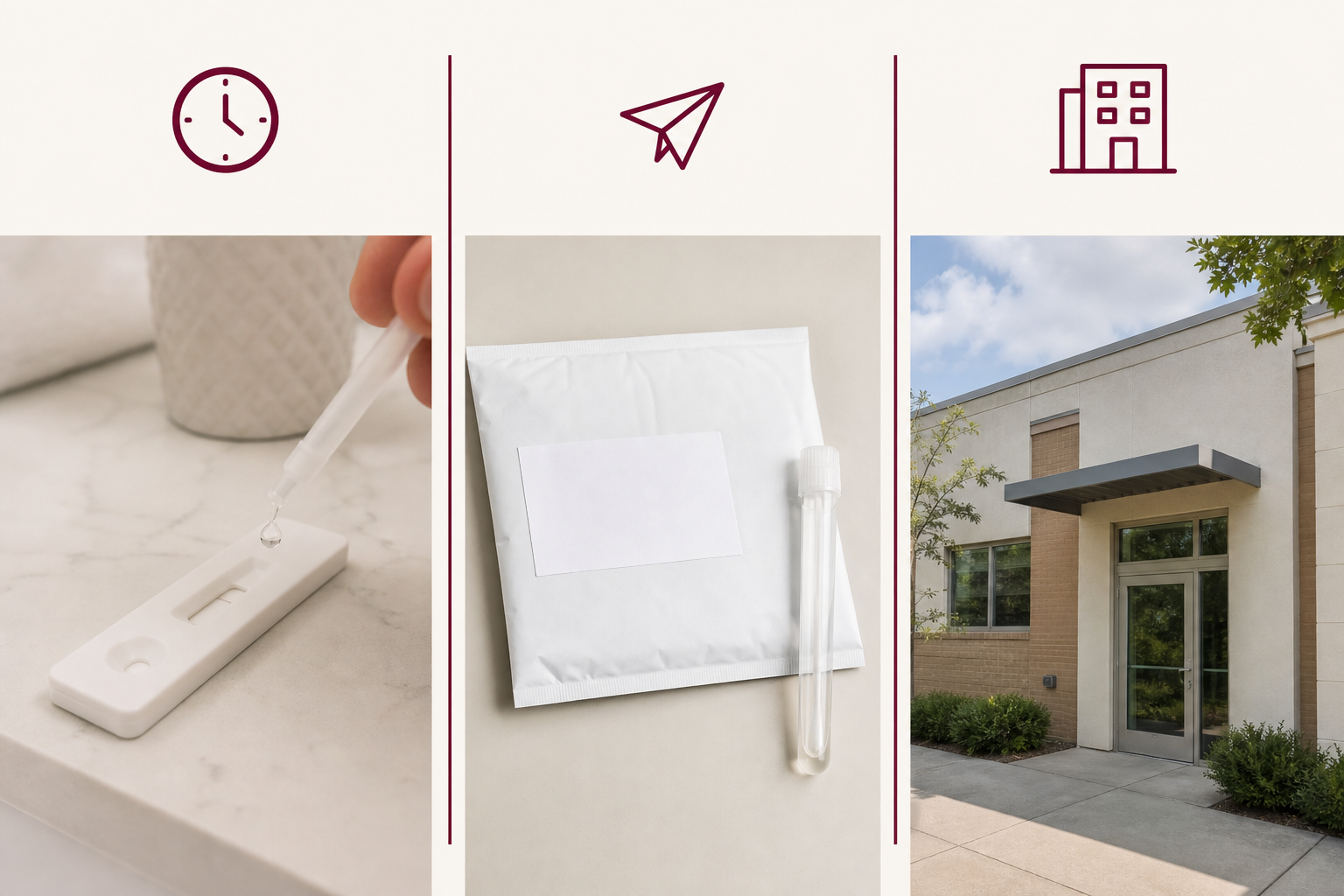
- At-home rapid kits. If walking into a clinic is not an option for privacy, geographic, or scheduling reasons, at-home rapid lateral-flow kits ship in plain packaging to any U.S. address you trust. You can use a friend's address, a UPS box, or a P.O. box. Many at-home kits qualify for HSA/FSA reimbursement; check your plan if you have a balance from a previous employer.
If you are between health plans and the new one will activate retroactively, save your test receipts. Some plans reimburse out-of-pocket preventive care once coverage starts.
Should You Retest? When and Why
Yes, sometimes. Retesting is not a sign you did something wrong the first time; it is the standard recommendation in three specific situations.
The first is when you tested inside the window period. A non-reactive result on day five after exposure is reassuring, but the bacteria or antibodies might not have reached detectable levels yet. CDC testing guidance recommends a follow-up test once you are past the upper bound of the window, which is roughly 14 days for chlamydia and gonorrhea, 6 to 12 weeks for syphilis, and 45 to 90 days for HIV depending on the test type used.
The second is when symptoms persist or evolve after a non-reactive result. If you tested for the most likely infection and the symptoms continue, run a broader panel or escalate to a lab-based test that uses a different methodology.
The third is after treatment. For bacterial infections like chlamydia and gonorrhea, the CDC recommends a "test of cure" three to four weeks after finishing antibiotics, and a repeat "test of reinfection" three months later. Testing too soon after treatment can pick up non-viable bacterial DNA from the cleared infection and produce a false positive.
If you are managing all of this without insurance, a practical strategy is to use a rapid test for the immediate-clarity step and a mail-in lab kit or low-cost clinic visit for the confirmatory step. The rapid gives you an answer tonight; the follow-up gives you the more sensitive read once your timeline allows.
Three situations that call for a retest
- You tested inside the window period. Plan a follow-up at the upper bound: 14 days for chlamydia/gonorrhea, 6 to 12 weeks for syphilis, 45 to 90 days for HIV depending on test type.
- Symptoms continue or change after a non-reactive result. Escalate to a lab-based test or a different test methodology.
- You finished antibiotic treatment for a bacterial infection. CDC recommends a test of cure 3 to 4 weeks after the last dose, and a test of reinfection 3 months later.
How to Stay Safe While You Wait
Sometimes the kit has not arrived yet. Sometimes you cannot afford the test until next week. Sometimes you are still deciding whether the symptom is "serious enough" to act on. In the gap, a few practical moves reduce risk without requiring a diagnosis.
Use barriers for any sexual contact. Condoms for penetrative sex, dental dams or condom-cut barriers for oral, and gloves for manual contact all reduce transmission risk substantially while you wait for results. If you and a partner share toys, do not pass them between you without cleaning and a fresh barrier in between.
Avoid sharing items that contact body fluids. This includes razors, toothbrushes, and any sex toys. Casual household contact does not transmit most STIs, but fluid contact does.
Watch for escalation. If symptoms worsen, including fever, severe pain, visible sores, unusual bleeding, pelvic or testicular pain, or pain that disrupts urination, do not wait for the kit. Walk into an urgent care or emergency department. U.S. emergency departments are required to provide stabilizing care regardless of insurance status under EMTALA, and you can negotiate self-pay pricing at intake.
Be honest with current and recent partners. "Hey, I am waiting on test results, can we use barriers in the meantime" is a complete sentence. It protects them, it protects you, and it does not require a diagnosis to say it.
Some symptoms cannot wait for a kit to ship or a follow-up appointment. Walk in for in-person care if you have any of the following: fever above 101F, severe pelvic or testicular pain, unusual vaginal bleeding, pain severe enough to interfere with urination, visible open sores that are spreading, or any symptom that has worsened sharply in the last 24 hours. EMTALA requires U.S. emergency departments to provide stabilizing care regardless of insurance status; ask for a self-pay estimate at intake.
Shame, Stigma, and the Stories We Do Not Tell
The hardest part of testing without a doctor is rarely the logistics. It is the thought spiral that sometimes shows up alongside the worry: "I should have known better. I cannot afford to get sick. People like me do not get to deal with this carefully." Those thoughts are common, and they are wrong.
STIs are extremely common in the U.S. The CDC's STI overview notes that millions of new infections are reported each year, and the actual case count including unreported infections is substantially higher. The people who get tested are not unusually reckless; they are unusually proactive. Every test is a person choosing information over avoidance.
Insurance gaps are a structural problem, not a personal failing. They reflect how U.S. healthcare is built, including long waits for new-patient appointments, narrow in-network panels, and out-of-pocket maximums that exceed most household savings. None of that is your fault, and none of it cancels your right to take care of yourself in the gap.
If this is your first time navigating STI testing on your own, the threshold you are crossing is real. You are deciding to act with the information you have, in a system that does not always make that easy. The information you gather in the next 24 hours is the information you need to decide what comes next.
Many sexually transmitted infections do not cause symptoms, so the only way to know for sure if you have one is to get tested.
You Deserve Answers, Not Approval
Whether you are between jobs, between relationships, or between insurance plans, the path to knowing your status does not run through a permission slip. STI testing is a basic part of sexual healthcare, and the at-home, public-clinic, and sliding-scale options that exist now did not exist a decade ago for a reason. They were built because the gap between insurance coverage and real life is wider than the system likes to admit.
A rapid test ordered tonight can deliver results before tomorrow morning, and a mail-in lab kit shipped on Monday usually returns results within the week. Public-health departments and Planned Parenthood take walk-ins right now in most cities, no referral or insurance required to be seen. None of those routes asks for a copay or anyone else's approval.
Your body is the one telling you it deserves attention. Listen to it.
Frequently Asked Questions
- Can I really test for STIs without going to a doctor?
- Yes. At-home rapid lateral-flow kits and mail-in lab kits both ship without a prescription to any U.S. address, and you read the rapid results yourself in 15 to 20 minutes. Public-health departments and Planned Parenthood also offer testing without requiring you to be an established patient anywhere.
- How much does at-home STD testing cost without insurance?
- Roughly $20 to $50 for a single-infection rapid test kit, $100 to $200 for a multi-infection panel kit, and $80 to $300 for a mail-in lab kit depending on the panel size. Walk-in clinic cash-pay panels run roughly $150 to $300 in most U.S. metros.
- How soon after exposure should I test?
- For the most common worries, chlamydia and gonorrhea, wait at least 14 days before trusting a negative result. HIV takes longer: up to 90 days for a rapid antigen/antibody fingerstick test or an antibody-only rapid, while the lab-draw antigen/antibody version is reliable by 45 days. Syphilis antibody tests can lag up to 12 weeks. If you cannot wait, run a rapid now and plan a follow-up at the right window length.
- What if I have no symptoms? Should I still test?
- Absolutely. No symptoms does not mean no infection. Chlamydia and gonorrhea frequently produce no symptoms, and most herpes transmissions happen between people who have never seen a sore. Testing after any new partner or unprotected exposure is the only reliable way to know your status.
- Can urgent care help if I walk in without insurance?
- Most urgent care centers and walk-in clinics offer cash-pay STI panels and same-day treatment. Ask for the price upfront before agreeing to the visit. Pricing varies, but expect roughly $150 to $300 for a panel, with antibiotics for bacterial infections often included or available at low cost on the spot.
- What if my at-home test is positive?
- A reactive home result is a screening signal, not a final diagnosis. Confirm with a lab-based test (NAAT for chlamydia and gonorrhea, confirmatory antibody panel for HIV or syphilis) at a public-health department, Planned Parenthood, urgent care, or telehealth service that can order labs. Most STIs are curable or manageable, and treatment is available regardless of insurance status.
- Are at-home test results private?
- Yes. Reputable at-home test companies follow HIPAA and do not share results with insurance, employers, or anyone else without your authorization. Kits arrive in plain packaging with no STI branding visible. You read the rapid results yourself, and only you decide what to do with them.
- Can I use an HSA or FSA card to pay for at-home tests?
- Often yes. Many at-home STI test kits qualify as eligible medical expenses under HSA and FSA rules. If you have a leftover HSA balance from a previous employer's plan, that money is still usable. Confirm with your HSA or FSA administrator before purchase if you want to be certain.
- U.S. Centers for Disease Control and Prevention. STI Treatment Guidelines, including recommended NAAT screening for chlamydia and gonorrhea and confirmatory testing for syphilis.
- U.S. Centers for Disease Control and Prevention. HIV Testing overview, including window-period guidance for antigen/antibody and antibody-only rapid tests.
- U.S. Centers for Disease Control and Prevention. About Sexually Transmitted Infections, including general guidance that many STIs are asymptomatic.
- U.S. Centers for Disease Control and Prevention. GetTested Locator for free and low-cost STI testing sites by zip code.
- Health Resources and Services Administration. Find a Health Center directory for federally qualified community health centers that charge based on income.
- Planned Parenthood. Sliding-scale STI testing services available regardless of insurance status; locations nationwide.
- World Health Organization. Sexually Transmitted Infections (STIs) Fact Sheet, including global incidence and screening guidance.
