
Published: October 2025 | Last updated: April 2026 | Editorial review and quality control: Martina N.
Is a mouth sore after oral sex an STI?
Most aren't. Friction, canker sores, and minor irritation account for the majority of post-oral-sex mouth sores, and they typically heal in 5 to 10 days. Three infections can show up in or around the mouth: oral herpes (HSV-1 or HSV-2), syphilis, and pharyngeal gonorrhea. Test if a sore lasts longer than two weeks, comes back repeatedly, appears as a cluster of blisters, sits there painlessly without healing, or is paired with a sore throat that won't quit.
You had oral sex, and now there's a sore in your mouth. The first thought hits fast, and it usually goes one of two ways. Some people land on canker sore and stop worrying. Others land on herpes and spiral.
Most of the time, neither extreme is right. A sore that shows up in the hours or days after oral sex is far more likely to be friction, a canker sore, or a minor irritation than a sexually transmitted infection. But not always. Three infections, oral herpes, syphilis, and pharyngeal gonorrhea, can show up in or around the mouth, and each follows a recognizable pattern once you know what to look for.
This guide walks through what these sores are, how to tell them apart, when testing makes sense, and which at-home tests cover the right infections (and which questions still need a clinic).
Key Takeaways
- Sores that appear within hours of oral sex are almost always friction or irritation, not infection. Most heal in 5 to 10 days.
- Painless sores that linger past two weeks deserve testing. Syphilis chancres are the classic example, and they get missed precisely because they don't hurt.
Most Mouth Sores After Oral Sex Are Not an STI
Your mouth lining is thin, soft, and constantly moving. Friction during oral sex, new bacteria from a partner's skin, dehydration, and small abrasions from teeth contact all show up the same way: a tender raw patch you didn't notice yesterday.
The non-infectious causes are by far the most common explanation:
- Friction or minor cuts. Show up within hours, feel sore but not severe, heal in 2 to 5 days.
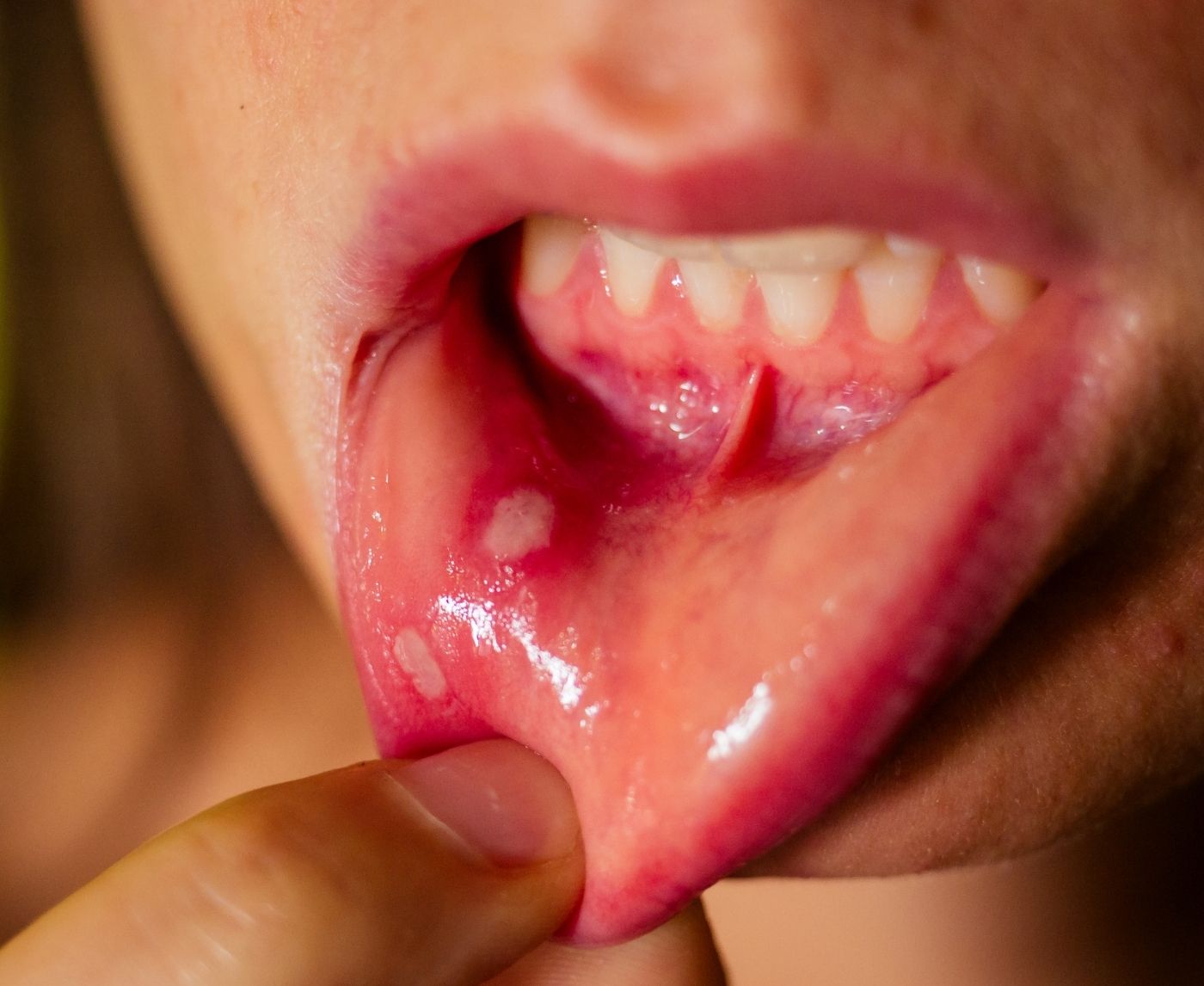
- Canker sores (aphthous ulcers). Round, white or yellow centered, with a red border, usually inside the cheek or on the inner lip. Triggered by stress, food acidity, or minor trauma. Heal in 7 to 10 days. The NHS notes most clear without treatment.
- Reactive irritation. A new toothpaste (especially one with sodium lauryl sulfate), a citrus-heavy meal, or a minor allergic reaction can all produce a sore that mimics infection.
Notice the timing pattern: these all show up fast and heal fast. If your sore appeared the morning after oral sex and is already starting to fade by day three, you are almost certainly looking at one of the above. You don't need a test, you need a few days of soft food and patience.
That timeline almost always points to friction or a canker sore, not infection. Watching and waiting for 7 to 10 days is reasonable, especially if the sore is shrinking each day rather than getting worse.
When a Mouth Sore Might Actually Be an STI
Three sexually transmitted infections can show up in or around the mouth: oral herpes (HSV-1 most often, sometimes HSV-2), oral or pharyngeal syphilis, and pharyngeal gonorrhea. Each follows a different timeline, and each has visual or symptom cues that distinguish it from a canker sore.
HIV is the fear most readers arrive with, and it deserves a brief honest answer here. HIV does not typically cause a visible mouth sore on its own. Per-act transmission risk through oral sex is also substantially lower than through anal or vaginal exposure, per the CDC's page on STI risk and oral sex. If you've had a recent unprotected exposure, HIV testing still belongs in your screening plan, but the sore in your mouth is unlikely to be the signal.
| Cause | STI? | Typical appearance | Time to appear after exposure |
|---|---|---|---|
| Canker sore | No | White or yellow center with red border, inside cheek or lip, painful but small | Not linked to sex; stress, acidic food, minor trauma |
| Friction abrasion | No | Red raw patch where rubbing happened, no ulcer crater | Within hours |
| Oral herpes (HSV-1 or HSV-2) | Yes | Cluster of small grouped blisters that break into painful ulcers, often on lips or gums; tingling or burning before they appear | 2 to 12 days for primary infection; recurrent outbreaks may be faster |
| Syphilis (primary chancre) | Yes | Single round painless ulcer with raised firm rolled border, on lip, tongue, or back of throat | 10 to 90 days, typically around 3 weeks |
| Pharyngeal gonorrhea | Yes | Often no visible sore; sore throat, mild scratchiness, or inflamed tonsils | 2 to 7 days |
| Oral HPV | Yes | Usually invisible; rarely small flesh-colored bumps | Weeks to months, often asymptomatic |
What Each Sore Looks Like
Visual self-diagnosis is unreliable. Two sores can look almost identical and behave completely differently. Still, knowing the typical appearance pattern of each helps you decide whether what you see lines up with friction, with a canker sore, or with something that warrants testing.
The figures below show side-by-side what each pattern typically looks like in clinical reference material. Use them as orientation, not as a substitute for a professional opinion.
Why Timing Matters More Than How It Looks
This is the single most useful concept in the article: the lag between exposure and symptom is biological, not coincidental.
Friction reactions show up within hours because that is how fast tissue responds to mechanical trauma. Bacterial and viral infections need to replicate before they cause visible disease, and that replication takes days, sometimes weeks. So a sore that appears the same evening as oral sex is almost certainly a reaction to the act itself, not an infection that somehow took hold and produced symptoms in five hours.
The flip side is also true. A sore that appears 10 to 30 days after a single exposure, with no obvious trigger, is more suspicious. That is exactly the syphilis primary-chancre window, per CDC syphilis guidance. A primary herpes outbreak hits 2 to 12 days after exposure. Pharyngeal gonorrhea symptoms (when they show at all) appear in 2 to 7 days, though most cases are silent according to the CDC gonorrhea fact sheet.
Before you spiral into worst-case thinking, ask the better question: does the timing of my sore match how the infection I'm worried about behaves?
Sore appeared within hours? Almost certainly friction or irritation, not infection. Cluster of blisters showing up 2 to 12 days after exposure? That fits the herpes pattern. Single painless ulcer appearing 10 to 30 days later with no obvious trigger? That window matches a syphilis chancre and merits a test.
Window Periods: When to Test
A test is only useful inside its window period, the time after exposure when the test can reliably detect the infection. Test too early and you risk a false negative. Test at the right time and you get a real answer.
The window depends on what the test is looking for: the pathogen itself (swab or PCR), or your immune response to it (antibody blood test).
| Infection | Test type | Earliest reliable test | Most accurate at |
|---|---|---|---|
| Oral herpes (HSV-1 or HSV-2), active sore | Lesion swab with PCR (clinic) | During the active outbreak, ideally days 2 to 5 | While the sore is still wet |
| Herpes (HSV-1 or HSV-2), no active sore | Blood antibody test (IgG) | Around 4 to 6 weeks | 12 weeks after exposure |
| Syphilis | Blood test (RPR or treponemal) | 3 to 6 weeks after exposure | 12 weeks after exposure |
| Pharyngeal gonorrhea | Throat swab with NAAT (clinic) | 5 to 7 days after exposure | Same window; retest 3 weeks after treatment |
| Pharyngeal chlamydia | Throat swab with NAAT (clinic) | 7 to 14 days after exposure | Same window; retest 3 weeks after treatment |
| Oral HPV | No routine screening test | N/A | Refer to ENT if visible warts appear |
What We Sell, and What You Will Need a Clinic For
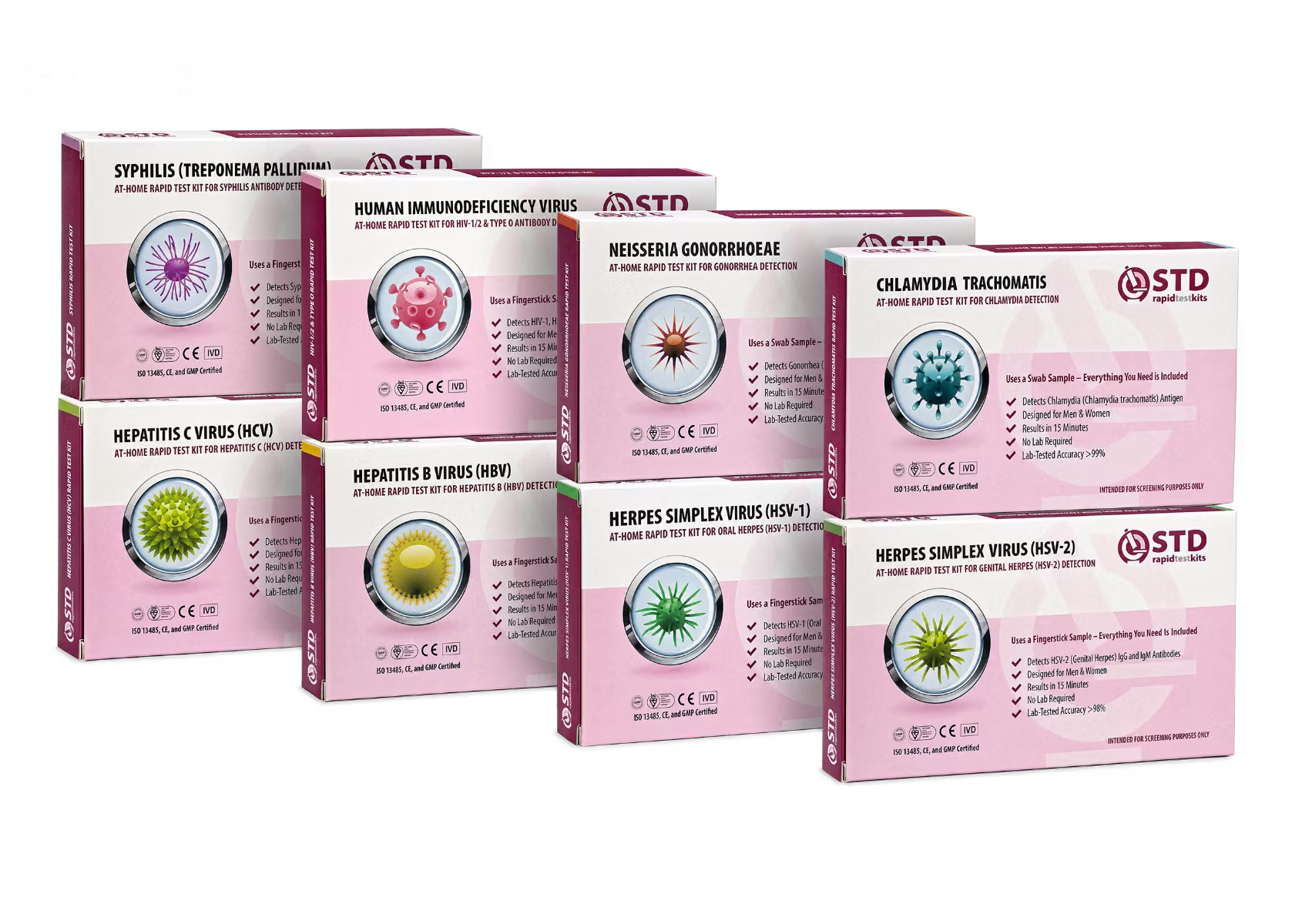
stdrapidtestkits.com sells rapid lateral-flow at-home tests for blood-detected infections (HIV, syphilis, hepatitis B, hepatitis C, HSV-1, HSV-2) and self-collected genital swabs (chlamydia, gonorrhea, plus trichomoniasis and HPV for women). These are screening tools using lateral-flow chemistry, not the same technology as the lab NAAT panels your clinic runs, but they are accurate within their indicated windows.
What we do not sell, and what you'll need a clinic for:
- Throat (pharyngeal) swab tests for chlamydia or gonorrhea. If you are specifically worried about a throat infection from receptive oral sex, you need a clinic. Labs use a NAAT pharyngeal swab, which is the validated method for that anatomical site. Our genital chlamydia and gonorrhea swabs are not interchangeable with throat swabs.
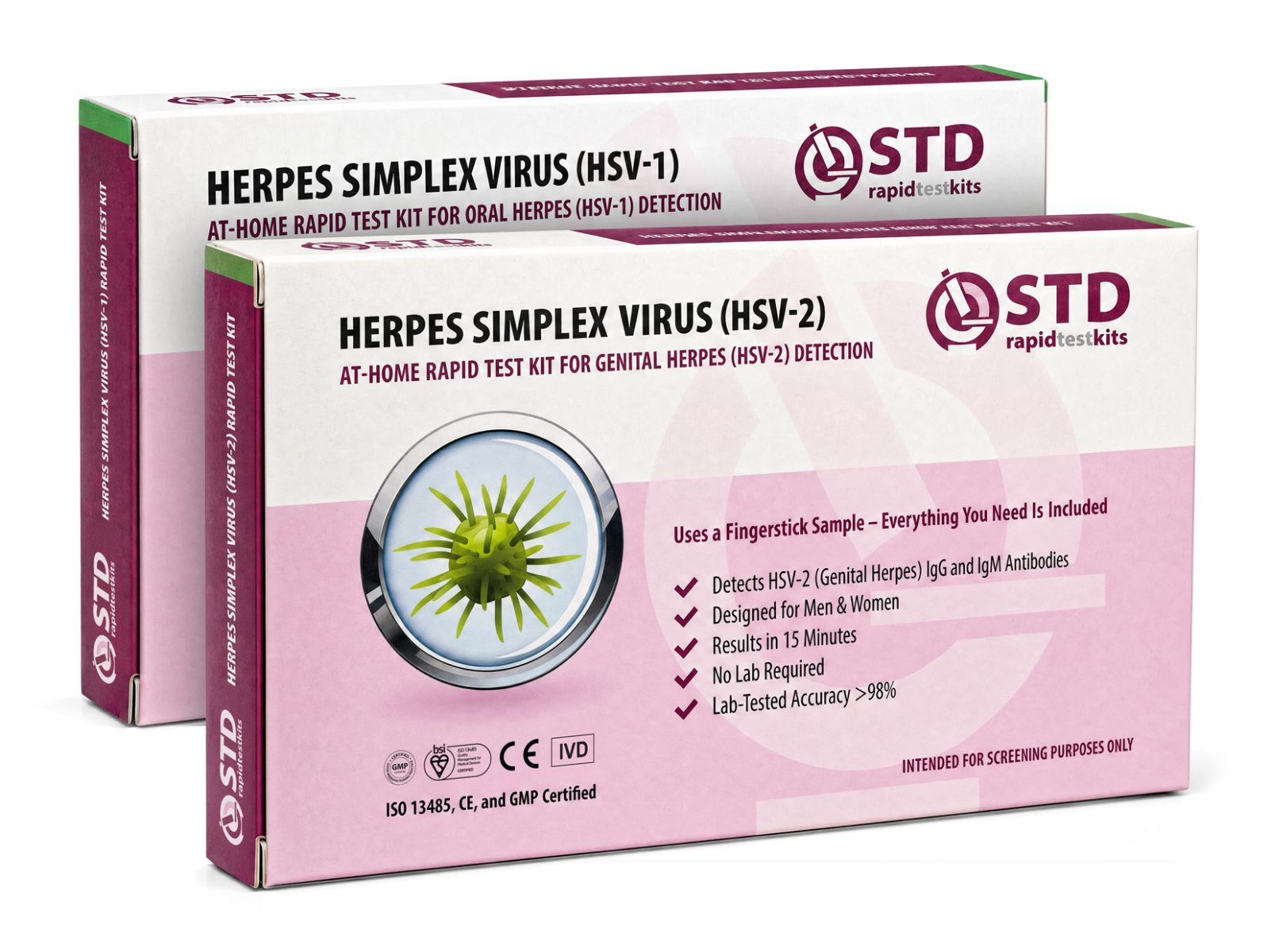
- Lesion swabs for active herpes outbreaks. Our HSV tests are blood antibody tests. They confirm whether your immune system has produced antibodies to HSV-1 or HSV-2, which takes 12 weeks or more after exposure to be reliable. They do not test the sore itself.
That distinction matters. If you have a visible blister cluster right now and you want a same-day answer about whether it is herpes, a clinic-administered lesion swab with PCR is the right tool. Our blood antibody test answers a different question: have you been exposed at any point and developed antibodies?
This article is published by stdrapidtestkits.com, which sells at-home STI testing kits. We recommend products based on whether they fit-for-purpose for the reader's situation, not on commercial benefit. Where the right test is something we don't sell (like a pharyngeal swab), we say so plainly.
Picking the Right At-Home Test for Your Situation
Match the test to the question you are trying to answer. Three common scenarios cover most readers.
After a one-time oral exposure several months back, with no symptoms and no sore, the question is usually peace of mind. A combo blood panel covers HIV, syphilis, hepatitis, and herpes antibodies in one kit. By 12 weeks post-exposure, all of those are inside their reliable detection windows.
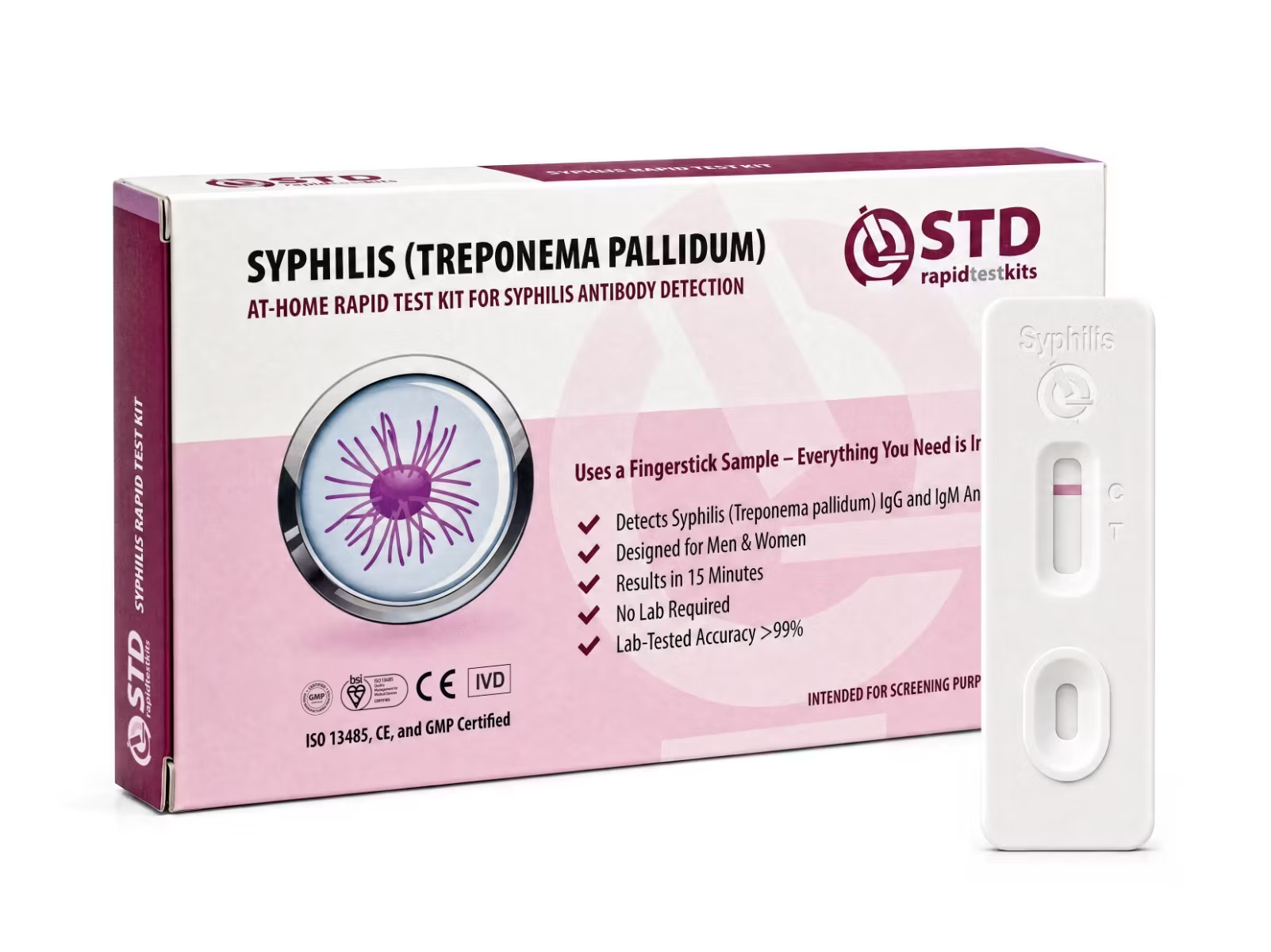
When a painless ulcer has been sitting in your mouth for over two weeks, syphilis becomes the priority concern. A blood test for syphilis becomes reliable around 3 to 6 weeks after exposure, with full accuracy by 12 weeks. Treatment in early syphilis is straightforward, and catching it early matters.
Recurrent clusters of painful sores that keep coming back point most often to recurrent oral herpes. An HSV-1 and HSV-2 antibody blood test confirms whether you carry the virus. For a same-day answer about an active outbreak specifically, a clinic-administered lesion swab is faster.
Whatever the scenario, do not stack multiple tests in the wrong window. Test once at the right time and you get a real answer. Test five times in week one and you get five false negatives.
What Happens If You Test Positive
A positive result is information, not a verdict. Each of the infections that can show up in the mouth is treatable, and most are common.
Syphilis caught early is curable with antibiotics, per the CDC's syphilis fact sheet. The exact antibiotic regimen and duration depend on stage, and your clinician will choose based on current treatment guidelines. Pharyngeal gonorrhea is cleared with a targeted antibiotic regimen; resistance patterns mean clinicians use specific combinations, and a follow-up swab confirms the infection is gone. Herpes is not curable but is highly manageable: daily suppressive antivirals reduce both outbreak frequency and transmission risk substantially.
The other side of a positive result is partner notification, which is the part most people dread. The next section covers a script that actually works.
Most people with genital herpes have no symptoms or have very mild symptoms.
Talking to a Partner Without the Shame
Two practical scripts work better than vague disclosure. The first is for someone you are still seeing: "I noticed a sore after we hooked up. I tested, and it turned out to be X. I wanted you to know so you can get checked too." The second is for someone you might be intimate with going forward: "I have HSV-1, the same virus that causes most cold sores. About half the U.S. adult population carries it. I take medication and avoid contact during outbreaks. I wanted to tell you upfront."
Both work because they lead with information, without apology. Most STIs that show up orally are extremely common. HSV-1 is essentially universal in the adult population per CDC herpes data. The cultural silence around them is what makes disclosure feel heavy.
If the conversation goes badly, that is information about the partner, not about you. The vast majority of people respond with appreciation when someone is upfront about their status, especially when the disclosure is paired with the basic fact that the infection is manageable and common.
"I have HSV-1, the same virus that causes most cold sores. About half the U.S. adult population carries it. I take medication and avoid contact during outbreaks. I wanted to tell you upfront." Lead with the fact, name the medication, name the precaution. No apology needed.
When to Stop Watching and Get Help
You don't need to test every sore. You also don't need to ignore one that is sending signals. The decision points are clearer than they feel:
Reasons to test or see a clinician
- Sore lasts longer than 14 days without healing
- Sore is part of a cluster of blisters or recurrent outbreaks
- Sore is painless but firm and won't go away (classic syphilis pattern)
- Persistent sore throat after receptive oral sex, lasting more than 2 weeks
- Swollen lymph nodes in your neck alongside the sore
Where Most People Land After All This
If you read this far, you probably arrived worried and you probably leave less worried. That is the right outcome for most readers. The painful sore that showed up the morning after oral sex and is already healing is friction or a canker sore. The cluster of small blisters is herpes, manageable, common, and worth confirming with a test. The painless lingering ulcer is the one to take seriously, because syphilis is the one most likely to be missed.
If you want broad coverage in a single kit, especially after multiple possible exposures, a combo panel makes more sense than three separate single-infection kits.
Frequently asked questions
- Can you really get an STI from giving oral sex?
- Yes, though the per-act risk is lower than for penetrative sex. Herpes, syphilis, and gonorrhea can all transmit through oral sex, especially if there are micro-cuts in the mouth or active sores on a partner. The CDC's page on STI risk and oral sex covers which infections can transmit through oral contact and describes the relative risk level for each.
- Is a sore in my mouth always something serious?
- No. The majority of mouth sores are friction abrasions, canker sores, or reactions to a new toothpaste or food. The ones that warrant testing are sores that last past two weeks, come in clusters, sit there painlessly, or are paired with a persistent sore throat.
- How do I tell the difference between herpes and a canker sore?
- Herpes typically appears as a cluster of small grouped blisters on the lip border or gum, often preceded by tingling or burning, and the blisters break into painful ulcers. Canker sores are usually single, round, soft ulcers inside the cheek or on the inner lip with a white-yellow center and red border. The cluster pattern is the strongest visual cue for herpes, but visual diagnosis isn't reliable on its own.
- What does a syphilis chancre in the mouth look like?
- A single round ulcer, usually 5 to 15mm wide, with raised firm rolled borders and a smooth clean base. The defining feature is that it's painless. People miss it because there's no burning or stinging to draw attention. If you have a sore that doesn't hurt and isn't healing past 10 to 14 days, get it checked.
- Can chlamydia or gonorrhea live in the throat without symptoms?
- Yes. Pharyngeal gonorrhea and chlamydia are often silent. When symptoms do appear, the most common is a sore throat that won't go away, sometimes with mild scratchiness or inflamed tonsils. The only validated test for either is a clinic-administered NAAT throat swab.
- Can I test for oral STIs at home?
- Partly. At-home blood antibody tests detect syphilis and herpes antibodies (the latter is reliable from about 12 weeks post-exposure). For pharyngeal chlamydia or gonorrhea, you need a clinic-administered NAAT throat swab; we don't sell that test, and you shouldn't substitute a genital swab. For an active herpes outbreak, a clinic lesion swab with PCR gives a same-day answer that an antibody test can't.
- How long should a normal mouth sore last before I worry?
- Most harmless sores improve within 5 days and clear in 7 to 10 days. By the 14-day mark, a sore that hasn't healed (or has gotten worse) is past the typical irritation window, and that's a reasonable trigger to test or see a clinician.
- Is it safe to kiss someone if I have a mouth sore?
- If it's a known canker sore, yes, those aren't contagious. If you don't yet know what the sore is, especially if it could be a cold sore (HSV), it's safer to wait until it's fully healed. HSV can shed and transmit even from a sore that looks small, and prodromal tingling counts as an active period.
- U.S. Centers for Disease Control and Prevention. About Genital Herpes. Used for prevalence figures, asymptomatic shedding, and outbreak timing.
- U.S. Centers for Disease Control and Prevention. About Syphilis. Used for primary chancre timing, presentation, and treatment guidance.
- U.S. Centers for Disease Control and Prevention. About Gonorrhea. Used for pharyngeal infection presentation and asymptomatic-rate context.
- U.S. Centers for Disease Control and Prevention. About STI Risk and Oral Sex. Used for transmission-route risk by infection and act, including HIV oral-sex risk context.
- National Health Service (UK). Mouth Ulcers. Used for non-infectious causes, healing timelines, and self-care guidance.
- World Health Organization. Sexually Transmitted Infections (STIs). Used for global prevalence framing and screening guidance.
