
Published: October 2025 | Last updated: May 2026 | Editorial review and quality control: Martina N.
The story most men tell themselves before paying for sex is the same one they tell themselves after: it was clean, she seemed careful, the condom stayed on, nothing happened. The research tells a different story. Men who pay for sex carry measurably higher rates of chlamydia, gonorrhea, syphilis, and HIV than men who don't, and the reason is usually not the partner. It's the patterns around the encounter: inconsistent condom use, oral sex without protection, less follow-up testing, and the quiet assumption that protection equals immunity.
This guide covers what the public-health data shows, where condoms protect and where they fall short, the testing windows that matter for each infection, and what a man can do after a paid encounter to know his status without turning the whole thing into a confession.
Key takeaways
- Men who pay for sex show higher prevalence of chlamydia, gonorrhea, syphilis, and HIV than men who don't, but the gap is driven by behavior patterns and testing delay around the encounter, not by the partner alone.
- Condoms cut most fluid-borne transmission risk substantially, but skin-to-skin infections (herpes, HPV, syphilis chancres outside the covered area) and unprotected oral sex still pass through. Timed testing, not symptom-watching, is the only way to know.
What the research says about STD risk in clients
The pattern across population studies is consistent. Men who report paying for sex in the past year carry higher rates of bacterial STIs (chlamydia, gonorrhea, syphilis) and viral STIs (HIV, herpes) than men who don't. Population studies and systematic reviews across high- and low-income settings have repeatedly shown the same gap, and it persists in studies that controlled for age, alcohol use, and reported condom use. The CDC's STI screening guidance reflects this with elevated screening recommendations for men reporting multiple recent partners or commercial sex contact.
The risk isn't a single number. It depends on what kind of contact happened (oral, vaginal, anal), whether condoms were used and used correctly the entire time, what's happening locally with antibiotic-resistant gonorrhea strains, and how recently each person last tested. None of these are knowable in the moment. Most are unknowable later. Your own test result, run on the right schedule, is the variable you can resolve.
The elevated STI prevalence in clients holds up after researchers control for age, alcohol use, and reported condom use. The behavior pattern around the encounter (impulse, travel context, inconsistent barrier use, delayed follow-up testing) explains more of the gap than any single demographic factor.
Where condoms protect, and where they don't
Condoms work. The reduction in HIV and other fluid-borne STI transmission with consistent, correct condom use is one of the most well-replicated findings in public health, going back to systematic reviews compiled by the WHO and CDC. The qualifier matters: consistent and correct. Used late, slipped off, used only for the penetrative portion of the encounter, used for vaginal sex but skipped for oral. Each gap is a transmission window, and clients tend to underestimate how many of those gaps a typical paid encounter contains.
Three categories of infection slip past even perfect condom use. The first is skin-to-skin viral infection, mainly genital herpes (HSV-2) and HPV, both of which can be transmitted from skin areas a condom doesn't cover and during periods of asymptomatic viral shedding. The second is syphilis, where the primary chancre can appear anywhere skin or mucous membrane contacted infected fluid, including outside the condom-covered zone. The third is oral transmission. Pharyngeal (throat) gonorrhea, oral chlamydia, and herpes can all transmit through unprotected oral sex, and clients rarely use barrier protection for that.
HIV deserves a sentence on its own because it's the fear most men carry into a paid encounter. The per-act risk for the receptive partner in unprotected vaginal sex is roughly 0.08% per CDC partner-study summaries, lower for the insertive partner, and meaningfully higher (about 1.4%) for receptive anal sex. Active genital ulcers from herpes or syphilis raise these figures by several-fold. Consistent, correct condom use cuts the risk further by a large margin. A modern fourth-generation HIV antigen/antibody test detects most infections by around 6 weeks, with near-complete accuracy by 12 weeks.
| Infection | Primary route | Condom protection | What still slips through |
|---|---|---|---|
| HIV | Bodily fluids | High with consistent, correct use | Breakage, slippage, or no condom for oral or anal sex |
| Gonorrhea | Bodily fluids | High for genital infection | Pharyngeal (throat) infection from unprotected oral sex |
| Chlamydia | Bodily fluids | High for genital infection | Pharyngeal and rectal infection from unprotected oral or receptive anal sex |
| Syphilis | Fluids and direct lesion contact | Moderate | Chancres on skin not covered by the condom |
| Herpes (HSV-2) | Skin-to-skin contact | Partial | Asymptomatic shedding from skin not covered by the condom |
| HPV | Skin-to-skin contact | Partial | Contact with uncovered genital skin |
| Trichomoniasis | Vaginal fluids | Moderate | Mostly asymptomatic in men, can persist undetected |
The most dangerous symptom in men: nothing at all
One of the most consistent findings across STI research in men is that the absence of symptoms tells you almost nothing about whether you're infected. According to the CDC's chlamydia guidance, a substantial share of men with urethral chlamydia have no symptoms at all. Pharyngeal gonorrhea is mostly asymptomatic. HIV in the acute phase produces flu-like symptoms in some men and nothing in others, and those symptoms are easy to write off as a passing virus. Herpes can sit silent for years between outbreaks, and HPV usually never produces a visible wart in men.
This is the trap of the post-encounter Google search. "No burning, no discharge, no sores" returns reassuring blog posts. The biology doesn't read those blog posts. An asymptomatic infection is still active, still transmissible, and still capable of progressing. Untreated chlamydia and gonorrhea can cause epididymitis and infertility complications. Untreated syphilis progresses through stages over years. HIV without treatment progresses to immune dysfunction, and the time between exposure and a positive antibody test can run several weeks during which a man feels fine.
STIs that are commonly silent in men
- Urethral chlamydia: a substantial share of male infections produce no symptoms.
- Pharyngeal gonorrhea: usually no sore throat, no visible signs.
- HIV in the acute phase: many men have no flu-like illness at all.
- HPV in men: rarely produces a visible wart, even when transmissible.
STD incubation and testing windows in men
The window period is the gap between exposure and the point at which a test can reliably detect the infection. It's the single most important number after a possible exposure, and it's also the one men most often get wrong. Below are the practical windows for at-home rapid lateral-flow tests, which are the test type sold on this site. Lab-processed NAAT (nucleic acid amplification, the technology behind PCR testing) can detect chlamydia and gonorrhea earlier than a rapid lateral-flow swab, so when in doubt, a confirmatory NAAT through a clinic remains the gold standard.
| Infection | Time to symptoms (if any) | How often asymptomatic in men | Earliest reliable test (rapid lateral-flow) |
|---|---|---|---|
| Chlamydia | 1 to 3 weeks | Frequently asymptomatic | Around 2 weeks (swab) |
| Gonorrhea (urethral) | 2 to 14 days | Sometimes asymptomatic; pharyngeal often silent | Around 2 weeks (swab) |
| Syphilis | 10 to 90 days for primary chancre | Chancre often missed or unnoticed | 6 weeks for blood antibody, retest at 12 weeks |
| Herpes (HSV-2) | 2 to 12 days for first outbreak | High; many never have a clear outbreak | 12 weeks for blood antibody (most reliable) |
| HIV | 2 to 4 weeks for acute flu-like phase, if any | Many have no acute symptoms | Antibody rapid: most by 6 to 12 weeks |
| HPV | Weeks to years (often never) | Almost always asymptomatic in men | No rapid home test available; visual inspection only |
How soon should I test after paying for sex?
Test for chlamydia and gonorrhea at around 2 weeks post-exposure (swab). Test for syphilis and HIV at 6 weeks, then retest at 12 weeks to clear the conservative window for both. For HSV-2 antibody testing, wait 12 weeks for the most reliable result. If you had unprotected contact or the condom failed, treat the 12-week retest as mandatory, not optional.
Why men wait too long to test
Most men skip testing for social reasons rather than logistical ones. The cost is low and the swab is simple. Walking into a clinic where someone might recognize them is the friction point, and an at-home rapid kit removes that almost entirely. A test that arrives in plain packaging, runs in a private bathroom, and produces a result in fifteen minutes still leaves you with whatever you choose to do afterwards, but it does not require you to ration courage to find out what you need to know.
Public-health workers describe a recognizable cycle: an encounter, a few days of mild anxiety, no symptoms, gradual return to baseline, and then the partner notification call from an ex or current partner that arrives weeks or months later. By that point the infection has had time to transmit forward, complications have had time to start, and the testing conversation is no longer about quiet self-knowledge. It's about damage control.
Walking into a clinic feels like an admission. Forms ask who you slept with. The receptionist is a stranger you might run into at the grocery store. For a married man or someone in a committed relationship, every step toward testing feels like a step away from the version of himself he wants to project. The home kit is engineered around exactly that hesitation: ship it to the door, run it in the bathroom, throw the packaging in the recycling.
The common pattern: encounter, mild anxiety, no symptoms, gradual return to baseline, then a partner-notification call weeks or months later. Testing the first time around is the only exit from that cycle.
How safe is sex work, really?
The stigma picture is often inverted from the reality. In jurisdictions where sex work is decriminalized or regulated (parts of Germany, the Netherlands, New Zealand, Nevada in the United States), professional sex workers typically test on a regular schedule (often monthly), use barrier protection consistently with paying clients, and operate in environments with clearer health-and-safety norms than the average casual encounter sourced from a dating app. Multiple European studies of regulated brothels have found infection rates among workers no higher than (and sometimes lower than) the general sexually-active population in the same age range.
The picture is different in jurisdictions where sex work is criminalized. There, workers face legal risk for seeking healthcare, lose negotiating power around condom use, and operate in conditions that limit testing access. The risk pattern shifts. The rise is structural, a product of legal arrangements that limit access to testing and reduce workers' negotiating power over condom use, rather than a reflection of individual choices.
The German brothel data is the clearest illustration: in workplaces where workers can demand condoms without losing income, refuse a client without retaliation, and access screening on a routine schedule, the worker-to-client transmission rate drops below the rate that holds among casually-paired partners in the same city.
More than 1 million curable sexually transmitted infections (STIs) are acquired every day worldwide in people 15-49 years old, the majority of which are asymptomatic.
What to do after paid sex, even if you feel fine
The standard medical advice after any encounter that might have exposed you to an STI is straightforward, and it doesn't require you to disclose anything to anyone. Test on the schedule the infection biology demands. Do not wait for symptoms.
The two-test pattern works for most men: an early test at around 2 weeks post-exposure to catch chlamydia and gonorrhea (the bacterial infections with the shortest window), and a second round at 6 to 12 weeks to clear the windows for HIV, syphilis, and HSV-2 antibody. If you had unprotected contact or the condom broke or slipped, the second test is non-negotiable.
If you're in a committed relationship, the order matters. Get your own test result first, then decide what to disclose and when. Disclosure made on top of an unknown test result is just anxiety. Disclosure made on top of a confirmed result is information your partner needs to make decisions about their own care. The two are not the same conversation.
If shame is the variable keeping you from testing, the practical question is whether the shame of testing privately at home today is greater than the regret of finding out later through someone else's diagnosis. A swab and a fingerstick run in your bathroom are the smaller of the two costs by an order of magnitude.

What the law has to do with your risk
The legal framework around sex work shapes the risk profile a client encounters in ways most clients never think about. In regulated systems, sex workers can access testing without legal jeopardy, can refuse a client who won't use protection without losing their primary income source, and can operate in environments with clearer norms around boundaries. The infection prevalence in those communities tends to be lower than in the surrounding general population.
In criminalized systems the dynamic inverts. Workers cannot easily access testing because clinics may report to law enforcement. They have less negotiating power on condom use because losing a client means losing their income with no fallback. They are more likely to be working in conditions arranged by third parties whose interests don't align with worker health. The infection rates rise, and the rise is structural rather than individual.
For the client, the takeaway from the legal-framework picture is that you can't read the local legal context off the encounter itself. You don't know whether the person you're with had access to testing last week. Most importantly, you don't know whether they had the standing to refuse a client who wouldn't use a condom, or whether condom use in their last several encounters was negotiated, accepted, or imposed by a third party.
You cannot read the local regulatory environment off a single encounter. You don't know whether the person you were with had access to testing last week or room to refuse a client who wouldn't use a condom. The variables that shape the partner's risk profile are not knowable from the room. The variable you can resolve is your own test result, on the schedule the infections demand.
Testing options for men after a paid encounter
Men testing after a paid encounter can choose from several routes. Privacy and speed vary considerably; the table below shows how the main options compare on cost-of-disclosure, breadth of coverage, and turnaround time.
| Method | Privacy | Tests included | Result time | Where |
|---|---|---|---|---|
| At-home rapid lateral-flow kit | Very high | Single-infection or combo (chlamydia, gonorrhea, HIV, syphilis, herpes, hepatitis) | About 15 minutes after running the sample | stdrapidtestkits.com and similar |
| At-home mail-in lab kit | High | Customizable lab panel (often NAAT) | 2 to 5 days from sample receipt | Various private services |
| Local STI clinic or sexual-health clinic | Moderate | Most major STIs, often free or sliding scale | 1 to 7 days | Public health departments |
| Walk-in private lab | Moderate | Customizable | 1 to 2 days | Quest, LabCorp, private labs |
Throat and rectal infections need a clinic swab, not a home kit
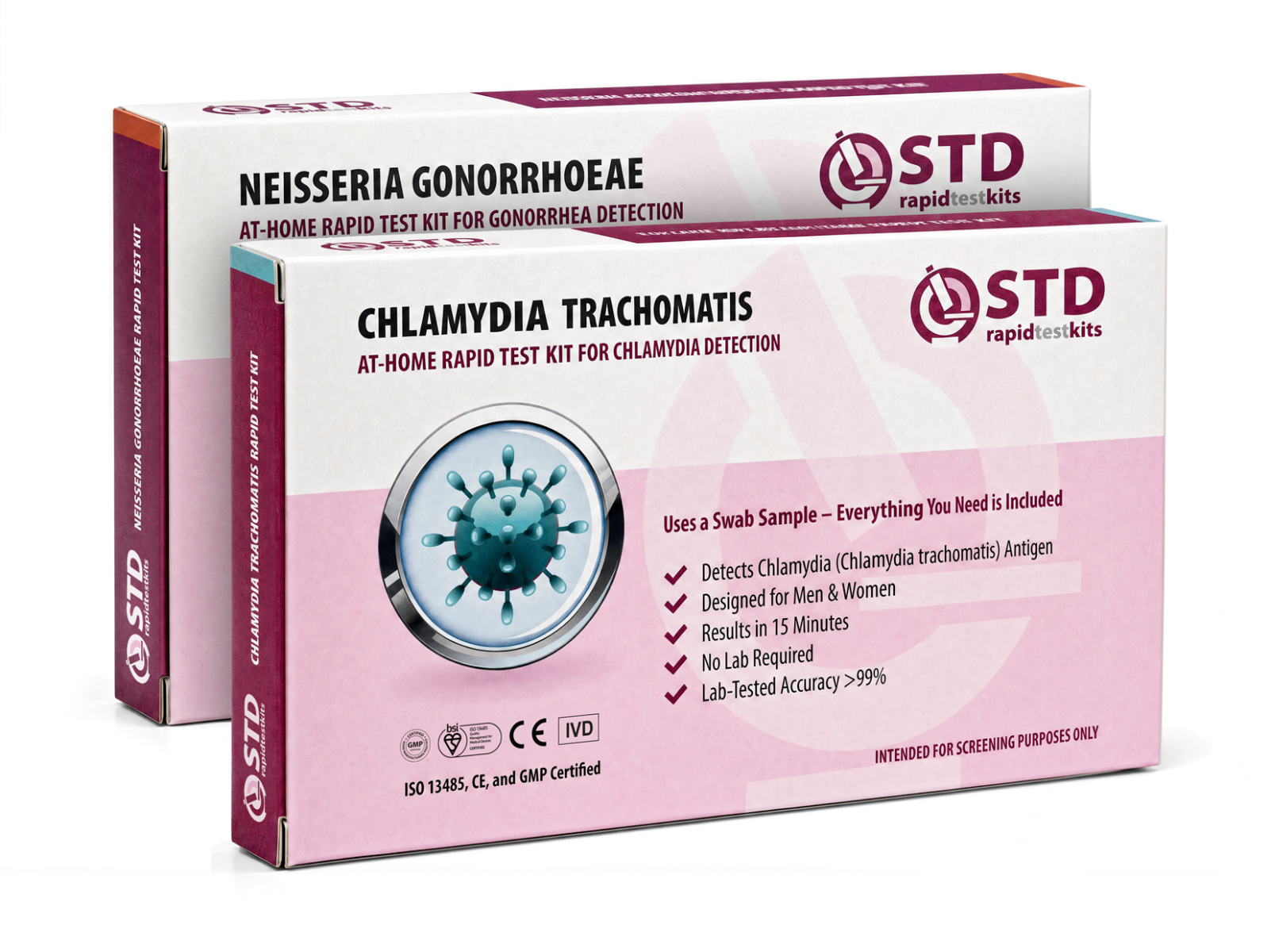
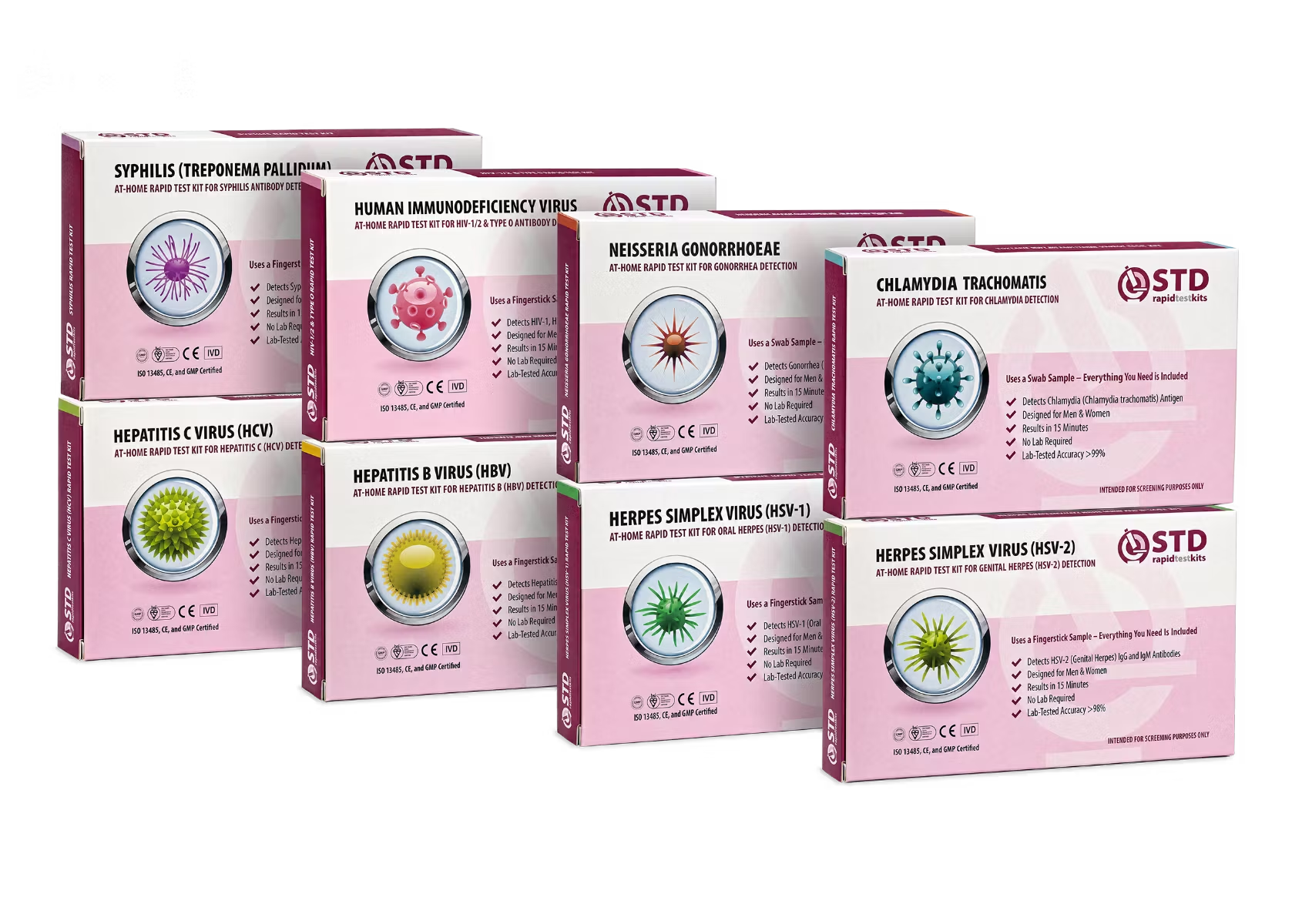
The rapid kits sold on stdrapidtestkits.com cover the most common at-home-testable STIs: chlamydia and gonorrhea (self-collected genital swab), HIV, syphilis, hepatitis B, hepatitis C, herpes (HSV-2 antibody), and combination panels of these. We do not sell pharyngeal swab tests for throat gonorrhea, rectal swabs, or lab-processed NAAT panels. If your concern is specifically a throat or rectal infection (which is plausible after unprotected oral or receptive anal sex), the right test is a clinic-administered swab of that anatomic site, not the genital swab kit. Our products cover the genital and bloodwork side of the same exposure event, which is the part most paid-sex encounters need testing for.
Genital chlamydia and gonorrhea (self-collected urethral or vaginal swab), HIV (fingerstick blood antibody/antigen), syphilis (fingerstick blood antibody), hepatitis B and C (fingerstick blood antibody), and HSV-2 (fingerstick blood antibody at 12 weeks). For pharyngeal gonorrhea or rectal chlamydia, schedule a clinic swab of the affected site. The two test types are complementary, not overlapping.
Frequently asked questions
- Can you get an STD from protected sex with a sex worker?
- Yes, though the risk is meaningfully reduced. Condoms cut most fluid-borne transmission (HIV, gonorrhea, chlamydia from genital contact) substantially when used correctly the entire encounter. They offer only partial protection against skin-to-skin infections (herpes, HPV) because those can transmit from genital skin the condom doesn't cover. Unprotected oral sex is the most common gap clients overlook.
- Is oral sex with a sex worker safe?
- Lower risk than unprotected vaginal or anal sex, but not risk-free. Pharyngeal (throat) gonorrhea, oral chlamydia, syphilis, and herpes can all transmit through oral sex. Pharyngeal infections are usually asymptomatic, which means clients often don't know they've picked something up until a partner is diagnosed.
- How soon should I test after paying for sex?
- Start with a swab at 2 weeks for chlamydia and gonorrhea, since those have the shortest detection window. Blood tests for HIV, syphilis, and HSV-2 antibody need at least 6 weeks, with a final clearance retest at 12 weeks. Skip the 12-week retest only if there was no unprotected contact and the condom held throughout the encounter.
- Do sex workers test more often than casual partners?
- Frequently yes, especially in regulated systems where periodic testing is part of the work. Many sex workers test on a monthly or weekly schedule and use protection more consistently than the average casual partner sourced from a dating app. The test schedule on the other side, however, is not a substitute for your own.
- I have no symptoms. Do I still need to test?
- Yes. A large share of men with chlamydia, gonorrhea (especially pharyngeal), HIV in the acute phase, and HPV have no symptoms at all. "No symptoms" is not a reliable signal of "no infection" in men. Testing is the only way to know.
- Can I test for everything at once?
- Yes. Combination home kits and clinic panels can screen for the major bacterial and viral STIs from a small set of samples (a self-collected swab plus a fingerstick blood drop covers most of the common-infection list). It's faster than running individual tests, and it removes the question of which infection to prioritize first.
- Can I get tested without anyone knowing?
- Yes. At-home rapid kits arrive in plain packaging and produce a result in your own bathroom in about 15 minutes. There's no clinic visit, no waiting room, and no record in your insurance claim file. The kit, the swab, and the result stay with you.
- What if I test positive?
- Most STIs are curable with a short course of antibiotics (chlamydia, gonorrhea, syphilis). The viral ones (HIV, HSV-2, HPV) are managed long-term, and HIV in particular is highly treatable when caught early. A positive home test should be followed by a clinic-confirmed diagnostic and treatment plan. Then, where appropriate, partner notification so the people you've been with can also test and get treated.
You don't need to confess. You need to know.
Most men who pay for sex don't catch anything from the encounter. But the men who do, and don't test in time, become the source of the partner-notification call months later. That's the risk pattern the data describes, and it's the one within your control. Not the encounter, which already happened. Not the partner, whose history you can't audit. Just the testing decision.
The best argument for testing isn't fear. It's the math: a fifteen-minute swab at week two and a fingerstick at week twelve cover the bulk of the common-infection panel for under the price of a restaurant dinner. Compared to weeks of background-noise anxiety or a partner-notification call you didn't see coming, that's a trade most men make once they see the actual numbers laid out.
- U.S. Centers for Disease Control and Prevention. STI screening recommendations for men and women, including elevated-risk groups.
- U.S. Centers for Disease Control and Prevention. Chlamydia basics: transmission, symptoms, and rate of asymptomatic infection in men.
- U.S. Centers for Disease Control and Prevention. Genital herpes basics: HSV-2 transmission, asymptomatic shedding, and condom-protection limits.
- U.S. Centers for Disease Control and Prevention. HIV testing basics, window periods for antibody and antigen testing.
- U.S. Centers for Disease Control and Prevention. Syphilis basics: stages, primary chancre presentation, and testing windows.
- World Health Organization. Sexually transmitted infections (STIs) fact sheet: global incidence and asymptomatic infection rates.
