
Published: November 2025 | Last updated: April 2026 | Editorial review and quality control: Martina N.
The most disorienting thing about genital herpes is how quiet it can be. The classic picture, painful blisters and a textbook flare, is real, but it represents only a slice of how the virus actually shows up. Many people carry herpes simplex virus (HSV-1 or HSV-2) for years without recognizing the signs, because the signs often look like a yeast infection, a stubborn ingrown hair, a urinary tract infection, or a stress rash. This guide walks through the symptoms most often missed, why the body sometimes whispers before it speaks plainly, and how to use testing, both at home and in clinic, to turn a vague worry into a clear answer.
What are the most-overlooked genital herpes symptoms?
The earliest signs are usually subtle: tingling, itching, or burning in the genital area, a single small bump or red patch, mild nerve pain in the buttocks or thighs, or a tiny crack that looks like dry skin. Pain during urination, unusual discharge, or low-grade flu-like aches can also be early clues. Many people have such mild first outbreaks that they assume it is a yeast infection or razor burn. According to the <a href="https://www.cdc.gov/herpes/about/index.html" target="_blank" rel="noopener">CDC</a>, most people with genital herpes have either no symptoms or symptoms so mild they go unrecognized. If something in the area has felt wrong for more than a few days, testing is the only reliable way to know.
Key Takeaways
- Most genital herpes infections produce mild or no obvious symptoms; a tingle, a single bump, or recurring "yeast infection" feelings can all be early clues.
- An at-home blood antibody test confirms whether you have been exposed (useful 12 or more weeks after the suspected event); an active lesion is best diagnosed by a clinic PCR swab.
What genital herpes actually looks and feels like
The textbook description of a first outbreak is dramatic: clusters of fluid-filled blisters that crust over, painful urination, swollen lymph nodes, fever, and body aches that arrive within two to twelve days of exposure. That presentation does happen, especially with a first HSV-2 infection, and it is what most images on the internet show. The NHS describes this pattern in detail.
Reality is usually quieter. Many first outbreaks are mild enough that the person assumes the discomfort is something else. Common atypical presentations include:
- A single small bump or red patch on the labia, penis, scrotum, perianal area, or inner thigh, sometimes mistaken for an ingrown hair or pimple.
- Tiny cracks or splits in the skin that look like dryness or irritation from sex.
- A persistent itch or burn that comes and goes for a few days, then resolves before any lesion appears.
- Mild nerve sensations (tingling, numbness, or shooting pain) in the buttocks, hips, or thighs, sometimes called the prodrome.
- Pain on urination or unusual discharge that mimics a urinary tract infection or yeast infection, particularly in women.
- Low-grade flu-like symptoms (mild fever, fatigue, swollen groin lymph nodes) without obvious skin changes.
Recurrent outbreaks tend to be milder than the first. The body has antibodies by then, so flares are shorter, less painful, and sometimes invisible. Triggers for recurrences include physical stress, illness, friction, hormonal shifts around menstruation, and sometimes nothing identifiable at all. The NHS notes that some people have many recurrences, others go years between them, and still others never have another after the first.
One under-discussed wrinkle: HSV-1, the strain most associated with cold sores around the mouth, is now a leading cause of new genital herpes infections, transmitted through oral sex. Genital HSV-1 typically causes fewer recurrences than genital HSV-2, which makes it even easier to overlook.
Why so many people never realize they are infected
If herpes were always painful and visible, it would be much easier to track. Instead, the virus has three habits that keep it hidden:
- Asymptomatic shedding. The virus can be present and transmissible on the skin without any visible sore or felt symptom. The CDC STI treatment guidelines confirm that most genital HSV-2 transmission occurs from people who do not know they are infected.
- Mild and atypical presentations. First outbreaks are commonly mistaken for friction irritation, jock itch, ingrown hairs, yeast infection, or bacterial vaginosis.
- Long latency. A first outbreak can occur weeks, months, or even years after the initial exposure, which makes it hard to identify a likely source.
The combined effect is that, per the CDC's herpes overview, most people in the United States with genital herpes have never received a diagnosis. They are not careless; they simply never had symptoms strong enough to send them to a clinic.
Recurring symptoms in the same area, especially burning, itching, small bumps, or pain on urination that resolves and returns every few weeks, are worth a second look. Standard urine tests will miss herpes entirely. Ask a clinician specifically about herpes testing, or use an at-home antibody test if you want a private first step.
Why getting diagnosed helps, even without a cure
A common reason people avoid testing is the assumption that there is no point: herpes is not curable, so why look for it? The reasoning is understandable and incomplete. A confirmed diagnosis changes several practical things.
It opens the door to suppressive therapy. Daily antiviral medication (acyclovir, valacyclovir, or famciclovir) can reduce the frequency and severity of outbreaks and substantially reduce the risk of transmission to a sexual partner, per the CDC's treatment guidelines. Episodic therapy, taken at the first sign of a flare, can shorten outbreaks.
It changes pregnancy planning. Neonatal herpes is rare but serious. Knowing your status before or early in pregnancy lets an obstetrician plan suppressive antivirals near term and consider a Cesarean delivery if active lesions are present at labor, which substantially reduces the risk of transmission to the baby.
It explains the past. Some people receive an HSV diagnosis after years of unexplained "recurring yeast infections" or unusual nerve pain. A confirmed diagnosis can finally give those experiences a name.
It enables honest conversations with partners. Disclosure feels harder before testing, when there is nothing concrete to share, than after. With a clear status, the conversation moves from anxiety to logistics: what you do during outbreaks, whether you take suppressive antivirals, and how you and your partner want to use protection.
None of these are small. Most people with herpes go on to have ordinary romantic and sexual lives once they understand what managing the virus looks like in practice.
Daily antivirals (acyclovir, valacyclovir, famciclovir) can cut outbreak frequency and meaningfully lower transmission risk to an uninfected partner. They are prescription medications, so a confirmed diagnosis is the starting point. A GP or sexual-health clinic visit after a positive at-home antibody test is the practical next step.
What at-home herpes testing can (and cannot) tell you
This is the most important practical section in the article, and the one most often muddled in marketing copy. There are two very different types of herpes test, and they answer two different questions.
PCR (nucleic acid) swab testing is performed on fluid taken directly from an active sore. It detects the virus itself and can usually identify the type (HSV-1 or HSV-2). PCR is the most accurate test when there is a visible lesion to swab. It is generally a clinic test rather than a home test, because it requires sampling a fresh sore correctly.
Type-specific antibody (IgG) blood testing is performed on a small blood sample. It detects antibodies the immune system has made in response to the virus, not the virus itself. Antibodies take time to develop after a new infection, a process called seroconversion. According to the CDC, antibodies typically appear within several weeks, but it can take up to four months for some people to seroconvert; testing is most reliable when at least 12 to 16 weeks have passed since a suspected exposure.
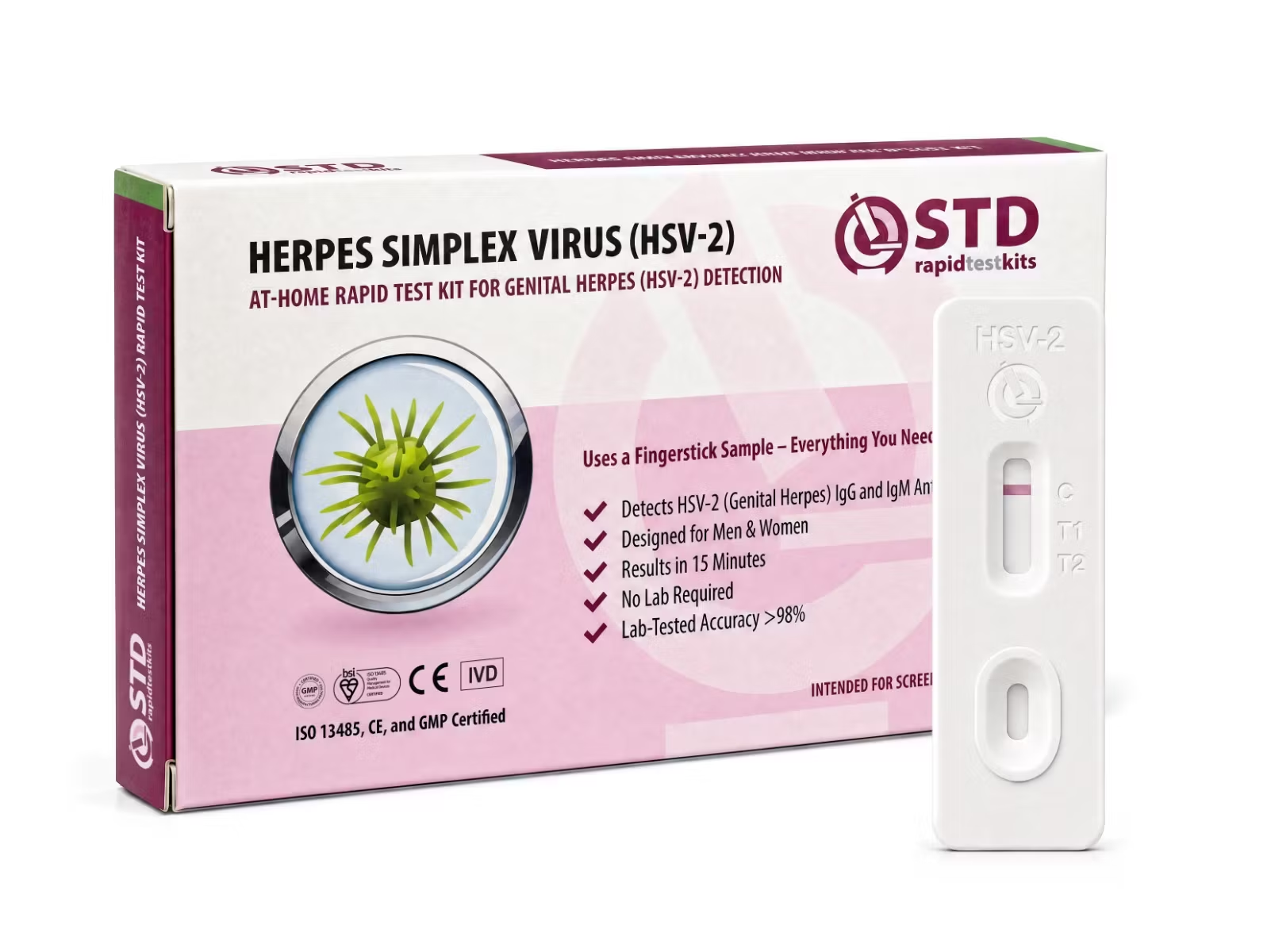
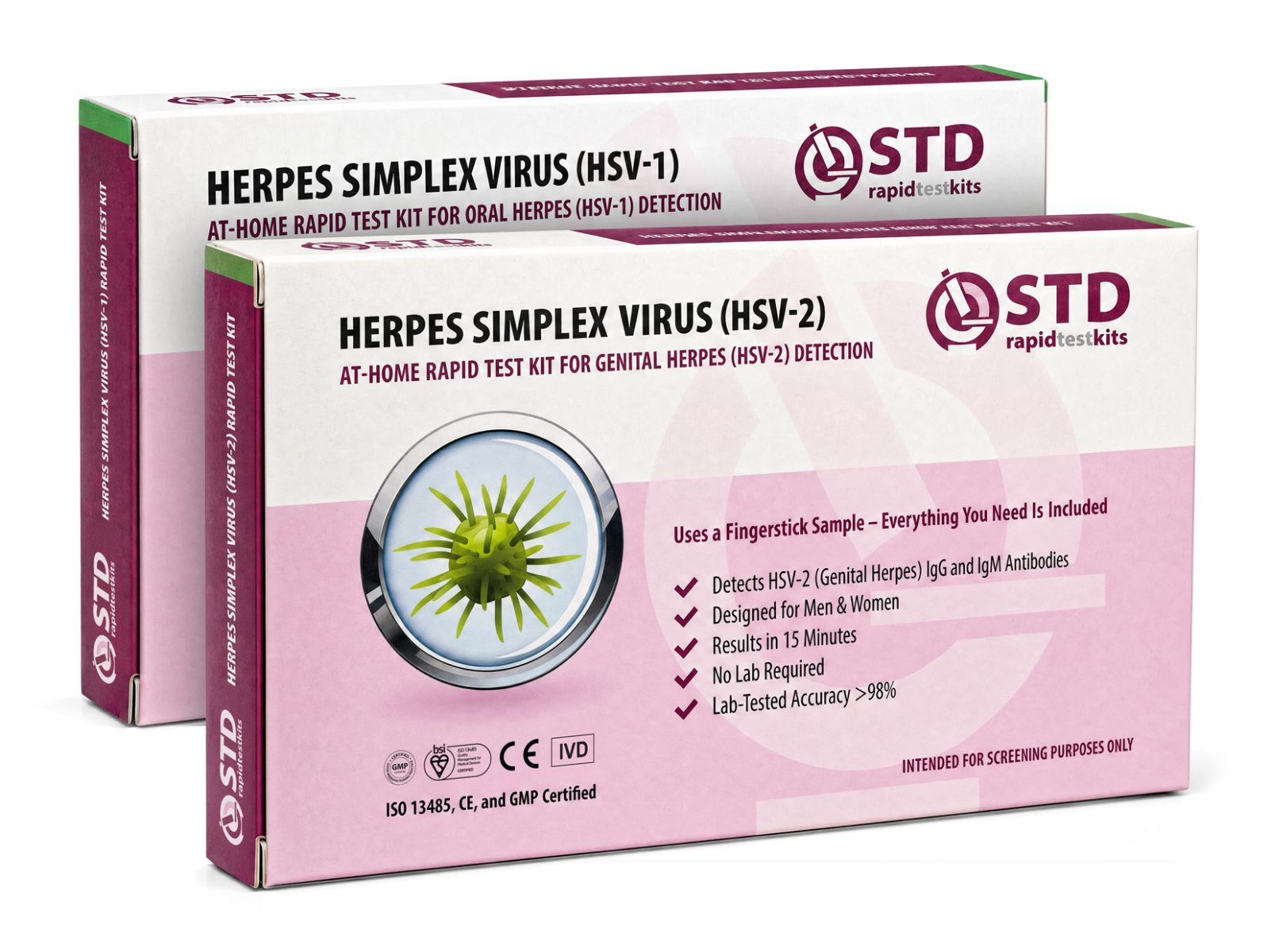
Our at-home herpes kits are fingerstick blood antibody tests. They are designed for the second question above: "have I been exposed at some point in the past?" They are not designed to diagnose what a specific bump on your skin today is, and they are not PCR. The right tool for an active sore is a clinic PCR swab. The right tool for a settled question, weeks after a possible exposure, is a blood antibody test, and that test is what we sell.
Disclosure: the at-home tests linked in this article are sold by stdrapidtestkits.com. Clinical claims throughout the article are sourced independently from CDC, WHO, and NHS.
See a clinician within a day or two. A PCR swab of a fresh lesion is the most accurate way to confirm herpes and identify the type, and is most reliable in the first 48 hours after a sore appears. An antibody test will not characterize the specific lesion in front of you; it answers the question of past exposure.
How transmission really works (and how to lower the risk)
Herpes spreads through direct skin-to-skin contact. Penetrative sex is not required; oral, vaginal, or anal contact, and sometimes close genital-to-genital contact without penetration, can transmit the virus. The skin does not need an obvious sore to be infectious, because of asymptomatic shedding.
Several practical steps lower transmission risk meaningfully:
- Avoid sex during outbreaks and prodromes. When you feel the early tingle or itch, pause until the area has fully healed. The virus is most contagious during this window.
- Use condoms or dental dams consistently. Condoms reduce transmission risk significantly, but not completely, because the virus can live on skin a condom does not cover. The WHO fact sheet on herpes simplex virus places condom use among the most useful preventive tools.
- Consider daily suppressive antivirals. For people with frequent outbreaks or partners who are not infected, daily valacyclovir (or similar) substantially reduces transmission risk, per CDC guidance.
- Be honest before sex. Telling a partner your status is uncomfortable, and most people who do it find that the conversation goes better than feared.
One thing condoms cannot solve is the fact that 80 percent or so of people with genital herpes do not know they have it. Testing matters at the relationship level, not just the individual one.
That figure, drawn from CDC and WHO estimates, is the single most useful piece of context for a new-relationship conversation. Most transmission happens from someone who has never been diagnosed and is not deliberately taking risks. A test before sex with a new partner closes that gap.
Pregnancy, fertility, and what the numbers show
People often hear "herpes" and "pregnancy" together and assume the worst. Reality is more reassuring, with caveats.
Most people with genital herpes have healthy pregnancies and healthy babies. The serious risk is neonatal herpes, when a newborn acquires HSV during birth. Neonatal herpes is rare but can be severe, with possible consequences ranging from skin infection to neurological injury. The risk is highest when the birthing parent acquires HSV for the first time during late pregnancy, because antibodies have not yet developed to cross the placenta and partially protect the baby.
Practical pregnancy steps look like this, per CDC guidance:
- If you know you have HSV, tell your obstetrician early in pregnancy.
- If you have a history of recurrent genital herpes, suppressive antiviral therapy is generally offered from around 36 weeks to reduce the chance of an outbreak at delivery.
- If active lesions or prodromal symptoms are present at the onset of labor, a Cesarean delivery is recommended to substantially reduce transmission risk.
- If you do not know your status and are planning a pregnancy, an antibody test now gives you and your provider time to plan calmly.
Genital herpes itself does not cause infertility. The interaction with pregnancy is real but manageable with early planning.
An antibody test now gives you and your obstetrician time to plan suppressive therapy well before 36 weeks, rather than handling it under time pressure at the end of pregnancy. If both partners test, the plan also accounts for the highest-risk case (a first infection acquired late in pregnancy).
The numbers, plainly stated
The scale of herpes is one of the strongest reasons not to treat it as a moral failure.
- The World Health Organization estimates that approximately 520 million people aged 15 to 49 worldwide are living with HSV-2 infection, roughly 13 percent of that age group.
- The same WHO source estimates approximately 3.8 billion people under age 50 are living with HSV-1, about 64 percent of that age group, the strain that causes cold sores and a growing share of new genital infections.
- The CDC's STI treatment guidelines place U.S. HSV-2 seroprevalence at approximately 12 percent (about 1 in 8) among people aged 14 to 49, with hundreds of thousands of new infections each year.
- The CDC also notes that most people with genital herpes have either no symptoms or symptoms so mild they do not realize they are infected.
- HSV-2 infection is associated with a roughly threefold higher risk of acquiring HIV during exposure, per the WHO, because herpes lesions and inflammation create entry points and recruit cells that HIV preferentially infects.
Read together, those figures describe a virus that is widespread, mostly silent, and routinely missed.
Most people with genital herpes do not know they have it. The infection is often mild or unrecognized, but the virus can still be passed to others.
Myths that keep people from testing
Several stubborn beliefs about herpes prevent people from getting answers and care. None of them survive contact with the data.
"You would know if you had it." Most people with HSV-2 do not know, per the CDC. The mild and atypical presentations described above are the rule, not the exception.
"Herpes only happens to people who are reckless." The virus spreads through skin-to-skin contact and asymptomatic shedding. Monogamous people, people with one lifetime partner, and people who used condoms every time still acquire it. The math of how widespread HSV-1 and HSV-2 are makes it inevitable that careful people are also affected.
"It will end my dating life." Most people with herpes go on to have ordinary romantic and sexual lives. Disclosure conversations are awkward and survivable; suppressive antivirals plus condoms reduce transmission risk significantly.
"A regular STI panel covers it." Standard panels often skip herpes unless requested specifically. If you want to know your HSV status, you usually have to ask for it directly or order a test that includes it.
"I cannot have children." The vast majority of people with herpes have healthy pregnancies. Risk management is real but well-established.
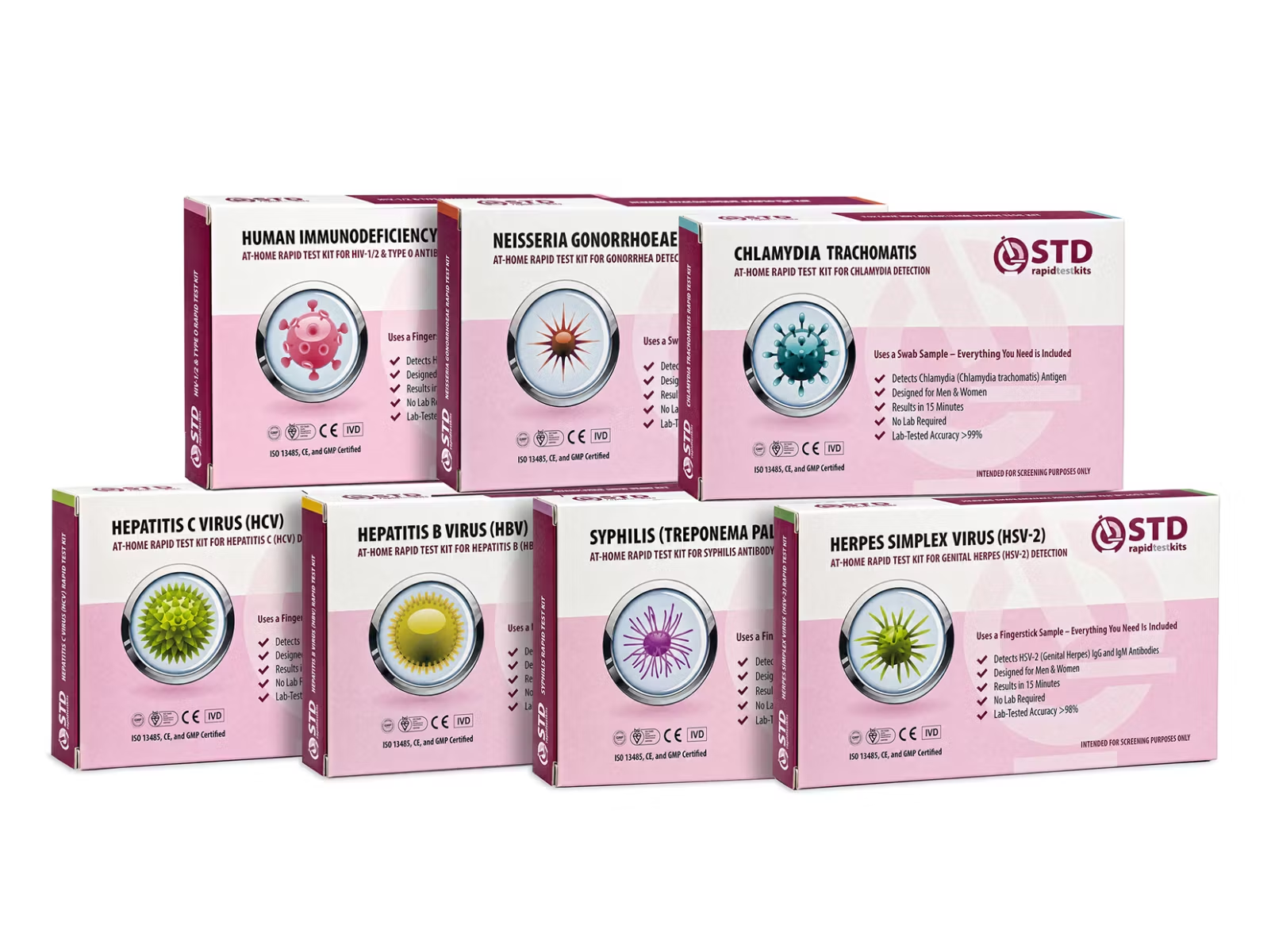
If you want a herpes result from a clinic visit, say so. "Full STI panel" usually means HIV, syphilis, chlamydia, and gonorrhea. HSV antibody testing is a separate request, and many clinicians will not run it without one. The same is true online: order a test that names HSV in its description.
Common questions about genital herpes symptoms
- How soon after sex would symptoms appear?
- If you are going to have a first outbreak, it usually shows up within 2 to 12 days of exposure, per NHS and CDC guidance. Some people have a first outbreak weeks, months, or years later, and many never have a recognizable first outbreak at all.
- Can I have herpes and never have an outbreak?
- Yes. The CDC notes most people with genital herpes either never develop noticeable symptoms or have signs so mild they go unrecognized. They can still transmit the virus through asymptomatic shedding.
- Is a single bump always herpes?
- No. Single bumps can be ingrown hairs, folliculitis, blocked oil glands, molluscum contagiosum, or simple irritation. The only way to know is to test, ideally with a PCR swab if the lesion is fresh, or an antibody test once enough time has passed since possible exposure.
- How accurate is an at-home herpes test?
- Type-specific IgG antibody tests, including the at-home format, perform well once the immune system has had time to seroconvert (commonly several weeks, with most people seroconverted by about 12 to 16 weeks per CDC). For exact sensitivity and specificity figures, see the data sheet on each product page (for example, the <a href="https://www.stdrapidtestkits.com/genital-herpes-2-at-home-rapid-self-test-kit" target="_blank" rel="noopener">HSV-2 antibody test page</a>). Testing too early after exposure is the most common reason for a false negative.
- Can I get genital herpes from oral sex?
- Yes. HSV-1, the strain most often associated with cold sores, can be transmitted to the genitals through oral sex. Genital HSV-1 typically causes fewer recurrences than genital HSV-2, but it is real herpes and can be transmitted onward.
- Do condoms fully prevent herpes?
- No. Condoms reduce transmission risk meaningfully because they cover the highest-risk skin, but the virus can shed from areas a condom does not cover. WHO and CDC both list condoms as one of several useful tools, alongside suppressive antivirals and avoiding sex during outbreaks.
- Will herpes affect pregnancy?
- Most people with HSV have healthy pregnancies. Risk to the baby is highest when a parent acquires HSV for the first time late in pregnancy. Suppressive antivirals from around 36 weeks and a Cesarean delivery if active lesions are present at labor substantially reduce neonatal risk, per CDC guidance.
- How do I tell a partner I have herpes?
- Pick a private, low-pressure moment before any sexual contact. State the facts plainly: which type, how often it flares, what you do to prevent transmission (suppressive antivirals, avoiding sex during prodromes, condoms). Most partners respond better than people fear, especially when the conversation feels informed rather than ashamed.
- U.S. Centers for Disease Control and Prevention. About Genital Herpes (overview, prevalence, and transmission).
- U.S. Centers for Disease Control and Prevention. Sexually Transmitted Infections Treatment Guidelines: Genital HSV Infections (U.S. seroprevalence, testing, antiviral therapy, suppressive therapy, pregnancy management).
- World Health Organization. Herpes simplex virus fact sheet (global HSV-1 and HSV-2 prevalence, HIV interaction, prevention).
- NHS. Genital herpes (overview, symptoms, recurrences, treatment).
