Published: December 2025 | Last updated: May 2026 | Editorial review and quality control: Martina N.
The question hides under a lot of late-night internet searches and a few quiet conversations with friends. New person, new bed, new worry. Should the next step be a full STD panel, or is that an overreaction? The grounded answer depends on three things: how often your sexual contacts change, what protection actually looks like in practice (not in the version you tell yourself afterward), and whether enough time has passed since the last exposure for a test result to mean anything.
This guide unpacks what a 'full panel' actually covers, which varies more than most people realize, when comprehensive testing is the right call, when it tips into anxiety management instead of risk management, and how to build a testing rhythm that matches your life rather than your worst-case-scenario brain.
Key Takeaways
- A 'full STD panel' is not a standardized list. The infections actually screened depend on the clinic, your reported risk factors, and what you specifically request.
- Testing frequency should match your exposure pattern, not your anxiety level. CDC suggests at least annual screening for sexually active people with risk factors, and every 3 to 6 months for those at higher risk, including people with multiple partners, those on PrEP, or per their provider's guidance.
Why This Question Hits So Hard
Testing is not just a medical event. It carries trust, control, anxiety, and sometimes shame. Two patterns show up over and over in sexual health counseling. One person tests after every new partner because the alternative is sleepless nights and a brain that invents symptoms by morning. Another person avoids testing for years because asking feels like accusing, and they equate 'responsible' with 'relaxed.'
Neither extreme is automatically wrong, and both are worth a closer look. Sexually transmitted infections do not care how trustworthy a partner seems, how exclusive things feel, or how good the chemistry was. Many infections, including chlamydia, gonorrhea, and early HIV, are commonly asymptomatic during the early window when transmission risk is highest, which is exactly why public-health guidance leans on screening rather than waiting for symptoms (CDC overview of STIs).
Feeling fine is not proof of being infection-free. But it also means testing strategy should be thoughtful, not purely fear-driven.
This article is published by stdrapidtestkits.com, which sells at-home rapid lateral-flow STI test kits (swab tests for chlamydia, gonorrhea, trichomoniasis, and HPV; fingerstick blood tests for HIV, syphilis, hepatitis B and C, and herpes). We do not sell throat swabs, rectal swabs, urine tests, or lab-processed NAAT panels. When this guide mentions a test we do not offer (for example, a pharyngeal swab after oral exposure), we point you toward a clinic for that specific sample type. We recommend at-home options based on fit, not commercial benefit.
What a 'Full STD Panel' Actually Covers (and What It Often Skips)
Most people assume a 'full panel' is a fixed list. It is not. The infections screened depend on the lab order, the clinician, and the risk factors a patient reports.
In many clinics, a standard panel covers chlamydia, gonorrhea, HIV, and syphilis. Some panels add hepatitis B and hepatitis C. Trichomoniasis is included less consistently. HPV testing is generally bundled with cervical cancer screening rather than offered as part of a general STI workup, and there is no routine HPV test for men in standard guidelines. So when someone says 'I just got a full panel,' that phrase is doing a lot of unverified work.
Herpes is the other commonly misunderstood category. Per CDC STI Treatment Guidelines, routine herpes serologic screening is not recommended for asymptomatic individuals in low-prevalence populations, because antibody tests have a meaningful false-positive rate and cannot reliably distinguish oral from genital infection (CDC STI Treatment Guidelines). What gets bundled into a 'full panel' and what needs a separate ask:
| Infection | Commonly Included in Standard Panel? | Often Requires Separate Request? |
|---|---|---|
| Chlamydia | Yes | No |
| Gonorrhea | Yes | No |
| HIV | Yes | No |
| Syphilis | Yes | No |
| Hepatitis B | Sometimes | Often |
| Hepatitis C | Sometimes | Often |
| Trichomoniasis | Not always | Yes |
| HPV | Rarely (and not for men) | Yes |
| Herpes (HSV-1 & HSV-2) | Not routine without symptoms | Yes |
Risk Is Mathematical, Not Moral
The cleanest way to answer 'is this overkill?' is to set aside judgment and look at exposure probability. Two examples make the contrast obvious.
Person A has one new partner every two years. Condoms are used consistently. Both partners test before going condom-free. There are no overlapping relationships. In this pattern, a full panel before becoming exclusive makes sense. Repeating a full panel every few months in the absence of new exposure adds little medical value.
Person B dates casually, with several new partners over the course of a year. Condom use is consistent for penetrative sex but not for oral sex. In that pattern, comprehensive screening every three to six months is reasonable and aligns with public-health guidance.
Frequency of new partners, condom use, types of sex, and whether partners overlap all change the math. CDC recommends at least annual chlamydia and gonorrhea screening for sexually active women under 25, and for older women and men with risk factors such as new or multiple sex partners (CDC STI screening recommendations). That does not mean panic testing after every kiss. It means your dating pattern matters more than your anxiety level.
Is a full STD panel after every new partner overkill?
Sometimes, and sometimes not. If you have multiple new partners per year, overlapping relationships, or inconsistent protection, comprehensive screening every 3 to 6 months (and sometimes after a specific new partner) is appropriate. If you are in a stable, mutually-tested relationship with no new exposures, repeating a full panel after every anxiety spike rarely changes outcomes. Timing matters as much as frequency: testing inside the window period produces unreliable negatives, no matter how many times you test.
When a Full Panel Is the Right Call
There are moments when a comprehensive panel is not overkill at all. It is strategic.
One natural moment is before stopping condom use in a new relationship. That conversation, the 'are we exclusive?' talk, is one of the cleanest opportunities to frame testing as mutual care rather than suspicion. Both partners test on the same timeline, both get the same conversation, and the dynamic stays equal.
Another is after a known risk event. A condom break. A partner disclosing a positive result. A blurry encounter where protection details are uncertain. In those moments, a full panel offers clarity across multiple infections at once rather than chasing one test at a time.
A third pattern is structural: people in non-monogamous relationships or who date frequently often schedule comprehensive screening every three to six months as maintenance. Maintenance testing is different from fear-based testing, and that distinction is the difference between feeling in control of your sexual health and feeling chased by it.
Three Moments When a Full Panel Earns Its Keep
- Before stopping condom use in a new relationship: mutual testing as collaborative prevention, not interrogation.
- After a known risk event: a condom break, a partner's positive disclosure, or a blurry encounter where protection details are uncertain.
- As scheduled maintenance for people in non-monogamous relationships or active casual-dating patterns: every three to six months, with the same predictability as any other routine health screening.
When Frequent Testing Tips into Over-Testing
There is a quieter side of this conversation that does not get enough airtime. Some people test compulsively. They test after every encounter even when protection was used correctly and no new risk occurred. They retest before window periods are complete. They chase reassurance rather than accuracy.
A common pattern: three HIV tests within two weeks of the same exposure, even though modern fourth-generation antigen-antibody tests need roughly 18 to 45 days to reliably detect early infection (CDC HIV testing overview). Testing too early produces false negatives that briefly calm anxiety, then feed it. Timing is the issue, not frequency.
The table below shows the typical window periods to keep in mind before scheduling a test.
| Infection | Earliest Reliable Detection | Optimal Testing Time |
|---|---|---|
| Chlamydia | About 7 days after exposure | 14 days after exposure |
| Gonorrhea | About 7 days | 14 days |
| Syphilis | 3 to 4 weeks | 6 weeks or later |
| HIV (4th-generation antigen/antibody) | 18 to 21 days | 45 days for high confidence |
| Hepatitis C | 2 to 6 weeks | 8 to 12 weeks |
How Clinicians Frame Testing Frequency
Clinicians do not start with the word 'overkill.' They start with patterns: patterns of exposure, patterns of protection, and patterns of partner change. A patient with two new partners in the last six months, inconsistent oral-sex protection, and no symptoms is not being ridiculous for asking about a full panel. That is proportional.
A patient in a monogamous relationship for two years, both partners tested before going exclusive, no new exposures since, who wants a full panel every time a wave of anxiety hits, is unlikely to change medical outcomes by retesting. The conversation in that visit usually shifts to whether the anxiety itself is the thing worth addressing.
Risk mapped to cadence, without the moral weight:
| Dating Pattern | Suggested Testing Cadence | Full Panel Each Time? |
|---|---|---|
| One new partner per year, consistent condom use | Before going condom-free, or annually | Usually no, unless new risk |
| Multiple partners per year, consistent protection | Every 3 to 6 months | Often reasonable |
| Multiple partners, inconsistent protection | Every 3 months | Yes, comprehensive screening recommended |
| Open or non-monogamous relationship | Every 3 months, or per partner agreement | Common practice |
| Long-term monogamous relationship, both partners tested | Only with new exposure or symptoms | No |
Testing Before Going Exclusive
This is one of the healthiest uses of a full STD panel and one of the easiest to recommend. The 'are we still seeing other people?' conversation is also a natural opening for the 'should we both get tested?' conversation. Comprehensive screening before stopping condom use is collaborative prevention, not interrogation.
The framing that makes this work: both partners test on the same timeline, with the same panel, and share the results. That structure removes the hierarchy where one person is the suspect and the other is the assumed-immune. It also accounts for the timing trap, where a recent negative result from one person looks reassuring but was actually taken before the most recent exposure cleared the window period.
For couples genuinely planning to skip condoms, testing together is one of the cleanest signals that the relationship is moving from casual to intentional.
'I really like where this is going. Want to test together so we can both feel good about ditching condoms?'
That phrasing turns testing into a shared step rather than a suspicion test. Both people opt in. Both get information. No one is on trial.
Cost, Access, and the Reality of Modern Dating
Full STD panels cost money. In a clinic without insurance, comprehensive testing can run several hundred dollars per visit. Even with insurance, copays and lab fees stack up fast for someone trying to retest after every new partner. For people who date frequently, that math becomes unsustainable.
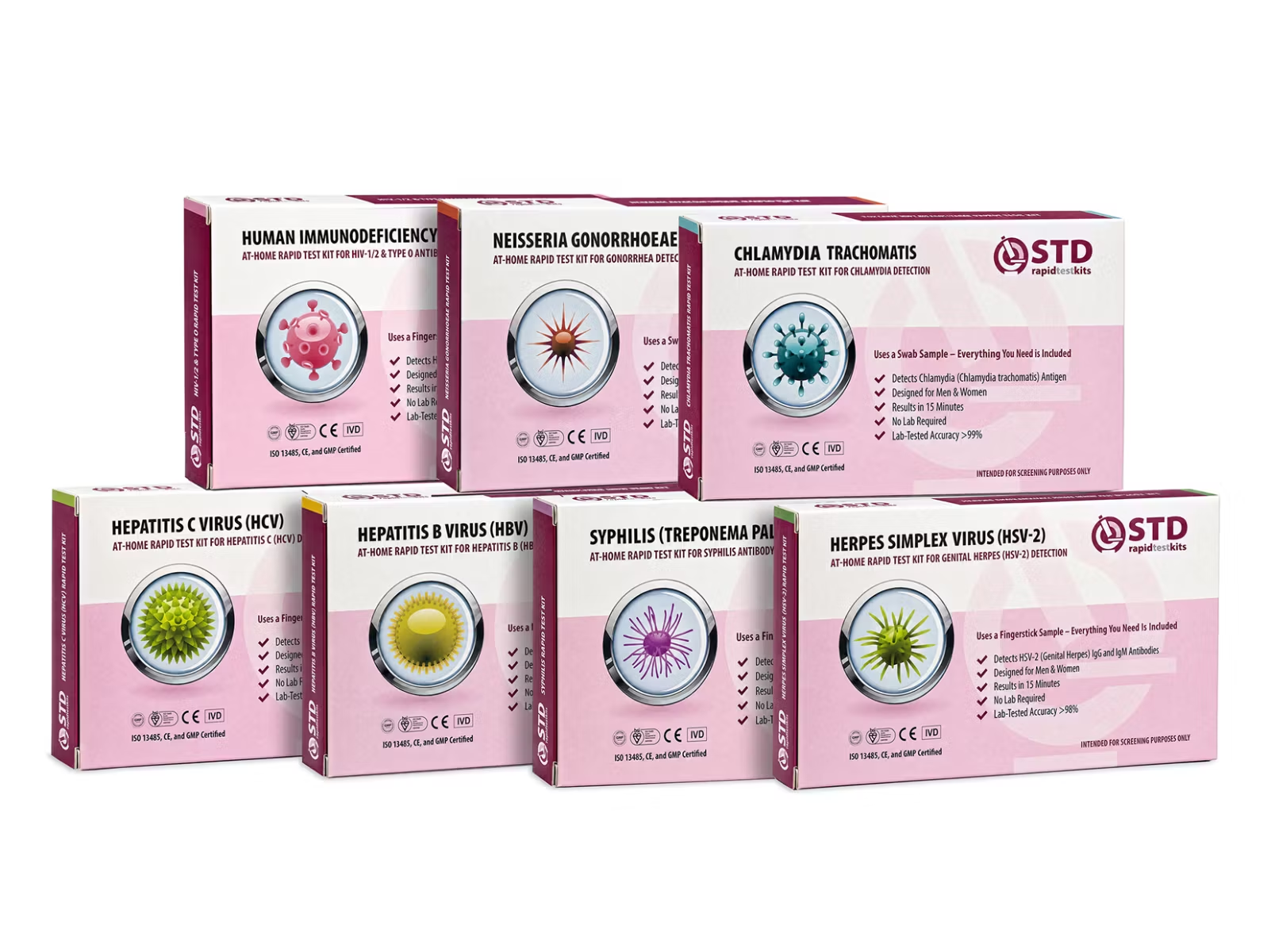
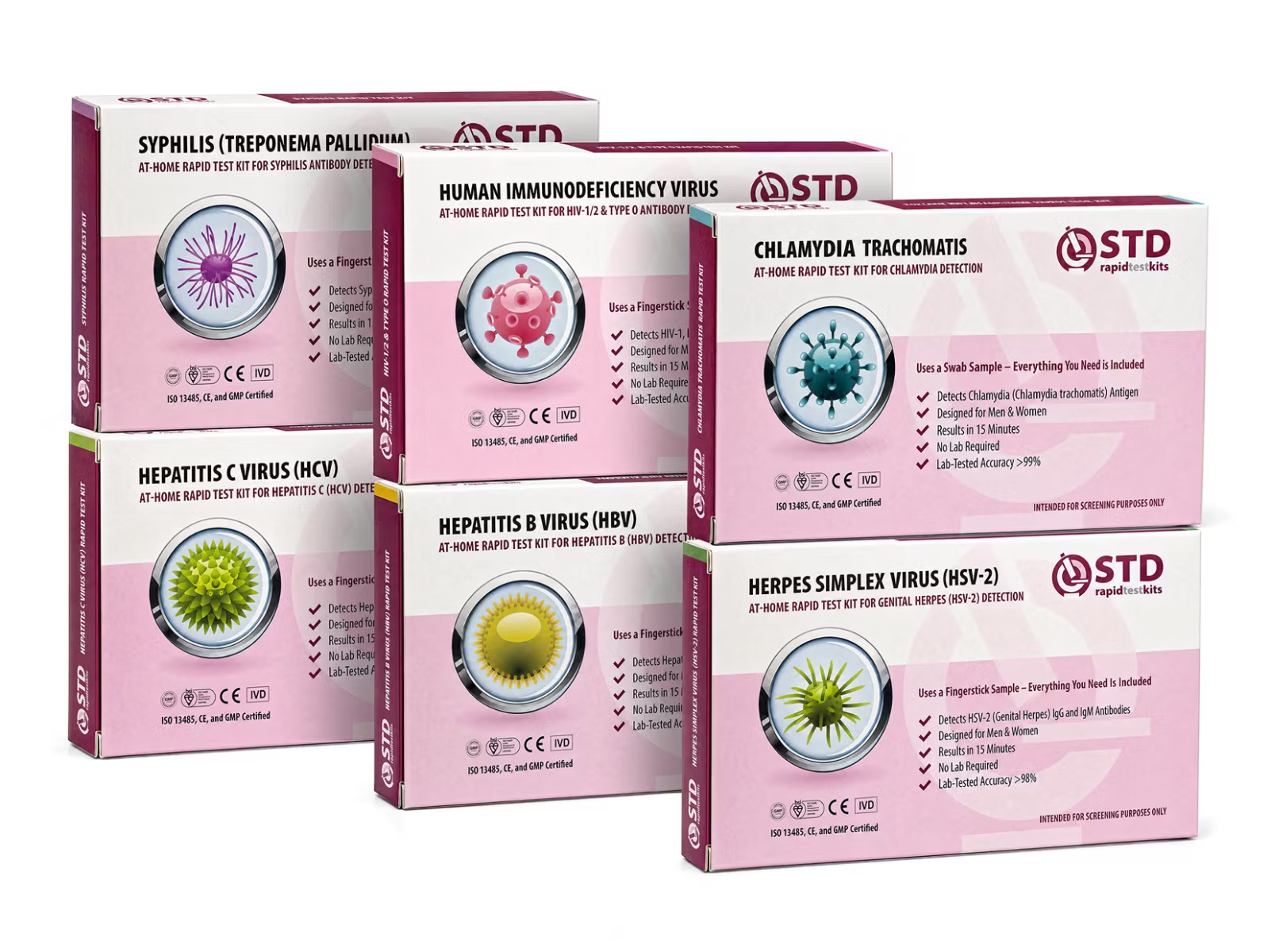
Home-based rapid testing has changed the access picture. Lateral-flow tests for HIV, syphilis, hepatitis, herpes, chlamydia, and gonorrhea (among others) let people screen on their own schedule without waiting rooms or confusing billing codes. They are not a replacement for lab NAAT testing in every situation; a positive home result is worth confirming in a clinic, and certain exposures (throat, rectal) need clinic-administered swabs that no home product covers. But for routine maintenance screening in someone with an active dating life, accessible at-home options remove a major reason people skip testing entirely.
Testing should not feel like a financial punishment for having an active sex life. It should feel like part of the infrastructure.
Clinic full panel without insurance: roughly $200 to $500+ per visit, depending on lab, region, and which infections are included.
Insured clinic visit: copay plus lab fees, which add up quickly when retesting every few weeks.
At-home rapid kit: one upfront cost, no appointment, screens on your own schedule. Positive results still warrant a confirmatory clinic test.
Condoms Lower the Risk, but Not to Zero
A common question: 'If we used a condom, do I still need a full STD panel?' Condoms dramatically reduce the risk of fluid-borne infections like HIV, chlamydia, gonorrhea, and hepatitis. They are one of the most effective single tools in STI prevention.
What they do not do is eliminate every risk. Infections transmitted through skin-to-skin contact, including herpes and HPV, can spread through areas a condom does not cover. Condoms are protective, not magical. That is not an argument against condoms. It is an argument for understanding what a 'we used protection' encounter actually covers.
If condom use was consistent and correct, and this was a single encounter, a targeted testing approach (chlamydia, gonorrhea, HIV at the appropriate window) may be enough. A full panel every single time is not automatically required. But if condom use was inconsistent, the condom slipped or broke, or you are simply not sure, broader testing is justified.

Retiring the 'I'm Clean' Script
There is a phrase that floats around early dating conversations that sounds reassuring but means almost nothing medically: 'I'm clean.' Two people will negotiate this in real time, one offers the phrase, the other nods, visibly relieved, and no one asks when the last test was, what was included, or whether there were partners since.
'Clean' is not a test result. It is a feeling. Feelings do not detect chlamydia, gonorrhea, or early syphilis. The phrase also carries the implication that an untested or positive person is 'dirty,' which is exactly the framing that drives people away from testing in the first place.
A better script gives concrete information someone can actually act on. It also signals that the speaker takes their own sexual health seriously enough to know the details, which is a far stronger indicator than 'clean.'
'I tested in March. The panel covered HIV, chlamydia, gonorrhea, and syphilis. I have had one partner since, and we used condoms.'
Date of last test. What was actually screened. What has happened since. Three pieces of information a partner can reason with, instead of a single vague word.
Build a Testing Rhythm, Not a Reflex
One of the healthier approaches to sexual health is creating a rhythm. Not reacting after every single encounter, but setting a baseline cadence that matches your dating life. Think of it less like a smoke alarm and more like an oil change. You do it at intervals based on actual usage, not because you happened to drive somewhere yesterday.
For people dating casually or with multiple partners per year, a three-to-six-month comprehensive panel is a reasonable rhythm. For people dating infrequently, testing before exclusivity or annually is usually enough. The point is consistency. When testing becomes routine rather than crisis-driven, it stops feeling like damage control and starts feeling like maintenance.
For people who want a more discreet, self-paced option, ordering through stdrapidtestkits.com lets you keep that rhythm without navigating clinic scheduling. A combo home test kit simplifies regular comprehensive screening for people whose dating pattern justifies it. It is part of adult sexual infrastructure.
When a Targeted Test Beats a Full Panel
Sometimes a full panel after a new partner is unnecessary because the exposure itself was narrow. If the only risk was unprotected oral sex, the most relevant test is a throat swab for chlamydia and gonorrhea, which is a clinic-administered pharyngeal swab. (That specific test is not something we sell at home; for a throat-swab evaluation, a sexual health clinic or your primary care provider is the right path.) Adding broad blood work on top of that adds cost without adding clarity for the specific exposure.
Similarly, if you had a condom-protected encounter with no skin-to-skin lesions or visible sores, broad herpes antibody testing without symptoms is unlikely to give you useful information and may give you a falsely positive one.
This is where individualized testing matters more than blanket panels. Medicine works best when it is specific. A targeted approach can reduce both cost and unnecessary anxiety while still meeting the responsibility you and your partners deserve.
If the exposure was oral sex only, the relevant test is a pharyngeal swab for chlamydia and gonorrhea, administered at a clinic or by your primary care provider. We do not sell throat swabs at home. Our genital swab and blood panels cover the systemic risk from the same exposure event (for example, HIV or syphilis after the appropriate window) but they do not detect a throat-specific infection. Use both tools where they fit.
Your Personal Decision Framework
Instead of asking 'is this overkill,' ask three sharper questions. How many new partners have you had since your last test? Was condom use consistent and correct, or were there gaps? Has enough time passed since the exposure for the relevant tests to be reliable?
If the answers point toward meaningful exposure, a full STD panel is not dramatic. It is appropriate. If the answers point toward low exposure with recent testing inside the appropriate window periods, waiting for your next routine screening is equally responsible.
You do not need to test after every spark of attraction. You need to test in alignment with your actual behavior. Responsible does not mean reactive, and restraint is not the same as carelessness. The goal of sexual health screening is empowerment, not obsession.
CDC recommends yearly chlamydia and gonorrhea screening for all sexually active women younger than 25, and for older women with risk factors such as new or multiple sex partners.
FAQs
- Do I really need a full STD panel after every new partner?
- Not always. If you have had three new partners in the last six months, routine comprehensive testing makes sense. If this is your first new partner in a year, condoms were used consistently, and you tested recently inside the appropriate window periods, you do not need to sprint to the lab. Responsible does not mean reactive. It means proportional.
- What if I feel anxious about an exposure regardless of the statistics?
- Anxiety is real and does not disappear because the numbers say risk is low. If testing helps you sleep, that is a legitimate reason to test, but time it correctly. Testing five days after exposure will not calm your brain if the result is not yet reliable. Wait for the appropriate window, then test once. For most infections, that ranges from 14 days (chlamydia, gonorrhea) to 45 days (fourth-generation HIV test); the window-period table above lists the key timelines.
- Is it weird to ask someone to test before we stop using condoms?
- Only if we keep pretending sex does not carry shared responsibility. Framing makes it easier: 'I really like where this is going. Want to test together so we can both feel good about ditching condoms?' That is collaboration, not interrogation.
- If a partner says they are 'clean,' should I just trust that?
- Trust is good. Concrete information is better. 'Clean' does not tell you when they tested, what was included, or whether there were partners after that test. It is reasonable to ask follow-up questions, and even more reasonable to suggest testing together instead of treating their word as a lab result.
- What if we used a condom the whole time?
- Condoms are excellent protection against fluid-based infections like HIV and chlamydia and dramatically reduce overall risk. They do not eliminate every possibility, especially for skin-to-skin infections like herpes or HPV. If protection was consistent and there were no condom issues, you may not need a full panel immediately, but a regular screening schedule is still smart.
- Is monthly testing too much?
- For most people, yes. Unless you have a high-frequency, higher-risk dating pattern, monthly testing usually reflects anxiety rather than exposure. Three-to-six-month intervals are common for people with multiple partners. Testing every few weeks without new risk rarely improves safety; it drains your wallet and your nervous system.
- Can I have an STD and feel completely fine?
- Absolutely. Many people with chlamydia, gonorrhea, or early HIV have no symptoms at all. No discharge, no pain, no rash. Testing decisions should not rest solely on how your body feels. Silence is not the same as a negative result.
- What if I test negative but still feel like something is off?
- First, check timing. Was the test inside the window period for the relevant infection? If yes and symptoms persist, see a clinician. Not every genital symptom is an STI. Yeast infections, UTIs, friction irritation, and even anxiety can mimic STI symptoms. Testing is one tool. Clinical evaluation is another.
How we sourced this article: This guide synthesizes current screening guidance from the U.S. Centers for Disease Control and Prevention, the World Health Organization, and peer-reviewed clinical literature on STI testing windows and screening cadence. Specific frequency and window-period figures are linked inline to the public-health sources they come from. Editorial framing reflects standard clinical-counseling practice in STI prevention, not personal clinical advice.
- U.S. Centers for Disease Control and Prevention. STI Treatment Guidelines, Screening Recommendations. Source for annual and risk-based screening cadence for chlamydia and gonorrhea.
- U.S. Centers for Disease Control and Prevention. About Sexually Transmitted Infections. Source for asymptomatic-infection framing and general STI prevalence context.
- U.S. Centers for Disease Control and Prevention. HIV Testing. Source for window-period guidance on fourth-generation antigen-antibody testing.
- U.S. Centers for Disease Control and Prevention. STI Treatment Guidelines. Source for the recommendation against routine herpes serologic screening in asymptomatic individuals.
- World Health Organization. Sexually Transmitted Infections (STIs) Fact Sheet. Source for global STI prevalence and screening rationale.
- Planned Parenthood. STDs, HIV & Safer Sex. Reader-facing reference for STI basics and testing access.
