Published: August 2025 | Editorial review and quality control: Martina N.
Six years after SARS-CoV-2 first reached the U.S., one question still lands in our inbox: can you catch COVID-19 from sex? The short answer is no, not in the way the question usually means it. COVID-19 is a respiratory illness, not a sexually transmitted infection. Researchers have studied semen, vaginal secretions, and rectal samples since 2020, and none of the major public-health agencies (CDC, WHO, NHS) classify SARS-CoV-2 as sexually transmitted in 2026.
That said, intimate contact is rarely just genital. Kissing, breathing near someone's face, sharing a bed for hours, all of these spread SARS-CoV-2 the same way being in any close conversation does. The risk during sex comes from breathing the same air for an extended period, not from anything sexual or genital. This guide explains what the 2026 evidence shows about COVID-19 transmission, what a positive partner means for your sex life, where the lasting overlap with STI testing actually sits, and how to make sense of intimate-health decisions without the 2020-era panic.
Key takeaways
- Six years of research has not established sexual fluids as a meaningful route of COVID-19 transmission. The virus spreads through respiratory droplets and aerosols people produce when they breathe, talk, cough, or sneeze, including during close intimate contact.
- If a partner has active COVID-19, intimacy is risky because you are sharing air, not because anything genital is happening. The same protective steps that work for any close indoor exposure (isolation, ventilation, masks if you must share a room) still apply in 2026.
The short answer: COVID-19 is not an STI
Sexually transmitted infections are defined by their primary route of transmission: through semen, vaginal fluid, blood, or skin-to-skin contact during sex. Chlamydia, gonorrhea, HIV, syphilis, HSV, HPV, hepatitis B, trichomoniasis, all of these spread because something biologically happens at the point of sexual contact.
SARS-CoV-2 does not fit that definition. The CDC's current page on how COVID-19 spreads attributes transmission to droplets and very small particles an infected person breathes out, which other people then inhale or get on their eyes, nose, or mouth (CDC, About COVID-19). The World Health Organization describes the same mechanism: liquid particles released when someone coughs, sneezes, speaks, sings, or breathes, ranging from larger respiratory droplets to smaller aerosols (WHO, Coronavirus disease).
Neither agency lists semen, vaginal fluid, or sexual contact among primary transmission routes. Researchers have looked, repeatedly, in studies dating back to 2020. The takeaway is consistent: viral RNA has been detected in bodily fluids in a handful of cases, but RNA presence is not the same as infectious virus, and no documented chain of person-to-person transmission has been traced specifically to sexual fluids rather than to the breathing that accompanied the sex.
stdrapidtestkits.com sells at-home STI testing kits. We're writing this piece because the question still comes up, and because the COVID-19 era genuinely did change how many people think about intimate health and routine testing. We recommend products only where they fit the reader's actual concern, not by default.
How SARS-CoV-2 moves between people
The mechanism matters because it determines what does and doesn't put you at risk during intimacy.
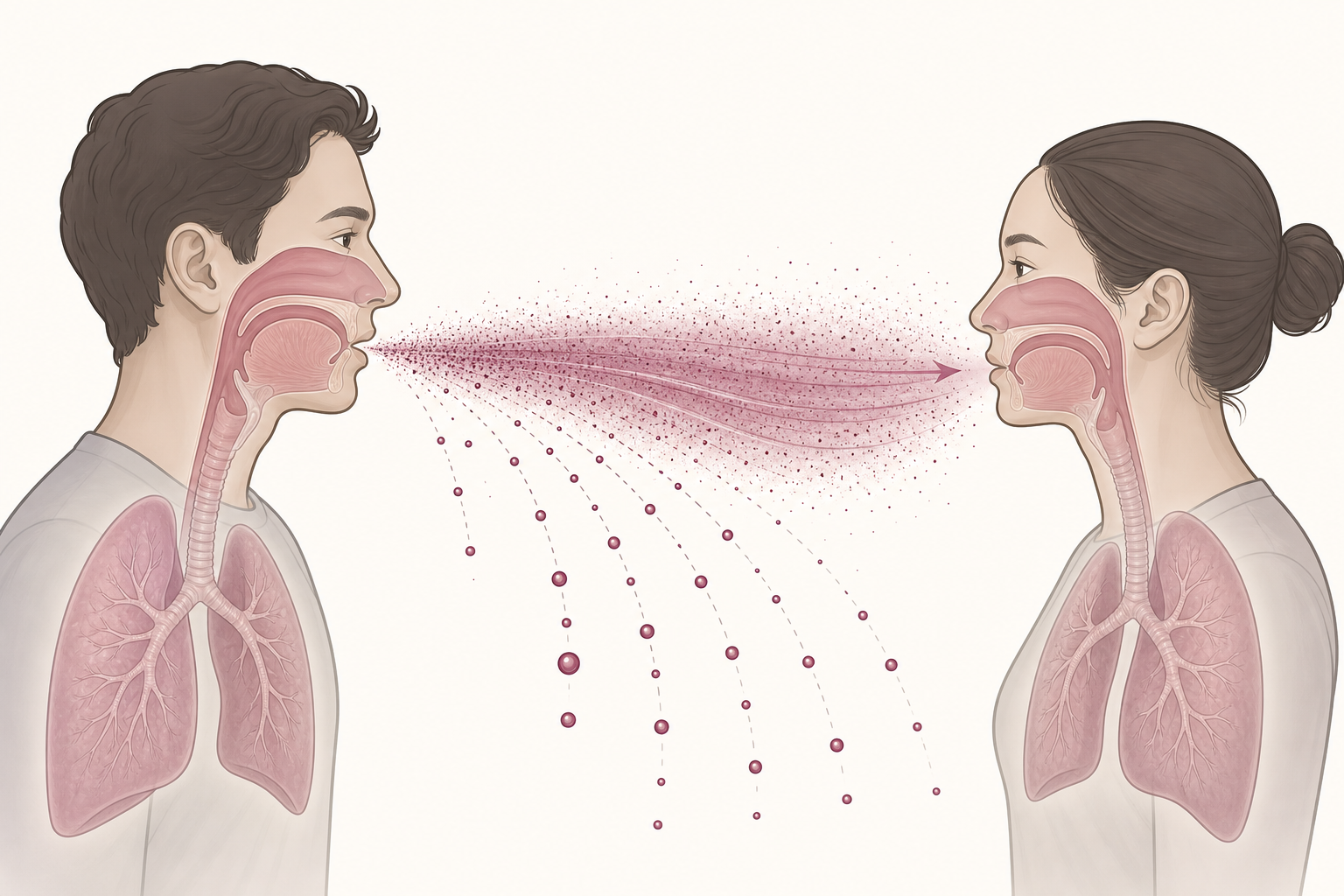
SARS-CoV-2 leaves an infected person through the respiratory system. Every breath, every word, every cough releases particles. Larger droplets fall to nearby surfaces within seconds. Smaller particles (often called aerosols) drift on indoor air currents and can linger in poorly ventilated rooms for minutes to hours. Another person catches the virus when those particles reach their nose, mouth, or eyes, either directly through inhaled air or, less commonly, through touching a contaminated surface and then touching their face.
Two practical implications of this for intimacy:
- Distance is irrelevant during sex. Any sexual activity puts your faces within centimeters of each other, often for extended periods, often with heavy breathing. From a transmission standpoint, this is one of the highest-exposure scenarios imaginable, but only if one partner is currently infected.
- Shared breathing is the mechanism. Two SARS-CoV-2-negative partners can do anything they like sexually with no COVID-19 risk to either of them. Two partners where one is currently contagious risk transmission from the first kiss onward, regardless of whether sex even follows.
This is why all the 2020-era "is sex safe?" guidance reduced to one question: is your partner currently infectious?
What about semen, vaginal fluid, and skin contact?
This is the actual question behind the "is it an STI?" framing, and it deserves a careful answer rather than a brush-off.
Researchers have tested for viral RNA in semen, vaginal secretions, and rectal samples since early 2020. Some studies have found SARS-CoV-2 genetic material in semen from a small number of patients with active COVID-19. Two important caveats apply. First, detecting RNA is not the same as detecting live infectious virus capable of causing infection in another person. The polymerase chain reaction (PCR) tests used pick up genetic fragments, including ones from non-viable virus particles. Second, even in the studies that found RNA, the rates were low and inconsistent, and no documented chain of transmission has been traced to sexual fluids as the source rather than to the respiratory exposure that accompanied any sexual encounter.
Rectal samples are a different case. SARS-CoV-2 RNA in stool is well-documented because the virus replicates in gut tissue. Theoretically, this raises a question about oral-anal contact. No clear human transmission chains have been documented through this route either, though it is a more biologically plausible scenario than transmission through penile-vaginal or penile-anal intercourse alone. If you and your partner are both healthy and asymptomatic, this is not a high-priority concern. If one of you has active gastrointestinal symptoms during a COVID-19 infection, this is a route worth being cautious about, along with the obvious respiratory exposure happening at the same time.
Skin-to-skin contact during sex is also not a documented transmission route. SARS-CoV-2 does not infect through intact skin. The exception is when contact happens to transfer respiratory secretions to a face that then gets touched, which is more about hand and surface hygiene than about sexual contact itself.
Finding viral RNA in a body fluid only tells you genetic fragments are present. Establishing a transmission route requires documented cases where the fluid itself, separate from any respiratory exposure, infected another person. That step has not been reached for sexual fluids and SARS-CoV-2.
Updated 2026 guidance for sex and intimacy
Public-health messaging on COVID-19 has shifted substantially since the early-pandemic days. In March 2024, the CDC moved its COVID-19 guidance into a broader respiratory-virus framework that treats COVID-19 alongside influenza and RSV, rather than as a standalone emergency category (CDC, Respiratory Virus Prevention). The practical implication for intimate relationships is that the rules now look a lot like the rules for any other respiratory virus: if you are sick, stay home; if your partner is sick, treat them like someone with a contagious cold or flu.
The 2026 framing for couples and people dating:
- Two well partners: Standard sexual-health considerations apply (STI risk, consent, contraception). COVID-19 specifically is not a meaningful concern between two people without symptoms or known recent exposure.
- One partner with active symptoms: Treat any active respiratory illness the way you would treat any contagious illness. Isolation until they are better, or accepting the high likelihood of transmission if you share space.
- Recent exposure but no symptoms: The current CDC respiratory-virus framework recommends taking added precautions around vulnerable household members in the days following a known exposure, including improved ventilation, distance, and mask use when sharing indoor space. Whether intimate contact counts as "close" depends on how you define it. From a virus-transmission standpoint, it does.
- Long COVID and sexual health: A growing body of research has explored sexual-function effects of post-COVID-19 conditions, including reports of decreased libido, erectile difficulties, and altered menstrual cycles in some patients. These are separate from transmission risk and worth raising with a clinician if they apply to you.
So can two healthy adults have sex without COVID-19 risk in 2026?
Yes. Two adults without symptoms and without a recent known exposure carry no meaningful COVID-19 risk through sexual contact itself. The risk tied to sex is the same risk tied to any close indoor contact: if one of you is currently infected, the other is highly likely to catch it from the breathing, kissing, and shared air, not from the sex specifically. Standard STI testing and contraception considerations still apply.
When intimacy meets active COVID-19 infection
If you have been intimate with someone who later tested positive for COVID-19, or you tested positive after intimate contact, here is what is actually worth knowing.
The virus is most contagious in the day or two before symptoms appear and during the first few days of symptoms. By the time someone develops a clear fever or cough, they have likely already exposed close contacts. This is why "wait until they have symptoms before being careful" is a poor strategy. If a partner tells you they were recently exposed, the next 48 hours are a high-risk window even before symptoms appear.
If you have been exposed to someone with active COVID-19, current CDC guidance recommends watching for symptoms and testing if any develop, while taking added precautions around vulnerable people in the meantime (CDC, Respiratory Virus Prevention). Most rapid antigen tests can detect infection once viral levels are high enough to be contagious, which is usually within a day or two of symptom onset.
What this does not require: STI testing. COVID-19 exposure is not an STI exposure, even when the exposure happened during sex. If you also had unprotected sex with a new partner during the same event, that is a separate testing conversation, and one worth having on its own merits.
Day or two before symptoms: viral shedding rises sharply. A partner can be contagious before they feel sick.
First few days of symptoms: peak contagiousness. Isolation matters most here.
After fever resolves and symptoms improve: contagiousness falls quickly but does not drop to zero immediately. Continued caution around vulnerable people is reasonable.
Why the pandemic shifted how people think about STI testing
The COVID-19 era reshaped sexual-health behavior in ways that still matter in 2026. The pandemic years rewired how people approach sexual-health care, and the after-effects show up in clinic data, in screening behavior, and in the kinds of conversations couples now have before sex.
Clinic access dropped, then partially recovered. In 2020 and 2021, many sexual-health clinics ran at reduced capacity. Diagnoses of chlamydia and gonorrhea fell during the early pandemic, in large part because fewer tests were being administered, not because infections decreased. The infections happened. They just were not being found. The CDC continues to flag undetected STIs as one of the largest drivers of ongoing transmission in the U.S., with millions of new infections each year and an undertreated screening gap (CDC, About STIs).
At-home testing became normal. Mailing rapid kits to people's homes was a niche category in 2019. After two years of every household ordering at-home COVID tests, the category normalized. Many people who would never have walked into a sexual-health clinic became comfortable testing themselves for STIs at home, which expanded screening reach.
Conversations about partner risk became more explicit. Negotiating "are you symptom-free?" before any close contact became routine during the pandemic. That language carries over. More couples now have explicit conversations about STI testing status before sexual contact than did pre-2020.
The practical takeaway: if you missed regular STI screening during 2020 to 2022, you are not alone, and catching up matters. The most-missed-during-pandemic STIs (chlamydia and gonorrhea especially) are also the ones most likely to be asymptomatic. The longer they go undetected, the more they spread and the more secondary complications stack up.
The COVID-19 and STI testing overlap most people miss
One genuine connection between COVID-19 and sexual health often goes unsaid: severe COVID-19 outcomes correlate with the same chronic-condition profile that some untreated STIs produce.
People who develop severe COVID-19 illness are disproportionately those with chronic immune compromise. Untreated HIV is a clear example of immune compromise. Untreated hepatitis B or C produces chronic liver damage that complicates many other illnesses. Untreated syphilis in its late stages can affect cardiovascular and neurological function. None of this means an STI causes severe COVID-19, but the underlying logic is the same: anything that compromises baseline health makes any acute illness harder to recover from.
The practical implication: knowing your STI status is not only about the STI. It is about having an accurate picture of your overall health going into the next respiratory-virus season, the next surgery, the next pregnancy, or the next anything. The U.S. CDC recommends routine STI screening for sexually active adults, with frequency depending on age, number of partners, and specific risk factors. Most adults should test at least annually, more often if you have multiple partners or a new partner.
If you fell behind during the pandemic and have not yet caught up, an at-home test kit is one practical way to restore that picture. The pandemic disrupted regular screening for chlamydia, gonorrhea, and syphilis, which are the STIs most likely to be missed when testing volumes drop.
The virus can spread from an infected person's mouth or nose in small liquid particles when they cough, sneeze, speak, sing or breathe. These particles range from larger respiratory droplets to smaller aerosols.
Practical safety steps for sexual health in 2026
Six years in, the steps that protect sexual health no longer separate cleanly into "COVID-era" and "normal." They have merged. Here is the consolidated picture:
For respiratory illness risk between intimate partners:
- If you or your partner have any symptoms of a contagious respiratory illness (fever, cough, sore throat, unusual fatigue), pause close contact until you feel better and symptoms resolve. The same logic applies to flu, RSV, and any other transmissible respiratory illness.
- Stay current on recommended vaccinations including the annual COVID-19 booster if you are in a recommended group. The CDC's respiratory virus prevention page lists immunization as the primary core strategy alongside hygiene and clean air.
- Ventilate shared indoor spaces when one of you is sick and you cannot fully isolate.
For sexual-health risk specifically:
- Consistent condom use during vaginal, anal, and oral sex reduces transmission of most STIs significantly. The WHO highlights condoms as "one of the most effective methods of protection against STIs, including HIV" when used correctly and consistently (WHO, STIs fact sheet).
- Routine STI screening at intervals appropriate to your risk profile. For most sexually active adults that is at least annual; for people with multiple partners or new partners, more frequently.
- HPV and hepatitis B vaccinations where you are eligible. Both are highly effective and are the two STIs currently preventable by vaccine according to WHO.
- Open partner communication about testing status, symptoms, and any new partners since last screening. The pandemic normalized this language; it is easier now than it was in 2019.
When to see a clinician (not just an at-home test)
At-home rapid tests are useful for routine screening and for getting clarity when you have a low-acuity concern. They are not a replacement for clinical care when something concerning is happening in your body. Specific situations that warrant a clinic visit:
- Active symptoms suggesting acute COVID-19 with breathing difficulty, chest pain or pressure that does not ease, confusion, persistent dizziness, or bluish color around the lips or fingertips. The CDC lists these as emergency warning signs. Call your local emergency number; do not sit and self-test.
- Persistent symptoms after COVID-19 has otherwise resolved (lasting fatigue, brain fog, exercise intolerance, new heart-rhythm sensations, sexual-function changes that do not resolve within a few weeks). Long COVID warrants a clinical evaluation rather than at-home testing.
- STI symptoms that need a clinician's eyes: unusual sores, painful urination, unexplained pelvic pain, abnormal vaginal or penile discharge that does not clear, or any rash you cannot identify. At-home antibody and swab tests can give you screening information; they cannot perform the physical examination some of these situations need.
- Positive STI test results, where the next step is confirmatory testing and a treatment plan from a clinician.
- Pregnancy planning, where pre-conception STI screening is part of standard prenatal preparation.
If you are somewhere in between (no symptoms, low acuity, just want to know your current STI status), home rapid testing is a sensible starting point. If anything turns up positive, the clinic visit follows.
Breathing difficulty, chest pain or pressure that does not ease, new confusion, persistent dizziness, or bluish color around the lips or fingertips need emergency care, not an at-home test. Call your local emergency number.
The bottom line
COVID-19 is not a sexually transmitted infection. Six years of evidence has not changed that classification, and no major public-health agency in 2026 treats it as one. The risk that close intimate contact carries when a partner is infected is the respiratory-exposure risk you would carry from any long indoor encounter, and not a sexual-fluid risk.
What did change during the pandemic was how people relate to testing. At-home tests went from a niche category to a household item. Many people fell behind on routine STI screening between 2020 and 2022 and never quite caught back up. If that is you, the most useful thing you can do for your sexual health right now is not to worry about COVID-19 in your bed. It is to find out where you stand on the STIs that genuinely are sexually transmitted, that often have no symptoms, and that can stack quietly for years before causing the chronic-disease outcomes that complicate everything else.
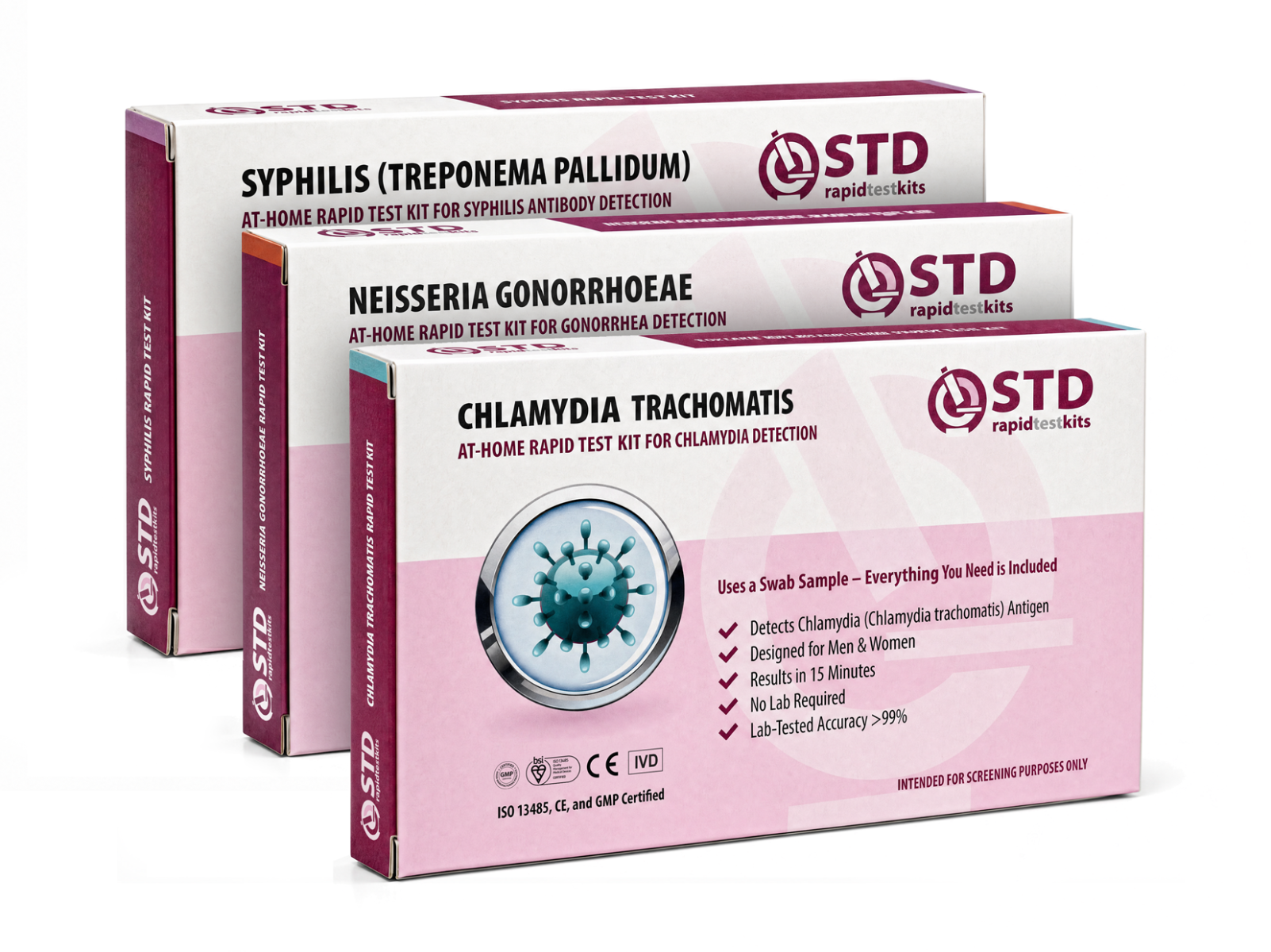
A single at-home rapid test or combination kit can give you a current-status snapshot in about 15 minutes. Anything positive is a starting point for a clinic visit; anything negative restores a baseline you can plan future testing around.
FAQs
- Can you get COVID-19 from semen or vaginal fluid?
- No transmission chain has been traced to semen or vaginal fluid as the route. A handful of studies detected viral RNA in semen during active infection, but RNA fragments are not the same as live, infectious virus capable of causing a new case.
- Should I get an STI test after COVID-19 exposure?
- Not based on the COVID-19 exposure itself. COVID-19 is not an STI. However, if the exposure happened during sex with a new partner, the STI testing conversation is a separate one and worth having on its own merits regardless of any COVID-19 outcome.
- Is kissing risky for COVID-19 transmission in 2026?
- Kissing someone with active, contagious COVID-19 is high-risk because of the close face-to-face contact and shared air, not because of saliva specifically. Between two healthy adults without symptoms or known recent exposures, kissing carries no meaningful COVID-19 risk.
- If my partner has COVID-19, how long should we avoid intimate contact?
- Current CDC respiratory-virus guidance recommends staying home until symptoms have improved and you feel well enough to resume normal activity, then taking added precautions around vulnerable people in the days that follow. Intimate contact during the acute phase is functionally guaranteed transmission, so most couples wait until the symptomatic partner has clearly recovered and is back to feeling normal before resuming close contact.
- Did the pandemic change STI rates in the U.S.?
- Reported cases of chlamydia and gonorrhea fell in 2020 and 2021 because testing volumes dropped, not because infections did. Surveillance picked back up from 2022 onward as routine screening resumed.
- Are at-home COVID tests still useful in 2026?
- Yes. Rapid antigen tests remain accurate at detecting active infection once viral levels are high enough to be contagious. They are widely available and useful for deciding whether to stay home from work, avoid contact with a vulnerable family member, or postpone an intimate encounter when you feel off.
- Can long COVID affect sexual function?
- Some studies have reported decreased libido, erectile difficulties, and altered menstrual cycles in patients with post-COVID-19 conditions. If these symptoms appear or persist after a COVID-19 infection, they are worth raising with a clinician rather than waiting them out.
- Is HPV or HSV more dangerous if I have had COVID-19?
- There is no direct evidence that prior COVID-19 makes HPV or HSV infections more severe. The broader principle (chronic untreated infections complicate any acute illness) cuts in the other direction: knowing your HPV and HSV status helps protect overall health, including during future respiratory illness seasons.
- U.S. Centers for Disease Control and Prevention. About COVID-19, including how it spreads through respiratory droplets and small particles.
- World Health Organization. Coronavirus disease topic page, including the description of SARS-CoV-2 transmission through respiratory droplets and aerosols.
- U.S. Centers for Disease Control and Prevention. Respiratory Virus Prevention, including the 2024 consolidated respiratory-virus framework that now covers COVID-19, flu, and RSV.
- U.S. Centers for Disease Control and Prevention. About Sexually Transmitted Infections, including the scale of undetected STI transmission in the U.S. and the importance of routine testing for sexually active adults.
- World Health Organization. Sexually transmitted infections fact sheet, including condom effectiveness statements and the list of vaccine-preventable STIs.
- U.K. National Health Service. COVID-19 information hub covering symptoms, transmission, vaccination, and long COVID.
