
Published: September 2025 | Last updated: May 2026 | Editorial review and quality control: Martina N.
Why does chlamydia seem to come back?
Chlamydia antibiotics (doxycycline or a single azithromycin dose) cure the infection in nearly all cases. When it seems to return, the cause is almost always reinfection from an untreated partner, sex resumed too soon, or a premature retest. True antibiotic failure is rare.
You did the responsible thing. You tested. You got the diagnosis. You took the antibiotic. You waited the recommended week. And then, somehow, the symptoms came back, or your retest still shows positive, and you are sitting with the same fear you had the first time around, plus a new one: did the medication even work?
The good news first. True antibiotic failure with chlamydia is rare. Most of what reads as a relapse is something else: reinfection from an untreated partner, a test taken too early after a fresh exposure, residual bacterial DNA picked up on a premature retest, or symptoms from a different infection the chlamydia treatment never addressed. A second positive can feel like an accusation, but the cause usually comes down to biology and timing rather than anything you got wrong. Knowing which one applies to you changes what you do next.
This article walks through what chlamydia treatment actually does inside your body, why it can look like it failed when it didn't, when to retest so the result means something, and how to handle the partner conversation without it turning into an interrogation. (Quick note for transparency: this site, stdrapidtestkits.com, sells at-home STI testing kits, and you will see two product mentions further down. They are placed where they fit the situation, not as a sales tactic.)
Key Takeaways
- Most chlamydia 'treatment failures' are actually reinfections from an untreated partner, sex resumed too early, a premature retest picking up dead bacterial DNA, or a co-infection that was never tested for. The medication itself almost always works when taken correctly.
- The CDC recommends retesting roughly three months after treatment even if you feel fine, because asymptomatic reinfection is common and untreated repeat infections raise the risk of pelvic inflammatory disease and long-term fertility problems.
What the Chlamydia Pill Actually Does (and Doesn't)
The standard first-line treatment for genital chlamydia changed in 2021. The U.S. Centers for Disease Control and Prevention now recommends doxycycline 100 mg taken twice daily for seven days as the preferred regimen, with azithromycin 1 g as a single dose kept as an alternative for situations where adherence is a concern or pregnancy is involved (per the CDC 2021 STI Treatment Guidelines for chlamydial infections). Doxycycline edged out azithromycin in the guideline rewrite because newer trial data showed it performs slightly better for urogenital chlamydia and much better against rectal chlamydia when the infection has spread there.
What neither regimen does is heal damaged tissue overnight, sterilize a partner's infection without their own course of antibiotics, or rebuild your sense of physical comfort the day after the last pill. Antibiotics interrupt the bacterium's ability to replicate inside your cells. The bacteria die off over the following days. Inflammation in the cervix, urethra, or rectum then has to settle on its own, which can take another week or two even after the infection itself is gone. Both regimens clear urogenital chlamydia in the large majority of people who take them as directed, though the CDC's updated guidance notes higher microbiologic treatment failure with azithromycin than doxycycline, particularly for rectal infection (per the CDC 2021 STI Treatment Guidelines). If you took the pills correctly and a result came back positive a few weeks later, the failure point is almost never the antibiotic itself. Feeling itchy, sore, or unusually discharge-prone on day five of treatment usually reflects inflammation that is still settling rather than a failed antibiotic.
Doxycycline (100 mg twice daily for 7 days) is the CDC's current first-line choice for genital and rectal chlamydia. Azithromycin (1 g single dose) remains an option during pregnancy or when adherence to a 7-day course is a concern. Neither regimen heals inflamed tissue overnight, and neither protects you from a partner who has not also been treated.
How Fast the Medication Starts Working
The bacteria themselves respond fast. Within the first 24 to 48 hours of starting doxycycline or finishing the azithromycin dose, the drug is already inhibiting protein synthesis and replication cycles inside the bacterial cells. By day seven, in the great majority of cases, the bacterial load has dropped to a level your immune system can finish clearing on its own. The CDC's framing for the azithromycin single dose is that people are considered no longer infectious seven days after taking it, assuming they have stayed abstinent and their partner has also been treated. For the doxycycline regimen, the CDC's instruction is to abstain from sex until the seven-day course is complete and symptoms have resolved.
Here is a more granular look at the typical recovery timeline.
| Day After Treatment Starts | What Is Happening Inside the Body | What You Should Be Doing |
|---|---|---|
| Day 1 to 2 | Antibiotic begins disrupting Chlamydia trachomatis replication. Bacterial load not yet meaningfully reduced. | Take every dose on schedule. Do not have sex. Hydrate, and take doxycycline with food if you feel nauseated. |
| Day 3 to 5 | Bacterial load is dropping. Some symptoms may ease, others (mild itching, faint discharge) may linger from tissue inflammation. | Continue the full course. Do not assume the easing means you are cured. Sex is still off the table. |
| Day 7 | Bacterial load is typically below the threshold for infectiousness. Tissue inflammation may still be settling. | If your partner has also completed treatment and your symptoms have resolved, sex becomes reasonable. If they haven't, wait. |
| Day 14 to 21 | Most residual inflammation has resolved. Lingering symptoms after this point usually point to something other than active chlamydia. | If symptoms persist, talk to a clinician about co-infection, yeast, or pelvic inflammatory disease. |
| Four weeks onward | Safe window for a NAAT test of cure if one is clinically indicated. Dead bacterial DNA has cleared from tissue by now. | If you fall into the test-of-cure groups below, retest. Otherwise schedule the three-month reinfection retest. |
Why the Infection Comes Back Even When You Did Everything Right
Most of what people call a treatment failure traces back to a familiar set of causes. Untreated partners account for the largest share of repeat positives, with a new, untested partner a close second. If your partner did not get diagnosed and treated in parallel, sex with them after your seven-day window simply redeposits the bacteria, and the CDC's research on repeat-positivity points consistently at partner non-treatment as the dominant driver.
A new partner introduces its own scenario. If you started seeing someone new in the months after treatment and they were not tested, the repeat positive reflects a fresh exposure to the same bacterium rather than a relapse.
Sex resumed too early causes another large share of repeat positives. A surprising number of people skip the seven-day rule because they feel fine on day four. The bacterial load is still measurable then, you are still infectious, and if your partner was treated at the same time you may have reinfected each other inside the abstinence window.
A premature retest can also produce a false signal. Chlamydia DNA can linger in tissue for several weeks after the bacteria themselves are dead. The CDC's 2021 STI Treatment Guidelines reserve repeat testing immediately after treatment for specific clinical situations and direct most patients to a retest at roughly three months instead, partly because earlier nucleic-acid tests can pick up that residual genetic material and produce a false-positive result.
And finally, sometimes it was never just chlamydia. Co-infection with gonorrhea, trichomoniasis, or bacterial vaginosis is common. Treating chlamydia alone leaves the other infection intact, and the symptoms continue. The CDC's chlamydia overview notes that most infected people experience no symptoms at all, which is exactly why these infections circulate so silently inside couples in the first place.
The Four Reasons Chlamydia Looks Like It Came Back
- Untreated partner: a partner who was not treated on the same timeline redeposits the bacteria at the next contact. This is the dominant driver of repeat positives.
- New partner: a fresh exposure to the same bacterium rather than a relapse of the original infection.
- Sex resumed too early: skipping the full seven-day window means you or your partner were still infectious.
- Premature retest: a NAAT run before four weeks can detect residual DNA from the now-dead original infection and read positive.
What Chlamydia Tests Detect (and Why It Matters for Retesting)
Not every chlamydia test works the same way, and the differences matter when you are looking at a second positive result. Three categories of test dominate the landscape, each with a different relationship to whether your body still has live, replicating bacteria.
A laboratory NAAT (the nucleic acid amplification test that most clinics and labs use) detects fragments of bacterial DNA from a urine sample or a swab (per the MedlinePlus chlamydia test overview). It is exquisitely sensitive, which is why it is the standard diagnostic used in clinics and labs. That same sensitivity is also why it can read positive for up to several weeks after successful treatment: dead bacteria still contain detectable DNA. The CDC's own guidance explicitly warns against running a NAAT before four weeks after treatment for exactly this reason.
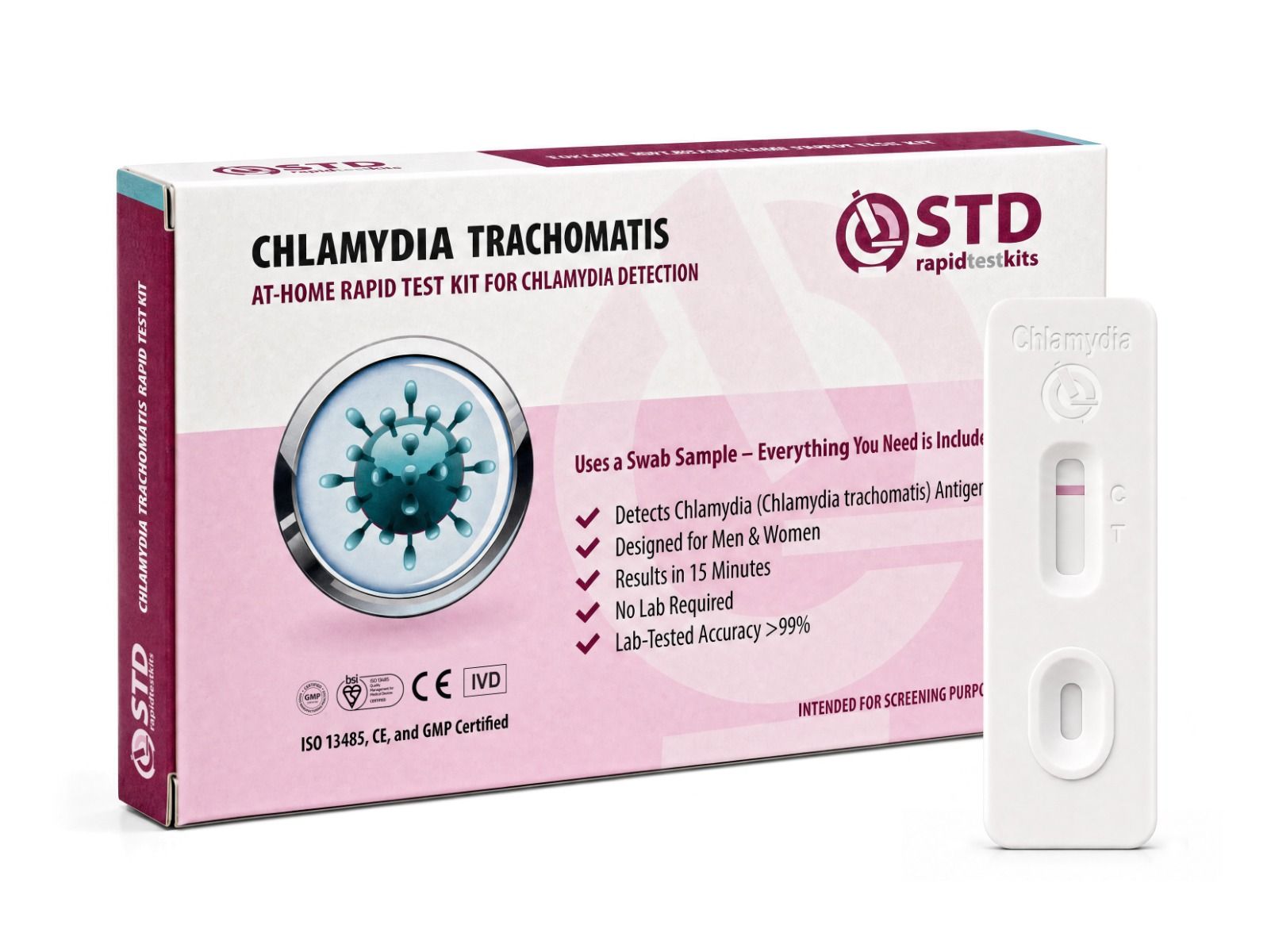
At-home rapid lateral-flow tests work differently. They detect bacterial surface proteins from live or recently active bacteria rather than nucleic acids, and they generally have a shorter residual-positive window than NAATs after treatment. Their analytical sensitivity is below that of a laboratory NAAT, so a positive result from an at-home chlamydia test is worth confirming with a lab NAAT, and a negative result taken inside the window period should be repeated.
Bacterial culture, which tries to grow live Chlamydia trachomatis in the lab, is highly specific but slow, technically demanding, and rarely used outside research or suspected treatment-resistant cases.
| Test Type | What It Detects | Where It's Used | Behavior After Treatment |
|---|---|---|---|
| Lab NAAT (urine or swab) | Bacterial DNA fragments | Clinics, labs, primary care | Can stay positive up to several weeks after successful treatment because residual non-viable DNA is still detectable. |
| Rapid lateral-flow (at-home) | Bacterial surface proteins from live or recent bacteria | At-home screening, fast results in about 15 minutes | Shorter residual-positive window than NAAT; lower analytical sensitivity, so positives are worth confirming with a clinic NAAT. |
| Bacterial culture | Live, replicating bacteria | Specialty labs, suspected treatment-resistant cases | Highly specific but slow and rarely used outside research or complicated cases. |
False Negatives, Lingering Symptoms, and the Right Time to Retest
A negative test taken three days after a new exposure offers less reassurance than it seems to. Chlamydia's window period (the gap between exposure and when a test can reliably detect the infection) runs roughly 7 to 14 days for most laboratory NAATs and most lateral-flow rapid tests. Testing before that window closes leaves the result with limited meaning, even with a sensitive test, so a very early negative is worth repeating once the window has closed.
This is also why a partner's negative result can be honest and still wrong. One of the hardest moments after a second positive is the conversation where your partner shows you a clinic note saying they tested negative. They may be telling the truth and still be infected. If they tested within their own window period, in the first days after a fresh exposure, the assay simply had nothing to detect yet. The fix here is simple: repeat their test once the window has closed, rather than relitigate the result.
The same problem runs in the opposite direction after treatment. A test done too early can pick up dead bacterial DNA and read positive when no live infection remains. A version of this plays out constantly: someone finishes their antibiotics, abstains carefully, and then around day 9 or day 12 the anxiety wins. They run a test, it comes back positive, and they spiral. What usually happened has nothing to do with reinfection. A NAAT run that early is very likely picking up residual fragments of the now-dead original infection. The treatment worked; the test just ran inside the residual-DNA window. The CDC's 2021 STI Treatment Guidelines for chlamydial infections distinguish carefully between two follow-up purposes for this reason.
A test of cure is reserved for specific situations: pregnancy, pharyngeal chlamydia, persistent symptoms, or suspected non-adherence to the medication. The CDC explicitly warns against running a NAAT before four weeks have passed, because the continued presence of nonviable organisms can produce false-positive results. The recommended timing is approximately four weeks after therapy completion.
A retest for reinfection is recommended for everyone who tests positive for chlamydia, at roughly three months after treatment (per the CDC's clinical retesting guidance). Reinfection in the months following treatment is common, which is why the CDC writes the three-month rescreen into its standard guidelines as the default expectation, not the exception.
If your symptoms return inside the three-month window, retest sooner. There is no medical reason to wait the full three months when something feels wrong.
| Situation | Most Likely Explanation | What to Do Next |
|---|---|---|
| Negative test taken within 5 days of a known exposure | Test was inside the window period. A false negative is plausible. | Retest 10 to 14 days after the exposure. Use protection in the meantime. |
| Mild symptoms still lingering at day 10 after treatment | Tissue inflammation, antibiotic-related yeast, or a co-infection that wasn't tested. | See a clinician. Consider a multi-infection retest panel. |
| Positive again at a NAAT taken before four weeks post-treatment | Most often residual dead bacterial DNA, which the CDC specifically warns NAATs can pick up at less than four weeks. | Repeat the NAAT at four to six weeks. If still positive, retreat and revisit partner-treatment status. |
| Positive again at three months despite feeling fine | Asymptomatic reinfection, typically from an untreated partner or a new partner. | Retreat, treat the partner, and observe the abstinence window from the later completion date. |
When Lingering Symptoms Aren't Chlamydia Anymore
Two conditions commonly get mistaken for chlamydia that failed to clear, when the real driver is something else.
Pelvic inflammatory disease (PID). When chlamydia goes undiagnosed for weeks or months before treatment, the bacteria can travel into the upper reproductive tract and trigger inflammation that outlasts the infection itself. The CDC's PID fact sheet notes that about 1 in 8 women with a history of PID experience difficulty getting pregnant later. PID needs a longer, broader antibiotic course than chlamydia alone, and it should be treated promptly rather than waited out.
Co-infection that was missed. A swab that came back positive for chlamydia may not have been tested for trichomoniasis, bacterial vaginosis, gonorrhea, or yeast. If discharge, itching, or odor persist after the chlamydia course is complete, retesting for these other infections is the right next step. Antibiotics for chlamydia (especially doxycycline) can also tip the balance of vaginal flora and trigger yeast overgrowth, which then mimics ongoing infection symptoms.
The checklist below sorts what is usually normal healing from what deserves a same-week clinic visit. A clinician, or an at-home multi-infection screening panel, can confirm which of these is in play.
After Treatment: What's Expected Healing and What to Flag
Mild symptoms for a week or two after antibiotics can be normal tissue healing rather than treatment failure. The lower items point to a co-infection or pelvic inflammatory disease and warrant a same-week clinician visit rather than a wait-and-see approach.
- Mild itching or a faint discharge in the first one to two weeks Common
- Brief irritation or light spotting as inflamed tissue settles Common
- Discharge, itching, or odor that persists beyond about two weeks (possible yeast or untested co-infection) Less common
- Deep pelvic or lower-abdominal pain Rare
- Pain during intercourse or spotting between periods Rare
- Unusual heavy or foul-smelling discharge with a low-grade fever Rare
Telling a Partner Without It Becoming an Accusation
Partner notification is the part of this process most people dread, and it is the single intervention with the largest impact on whether your infection comes back. There is no medically clean way to do it, but there are workable scripts. State the fact, state what you want, and move on: 'I tested positive for chlamydia and was told to let recent partners know so they can get tested too. There is no blame in this message, just information.' Or, for an ongoing relationship: 'I tested positive again. I want us both treated on the same schedule and to wait the full seven days before sex. Can we plan that?'
Both versions move the focus off who caused this and onto how to close the loop together. Chlamydia frequently has no symptoms at all, so a partner who passed it to you may have had no way of knowing. Most reinfections come down to timing gaps and missed follow-up appointments rather than deliberate exposure: partners caught inside their own window periods, or someone deferring a clinic visit because of cost or schedule.
In the United States, most state and county health departments offer anonymous partner notification through the local STI program, and several telehealth services will send an email or text on your behalf without identifying you. Many states also offer expedited partner therapy, where a clinician can give the diagnosed person enough medication to deliver directly to their sexual partner, with no separate clinic visit required. That option is particularly useful when a partner is reluctant to visit a clinic but is willing to take the medication.
If you genuinely don't know whether a former partner has been treated, the safest assumption for your own retesting is that they haven't. Treat any unprotected contact with them after your treatment as a fresh exposure.

Sex After Treatment: The Real Rules
The abstinence window is shorter than many people assume, but it depends on which regimen you took. The NHS frames the rule in plain terms: avoid vaginal, anal, or oral sex until both you and your partner have finished treatment (NHS chlamydia guidance).
If you took the azithromycin single dose, abstain from sex for seven days after the dose. If you took the doxycycline seven-day course, abstain from sex until the final dose is taken AND your symptoms have resolved. Doxycycline needs no additional seven-day wait after the last pill.
Either way, the same condition applies to your partner: their treatment must also be complete on the same terms. Couples who started treatment on different days, which is common when one person is diagnosed first and brings the other in later, often miscalculate this. Sex is safe only when both people have completed their respective courses and the later-finishing partner has hit their own end-of-treatment marker. Count seven days from the later of the two finish dates, not the earlier one. If start dates differ by even a day, recalculate from the later finish date, because that is when both partners' abstinence windows actually close.
If your partner cannot or will not get treated, the calculation stays the same. Your only protected option is condoms every time, or no sex with that partner, until they have been tested and treated.
| Regimen | Abstinence Rule | Couple's Resume-Sex Trigger |
|---|---|---|
| Azithromycin 1 g single dose | Abstain from sex for 7 full days after taking the dose. | Both partners hit day 7 after their respective doses, with no remaining symptoms. |
| Doxycycline 100 mg twice daily for 7 days | Abstain until the final pill is taken AND symptoms have resolved (no extra 7-day wait after the last dose). | Both partners have finished the 7-day course and resolved any symptoms; clock starts from the later finish date. |
Stigma, Shame, and Why None of This Means You're 'Dirty'
Chlamydia is the most commonly reported bacterial STI in the United States, year after year, in CDC surveillance data. That fact alone should put the shame question to rest. The first thought after a second positive is often some version of 'what did I do wrong', or 'is it me or my partner'. In almost every case the honest answer is that nobody did anything wrong. Reinfection is not a moral category. It is a function of how a silent bacterium moves through couples and how easy it is to miss the timing rules.
The internalized version of stigma sounds like this in real life: people delay retesting because a second positive feels like a verdict on them; partners avoid follow-up appointments because they don't want to be the one who 'gave it back'; couples skip the seven-day rule because abstinence after a stressful conversation feels like punishment. Each of those moves quietly raises the chance of another reinfection cycle.
The way out is to treat testing like any other healthcare routine: dispassionate, scheduled, on a calendar, not tied to how you feel about yourself that morning. If you are reading this after a second positive, the next step is short: pick a retesting date, message your partner the same date, abstain until seven days after whichever of your two treatments finishes later, and then repeat the screen at three months.
Men and women who have been treated for chlamydia should be retested approximately 3 months after treatment, regardless of whether they believe their sex partners were treated.
Preventing the Next Round
Routine retesting on a fixed schedule prevents more repeat infections than any other single step. Test every three months if you have multiple partners or a new partner since your last screen. The CDC's routine screening recommendations also call for annual screening in sexually active women younger than 25, and at least annual screening in sexually active gay and bisexual men regardless of age. Asymptomatic chlamydia is the norm rather than the exception, so symptom-based testing alone misses most infections in the population.
Coordinated treatment with partners is the most-missed step. If you and a partner both test positive, scheduling both treatments on the same calendar so the abstinence window aligns prevents the back-and-forth reinfection pattern. Where expedited partner therapy is available, it works around the 'they won't go in' problem in many states.
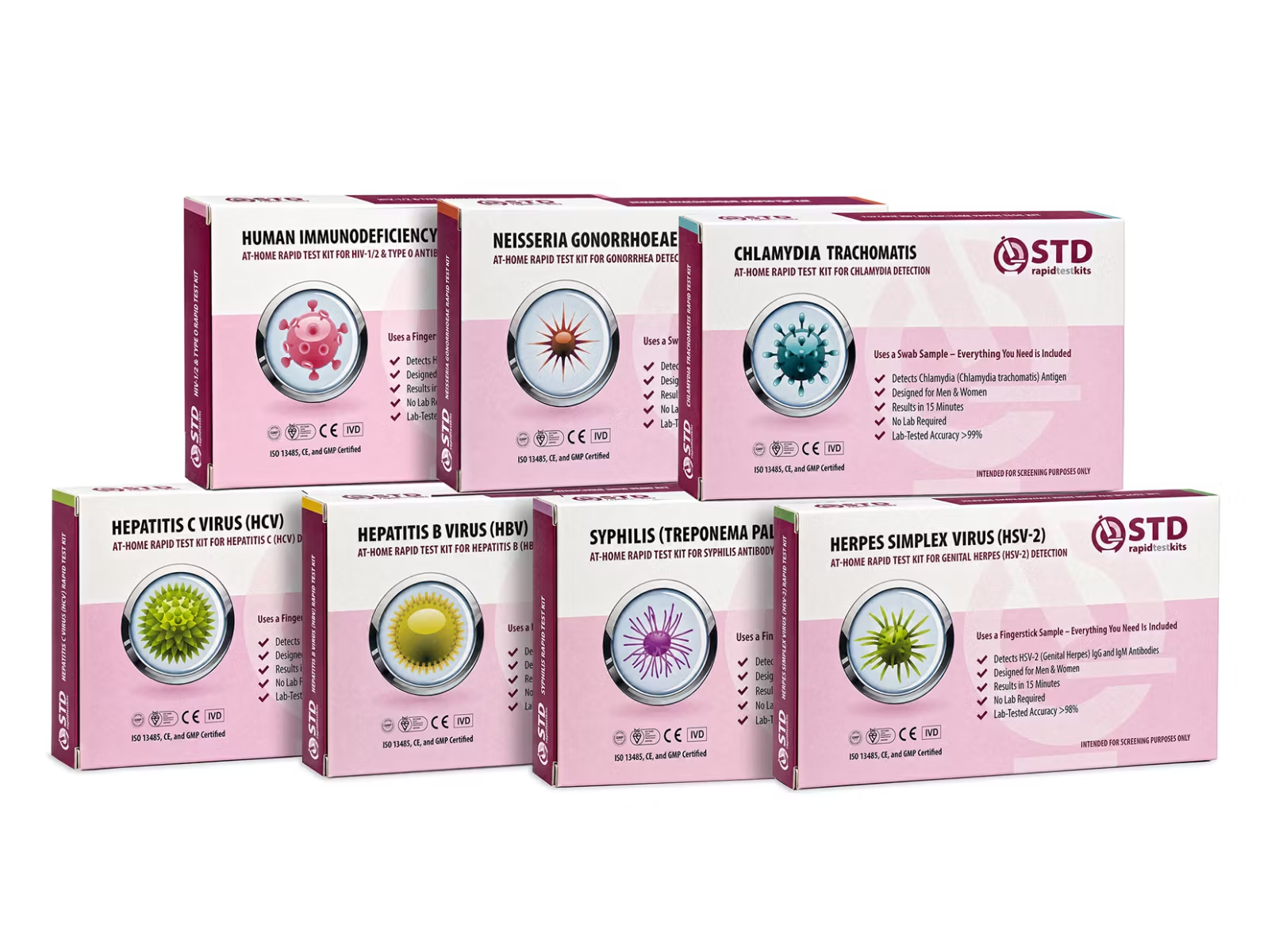
If reinfection has happened more than once, or if there has been a new partner whose testing history isn't clear, broader screening is worth doing at the same visit. Chlamydia and gonorrhea are commonly co-acquired, and an HIV plus syphilis blood panel is a common addition after a new exposure, regardless of which infection triggered the visit. The WHO's sexually transmitted infections fact sheet underscores how common these infections are worldwide, part of why a combined screen is standard after a new exposure. At-home combination STI test kits cover that same set of infections in one package, with the same caveat that they screen using lateral-flow chemistry rather than lab NAATs, so a positive is worth confirming clinically.
Layered prevention closes the loop. Hormonal contraception (the pill, IUDs, implants) prevents pregnancy; condoms are the barrier method that also blocks STI transmission, with high real-world effectiveness against chlamydia specifically. Using both is reasonable while you are between tested partners, and condoms remain the simplest tool for reducing transmission of multiple infections at once. None of this makes chlamydia a moral failure. It is a common bacterial infection that responds to the same things as any other: accurate testing, complete treatment, coordinated partner care, and a follow-up plan.
Your Next Move After a Repeat Positive
Have you and your partner both completed treatment, with your symptoms resolved?
Yes: Put the three-month reinfection retest on your calendar now, and resume sex only seven days after the later of your two finish dates.
Do symptoms persist beyond about two weeks after finishing antibiotics?
Yes: Book a clinician visit or run a multi-infection panel. Lingering symptoms past two weeks more often signal a co-infection, yeast, or PID than active chlamydia.
No: If your partner is still untreated, use condoms every time until their course is complete, then retest yourself at three months.
Guidance only. A healthcare provider can advise based on your specific situation.
Three actions that turn a first infection into a last one
- Put the three-month retest on the calendar the day you finish treatment, not when you remember to do it. Asymptomatic reinfection is common enough that the CDC writes this rescreen into its standard guidance.
- Coordinate treatment completion dates with your partner so the abstinence windows align. Sex resumes only after seven days from the later finish date.
- Use condoms with any new or untested partner until you both have a clean screen. Condoms are the single most reliable layer of protection between tested partners.
FAQs
- Can chlamydia come back after a complete course of antibiotics?
- It can, and reinfection in the months after treatment is common enough that the CDC recommends retesting everyone who tests positive at roughly three months. The repeat positive is almost always a reinfection from an untreated partner, a new partner, or sex resumed before the post-treatment window closed, not a failure of the medication itself. True antibiotic-resistant chlamydia is rare.
- Is it normal to test positive for chlamydia more than once?
- Yes. Repeat infection in the months after treatment is common enough that the CDC builds a standing three-month rescreen into its guidance. More than anything else, that traces to a partner who was not treated on the same timeline. In most cases it reflects neither treatment failure nor personal carelessness, and on its own it carries no implication about fertility.
- How soon can I have sex after my antibiotics?
- It depends on which regimen you took. After the single 1 g azithromycin dose, abstain for seven days. After the seven-day doxycycline course, abstain until the final dose is taken and your symptoms have resolved. In both cases, your partner must also have completed their own course on the same terms before sex resumes. Count seven days from the later of the two finish dates.
- Why did my partner test negative when I just tested positive again?
- Most often, timing. If your partner tested within their own window period (roughly the first 7 to 14 days after a new exposure), the assay had nothing to detect yet. A partner who tested two days after a fresh exposure can be genuinely infected and still test negative, through no fault of the test or the partner. The fix is to repeat their test outside the window.
- Why am I still itchy or sore after the medication?
- Tissue inflammation from the original infection takes longer to settle than the bacteria themselves take to die. Symptoms can persist a week or two after the antibiotics end without meaning the treatment failed. If they last beyond about two weeks, the more likely explanations are antibiotic-related yeast overgrowth, a co-infection (trichomoniasis, BV, gonorrhea) that wasn't tested, or pelvic inflammatory disease. A clinician visit or a multi-infection panel sorts it out.
- Do I need a test of cure after treatment?
- For most people, no. Standard post-treatment follow-up is the three-month reinfection retest. The CDC reserves the test of cure for four situations: pregnancy, pharyngeal infection, ongoing symptoms, or if you struggled to complete the full antibiotic course. When indicated, a NAAT is run no earlier than four weeks after finishing treatment, because residual bacterial DNA can produce a false positive before that window closes.
- What if my partner refuses to get tested or treated?
- You can't force the issue, but you can change the math for yourself. Pause unprotected sex with them. Offer them an at-home test or a telehealth link to lower the friction. In states with expedited partner therapy, ask your own provider whether they can prescribe a course for your partner without an appointment. If none of that lands, treat any future contact with them as a fresh exposure and retest yourself accordingly.
- Can chlamydia cause long-term problems if I keep catching it?
- Yes. Repeat infections increase the cumulative risk of pelvic inflammatory disease, ectopic pregnancy, chronic pelvic pain, and tubal-factor infertility in people with a uterus. They also increase the risk of epididymitis in people with a penis. This is the main reason the three-month retest matters even when you feel fine: asymptomatic reinfection is common, and each additional round of inflammation adds to the long-term risk.
How we sourced this article. The clinical guidance summarized above is drawn from the CDC's 2021 STI Treatment Guidelines (the current first-line recommendations for chlamydia), the CDC's separate clinical retesting and PID resources, the CDC's expedited partner therapy clinical guidance, the MedlinePlus chlamydia test overview, the NHS chlamydia overview, and the WHO STI fact sheet. We do not provide clinical diagnosis. For symptoms that concern you or persistent positive results after a full course of treatment, see a licensed clinician.
- U.S. Centers for Disease Control and Prevention. 2021 STI Treatment Guidelines, Chlamydial Infections section. Source for the doxycycline-first regimen, the azithromycin alternative, the comparative efficacy of the two regimens, the abstinence guidance, the test-of-cure vs reinfection-retest distinction, the four-week NAAT minimum after treatment, and the three-month rescreen.
- U.S. Centers for Disease Control and Prevention. About Chlamydia. Source for the asymptomatic-prevalence framing and the routine annual screening recommendation in sexually active women under 25.
- U.S. Centers for Disease Control and Prevention. About Pelvic Inflammatory Disease. Source for the long-term complication framing after untreated upper-tract chlamydia, including the 1-in-8 fertility-difficulty figure.
- MedlinePlus (U.S. National Library of Medicine). Chlamydia Test. Source for what NAAT testing detects, sample types (urine or swab), and clinical use.
- NHS (United Kingdom). Chlamydia overview. Source for how chlamydia testing is done (urine sample or swab), antibiotic treatment, and the advice to avoid vaginal, anal, or oral sex until both partners have finished treatment.
- World Health Organization. Sexually transmitted infections fact sheet. Source for global STI epidemiology and the combined-testing rationale.
