
Published: August 2025 | Last updated: May 2026 | Editorial review and quality control: Martina N.
You notice a bump that wasn't there yesterday. A new ache. A patch of irritation that feels different from a razor burn or a yeast flare. You call your clinic and the next opening is four weeks out. Urgent care tells you it's probably nothing. You end up at home with a browser full of half-answers, wondering if you should be worried or relieved.
Before going further, a piece of reassurance worth holding onto: most bumps, patches of irritation, or odd sensations in the genital area are not STIs. Razor irritation, ingrown hairs, contact dermatitis from a new soap or detergent, friction-related soreness, and minor yeast or bacterial imbalances are far more common than any sexually transmitted infection. If you are here to rule something out rather than because of a confirmed exposure, the information below will help you do that accurately without spiralling.
This article is for the moment after the clinic-door has closed but the question hasn't. We will walk through what delayed STI testing actually costs, why "it went away" is rarely the reassurance it feels like, where at-home rapid tests genuinely fit, and where they don't substitute for in-clinic care.
Key Takeaways
- Symptoms resolving on their own does not mean an STI has cleared. Herpes, syphilis, chlamydia, and gonorrhea can all produce a brief first episode followed by a quiet phase during which the infection continues.
- When a clinic appointment is weeks out, at-home rapid tests fill a real gap for screening and exposure-event ruling-out, but they do not replace clinical care when there is an active lesion or systemic symptoms.
When Clinic Doors Close, Infections Don't Pause
Access to sexual health care in the United States has been thin for years, and got thinner during and after the COVID-19 era. Public-sector STI clinics were among the services most disrupted by pandemic staffing shortages, and many never returned to pre-2020 capacity. Federal and state funding for STI surveillance and prevention has been cut repeatedly across the past several years, with measurable effects on testing throughput, contact tracing, and laboratory capacity.
The pattern matters because infections do not pause when the system shuts down. The Centers for Disease Control and Prevention's national STI surveillance program continues to report chlamydia, gonorrhea, and syphilis at historically high levels, with congenital syphilis in particular rising sharply over the past five years. When people cannot get tested, they cannot be diagnosed, and untreated infections continue to transmit silently, often before either partner has a symptom severe enough to force the issue.
Rural counties, areas with high uninsured populations, and neighborhoods that relied on Title X family planning clinics for routine STI screening have been hit hardest. For someone in those geographies, "go get tested" is not a five-minute errand. It is a multi-week project requiring transportation, paid time off, and the willingness to navigate a system that may not respond at all.
Congenital syphilis cases in the U.S. have risen sharply over the past five years, a trend the CDC ties partly to weakened public-sector STI services. When testing access falls, undiagnosed maternal infections are passed on at birth. The cost of a closed clinic is not abstract; it shows up in the most preventable cases on the surveillance report.
Why Delayed Testing Carries Real Consequences
Untreated bacterial STIs do not behave like a cold that resolves and disappears. They settle in. In women and people with a uterus, untreated chlamydia and gonorrhea can ascend from the cervix to the uterus and fallopian tubes, causing pelvic inflammatory disease. The CDC's chlamydia detailed fact sheet notes that pelvic inflammatory disease can scar reproductive tissue without producing memorable symptoms, leaving people with chronic pelvic pain, ectopic pregnancy risk, or infertility that only becomes apparent years later.
Untreated syphilis follows its own staged path. The primary chancre heals on its own within three to six weeks, often without the affected person realizing what it was. Months later a secondary-stage rash may appear and resolve. Then the infection enters a latent period that can last decades before causing cardiovascular or neurological damage. None of this is theoretical. The CDC's syphilis disease fact sheet walks through this staged progression, and the agency's annual STI surveillance report publishes the case counts that show late-stage and congenital syphilis diagnoses occurring every year in the U.S.
Viral STIs add a different layer. Herpes simplex virus, once acquired, stays in the body for life. Antiviral therapy reduces outbreak frequency and lowers transmission risk, but it works best when started early in the course of the infection and continued consistently. The longer someone waits before testing, the more transmission events occur before they can have a conversation with a current or future partner about disclosure and risk reduction.
The cost of delay is not just personal. STIs are network infections. Each delayed diagnosis is roughly equivalent to several additional potential transmissions before treatment, depending on the infection and how active someone is sexually. A six-week wait for a clinic appointment is six weeks of unmonitored exposure across a sexual network, with concrete downstream consequences for the partners who did not consent to that risk.

The "It Went Away on Its Own" Trap
One of the most common reasons people abandon the testing process is that the symptom that prompted the worry fades. The bump dries up. The tingling stops. The discomfort that felt like an emergency last week feels like a memory by the weekend. The natural conclusion is that whatever it was, it could not have been serious.
That conclusion is wrong often enough to be dangerous. Several STIs are characterized by exactly this pattern: a loud-then-quiet first episode that hides ongoing infection.
Genital herpes commonly produces a first outbreak of painful sores or vesicles that lasts two to four weeks, then resolves. Per the CDC's genital herpes information page, the virus remains latent in nerve tissue and can reactivate at any time. Many people, especially after their first episode, do not see another outbreak for months or years, which makes them think the diagnosis was incorrect. It usually was not.
Syphilis is even quieter. The primary chancre is typically painless. It can sit in the genital area, the rectum, or the throat, where the person never sees it. It heals without treatment in a few weeks. The bacteria do not heal with it; they enter the bloodstream and continue without obvious symptoms for months or years.
Chlamydia and gonorrhea sometimes cause brief symptoms that resolve when minor inflammation calms down, then continue silently until they show up as pelvic pain, infertility evaluation findings, or a partner's diagnosis. The pattern is consistent enough that clinicians treat "my symptoms went away" as a flag to keep looking, not as a reason to stand down.
Herpes, syphilis, chlamydia, and gonorrhea can all produce a brief initial episode followed by a quiet phase during which the infection continues. If you had a symptom that prompted a worry, complete the testing window for the likely infections, even if you feel fine now. The right time to test is set by the exposure date and the assay's window period, not by how you feel today.
Asymptomatic Doesn't Mean Uninfected
The "it went away" trap has a darker cousin: never having symptoms in the first place. A large fraction of STIs is detectable only through testing because they do not produce noticeable signs in many infected people, particularly in early infection.
The CDC's chlamydia fact sheet states plainly that most people who have chlamydia have no symptoms. The same is true for a large share of gonorrhea cases, especially pharyngeal and rectal infections. HIV in the chronic phase is often clinically silent for years before symptoms appear, which is why early testing matters so much for treatment outcomes and transmission prevention.
Trichomoniasis, hepatitis B, and hepatitis C all have substantial asymptomatic phases. HPV is almost always invisible without screening, which is why cervical screening programs exist in the first place. Persistent infection with high-risk HPV strains is the leading cause of cervical cancer and contributes to several other cancers including anal, oropharyngeal, and penile. The reassuring side of that statement: most HPV infections clear without intervention within one to two years, and regular cervical screening identifies the minority that do not, well before they progress. At-home rapid lateral-flow HPV tests are available for women; a positive result should prompt follow-up with a clinician for confirmatory testing and colposcopy referral if indicated.
The only reliable signal that someone is uninfected is a negative test taken at the correct window period. Routine screening catches the asymptomatic cases that would otherwise become chronic infections, fertility damage, or onward transmission to a partner who also has no idea. The WHO's STI fact sheet notes that STIs are often asymptomatic and, when symptoms do appear, they tend to be non-specific, which is the same logic that makes routine screening the only reliable safety net.
Most people who have chlamydia have no symptoms.
Why Urgent Care Often Isn't Equipped for Full STI Care
When a primary care appointment is weeks away and a dedicated sexual health clinic is unavailable, urgent care is the obvious next stop. It is open most days, it accepts walk-ins, and it can run basic point-of-care tests. For some sexual-health concerns it is exactly the right place to go. For others it is not.
Urgent care is reliably useful for a few categories: pregnancy testing, suspected urinary tract infection, visible-lesion evaluation that may warrant a prescription, and emergency contraception. Many urgent care clinics can also start post-exposure prophylaxis for HIV if you arrive within 72 hours of a high-risk exposure. If a recent exposure is the concern and you can get to urgent care within that window, that is exactly the right move.
Where urgent care falls short is comprehensive STI panel testing. Most facilities are not staffed or equipped for the full range of nucleic acid amplification tests that labs use to diagnose chlamydia, gonorrhea, and trichomoniasis at multiple anatomic sites. They may swab the most obvious area, send it off, and tell you to follow up in a week, which is fine if the result comes back and someone calls you. It often does not work that way in practice.
For viral STIs the gap is wider. Herpes serology is rarely run in urgent care unless the clinician sees an active lesion to swab. HIV testing may be offered but is typically a single rapid test rather than a full panel with appropriate confirmatory and window-period considerations. HPV is not routinely tested in urgent care at all.
The practical takeaway: urgent care can rule in a couple of conditions and start some prescriptions. It usually cannot rule out an STI in someone who is asymptomatic, and it is not where most clinicians would recommend you go for routine sexual-health screening.

What to Do When You Can't Get Into a Clinic
If a clinic appointment is weeks out and urgent care has waved you off, you have more options than the "wait and see" advice suggests. The right path depends on the specific concern.
For a visible lesion, photograph it as soon as you notice it, ideally with a coin or ruler for scale. Lesions evolve quickly. A clinician seeing a high-quality photo from the active phase is far better positioned to make an assessment than one looking at a healed area weeks later. Send the photo through your provider's secure messaging portal if one is available, or upload to a telemedicine service that can review and recommend next steps.
For a possible exposure event without symptoms, the question is which infections to test for and when. Window periods vary by infection and assay. HIV testing windows depend on the test type, with rapid antibody tests typically reliable from roughly three to twelve weeks post-exposure. Chlamydia and gonorrhea testing is generally accurate from about two weeks. Syphilis blood antibody testing is typically reliable from twelve weeks. Herpes blood antibody testing is most reliable from twelve weeks post-exposure onward, as the body needs time to build detectable antibody levels. Check your kit's instructions or the linked CDC fact sheets for the specific window applicable to your situation.
We sell rapid lateral-flow STI test kits as part of this site's product offering, and the relevant products are linked in the sections below; readers should weigh that commercial context when evaluating the at-home testing path. With that disclosure in mind: at-home rapid testing fills a genuine gap when a clinic is unavailable. The kits use the same sample types and similar assay chemistry to in-clinic rapid tests. They are screening tools, not lab nucleic acid amplification tests, which means a positive should typically be confirmed in a clinical setting before treatment decisions, especially for HIV and syphilis. For ruling out a feared exposure or catching an asymptomatic infection that would otherwise go undetected, a rapid test that fits in a desk drawer is genuinely useful.
For a partner conversation, you do not need a diagnosis to start it. "I haven't been able to get tested through my normal channels yet, so I want to talk about what we both should do" is a kinder opening than waiting until you have results, and it lets both people start the testing-window clock at the same time.

When Home Testing Isn't Enough, and When It's Plenty
At-home rapid tests are useful screening tools. They are not lab nucleic acid amplification tests, and they do not replace a clinical exam in cases where one is genuinely needed.
See a clinician in person, not just by chat, if any of the following apply: visible sores or lesions that need direct evaluation; rectal or throat symptoms that may need a sample type beyond what at-home kits collect; pelvic pain, fever, or any symptom suggesting infection has progressed past initial mucosal involvement; a known exposure to a partner with a confirmed diagnosis where presumptive treatment is appropriate; or a positive at-home result that needs confirmatory testing before treatment.
At-home rapid testing is enough on its own in many other situations, including routine periodic screening between sexual-health visits, ruling out a worry after a low-risk exposure, checking in once a new partner relationship is established, and the CDC-recommended three-month re-screen after chlamydia or gonorrhea treatment (reinfection from an untreated partner is common enough to warrant it).
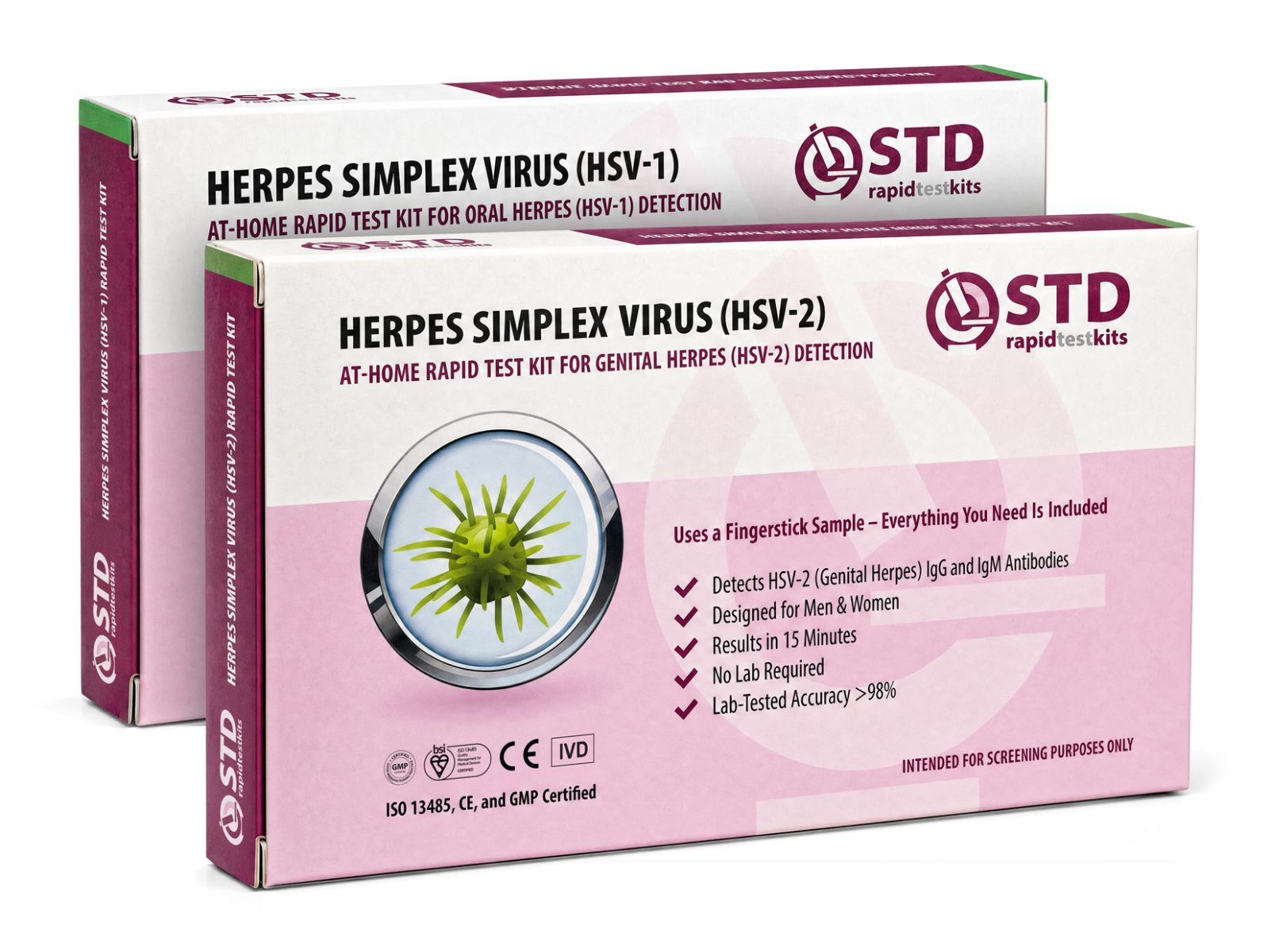
For herpes specifically, blood antibody testing is the appropriate path when there is no active lesion to swab. Our HSV-1 and HSV-2 panel uses a fingerstick blood sample and looks for antibodies the immune system produces in response to infection. It is most reliable from twelve weeks post-exposure onward, which aligns with the standard guidance for IgG antibody assays. If you have an active lesion right now, a clinic-administered PCR swab will be more informative than an antibody test, because antibodies measure past exposure rather than the active outbreak you are looking at.
Frequently Asked Questions
- What should I do if my symptoms went away before I could test?
- Still test. Herpes, syphilis, chlamydia, and gonorrhea all have well-documented patterns where the first symptom resolves on its own and the infection continues. Choose the test window appropriate for the suspected infection (two weeks for chlamydia and gonorrhea, twelve weeks for syphilis and herpes antibody, three to twelve weeks for HIV by rapid antibody), then test even if you currently feel fine.
- How accurate are at-home rapid STI tests compared to lab tests?
- Rapid lateral-flow tests are screening tools that detect the same target as in-clinic rapid tests. Laboratory nucleic acid amplification tests (NAATs) have higher analytical sensitivity, especially for very early infection, so a negative rapid result during the window period does not fully rule out infection. A positive rapid result for HIV or syphilis should be confirmed in a clinical setting before treatment.
- Can urgent care really not do a full STI panel?
- Most urgent care facilities are not staffed or equipped for the full range of NAAT-based panels that public sexual health clinics use, and they typically do not run herpes serology unless an active lesion is present. They are good for visible-lesion evaluation, suspected UTI, HIV post-exposure prophylaxis if you arrive within 72 hours of exposure, and a few other targeted situations.
- Is it possible to have an STI and feel completely normal?
- Yes, and it is common. The CDC notes that most people with chlamydia have no symptoms. The same is true for a large share of gonorrhea cases (especially pharyngeal and rectal), early-stage HIV, and many cases of trichomoniasis, hepatitis B, hepatitis C, and HPV. Feeling normal does not rule out infection after a new exposure; only a negative test at the correct window period does.
- How fast do at-home rapid tests give a result?
- Lateral-flow rapid tests typically display a result in 10 to 20 minutes after the sample is applied to the cassette. The bigger time variable is the window period for the infection: even the fastest test in the world cannot detect an infection before the body has had time to produce the marker the test is looking for, so timing the test correctly matters more than how fast the strip develops.
- Do I need to retest after treatment for chlamydia or gonorrhea?
- Yes. The CDC recommends a follow-up test about three months after treatment for chlamydia or gonorrhea, regardless of whether your partner was treated, because reinfection from an untreated or newly infected partner is the most common reason for a positive retest. This is not the same as a test-of-cure (which is done sooner and only in specific situations); it is a routine three-month re-screen.
- Can I test at home if I might have a herpes outbreak right now?
- Our at-home herpes test is a blood antibody test, which measures the immune response to past infection. It is most informative twelve or more weeks after a suspected exposure. For an active lesion happening right now, a clinic-administered PCR swab of the lesion is more useful because it detects the virus directly. The two tests answer different questions and complement each other.
- Is at-home STI testing actually confidential?
- Kits ship in discreet packaging, results are read by you (for rapid lateral-flow tests) or returned to you through a secure portal (for mail-in lab tests), and we do not report results to public health authorities. Reporting requirements for reportable infections apply to clinicians and labs who confirm a diagnosis, not to at-home screening tests you read yourself.
- U.S. Centers for Disease Control and Prevention. National STI surveillance and prevention program overview, including the annual STI surveillance report and reported case counts for chlamydia, gonorrhea, syphilis, and congenital syphilis.
- U.S. Centers for Disease Control and Prevention. Chlamydia detailed fact sheet, covering asymptomatic prevalence, complications including pelvic inflammatory disease, and the three-month re-screening recommendation after treatment.
- U.S. Centers for Disease Control and Prevention. Genital herpes information page, covering HSV-1 and HSV-2 transmission, the latent-then-reactivating pattern of infection, and antiviral suppression therapy.
- U.S. Centers for Disease Control and Prevention. Syphilis disease fact sheet covering staged progression from the primary chancre through latent and late-stage disease.
- World Health Organization. Sexually transmitted infections fact sheet, covering global prevalence, the often-asymptomatic and non-specific presentation of STIs, and the role of screening and testing in prevention.
- National Health Service (UK). Genital herpes condition page, covering symptoms, clinical swab-based testing pathways, and the role of antiviral treatment.
