Published: August 2025 | Last updated: May 2026 | Editorial review and quality control: Martina N.
A painless bump in the wrong place after a new partner is one of the most under-diagnosed warning signs in sexual-health medicine. People shave around it, mistake it for an ingrown hair or grooming bump, watch it for a few days, and forget about it once the skin closes over. The infection underneath does not heal with the skin. Syphilis is a bacterial infection caused by Treponema pallidum, and its first sign is often something that looks completely innocent.
This guide walks through what an early sore actually looks like, where chancres show up (including the ones you cannot see yourself), how the infection moves through its stages, what laboratory testing involves (including what an RPR titer really means), and why catching it early turns a five-minute treatment into a full cure. The information here synthesizes current CDC, WHO, and NHS guidance for general readers. It is not personal clinical advice. If a sore or unexplained rash is worrying you right now, a blood test and a clinic visit are the right next steps.
Key Takeaways
- A primary syphilis sore is usually a single painless firm bump or shallow ulcer at the contact site, appearing roughly 3 weeks after exposure and healing on its own in 3 to 6 weeks. Healing skin does not mean the infection is gone.
- Weeks to months later, a non-itchy rash that often involves the palms and soles is the classic secondary-stage signal. A blood test confirms or rules out infection whether the chancre is still visible or has already healed.
Razor Burn, Ingrown Hair, or Something Else?
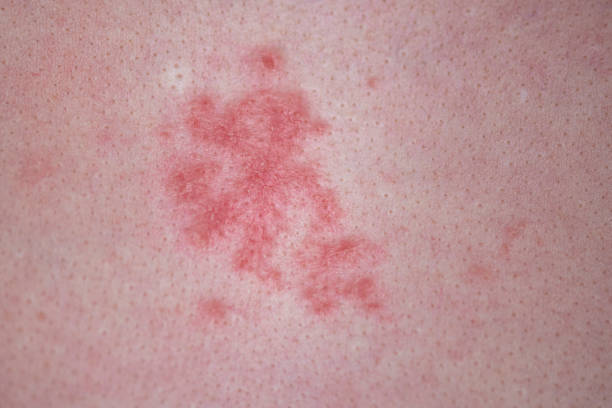
Razor burn stings and fades within a day or two. An ingrown hair tends to be tender, especially when pressed, and you can often see a coiled hair under the skin or a small whitehead. A primary syphilis chancre behaves differently. It is usually a firm, round or oval bump or shallow ulcer with smooth, slightly raised borders and a clean base, and it rarely hurts. Touch it and it feels like a small button under the skin: indurated (firm and hardened), rubbery, and dry. There is no pus, no foul odor, minimal redness or swelling. Because it does not scream for attention, people keep shaving, sweating, and living life. The sore quietly heals in three to six weeks per CDC guidance, and that healing is exactly why so many cases get missed.
The infection has not gone anywhere. It has moved on. Treponema pallidum, the spirochete bacterium that causes syphilis, is multiplying in the lymph and bloodstream while the surface heals. Weeks to months later, the body's response shows up as the secondary stage, often as a non-itchy rash on the trunk, arms, or palms and soles, sometimes alongside fatigue, sore throat, swollen lymph nodes, or patchy hair loss. By then, the original sore is long gone.
Most bumps after grooming really are ingrown hairs, follicle irritation, or small cysts that resolve with warm compresses and basic skin care. The reason this article exists is the small percentage that look identical and are not. If a 'grooming bump' refuses to budge after a week and shows none of the redness, tenderness, or pus you would expect, the safest move is a blood test, not another week of hot compresses. Multiple chancres can occur, especially in people with HIV or other forms of immune suppression, but the classic presentation is a single solitary lesion.
| What people often think it is | Typical appearance | How a chancre differs |
|---|---|---|
| Pimple or ingrown hair | Tender red papule with a yellow-white pustule head, often a visible hair | Chancres are firm and painless, with no pus and no central hair |
| Herpes (HSV) sore | Cluster of small painful vesicles on a red base, often crusts over | Chancres are solitary, dry, smooth-edged, and not painful |
| Canker sore (aphthous ulcer) | Shallow oral ulcer with a white-yellow center and red halo, painful | Chancres are painless and firm-based, not soft-based |
| Razor bump or friction sore | Small irritated bump or scratch, usually resolves within a week | Razor irritation itches or burns; chancres do neither |
| Cyst | Soft, mobile, fluid-filled lump under intact skin | Chancres are open ulcers, not closed lumps |
The Four Stages Most People Do Not Know
Syphilis runs on a multi-stage clock that almost nobody learns in sex-ed. The incubation period from exposure to the first sore is about 3 weeks or more per the NHS syphilis page. That window is part of why people struggle to link a current sore to a specific encounter. The partner you are thinking of may not even be the one who exposed you.
Stage 1: Primary
One painless chancre at the contact site, lasting roughly 3 to 6 weeks, then healing on its own. Transmission risk is very high during this window because the chancre fluid is loaded with active bacteria. Most people pass the infection on without ever realizing they had it.
Stage 2: Secondary
Typically several weeks to a few months after the primary sore, sometimes overlapping with it. The classic sign is a non-itchy rash that often includes the palms and soles. The CDC's About Syphilis overview describes additional secondary signs: fever, fatigue, sore throat, swollen lymph nodes, patchy hair loss, headache, weight loss, and muscle aches. Patients at this stage are frequently misdiagnosed with eczema, ringworm, psoriasis, or a viral illness. Transmission risk remains high.
Stage 3: Latent
No outward symptoms. Subdivided into early latent (under one year since infection, still potentially transmissible through sex) and late latent (over one year, much less commonly transmitted sexually). Latency can last years or even a lifetime. The only way to detect syphilis during this window is a blood test.
Stage 4: Tertiary
Rare in the antibiotic era, but possible years to decades after untreated infection, with damage to brain, nerves, eyes, heart, or large vessels per the WHO syphilis fact sheet. Tertiary syphilis is no longer sexually contagious, but the damage is often permanent. Neurosyphilis and ocular syphilis can occur at any stage, not only decades later. Early treatment matters even when symptoms feel mild because the bacteria can reach the brain and eyes before any other warning signs appear.
Any painless sore at a contact site, or a non-itchy rash that follows weeks later including on the palms or soles, is reason enough to arrange a syphilis blood test. The stages are not strict gates. People sometimes notice secondary-stage signs while a primary sore is still healing, and the latent phase produces no signs at all.
How Syphilis Looks on Brown and Black Skin
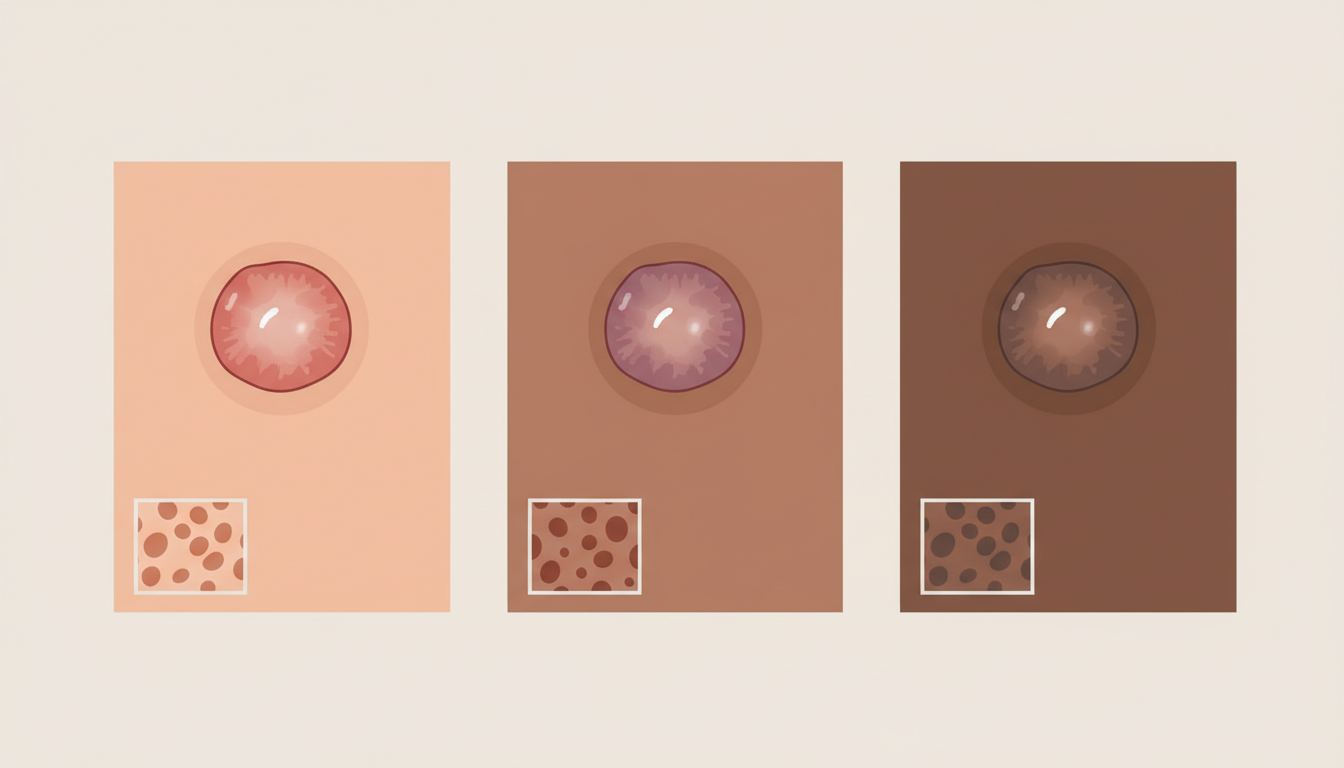
Most teaching photos show bright red rashes on light skin, which means people with brown and Black skin learn to look for the wrong color. On darker skin, a primary chancre may appear flesh-colored, violaceous, or simply slightly darker than the surrounding tissue rather than red. Secondary rashes can show up as coppery, reddish-brown, dusky purple, or even subtle gray patches. They may be easier to feel as small raised areas than to see at a glance.
Reliable clues do not depend on color: firmness, painlessness, persistence past one week, smooth round borders, and a clean base for the primary sore; flat or slightly raised non-itchy spots that include the palms and soles for the secondary rash. Trust sensation and pattern over hue. If a bump or rash fits the behavioral description regardless of the shade on your screen, that is enough reason to get a blood test.
Under-diagnosis on darker skin contributes to later-stage presentations, which means harder cases, longer transmission windows, and worse outcomes. Imagery in medical training is improving, but in the meantime, behavior of the lesion is more reliable than its color.
Sores That Hide: Mouth, Throat, Anus, and Less Obvious Sites
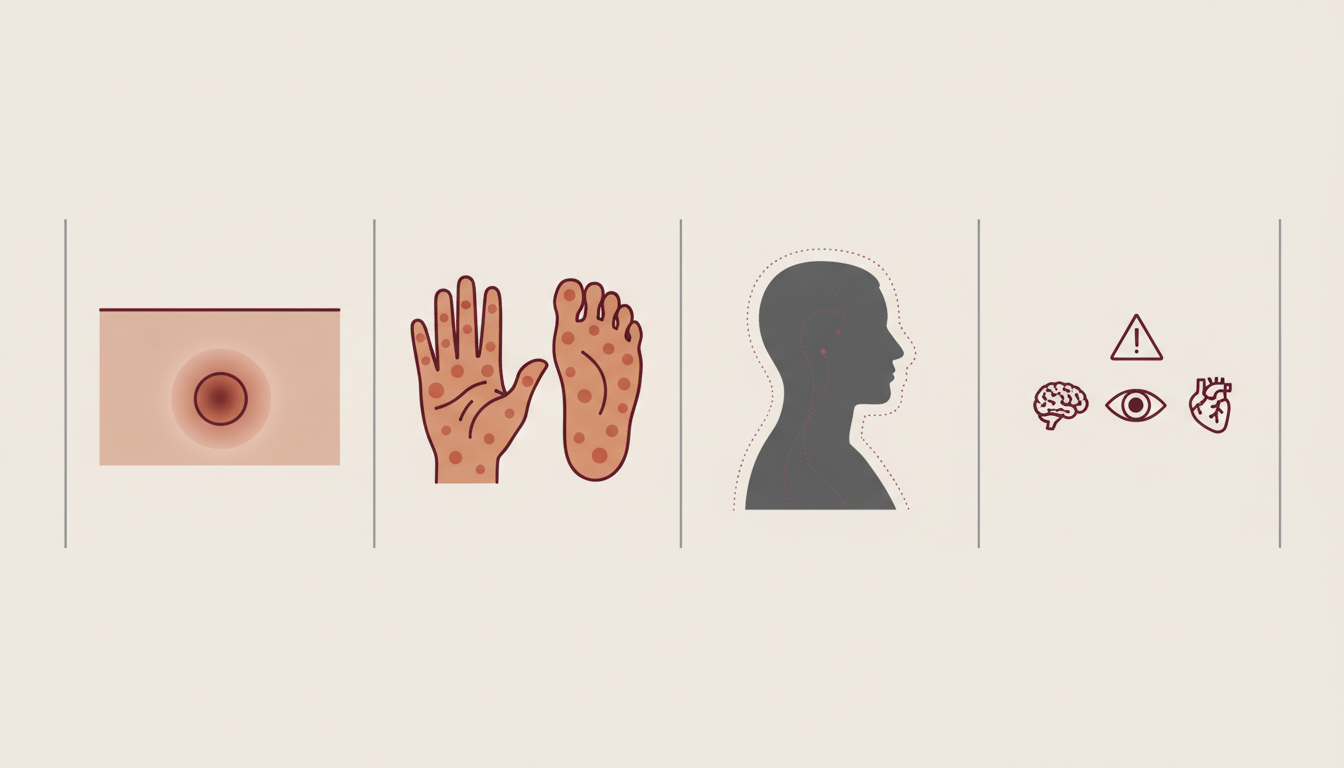
The first sore of syphilis does not always appear on the genitals. The chancre forms exactly where Treponema pallidum slipped through the skin or mucous membrane, so the location depends entirely on where contact happened. Oral sex can place a chancre on the lip, tongue, tonsil, soft palate, or pharynx. Anal contact can put one at the anus or just inside the canal. Because these areas are already prone to nicks, hemorrhoids, canker sores, or biting your cheek, the chancre blends in. It is typically firm, round or shallow, and oddly painless even when you press on it directly. That lack of pain is the red flag most people miss.
An oral chancre often looks like a neat, round ulcer with a smooth edge and a clean base. A traumatic bite or canker sore usually has ragged edges and stings when you eat acidic food. An anal chancre may be mistaken for an external hemorrhoid or fissure, especially when there is mild bleeding with wiping. If a 'hemorrhoid' or 'canker sore' sits unchanged for over a week without pain, or feels uncannily perfect around the edges, stop the home remedies and arrange a blood test.
Less common but documented chancre locations include the fingers (after manual contact with infected lesions, sometimes called chancre of the digit), the nipples, and the eyelids. These are rare enough that even experienced clinicians may not put them at the top of the differential on first sight.
Cervical, vaginal, rectal, urethral, and pharyngeal chancres are routinely missed because there is no easy way to inspect those areas at home. A clinician's speculum, anoscope, or pharyngeal exam is often the only way to find them. If your exposure included receptive vaginal, anal, or oral contact and a partner was diagnosed with syphilis, ask for a clinical exam even when no sore is visible. The blood test still works whether you can see the chancre or not.
The Palms-and-Soles Plot Twist
Weeks to months after the primary sore disappears, secondary syphilis can stage a quiet takeover. The signature sign is a diffuse, non-itchy rash that often involves the palms of the hands and the soles of the feet, per the NHS. That distribution is uncommon in most everyday skin conditions, which is part of why the rash is worth taking seriously even when it does not bother you. The spots can be flat or slightly raised. On lighter skin they often look coppery or reddish-brown. On brown and Black skin they may appear darker, violaceous, or gray. The rash does not care about your laundry detergent or your pillowcase, because this is not an allergy.
People dismiss it because it does not itch and because it shows up in odd places: along the sides of the torso, under the arms, around the hairline, or as faint patches on palms and soles. The CDC's About Syphilis overview notes additional secondary signs including weight loss, headache, muscle aches, and fatigue, alongside fever, swollen lymph nodes, sore throat, and patchy hair loss.
Ask one question: is this rash appearing where everyday rashes do not, on the palms, the soles, or inside the mouth? When a non-itchy rash lingers and includes any of those areas, especially after a recent painless sore that healed on its own, plan a blood test that week.
Testing Without Panic: RPR, TP-PA, and What 'Titer' Means
Lab-based syphilis testing typically uses two tests in sequence per CDC treatment guidelines: a non-treponemal screen (RPR or VDRL) that detects antibodies your body produces during active infection, and a treponemal confirmatory test (TP-PA, FTA-ABS, or a treponemal EIA) that verifies the result. Either one can be run first depending on the laboratory's algorithm. The combination is what gives clinicians confidence.
If a chancre is still present and visible, some clinics also use dark-field microscopy to identify the spirochete-shaped bacterium directly from a swab of the lesion fluid. This older technique remains valuable in early primary syphilis, when antibody tests have not yet had time to turn positive.
Understanding a few lab terms makes follow-up easier:
- Reactive vs non-reactive: the screen reports whether antibodies are present. A non-reactive screen during the window period does not rule out infection.
- Titer: a number like 1:8 or 1:64 reflecting how much antibody is present. After successful treatment, the RPR titer should drop fourfold over several months (for example, 1:32 falling to 1:8). That fall tells the clinician therapy worked.
- Lifetime positive: treponemal tests (TP-PA, EIA) typically remain positive for life even after a complete cure. They prove past or current infection, not active disease. This is why titer trend matters more than a single reactive result.
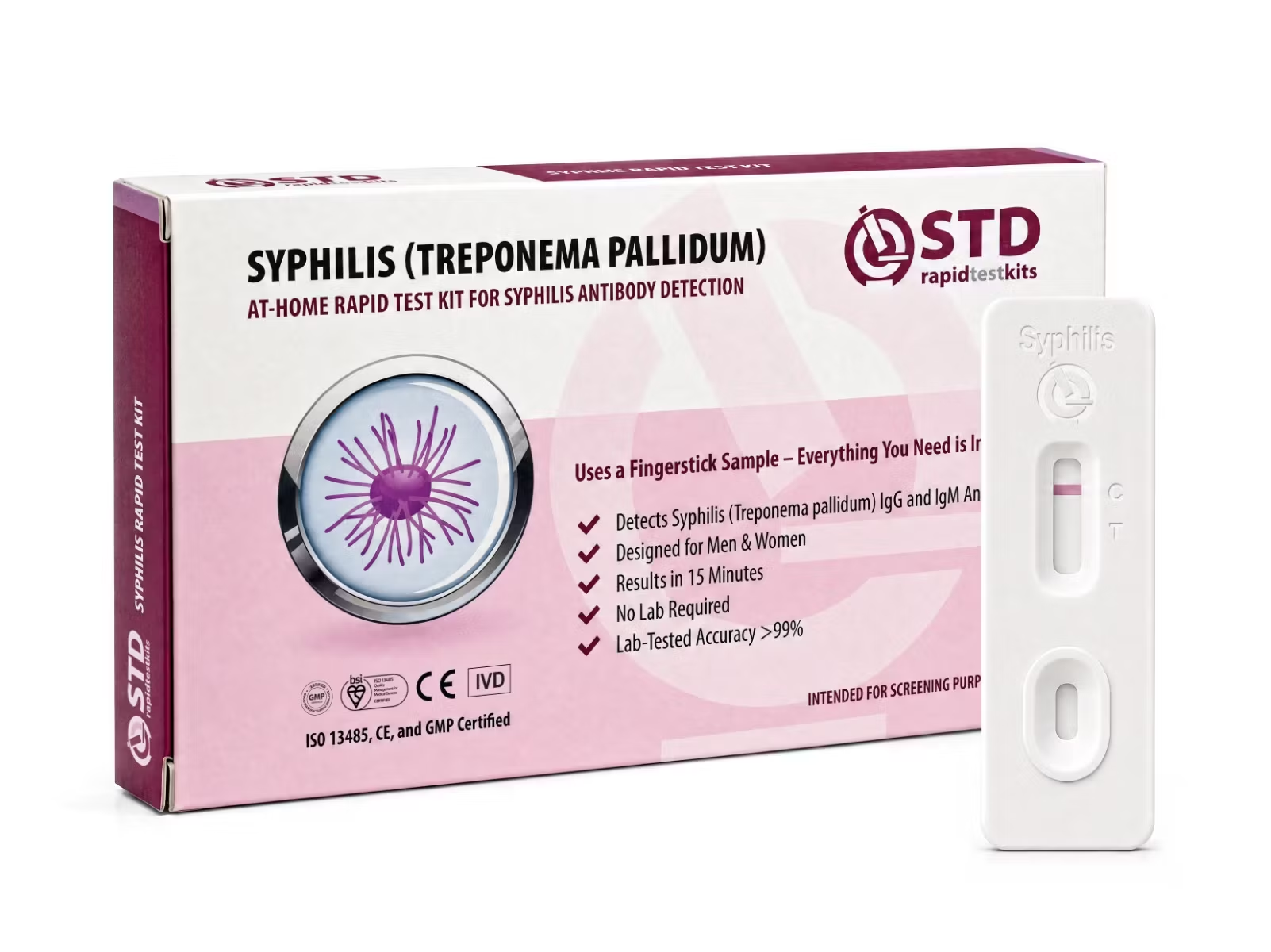
Rapid at-home tests, including stdrapidtestkits.com's syphilis fingerstick test, are lateral-flow antibody screens that detect treponemal antibodies. (Disclosure: this site sells the rapid at-home syphilis test described in this section.) They become detectable from about 3 to 6 weeks post-exposure, with 6 weeks the preferred threshold for reliably ruling out infection. They are useful for fast initial information and for people who cannot easily access a clinic. A reactive home result is a strong reason to follow up with a clinician for laboratory confirmation, RPR titer, treatment if indicated, and partner notification. A non-reactive home result very early after exposure does not rule out infection. Retesting at 6 weeks and again at 12 weeks is the conservative approach if exposure is recent.
Rapid lateral-flow home tests screen quickly and privately for syphilis antibodies. A reactive home result should be followed by laboratory RPR and TP-PA for titer measurement and confirmatory diagnosis. The two are complementary, not competing. Home tests give you a first answer; laboratory tests give your clinician the numbers needed to stage the infection and track treatment response.
The Quiet Years: Latent Syphilis and Pregnancy
After the secondary stage settles, syphilis enters the latent phase. There are no outward symptoms. No sores, no rash, no fatigue tied to it. The bacteria are still present, but the immune system has temporarily suppressed visible signs. CDC divides latent syphilis into two periods: early latent, the first year after infection, when sexual transmission can still occur and treatment is shorter, and late latent (or unknown duration), after which transmission risk through sex is much lower but the infection can still cause organ damage if untreated.
Treatment in early latent syphilis is typically a single intramuscular injection of benzathine penicillin G. Late latent and unknown-duration cases usually require three weekly injections per CDC treatment guidelines. Both work. Both prevent progression.
Pregnancy raises the stakes. Untreated syphilis can pass from a pregnant person to the fetus across the placenta at any stage of the infection, including latent stages with no visible symptoms. The consequences of untreated congenital syphilis are severe: stillbirth, neonatal death, low birth weight, bone deformities, blindness, deafness, and developmental delays per the WHO syphilis fact sheet. The CDC recommends syphilis screening at the first prenatal visit, with repeat testing in the third trimester and at delivery for higher-risk groups or in areas with elevated syphilis rates. Penicillin during pregnancy is safe and highly effective at preventing transmission to the fetus. Ask your prenatal provider explicitly whether your panel includes syphilis testing, since coverage varies by clinic and state.
| Stage | Standard treatment | Sexual transmission risk |
|---|---|---|
| Early latent (under 1 year since infection) | Single intramuscular injection of benzathine penicillin G | Sexual transmission still possible |
| Late latent or unknown duration (over 1 year) | Three weekly intramuscular injections of benzathine penicillin G | Sexual transmission much less common; organ-damage risk if left untreated |
Reinfection Is Not the Same as Treatment Failure
After successful treatment, RPR titers fall over months. If a new bump or rash appears after that, panic often follows. The clinical reality is more nuanced. Treatment cures the infection but does not produce immunity. A person who was successfully treated can be exposed again from an untreated partner and reinfected. That is reinfection, not treatment failure. True treatment failure is uncommon when the right antibiotic and dose were used per the CDC's STI Treatment Guidelines.
Clinicians distinguish the two using titer trends. After treatment, the RPR should drop at least fourfold over several months. If titers fall and then climb again, that pattern points to reinfection. If titers never fall (called 'serofast' when they stop dropping but stay stable), the clinician will look at the timing, the antibiotic used, and any HIV status that might affect immune response. The fix is practical: retest, retreat if indicated, and make sure recent partners are evaluated.
HIV and syphilis frequently co-occur. Untreated syphilis can increase the efficiency of HIV transmission per CDC guidance, and routine syphilis screening is part of HIV care. Anyone diagnosed with syphilis should also be tested for HIV, hepatitis B and C, and other common STIs, since exposure routes overlap.
| Pattern | Reinfection | Treatment failure or serofast state |
|---|---|---|
| Titer trend after treatment | Falls fourfold, then rises again | Never falls fourfold, or stays stable at the same level |
| Likely cause | Re-exposure from an untreated or new partner | Inadequate dose, atypical immune response, or HIV co-infection |
| Clinical action | Retreat with full course; notify recent partners | Reassess dosing; test for HIV; consider longer follow-up |
Prevention That Goes Beyond Condoms
U.S. syphilis is no longer a rare disease. The CDC's annual STI surveillance report tallied 190,242 total reported syphilis cases in 2024, with primary and secondary cases at 41,496 and congenital syphilis climbing for the 12th consecutive year to nearly 4,000 reported cases. Layered prevention matters because cases are not slowing down.
Condoms reduce syphilis risk substantially because they cover skin where most chancres form, but they are not a complete shield. Treponema pallidum can transmit through any direct contact with an infectious sore, and chancres can sit on the scrotum, base of the penis, vulva, anus, lip, or tongue, places condoms do not always cover. Per CDC guidance, layered prevention works better than any single tool:
- Routine testing: at least annually for sexually active adults, every 3 to 6 months for men who have sex with men, people with multiple partners, people living with HIV, and pregnant people at the first prenatal visit and again in the third trimester.
- Partner conversations: when a partner discloses a positive result, get tested even if you feel fine. Early treatment prevents the long timeline.
- Barrier methods: condoms and dental dams during oral, vaginal, and anal sex.
- Doxy-PEP: doxycycline taken within 72 hours after condomless sex has shown substantial reduction in syphilis, chlamydia, and gonorrhea among high-risk groups in recent CDC clinical guidance. It is not for everyone; ask your clinician whether it is appropriate.
- Treat partners: if you test positive, partners from the past 90 days for primary syphilis (and longer windows for later stages) need notification and treatment.
What to Do If You Find a Sore on Yourself or a Partner
The right sequence is short and worth following exactly. Most U.S. states offer anonymous partner notification services through public health departments, so the awkward conversation does not have to start with you. The clinician confirming your diagnosis can connect you with those services.
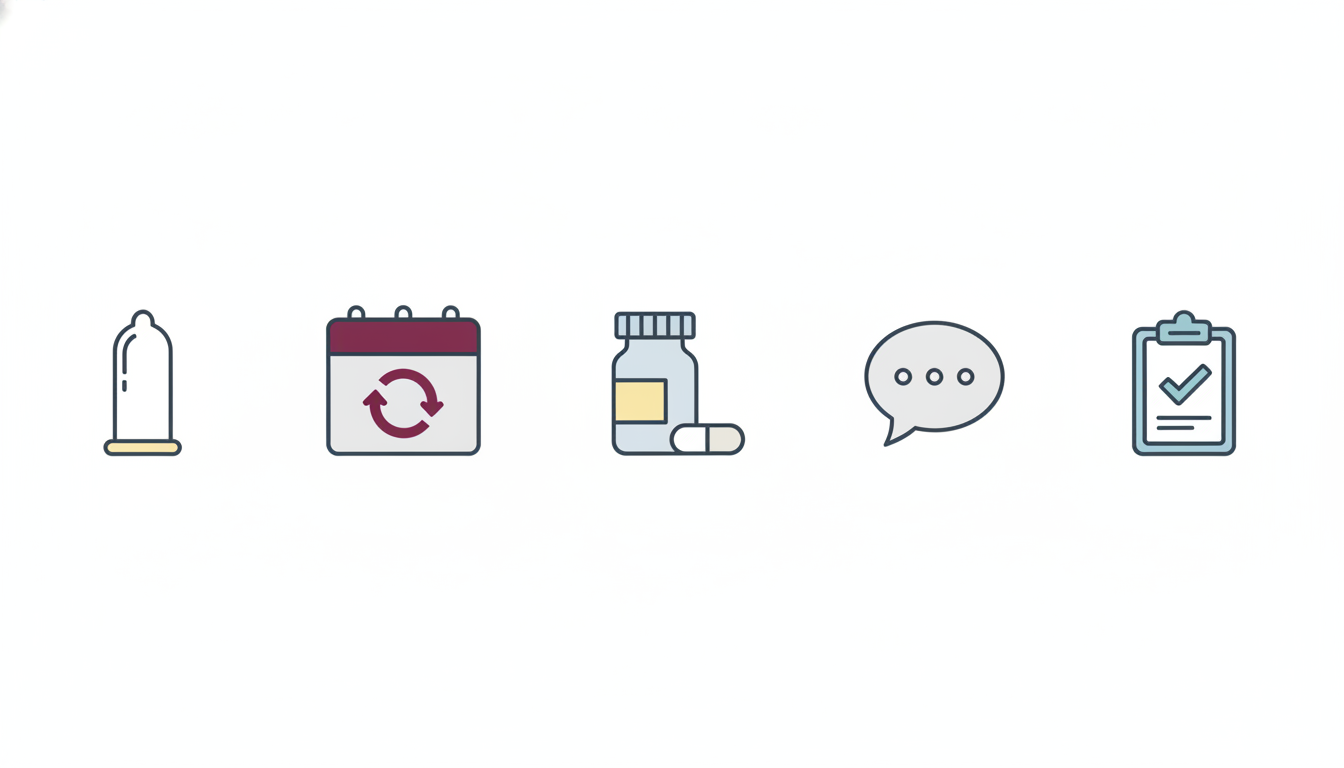
The five-step sequence at a glance
- Pause sexual contact while you find out what the sore is. Condoms reduce risk but do not cover every place chancres form.
- Test for syphilis even if the sore is small or already shrinking. A blood test detects infection whether the chancre is visible or has healed.
- Add a multi-infection panel if the same exposure event raises questions about HIV, hepatitis, or other STIs.
- Follow up with a clinician on any reactive at-home result for laboratory confirmation, titer measurement, and treatment.
- Notify recent partners (last 90 days for primary syphilis) so they can test and treat. State health departments will do this anonymously on your behalf.
The Awkward Part: Telling Partners
Partner notification is the part most people stall on, and it is also the part that determines whether syphilis stops with you or keeps moving. The framing that helps most: this is a medical heads-up, not a confession. Recent partners need a chance to test and treat, and most will appreciate the call (or text, or message through a clinic-supported anonymous notification service) rather than discovering the infection at stage 2 themselves.
State and local health departments in the U.S. offer partner services that can notify contacts on your behalf without revealing your name. The clinician confirming your diagnosis can connect you with these services, which exist precisely because the public health system understands how hard the conversation is.
If you tested positive at home with a rapid kit and have not yet been confirmed at a clinic, hold off on partner notification until the confirmatory result is in. False positives on screening tests do happen, and prematurely worrying a partner about an infection that confirmation testing rules out is its own kind of harm. Reframing the test as routine, similar to a dental cleaning or a cholesterol panel, also shifts the question from 'should I get tested?' to 'when did I last get tested?' That mindset is what changes outcomes at the population level.
Syphilis screening is part of routine sexual-health maintenance, similar to a dental cleaning or a cholesterol panel. Frequent testing is what changes outcomes. The result is information that helps you and any partners make decisions, and it carries no judgment about how you got there.

You Deserve Answers, Not Assumptions
Mistaking a chancre for an ingrown hair is common because early syphilis stays quiet and heals on its own at the surface. Underneath, the infection keeps moving. What matters is what comes next. If a painless bump refuses to behave, or a non-itchy rash shows up in unusual places like the palms and soles, testing turns guesswork into a plan. Quick diagnosis leads to straightforward treatment with antibiotics, protects partners, and keeps the current syphilis surge from reaching one more person.
The right first step depends on your situation. If your concern is specifically about syphilis exposure, a fingerstick syphilis blood test gives a fast initial answer at home, with laboratory confirmation through your clinician for any reactive result. If recent exposure could plausibly include other infections (HIV, hepatitis B or C, herpes, gonorrhea, chlamydia), a combination kit covers more ground in a single session.
Untreated syphilis in pregnancy may lead to severe negative consequences, such as stillbirth, neonatal death, prematurity, low birth weight and life-long health problems to the infected infant.
Frequently Asked Questions
- Can a syphilis chancre really be painless?
- Yes. A primary chancre is typically firm, clean-edged, and surprisingly painless, which is exactly why people mistake it for an ingrown hair or pimple. A painless sore is still infective and still progressing; the lack of pain is what makes early syphilis so easy to miss. If a 'grooming bump' or sore lingers more than a week, or is followed by a non-itchy rash, get a blood test promptly.
- How fast does the secondary rash appear after the first sore heals?
- The secondary rash typically appears several weeks to a few months after the primary sore and may overlap with it. It can be subtle and non-itchy, often involving the trunk, arms, and the palms and soles. Because of the gap, people frequently fail to connect the rash to the painless bump from a couple of months earlier.
- Can you get syphilis from oral sex?
- Yes. Chancres can form on the lips, tongue, tonsils, or pharynx after oral contact with an infected partner, and oral chancres are easy to mistake for canker sores or strep throat. Our blood antibody test still detects the systemic infection regardless of where the original sore was. Oral sex is a documented route of syphilis transmission.
- What is the difference between RPR and TP-PA?
- RPR gives a number, called the titer, that your clinician uses to track whether treatment is working. TP-PA confirms the diagnosis and typically stays positive for life even after a full cure. For follow-up purposes, the trend across repeated RPR tests matters more than a single reactive result on either test.
- Can I have syphilis if my early blood test was negative?
- Yes. Very early infections can produce a non-reactive screen during the window period, before antibodies have risen to detectable levels. Antibody-based tests become detectable from about 3 to 6 weeks post-exposure, with 6 weeks the preferred threshold for reliable ruling-out. If a painless sore or non-itchy rash fits the timeline, your clinician may retest at 6 and 12 weeks or, when suspicion is high, treat empirically.
- What is the standard treatment for syphilis?
- Per CDC guidelines, benzathine penicillin G given by intramuscular injection is the recommended treatment for all stages of syphilis. Early-stage syphilis usually requires a single dose; late latent or unknown-duration syphilis typically needs three weekly doses. People with documented penicillin allergy may be candidates for doxycycline in non-pregnant adults, though desensitization to penicillin is preferred when possible, especially during pregnancy.
- When should my RPR titer start to drop after treatment?
- Most people see at least a fourfold drop (for example, 1:32 falling to 1:8) over several months, but the pace depends on the stage at treatment and immune status. Your clinician will schedule follow-up testing at 6 and 12 months to confirm the trend. If titers do not fall, the clinician will look for reinfection, treatment failure, or the 'serofast' state where the titer stays stable.
- Do standard STD panels include syphilis testing?
- Not always. Some clinic panels test only for chlamydia and gonorrhea unless syphilis is specifically requested. Ask your provider directly whether syphilis (RPR or treponemal antibody) is on your panel, especially during pregnancy or after a possible exposure.
- U.S. Centers for Disease Control and Prevention. STI Treatment Guidelines, Syphilis. Source for staging definitions, RPR titer trends after treatment, and benzathine penicillin G dosing across stages.
- U.S. Centers for Disease Control and Prevention. About Syphilis. Patient-facing overview of stages, transmission routes, and secondary symptoms including weight loss, headache, muscle aches, and fatigue.
- U.S. Centers for Disease Control and Prevention. Annual STI surveillance report. Source for 2024 case counts: 190,242 total syphilis, 41,496 primary and secondary, and nearly 4,000 congenital cases.
- World Health Organization. Syphilis fact sheet. Source for congenital syphilis outcomes and tertiary-stage organ involvement.
- U.K. National Health Service. Syphilis: symptoms, testing, and treatment. Patient-facing reference for incubation timing (about 3 weeks or more from exposure to first symptoms) and the palm-and-sole rash distribution.
- MedlinePlus, U.S. National Library of Medicine. Plain-language overview of syphilis symptoms, transmission, and treatment.
