I Slept with a Sex Worker: Should I Get Tested and When?
A new partner, paid or not, can leave you scanning your body and the search bar for hours. This guide skips the moralizing and walks you through what current CDC and WHO guidance says about testing timelines, what condoms protect against, and how to think clearly about your next step in plain English.




- Testing windows differ by infection: chlamydia and gonorrhea become detectable from about 1 to 2 weeks post-exposure, syphilis from 3 to 6 weeks, and HIV from roughly 18 days on lab antigen/antibody tests up to 12 weeks for a definitive negative on rapid antibody tests.
- Condoms substantially reduce HIV, chlamydia, and gonorrhea risk, but herpes, HPV, and syphilis chancres can transmit through skin contact in areas a condom doesn't cover.
Published: August 2025 | Last updated: May 2026 | Editorial review and quality control: Martina N.
It hits the body before it hits the brain. You're home, alone, scrolling. The encounter replays. Somewhere between the second tab and the third coffee at midnight, the question lands: should I get tested? If she said she gets tested every two weeks, does that close the loop? If you used a condom, is that the end of it? The browser doesn't give you a calm answer. It just gives you more tabs.
Here is what you actually need: a clear picture of which infections take how long to show up on a test, an honest read on what condoms do and don't cover, and a plan you can act on without spending the next 90 days in panic mode. Paid or unpaid, new partners come with the same kind of risk math. Below, you'll find the relevant numbers from CDC and WHO guidance, translated into plain English so you can decide what to do next.
Was sleeping with a sex worker actually higher-risk than your last casual hookup?
Probably not, and the panic in your head is usually running ahead of the actual math. Many professional sex workers, especially in places with healthcare access and harm-reduction support, test more often than the average dating-app user. The World Health Organization identifies sex workers as a priority group for STI screening, recognising that healthcare access in that population reduces onward spread. The cultural trope that paid sex is automatically high-risk is more about stigma than risk math.
That doesn't mean risk is zero. No sexual encounter, paid or unpaid, is risk-free. What it does mean is that the panic spiral is usually focused on the wrong variable. The variable that actually predicts STI exposure is behavior: was a condom used correctly, was there oral or anal contact, did any contact happen with visible lesions, was the encounter recent enough that an STI might still be in its window period for the other person too. Those questions matter. The label of who you slept with matters less.
A one-time encounter with someone who tests every two weeks and uses barriers is, on the numbers, lower-risk than serial unprotected hookups with people who never test. The relevant questions are about the specific behavior during the encounter, not the partner's occupation.

When can each STI actually show up on a test?
The number that matters here is the window period: the gap between exposure and when a test can reliably detect an infection. Test too early and you can get a false-negative result while the infection is still ramping up. Per CDC STI guidance, the rough timelines look like this.
Chlamydia and gonorrhea are typically detectable about 1 to 2 weeks post-exposure using nucleic acid amplification (NAAT) lab tests. At-home rapid tests use lateral-flow chemistry (the strip-based technology used in rapid pregnancy and flu tests), which is different from lab NAAT; the manufacturer's recommended window is usually similar but worth checking on the product data sheet.
HIV has the widest range. A fourth-generation antigen/antibody combination lab test can detect infection from about 18 to 45 days post-exposure. Rapid antibody-only tests, including most at-home blood-draw kits, sit in a 23 to 90 day window, with the conservative definitive-negative point usually quoted at 12 weeks (CDC HIV testing). A nucleic acid test (NAT), available at some sexual-health clinics, can detect HIV from as early as 10 days post-exposure, useful if the encounter was within the past two weeks and the risk level was high. If the exposure was very recent and high-risk, talk to a clinician about post-exposure prophylaxis (PEP), which must be started within 72 hours.
Syphilis blood tests generally become reliable from 3 to 6 weeks after exposure. Hepatitis B and C can also transmit sexually; blood tests for both become reliable from around 6 to 8 weeks post-exposure, which is why they appear in multi-infection screening kits. Herpes antibody testing is the trickiest of the common screens: seroconversion typically takes 6 to 12 weeks, with some assay labels extending the window to 16 weeks for a definitive negative, and many clinicians don't routinely screen asymptomatic patients for HSV because the test has a high false-positive rate in lower-prevalence populations.
The takeaway: a test at day 4 is almost always too early. A test at day 14 catches most chlamydia and gonorrhea. A test at week 6 catches most syphilis and a meaningful share of HIV. A confirmation test at 12 weeks closes the HIV window for nearly everyone.
The kits linked in this article are sold by this site; all use rapid lateral-flow chemistry, not lab-grade NAAT. We recommend products based on fit-for-purpose for the reader's concern, not commercial benefit.
Where condoms protect, and where they don't
Condoms are not magic. They are very effective at one specific thing: blocking the exchange of fluids during penetrative sex. Per the CDC's condom guidance, consistent and correct use substantially reduces transmission of HIV, gonorrhea, and chlamydia. That's the column where condoms shine.
The column where they don't: skin-to-skin infections. Herpes (HSV-1 and HSV-2), human papillomavirus (HPV), and syphilis spread through direct skin contact and can transmit from areas a condom doesn't cover. Inner thighs, base of the penis, scrotum, vulva, pubic mound. Syphilitic chancres in those locations can transmit infection during contact even with a perfectly used condom in place.
Oral sex is the other gap. Most people who use condoms for vaginal or anal sex do not use barriers for oral. Gonorrhea in the throat (pharyngeal gonorrhea) is the most-discussed risk; chlamydia and syphilis can also transmit orally; and HSV-1 transmission from oral contact to the genitals is well-documented. None of this is fearmongering. It's the reason CDC guidance recommends throat and rectal swab testing for people who have had oral or anal sex, separate from urethral or vaginal screening.
Consistent and correct use provides substantial protection against fluid-borne infections like HIV, chlamydia, and gonorrhea, and partial protection against skin-to-skin infections depending on where contact occurred.

What to ask for, at the clinic or at home
If you're going to a clinic, ask for a full STI panel: chlamydia, gonorrhea, syphilis, HIV, and hepatitis B and C. If you had oral sex, ask specifically for a pharyngeal swab for chlamydia and gonorrhea. If you had receptive anal sex, ask for a rectal swab. Genital-only screening misses throat and rectal infections, and many clinics won't add those by default unless you say the words. Note that throat and rectal swabbing is a clinic procedure; at-home kits validated for those sample types aren't part of the typical home-testing market.
If you're testing at home, the calculation is different. At-home rapid tests use lateral-flow chemistry, not lab NAAT, and they are best understood as a privacy-preserving first screen. A negative result on a properly timed at-home test is reassuring; a positive result is worth confirming with a lab test and a clinician visit. The convenience advantage is real (no waiting room, no judgment, results in 15 minutes), and the trade-off is that the analytical sensitivity is generally lower than a centralized lab NAAT.
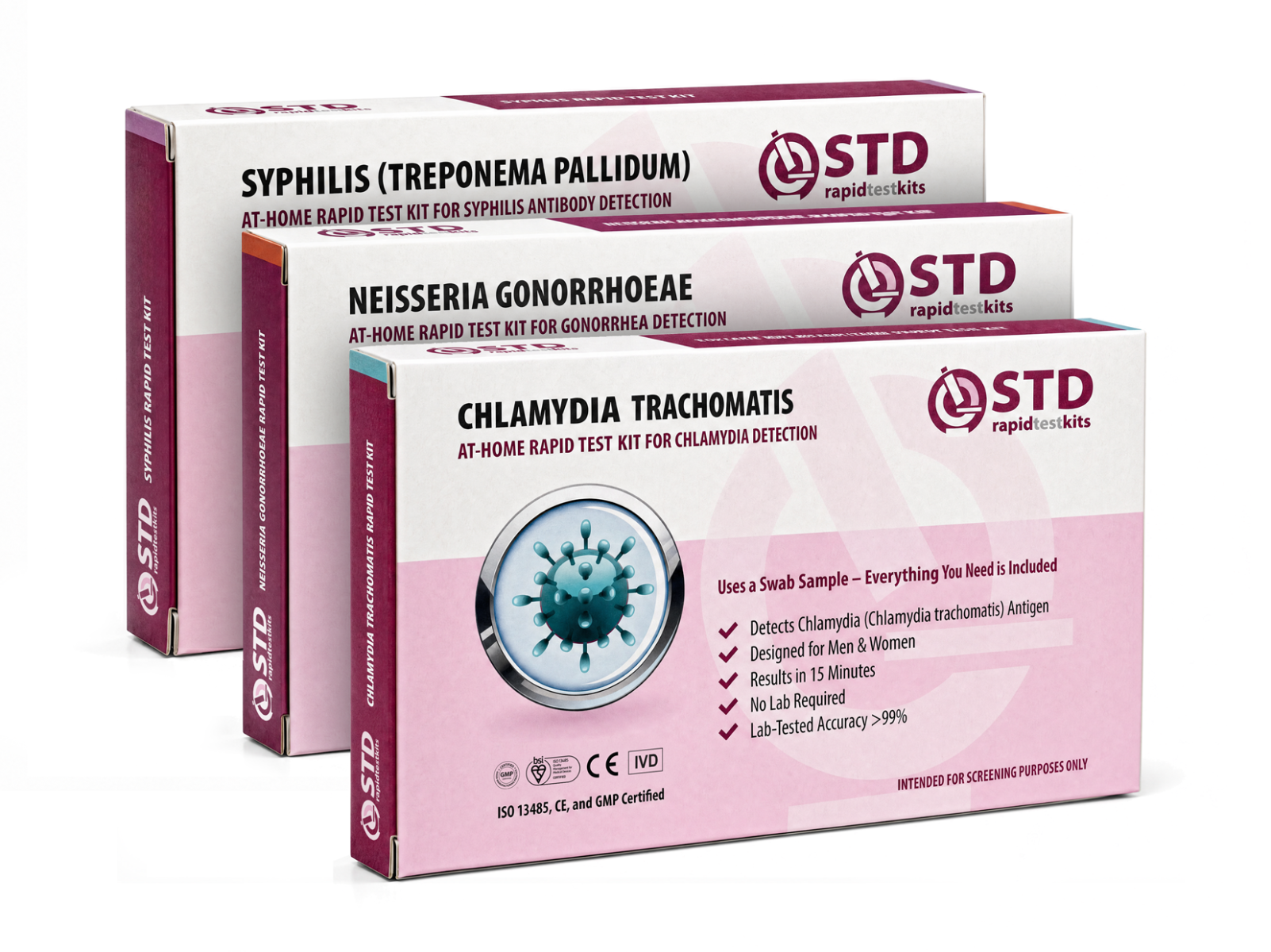
For the kind of broad first-pass screen most readers in this position need, a multi-test combination kit is the practical pick. It covers the highest-incidence infections in one shipment so you're not making three separate purchasing decisions while you're stressed.
Talking to your partner without spiraling
If you have a partner you're sleeping with, the question of whether and how to disclose lands fast. There isn't a universal script, but there's a useful frame: transparency is protective, and it doesn't have to be a full confession. If you plan to have unprotected sex with your partner before your testing window closes, they need the information to make their own decision. If you don't plan to, the moral and relational calculus is yours.
A clean version of the conversation sounds like: "I had an outside encounter recently, I'm getting tested before we sleep together again, I wanted you to know so you can decide what you want to do." That's honest, it's specific to behavior, and it gives the other person agency. It is also significantly easier to deliver before a positive result than after.
If shame is loud right now, that's normal. Shame is what stigma feels like from the inside. Getting tested first, then having the conversation, is the most protective sequence for everyone involved.

Why testing matters even when nothing feels wrong
The single largest driver of STI transmission isn't reckless behavior. It's asymptomatic infection. Per the WHO STI fact sheet, most STIs cause no symptoms or only mild symptoms that go unrecognized. Chlamydia is famously silent: a large share of infected people, particularly people without a uterus, never develop noticeable symptoms. HPV is silent until it isn't. HIV can mimic a cold during acute infection and then go quiet for years.
Feeling fine is a useful data point, but it is not a diagnostic. Waiting for symptoms before testing is how an infection gets transmitted to the next partner, and the partner after that, before anyone notices it's there. The whole point of screening is that it works when you're asymptomatic.
Late detection also drives the worst outcomes. Untreated chlamydia can cause pelvic inflammatory disease and fertility damage. Untreated syphilis progresses through stages with serious cardiac and neurological consequences. Untreated HIV is now a highly manageable chronic condition, but only because the people taking antiretrovirals were tested first.
More than 1 million curable sexually transmitted infections are acquired every day worldwide, the majority of which are asymptomatic.
FAQs
- Was sleeping with a sex worker actually higher-risk than other casual sex?
- Statistically, no. The exposure-relevant questions are what happened during the encounter, not who the partner was. Condom use, oral or anal contact, and how recently the partner last tested predict risk far more reliably than occupation.
- Can I still get an STI if we used a condom?
- Yes, but the risk profile is much lower for fluid-borne infections like HIV, chlamydia, and gonorrhea. Skin-to-skin infections (herpes, HPV, syphilis chancres) can transmit from areas a condom doesn't cover: inner thighs, scrotum, pubic mound, base of the penis. A condom substantially reduces overall STI risk; it doesn't eliminate it.
- She said she gets tested every two weeks. Is that enough?
- Frequent testing is a strong sign and a real protective behavior, but every test has a window period: the time between infection and detectability. If she contracted something between her last test and your encounter, her recent negative result wouldn't have caught it. Your testing is still your responsibility.
- I feel completely fine. Doesn't that mean I'm okay?
- Feeling fine is not a diagnostic. The majority of STIs are asymptomatic, especially chlamydia, gonorrhea in many populations, HPV, and HIV in its chronic phase. Many people are infected and unaware. Screening is designed for exactly this situation: catching infections before symptoms appear.
- Can oral sex transmit STIs?
- Yes. Gonorrhea, chlamydia, syphilis, herpes (HSV-1 and HSV-2), and HPV can all transmit through oral contact, in either direction. Pharyngeal gonorrhea is the most-discussed throat risk. CDC guidance recommends throat swabs for people who had oral sex; regular urethral or vaginal screening will miss throat infections.
- How long do I have to wait before I can trust a test result?
- About 1 to 2 weeks for chlamydia and gonorrhea, 3 to 6 weeks for syphilis, roughly 18 to 45 days for a lab-based fourth-generation antigen/antibody HIV test, and up to 12 weeks for a definitive negative on rapid antibody-only HIV tests. Testing earlier can return a false-negative while the infection is still in its window.
- Should I tell my partner now or wait for results?
- Tell them before you have unprotected sex with them again. You don't owe a full confession, but they need enough information to choose whether to test alongside you. Disclosure before a positive result is significantly easier than after, and it preserves the relational trust that an after-the-fact disclosure usually doesn't.
- Are at-home rapid tests as reliable as a clinic test?
- At-home rapid tests use lateral-flow chemistry, which is different from the NAAT or fourth-generation antigen/antibody chemistry that centralized labs use. They are well-suited as a privacy-preserving first screen, with a properly timed negative result being reassuring. A positive result on a rapid test is worth confirming with a lab test and a clinician visit.
- U.S. Centers for Disease Control and Prevention. Sexually transmitted infections hub, including screening recommendations, testing types, and asymptomatic-infection prevalence.
- U.S. Centers for Disease Control and Prevention. HIV testing, including window periods for fourth-generation antigen/antibody combination tests, rapid antibody-only tests, and nucleic acid tests (NAT).
- U.S. Centers for Disease Control and Prevention. Condoms and HIV prevention, including effectiveness against HIV, gonorrhea, and chlamydia.
- World Health Organization. Sexually transmitted infections fact sheet, covering global incidence, asymptomatic infection prevalence, and screening guidance.
- U.K. National Health Service. Sexually transmitted infections overview, including testing windows and sexual-health clinic referral guidance.
- MedlinePlus, U.S. National Library of Medicine. Sexually transmitted diseases overview, including symptoms, transmission routes, and diagnostic testing.