

Published: November 2025 | Last updated: April 2026 | Editorial review and quality control: Martina N.
A single Tinder match, a fast evening, and a positive chlamydia result a few weeks later. That sequence sits behind a large share of new chlamydia diagnoses, especially in adults under 25. Chlamydia rarely announces itself: most people who carry the infection have no symptoms at all (CDC, About Chlamydia). By the time something feels off, weeks may have already passed.
This guide walks through what actually happens after a casual hookup that turns out to be the source of a silent infection: how the math of asymptomatic spread works, when to test, what positive results mean, how to handle partner notification when the other person has already gone quiet, and what at-home rapid tests can and cannot answer. The aim is calm, specific information you can act on, with citations to the public-health sources behind each claim.
Can you get chlamydia from a single Tinder hookup, even with a condom and no symptoms afterward?
Yes. Condoms reduce risk substantially but do not bring it to zero, and most people who have chlamydia have no symptoms at all, per the CDC. The reliable test window is 7 to 14 days after exposure for chlamydia, with a follow-up retest 3 months after any treatment to catch reinfection.
Key takeaways
- Most people with chlamydia have no symptoms, so feeling fine after a hookup does not rule it out.
- The reliable test window is 7 to 14 days after exposure; a single rapid test is a starting point, with a 3-month retest to catch reinfection.
Why chlamydia hides so well
The bacterium responsible for chlamydia, Chlamydia trachomatis, infects mucous membranes inside the cervix, urethra, rectum, and throat. It lives inside the cells lining those surfaces, often without triggering an obvious immune response. CDC fact sheets on chlamydia note that most people who carry the infection have no noticeable symptoms.
Anatomy is part of the reason. The cervix has very few pain receptors, so a low-grade infection can persist for weeks or months without causing discharge, burning, or pelvic pain. In the urethra, men are slightly more likely to feel burning during urination, but many still report nothing unusual. Throat and rectal infections are usually silent regardless of gender.
This is why screening guidelines focus on regular testing rather than waiting for symptoms. The CDC recommends annual screening for sexually active women under 25 and for older women with new or multiple partners. When symptoms do appear, they are nonspecific: a change in discharge, a mild pelvic ache, light spotting between periods, or irritation that could be mistaken for a urinary tract infection.
CDC routine-screening cadence (chlamydia)
- Sexually active women under 25: annual screening for chlamydia and gonorrhea.
- Women 25 and older with new or multiple partners: annual screening at minimum.
- Men who have sex with men: every 3 to 6 months at sites of exposure.
- Pregnancy: at the first prenatal visit, with a third-trimester repeat for those at higher risk.
How one hookup becomes an infection
Chlamydia transmits through vaginal, anal, and oral sex with someone who carries the bacterium. Condoms reduce risk substantially but do not bring it to zero, since transmission can occur through skin and fluid contact at the base of the penis or around the vulva not covered by the condom. Oral exposure can transfer the bacterium to the throat, where it usually causes nothing noticeable but can still pass to a future partner.
The math of asymptomatic spread is straightforward. If most people who carry chlamydia do not know they have it, then partners cannot honestly disclose what they cannot detect. "I got tested last year and was negative" sounds reassuring but only covers the period before that test. Apps that compress the time between meeting and sex also compress the time available for shared health context.
None of this means casual sex is uniquely dangerous. It means that, for anyone with new partners, routine screening matters more than asking about a partner's last test, because most people answering that question are guessing.
| Infection | How often silent | Symptoms when present |
|---|---|---|
| Chlamydia | Most carriers have no symptoms | Discharge, burning urination, mild pelvic ache, spotting |
| Gonorrhea | Often silent in women; sometimes silent in men | Discharge, painful urination, sore throat (pharyngeal) |
| Genital herpes (HSV-2) | Most carriers are unaware | Tingling, blisters, ulcers (often mild and missed) |
| HPV | Almost always silent until warts or abnormal Pap | Genital warts, cervical cell changes detected on Pap |
When to test after a hookup
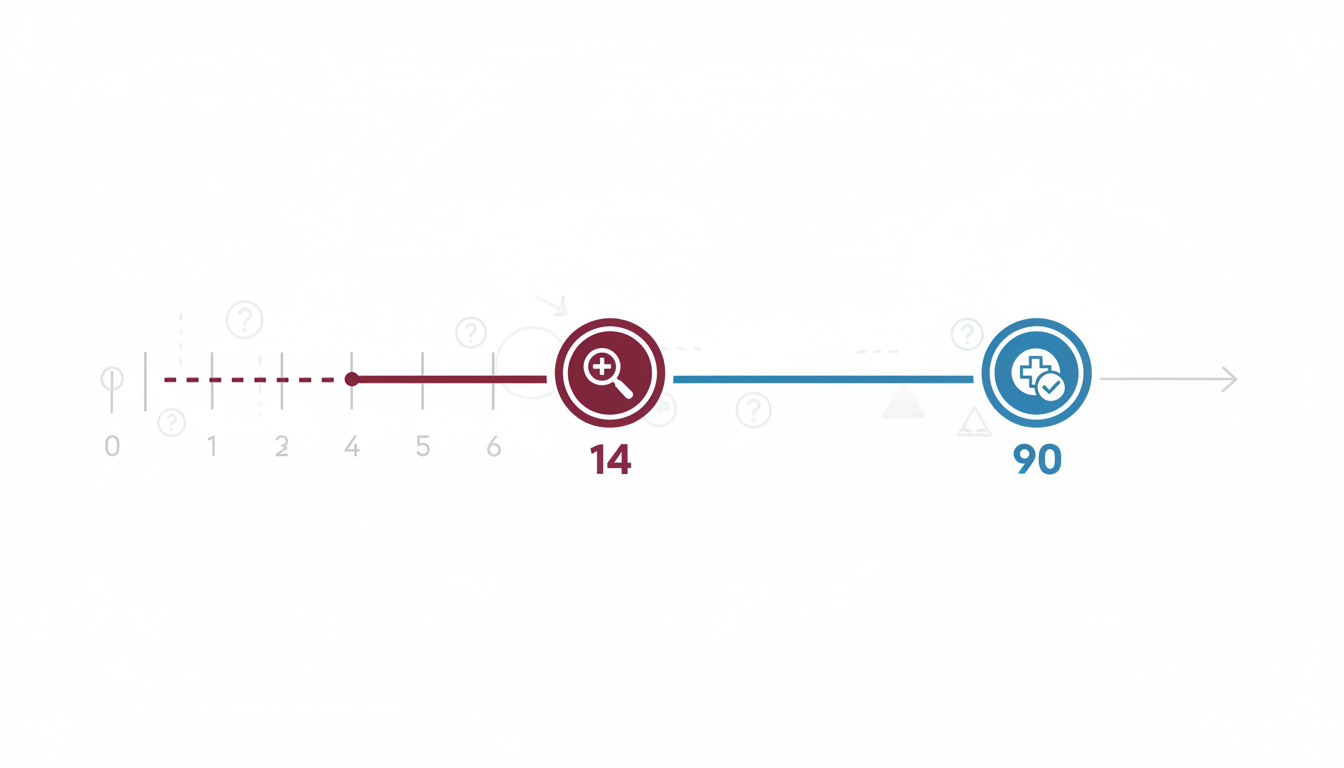
Every infection has a window period, the time between exposure and when a test can reliably detect the infection. Test too early and you risk a false negative; test at the right point and a single result is meaningful. The chart below summarizes the windows most relevant after a single hookup.
| Infection | Earliest reliable test | Recommended retest |
|---|---|---|
| Chlamydia | 7 to 14 days post-exposure | 3 months after treatment |
| Gonorrhea | 7 to 14 days post-exposure | 3 months after treatment |
| Syphilis | 3 to 6 weeks post-exposure | 12 weeks if early test was negative and exposure was high-risk |
| HIV (4th-gen Ag/Ab) | 18 to 45 days post-exposure | 90 days for definitive negative |
This article is published by stdrapidtestkits.com, which sells at-home STI testing kits. Recommendations below match the test type to the specific question being asked. Where a clinic visit or laboratory NAAT is the better tool, the article says so.
What a positive chlamydia test means
A positive chlamydia result is treatable and not unusual. CDC STI treatment guidelines name doxycycline 100 mg twice daily for seven days as the first-line therapy for genital and rectal chlamydia in non-pregnant adults. Azithromycin (a single 1 g dose) remains an alternative, particularly during pregnancy, but doxycycline now leads because it has higher cure rates for rectal infection and lower reinfection rates overall.
If chlamydia is caught and treated within weeks of exposure, complications are uncommon. Untreated infection in people with a uterus can ascend to the fallopian tubes and cause pelvic inflammatory disease (PID), which is associated with chronic pelvic pain, tubal scarring, infertility, and ectopic pregnancy. In people with testes, untreated chlamydia can cause epididymitis (swelling and pain in the coiled tube behind the testicle) and, less commonly, contribute to fertility problems. Per the WHO, these are real risks of inaction. The antibiotic course itself is short and reliable.
One technical note about retesting after treatment. If a follow-up laboratory NAAT is run within a few weeks of finishing antibiotics, it can occasionally detect residual bacterial nucleic acid even after the live infection has cleared. That is a quirk of nucleic-acid amplification, not a sign of treatment failure. At-home lateral-flow antigen tests do not share this behavior, because they detect bacterial proteins rather than DNA. For post-treatment confirmation, the cleanest approach is a clinic NAAT at the standard 3-month retest milestone rather than an early retest at home.
Untreated chlamydia is the leading preventable cause of tubal-factor infertility in people with fallopian tubes. A single treated episode rarely causes permanent damage. Repeated untreated infections increase the risk substantially, which is why catching a silent infection early and finishing the antibiotic course matters more than the diagnosis itself feels at the time.
Telling a partner who has gone quiet
Partner notification is uncomfortable, and many people have already lost contact with the partner who passed the infection along. The practical script is short and not dramatic: "Hey, I tested positive for chlamydia and you may want to get tested too." That is enough. Whether the partner replies is outside your control, and the message has done its job once it is sent.
If direct contact feels impossible, anonymous partner notification tools can send a notification to a phone number or email without identifying you. State and local public health departments in the United States also offer free partner notification services, sometimes called Disease Intervention Specialist (DIS) outreach, where a trained counselor reaches out for you. The NHS chlamydia page describes a similar service in the UK.
Expedited partner therapy (EPT) is another option in many U.S. states. Your clinician can prescribe doxycycline directly to your partner without a separate visit, which often closes the loop faster and reduces the chance of passing the infection back and forth.
"Hey, I just got a positive chlamydia test. Doctors recommend everyone I have been with in the last few months get tested too. It is treatable with a short antibiotic course. Wanted you to know." That is the whole script. No blame, no debate, no apology required.
Treatment, retesting, and reinfection
The doxycycline course usually clears chlamydia, but the bacterium can come back if a partner was not treated, if the seven-day abstinence rule was broken, or if a new exposure happens. Two timing rules cover most reinfection cases:
- Avoid sex for seven days after starting treatment, and confirm any current partners have completed their own treatment before resuming.
- Schedule a retest about three months after treatment to catch reinfection. CDC guidance is explicit that this retest is to detect new exposure, not to confirm cure. Most people clear the bacteria with the antibiotic course itself.
A significant share of people who are treated for chlamydia test positive again within a few months, almost always because of re-exposure rather than treatment failure. The three-month retest is designed to catch exactly this pattern. If your partner was treated separately and you both stayed abstinent through the seven-day window, the odds of reinfection drop sharply.
| Regimen | Dose | Notes |
|---|---|---|
| Doxycycline (first line) | 100 mg twice daily for 7 days | Take with food. Higher cure rate for rectal infection. Avoid in pregnancy. |
| Azithromycin (alternative) | 1 g single oral dose | Used in pregnancy and when doxycycline is contraindicated. |
| Amoxicillin (pregnancy alternative) | 500 mg three times daily for 7 days | Used when azithromycin is not available or tolerated. |
At-home rapid tests, mail-in NAATs, and clinic visits
Three at-home or near-home options exist for chlamydia screening, and they answer slightly different questions. Picking the right one depends on how fast you need an answer, how confident you need to be in a negative result, and what comes next if it is positive.
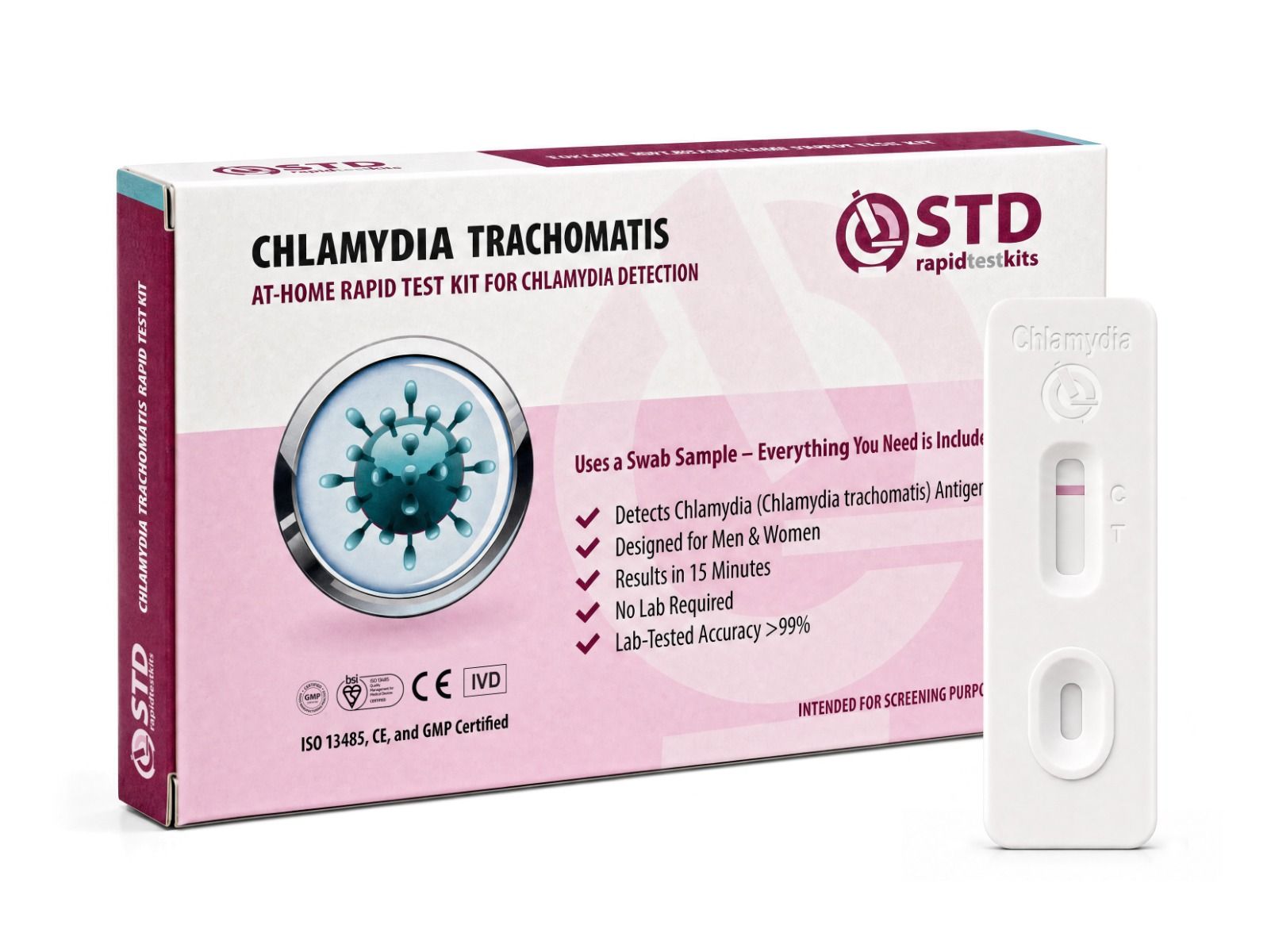
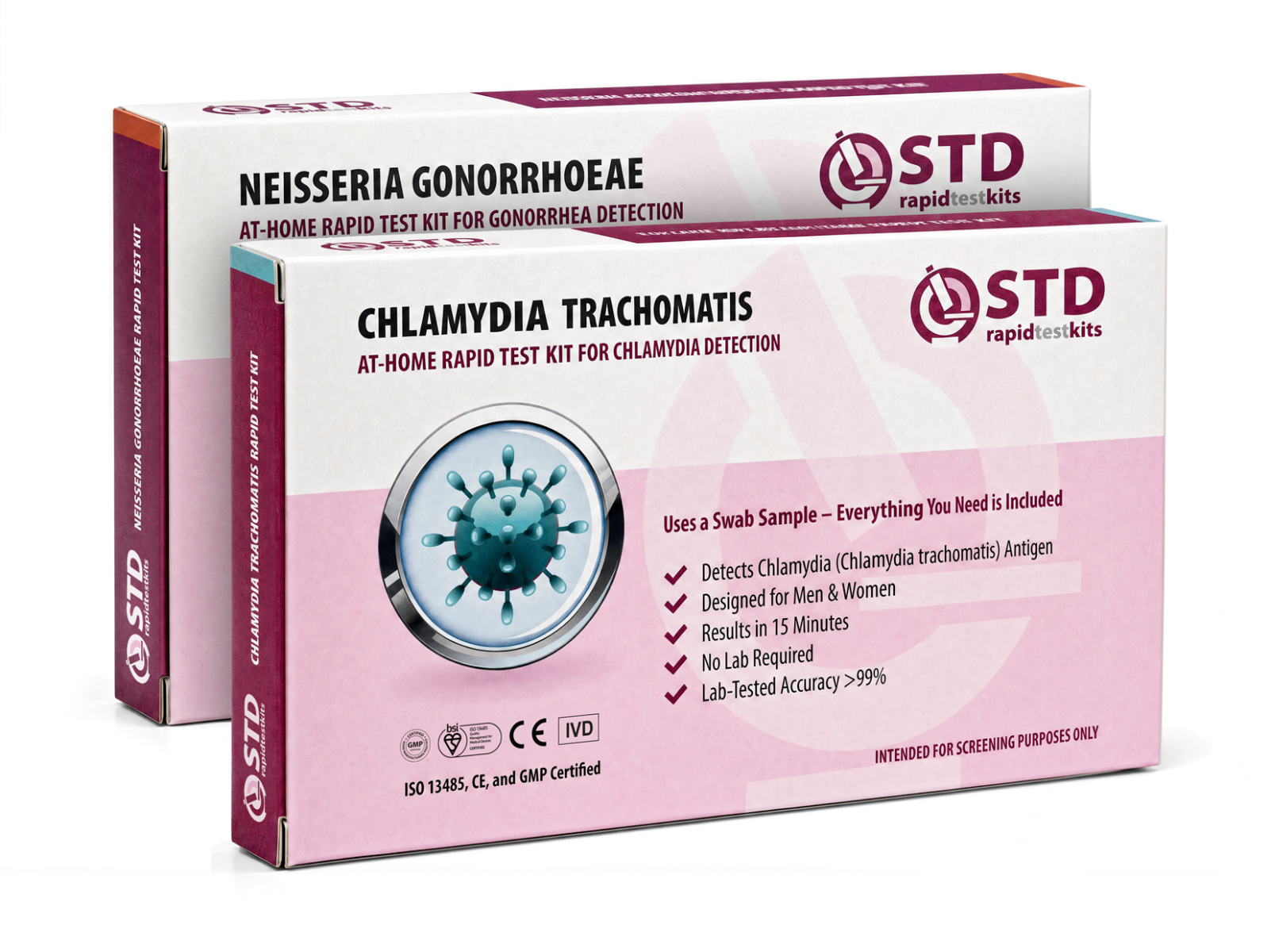
- Rapid lateral-flow tests (the kits sold here): you collect a vaginal swab (women) or urethral swab (men), apply it to a test cassette, and read a positive or negative result in about 15 minutes. Lateral-flow chemistry has lower analytical sensitivity than a laboratory NAAT, especially in early or low-load infections. The strength of these kits is privacy and speed for a first screen at the right point in the window.
- Mail-in NAAT kits: you collect a sample at home and mail it to a lab, where a NAAT (nucleic acid amplification test) is run. NAAT is the laboratory gold standard for chlamydia detection. Turnaround is typically 2 to 4 days after the lab receives the sample, and you arrange treatment separately if positive.
- Clinic testing: a clinic visit gives a NAAT plus a clinical exam and immediate access to treatment if positive. The trade-off is privacy and access, particularly in rural areas or for people without insurance.
Rapid lateral-flow tests are not equivalent to NAATs. They are complementary: a rapid positive tells you to start the conversation about treatment quickly, and a clinical or mail-in NAAT confirms the diagnosis when the stakes are high (pregnancy, persistent symptoms, or treatment-failure follow-up).
Most people who have chlamydia have no symptoms. If you do have symptoms, they may not appear until several weeks after you have sex with an infected partner.
Make testing a routine, not a reaction
The most useful change after a positive chlamydia result is usually a screening cadence change rather than a behavior change. CDC screening recommendations lay out a few reasonable defaults:
- Sexually active women under 25: annual screening for chlamydia and gonorrhea.
- Anyone with new or multiple partners: every 3 to 6 months.
- Men who have sex with men: every 3 to 6 months for chlamydia, gonorrhea, syphilis, and HIV.
- Pregnancy: at the first prenatal visit, with a third-trimester repeat for those at higher risk.
Annual at the minimum, more often with new partners. The aim is to find silent infections before they cause complications or transmit, rather than to react to every nervous moment after a date.
At-home rapid kits sold here cover genital (swab) and bloodborne (fingerstick) testing. They do not cover pharyngeal (throat) or rectal swab testing. If a hookup involved oral or anal sex and you want those sites tested, see a clinic for site-specific NAAT swabs. The article above explains how oral exposure can move chlamydia to the throat without symptoms, and a clinic visit is the right path for that scenario.
The point is not that you missed something
Chlamydia does not announce itself. A positive result does not mean carelessness, recklessness, or a moral failure. It means a routine bacterial infection that responds well to a short antibiotic course, requires a calm conversation with anyone you might have shared it with, and warrants a retest in three months to be sure.
Most people who have treated chlamydia once say the next testing conversation was easier. They already knew the routine: test at 14 days, treat if positive, retest at three months.
If your test is positive, three concrete steps
- Start the antibiotic course your clinician prescribes (usually doxycycline 100 mg twice daily for 7 days) and avoid sex for 7 days after starting.
- Send a short notification to anyone you have had sexual contact with in the last few months, or use a state public-health partner-notification service if direct contact is not possible.
- Schedule a retest about 3 months after treatment to catch any reinfection from a partner who was not treated.
Frequently asked questions
- Can you get chlamydia from a single hookup?
- Yes. One sexual encounter is enough for transmission, even with a condom and even if both people felt fine afterward. Condoms reduce risk substantially but the bacterium can transmit through skin and fluid contact at edges not covered, and oral exposure can move the infection to the throat without symptoms.
- I had no symptoms. Could I have had chlamydia for weeks?
- Yes, and this is the typical pattern. Most people who have chlamydia have no symptoms, per the CDC chlamydia fact sheet. Many positive results are detected during routine screening rather than because the person felt something was wrong.
- How soon after a hookup should I get tested?
- The reliable detection window for chlamydia is 7 to 14 days after exposure. You can test earlier if you are anxious, but treat an early negative as preliminary and retest at 14 days. Syphilis and HIV have longer windows (3 to 6 weeks for syphilis, up to 45 days for 4th-generation HIV antigen-antibody tests).
- Are at-home rapid tests accurate?
- At-home rapid tests are lateral-flow immunoassays. They are useful for screening at the right point in the window period, but they have lower analytical sensitivity than laboratory NAAT testing, especially for early or low-load infections. A positive rapid result is meaningful and worth acting on; a negative result is reassuring but should be confirmed with a clinic NAAT if a high-risk exposure is recent.
- Do I have to tell someone I hooked up with if I test positive?
- It is the right thing to do, even if uncomfortable. A short message ("Hey, I tested positive for chlamydia and you may want to get tested too") is enough. If direct contact is impossible, anonymous partner notification services through state public health departments can send the message for you.
- How long after starting antibiotics is sex safe again?
- Wait seven days after starting doxycycline (or seven days after a single-dose azithromycin), and confirm that any current partner has also completed treatment. Resuming sex earlier risks passing the infection back and forth.
- What if I test again after treatment and it is still positive?
- If a laboratory NAAT is run within a few weeks of finishing antibiotics, it can occasionally pick up residual bacterial DNA even after the live infection has cleared. That is a quirk of nucleic-acid amplification rather than treatment failure. The cleaner approach is to wait until the standard 3-month retest milestone. If a clinic NAAT at that point is still positive, contact a clinician to rule out reinfection or a less common treatment-failure scenario.
- Can you get chlamydia more than once?
- Yes. Chlamydia infection does not produce lasting immunity, so a previous infection does not protect you from a new exposure. A significant share of people who are treated test positive again within a few months, almost always because of re-exposure to an untreated partner. The 3-month retest is designed to catch this.
- U.S. Centers for Disease Control and Prevention. About Chlamydia public fact sheet, including asymptomatic-infection framing, complications, and screening recommendations.
- U.S. Centers for Disease Control and Prevention. STI Treatment Guidelines for chlamydial infections, doxycycline first-line dosing, rectal-infection considerations, and 3-month retest guidance.
- World Health Organization. Chlamydia fact sheet, global epidemiology, and complications including PID and infertility.
- U.S. Centers for Disease Control and Prevention. STI screening recommendations by population (women under 25, men who have sex with men, pregnancy).
- UK National Health Service. Chlamydia overview page, partner notification options, and treatment information used as a cross-reference for non-US readers.
