
Published: November 2025 | Last updated: May 2026 | Editorial review and quality control: Martina N.
How soon can you test for STIs after unprotected sex?
It depends on the infection. Chlamydia, gonorrhea, and trichomoniasis become detectable around 7 to 14 days. HIV, syphilis, and hepatitis B give a useful first read at 4 to 6 weeks. Herpes, hepatitis C, and a confirmatory HIV result need the longest wait, up to 12 weeks (90 days for HIV). Testing earlier risks a false negative.
Most after-sex testing worry comes down to one practical question: when can a test actually tell you something useful? If you are here because something feels off, a twinge of burning when you pee or a day of vague discomfort, the reassuring part is that the cause is often a urinary tract infection, minor irritation, or a shift in pH rather than an STI, and it tends to settle within a day or two. This guide is for the rest of the worry. STIs do not appear on a test the moment exposure happens. Each infection needs time for the bacteria, the virus, or your immune response to reach detectable levels. That gap is the window period, and it is the difference between a result you can trust and a false negative that hands you false peace of mind.
Below are realistic windows for the most-tested STIs, the one situation where you should not wait (post-exposure prophylaxis for HIV is time-sensitive), how the answer changes if you have symptoms, why a single negative often is not the end of the story, and how at-home rapid kits fit in. The short version sits at the top so you can act on it; the detail follows.
Key Takeaways
- Window periods are different for every STI, and testing too early is the single most common reason an at-home rapid test misses a real infection.
- If your first test was inside the window for that infection, retest at the outer window: 90 days for HIV, 12 weeks for herpes and hepatitis C, 6 weeks for syphilis. Active symptoms now, or a known high-risk HIV exposure in the last 72 hours? See a clinician today, regardless of any home result.
Why window periods exist in the first place
An STI test does not look for the sex itself; it looks for the infection's signature. For bacterial STIs like chlamydia and gonorrhea, that signature is bacterial DNA or antigens building up locally in the urethra, cervix, throat, or rectum. For viral STIs like HIV, herpes, and hepatitis B (and for syphilis, which is bacterial but tested through the antibody response), the test usually looks for antibodies or viral antigens, both of which take days to weeks to reach detectable levels.
That means the same exposure event will produce different test results depending on when you test. A swab on day 2 will not yet have enough bacterial load to register. A blood antibody test on day 5 will not yet have antibodies to find. Testing during the window period is the single biggest reason a rapid at-home test produces a false negative on someone who is genuinely infected (CDC STI testing guidance).
Bacterial STIs (chlamydia, gonorrhea, trichomoniasis) are detected by finding the pathogen itself at the site of infection, so the clock is short: about 5 to 14 days from exposure. Viral infections and syphilis are usually detected through your immune response (antibodies) or viral antigens in blood, which take weeks to months to reach reliable levels. The outer HIV antibody window is 90 days; herpes and hepatitis C antibodies can take up to 12 weeks. Timing the test to the outer window is as important as choosing the right test type.
Window periods by infection
The numbers below are based on current U.S. CDC guidance and on manufacturer-published windows for laboratory and rapid tests. They are realistic ranges, not absolute boundaries; individual immune responses vary. The table summarizes the windows for quick scanning, and each section below adds the detail behind the numbers.
| Infection | Earliest reliable detection | At-home rapid test window | Retest at |
|---|---|---|---|
| Chlamydia and gonorrhea | 5 to 7 days (lab NAAT) | 7 to 14 days (swab) | 2 weeks if symptoms persist |
| HIV | 10 to 33 days (lab NAT) | 23 to 90 days (rapid antibody) | 90 days for full confidence |
| Syphilis | 3 weeks | 3 to 6 weeks (blood antibody) | 6 weeks if first test negative |
| Herpes (HSV) | 4 to 6 days with sores (clinic swab) | 4 to 12 weeks (blood antibody) | 12 weeks for confident negative |
| Trichomoniasis | 5 to 7 days (symptomatic) | 7 to 14 days (vaginal swab) | 2 weeks if symptoms persist |
| Hepatitis B | 1 to 9 weeks (avg ~4 weeks) | 3 to 6 weeks (HBsAg) | 6 months after high-risk exposure |
| Hepatitis C | 2 to 6 weeks (HCV RNA) | 8 to 11 weeks (antibody) | 12 weeks for confident negative |
Detail behind the windows
Chlamydia and gonorrhea
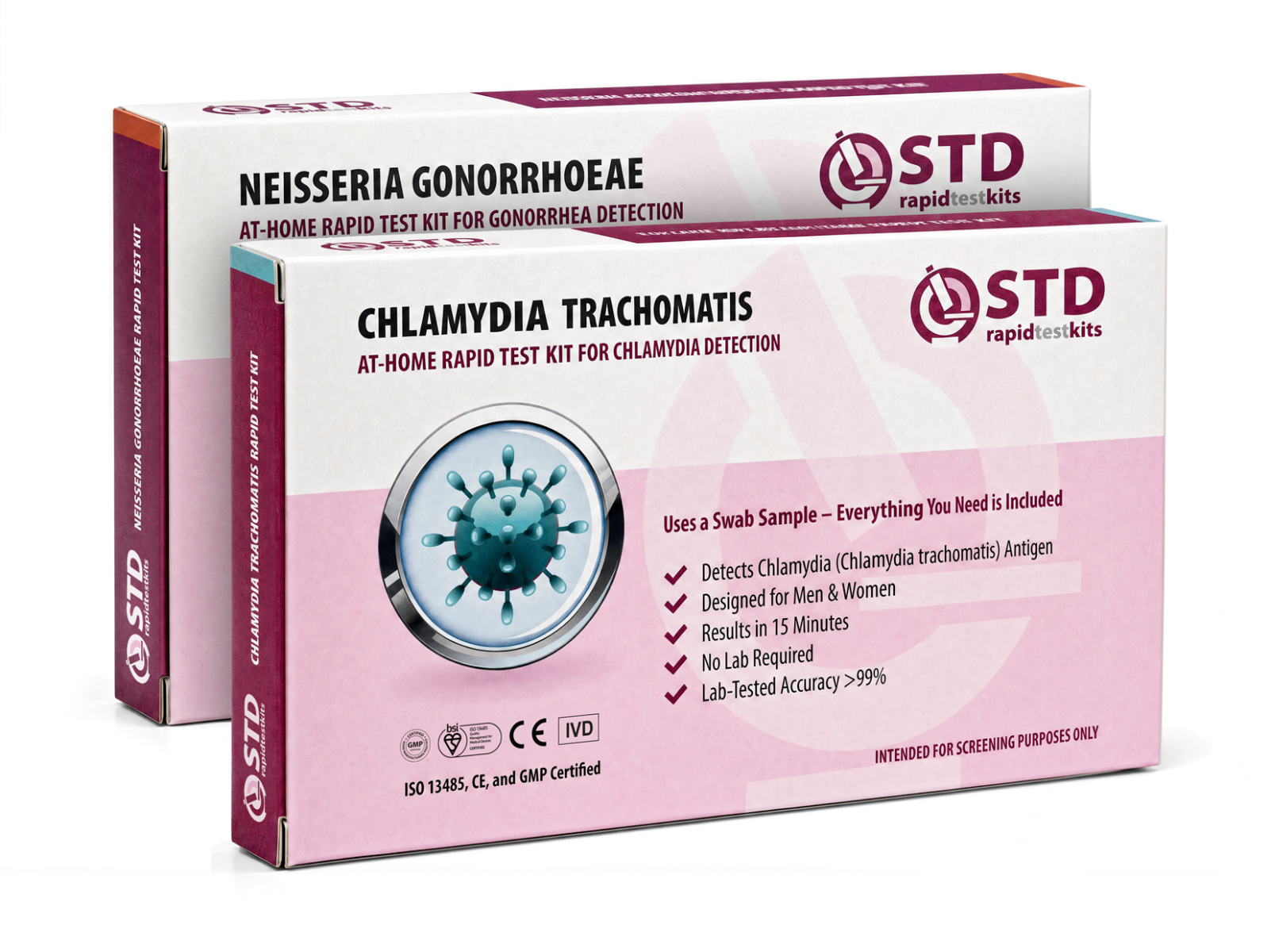
Earliest realistic detection is around 5 to 7 days after exposure with a sensitive lab nucleic acid amplification test (NAAT). At-home swab-based rapid tests are most reliable from 7 to 14 days, with retesting recommended at 2 weeks if symptoms persist and the first result was negative. Early symptoms, when they appear at all, can be subtle: burning when you pee even without any visible discharge is a recognized early sign of both infections. Untreated chlamydia and gonorrhea are leading preventable causes of pelvic inflammatory disease and infertility (CDC Chlamydia overview, CDC Gonorrhea overview), so the window is worth respecting.
HIV
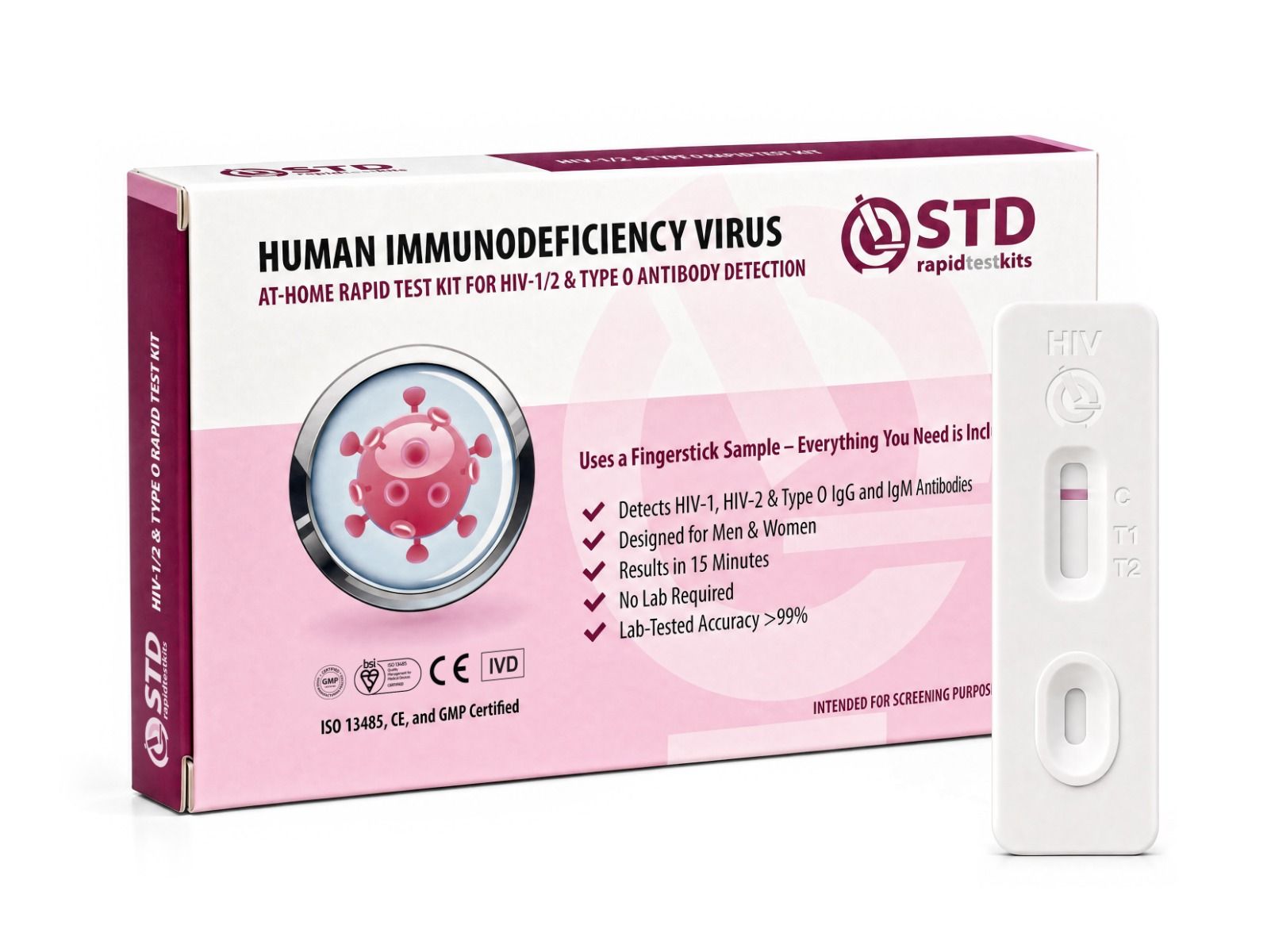
Lab nucleic acid testing (NAT) can detect HIV RNA roughly 10 to 33 days post-exposure. Fourth-generation antigen and antibody lab tests catch most infections by 18 to 45 days. At-home rapid antibody tests have a longer window of 23 to 90 days. The CDC's recommendation is to confirm with a repeat test at 90 days if the first result was negative after a known high-risk exposure (CDC HIV Testing).
Syphilis
Syphilis is a bacterial infection tested through blood antibodies. The earliest reliable detection is around 3 weeks; some people need up to 6 weeks for antibodies to develop, based on manufacturer-published rapid-test windows (see the CDC Syphilis overview for background on staging and testing). Primary syphilis often starts as a single painless sore at the site of exposure that is easy to miss, which is why blood testing matters even if you saw nothing visible.
Herpes (HSV-1 and HSV-2)
If sores are present, a clinic-administered swab can detect viral DNA from the lesion within days of symptom onset. For blood antibody testing (the technology used by at-home rapid kits), the realistic window is up to 12 weeks; some people seroconvert in 4 to 6 weeks, but a confident negative requires a 12-week follow-up. The CDC Genital Herpes overview covers transmission and asymptomatic shedding. Many herpes infections are asymptomatic, which is why antibody testing exists as a secondary tool.
Trichomoniasis
Trichomoniasis is a parasitic infection most commonly tested in women through a vaginal swab. Detection is reliable from 5 to 7 days post-exposure for symptomatic cases, with the broader testing window at 7 to 14 days, based on manufacturer-published rapid-swab assay windows. For general background on symptoms and treatment, see the CDC Trichomoniasis overview. Our at-home trichomoniasis kit is validated for vaginal self-swab only; men who need testing should see a clinician.
Hepatitis B
Hepatitis B surface antigen (HBsAg), the marker most rapid blood tests look for, typically appears 1 to 9 weeks after exposure with an average around 4 weeks, based on manufacturer assay specifications (see the CDC Hepatitis B overview for background). A confirmatory follow-up test at 6 months is recommended after a known high-risk exposure to rule out chronic infection.
Hepatitis C
Hepatitis C antibody tests, including most at-home rapid versions, become reliable around 8 to 11 weeks after exposure, with a 12-week retest for a confident negative (background at the CDC Hepatitis C overview). HCV RNA testing can detect the virus earlier (2 to 6 weeks) but is laboratory-only. The sexual transmission risk for hepatitis C is lower than for hepatitis B, but it is not zero, particularly with bleeding-prone exposures.
The shortest at-home window in this list is chlamydia and gonorrhea at 7 to 14 days. The longest is herpes and hepatitis C at up to 12 weeks. That is a 12-fold spread, and it means a single test cannot rule out every infection at the same time. After a known high-risk exposure, plan a two-step schedule: a swab test for the bacterial infections at 1 to 2 weeks, and a follow-up blood test for HIV, syphilis, herpes, hepatitis B, and hepatitis C at the outer windows. Treat the early swab result as partial information, not a clean bill of health.
The one exception: HIV post-exposure prophylaxis is time-sensitive
Waiting for the window period is the right strategy in almost every after-sex testing scenario. There is one important exception. If you have had a known high-risk HIV exposure in the last 72 hours (a partner who is HIV-positive and not virally suppressed, an exposure during sexual assault, or a similar high-probability event), post-exposure prophylaxis (PEP) is a clinician-prescribed course of antiretroviral medication that substantially reduces the chance of HIV taking hold (CDC HIV resources).
PEP is most effective when started within 72 hours of exposure, and earlier is better. The course runs 28 days. An emergency room or sexual-health clinic can initiate PEP same-day; many states fund it at no cost when started for high-risk exposures. If this scenario describes you, do not wait for an at-home rapid test result. Go to an emergency room or clinic today, get the prescription, and use at-home tests later for baseline and follow-up screening.
If a known high-risk HIV exposure happened in the last 72 hours, treat it as urgent. Post-exposure prophylaxis works best the sooner it starts, and eligibility closes at the 72-hour mark. Call a sexual-health clinic or go to an emergency room today rather than waiting for an at-home test result.
Our role, and what we sell
This article is published by stdrapidtestkits.com. We sell at-home rapid lateral-flow test kits for several of the infections covered above, and we recommend the kit that fits the reader's exposure, not whichever one sells best. Where a clinic visit is the better option (active symptoms, throat or rectal exposure, suspected primary syphilis, a recent high-risk HIV exposure where PEP is the right tool), we say so plainly. We do not sell pharyngeal or rectal swab tests; those infections need a clinic NAAT.
Why testing too early gives false comfort
The instinct to test the day after a high-risk exposure is understandable; the result is rarely useful. A negative test taken inside the window period is what clinicians call a non-result. It does not mean uninfected; it means the test did not have enough material to detect an infection if one was forming. A reader who treats that negative as a clean bill of health may stop using barriers with new partners, skip the follow-up retest, and unintentionally pass the infection along.
A more useful frame is to treat an early-window negative as a baseline: confirmation that you were not carrying a long-standing infection from before this exposure. The result that matters is the second test, taken at the appropriate window. For HIV and syphilis specifically, the U.S. Preventive Services Task Force and the CDC consistently emphasize that confirmatory testing at the outer window is the standard of care.
An early-window negative confirms one thing: you were not carrying a long-standing infection from before this exposure. It does not confirm that the recent exposure failed to transmit. Treat it as a baseline, and retest at the outer window for the infection you are worried about.
Rapid test, mail-in lab, or clinic: how to choose
Picture standing outside a pharmacy late at night, deciding whether to grab a rapid kit now or wait two days for a mail-in lab kit. All three routes can give you a real answer; they trade speed, privacy, and analytical sensitivity against each other. At-home rapid lateral-flow kits read in about 15 minutes and are built for privacy and speed. Mail-in kits collect your sample at home, then a certified lab processes it with the same NAAT or antibody assays a clinic uses. A clinic visit stays the right call when symptoms are persistent, when you need same-day treatment, or when a screening result has already come back positive.
For routine screening when you have no symptoms and value privacy and a fast result, an at-home rapid kit is a strong starting point, with a clinic visit reserved for confirmation or anything that needs a physical exam.
At-home rapid vs mail-in lab vs clinic
| Feature | At-home rapid (lateral-flow) | Mail-in lab | Clinic visit |
|---|---|---|---|
| Privacy | Very high; results stay with you | High; sample posted to a lab | Moderate; in-person visit |
| Speed | About 15 minutes | 2 to 5 business days | Same day to about a week |
| Sensitivity | Good for screening; confirm a positive with a lab | High; lab runs NAAT or antibody assays | Highest; lab testing plus a physical exam |
| Best for | Fast, private screening and repeat testing | Broad panels without a clinic visit | Active symptoms, treatment, and confirmation |
Rapid kits trade some analytical sensitivity for speed and privacy; laboratory NAAT stays the confirmation standard.
When to test based on your situation
The right testing schedule depends on what happened, when, and whether you have symptoms now. Four common scenarios:
- You have symptoms today (discharge, sore, burning urination, fever, rash): See a clinician now. A clinic can swab the symptomatic site, prescribe empirical treatment when appropriate, and confirm with NAAT.
- Known high-risk HIV exposure within 72 hours: Go to an emergency room or sexual-health clinic same-day for post-exposure prophylaxis (PEP). Do not wait for at-home test results.
- No symptoms, recent specific high-risk exposure (condom failure, partner disclosed status, anonymous partner): Test at 7 to 14 days for chlamydia, gonorrhea, and trichomoniasis with a swab kit. Test at 4 to 6 weeks for HIV, syphilis, and hepatitis B as a first pass, and retest at 90 days for HIV to confirm. Test at 12 weeks for herpes and hepatitis C if you want a confident antibody result.
- No symptoms, ongoing routine screening: The CDC recommends annual chlamydia and gonorrhea screening for sexually active women under 25 and for higher-risk men. HIV screening at least once for every adult is the broader recommendation, with more frequent screening for higher-risk groups. Syphilis and hepatitis screening is risk-based; the CDC's STI treatment guidelines recommend testing every 3 to 6 months for people with multiple partners or condomless sex outside a closed relationship (CDC STI Treatment Guidelines).
Why retesting at the right window matters
One test is rarely enough after a known high-risk exposure. The most common pattern that lands people back in the at-home test inbox: an anxious test taken in the first week, a negative result, a sense of relief, no follow-up. Three weeks later a partner discloses an STI. The original negative was not wrong; it was simply too early.
If your first test landed inside the window for that infection, schedule the retest now while you are thinking about it. A negative taken at the outer end of the window is generally trustworthy for that specific exposure, and a new exposure resets the clock. Two other situations call for a retest. If you have already been treated for chlamydia or gonorrhea, the CDC recommends retesting roughly three months after treatment to catch reinfection (usually from an untreated partner). And if a test-of-cure is being done after antibiotics, wait at least three weeks after finishing treatment, because residual bacterial fragments can occasionally produce a misleading NAAT result.
Retest timings to put on the calendar
- 90 days after exposure for a confirmatory HIV result.
- 12 weeks after exposure for a confident herpes (HSV) antibody result.
- 12 weeks after exposure for a confident hepatitis C antibody result.
- 6 weeks after exposure for syphilis if the first antibody test was negative.
- 6 months after a known high-risk hepatitis B exposure to rule out chronic infection.
- 3 months after treatment for chlamydia or gonorrhea, to catch reinfection from an untreated partner.
What to do if your result is positive
Seeing a positive line on a rapid test is unsettling, and it is also a fixable problem in most cases. Bacterial STIs (chlamydia, gonorrhea, syphilis, trichomoniasis) clear with a course of antibiotics that most providers can prescribe same-week. Viral STIs (HIV, herpes, hepatitis B, hepatitis C) are managed long-term with modern therapies; HIV treatment in particular makes a normal lifespan and an undetectable viral load (which carries no sexual transmission risk to partners) the standard of care.
The first step after a positive at-home result is confirmation. A positive on a lateral-flow strip is a screening signal, not a diagnosis. A clinician will run a confirmatory NAAT for bacterial infections or a confirmatory blood panel for HIV, syphilis, or hepatitis. Most state health departments fund free or low-cost STI clinics for people without insurance; telehealth services can prescribe treatment for most bacterial STIs after a confirmatory lab result, without requiring an in-person visit.
Partner notification is the step that often feels harder than the diagnosis itself. You do not have to hand-deliver the news. Anonymous partner-notification services run by many state health departments, plus apps like Tell Your Partner, can send a notification on your behalf so recent partners can test on the right window.
1. Confirm with a clinic lab test: NAAT for bacterial STIs, or a confirmatory blood panel for HIV or syphilis. A rapid screen is not a diagnosis on its own.
2. Schedule treatment. Antibiotics for bacterial STIs are typically a single short course; viral infections move into ongoing management with a provider.
3. Notify recent partners directly, or through an anonymous partner-notification service, so they can test on the right window. Both partners treated or both confirmed clear is the standard before resuming barrier-free sex.
Who should consider testing
If unprotected sex happened, you are in the testing-worth-doing group. Clinically silent infections are common. Chlamydia infections in women often cause no symptoms (per the CDC), and the same is true for many men. HIV's early phase can feel like a brief flu and resolve on its own. Genital herpes infections frequently go undiagnosed for years. Hepatitis C can persist quietly for decades before causing liver damage.
Some situations make testing more pressing than others. If any of the factors below apply, plan a test at the appropriate window; partial reassurance from an early negative is not a reason to skip the follow-up.
Situations that make testing more urgent
Having one or more of these does not mean you are infected; it means testing at the appropriate window is worth doing.
- Your partner had other partners recently, or their status is undisclosed Common
- The exposure included receptive anal sex, which carries a higher per-act HIV transmission probability Common
- You had multiple partners in a short window Common
- Your partner has a known STI history or current symptoms Common
- Drugs or alcohol were involved and the encounter is partly or fully a memory gap Less common
- Burning when you pee, unusual discharge, or a new sore appeared within a week of the exposure Common
At-home rapid testing as an option
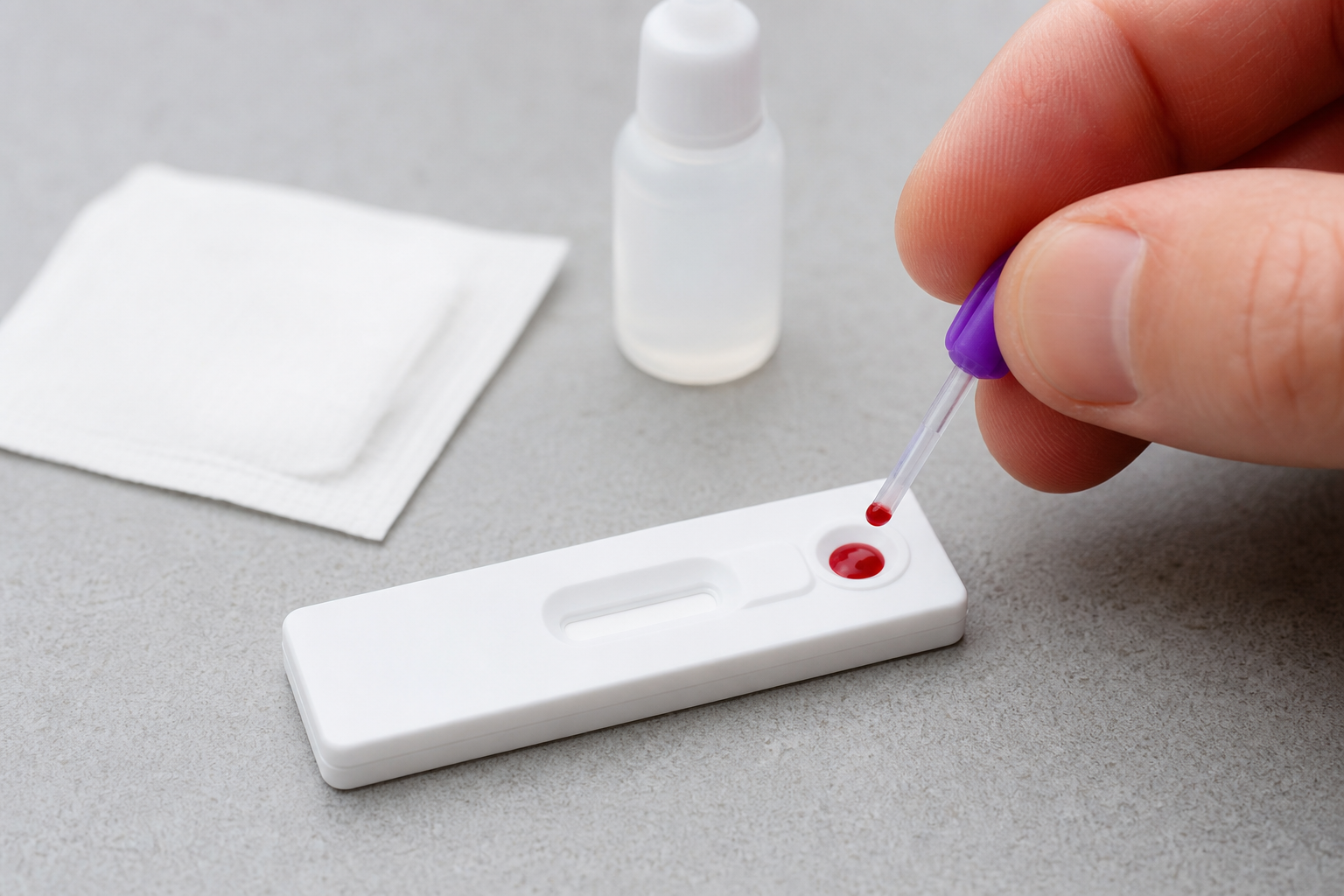
For readers who would rather not sit in a clinic waiting room, at-home rapid kits are a reasonable first step. They use the same sample type as their lab counterparts (vaginal or penile swab for chlamydia and gonorrhea; fingerstick blood for HIV, syphilis, and hepatitis), produce results in roughly 15 minutes, and ship in plain packaging with no clinical branding on the outer box. An at-home result does not create a clinic record or an insurance claim, which matters to readers who value privacy.
What at-home rapid kits are good for: fast first-pass results during the appropriate window, low-friction follow-up testing you can keep doing in private, and combination panels when you want to screen for several infections after a single exposure event. What they are not: a substitute for a clinician's diagnosis when you have active symptoms, and not equivalent to laboratory NAAT in early-window or low-load infections. Confirm any positive at-home result with a clinician's lab test before starting treatment. Mail-in home-collection kits, which use a home-collected sample processed at a certified lab, sit between the rapid kit and a clinic visit on speed versus sensitivity. If a single exposure could have involved more than one infection, a combination panel covers 2-in-1 through 10-in-1 options at the relevant window for each test inside.
Skip the at-home kit and book a clinic visit if any of the following apply: active symptoms (sore, ulcer, unusual discharge, painful urination, rash, fever); the exposure was throat or rectal (we do not sell pharyngeal or rectal swab tests; a clinic NAAT is the right tool); you suspect primary syphilis with a visible sore (a clinic can swab the lesion directly); you are pregnant or trying to conceive; or you had a known high-risk HIV exposure within the last 72 hours (post-exposure prophylaxis is time-sensitive and clinician-prescribed).
Antibody tests can usually detect HIV 23 to 90 days after exposure. A negative result doesn't necessarily mean that you don't have HIV. That's because of the window period.
What to do now, based on your situation
Do you have active symptoms now (sore, discharge, painful urination, rash, fever), or a known high-risk HIV exposure in the last 72 hours?
Yes: See a clinician or emergency room today. PEP for HIV works best within 72 hours, and active symptoms need an in-person exam and possible same-day treatment.
No symptoms, but a specific exposure in the last 1 to 2 weeks?
Yes: Use a swab kit now for chlamydia, gonorrhea, and trichomoniasis, then schedule a blood test for HIV, syphilis, and hepatitis B at 4 to 6 weeks.
Already past the 4 to 6 week mark, or want a fully confident negative?
Yes: Test for HIV, syphilis, and hepatitis B now, then retest for HIV at 90 days and for herpes and hepatitis C at 12 weeks.
No: If your only test so far fell inside the window period, treat it as a baseline and retest at the outer window. Confirm any positive result with a clinic lab test, and tell recent partners so they can test on the right window.
Guidance only; a healthcare provider can advise based on your specific exposure.
FAQs
- Can I test for STIs the day after unprotected sex?
- You can, but most tests will not be accurate that early. The infection needs time to reach detectable levels in your body. The earliest reliable testing windows are around 5 to 7 days for chlamydia and gonorrhea, with longer windows for HIV, syphilis, herpes, and the hepatitis viruses. A test taken the day after sex is best treated as a baseline, with the result that matters arriving at the appropriate window.
- It burns when I pee, but there's no discharge. Should I be worried?
- Possibly, but not necessarily. Burning without discharge is a recognized early presentation of chlamydia and gonorrhea, especially in the first week or two after exposure. It is also a common sign of a urinary tract infection, irritation from a new product, or a shift in vaginal pH. Guessing will not resolve it; a swab or urine test for chlamydia and gonorrhea, plus a simple UTI check, sorts the question quickly.
- Which STI shows up fastest on a test?
- Chlamydia, gonorrhea, and trichomoniasis are detectable earliest, typically from about 5 to 7 days post-exposure with a sensitive swab test. The 7 to 14 day window is the most reliable for at-home rapid swab tests.
- I had a high-risk HIV exposure two days ago. Should I test now?
- No, go to an emergency room or sexual-health clinic today for post-exposure prophylaxis (PEP). PEP is a clinician-prescribed 28-day course of antiretrovirals that substantially reduces the chance of HIV taking hold, and it is most effective when started within 72 hours of exposure. An at-home rapid antibody test will not yet show anything reliable this early. Test later for baseline and follow-up at the standard windows.
- Why is the HIV testing window so long?
- HIV antibody tests rely on the body producing detectable antibodies, which takes weeks to months. Lab nucleic acid testing (NAT) can detect HIV RNA earlier, around 10 to 33 days. At-home rapid antibody tests are most reliable at 23 to 90 days, with a 90-day retest for full confidence.
- Do I need to retest after a negative result?
- For most exposures, yes. The specific follow-up window depends on which test you took: 90 days for an HIV antibody result, 12 weeks for herpes or hepatitis C antibodies, 6 weeks for syphilis, and 2 to 4 weeks for chlamydia or gonorrhea if the first test was inside the bacterial window. An early-window negative is a baseline, not a conclusion. The follow-up test is the one you can act on.
- Can I have an STI without symptoms?
- Yes, and for several STIs no symptoms is the norm rather than the exception. Chlamydia, gonorrhea, and trichomoniasis are often entirely silent. Herpes can recur for years without a recognized sore. Hepatitis C can cause liver damage over decades with no obvious signs. Absence of symptoms is not absence of infection, which is why scheduled testing after an exposure matters even when nothing feels wrong.
- Are at-home rapid tests as accurate as lab tests?
- At-home rapid tests use lateral-flow immunoassay technology and provide reliable results when used in the correct window. Laboratory NAAT and PCR testing have higher analytical sensitivity, especially in early-window or low-load infections, and remain the standard for confirming positive results. A positive at-home result is worth confirming with a clinician's lab test before starting treatment.
- U.S. Centers for Disease Control and Prevention. STI Treatment Guidelines: NAAT methodology, retesting after treatment, and screening intervals for higher-risk groups.
- U.S. Centers for Disease Control and Prevention. HIV testing types, the 23 to 90 day antibody window, confirmatory follow-up at 90 days, and PEP within 72 hours of exposure.
- U.S. Centers for Disease Control and Prevention. Chlamydia overview: asymptomatic rates, complications of untreated infection, and three-month retesting after treatment.
- World Health Organization. Sexually transmitted infections fact sheet: global epidemiology, prevention, and testing.
- NHS. Sexually transmitted infections (STIs) overview, including symptoms and testing pathways.
- MedlinePlus (U.S. National Library of Medicine). Sexually transmitted infections: testing, symptoms, and prevention overview.
