Published: August 2025 | Last updated: May 2026 | Editorial review and quality control: Martina N.
A sore appears somewhere it definitely was not before, on or around the genitals, inside the mouth, near the anus, and the first instinct is to Google it. The phrase syphilis blister gets typed into search engines millions of times a year by people trying to figure out whether what they are looking at is serious.
Most of the time, the answer turns out to be more reassuring than the search history suggests. Unusual genital sores are far more often friction injuries from sex, ingrown hairs, canker sores, or the beginning of a herpes outbreak than they are syphilis. The comparisons in this guide help sort that out quickly, and for anyone left with real uncertainty after reading, a single fingerstick blood test from six weeks after the exposure resolves it in about fifteen minutes.
The technical name for the sore that marks the first stage of syphilis is a chancre. It is firm, round, and almost always painless. That last detail is the reason most people who develop one do not realize what they are dealing with. A blister stings, itches, and demands attention. A chancre sits quietly, heals on its own within a few weeks, and leaves the person assuming the problem resolved itself. It did not. The bacteria are still there, still multiplying, and without antibiotic treatment the infection moves into its next stage whether or not the original sore is still visible.
Key Takeaways
- A syphilis chancre is firm, round, and painless. Because it does not hurt and heals on its own, it is the single most commonly missed early sign of an STI.
- Without antibiotics, syphilis silently progresses through secondary, latent, and potentially tertiary stages even after the chancre heals on its own.
What a “Syphilis Blister” Actually Is
The word blister is understandable shorthand for any unusual sore in the genital area, but it is technically wrong when applied to the primary syphilis sore, and that inaccuracy has real consequences. A medical blister is a fluid-filled sac sitting on the surface of the skin. It is raised, often translucent, and usually causes discomfort. Herpes, chickenpox, friction injuries, and burns all produce true fluid-filled blisters. Syphilis does not.
The syphilis chancre behaves differently in every respect. It is an ulcer: an open, crater-like wound with clean, defined edges that penetrates the full thickness of the skin rather than sitting on top of it. Pressing on it feels firm, almost like a small button beneath the surface. It does not weep fluid the way a herpes blister does. Most chancres are between 1 and 2 centimeters across, though they can be smaller and are sometimes barely visible. They typically appear as a single sore; syphilis does not usually produce clusters the way herpes does. The base is smooth and clean rather than crusted or scabbed. The edges are raised and clearly defined, giving it a punched-out appearance. On lighter skin tones the sore tends to look pinkish-red or flesh-colored. On darker skin tones it can be harder to spot because the contrast is less obvious, which is one reason syphilis is more likely to be missed in people with deeper complexions.
The painlessness is the defining trap. Because there is no burning, no itching, and no throbbing, most people who develop a chancre either do not notice it at all (especially if it is in a location that is hard to see) or notice it briefly and conclude it must be a minor irritation, an ingrown hair, or a friction sore from sex. According to the CDC, syphilis sores are usually (but not always) firm, round, and painless, and because the sore is painless, it can be easy to miss entirely.
Is a syphilis blister actually a blister?
Not in the medical sense. The primary syphilis sore, called a chancre, is a firm, painless, open ulcer with clean, defined edges and no fluid inside. It typically appears about 3 weeks after exposure (the full window runs 10 to 90 days), grows to roughly 1 to 2 cm, and heals on its own in 3 to 6 weeks. The bacteria stay in the body even after the sore disappears, so a healed chancre still means an active infection. A blood test from 6 weeks after exposure is the reliable way to know.
Where Syphilis Sores Appear, and Where They Hide
The chancre forms wherever the Treponema pallidum bacteria entered the body, which means it can appear in a surprisingly wide range of locations depending on the type of sexual contact involved. The genitals are the most common site: the shaft or head of the penis, the labia, the vaginal opening, or the cervix (where it is almost never visible without a speculum exam). Syphilis is also transmitted through oral and anal sex, so chancres can turn up on the lips, tongue, inside the mouth, in the throat, around the anus, inside the rectum, and occasionally on the fingers.
The hidden locations are where the real diagnostic problem lies. A chancre on the outside of the penis is at least visible. A chancre inside the vagina, on the cervix, inside the rectum, or deep in the throat is functionally invisible: the person has no idea it is there, it heals on its own, and they move into the secondary stage of infection without ever having had a reason to test. This is not an edge case. A substantial proportion of syphilis diagnoses happen at the secondary stage or later, precisely because the primary sore was never detected. The CDC notes that syphilis sores in the vagina, anus, mouth, or under the foreskin can be hard to see, which is one of the central reasons routine testing matters more than symptom-watching.
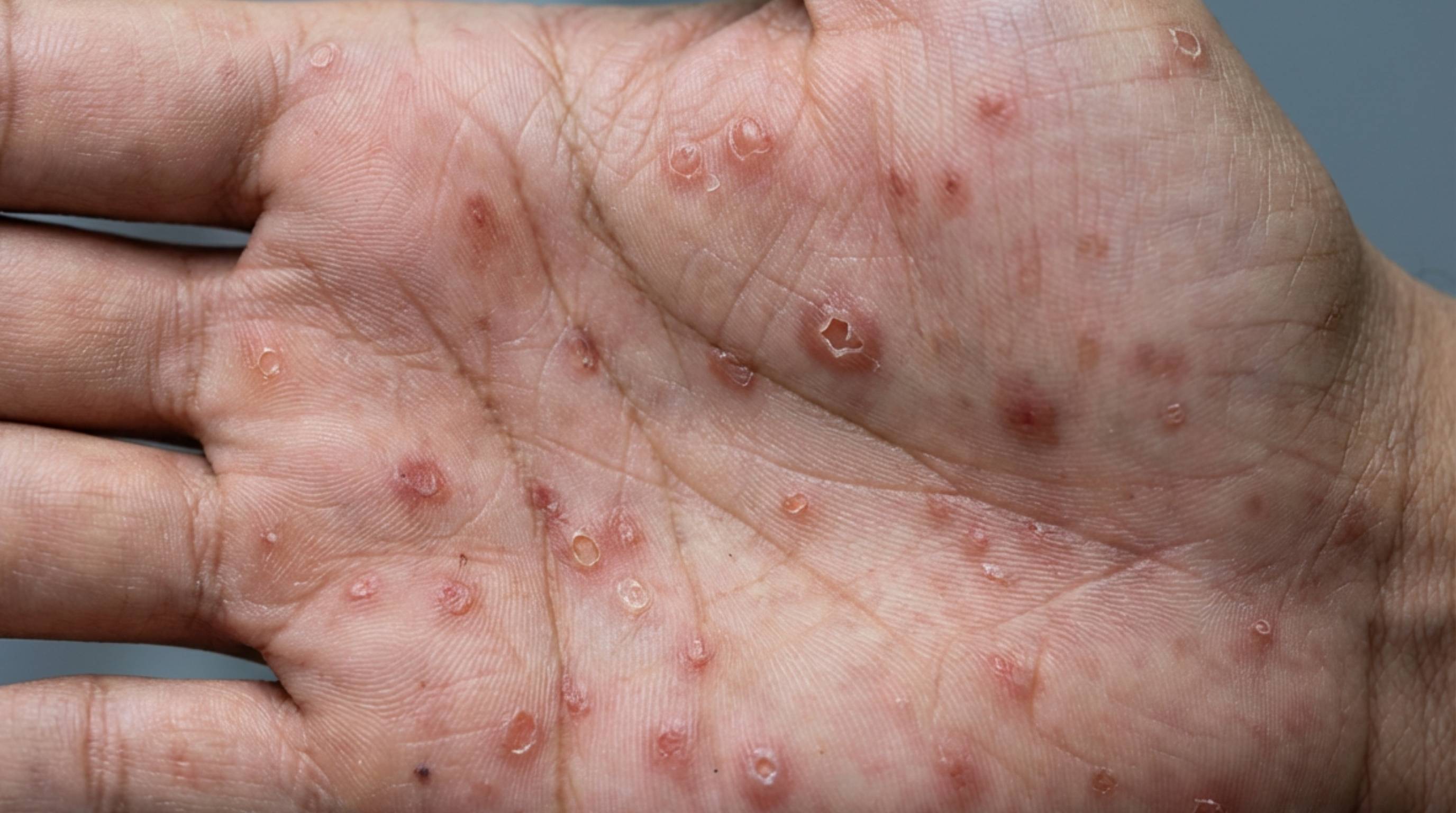
The secondary stage brings a different set of skin changes: a widespread rash and, sometimes, mucous-membrane sores. The famous secondary syphilis rash classically appears on the palms of the hands and soles of the feet, which is one of the most reliable identifying features because very few other conditions produce that specific pattern. Per the NHS syphilis guide, the rash typically does not itch, which is another important distinguishing feature. It can also appear on the trunk, arms, face, and elsewhere, and on darker skin tones the spots can look more muted brown than red. Like the primary chancre, the secondary rash is easy to dismiss as dry skin, an allergic reaction, or a heat rash without context about recent sexual exposure.
Chancres in the mouth, anus, vagina, or cervix may not be visible to the person who has them. Painless and out of sight, they get dismissed as a canker sore or a minor friction injury. By the time secondary symptoms appear weeks later, the chancre has long since healed and the connection is not obvious. If you have had unprotected sex with a new or untested partner in the last three months and notice any new painless sore on the genitals, anus, or lip, treat it as a possible chancre until a test says otherwise.
The Syphilis Timeline at a Glance
The infection moves through fairly predictable stages on a fairly predictable schedule, which is useful because it lets you map a current symptom back to a possible exposure date and decide when to test. The sequence below reflects standard clinical guidance from the CDC, WHO, and NHS:
- Day 0: exposure.
- Days 10 to 90 (median around 21): chancre appears at the spot where the bacteria entered the body.
- Weeks 3 to 6 after the chancre starts: the chancre heals on its own, with or without treatment.
- Weeks 4 to 10 after exposure: the secondary stage begins, with rash, flu-like symptoms, and swollen lymph nodes.
- Up to 12 weeks of secondary symptoms: the rash and systemic signs typically fade on their own.
- After secondary symptoms fade: latent (silent) syphilis. No visible signs, but the bacteria are still active inside the body and can re-emerge as tertiary disease years or decades later.
This is where syphilis earned its old nickname, “the great imitator.” Symptoms come and go, mimic dozens of other conditions, and disappear without treatment. The infection itself does not disappear. It hides.
| Stage | What Appears | Common Locations | Visible to the Person? |
|---|---|---|---|
| Primary | Chancre: firm, painless, round ulcer | Genitals, anus, mouth, lips, throat, fingers | Sometimes; often hidden or missed |
| Secondary | Rash: rough, non-itchy red or brown spots | Palms, soles, trunk, face, limbs | Usually, though often dismissed |
| Secondary | Mucous patches and condyloma lata | Mouth, genitals, anus, armpits | Rarely noticed without examination |
| Latent | No visible symptoms | N/A | No |
| Tertiary | Gummas: deep, destructive lesions | Skin, bones, liver, heart, brain | Yes, but at this stage damage is already severe |
Syphilis Chancre vs Herpes Blister: The Key Differences
This is the comparison most people are actually trying to make when they search for a “syphilis blister.” Both infections produce sores in the genital area. Both can appear after sexual contact. Both can show up on the genitals, around the anus, or in the mouth. And neither can be definitively diagnosed by looking at a picture on a phone screen, which is important to say upfront, because the internet is full of people trying to do exactly that. What comparing the two can do is give you enough information to understand what you are probably dealing with and how urgently to act.
Pain is the single most useful distinguishing feature. Herpes sores hurt, often described as burning, stinging, or throbbing, and the outbreak is usually preceded by warning sensations like tingling or nerve sensitivity in the area before the blisters even appear. The syphilis chancre, by contrast, is almost always painless. If a sore is causing significant discomfort, herpes is the more likely explanation. Appearance is the second clear divider. Herpes produces small, fluid-filled blisters, often in clusters, that rupture and leave shallow, moist ulcers with a crusted base as they heal. The syphilis chancre presents as a single, dry, clean-based ulcer with firm, defined edges and no fluid.
Timing and healing pattern also differ meaningfully. Herpes blisters typically appear 2 to 4 days after exposure (sometimes up to 12 days), whereas a syphilis chancre takes an average of 3 weeks (and can take up to 90 days) to appear after infection. Herpes sores heal within one to two weeks but return periodically because the herpes virus lives permanently in nerve tissue. The syphilis chancre heals in three to six weeks and does not come back, but that disappearance is deceptive: the bacteria have simply moved deeper into the body and begun the next stage of infection.
| Feature | Syphilis Chancre | Herpes Blister |
|---|---|---|
| Pain level | Usually painless | Usually painful (burning, stinging) |
| Appearance | Firm, round, clean-based ulcer; no fluid | Small fluid-filled blisters; rupture and crust |
| Number of sores | Usually one | Usually multiple, clustered |
| Size | Up to 1 to 2 cm | Very small, 1 to 3 mm each |
| Warning signs before sore | None | Tingling, itching, or nerve pain beforehand |
| Time to appear after exposure | Average 3 weeks (up to 90 days) | 2 to 4 days (up to 12 days) |
| How long it lasts | 3 to 6 weeks, then heals | 1 to 2 weeks, then recurs |
| Does it come back? | No, but the infection progresses | Yes, recurring outbreaks for life |
| Curable? | Yes, with antibiotics | No, manageable but not curable |
How the Sore Changes as Syphilis Progresses
An important thing to understand about syphilis is what happens after the visible sore disappears. The chancre heals on its own within three to six weeks whether or not treatment has been received, but the bacteria do not leave with it. They spread through the bloodstream and begin attacking the body systemically. By the time syphilis reaches its secondary stage, it can mimic a wide variety of other conditions and has often moved well beyond the point where the person connects their current symptoms to a sore they had weeks earlier.
Secondary syphilis typically begins six weeks to three months after the chancre first appeared. The most recognizable feature is the rash: rough, reddish-brown spots that frequently appear on the palms of the hands and soles of the feet, a combination that is unusual for common rashes like eczema or allergic reactions. The rash can also appear on the torso, face, and limbs. Secondary syphilis often produces flu-like symptoms (fever, fatigue, swollen lymph nodes, sore throat, muscle aches) alongside the skin changes. Some people develop patchy hair loss on the scalp, eyebrows, or beard, which clinicians call “moth-eaten alopecia.” Flat, wart-like lesions called condyloma lata can develop in moist areas like the genitals and anus, and grayish-white mucous patches can appear on the tongue, inside the cheeks, or on the genitals. Both the rash and the mucous patches contain live Treponema pallidum, which makes secondary syphilis the most contagious stage of the infection. Skin-to-skin contact with these lesions during sex is enough to transmit the infection to a partner.
After the secondary stage resolves (again, on its own, without any treatment), syphilis enters the latent stage. Symptoms vanish entirely. The person feels fine, and this can last for years, sometimes decades. Most people with untreated syphilis do not develop tertiary disease, but a meaningful minority eventually do, and at that point the infection becomes genuinely life-threatening, causing damage to the heart, brain, nervous system, and other organs. Tertiary syphilis can lead to blindness, paralysis, dementia, and death.
The single most dangerous feature of syphilis is how persuasively the disappearing sore mimics a “problem solved.” The bacteria do not heal with the skin. They spread. If you saw a sore that came and went, and you have not been tested, the right move is to test, not to assume.
What Else Looks Like a Syphilis Rash
The secondary stage gets missed not only because it does not itch but because it visually overlaps with several common rashes. Knowing the differential helps you describe what you are seeing to a clinician and avoid both false alarm and false reassurance. None of these comparisons replace a blood test; they help you decide how urgently to seek one.
| Condition | Itchy? | Where it starts | Other key features |
|---|---|---|---|
| Secondary syphilis | No (usually) | Trunk, spreads to palms and soles | Coppery spots, flu-like symptoms, painless |
| Pityriasis rosea | Often yes | Single “herald patch” on trunk | Christmas-tree pattern on the back, no genital sores |
| Viral exanthem (measles, COVID-19) | Variable | Face or trunk | Fever, cough, sore throat, respiratory illness |
| Drug rash | Often | Trunk first | Started a new medication in the last 1 to 2 weeks |
| Tinea (ringworm) | Yes | Anywhere | Ring-shaped scaly border with a clear center |
| HIV seroconversion rash | Usually no | Trunk and face | Fever, sore throat, mouth ulcers, recent exposure |
| Hand-foot-mouth disease | Sometimes | Palms, soles, mouth | Painful blisters or papules, most common in children |
When and How to Test After a Syphilis Sore
Whether the rash pattern above points toward syphilis or toward one of the conditions in the differential table, a blood test is the only thing that removes the ambiguity. You have noticed a sore. Maybe it is already gone. Maybe you are not even sure what you saw, but the timing relative to a recent sexual encounter is nagging at you. This is the moment to test, not to keep watching to see if anything else develops. Every stage of syphilis produces symptoms that are easy to explain away, and the latent stage produces no symptoms at all. Testing is the only thing that removes the guesswork entirely.
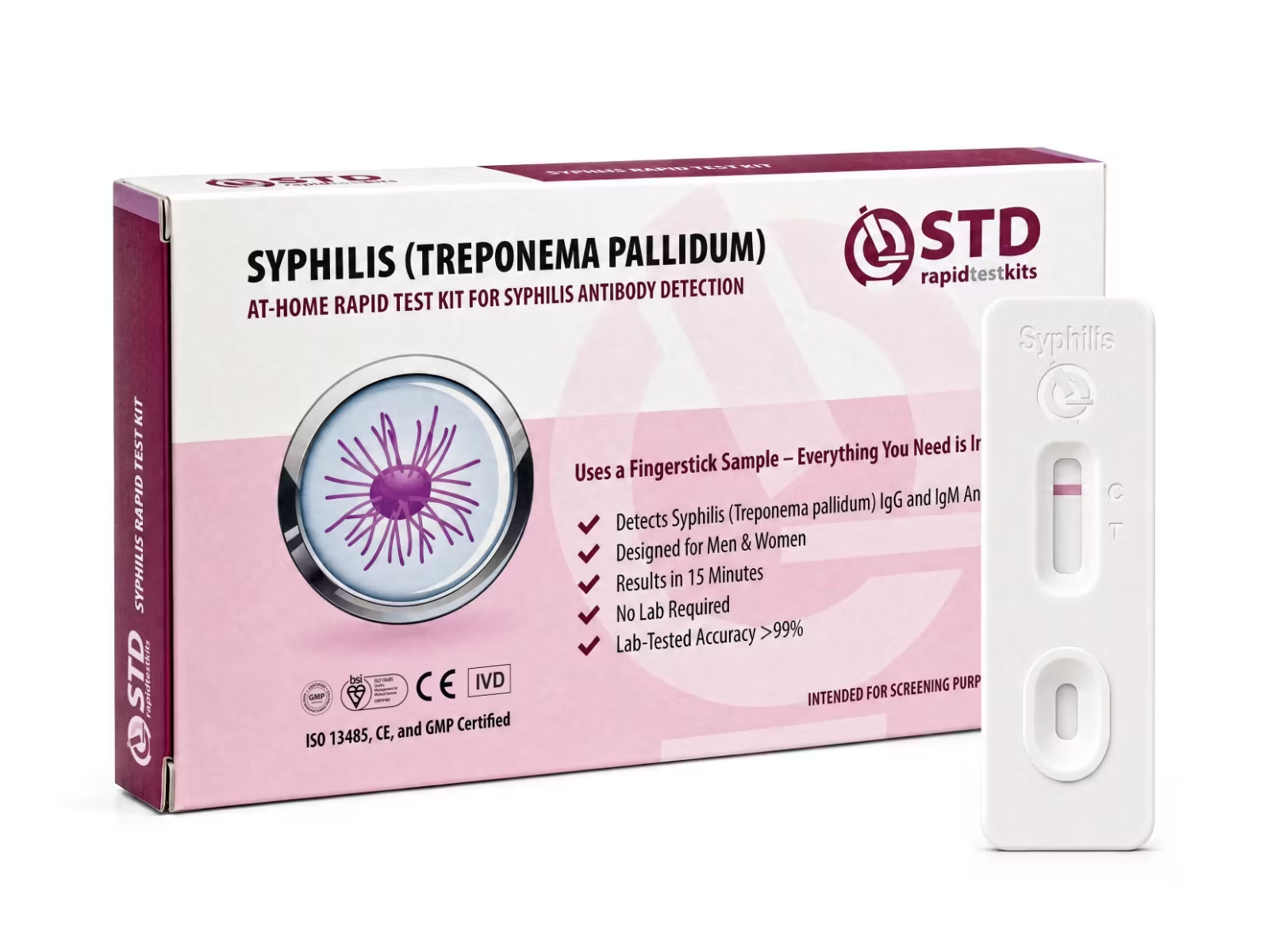
Syphilis testing is blood-based. Standard laboratory diagnosis combines a non-treponemal test (RPR or VDRL, which detects antibodies against substances released during infection and can be quantified to track treatment response) with a confirmatory treponemal test (FTA-ABS, TP-PA, EIA, or CIA, which detects antibodies specific to Treponema pallidum). At-home rapid syphilis tests use lateral-flow immunoassay chemistry on a fingerstick blood sample and detect treponemal antibodies in about 15 minutes. They are screening tools; a positive home result should be confirmed with a lab follow-up before treatment, because dosing decisions and follow-up monitoring rely on quantitative non-treponemal titers run in a lab.
Because antibodies take time to build to detectable levels, testing in the first one to two weeks after exposure is likely to return a negative result even when infection is present. By around 6 weeks the antibody response is usually high enough for reliable detection, and a follow-up test at 3 months covers the small minority whose seroconversion takes longer. Plan for a first test at 6 weeks and a confirmatory repeat at 3 months if there is ongoing concern. Disclosure: the at-home rapid tests linked below are products this site sells; recommendations are based on fit-for-purpose for the reader’s concern, not commercial benefit.
You do not have to wait six weeks before doing anything. See a healthcare provider. A fresh chancre can sometimes be swabbed directly and examined for syphilis bacteria using dark-field microscopy or PCR, which gives a result faster than waiting for antibody levels to develop. The six-week window applies specifically to blood-based antibody testing. Either way, do not wait for the sore to heal and then forget about it.
What Happens If Syphilis Goes Untreated, and What Treatment Looks Like
The current syphilis epidemic in the US makes early testing more important than it has been in decades. According to recent CDC reporting, primary and secondary syphilis cases declined by roughly 22% in 2024, the first meaningful drop in years and a real public-health gain. The overall burden, though, is still very high, and congenital syphilis (when a pregnant person passes the infection to their baby) has continued to rise for more than a decade, reaching nearly 4,000 cases in 2024, a figure that has multiplied many times over since 2015. Each of those cases is a baby whose mother’s easily curable infection went undetected.
At the individual level, untreated syphilis progresses through the latent stage into tertiary disease over a timeline of years to decades. Tertiary syphilis causes gummas (destructive, tumor-like lesions that can form in the skin, liver, bones, and other organs), along with cardiovascular syphilis (damage to the aorta and heart valves) and neurosyphilis (damage to the brain, spinal cord, and nervous system). Neurosyphilis can cause personality changes, memory loss, blindness, paralysis, and dementia, and can develop at any stage of the infection rather than only decades later, per the WHO syphilis fact sheet.
The good news, and it is genuinely good news, is that syphilis remains one of the most treatable STIs in existence. Standard treatment for primary, secondary, and early latent syphilis is a single intramuscular injection of long-acting penicillin (benzathine penicillin G); late latent and tertiary stages use three weekly injections. Penicillin-allergic patients can receive doxycycline, but penicillin remains first-line, especially during pregnancy. After the injection some people experience a brief flu-like reaction within 24 hours (the Jarisch-Herxheimer reaction), which lasts under a day and is not dangerous. Quantitative non-treponemal titers at 6 and 12 months confirm the cure: a fourfold drop (for example, a 1:64 titer falling to 1:16) is the marker of successful treatment. Treatment in the latent or tertiary stage can stop further progression, but it cannot reverse damage that has already occurred.
Sores are usually (but not always) firm, round, and painless. Because the sore is painless, you may not notice it.
Who Sees Syphilis Most, and Why That Matters for Testing
Syphilis affects people of every gender, age, and orientation, and any sexually active adult can acquire it. The epidemiology in the US, though, is not evenly distributed, and knowing where the burden falls helps individual readers calibrate their own risk. Per the 2025 CDC surveillance update, men account for the majority of primary and secondary syphilis cases, with the highest rates among gay, bisexual, and other men who have sex with men. Heterosexually-transmitted cases in women have also been climbing in recent years, which is part of what is driving the rise in congenital syphilis.
One reason syphilis spreads so effectively in any sexually active network is its interaction with HIV. Open chancres provide an entry point that increases the risk of acquiring or transmitting HIV during sex, and co-infection rates between syphilis and HIV are meaningfully elevated, particularly among MSM, per CDC guidance. This is one reason combined-panel testing makes sense after a possible exposure: if there is a chance of one bacterial STI, there is usually a chance of others, and an HIV test belongs in the same conversation.
The other reason men in particular are encouraged to test routinely is that primary chancres on the penis are usually visible, and many men assume that means they will see one if they have it. In practice, chancres can also form on the inside of the foreskin (where they are easily missed in uncircumcised men), inside the urethral opening, or in the rectum after receptive anal sex, where they are functionally invisible without a clinical exam.
An open syphilis chancre is a biological doorway for HIV: it breaks the mucosal barrier that normally helps block the virus from entering or leaving the body during sex. Co-infection rates are correspondingly elevated, especially among men who have sex with men. If you are testing for syphilis after a possible exposure, fold an HIV antibody test into the same round, either as part of a combined panel or as a separate fingerstick alongside it. The cost in time and effort is minimal, and a missed HIV diagnosis is the single most consequential thing a syphilis-focused workup can leave behind.
Reducing Your Risk Going Forward
Treatment cures the current infection but does not grant lifelong immunity. Reinfection is possible, and rates of repeat syphilis are not low among people who continue to have unprotected sex with new partners. Prevention going forward draws on a few practical habits, reflecting CDC prevention guidance and NHS recommendations:
- Use condoms consistently with new or non-monogamous partners. Condoms reduce but do not eliminate transmission, since chancres and rash can occur on skin outside the area condoms cover.
- Test before sex with new partners, both you and them. Recent mutual test results remove most of the guesswork.
- Test routinely if you are in a higher-risk group: men who have sex with men, people with HIV, pregnant people (mandatory at the first prenatal visit per CDC guidance), or anyone with a partner whose status is uncertain. Annual testing is the baseline; every 3 to 6 months for higher-frequency partner changes.
- Test for other STIs at the same time, since they often travel together. Someone with syphilis has a meaningfully higher risk of HIV, gonorrhea, and chlamydia at the same time.
- Do not ignore unfamiliar sores or rashes, even ones that do not hurt. Painless is part of what makes syphilis dangerous.
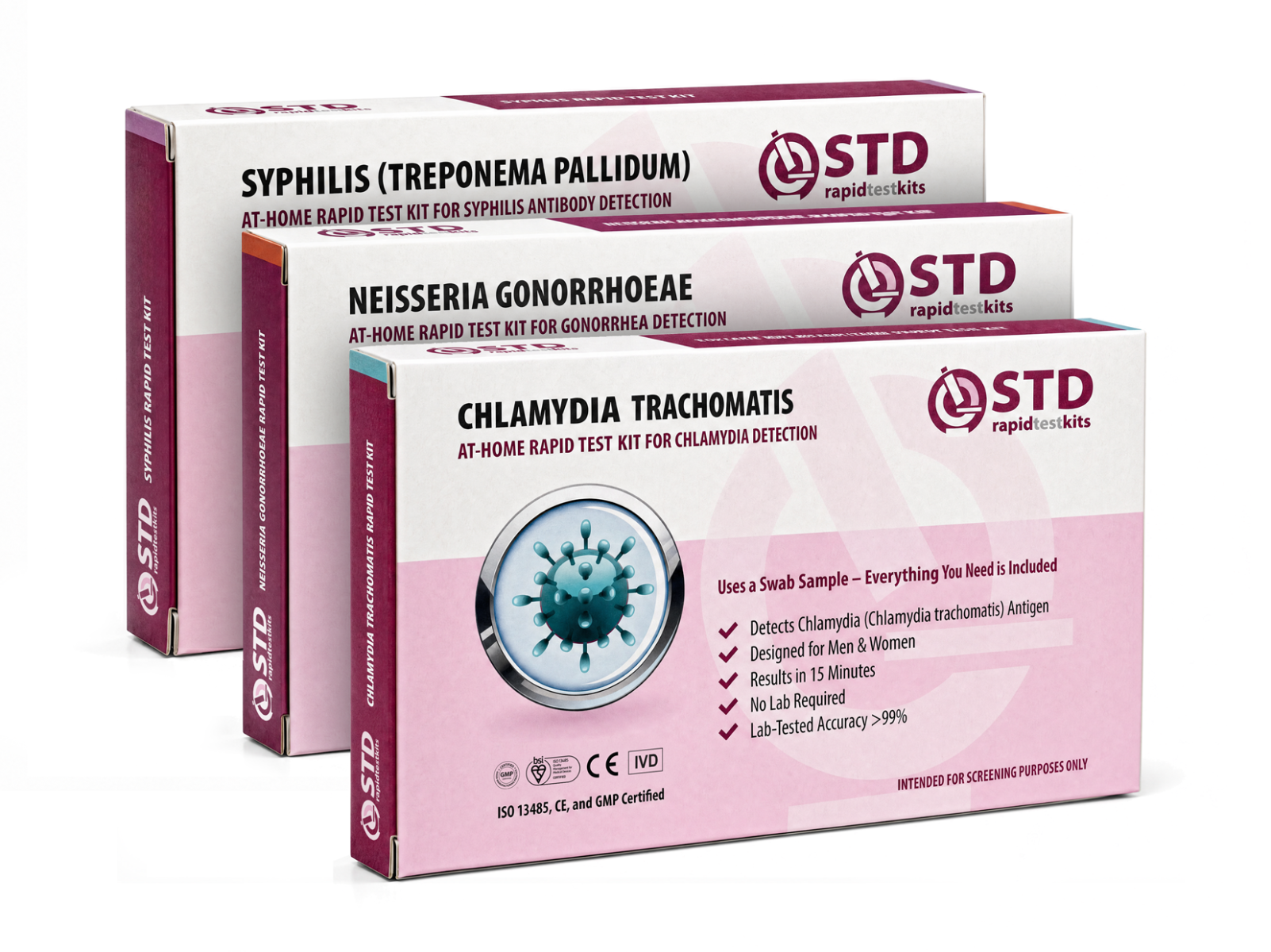
For readers who want a single-round screen for multiple STIs at home, a combination kit covers the most likely concurrent infections in one go.
A Sore That Comes and Goes Is Not a Problem That Comes and Goes
Syphilis is one of the easiest STIs to treat and one of the hardest to catch without testing, because every stage of the infection is biologically built to look like nothing serious: a painless sore that heals quietly in a few weeks, a rash that causes no itching, then years without any symptoms at all. The people who catch it early and treat it quickly are the ones who test, rather than the ones who wait for something dramatic enough to act on.
If your concern is one specific exposure, a single-infection rapid test gives you a clear answer in minutes from home. If the exposure involved more than one possible risk, a 3-in-1 panel covers the three most common bacterial STIs together. And if a positive result does come back, partner notification matters: per CDC treatment guidelines, contact sexual partners from the past 90 days for primary syphilis, the past 6 months for secondary, and the past year for early latent infection. They need to test and, in many cases, receive presumptive treatment whether their own result is positive yet or not.
Testing takes about fifteen minutes and gives you either peace of mind or the information you need to act while the infection is still easily treatable.
Your next steps
- Test at 6 weeks post-exposure with a fingerstick rapid syphilis test or a lab blood draw, and repeat at 3 months if there is ongoing concern.
- If your result is positive, notify sexual partners from the past 90 days (primary), 6 months (secondary), or 1 year (early latent) so they can test and, in many cases, receive presumptive antibiotic treatment.
FAQs
- Is a syphilis sore actually a blister?
- A medical blister is a fluid-filled sac sitting raised on the skin surface; the primary syphilis sore is a different lesion type entirely. It is an ulcer, an open crater-like wound that penetrates the full thickness of the skin, with no fluid inside and a firm rolled edge. People reach for the word ‘blister’ because the term gets applied loosely to any unusual genital sore, but the chancre’s appearance and structure are quite distinct from a herpes vesicle, which is the other common cause of genital sores.
- Can syphilis cause actual fluid-filled blisters?
- True fluid-filled blisters are unusual with syphilis. Primary syphilis produces a firm painless ulcer (the chancre), and secondary syphilis produces flat coppery spots. Fluid-filled clustered blisters point much more strongly toward herpes (HSV-1 or HSV-2). If the bumps you see are clearly blistered, painful, and itchy, get a herpes test rather than a syphilis test, or test for both to be certain.
- Does a syphilis sore hurt?
- Usually not, and that is exactly what makes it so easy to miss. The primary syphilis chancre is almost always painless. There is no burning, no itching, and no throbbing. Some people notice a very mild tenderness if the sore is pressed, but most describe it as completely asymptomatic. This is one of the defining features that distinguishes it from a herpes sore, which tends to be noticeably painful from the start.
- How long does a syphilis sore last before it goes away?
- The primary chancre typically heals on its own within three to six weeks. This happens whether or not the person receives treatment, which is one of the most deceptive features of syphilis. The healing of the sore does not mean the infection has cleared; it means the bacteria have moved deeper into the body and are progressing toward the secondary stage. Anyone whose sore has healed but who has not been tested should still get tested.
- Can syphilis appear without a visible sore, including in hidden locations like the mouth or rectum?
- Yes, and this is very common. Oral chancres can appear on the lips, tongue, gums, inside the cheeks, or at the back of the throat following oral sexual contact, and chancres can also form inside the vagina, on the cervix, inside the rectum, or in the urethra following vaginal or anal sex. Out of sight and painless, they get dismissed as canker sores, ingrown hairs, or friction injuries when they get noticed at all. A significant proportion of syphilis cases are diagnosed at the secondary stage or later precisely because the primary sore was never detected. A blood test is the only reliable way to rule it out.
- What is the difference between a syphilis sore and a herpes blister?
- The key differences are pain, appearance, and number. Herpes blisters are typically painful, small, fluid-filled, and appear in clusters. The syphilis chancre is usually painless, firm, dry, and appears as a single sore. Herpes sores are also preceded by warning sensations like tingling or burning before they appear, while the syphilis chancre arrives with no warning signs. Both require testing to confirm; visual identification alone is not sufficient for diagnosis.
- Will a syphilis rash always show up on the palms and soles?
- Palms and soles involvement is one of the most distinctive signs of secondary syphilis, but it does not appear in every case. The rash can be limited to the trunk, scattered widely across the body, or barely visible on darker skin. Absence of a palm or sole rash does not rule out syphilis; only a blood test can do that.
- When should I test for syphilis after a potential exposure?
- Six weeks is the minimum for a reliable blood antibody result. Earlier than that, the body has typically not produced enough antibody to detect the infection consistently, so a negative result inside the window does not rule syphilis out. Plan on a repeat at 3 months if the exposure was higher-risk or the first reading was borderline. If a sore is still visible right now, do not wait at all: a clinician can sometimes swab the chancre directly for dark-field microscopy or PCR and get a faster answer than antibody timing allows.
- If the syphilis sore heals on its own, do I still need treatment?
- Yes. For an infection to truly clear, the immune system or antibiotics need to eliminate the Treponema pallidum bacteria from the body, and spontaneous healing of the skin lesion does neither. The chancre disappears because skin repair processes close the local wound, while the bacteria themselves migrate deeper through the bloodstream and continue to multiply. The infection then progresses through secondary, latent, and potentially tertiary stages regardless of whether the original sore is still visible. Antibiotic treatment is what actually eliminates the bacteria.
- U.S. Centers for Disease Control and Prevention. About Syphilis: stages, transmission, chancre symptoms, and the 3 to 6 week duration of a primary chancre.
- U.S. Centers for Disease Control and Prevention. STI Surveillance Statistics: overview portal for national case counts and demographic distributions of primary and secondary syphilis.
- U.S. Centers for Disease Control and Prevention Newsroom. Latest national data on syphilis in newborns and sexually transmitted infections, supporting the 22% decline in primary and secondary cases in 2024 and the continued rise in congenital syphilis to nearly 4,000 cases.
- U.S. Centers for Disease Control and Prevention. Sexually Transmitted Infections Treatment Guidelines: Syphilis. Clinical reference covering staging criteria, penicillin dosing across stages, partner notification windows, and follow-up titer protocols.
- World Health Organization. Syphilis fact sheet covering global epidemiology, transmission, staging, and tertiary-stage complications of untreated infection.
- U.K. National Health Service. Syphilis symptoms, primary chancre and secondary rash characteristics, palm and sole involvement, and testing pathways.
