
Published: October 2025 | Last updated: May 2026 | Editorial review and quality control: Martina N.
Asking a partner for an STD test is one of the most common stress points in modern relationships, and one of the most misread. The words come out, and they can sound like an interrogation. In your head, you meant something closer to “I want us both to feel safe, and I want to keep this good thing going.” The gap between what you mean and what your partner hears is the whole problem. This guide walks through how to close it.
The framing here is shaped around polyamorous and open dynamics because that is where the conversation comes up most often, but the same principles apply to monogamous relationships, new connections, and reconnecting after time apart. Lead with care, normalize testing as part of routine adult life, and stay grounded if the conversation gets sticky. None of that requires the perfect script.
Key Takeaways
- Asking for an STI test is a request for shared care, not an accusation. The framing you choose decides whether your partner hears it that way.
- Most defensiveness comes from timing and tone. Bringing testing up early, before sex is on the table, almost always lands better than waiting until things are heated.
Testing as Shared Care: Reframing the Conversation
In polyamorous and open dynamics, conversations about sexual health are part of the relationship scaffolding, not a sign it is falling apart. Even so, the words don’t always come easy. A lot of people grew up associating STI testing with guilt, infidelity, or a clinic visit they wanted to forget. If you have ever had a partner bristle when you raised the topic, you are not alone. That reaction almost always comes from shame the partner is carrying, not from the idea of testing itself.
One pattern that comes up over and over: someone asks a new partner to test before becoming fluid-bonded (the agreement in non-monogamy to have sex without barrier protection with a specific partner), and the partner gets visibly hurt. “Do you think I’m dirty?” is a common reaction. The person asking was not making an accusation. They were trying to set up the kind of mutual protection that lets the relationship deepen. The fact that two people in the same room can hear the same sentence so differently is the gap this article exists to close.
Requesting an STI test does not mean you think your partner is lying. It means you care enough to bring your body into alignment with your values. When you ask, you are saying “I value what we are building and want to keep it safe, for us and for everyone we connect with.”
Requesting a test is care work. It belongs in the same category as planning a holiday together or talking through finances. Treat it that way and your partner usually will too.
Why It Feels Accusatory, and How to Defuse That
A lot of meaning can sit on top of a simple question. Someone hears “have you been tested lately?” and their brain runs through years of bad scripts: a parent’s warning, an ex’s accusation, a clinic visit where they felt judged. Polyamorous people often carry an extra layer because they are routinely defending their relationship style to family or coworkers. A testing question can feel like one more place they have to justify how they live, even when no one is asking them to.
That is why timing, tone, and framing matter more than getting the words perfect. A calm, low-stakes setting, before any physical intimacy is on the table, gives both of you room to talk without defensiveness flaring. Don’t wait until clothes are coming off. Build the conversation into the connection early, the way you might mention how you handle sleep, allergies, or whether you eat meat.
Instead of framing testing as a reactive step (“I’m nervous because you hooked up with someone last weekend”), reframe it as proactive care: “I really like where this is going, and I’d love to talk about how we handle testing in our lives.” That swap, from reactive to proactive, opens the door to mutual responsibility instead of implying blame. Most people who initially flinch at the topic relax visibly once they realize you are not interrogating them.
Raise testing before physical intimacy is on the table. The earlier in the connection it comes up, the less emotional charge it carries, and the more room your partner has to engage without feeling cornered.
What Testing Conversations Look Like in Practice
The same request, said two different ways, can land as either thoughtful or attacking. Below is a comparison of phrasings that come up often in the testing conversation. These are not scripts to memorize, but the patterns matter: who is being centered, what tone is being set, and whether the words invite a shared response or trigger a defensive one. Notice how the same underlying request shows up in all four rows; the difference is the frame. Collaborative phrasings start a conversation, blame-frames start a defense.
| Approach | Sounds Like | How It Feels |
|---|---|---|
| Collaborative | “Hey, I’d love for us to talk about testing before we get more physical. What’s your usual routine?” | Invites shared care, respects autonomy |
| Neutral and curious | “Do you have a usual schedule for testing with your other partners?” | Centers routine instead of fear, opens space |
| Blame-framed | “I saw you were at that play party. Did you get tested after?” | Lands as accusatory, often triggers defensiveness |
| Shame-based | “I just don’t want to get something from you. I’ve been safe.” | Centers blame, usually shuts the conversation down |
When to Have the Talk (and When It’s Too Late)
Many people delay these conversations until they feel “ready.” In non-monogamy, relationships often develop fast, especially in tight-knit communities where attraction is strong and overlap is common. You can wake up six dates in, four partners deep, and realize you haven’t had the testing conversation with anyone. By that point, bringing it up feels like a “gotcha” rather than a casual check-in.
Start early. It doesn’t have to be clinical. One way to normalize testing in your relationships is to mention it the way you would mention a flu shot or a dentist appointment. In polyamory specifically, group testing agreements or shared calendars can make the topic feel ambient and low-pressure.
The harder reality is that waiting until a sexual encounter is imminent puts the conversation under stage lights. Anything you ask in that moment carries an implicit charge: are we doing this or not? Bringing it up days or weeks earlier removes that charge entirely. The question becomes “what is your testing routine?” instead of “is something wrong here?”
“I’m working out my retest schedule for next month. Want to sync up and do ours together?”
It is calendar talk, not crisis talk. It makes testing feel like a routine you share rather than a referendum on anyone’s behavior.
What Should You Ask Them to Test For?
This is where many people freeze. You finally find the nerve to bring up testing, and your partner asks, “What tests, exactly?” If you are not sure, the conversation can stall, or end in confusion. Different STIs use different test types, and not every standard panel covers everything.
A common surprise: a typical “STI panel” at a primary-care clinic often does not include herpes unless you specifically ask for it. The CDC’s 2021 STI Treatment Guidelines note that routine HSV-2 antibody screening is not recommended for asymptomatic people because of the false-positive rate, so most clinicians skip it by default. HPV screening also uses different tools depending on anatomy: cervical Pap or HPV co-testing for people with a cervix, and visual inspection or biopsy for visible warts. There is no routine blood test that screens for HPV the way one screens for HIV.
Window periods matter too. A test taken a few days after a risky encounter may come back negative even when the infection is present, simply because the body has not generated enough antibody or antigen for the test to detect yet. That is why “I tested last week” is not always the reassurance it sounds like, particularly if the exposure being asked about happened recently.
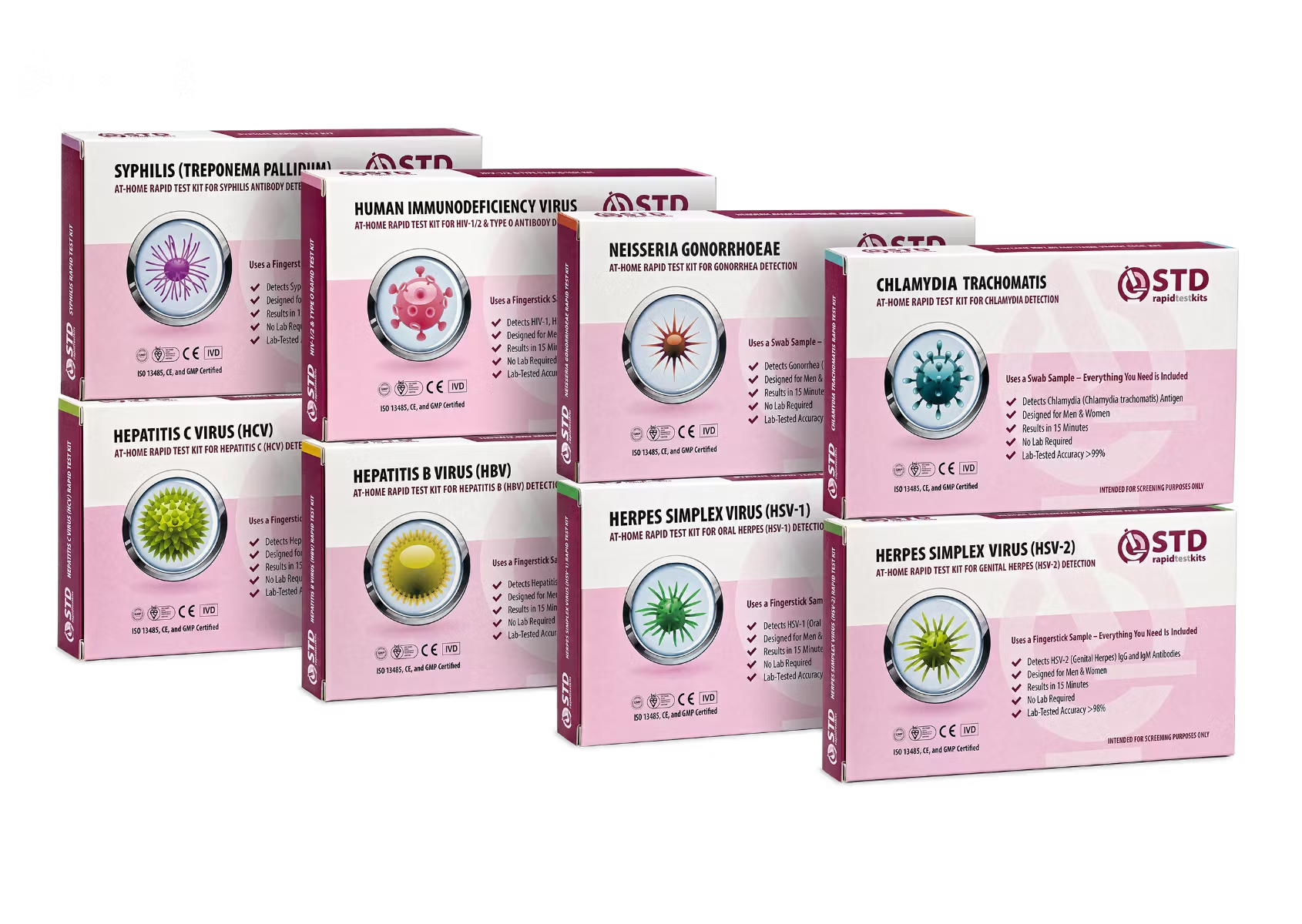
One note on terminology, because the difference matters. Lab clinics typically use NAAT (nucleic acid amplification testing) for chlamydia and gonorrhea, which the CDC regards as the most analytically sensitive option. Our at-home rapid kits, by contrast, use lateral-flow immunoassay chemistry, the same technology behind home pregnancy tests, validated against lab references. They are designed for fast at-home screening and complement lab testing rather than replacing it. A reactive at-home result should be confirmed at a clinic before anyone makes a treatment decision.
A short disclosure on that point: we publish this article and we sell at-home rapid lateral-flow screening kits for several of the infections discussed below, including a bundled multi-STI option that appears as a referenced product after the table. We try to be specific about what those kits can and cannot do, including the window-period and confirmation caveats above. Here is a quick reference for the most-asked-about infections at a lab clinic:
| STI | Standard Lab Test | Window Period | Retest Needed? |
|---|---|---|---|
| Chlamydia | NAAT (urine or swab) | About 7 to 14 days after exposure | Yes after any new exposure |
| Gonorrhea | NAAT (urine or swab) | About 7 to 14 days | Yes if symptomatic or re-exposed |
| HIV | Fourth-gen antigen/antibody combo (lab) | About 18 to 45 days | Confirmatory test at about 3 months if exposure ongoing |
| HIV | Nucleic acid test (NAAT) | About 10 to 33 days | Same as above, with earlier first-test window |
| Syphilis | Treponemal antibody blood test | About 3 to 6 weeks | If symptoms appear or a partner tests positive |
| Herpes (HSV-2) | IgG antibody blood test | Up to 12 weeks for seroconversion | Not routine; based on exposure or symptoms |
When They Push Back: What to Do If They Get Defensive
It happens more often than people expect. You finally work up the nerve to bring up testing, and your partner gets quiet. Or worse, they snap back: “So you don’t trust me?” The temptation in that moment is to backpedal: soften the ask, dodge the topic, tell yourself it isn’t worth a fight.
Here is the harder truth. Anyone who genuinely respects your body and your autonomy will not read a testing request as an attack on their character. They might be caught off guard. They might be carrying shame or trauma about past STI scares. Their defensiveness is information about what they are carrying, and it is not your job to convince them that your boundaries are reasonable.
A useful response when the words “don’t you trust me?” come up is something like: “I do trust you, and I also trust window periods, and I trust myself to ask for what I need.” That phrasing keeps the trust frame intact while gently anchoring the request in something larger than feelings, in bodies, biology, and the timing of how infections become detectable. None of that has anything to do with whether your partner is a good person.
If a partner consistently avoids, deflects, or refuses to test, and they still want physical intimacy, that pattern is information, not a misunderstanding. You are inviting them into a care-based, adult conversation by asking. If they cannot meet you there, pausing the physical side of the connection until they can is a reasonable boundary, and a fair one to hold.

Different Relationships, Different Testing Cultures
Every polycule (the network of people connected through overlapping non-monogamous relationships), triad, or open partnership has its own testing culture. Some groups sync their test dates and share screenshots of clinic results in a private chat. Others rely on verbal check-ins between partners. Some people always test between new partners; others go on a timed cadence, every three or six months for example, regardless of activity.
There is no universal rule, but there is a universal principle: transparency reduces harm. Whether your setup is hierarchical, kitchen-table, or DADT (don’t ask, don’t tell), there needs to be a baseline for what testing looks like. If one person deviates from that baseline, the others in the network deserve to know so they can adjust their own choices.
For example, if one of your partners attends a play event with higher-risk contacts, it is reasonable to adjust your own testing frequency, or to ask for proof of post-event testing before resuming physical contact. That is informed consent at work.
The CDC’s screening guidance reinforces why this matters. People with more than one partner, or with partners who themselves have multiple connections, are explicitly advised to test more often than once a year, particularly for chlamydia, gonorrhea, and HIV (CDC STI Treatment Guidelines, 2021).
Here is a comparison of how different relationship styles tend to shape testing dynamics in practice:
| Relationship Type | Typical Testing Cadence | Common Communication Method |
|---|---|---|
| Nesting partners | Every 3 to 6 months, or after outside partners | In-person check-ins, shared calendar |
| Play-based connections | Before and after events, monthly if active | Digital result-sharing, app tracking |
| DADT (don’t ask, don’t tell) | Individual discretion, higher personal responsibility | Often none, requires strong self-boundaries |
| Polycule-wide agreements | Synced quarterly or by exposure timeline | Group chats, shared trackers, joint clinic visits |
Your Body, Your Call
Asking for an STI test is advocacy for what your body needs to feel safe, whole, and respected. You can want test results before having sex. You can decline fluid bonding. If a partner is not up to date and refuses to update, you can pause physical intimacy. Those are limits, not accusations.
A useful frame is the seatbelt comparison. No one puts on a seatbelt because they think the driver is reckless. They put it on because safety is shared, because human bodies are fragile, and because the consequences of skipping the gesture are higher than the small social cost of making it.
If you are not sure how to start, let your values lead. “I want to build trust, and for me, part of trust is knowing we are both current on testing” is a complete sentence. You do not need to defend it. State the need, stay grounded, and let the conversation breathe. A partner who respects you will meet you there, with curiosity and care rather than fear.
Annual chlamydia and gonorrhea screening is recommended for all sexually active women younger than 25 years, as well as older women with risk factors such as new or multiple sex partners.
FAQs
- What if they think I’m accusing them of something?
- Try a phrasing like “I’m not saying you’ve done anything wrong, I just want both of us to feel safe and clear.” Most defensiveness softens when the conversation feels like a team sport rather than an interrogation. Keep your tone curious and honest, and stay open to their experience instead of arguing your case.
- They said they ‘just got tested.’ Should I still ask for more details?
- Yes. “Just tested” can mean last month, last year, or only for HIV. Specific follow-ups are clarifying, not doubting. Try: “That’s great. Do you remember which infections were on the panel and roughly when you got the results?” Specific questions are kinder than vague worry.
- Is it okay to ask for proof, like a screenshot of results?
- Yes, and it is more common than people expect in poly circles. Asking is a way to make sure everyone is on the same page rather than a sign of distrust. A gentle phrasing: “I’m a visual person. If you’re comfortable sharing your results, that would help me feel solid.” If they decline, that response is also useful information.
- How often do polyamorous people usually test?
- Every three months is a common baseline for sexually active non-monogamous people. Some go monthly when activity is high, others sync to event calendars or new-partner thresholds. The cadence matters less than having one. CDC guidance also leans on this: for people with multiple partners, screening more than once a year for chlamydia, gonorrhea, and HIV is recommended.
- I’m scared bringing it up before sex will kill the mood. Is that true?
- Only if you frame it as a problem to solve. “I’d feel even more turned on knowing we are both current on testing” lands very differently from “we need to talk.” Bring it up earlier than the bedroom moment, and the conversation does not have to compete with arousal.
- Can I still get an STI even if we use condoms?
- Yes. Condoms reduce risk substantially but they do not cover all skin contact, so infections like herpes and HPV can still transmit through skin-to-skin contact in areas the condom doesn’t cover. Think of testing and barriers as complementary, not interchangeable.
- They got defensive and said I was being paranoid. What now?
- Take a breath before responding. A grounded reply: “This is about what makes me feel safe enough to be physical with you. I need to know we’re both protected.” If they shut down completely, that is information about how they handle uncomfortable conversations, not a verdict on your request.
- What if I test positive after asking someone else to test?
- Take a breath. Most STIs are treatable, and a positive result does not retroactively make asking the wrong call. Testing positive means you are informed, and now you can take care of yourself and tell others so they can do the same. The same care you asked of your partner extends in both directions.
How We Sourced This Article: We combined current public-health guidance from the CDC, WHO, and NHS with peer-reviewed clinical literature to make this guide accurate and reader-respecting. This article is editorial, not clinical advice; for symptoms or specific exposure concerns, see a licensed provider. Sources cited in the article are listed below.
- U.S. Centers for Disease Control and Prevention. 2021 STI Treatment Guidelines, covering recommended testing approaches, screening cadence, and counseling guidance for chlamydia, gonorrhea, syphilis, HIV, and herpes.
- U.S. Centers for Disease Control and Prevention. Sexually Transmitted Infections, general public-facing information on common STIs, transmission routes, and prevention.
- U.S. Centers for Disease Control and Prevention. HIV Testing Information, including window periods for antigen/antibody combo, antibody-only, and nucleic acid tests.
- World Health Organization. Sexually Transmitted Infections fact sheet, including global incidence figures, common infections, and prevention guidance.
- U.K. National Health Service. Sexually Transmitted Infections, condition overview and testing access information.
