
Published: July 2025 | Last updated: May 2026 | Editorial review and quality control: Martina N.
Burning urination, a patchy rash on your palms, a sore throat that lingers past a week. These three show up at primary care visits constantly, and most of the time they are exactly what they look like: a urinary tract infection, a contact rash, a viral cold. But a small share of those visits walks out with the wrong label. Three bacterial sexually transmitted infections, syphilis, gonorrhea, and chlamydia, are unusually good at copying common conditions, and the cost of missing them is high.
This article walks through the disguises each of these infections wears, the misdiagnosis patterns that show up in surveillance data, and what to do when symptoms are not behaving the way a UTI or eczema usually behaves. The goal is not to make every sore throat or rash feel sinister. It is to give you a short list of “this is not adding up, time to test” cues you can act on without waiting for a second appointment.
This article is published by stdrapidtestkits.com, which sells at-home STI testing kits. We recommend products based on fit for the reader’s concern, not commercial benefit, and we are explicit about which sample types our kits use.
Can a UTI, eczema, or a sore throat actually be an STI?
Yes, and it happens more often than most people realize. Chlamydia and gonorrhea cause urethral and pelvic symptoms that overlap heavily with UTIs. Secondary syphilis produces a painless rash on the palms or soles that gets read as eczema or an allergic reaction. Pharyngeal gonorrhea looks like viral or strep throat. The clearest tell is a recent sexual exposure plus symptoms that do not fully fit the obvious diagnosis. When that combination shows up, a targeted STI test, lab-based or rapid, settles the question quickly.
Key takeaways
- Per CDC chlamydia guidance, chlamydia often causes no symptoms at all, which means a routine UTI workup can come back negative while a real infection sits untreated.
- Secondary syphilis classically appears as a painless, non-itchy rash on the palms and soles, the opposite of how eczema usually behaves, and is one of the most consistently missed STI presentations in primary care.
Syphilis: the great imitator
Syphilis earned its century-old nickname for a reason. The bacterium Treponema pallidum can present as a single painless ulcer, a body-wide rash, vague flu-like fatigue, or nothing visible at all. Each of those stages mimics something more familiar, which is exactly how the infection gets missed.
Primary syphilis shows up as a chancre, a single firm round ulcer at the site of exposure. Per CDC syphilis basics, the chancre typically lasts three to six weeks and heals on its own even without treatment. It does not hurt. People assume a non-painful sore is a canker, an ingrown hair, or a small cut. The chancre heals on its schedule. The infection does not heal with it.
Secondary syphilis arrives weeks to months later as a rough, copper-pink rash, often on the palms and soles, and often without itch. Eczema and allergic dermatitis nearly always itch and almost never appear on the palms first. That mismatch is the diagnostic flag clinicians are taught to look for, but only when the patient mentions a recent sexual exposure.
Latent and tertiary syphilis can be silent for years before resurfacing as cardiovascular damage or neurological symptoms. By that point the misdiagnosis has usually already happened, sometimes years earlier.
- A painless genital, anal, or oral sore that goes away on its own without treatment
- A rash on the palms or soles that does not itch, especially within several months of a new partner
- Patchy hair loss, low-grade fever, or swollen lymph nodes that do not match a viral illness
A single RPR or treponemal antibody blood test settles the question. The test is inexpensive and widely available.
Chlamydia: the silent pretender
Chlamydia is the most reported bacterial STI in the United States, and it is also the most likely to be mistaken for something benign. Per CDC chlamydia guidance, chlamydia often causes no symptoms. When symptoms do appear, they read as a urinary tract infection, a yeast infection, or period-related cramping.
Burning during urination is the most common cross-up. UTIs and chlamydia both produce a burning, urgent feeling at the urethra, and a standard urine dipstick can come back equivocal in a chlamydia case. If a clinician does not run a separate chlamydia and gonorrhea NAAT on the same urine sample, the patient gets antibiotics aimed at E. coli and the chlamydia keeps replicating quietly.
In women, untreated chlamydia can lead to pelvic inflammatory disease, which the NHS chlamydia overview notes can cause infertility or ectopic pregnancy. The pelvic ache that gets blamed on cramps or stress can be a quiet PID flare. In men, untreated infection can ascend to the epididymis and cause testicular pain and swelling that gets attributed to a sports strain or a hernia.
- Burning urination that does not respond to a finished UTI antibiotic course within 48 hours
- Pelvic or lower-abdominal ache that recurs around or after each period
- Discharge that is clear or thin, rather than the thick white discharge typical of yeast
- Bleeding between periods or after sex
Any one of these after a recent new partner is reason enough to add a chlamydia and gonorrhea NAAT to the workup.
Gonorrhea: the master of misdirection
Neisseria gonorrhoeae infects the urethra, cervix, throat, and rectum, and each location produces a different misleading presentation. The World Health Organization STI fact sheet reports an estimated 82 million new gonorrhea infections worldwide in 2020, and the bacterium has steadily acquired resistance to most front-line antibiotics, which makes early detection more important, not less.
Genital gonorrhea in men typically produces yellow or green urethral discharge plus burning urination within two to seven days of exposure. The colored discharge is the giveaway that distinguishes it from a typical UTI. In women, the cervical infection is far quieter; many cases are asymptomatic until the infection ascends and triggers pelvic inflammatory disease.
Pharyngeal (throat) gonorrhea is the variant that hides best. Most pharyngeal infections cause no symptoms; the ones that do produce a sore throat clinically indistinguishable from viral pharyngitis or strep. A rapid strep test will not detect gonorrhea, and a routine throat culture is almost never run for it. The infection is usually only found during a targeted screen at a sexual-health appointment.
Rectal gonorrhea presents as discharge, anal itching, or rectal pain that gets diagnosed as hemorrhoids or proctitis until a swab confirms otherwise.
- Colored (yellow or green) urethral discharge plus burning urination within a week of a new sexual exposure
- Sore throat after recent oral sex that does not test positive for strep and does not behave like a typical viral cold
- Rectal discomfort, discharge, or itching after receptive anal sex, especially when a hemorrhoid treatment does not help
A targeted NAAT for gonorrhea on a urine sample, genital swab, pharyngeal swab, or rectal swab matched to the suspected site is the standard test. The site has to be specified by the clinician.
When it looks like a UTI but is not
Confusing a chlamydia or gonorrhea infection for a UTI is the single most common diagnostic miss in sexual health, especially in women under 35. The reason is structural: both conditions cause inflammation of the urethra, and urethral inflammation feels like burning urination plus a sense of needing to urinate more often. The body cannot tell the two apart from inside.
Where they diverge is in the urine itself, the discharge pattern, and the antibiotic response. A standard UTI is usually caused by gut bacteria (most often E. coli) and resolves on a three to seven day course of nitrofurantoin or trimethoprim. Chlamydia or gonorrhea urethritis does not respond to those antibiotics; it requires doxycycline, azithromycin, or ceftriaxone depending on the organism and resistance pattern. If burning urination is still present after a finished UTI course, the next test is for STIs, not a stronger UTI antibiotic.
| Symptom or sign | Typical UTI | Chlamydia or gonorrhea urethritis |
|---|---|---|
| Burning urination | Yes, often severe | Yes, often milder and lingering |
| Cloudy or strong-smelling urine | Common | Uncommon |
| Visible discharge | No | Possible: clear, white, yellow, or green |
| Fever or flank pain | Possible if kidney involved | Rare |
| Response to standard UTI antibiotic | Resolves within 2 to 3 days | Little or no improvement |
| Time from sexual exposure | No relationship | Symptoms typically 7 to 21 days post-exposure |
| Confirmatory test | Urine culture | Urine or swab NAAT for chlamydia and gonorrhea |
When that rash is not just a skin thing
Most rashes are not STIs. Eczema, contact dermatitis, drug eruptions, viral exanthems, and pityriasis rosea cover the vast majority of new rash visits. Secondary syphilis is a specific exception that primary care literature flags repeatedly: it is the rash most likely to be misread as eczema in someone with a recent sexual exposure history.
The defining features set it apart from common skin conditions. Per CDC syphilis basics, a secondary syphilis rash is usually:
- Non-itchy (eczema, hives, and most allergic rashes itch intensely)
- Symmetric and present on the palms and soles, an unusual location for almost every other rash
- Coppery red to brownish pink, flat or slightly raised, sometimes scaly
- Accompanied by a recent painless ulcer that may have already healed
- Sometimes paired with patchy hair loss, low-grade fever, sore throat, or swollen lymph nodes
The rash typically appears six to twelve weeks after a primary chancre, and it can fade and return for up to a year. A patch of palm or sole rash that is not itching, especially within several months of a new sexual partner, deserves a syphilis blood test (RPR or treponemal antibody) regardless of how ordinary the rash looks otherwise.
Secondary syphilis rash: non-itching, copper-pink to brown patches, often on the palms and soles, symmetric, may follow a recently healed painless sore, can fade and return.
Eczema or allergic dermatitis: intensely itchy, inflamed and often weepy patches in flexural folds (inner elbows, behind knees, neck, hands), usually responds within days to a topical steroid or moisturizer.
The non-itch palm or sole pattern is the strongest single tell. If a rash matches that description after a recent sexual exposure, request a syphilis blood test rather than waiting for the rash to declare itself.
Oral symptoms beyond strep and cold sores
Oral STIs are often invisible to the person who has them. Public-health surveillance shows that pharyngeal gonorrhea is asymptomatic in the great majority of cases, and oral primary syphilis chancres are painless when they appear. That is the inverse of how patients usually think about throat or mouth problems: pain drives the doctor visit, and absence of pain reads as “probably nothing.”
Two patterns are worth flagging:
- Sore throat after recent oral sex that does not test positive for strep, does not produce the swollen tonsils plus white exudate of bacterial pharyngitis, and lingers past the typical viral 5 to 7 day window. Pharyngeal gonorrhea is the differential to ask about.
- A single painless ulcer on the tongue, lip, gum, or tonsil. Canker sores hurt and recur in clusters; herpes lesions cluster as small painful blisters that crust over. A solitary, painless, round ulcer that does not hurt to eat with is more consistent with a primary syphilis chancre.
Oral STI testing is not part of a routine throat swab. The clinic must specifically order a pharyngeal NAAT for gonorrhea and chlamydia, and a syphilis blood test runs separately. If the symptom does not match what your provider is testing for, it is reasonable to ask directly: “Could this be an oral STI? What would I need to add to the workup to rule it out?”

Mouth sores: painless does not mean harmless
The lesions inside the mouth caused by syphilis, herpes, and recurrent canker sores look different from each other in ways that matter clinically. Treating them all as “a canker that will heal” is the misstep that lets oral syphilis, especially, progress untreated.
A primary syphilis chancre in the mouth is typically a single round ulcer with a clean, slightly raised, firm border. It is painless. It heals on its own in three to six weeks. The infection does not heal with it. Herpes simplex (HSV-1 most often) presents as a cluster of small painful blisters that rupture into shallow grouped ulcers; these recur in the same spot under triggers like stress or sun exposure. Aphthous ulcers (canker sores) are small, painful, with a yellowish or gray base, and they recur but do not transmit between partners.
If a mouth lesion is solitary, painless, and not healing within a typical canker timeline, syphilis testing is the conservative next step. If it appears as a recurring painful blister cluster, it is more likely herpes; the dedicated HSV-1 antibody test can confirm prior exposure but does not detect an active local lesion. A clinic-administered swab or PCR of the lesion is the right test for an active sore.

Neuro confusion: when untreated syphilis reaches the brain
Neurosyphilis is the rare but real late-stage complication that explains why syphilis became known as the great imitator in the first place. Untreated syphilis can invade the central nervous system at any stage, but the symptoms most associated with it (memory problems, mood changes, vision changes, gait instability, severe headaches) usually appear years to decades after an untreated primary infection.
Neurosyphilis presents in patterns that mimic dementia, multiple sclerosis, psychiatric mood disorders, and chronic migraine. Modern primary care rarely thinks of it first because routine screening usually catches syphilis well before this stage. In groups with limited healthcare access, or in cases where the primary chancre and secondary rash were never noticed, late-stage cases still occur.
For a lay reader the takeaway is simpler than the clinical workup: a clinician may order cerebrospinal fluid analysis when syphilis appears with neurological symptoms or in certain higher-risk situations, but this is a specialist decision. If you have unexplained cognitive, vision, or balance symptoms and you have never been tested for syphilis, ask for the test. It is a single blood draw (RPR or treponemal antibody) and it is inexpensive. The blood test is the entry point; any further investigation a clinician decides on follows from a positive result.
Ask your doctor about a syphilis blood test if you have unexplained cognitive, vision, balance, or persistent severe headache symptoms and have never been screened, especially if there is any history of an untreated genital, anal, or oral ulcer in the past several years. The test is one tube of blood. Ruling neurosyphilis out is straightforward; missing it is what causes the harm.
Why misdiagnosis happens so often
Several structural reasons explain why these infections keep getting missed in primary care, none of which involve clinician negligence.
Base rates. A US primary care doctor sees burning urination dozens of times a month, and the overwhelming majority are uncomplicated UTIs. Reflexive UTI antibiotics work the vast majority of the time. The minority of cases that are chlamydia or gonorrhea require the clinician to think one step further, and the cue to do that, sexual exposure history, only comes up if the visit slows down enough to ask.
Sample-type mismatch. A standard urine dipstick and culture is run for UTI, not for chlamydia and gonorrhea. The two tests use different lab procedures and different sample handling. Even on the same urine specimen, the chlamydia and gonorrhea NAAT has to be specifically ordered. If the doctor does not order it, the lab does not run it, and the result reads “no infection found.”
Presentation overlap. Eczema, contact dermatitis, viral pharyngitis, and IBS all share visible features with secondary syphilis, oral gonorrhea, and chlamydia-related pelvic pain. Without a sexual exposure prompt, the clinician is rationally optimizing for the most likely diagnosis.
The fix is not blaming the system; it is recognizing the pattern early enough to ask.
- Have I had any new sexual partners in the last three to six months?
- Did the typical first-line treatment for the obvious diagnosis (UTI antibiotic, eczema cream, throat lozenges) actually resolve the symptom?
- Is there any aspect of the symptom that does not fit the obvious diagnosis?
A yes to question one plus a yes to question three, or a no to question two, is reason enough to ask for an STI workup at the next visit.
Common misconceptions that keep people sick
The myths that delay testing tend to cluster into a small set, and they are surprisingly consistent across patient demographics.
- “I would feel sick if I had something.” The majority of chlamydia, oral gonorrhea, and primary syphilis cases produce no symptoms or only painless ones. Symptoms are not a reliable filter.
- “I have only had one or two partners, so I am low risk.” One unprotected exposure to an asymptomatic partner is enough. Cumulative partner count matters less than whether any partner had an undiagnosed infection.
- “I tested negative last year.” A negative test is a snapshot of that day. Any new sexual exposure resets the clock, and repeat testing is the standard CDC recommendation for sexually active women under 25 (annually) and for anyone with new partners.
- “My doctor would have tested me.” Routine annual physicals in the US do not automatically include STI screening unless the patient asks or unless the visit is at a sexual-health clinic. Default screening varies by state and by insurer.
- “If something were wrong, my partner would have told me.” Most people who transmit chlamydia, gonorrhea, or early syphilis do not know they have it. Notification depends on the partner getting tested first, which most do not.
The CDC’s screening guidance for chlamydia, drawing the same point, notes that the infection often causes no symptoms and that annual screening is recommended for sexually active women under 25 and for anyone with new partners.
Chlamydia often has no symptoms, and the CDC recommends annual screening for all sexually active women under 25 and for older women with risk factors such as new or multiple partners.
When to test and what to do next
The decision to test does not require certainty that something is wrong. It requires only that the cost of waiting outweighs the inconvenience of testing, and for chlamydia, gonorrhea, and syphilis, the cost of waiting is real. Untreated chlamydia and gonorrhea are among the major infectious causes of tubal-factor infertility in women; the scarring left by a missed pelvic inflammatory disease episode is permanent. In men, epididymo-orchitis from untreated infection can impair sperm production. Both infections are curable with antibiotics, but structural damage from delayed treatment is not reversed once it has occurred. Untreated syphilis can cause irreversible cardiovascular and neurological damage on a longer timeline. None of these outcomes are common after early detection; all of them are preventable with a single screen and a course of antibiotics.
A short list of “test now” cues:
- Burning urination that has not resolved after a finished UTI antibiotic course
- A non-itching rash on the palms or soles after any sexual exposure in the last six months
- A painless oral or genital ulcer, regardless of whether it has healed
- A sore throat lasting more than a week without typical viral or strep features, especially after recent oral sex
- Any pelvic, abdominal, or testicular pain that recurs without an obvious explanation
- Any sexual exposure with a partner who later tested positive, or whose status is unknown
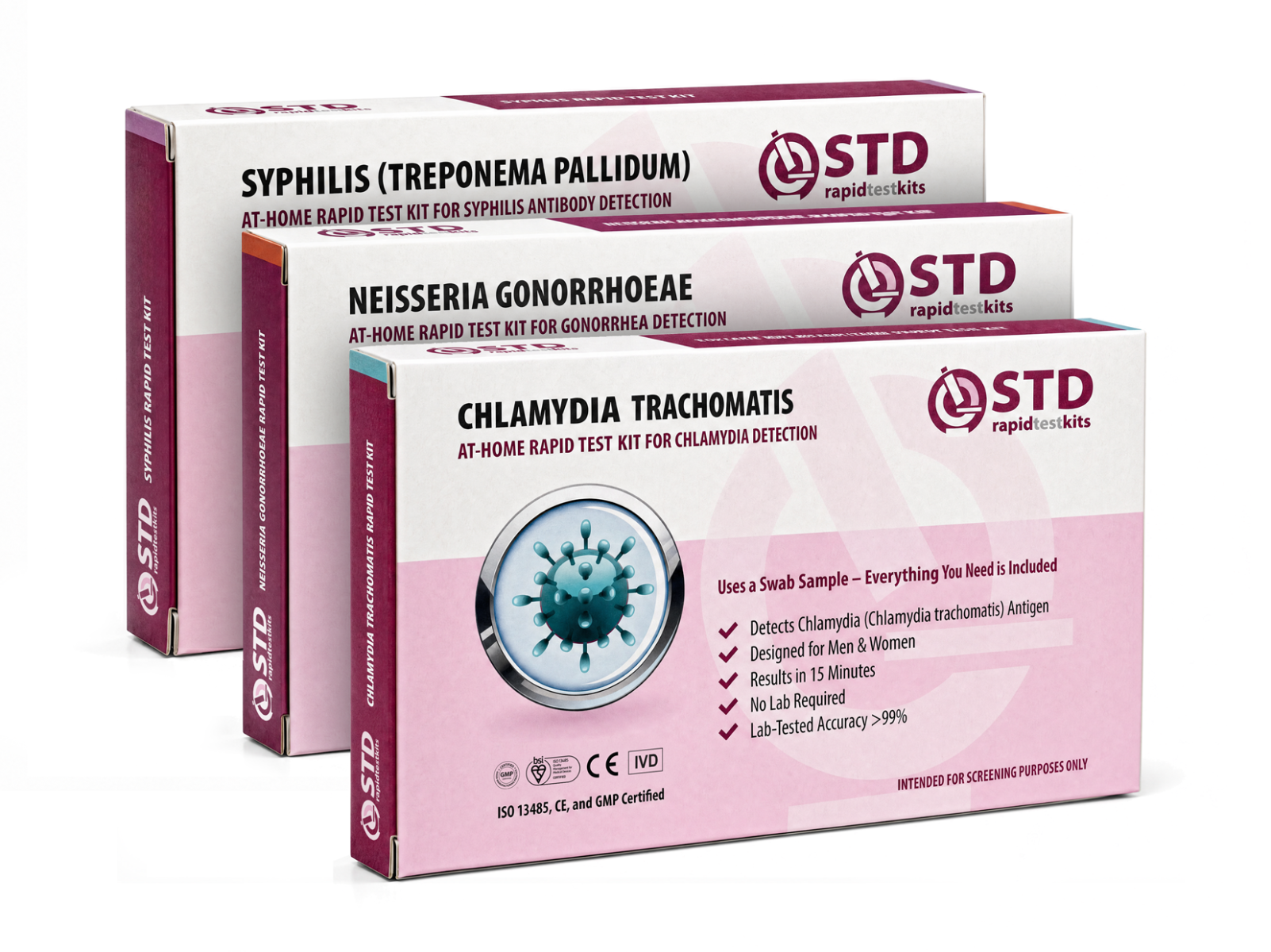
Two testing paths cover most of these scenarios. A clinic-based STI panel with NAAT for chlamydia and gonorrhea plus an RPR or treponemal antibody test for syphilis is the laboratory standard and is what most primary care offices, urgent care centers, and sexual-health clinics will run. An at-home rapid test, which uses lateral-flow chemistry, gives a faster preliminary read in privacy. It is a screening tool, not a NAAT-equivalent diagnostic, and any reactive result should be confirmed with a lab test before treatment decisions are made. Window-period rules apply either way: NAAT testing for chlamydia and gonorrhea is reliable about two weeks after exposure, and syphilis antibody testing is reliable from about three to six weeks, with three months being the most conservative window.

Frequently asked questions
- Can chlamydia really be mistaken for a UTI?
- The clearest signal is treatment response. A UTI typically resolves on nitrofurantoin or trimethoprim within about 48 hours, while chlamydia does not respond to those antibiotics and needs doxycycline or azithromycin. If burning urination persists after a finished UTI antibiotic course, add a chlamydia and gonorrhea NAAT to the next visit; the same urine sample can usually be used for both.
- What does a syphilis rash look like, and how does it differ from eczema?
- Secondary syphilis typically produces flat or slightly raised coppery-pink to brown patches, often on the palms and soles, that do not itch. Eczema is intensely itchy, usually appears in flexural folds (elbows, knees, neck), and rarely starts on the palms. The non-itch palm or sole pattern is the strongest tell.
- Can gonorrhea actually cause a sore throat?
- Yes. Pharyngeal gonorrhea is asymptomatic in the great majority of cases, but when it causes symptoms it produces a sore throat that looks clinically identical to viral pharyngitis. A rapid strep test does not detect it. A specific pharyngeal NAAT for gonorrhea is the right test, and it has to be ordered explicitly.
- How long can chlamydia or gonorrhea sit untreated without me knowing?
- Months, sometimes years for chlamydia. Most chlamydia cases in women, and many in men, are asymptomatic. Gonorrhea tends to surface faster in men with urethral symptoms but can stay quiet in cervical, pharyngeal, or rectal infections. The only reliable detection is testing.
- Is discharge always a sign of an STI?
- No. Yeast infections, bacterial vaginosis, and normal cyclical changes all produce discharge. The discharge most concerning for an STI is yellow, green, or unusually thick with a sudden onset, especially after a new sexual exposure. Any new discharge paired with burning, odor, or pain deserves a test.
- What window should I wait before testing after a possible exposure?
- For chlamydia and gonorrhea, NAAT-based testing is reliable about two weeks after exposure. For syphilis, antibody tests are reliable from about three to six weeks, with three months being the most conservative window. For at-home rapid tests, follow each product’s stated window; they generally align with the lab-based windows above.
- What if my doctor does not want to run an STI test?
- You can ask specifically: “Given my symptoms, would you add a chlamydia and gonorrhea NAAT and a syphilis screen to today’s labs?” Most clinics will accommodate. If not, a sexual-health clinic, Planned Parenthood, or an at-home rapid panel are alternatives. The test does not need to be unanimous.
- If I get a reactive result on an at-home rapid test, what next?
- Take the result to a clinic for confirmatory NAAT (for chlamydia and gonorrhea) or RPR plus treponemal antibody (for syphilis). Treatment is straightforward antibiotics in nearly all cases, but starting them depends on a confirmed diagnosis. The at-home result is a strong screening signal, not a final answer.
- U.S. Centers for Disease Control and Prevention. Syphilis basics: stages, primary chancre, secondary rash on the palms and soles, latent and tertiary phases, neurosyphilis symptoms.
- U.S. Centers for Disease Control and Prevention. Chlamydia: typical asymptomatic presentation, NAAT testing, screening recommendations for sexually active women under 25.
- U.S. Centers for Disease Control and Prevention. Gonorrhea: pharyngeal, urethral, and rectal presentations, antibiotic-resistance trends, treatment guidance.
- World Health Organization. Sexually transmitted infections fact sheet: 2020 global incidence figures and trends in antibiotic resistance for gonorrhea.
- UK National Health Service. Chlamydia: symptoms, complications including pelvic inflammatory disease and infertility or ectopic pregnancy, treatment, and screening guidance.
