
Published: August 2025 | Last updated: May 2026 | Editorial review and quality control: Martina N.
Polyamorous and other consensually non-monogamous (CNM) relationships often carry a stereotype that more partners equals more sexually transmitted infections. The research tells a more nuanced story. Peer-reviewed studies find that people in negotiated non-monogamous arrangements test more frequently, use condoms more consistently, and disclose results more openly than people who have undisclosed outside sex while claiming to be monogamous. The behaviors that drive lower STI rates are not the relationship structure itself. They are the testing, communication, and disclosure routines that CNM communities have built out of necessity.
This article walks through what those routines actually look like, what the evidence says about CNM and STI risk, when to test, and how to handle the harder conversations that come with multiple partners. The same playbook works for anyone with more than one current sexual partner, whether they call themselves poly, open, swinging, or just dating around.
Key Takeaways
- Research consistently shows that people in consensually non-monogamous relationships use condoms more often and test more frequently than people who have undisclosed outside partners.
- Three habits do most of the work: scheduled testing every three to six months, honest partner disclosure when results or exposures change, and barrier choices that match each activity’s actual transmission risk.
Does non-monogamy actually raise STI risk?
Risk follows behavior, not relationship label. Studies of CNM samples have looked at condom use, testing frequency, and STI prevalence, and they consistently find that openly non-monogamous individuals score better on safer-sex metrics than people who have outside sex without their primary partner’s knowledge. The openly non-monogamous groups in this research report significantly higher condom use during vaginal and anal sex with secondary partners, and higher rates of STI testing across the prior year.
The CDC’s most recent STI surveillance counted over 2.2 million reported cases of chlamydia, gonorrhea, and syphilis across the U.S. in a single year (CDC STI surveillance). A meaningful share of those infections happen inside relationships that the people involved would describe as exclusive. Tested-and-disclosed sex is statistically lower-risk than untested-and-assumed sex, regardless of how many people are involved.
Put differently: a person with four partners who all test quarterly, share results, and use barriers for higher-risk activities is statistically lower-risk than a person with one partner, no testing, no barriers, and an unspoken assumption that exclusivity is in effect. The math does not care about the label on the relationship.
Two behavior patterns drive the safer-sex math. People who openly negotiate non-monogamy tend to test on a schedule, use condoms with secondary partners, and disclose results. People who have undisclosed outside sex while claiming exclusivity tend to do none of those things. The infection math follows the behaviors, not the labels.
What a working testing cadence looks like
The CDC’s STI testing guidance recommends that anyone sexually active screen for HIV at least once, that sexually active women under 25 screen annually for chlamydia and gonorrhea, and that anyone with new or multiple partners screen at least annually for chlamydia, gonorrhea, syphilis, and HIV (CDC STI testing). The CDC’s tighter cadence (every three to six months) is stated specifically for sexually active gay or bisexual men with multiple or anonymous partners. CNM communities of all genders broadly adopt the same three-to-six-month cadence as community practice, since the risk profile of multiple ongoing partners is comparable.
Most CNM communities run tighter than the CDC floor. Common patterns include:
- Every three to six months for people with stable partner counts and consistent barrier use.
- Before first unprotected sex with a new partner (sometimes called fluid-bonding in CNM communities), plus a repeat test after the relevant window period closes (typically four to twelve weeks depending on infection).
- When a partner reports a new exposure or symptom in the network, whether or not the symptom seems STI-related.
- After known higher-risk events: a broken condom, an exposure from a partner whose status changed, or any new symptom.
A full panel for actively partnered adults typically covers chlamydia, gonorrhea, syphilis, HIV, and hepatitis B and C. Trichomoniasis is added for people with vaginas. HSV-2 antibody testing is generally not included in standard STI panels for asymptomatic adults and is usually offered only on request. HPV testing is offered as part of cervical cancer screening for people with cervixes; there is no equivalent routine HPV screening for people with penises.

Window periods are why “I feel fine” is not enough
Every STI has a window period: the time between exposure and when a test can reliably detect infection. Test too early and a true positive can read negative. The numbers vary by infection and by the type of test, summarized in the table below.
This is the math behind the CNM rule of thumb: when you start a new partner, the safest sequence is to test together at the start, use barriers through the relevant window period, then retest before dropping barriers. Doing it the other way around, dropping barriers first and testing later, leaves a window in which a transmitted infection cannot yet be detected.
The same window math is why asymptomatic transmission is so common. People with newly-acquired chlamydia, gonorrhea, or HSV often feel completely normal during the first weeks or months, exactly when they are most likely to pass infection on. The WHO estimates that the majority of STI cases are asymptomatic in either the carrier, the partner, or both (WHO STI fact sheet). For HSV-2 specifically, a large fraction of people who carry the virus have never had a symptom they recognized as herpes; some had a mild outbreak years earlier and assumed it was razor burn or an ingrown hair.
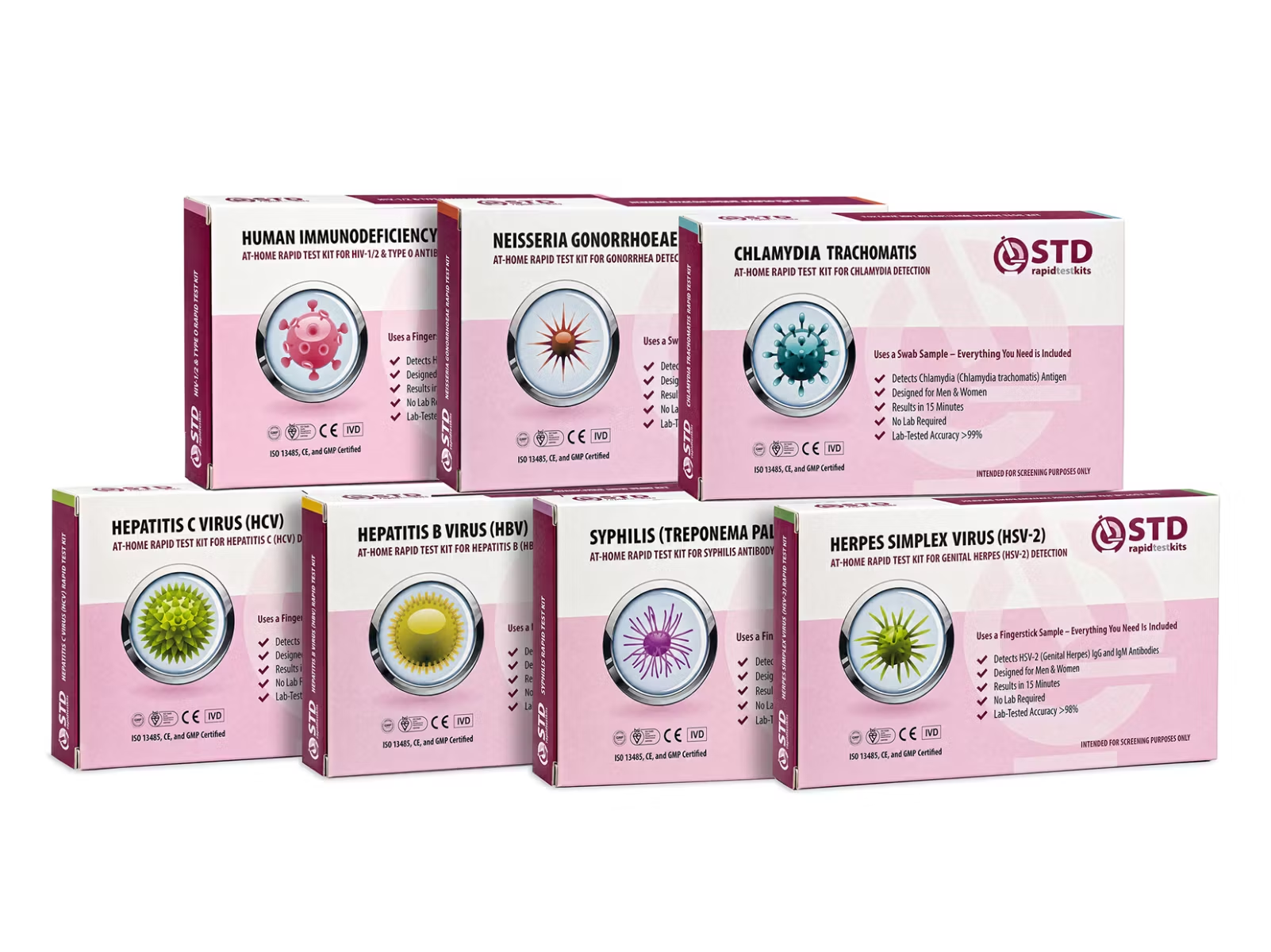
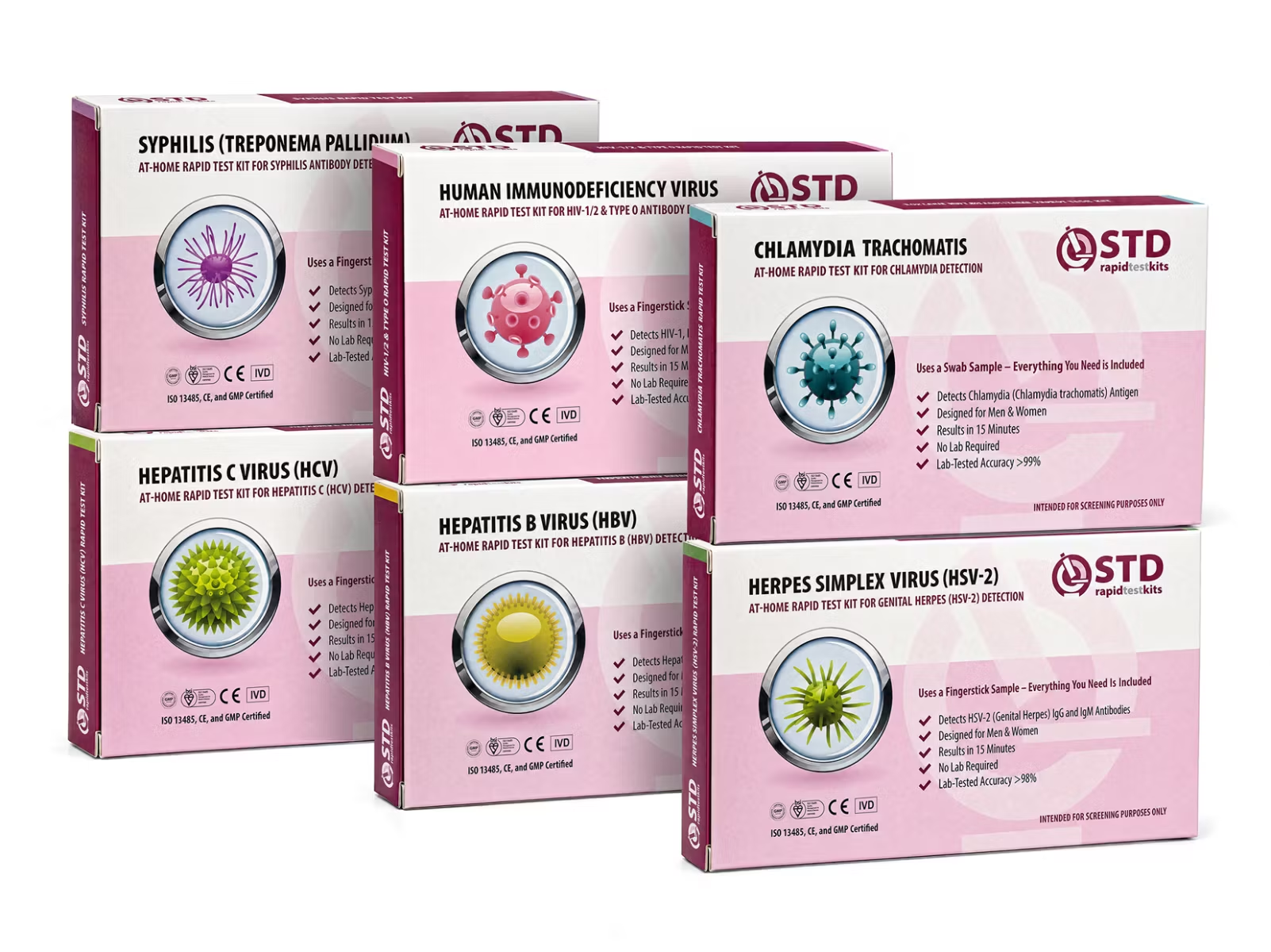
Our site sells at-home rapid lateral-flow panels designed for this kind of between-clinic screening; we recommend products based on fit for the reader’s testing routine, not commercial benefit.
| Infection | Test type | Reliable detection window after exposure |
|---|---|---|
| Chlamydia and gonorrhea | NAAT (lab) | About 2 weeks |
| HIV | 4th-gen antigen-antibody | 18 to 45 days |
| HIV | Rapid antibody only | Up to 90 days |
| Syphilis | Serology | 3 to 6 weeks |
| Hepatitis B and C | Antibody | 6 to 12 weeks |
| HSV-2 | Antibody (on request) | About 3 months |
Disclosure: the part most monogamous couples skip
The single behavioral difference between CNM safer-sex routines and the typical monogamous default is disclosure. CNM partners share testing results, share news about new partners, share symptom flags, and share what kind of activities are happening with whom. Monogamous couples often skip this entire layer because they assume exclusivity means there is nothing to disclose.
This is where the structural advantage of CNM kicks in. When disclosure is normal, three things follow:
- Testing happens proactively. Nobody is waiting for a symptom to get checked.
- Contact tracing is faster. If a positive result comes back, the people who need to know already expect that kind of message.
- Treatment starts earlier. Most bacterial STIs are easily treatable when caught early; delays are what cause complications like pelvic inflammatory disease or epididymitis.
None of this requires being polyamorous. It requires being honest. Couples who are nominally monogamous can adopt the same disclosure habits, and many do once they understand the alternative: silence that lets an asymptomatic infection move through a network undetected for months.
Partners of your partners (what CNM communities call metamours) matter too in the notification chain. In a well-functioning CNM network, a positive result moves outward by one or two degrees of contact within hours, not weeks. People do not need to socialize with each other’s partners to share status information about a shared exposure window. That kind of network-aware disclosure is the part of the public health response that clinical contact tracing has always had to work hardest at.
Sexually transmitted infections are common, and most are treatable or curable. Routine screening and prompt partner notification are the most effective steps people can take to limit transmission.
The conversation script that doesn’t kill the vibe
The hardest part of safer sex in a multi-partner context is not the latex or the lab work. It is bringing testing up before sex with someone new. CNM communities have developed scripts that lean on framing rather than apology. A few patterns that consistently work:
- Lead with care, not suspicion. “I want this to be a good experience for both of us, so I’d like us to compare recent test dates first” lands differently than “Have you been tested?”
- Trade, do not interrogate. Offer your own most recent panel before asking for theirs. Reciprocity reframes the conversation as mutual rather than accusatory.
- Be specific about what “tested” means. “I screen quarterly for chlamydia, gonorrhea, HIV, and syphilis, last panel was three weeks ago, all negative” is a real answer. “I’m clean” is not.
- Treat refusal as information. Someone who declines to share recent test results is declining a reasonable standard of mutual care. That alone is enough information to keep barriers in place for the evening.
- Distinguish status from history. “Have you ever had an STI?” is a different question from “When were you last screened?” Both are reasonable; the second is more useful for planning the next few weeks.
The script becomes easier with repetition. The first time anyone asks for test dates feels awkward. The tenth time feels like asking about food allergies before dinner. The conversation pattern is also portable: someone who learned it in a CNM context can use it in a casual hookup, a new relationship, or a long-term partnership where testing has lapsed.
“I screened last month for chlamydia, gonorrhea, HIV, and syphilis, and everything came back negative. When did you last test?” That sentence does the work of a much longer conversation. It offers specifics, invites reciprocity, and treats testing as routine rather than a confession.
Where at-home rapid tests fit in
At-home rapid tests have changed what routine testing costs in time and friction. A panel that used to require a clinic appointment, time off work, and a wait for results now happens in fifteen minutes on a bathroom counter. For people running tight testing schedules across multiple partners, that matters.
A few things to know about how the technology works. At-home rapid kits are lateral-flow immunoassays, the same chemistry that powers pregnancy tests and at-home COVID tests. They are screening tools, not laboratory-grade diagnostics. A negative result on a lateral-flow test is reliable once you are past the relevant window period. A positive result should always be confirmed at a clinic with a laboratory test, typically a NAAT for bacterial STIs or a Western blot or RNA test for HIV.
That means at-home rapid kits are best used as the front line of a tiered testing approach:
- Routine screening between clinical panels, on the three-to-six-month cadence most CNM groups run.
- Faster turnaround when timing matters, like testing a few days before a partner-rotation weekend.
- Lower-friction repeat tests after a known window-period reset, which would otherwise require multiple clinic visits.
The clinic still has a role. Annual or biannual visits remain the gold standard for the more complex pieces of sexual health care: gynecologic exams, cervical screening, vaccination updates (HPV, hepatitis B, mpox where indicated), and confirmatory testing for anything a home kit flags. The two layers are complementary, not interchangeable (CDC STI basics).

When someone in your network tests positive
The moment that tests a CNM network’s communication system is when a positive result comes back. Done well, the cascade looks like this:
- The person who tested positive contacts current and recent partners directly, with a specific message: which infection, approximate exposure window, recommended action.
- Affected partners get tested. Depending on the infection, they may also be presumptively treated, especially for chlamydia and gonorrhea where empiric treatment of recent contacts is standard practice.
- Sexual activity within the affected sub-network pauses or shifts to barriers-only until everyone has clear results.
- The information moves outward one degree: partners of partners get notified if the exposure timeline overlaps with their own activity.
Most CNM groups have agreed on this protocol before they ever need it. Working it out in advance, when nobody is anxious or defensive, is much easier than improvising during an actual diagnosis. The NHS recommends that anyone who tests positive notify current and recent partners promptly so they can be tested and treated (NHS sexual health overview).
The emotional layer is real too. A positive result is not a moral verdict. Most STIs are common, manageable, and in many cases curable. Chlamydia and gonorrhea are bacterial and clear with a short course of antibiotics. Syphilis is curable when caught at any stage, ideally early. HIV is now a manageable chronic condition with effective antiretroviral therapy, and undetectable viral load equals untransmittable on consistent treatment. Even HSV, which is lifelong, is far more often a manageable inconvenience than a major health event. The shame attached to these infections tends to do more damage than the infections themselves, which is the next thing worth saying.
Shame, not sex, is the actual transmission engine
Public health research has documented for decades that stigma around STIs delays testing, delays disclosure, and delays treatment. Each of those delays gives an infection more time to spread. People who feel safe talking about their sexual health get tested earlier, name their partners faster, and start treatment sooner. People who feel judged hide, and an infection hidden inside a relationship network is an infection on the move.
This is why the cultural work that CNM communities have done around normalizing testing has practical public health value. Treating a chlamydia diagnosis the way another community might treat a strep throat diagnosis (information that calls for treatment plus a heads-up to recent contacts) changes the math of how the infection spreads. Nobody hides a strep diagnosis. Strep throat carries no moral weight. Chlamydia is medically simpler than strep in most respects, but it carries a social weight that has nothing to do with the bacteria.
The same shift is available to anyone, regardless of relationship structure. The infrastructure is already there: routine screening, transparent disclosure, fast treatment, and a frame that treats STIs as health events rather than character judgments. Public health departments have been promoting this exact frame for years; CNM communities are one of the few groups that have organically adopted it at the relational level.
Nobody hides a strep diagnosis from people they kissed last week. Strep simply doesn’t carry the social baggage that chlamydia does, and that difference, not anything about the bacteria themselves, is why people talk about strep openly and chlamydia in private. Chlamydia is medically simpler to treat than strep in most respects. If it carried the same low social weight, it would also spread less, because people would talk about it sooner and treat it faster.
Testing is the foundation, not a fallback
The takeaway from the research and the community practice is simple. The factors that keep STI rates low across multiple partners are the same factors that keep them low across one partner: regular testing, honest disclosure, barrier choices that match the actual risk of each activity, and a low-shame attitude toward results.
Mainstream sex education in many places never taught any of this, which is part of why CNM routines get described as radical. The routines themselves are not radical. They are public health basics applied consistently, available to anyone with more than zero current partners. A person who wants to lower their risk does not need to change their relationship structure. They need to test, talk, and treat what comes back.
For people running a multi-partner schedule, an at-home rapid panel between clinical visits can be a useful piece of that infrastructure. It does not replace the clinic, and it does not replace the conversation. It makes the testing part of the loop fast enough that doing it routinely stops feeling like a special event.
The three-step routine
- Test on a schedule: every three to six months for actively partnered adults, plus before any new fluid-bonded partner and again once the relevant window period closes.
- Disclose honestly: share results, new partners, and any symptom flags with current and recent partners without delay.
- Treat what comes back: most STIs are curable or manageable when caught early, and partner notification is part of the treatment itself.
FAQs
- Can you still get STIs even if everyone in your polycule has been tested?
- Yes. Testing lowers risk significantly but does not remove it. Every STI has a window period during which a true infection may not yet be detectable, and not every panel covers every infection. The closer your shared testing cadence is, and the better your barrier use matches each activity’s risk, the smaller the residual window.
- How often should polyamorous people get tested for STIs?
- Most people running a multi-partner schedule test every three to six months as a baseline, plus before fluid-bonding with a new partner and again once that partner’s window period closes. People with frequent new partners, or who do higher-risk activities, often test more often. The CDC’s minimum is annual for anyone with multiple or new partners.
- Is oral sex really risky for STIs?
- Yes, though the risk profile is different from genital-to-genital contact. Gonorrhea, chlamydia, syphilis, HSV-1 and HSV-2, and HPV all transmit through oral sex. Condoms and dental dams reduce risk significantly, as does routine screening. Pharyngeal infections are often asymptomatic and need a throat swab to detect.
- What if a partner refuses to get tested?
- Refusal is information. In CNM contexts, testing is usually treated as part of mutual care, and you are allowed to make it a precondition for unbarriered sex (or for sex at all). Framing it as a shared agreement rather than a personal demand makes the conversation easier.
- Can you get herpes from kissing?
- Yes, kissing can spread oral HSV-1 even with no visible sores, because viral shedding can happen between outbreaks. Many people carry HSV-1 from childhood and never know. Risk is reduced by avoiding kissing during active outbreaks and by partners who already share HSV-1 status.
- Do at-home STI tests actually work?
- Yes, when used correctly and past the relevant window period. At-home rapid tests are lateral-flow immunoassays, the same chemistry used in many other home tests. They function well for routine screening between clinical visits. Any positive result should be confirmed at a clinic with a laboratory test.
- How do I bring up testing without making it awkward?
- Lead by offering your own recent results before asking for theirs, frame it as care rather than suspicion, and be specific. “I screened last month, here is what was on the panel, when did you last test?” lands much better than a vague “are you clean?”
- Is polyamory riskier than monogamy?
- Not by itself. The actual risk drivers are testing frequency, disclosure habits, and barrier use, not the number of partners. People in well-run CNM networks often have lower STI risk than people in supposedly-monogamous relationships where testing never happens and outside sex is undisclosed.
- U.S. Centers for Disease Control and Prevention. About sexually transmitted infections, including transmission, screening rationale, and treatment overviews referenced throughout this article.
- U.S. Centers for Disease Control and Prevention. Getting tested for STIs, including annual minimums for sexually active adults and the every-three-to-six-month cadence stated specifically for sexually active gay or bisexual men with multiple or anonymous partners.
- U.S. Centers for Disease Control and Prevention. Annual STI surveillance, including total reported chlamydia, gonorrhea, and syphilis cases in the U.S. (over 2.2 million combined).
- U.S. Centers for Disease Control and Prevention. Genital herpes overview, including viral biology, transmission patterns, and asymptomatic shedding context referenced in the window-period section.
- World Health Organization. Fact sheet on sexually transmitted infections, including global prevalence and the high proportion of asymptomatic cases.
- United Kingdom National Health Service. Sexually transmitted infections overview, including partner notification guidance referenced in the positive-result cascade.
