
Published: September 2025 | Last updated: May 2026 | Editorial review and quality control: Martina N.
The answer most people search for is a number, and it has one. For an at-home herpes blood test, the most reliable window opens around 12 weeks after a possible exposure and closes around 16 weeks. Test before then and you might get a clean negative even when you actually have the virus. During an active sore, a clinic PCR swab gives you a faster, more direct answer.
The reason there are two answers, not one, is that there are two different testing methods. One looks for the virus directly in a sore. The other looks for your immune system's antibody response to the virus. They have different timelines, and using the wrong one at the wrong time is the single most common cause of false negatives.
Key Takeaways
- An at-home blood antibody test for herpes is most reliable 12 to 16 weeks after exposure. Earlier testing risks a false negative because IgG antibodies take weeks to build up.
- If you have an active sore right now, a clinic PCR swab from the lesion is the more direct test. At-home rapid kits are blood antibody tests built for the no-symptom window after 12 weeks.
Two Tests, Two Different Windows
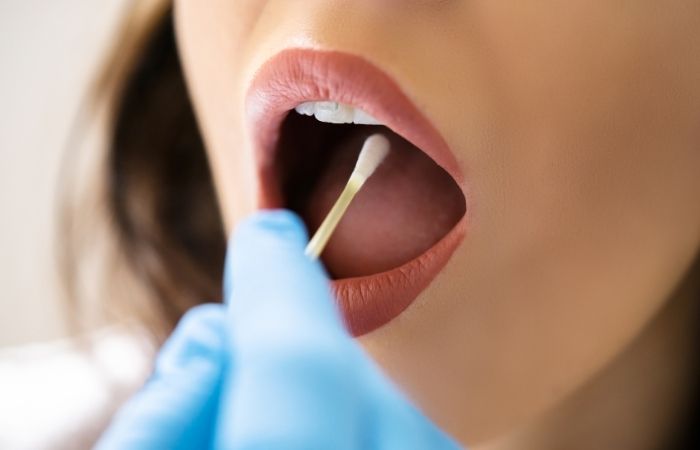
The first method is a swab test, also called PCR. A clinician swabs an active sore or lesion, and the lab looks for the actual viral DNA. PCR is direct: if the virus is in that sore, the test finds it. The window for swab testing runs roughly 2 to 12 days, when symptoms are usually visible. Outside that window there is no sore to swab, so PCR is no longer an option.
The second method is a blood test for IgG antibodies. Instead of looking for the virus, it looks for the proteins your immune system makes after meeting the virus. Antibodies take weeks to build up to detectable levels. The CDC notes that it can take up to 16 weeks or more for current blood tests to detect herpes after exposure (CDC herpes testing). The American Sexual Health Association puts the practical window at 12 to 16 weeks for most people (ASHA herpes testing). Some seroconvert sooner, around 6 to 8 weeks, but the conservative cut-off is what protects you from false negatives.
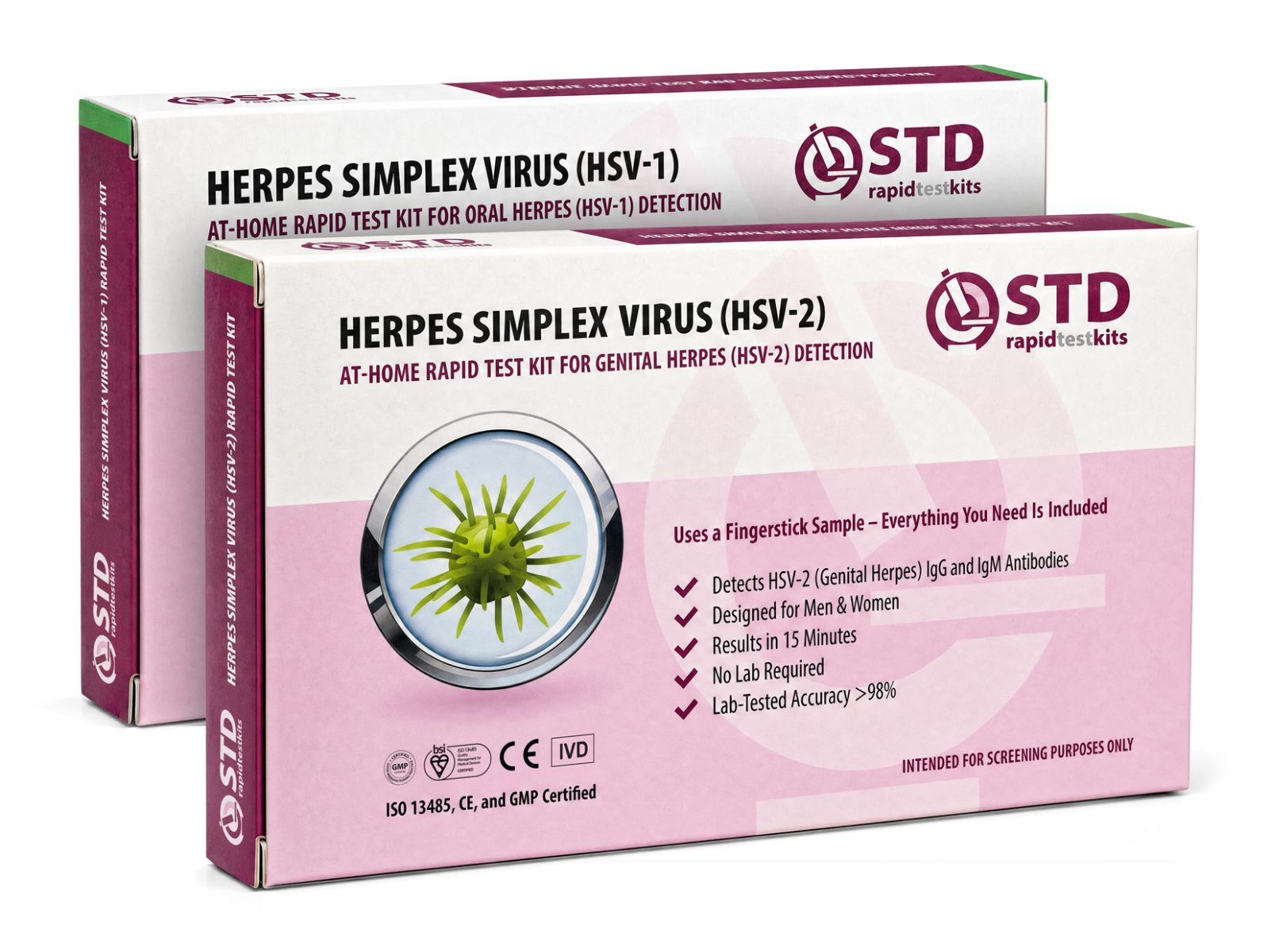
At-home rapid herpes kits, including the lateral-flow blood test we sell, fall into the second category. They detect antibodies, not the virus itself. So they are screening tools designed for the no-symptom window after exposure, rather than real-time outbreak diagnosis.
Incubation vs Window Period: They Are Not the Same
People mix these up constantly, and it leads to bad timing decisions. The incubation period is how long after exposure your body might develop symptoms. For herpes, that is roughly 2 to 12 days. The window period is how long it takes for a test to detect the infection. For PCR, the window matches the incubation period, because the virus has to be physically present in a sore. For an antibody blood test, the window stretches much longer, because your immune response has to ramp up first.
Here is how the main test types compare:
| Test Type | What It Detects | Timing After Exposure | Best Use Case |
|---|---|---|---|
| PCR swab (lesion test) | Viral DNA | 2 to 12 days, while a sore is present | Active outbreak with a visible sore at a clinic |
| Type-specific IgG blood test | HSV-1 and HSV-2 antibodies | 12 to 16 weeks | Post-exposure screening with no current symptoms |
| IgM blood test (not recommended) | Early antibodies | 1 to 4 weeks | Generally avoided; high false-positive and cross-reactivity rate |
How long should I wait to test for herpes after sex?
For an at-home blood antibody test, wait 12 to 16 weeks after the exposure. That is the window where your immune system has built enough IgG antibodies for the test to detect them reliably. If you have an active sore right now, skip the blood test and go to a clinic for a PCR swab while the sore is fresh. Testing too early in either direction is the most common reason results come back wrong.
Your Timeline, by Exposure Scenario
The right test and the right timing change with what actually happened. Find the scenario that matches your situation and use it as a starting point. None of these substitute for a clinician's judgement on a specific symptom.
- Oral exposure with cold-sore contact. You gave or received oral sex with someone who had a cold sore, and you feel tingling or see a small lesion within days. A clinic PCR swab from that sore is your best move while it is still active. If symptoms resolve before you can get to a clinic, schedule a type-specific IgG blood test for 12 to 16 weeks after the exposure.
- Genital exposure, no symptoms yet. You had condomless or partially-protected sex and the calendar is sitting at one to three weeks. A blood test now is mostly noise: too early to mean much. Mark your calendar for 12 weeks out and book then. If a sore appears in the meantime, get it swabbed at a clinic immediately.
- Anal exposure with itching but no visible sore. Itching alone could be many things, including non-STI causes such as friction or skin irritation. Without a sore to swab, you are in IgG-blood-test territory: 12 to 16 weeks for the most reliable result.
- You cannot remember when exposure happened. Take a baseline test now, then again at 12 to 16 weeks past your last potential exposure.
Why Early Tests Often Come Back Negative
False negatives in herpes testing usually trace back to biology. Your immune system makes IgG antibodies on its own schedule, and that schedule does not match the calendar of when you wanted answers. At week 2, very few people have detectable IgG. By week 6, more do, but a meaningful share still test negative despite being infected. By week 12, the curve flattens out and most antibody-positive people will register as positive. By week 16, the curve is essentially complete.
The other false-negative trap is the wrong test type. Some clinics still run an IgM antibody test, which picks up earlier than IgG but is unreliable for herpes. The CDC explicitly does not recommend IgM for herpes diagnosis because it has high cross-reactivity and a high false-positive rate (CDC STI treatment guidelines). If you are offered IgM, ask for a type-specific IgG test instead.
IgM herpes blood tests are not recommended by the CDC because they have high cross-reactivity and frequently produce false positives. If a provider offers you an IgM test for herpes, request a type-specific IgG test instead, and time it for 12 to 16 weeks after exposure.
When to Retest, and When You Do Not Need To
If your first blood test was at 3 weeks and came back negative, treat it as a baseline, not a clearance. The test was simply too early to be definitive. Re-run the antibody test at 12 to 16 weeks past the exposure for a result you can act on.
You probably do not need to retest if a clinician swabbed an active sore and the PCR came back positive: that result is direct viral detection, and it is conclusive. The exception is when you want to know whether the virus is HSV-1 or HSV-2 specifically. A type-specific IgG blood test will tell you which strain you carry, which matters for partner conversations and for predicting how often outbreaks may recur.
When a Retest Makes Sense
- Your first test was earlier than week 6 post-exposure.
- You tested negative but a sore appeared afterwards and was not swabbed.
- You only had a generic herpes panel and you want HSV-1 vs HSV-2 type-specific results.
- An IgM result conflicts with an IgG result; trust the IgG.
HSV-1 vs HSV-2: Both Can Show Up Anywhere
The clean split most people learned in school, HSV-1 is oral and HSV-2 is genital, is no longer how the viruses behave. HSV-1 has become a common cause of new genital infections, particularly in younger adults, often acquired through receiving oral sex from a partner with cold-sore HSV-1 (WHO herpes simplex virus fact sheet). HSV-2 occasionally shows up orally, though it is less common.
For testing, this means two things. First, ask for a type-specific IgG test, not a generic herpes screen. The type matters because HSV-2 tends to cause more frequent recurrences than HSV-1, and partner-disclosure decisions depend on knowing which strain you carry. Second, do not assume a partner with cold sores is unable to transmit a genital infection. They can, especially during an active outbreak or asymptomatic shedding.
HSV-1 is mainly transmitted via contact with the virus in sores, saliva or skin surfaces in or around the mouth.
What If You Do Not Know When You Were Exposed?
Sometimes the calendar does not help. You might have been exposed months ago, or have a partner whose status changed unexpectedly, or simply not remember the timing of every encounter. Herpes is one of the most common viruses globally; many people carry HSV-1 from childhood without knowing, and a meaningful share of HSV-2 carriers acquired the virus years before any symptoms appeared (WHO HSV fact sheet).
If the timing is fuzzy, take a baseline IgG test now. Note the result. If you have any new exposure between now and the next 12 to 16 weeks, retest after that window closes. The point is not to nail the exact date but to give your body enough time to seroconvert before the test is run.
If You Test Positive
A herpes diagnosis is a manageable health condition, not a verdict on your future. Most people with HSV-1 or HSV-2 have one or two outbreaks early on, and many never have another visible recurrence. Antiviral medications such as valacyclovir or acyclovir reduce outbreak frequency, shorten duration, and lower the risk of transmission to a partner.
The first practical step after a positive at-home result is confirmation. If your positive came from a blood antibody screen, ask a clinician to repeat the test in a lab setting and confirm the type (HSV-1 vs HSV-2). If the positive came from a clinic PCR swab during an outbreak, that is already a definitive result. Either way, your provider can talk through antiviral options, partner-disclosure timing, and the small lifestyle adjustments that reduce transmission risk.
Bottom Line: Time the Test, Do Not Race It
The single biggest mistake people make with herpes testing is testing too soon and reading the negative result as the all-clear. Antibody tests need 12 to 16 weeks after exposure to produce a reliable result. PCR swab tests need an active sore. If you fall outside both windows, what you actually need is a calendar reminder, not a test.
If you are inside the antibody window and ready to test, our at-home HSV-1 and HSV-2 kit gives you a private, 15-minute screening result. If a sore is the reason you are reading this, the right next call is a clinic that can swab the lesion while it is fresh.
Your Next Step
- Active sore right now: go to a clinic for a PCR swab while the lesion is fresh.
- No sore, less than 12 weeks since exposure: set a calendar reminder for week 12 and wait.
- No sore, 12 or more weeks since exposure: use an at-home type-specific IgG blood test.
FAQs
- How long after exposure should I wait to test for herpes?
- If you have an active sore, skip the home kit and go to a clinic for a PCR swab while it is fresh. If there is no sore and at least 12 weeks have passed since the exposure, an at-home type-specific IgG blood test will give you a reliable result; the standard window stretches to 16 weeks for the small share of people who seroconvert later.
- Can a blood test miss herpes if I take it too soon?
- Yes. Antibodies take weeks to build up. At week 2 or 3, the test may show negative even when the virus is present. By week 6 most people start to seroconvert, and by week 12 to 16 the result is reliable for almost everyone.
- I have a sore right now. Should I order a home test or go to a clinic?
- Go to a clinic. PCR swab testing of an active sore detects the virus directly, and it is the most accurate diagnostic method during an outbreak. Our at-home blood antibody test is for screening 12 weeks or more after a possible exposure when no symptoms are present.
- Why do some clinics still use IgM and is it reliable?
- IgM antibodies appear earlier than IgG, but the IgM herpes test has high cross-reactivity and a high false-positive rate. The CDC does not recommend IgM for herpes diagnosis. If a provider offers it, ask for a type-specific IgG test instead.
- Can my partner's cold sore actually give me genital herpes?
- Yes. HSV-1 transmits through skin-to-skin contact, including from oral cold sores during oral sex. HSV-1 is now a common cause of new genital herpes infections in younger adults. Avoid oral and genital contact during an active outbreak.
- Does a negative test at 6 weeks mean I am in the clear?
- Not yet. Six weeks is a useful checkpoint, but it sits inside the seroconversion window. Some people are positive by week 6 and others are not. Repeat the test at 12 to 16 weeks for a result you can rely on.
- If I never have symptoms, is it worth testing?
- Most people with HSV-2 do not know they have it because they never have a classic outbreak. If you have had unprotected sex or oral contact and want to know your status, a 12 to 16 week IgG test is the standard tool.
- What is the difference between HSV-1 and HSV-2 testing?
- A type-specific IgG blood test reports HSV-1 and HSV-2 separately, which matters because HSV-2 tends to recur more often than HSV-1, and the disclosure conversation with a partner depends on knowing which strain you carry. Avoid generic herpes panels that do not distinguish between the strains.
How We Sourced This Article: Our article was constructed from current guidance published by the U.S. Centers for Disease Control and Prevention, the World Health Organization, the UK National Health Service, the Mayo Clinic, and the American Sexual Health Association. We then translated that guidance into plain-English action items for readers deciding when and how to test. All citation URLs were verified at time of writing.
- U.S. Centers for Disease Control and Prevention. Herpes testing guidance, including the 16-weeks-or-more antibody detection window and the IgG vs IgM distinction.
- U.S. Centers for Disease Control and Prevention. Sexually Transmitted Infections Treatment Guidelines, herpes section, on type-specific testing and the IgM caveat.
- World Health Organization. Herpes simplex virus fact sheet: global prevalence, transmission patterns, and asymptomatic carriage.
- UK National Health Service. Genital herpes overview: symptoms, testing pathways, and treatment.
- Mayo Clinic. Genital herpes symptoms and causes overview, including transmission routes and clinical presentation.
- American Sexual Health Association. Herpes testing FAQ, including the 12 to 16 week antibody window for type-specific IgG testing.
