
Published: September 2025 | Last updated: April 2026 | Editorial review and quality control: Martina N.
A condom slipped, a partner texted bad news, or a one-night thing keeps replaying in your head. The first impulse is to test, immediately, just to know. That impulse is human. It is also, biologically, often too early to be useful.
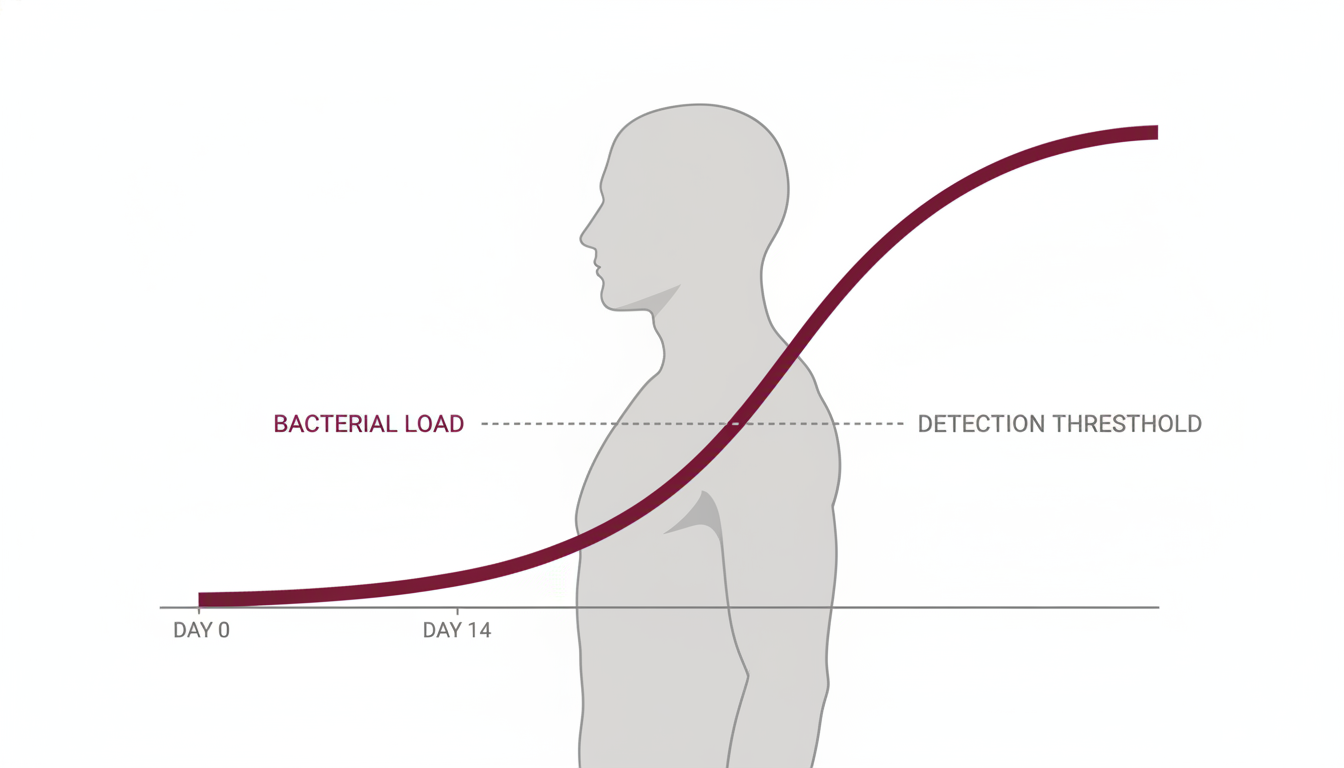
Chlamydia bacteria need time to multiply inside the body before any test can find them. Run a kit on day one, day three, even day five, and a negative result tells you almost nothing. Wait until day fourteen and the same kit gives you a far more honest answer. The science does not change between those two moments. What changes is how much bacterial material your sample contains.
This guide walks through why that gap exists, what it means for at-home lateral-flow rapid kits versus laboratory NAATs, why faint lines deserve attention, how a recent course of antibiotics can mask a real infection, and exactly when to retest. By the end you should know whether your last test was timed right, whether you need a follow-up, and what to do if symptoms keep nagging you despite a clean strip.
Can you test too early for chlamydia?
Yes. Testing within the first 5 days of exposure is too early for any rapid or lab test to be reliable, and a negative result in that window often means the test simply did not have enough bacterial material to detect. Wait at least 14 days from the suspected exposure for the most accurate result. If you tested earlier and got a negative, retest at the 2-week mark, or sooner if symptoms appear.
Key Takeaways
- Chlamydia rapid tests reach their most accurate detection window roughly 14 days after exposure. Testing earlier is a common cause of false negatives even when infection is present.
- A faint test line, ongoing symptoms after a negative result, or a recent course of antibiotics are three signals that you should retest, ideally with a confirmatory laboratory NAAT.
How chlamydia rapid tests actually work
Two technologies dominate chlamydia testing, and they look for different things. Laboratory nucleic acid amplification tests (NAATs) hunt for the bacterial DNA of Chlamydia trachomatis. They amplify even tiny fragments through chemistry that copies the genetic material billions of times, which is why they are so sensitive. NAATs are the laboratory gold standard recommended by the CDC for chlamydia screening, and they typically test a urine sample or a self-collected vaginal swab.
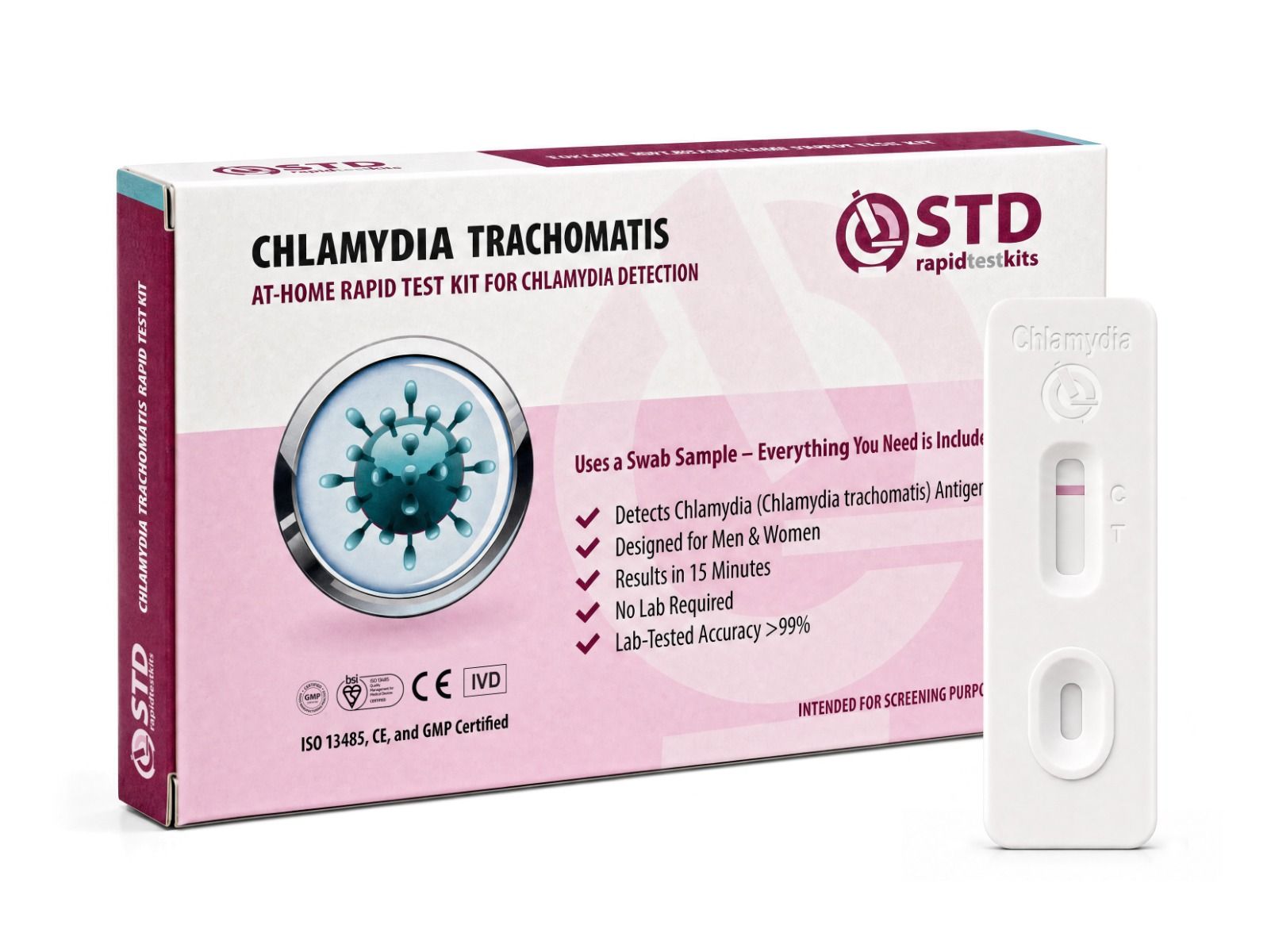
At-home rapid tests, including the lateral-flow cassettes sold by stdrapidtestkits.com, use a different chemistry. They detect chlamydia antigens, the protein structures on the surface of the bacterium, using antibodies bound to a paper strip. When enough antigen flows through the strip, a colored line appears within roughly 15 minutes. No lab, no waiting, no clinic visit.
Both technologies share the same fundamental dependency: there has to be something there to find. If your sample contains too few bacteria or too little antigen, even a perfectly manufactured test will read negative. This is a basic limit of detection-based diagnostics, and the kit itself works fine. The clinical name for the gap between exposure and reliable detectability is the window period, and for chlamydia it is the single biggest reason real infections get missed.
Disclosure: stdrapidtestkits.com sells the at-home rapid test kits linked in this guide. All product links in this article go to our own catalog.
At-home rapid test (lateral-flow): detects bacterial antigen (proteins on the bacterium's surface), needs a higher bacterial load to trigger a result, returns a colored line in roughly 15 minutes. Best for first-line screening at home when convenience and privacy matter.
Laboratory NAAT: detects bacterial DNA, amplifies tiny genetic fragments through PCR-style chemistry, much higher analytical sensitivity, typical 1 to 5 day turnaround. Best for confirmation when symptoms persist, when partners disagree on results, or when antibiotics may have suppressed an active infection.
Window period vs incubation period: two timelines, often confused
People mix these two concepts up constantly. They describe different things.
The incubation period is how long the bacteria take to cause symptoms in someone who develops them. For chlamydia that runs roughly 1 to 3 weeks after exposure, though plenty of infections never produce noticeable symptoms at all (more on that below).
The window period is how long the bacteria take to multiply enough that a diagnostic test can detect them. For chlamydia rapid tests this is roughly 14 days. For laboratory NAATs the detection window is shorter because the chemistry amplifies smaller amounts of genetic material, but most clinicians still suggest waiting at least 7 to 14 days post-exposure for the most reliable NAAT result.
Why does this matter? Because you can be infected and contagious, with no symptoms yet, and still test negative if you test inside the window period. The variable that determines whether a test catches the infection is bacterial load, and bacterial load takes time to build, regardless of whether your immune system has started producing the inflammation that causes burning, discharge, or pelvic pain.
| Incubation period | Window period | |
|---|---|---|
| Definition | Time from exposure to first symptoms (in those who develop any) | Time from exposure to when a test can reliably detect the infection |
| Typical timeline for chlamydia | 1 to 3 weeks; many infections never produce symptoms at all | Roughly 14 days for at-home rapid kits; somewhat shorter for lab NAATs |
| What it means for testing | Symptoms cannot be your trigger to test, since most chlamydia is asymptomatic | Tests run too early give false negatives because bacterial load sits below the detection threshold |
Why testing too early returns false negatives
The biggest single cause of a false-negative chlamydia result is not a faulty kit, a clumsy swab, or a contaminated sample. It is the calendar. Testing within the first week after exposure means the bacterial load is almost always below what any rapid test can pick up. Even at the 7 to 13 day window, a meaningful fraction of real infections still slip through.
The table below summarizes how detection probability shifts with timing. The figures reflect the general pattern reported across published evaluations of rapid antigen kits and at-home test validations. Individual product specifications vary, so always check the data sheet that ships with your kit.
| Days since exposure | Estimated detection sensitivity | What this means in practice |
|---|---|---|
| 0 to 3 days | Very low | Almost any negative result is unreliable. Bacterial load is below detection threshold for both rapid kits and most lab NAATs. |
| 4 to 7 days | Low to moderate | False negatives common. A positive in this window is meaningful, but a negative does not rule out infection. |
| 8 to 13 days | Moderate to high | Detection improves but real infections still slip through. Repeat testing if symptoms appear or risk was high. |
| 14+ days | Highest available for the kit type | The most reliable window for at-home rapid tests. NAATs can detect earlier but still benefit from this window. |
How antibiotics can mask a real infection
Recent antibiotic use is one of the sneakiest causes of false negatives, and most people do not realize it applies to them. Even antibiotics taken for an unrelated reason (a sinus infection, a dental procedure, a course of doxycycline for acne) can temporarily suppress chlamydia bacteria below the detection threshold. The infection is still there. Your sample just looks cleaner than it is.
Once the medication clears your system, the bacteria can rebound, and the next test (or the symptoms that follow) tells the real story. This is why most clinicians recommend testing before starting any antibiotic course when you suspect an STI exposure, unless treatment is genuinely urgent.
If you have taken any antibiotic in the past 4 to 6 weeks and tested negative for chlamydia, treat that result with caution. A repeat test 3 to 4 weeks after finishing the antibiotic course gives the bacteria time to repopulate to detectable levels if they were suppressed but not eradicated. The same logic applies after completing treatment for chlamydia itself: a test of cure should be timed at least 3 to 4 weeks after finishing the prescribed course, not earlier, because dead bacterial fragments can linger and mislead.
If you have taken any antibiotic in the past 4 to 6 weeks (for any reason, sexual-health-related or not) and tested negative for chlamydia, treat that result with caution. The medication may have temporarily suppressed bacterial levels below the detection threshold. Retest 3 to 4 weeks after finishing the course, or ask your clinician about a laboratory NAAT for confirmation.
Sample collection and handling errors that ruin accuracy
Beyond timing and antibiotics, the way the sample is collected accounts for most other false-negative results. None of these errors are obvious in the moment. Most happen because someone is anxious, rushed, testing in secret, or running through the steps before fully reading the leaflet.
| Common error | What it does to the test | How to avoid it |
|---|---|---|
| Testing too early | Bacterial load below detection threshold | Wait at least 14 days from exposure before testing with a rapid kit. |
| Insufficient sample | Not enough antigen reaches the test strip | Follow swab depth and rotation instructions exactly; saturate the swab fully. |
| Reading the result outside the time window | Evaporation lines and false positives or negatives appear | Read the result strictly within the kit's stated window, usually 5 to 15 minutes. |
| Improper storage of the kit | Heat, freezing, or moisture degrade the antibody chemistry | Store the kit per the leaflet, room temperature and dry, until use. |
| Cross-contamination of the sample area | Cleaning products, lubricants, or recent douching can interfere | Avoid vaginal washes, lubricants, or topical products in the hours before swabbing. |
What a faint line really means
Few things trigger more anxiety than staring at a test strip and squinting at a faint, ghost-like second line. Is it positive? Negative? An evaporation artifact? A trick of the bathroom lighting?
The honest answer for chlamydia rapid tests: any visible line in the test zone, however faint, should be treated as a presumptive positive. The chemistry is binary in the sense that the antibody-antigen reaction either fires or it does not. A faint line usually means the bacteria are present but at a relatively low concentration, which is consistent with an early-stage infection or a sample with limited material. It does not mean half-positive or maybe-positive. It means there is enough antigen present to trigger a visible reaction.
That said, three things can produce a misleading faint line:
- Evaporation lines: faint marks that appear after the result window has closed (typically beyond 15 to 20 minutes).
- Kit degradation: a kit stored in heat, frozen, or past its expiry date may produce faint or invalid lines that do not reflect the actual sample.
- Partial sample contact: a swab that did not collect a sufficient sample can produce a borderline result that is hard to interpret either way.
The right move with a faint line is the same regardless of cause: confirm. Order a second rapid test for retesting at the 14-day mark, or follow up with a laboratory NAAT to settle the question definitively.
Read your test exactly within the stated time window in the leaflet, usually between 5 and 15 minutes after applying the sample. Lines that appear after the window has closed are evaporation artifacts and not real results. Photograph the cassette at the correct minute mark if you want a record.
When confirmatory testing matters
Rapid kits are excellent first-line screening tools. They give you privacy, speed, and a result in 15 minutes without booking a clinic visit. They are not a substitute for laboratory confirmation when the stakes are high, and a few specific situations call for a confirmatory NAAT regardless of the rapid result:
- You tested inside the window period (less than 14 days post-exposure) and got a negative result, but symptoms have appeared.
- You see a faint or borderline line on the rapid test.
- A partner has tested positive and your own rapid test is negative.
- You took antibiotics for any reason in the 4 to 6 weeks before testing.
- You are pregnant, immunocompromised, or being screened during a high-risk clinical situation.
NAAT testing through a clinic, sexual health service, or a mail-in laboratory kit detects bacterial DNA at concentrations far lower than what a rapid test can pick up. The CDC describes NAAT as the recommended laboratory test for chlamydia screening and diagnosis.
Most people who have chlamydia have no symptoms. If you do have symptoms, they may not appear until several weeks after you have sex with an infected partner.
When to retest for chlamydia
Follow-up testing is a normal part of chlamydia screening, not an overreaction. Bacteria can persist after incomplete treatment, partners can reinfect each other when both are not treated, and a window-period result can shift dramatically a week later. The table below covers the four most common situations where a follow-up test is the right call.
| Your situation | When to retest | Why |
|---|---|---|
| You tested less than 14 days after exposure and got a negative result | Retest at day 14+ post-exposure | The first test was likely inside the window period and may have missed an early infection. |
| You saw a faint or borderline line on a rapid test | Repeat in 3 to 5 days, or confirm with a laboratory NAAT | Faint lines are usually meaningful but warrant confirmation before assuming a diagnosis. |
| You completed antibiotic treatment for chlamydia | Test of cure 3 to 4 weeks after finishing the medication | Confirms the infection has cleared and rules out reinfection from an untreated partner. |
| You have ongoing risk (new or multiple partners) | Every 3 months, or after each new partner change | Asymptomatic reinfection is common; the CDC recommends 3-month rescreening after a positive diagnosis. |
Special situations: pregnancy, immune issues, asymptomatic infection
The general timing rules above apply to most people. A few specific situations deserve a closer look, because the standard 14-day window or routine annual screening does not cover them well.
| Situation | Why it matters | What to do differently |
|---|---|---|
| Pregnancy | Untreated chlamydia raises the risk of preterm delivery, low birth weight, and transmission to the newborn during birth. | The CDC recommends screening at the first prenatal visit and rescreening in the third trimester for those at increased risk. If you suspect an exposure during pregnancy, do not wait the standard 14 days; consult a clinician promptly for earlier laboratory testing. |
| Immunocompromised (HIV-positive, post-transplant, on immunosuppressive medication) | Atypical immune response can affect symptom presentation, and borderline test results are harder to interpret. | Window-period guidance still applies to bacterial detection. Interpret rapid-test results with a clinician rather than acting on them alone. |
| Asymptomatic infection (the silent majority) | Most chlamydia produces no noticeable symptoms; complications such as pelvic inflammatory disease, ectopic pregnancy, and infertility can develop without warning. | Follow CDC routine screening: annual screening for sexually active women under 25, and for older women with new or multiple partners. Routine testing does not depend on how you feel. |
Putting it together: a practical timeline
If you are anxious right now and trying to decide what to do, here is the short version.
If your last possible exposure was within the last 5 days, any test you take today will be unreliable. Use the time to prepare: order a kit, decide whether you want to test at home or go to a clinic, and let your partner know what is happening. Set a calendar reminder for day 14.
If your exposure was 5 to 13 days ago, you can test now if waiting is unbearable, but understand that a negative result is not conclusive. Plan a second test at day 14 or beyond.
If your exposure was 14 or more days ago, you are inside the reliable detection window for at-home rapid tests. A negative result is meaningful, especially in the absence of symptoms. A positive or faint result should be followed up with treatment and partner notification.
If you tested negative but symptoms have appeared, retest. If you tested positive and completed treatment, retest at the 3 to 4 week mark. If you have new or multiple partners, retest every 3 months as part of routine sexual health maintenance.
| Time since possible exposure | Recommended action | Reason |
|---|---|---|
| 0 to 5 days | Do not test yet. Order a kit, set a reminder for day 14, notify partners. | Bacterial load is below detection threshold for any rapid or lab test. |
| 5 to 13 days | Test now if waiting is unbearable, but plan a confirmatory test at day 14+ regardless of result. | Detection improves through this window, but real infections still slip through. |
| 14+ days | Test now. Treat any positive or faint line as actionable; treat a clean negative as reasonably reliable. | Inside the reliable detection window for at-home rapid tests. |
Frequently asked questions
- Can you really test too early for chlamydia?
- Yes, and it is one of the most common reasons for false-negative results. Bacteria need time to multiply inside the body before any test can detect them. Testing within the first 5 days of exposure is almost always too early for a rapid test to be reliable, and even tests at day 7 to 13 can miss real infections. The 14-day mark is the practical threshold for a reliable at-home rapid test result.
- I got a negative test 4 days after sex, am I in the clear?
- Not yet. A negative result inside the window period is not the same as being uninfected. It means the test could not detect bacteria at the concentration in your sample on that day. Retest at day 14 or beyond before treating the negative as conclusive. If symptoms appear in the meantime, retest immediately and consider a laboratory NAAT for confirmation.
- How long after exposure is a chlamydia rapid test most accurate?
- For at-home lateral-flow rapid kits, around 14 days post-exposure is the most reliable window. Laboratory NAATs detect chlamydia somewhat earlier because the chemistry amplifies bacterial DNA rather than detecting proteins directly. Even with a NAAT, however, most clinicians still suggest waiting at least 7 to 14 days for the most reliable result. The 14-day mark is a safe default whichever test you use.
- What does a faint line mean on a chlamydia rapid test?
- Treat any visible line in the test zone as a presumptive positive, even if it is faint. The antibody chemistry is binary, so any reaction usually means antigen is present. Faint lines are most often seen with early-stage infections or low bacterial loads. Confirm with a repeat rapid test in 3 to 5 days or with a laboratory NAAT before drawing final conclusions.
- I have symptoms but the test came back negative. What now?
- Trust the symptoms more than the strip in this scenario. A negative result with active symptoms can mean the test was timed inside the window period, the sample collection was suboptimal, or the symptoms are caused by a different infection (gonorrhea, trichomoniasis, a urinary tract infection, or non-infectious irritation). Retest after waiting an appropriate window, and consider a broader STI panel or a clinic visit for differential diagnosis.
- Can I test for chlamydia during my period?
- Urine-based laboratory tests are unaffected by menstruation. Self-collected swab tests can still work but are easier to interpret and collect cleanly when bleeding has stopped. If you are on day one of a heavy flow and the test is not urgent, waiting two or three days makes the swab procedure simpler. If you cannot wait, follow the kit instructions carefully and ensure adequate sample collection.
- Do I need to retest after finishing antibiotics for chlamydia?
- Yes, with timing that matters. The CDC recommends retesting roughly 3 months after treatment for chlamydia because reinfection from an untreated partner is common. A test of cure (to confirm the antibiotic actually cleared the infection) should be done at least 3 to 4 weeks after finishing the medication, not earlier, because dead bacterial fragments can linger and produce misleading results.
- Why might my partner test negative when I tested positive?
- Three common reasons. One: your partner tested inside the window period and the bacteria had not yet multiplied to a detectable level. Two: the sample collection or handling was suboptimal. Three: your partner had recently taken antibiotics for an unrelated reason that suppressed the bacteria temporarily. Discordant results between partners are common; the standard clinical response is for both partners to be treated when one tests positive, regardless of the other partner's result.
- U.S. Centers for Disease Control and Prevention. Chlamydia basic fact sheet covering symptoms, testing, treatment, and screening recommendations.
- Cleveland Clinic. Chlamydia overview, including symptoms, incubation period, diagnostic testing methods, and treatment regimens.
- NHS. Chlamydia testing and treatment information for the UK general public, including post-treatment retesting advice.
- World Health Organization. Sexually transmitted infections fact sheet, with global incidence figures and screening guidance for chlamydia and other bacterial STIs.
- U.S. Preventive Services Task Force. Recommendation statement on chlamydia and gonorrhea screening, including population-level screening intervals.
- U.S. Centers for Disease Control and Prevention. STI treatment guidelines hub. The chlamydia chapter linked from this hub covers treatment regimens, test of cure timing, and 3-month rescreening intervals.
