What Looks Like Herpes but Isn't? 7 Conditions Commonly Mistaken for Herpes
A small red bump near the pubic line. A stinging sore. An itchy patch that wasn't there yesterday. Panic comes first, then the assumption of herpes. For most people, it's neither. Here are seven everyday conditions that imitate a herpes outbreak, plus how to actually tell the difference.



- Most genital bumps, sores, or rashes that send people spiraling are not herpes. Ingrown hairs, contact dermatitis, yeast, eczema, molluscum, shingles, and urinary tract infections all produce similar-looking changes on sensitive skin.
- Visual diagnosis is unreliable, even for clinicians. A swab from an active sore or a blood test for HSV antibodies (taken at least 16 weeks after exposure) is the only way to know for sure.
Published: August 2025 | Last updated: May 2026 | Editorial review and quality control: Martina N.
It usually starts in the shower or while getting dressed. A small red bump near the pubic line that wasn't there a week ago. A patch of skin that itches in a way it didn't yesterday. A sore that stings when you pee. Panic arrives first, then a self-diagnosis of herpes, then a late-night Google deep-dive into images no one should look at while anxious.
For most people, the answer is no, it isn't herpes. The genital area is thin-skinned, warm, often slightly moist, and densely innervated. It reacts strongly to almost anything: shaving, soap, sweat, friction, fragrance, fungus, ordinary skin bacteria, even stress. Many of those reactions produce bumps, redness, blisters, or sores that look unsettlingly close to a textbook photo of herpes. The flip side is also true. Herpes can be mild enough to look like an ingrown hair or a heat rash. That overlap is the whole reason you can't tell by looking, and why testing matters.
This article walks through seven common conditions that get confused with a herpes outbreak, what each one actually looks and feels like, and the testing options that resolve the question.
Key Takeaways
- Most genital bumps, sores, or rashes that send people spiraling are not herpes. Ingrown hairs, contact dermatitis, yeast, eczema, molluscum, shingles, and urinary tract infections all produce similar-looking changes on sensitive skin.
- Visual diagnosis is unreliable, even for clinicians. A swab from an active sore or a blood test for HSV antibodies (taken at least 16 weeks after exposure) is the only way to know for sure.
Why genital skin is so good at faking it
The skin around the genitals has a handful of unusual features. It's thinner than skin on the arm or back. Blood supply is dense, so redness shows quickly and dramatically. Nerve endings are concentrated, so irritation registers as pain or itching at a low threshold. The area is warm and partly enclosed by clothing, which traps moisture and friction. Anything that disrupts that skin (shaving, scented soap, a new lubricant, a sweaty workout, or just a virus the immune system was holding back) tends to produce one of a small handful of visible reactions: redness, bumps, blisters, scaling, or open sores.
Herpes uses the same visual vocabulary. A herpes outbreak is, at its core, the immune system reacting to viral replication in nerve endings near the skin surface. That reaction looks a lot like the reaction to almost anything else that bothers genital skin. Clinicians know this, which is why the formal diagnostic pathway for any genital lesion includes lab confirmation, not just a look. The American Academy of Family Physicians' differential diagnosis guide for genital ulcers lists more than a dozen plausible explanations for the same visual finding, including irritant and contact causes.
Thin skin: Less protective layer than skin on the arm or back, so irritants reach nerve endings faster.
Dense blood supply: Redness, swelling, and inflammation become visually dramatic at low thresholds.
Concentrated nerve endings: Mild irritation registers as itching, burning, or pain that feels like something serious.
What an actual herpes outbreak looks like
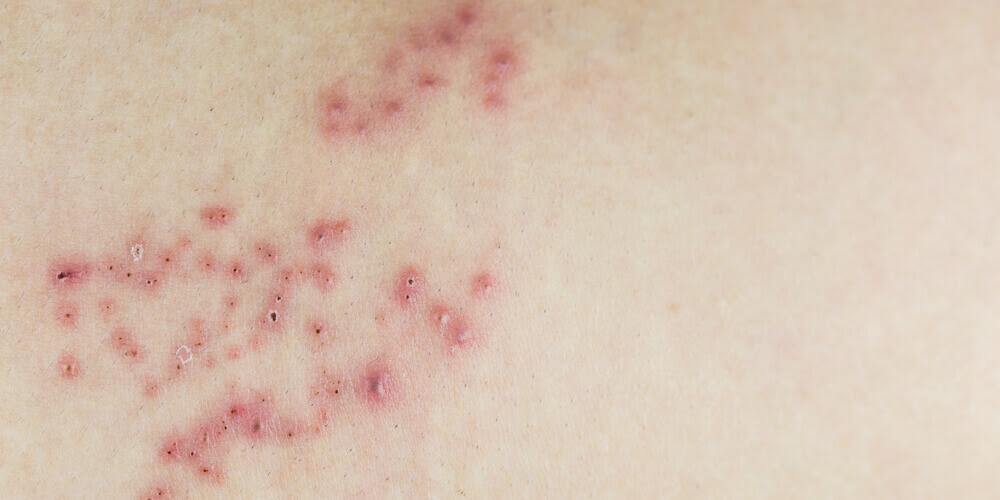
The classic herpes pattern is a tight cluster of small fluid-filled blisters (vesicles) on a pink-red base, usually 1 to 3 mm each, often 4 to 10 in a group. They tingle or burn for a day or so before appearing, then rupture into small shallow ulcers that crust over and heal within one to two weeks. A first outbreak is usually the worst, with fever, swollen lymph nodes near the groin, and pain on urination. Recurrences are milder, shorter, and more localized.
That said, the textbook presentation is only one of many. According to the CDC's genital herpes overview, most people with the infection either have no symptoms or have symptoms mild enough to be mistaken for something else. Plenty of HSV-2 carriers never knew they had it because their "outbreaks" were a single small bump they wrote off as razor burn. The visual gallery below shows what herpes can look like at its most recognizable, alongside three common mimics for direct comparison.
1. Ingrown hairs
Ingrown hairs are the most common herpes look-alike, and they appear after shaving, waxing, or even just friction from tight clothing. The hair curls back into the follicle instead of exiting cleanly, the body treats it as a foreign object, and the follicle inflames. The result is a red, sometimes tender bump, occasionally with a white or yellow pustular center. A trapped curled hair is often visible under the surface if you look closely in good light.
What gives an ingrown hair away as not-herpes is that it stays one bump, not a cluster, and it usually follows a shave or wax by a few days. Warm compresses and time clear it; gentle exfoliation prevents recurrence. People who get them repeatedly often see fewer flare-ups after switching from a multi-blade razor to clipping or a single-blade safety razor, because closer shaves are more likely to drive hair tips back into the follicle.
Solitary, not clustered: Ingrown hairs almost always appear as a single bump. Herpes prefers tight groups of 4 to 10 small blisters.
Trapped hair visible: In good light, you can often see a dark curled hair just under the surface of the bump.
Follows a shave or wax: Onset typically 2 to 7 days after hair removal in the area.
Resolves with warm compresses: A warm wet washcloth pressed to the spot for 10 minutes a couple of times a day usually clears it within a week.
2. Contact dermatitis
Contact dermatitis is skin irritation from something the skin doesn't like: a new soap, a perfumed laundry detergent, a lubricant ingredient, a scented wipe, certain condom materials, or even a fabric softener residue still on underwear. It shows up as redness, scattered small bumps, sometimes tiny blisters, and frequently a diffuse patch with poorly defined edges. That pattern is the opposite of the tight cluster herpes typically makes.
Timing is usually the giveaway: the rash appears within hours to a few days of using something new, and improves when that product is removed. A common pattern people describe to dermatologists is a recurring "herpes outbreak" that turns out to track perfectly with a switch in laundry detergent, body wash, or shaving cream, and disappears entirely after a switch to fragrance-free formulas. The AAFP differential-diagnosis guide lists irritant and allergic contact causes among the most frequently missed explanations for genital lesions.
Recently changed soap, detergent, body wash, lubricant, or underwear material? Strip it back to fragrance-free basics for a week before you panic. A surprising number of "herpes" bumps are an allergic reaction to a new product, and they clear up on their own once the trigger is removed. If symptoms persist past a week of bland-basics, then move to testing.
3. Yeast infections
Yeast (most commonly Candida albicans) lives quietly on healthy skin and mucous membranes. It overgrows when conditions tilt in its favor: after antibiotics, during pregnancy, with poorly controlled blood sugar, after sweating in tight athletic wear, or after a course of steroids. The CDC's STD treatment guidelines for vulvovaginal candidiasis describe the classic vaginal pattern: pruritus, soreness, and a thick curdy discharge. The penile pattern is less dramatic: red patches with small red or white spots, itching, and a sore foreskin in uncircumcised men.
What gets yeast confused with herpes is friction. People who already itch tend to scratch, scratching breaks the skin, and broken skin produces small raw spots that look surprisingly like the shallow ulcers herpes leaves behind. A typical scenario reported in primary-care clinics: a week of summer sports, sweat trapped under athletic wear, irritation that becomes raw patches, then a tiny ulcer that triggers panic. The treatment is usually a course of topical antifungal cream over one to two weeks, often available without a prescription.
STD Rapid Test Kits sells at-home lateral-flow tests. The kits linked in this article are products we carry. If you're not sure whether what you're seeing is herpes, a rapid blood test is the fastest way to find out at home before booking a clinic visit.
4. Genital eczema
Most people associate eczema (atopic dermatitis) with the elbow creases, the backs of the knees, and the neck. It can absolutely appear on the genitals, especially in people who have eczema elsewhere or a personal or family history of asthma and allergies. Genital eczema causes redness, scaling, sometimes oozing, and small cracks in the skin that sting on contact with urine or sweat. Flares come and go, often triggered by stress, heat, tight clothing, or contact with an allergen.
Eczema flares migrate and often appear in multiple skin folds at once, while herpes outbreaks tend to return to roughly the same spot each time because the virus lives in a specific nerve root. Eczema responds to topical steroids; herpes responds to antivirals. People sometimes go through several negative STI panels before a dermatologist diagnoses a chronic case of genital eczema, which is then treatable with the same steroid creams and emollients used for eczema elsewhere on the body.
| Feature | Herpes | Eczema |
|---|---|---|
| Cause | HSV-1 or HSV-2 virus | Inflammatory skin disorder, not infectious |
| Pattern over time | Returns to roughly the same spot | Flares migrate; may appear in several folds at once |
| Prodrome | Tingling or burning 1 to 2 days before lesion | Itch and dryness; no nerve-pain prodrome |
| Lesion shape | Tight cluster of small vesicles on red base | Scaling, cracking, oozing patches with poorly defined edges |
| Treatment | Antiviral pills (acyclovir, valacyclovir) | Topical steroids, moisturizers, trigger avoidance |
5. Molluscum contagiosum
Molluscum contagiosum is a viral skin infection caused by a poxvirus. It spreads through skin-to-skin contact, contaminated towels, shared razors, and (in adults) sexual contact. According to NHS UK, the lesions are small, firm, dome-shaped bumps, typically 2 to 5 mm, with a smooth pearly surface and a small central dimple (the umbilication) that is easy to see in good light.
Molluscum bumps are not painful and don't burst into the fluid-filled blisters herpes makes. They may itch, especially if scratched. Untreated, lesions typically clear on their own within 18 months, although a clinician can remove them faster with cryotherapy, curettage, or topical agents if they spread or cause distress. Once you know to look for the central dimple, it's by far the easiest way to distinguish molluscum from a herpes outbreak.
The defining visual feature of molluscum is a tiny central depression (umbilication) on top of each smooth, pearly bump. Use good lighting and check several bumps. If every bump has a dimple, you're almost certainly looking at molluscum, not herpes blisters.
6. Shingles below the waist
Shingles is a reactivation of the varicella-zoster virus that causes chickenpox. After a childhood case of chickenpox, the virus stays dormant in nerve roots for decades, then can reactivate during a period of physical or emotional stress, illness, or immune suppression. It usually appears on the trunk, but it can absolutely appear in the genital, buttock, or upper thigh region when the affected nerve serves that area. The NHS shingles page describes the rash as painful, blistering, and following the path of a single nerve.
The single most useful clue is that shingles is one-sided. The blisters appear in a stripe or band along the nerve root, not crossing the midline of the body. Herpes can be one-sided too, but the strict band pattern of shingles is distinctive. Shingles also usually starts with tingling, burning, or shooting pain in the area for a day or two before any rash appears. Quick treatment with antivirals (started within 72 hours of the rash) shortens the course and reduces the risk of lingering nerve pain (postherpetic neuralgia).
If you're over 50 or immunocompromised and develop a one-sided painful blistering rash anywhere on the body, seek same-day evaluation. Antiviral treatment started within 72 hours of rash onset significantly reduces severity and the risk of lasting nerve pain. After 72 hours, antivirals still help but the benefit drops.
7. Urinary tract infections
UTIs are usually thought of as a bladder problem: urgency, burning on urination, pelvic discomfort, and sometimes blood in the urine. When the infection extends to the urethra (urethritis) the burning is felt right at the genital opening, and the irritation can produce visible redness and swelling. The CDC's UTI overview notes that women's shorter urethra makes upward bacterial migration easier, which is why UTIs are far more common in women, and when the urethra is inflamed, the burning can closely resemble what a herpes outbreak produces at the genital opening.
With a UTI, urinary symptoms dominate: urgency, frequency, and burning during urination, with little or no separate visible blister or ulcer beyond local redness. A urine test is the diagnostic gold standard. A short course of antibiotics resolves most uncomplicated cases within two to three days. UTIs can recur, especially in sexually active women, so a single UTI does not signal anything wrong with your immune system or hygiene.
| Feature | UTI / urethritis | Herpes outbreak |
|---|---|---|
| Burning on urination | Yes, throughout the urine stream | Yes, but only when urine touches a lesion |
| Visible blister or ulcer | Usually no; redness only | Yes, in clusters of small vesicles |
| Urinary urgency / frequency | Common | Uncommon unless first outbreak |
| Diagnostic test | Urine dipstick and culture | Lesion swab (PCR) or HSV antibody blood test |
| Treatment | Short course of antibiotics | Antiviral pills, often with suppressive therapy |
Why even doctors don't diagnose by eye
The seven conditions above share a small visual vocabulary with herpes, and herpes itself presents differently in different people. Even experienced clinicians who see hundreds of genital exams a year don't make a confident diagnosis on appearance alone. The standard pathway is to swab an active lesion for HSV PCR (highly sensitive, ideal for fresh blisters) or to draw blood for HSV antibody testing (useful when no active lesion is present but exposure may have happened weeks ago).
Testing matters because the wrong assumption has real costs. Assuming an ingrown hair is herpes means months of unnecessary anxiety and avoided intimacy. Assuming a herpes outbreak is razor burn means transmitting it to a partner who didn't sign up for the exposure. A swab or blood test resolves the question in a day or two at a fraction of the cost of months of uncertainty.
Most people with genital herpes have no symptoms or have very mild symptoms.
How to actually test
There are three useful ways to find out whether something below the waist is herpes, depending on the situation.
Swab of an active lesion. If you have a fresh blister or ulcer right now, a clinician can swab it for HSV PCR. This is the most accurate test for an active outbreak, and lab results typically return in 1 to 3 days. The swab needs to be taken within the first few days of the lesion, before it has crusted over and viral levels have dropped.
Blood test for HSV antibodies. If you don't have a visible lesion but you're worried about an exposure or want to know your overall HSV status, a type-specific antibody blood test (HSV-1 IgG and HSV-2 IgG) can answer the question. Antibodies take time to develop after exposure, so a test taken the day after a worrying encounter will not yet be reliable. CDC testing guidance states that it can take up to 16 weeks or more for current tests to detect infection. A negative result before that window has closed should be repeated.
At-home rapid antibody test. A fingerstick blood antibody test can be done at home with results in about 15 minutes. These are lateral-flow rapid tests, not laboratory NAATs, so a positive result is worth confirming with a lab test, and a negative result before the 16-week window has closed should be repeated. The advantage is privacy and speed for an initial screen, without the wait of a clinic appointment.
If your concern is broader than just herpes (for example after a partner notification or a higher-risk encounter), a multi-test panel covers HIV, syphilis, hepatitis B and C, chlamydia, and gonorrhea in one kit. HSV is NOT included in the 6-in-1 panel below, so full coverage means pairing the HSV antibody test above with the 6-in-1 panel here.
What if it actually is herpes?
Genital herpes is one of the most common STIs in the world. The CDC estimates around 572,000 new genital herpes infections each year in the U.S. among people aged 14 to 49, and a far higher fraction of adults carries HSV-1 (most often from non-sexual childhood exposure). Most people with the virus live full, normal, sexually satisfied lives. Antivirals (acyclovir, valacyclovir, famciclovir) shorten outbreaks, reduce recurrence frequency, and lower transmission risk. Consistent condom use plus daily suppressive antiviral therapy substantially reduces transmission to a regular partner.
A positive herpes result is diagnostic information. It tells you when to use barriers, when to have a conversation with a partner, and when to start suppressive therapy. The day-to-day experience for most people with herpes is months of no symptoms at all, with occasional minor flares managed by a short course of antiviral pills.
If the answer is yes, the day-to-day reality is manageable
- Antivirals (acyclovir, valacyclovir, famciclovir) shorten outbreaks when taken at the first prodrome and, taken daily as suppressive therapy, substantially reduce both recurrence frequency and transmission risk to a regular partner.
- For most people with the virus, the day-to-day experience is months of no symptoms at all, with occasional minor flares cleared by a short course of antiviral pills.
FAQs
- Can a single bump really be mistaken for herpes?
- Yes, and this is the most common scenario. A single tender bump in the pubic area sends a lot of people into panic, and the most common explanation is an inflamed ingrown hair follicle, not a viral outbreak. Herpes typically appears as a tight cluster of small blisters on a red base, not a solitary bump.
- How long after exposure do herpes symptoms appear?
- A first outbreak usually shows up between 2 and 12 days after exposure, with the average around 4 days. After symptoms appear, antibodies develop over the following weeks to months. For a negative HSV blood test to be reliable, retest at least 16 weeks from a known exposure date, since the CDC notes current tests can take up to 16 weeks or more to detect infection.
- If my STI test is negative, am I clear?
- Mostly, but watch the window period. HSV antibodies, syphilis, HIV, and hepatitis all have windows during which a test taken too soon will miss a fresh infection. For HSV antibodies specifically, the CDC says current tests can take up to 16 weeks or more after exposure to turn positive. A negative result before that point should be repeated.
- Is molluscum contagiosum a sexually transmitted infection?
- Not exclusively. The molluscum poxvirus spreads through any skin-to-skin contact, including shared towels, gym equipment, or razors. In adults, sex is the most common transmission route for lesions located in the genital area, but the virus itself is not classed as an STI in the way chlamydia or herpes are.
- Can a yeast infection cause actual sores that look like herpes?
- Yes, but the sores come from scratching, not from the fungus itself. Severe itching breaks the skin, and broken skin can look like the shallow ulcers herpes leaves behind. An antifungal cream resolves it; antivirals would not.
- Do I need to tell a partner about a rash that turns out not to be an STI?
- For contagious skin conditions (molluscum, ringworm, scabies), yes, because they spread through skin contact. For non-contagious conditions (eczema, ingrown hairs, contact dermatitis), it's your choice. Honesty tends to be the easier policy either way.
- How quickly should I get tested if I see a new sore?
- For an active sore, a swab is most accurate in the first 48 to 72 hours. If there's no active lesion, a blood antibody test works at any point, but give it at least 16 weeks from a known exposure before trusting a negative result.
- American Academy of Family Physicians. Differential diagnosis of genital ulcers, covering syphilis, chancroid, herpes, contact and irritant causes, and the rationale for lab confirmation over visual diagnosis.
- U.S. Centers for Disease Control and Prevention. Genital herpes overview, including transmission, the typical and atypical symptom patterns, treatment, and annual incidence figures.
- U.S. Centers for Disease Control and Prevention. HSV testing guidance, used for the up-to-16-weeks-or-more antibody window period.
- NHS UK. Shingles fact sheet, used for the one-sided dermatomal rash pattern and the 72-hour antiviral treatment window.
- U.S. Centers for Disease Control and Prevention. STD Treatment Guidelines, Vulvovaginal Candidiasis section, used for classic yeast-infection symptoms (pruritus, soreness, thick curdy discharge) and risk factors.
- NHS UK. Molluscum contagiosum fact sheet, used for the dome-shaped pearly papule morphology, the central umbilication, and the typical 18-month natural course.
- U.S. Centers for Disease Control and Prevention. Urinary tract infection overview, used for the urethritis presentation that can mimic genital STI symptoms and the female anatomical risk factor.