STD Symptoms After a One-Night Stand: What They Mean and When They Show Up
Why next-day STD fears are almost always something else




- True STD symptoms almost never appear within hours. Most infections need 2 days to 3 weeks before producing real signs, so what you feel the next morning is usually irritation, pH shift, or heightened body awareness.
- The most reliable early testing window for common STIs is roughly day 7 to day 14 after exposure, with follow-up testing at 4 to 12 weeks for HIV and syphilis.
Published: November 2025 | Last updated: May 2026 | Editorial review and quality control: Martina N.
There's a pattern that shows up after almost every one-night stand. The hookup ends, the high fades, and somewhere between checking your phone and replaying the night, a quieter question lands: was that safe? Then every twinge starts to feel like proof of something.
If you're reading this within hours of the encounter, here's the most useful thing anyone can tell you right now. What you're feeling is almost certainly not an STD. Most infections take days to weeks to produce real symptoms (CDC, sexually transmitted diseases overview). Your body is reacting, your nervous system is on alert, and your brain is filling in the gaps with worst-case scenarios. The next 12 to 72 hours are about steadying that loop, not solving it.
What this article does: map the timeline your body is actually following, separate the noise from the signals worth tracking, and give you a plan for testing that produces a real answer instead of a guess.
Key Takeaways
- True STD symptoms almost never appear within hours. Most infections need 2 days to 3 weeks before producing real signs, so what you feel the next morning is usually irritation, pH shift, or heightened body awareness.
- The most reliable early testing window for common STIs is roughly day 7 to day 14 after exposure, with follow-up testing at 4 to 12 weeks for HIV and syphilis.
The Morning After Feels Loud, Even When Your Body Is Quiet
There's a specific kind of anxiety that shows up after a one-night stand. It's not just about the person, it's about your body, your health, and the unknown timeline your brain is trying to fill in. Every sensation suddenly feels like evidence.
One reader described the loop almost universally. Your body physically cannot develop most STD symptoms overnight; the biology runs slower than the panic does. Before you let the spiral build, it helps to look at what you might actually be feeling, and what those sensations usually mean in the first 24 to 48 hours.
"I swear I felt something within hours. I kept checking, Googling, comparing. By noon I was convinced I had three different STDs."
What You're Feeling Right Now (And What It Usually Means)
Right after sex, or even the next day, your body can react in ways that feel intense but aren't dangerous. Friction, dryness, fluid exposure, and a sudden change in your normal routine can all leave tissues sensitive. The tricky part is that these sensations overlap with what people associate with STDs, so your brain reaches for the scariest explanation first.
Here's a grounded breakdown of what early symptoms most often are versus what people fear they are.
| What You Feel | Most Likely Cause (Day 1–2) | Possible STD Link (Later On) |
|---|---|---|
| Burning when peeing | Friction, dehydration, irritation | Chlamydia, gonorrhea |
| Itching | pH imbalance, yeast irritation | Trichomoniasis, herpes (later) |
| Soreness | Friction or microtears | Rarely STD-related this early |
| Discharge change | Semen, lubrication, hormonal shift | Gonorrhea, chlamydia |
| Tingling or awareness | Anxiety, hyperfocus | Sometimes herpes (but not instantly) |
Why STDs Don't Show Up Overnight (Even When It Feels Like They Did)
STDs have what's called an incubation period. That's the time between exposure and when your body starts reacting in a noticeable way. During that window the infection is establishing itself quietly. Bacteria or viruses need time to multiply before your immune system mounts a response, and only after that does the body produce signs you can actually feel.
Think of it less like flipping a switch and more like a slow build. The World Health Organization's STI fact sheet notes that many of these infections cause no early symptoms at all. The timing of any symptoms that do appear varies considerably by pathogen (per CDC infection-specific guidance); here's how that breaks down for the most common ones.
| Infection | Earliest Symptoms | Common Window |
|---|---|---|
| Chlamydia | 2–5 days | 1–3 weeks |
| Gonorrhea | 2–5 days | 1–2 weeks |
| Herpes (genital) | 2 days | 2–12 days |
| Syphilis (primary chancre) | 10 days | 3–6 weeks |
| HIV (acute symptoms) | 1–2 weeks | 2–4 weeks |
STD or Just Irritation? The Line Most People Struggle to See
This is where things get most confusing. There's a real overlap between normal post-sex reactions and early STD symptoms, but there are patterns that can help you tell them apart without having to guess.
Irritation tends to feel immediate, surface-level, and tied to friction or sensitivity. It often improves within 24 to 72 hours. STD-related symptoms tend to build, persist, or become more specific over time. According to NHS guidance on STIs, the symptoms that warrant testing are typically the ones that don't resolve on their own and come paired with discharge, sores, or pain that wasn't there before exposure. Timing, progression, and consistency carry more weight than any single sensation, which is why the next few days tell you more than the first few hours can.
Irritation arrives within hours, stays surface-level, and resolves on its own within 24 to 72 hours. Causes are usually friction, dryness, pH shift, or new bacterial flora.
An STD tends to arrive later (2 to 14 days for the common bacterial infections), build instead of fade, and become more specific over time: distinct discharge, sores, deep pelvic or testicular pain, or persistent burning that doesn't settle.
What to Actually Do Today (Without Spiraling)
A concrete testing plan does more for the worry than another hour of Googling. Today isn't about diagnosing yourself. It's about staying calm, reducing further risk, and setting yourself up for accurate answers instead of panic-driven ones.
Start simple. Notice what you feel, but don't interrogate every sensation. Avoid sex or use protection until you know more. Drink water. Pee after intimacy if you haven't. Give your body a little space before jumping to conclusions.
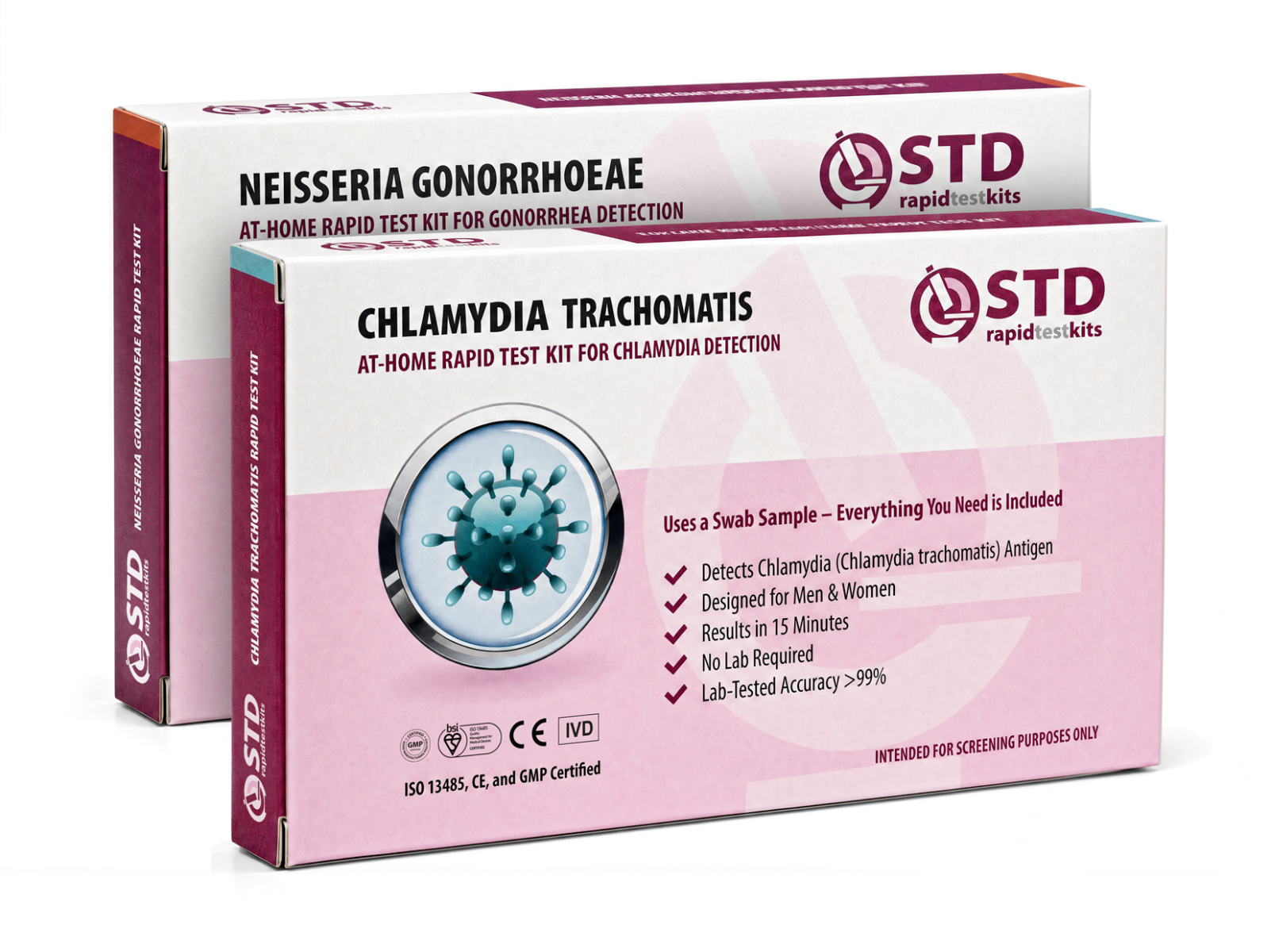
If you want control without waiting weeks, this is where testing strategy comes in. Testing at the right time produces a real result; testing too early just produces uncertainty. For most common bacterial infections like chlamydia and gonorrhea, that means waiting until at least day 7 to 14 after exposure for a meaningful screen. For HIV and syphilis, an early result at 2 to 4 weeks should be followed up with a confirmatory test at 4 to 12 weeks, per the CDC's HIV testing guidance. (The tests linked throughout this article are sold by this site.)
The Timeline Your Body Is Actually Following
Right now, your brain wants answers immediately. Your body doesn't work like that. There's a lag between exposure, infection, and symptoms, and understanding that gap is what stops you from jumping to the wrong conclusion.
Instead of asking "do I have something right now," the better question is: where am I in the timeline? Because what you feel on day 1 means something very different than what you feel on day 5 or week 3. Here's the rough map of what's happening biologically and what those sensations usually mean.
| Time Since Exposure | What's Happening Biologically | What You Might Feel | What It Actually Means |
|---|---|---|---|
| 0–24 hours | No infection detectable yet | Irritation, soreness, anxiety | Not an STD symptom yet |
| 2–5 days | Early bacterial growth (if exposed) | Possible mild symptoms begin | Too early for most testing accuracy |
| 7–14 days | Infections more detectable | Clearer symptoms (if any) | Best early testing window |
| 3–6 weeks | Immune response fully active | Delayed symptoms possible | Follow-up testing window |
Can you feel STD symptoms the next day?
Almost never. Real STD symptoms typically take 2 to 14 days to develop because most pathogens need time to multiply before triggering a noticeable immune response. What people feel within the first 24 hours after sex is almost always friction, dehydration, pH shift, or anxiety-driven body awareness rather than a developing infection. If a sensation appears immediately and fades within 48 to 72 hours, that pattern fits irritation. If a sensation starts a few days later and gets stronger or more specific, that's when testing matters.
Why "Next Day Symptoms" Panic Usually Isn't What You Think
This is one of the most searched questions online: "STD symptoms the next day, what does it mean?" And the honest answer is almost always uncomfortable but important. It usually doesn't mean what you think.
What people describe as symptoms the next day are often one of three things:
Mechanical irritation. Friction during sex can leave tissues sensitive, especially if lubrication was low or the encounter was longer than usual. This typically resolves within 24 to 48 hours.
pH disruption. Semen, saliva, or new bacterial flora can temporarily shift your body's normal balance, especially for people with vaginas. This shows up as itching, mild burning, or unfamiliar discharge that settles on its own.
Heightened awareness. Once your brain flags risk, your body suddenly feels louder than usual. Sensations you'd normally ignore start feeling suspicious.
When Symptoms Actually Start to Mean Something
There's a shift that happens a few days in. If symptoms appear later, and especially if they stick around, that's when they start to carry diagnostic weight. You're not looking for a single moment. You're looking for patterns: persistence, progression, and specificity.
Persistence means symptoms that don't fade after a couple of days. Progression means things getting more noticeable, not less. Specificity means discharge, sores, or pain that feels distinct, not vague. Burning that shows up immediately and disappears is usually irritation. Burning that starts days later and intensifies is a signal worth acting on; book a test.
This is also where infections like chlamydia and gonorrhea tend to show clearer signs, if they show any at all. Many STDs, though, don't cause symptoms at all, especially early on, which is the part that catches most people off guard.
How often common STIs are asymptomatic
- Roughly 70% of women and 50% of men with chlamydia have no noticeable symptoms, per CDC surveillance.
- Most genital gonorrhea infections in women, and many in men, produce no symptoms in the early weeks after exposure.
- Early HIV infection can feel like a mild flu, or like nothing at all, which is why antibody tests, not symptoms, are the screening tool.
The Silent Scenario No One Talks About Enough
Not having symptoms doesn't mean you're in the clear. Some of the most common infections stay quiet for weeks or longer. That includes chlamydia, which can exist without noticeable signs but still be transmissible, and early-stage HIV, which may feel like nothing or like a passing flu (CDC STD overview). People feel fine, assume they're fine, and skip the step that would actually tell them.
For HIV specifically, the per-act transmission risk varies considerably by route. Receptive anal sex carries the highest baseline per-act risk, vaginal intercourse sits in the middle, and oral exposure is very low. Co-occurring STIs, condomless sex, and a partner with a high viral load all raise the baseline. The other reason "I feel fine at week one" isn't reassuring: the CDC's antibody-test window period for HIV runs roughly 23 to 90 days depending on the assay, so a negative early test still needs a confirmatory result at the right point in that window (CDC HIV testing guidance).
This is where people get stuck in a loop: "I feel fine, so I'm probably fine, right?"
The CDC pegs the antibody-test window for HIV at roughly 23 to 90 days depending on which assay the lab uses. A test taken on day 7 or day 10 simply can't see an infection that exists but hasn't yet triggered detectable antibodies.
Practical takeaway: a 4th-generation antigen/antibody lab test becomes reliable around 4 to 6 weeks, and a final confirmatory result at 12 weeks rules out HIV from this specific exposure. Feeling fine in the first week is expected, not reassuring on its own.
Symptoms That Deserve Attention (Not Panic)
Not every sensation matters, but some patterns do. Some are worth following up on; others are just your body adjusting to the moment. Knowing the difference keeps you from chasing sensations that don't warrant a test, and from dismissing ones that do. There's a real gap between something that feels noticeable and something that's clinically relevant.
Here are the signals worth paying closer attention to over the next several days:
- Burning that doesn't go away. Especially if it continues beyond 48 to 72 hours or gets stronger.
- Unusual discharge. Thick, colored, or foul-smelling changes that weren't there before.
- Sores, bumps, or blisters. Particularly if they appear a few days after exposure.
- Pelvic or testicular pain. Not just soreness, but something deeper or persistent.
- Flu-like symptoms. Fever, fatigue, swollen glands, or a non-itchy rash showing up days to weeks later.
What If You Used Protection?
This question comes up constantly: "I used a condom, am I safe?" The honest answer is that you significantly reduced your risk, but not to zero.
Condoms are highly effective against fluid-based infections like HIV and substantially reduce the risk of chlamydia and gonorrhea when used correctly and consistently. They don't fully protect against skin-to-skin infections like herpes or HPV if contact happens outside the covered area, and they can slip, tear, or come off without you noticing.
- Strong protection against: HIV, hepatitis B, and other fluid-transmitted infections when used correctly for the entire encounter.
- Meaningful (but partial) protection against: Chlamydia, gonorrhea, trichomoniasis, and syphilis transmitted via genital fluid.
- Limited protection against: Herpes (HSV) and HPV, which spread through skin-to-skin contact in areas the condom doesn't cover.
- No protection if: The condom slipped, tore, came off, or wasn't on for the entire encounter.
Your 3-Step Plan From Here
You don't need to solve everything today. You need to move forward in a way that keeps you informed and in control. Three concrete steps, in order:
- Give your body 48 to 72 hours. Let initial irritation settle. Many early sensations fade once your body recalibrates. Jumping to conclusions before that window closes leads to unnecessary stress.
- Set your testing timeline now. Decide when you'll test instead of wondering every day. Most people aim for around day 7 to 14 after exposure for early bacterial screens, then follow up at 4 to 12 weeks for HIV and syphilis if those are on your list.
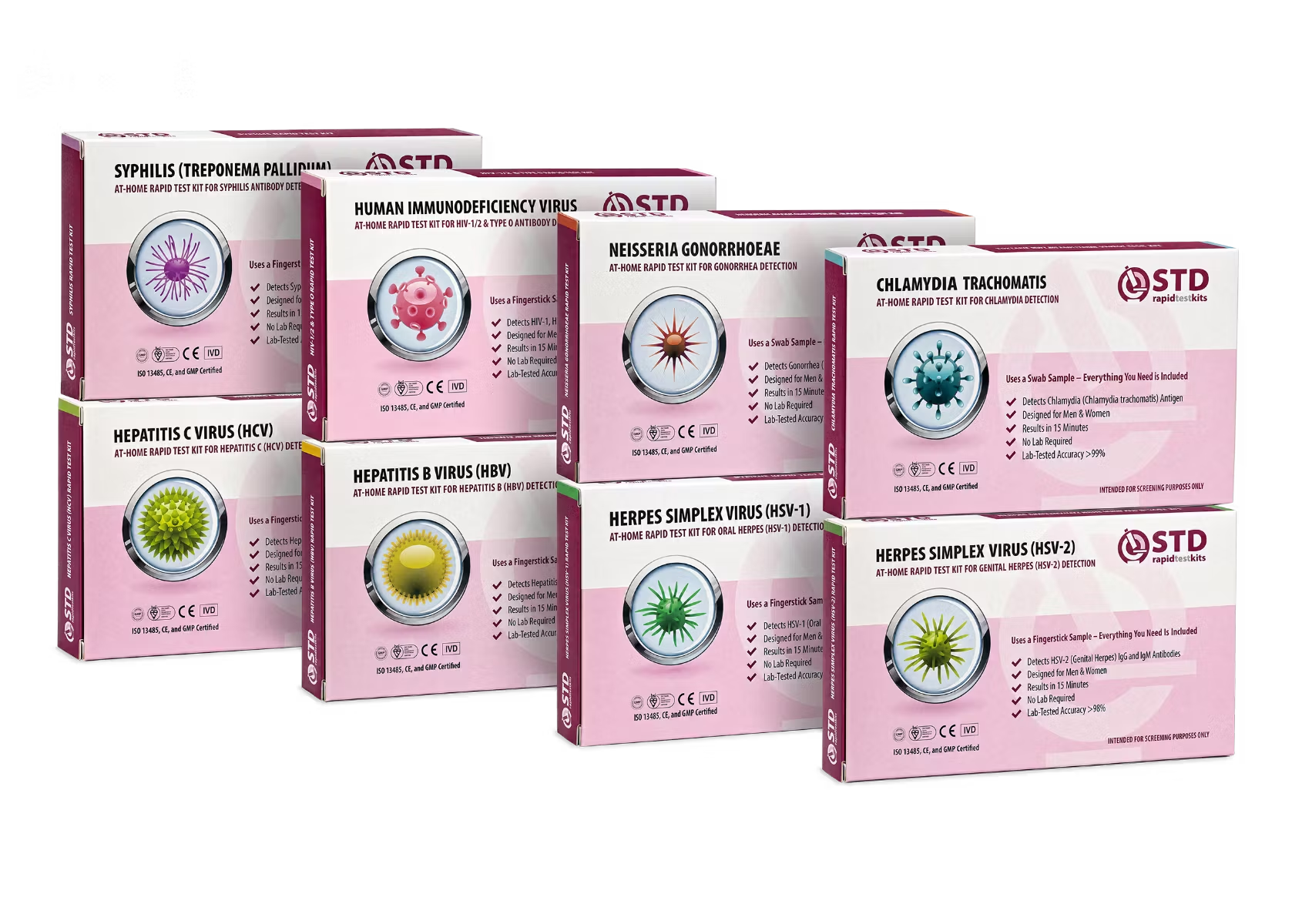
- Choose your testing method in advance. Whether that's a clinic visit or something private like an at-home test, having it ready removes a huge layer of anxiety. The hardest part isn't the test, it's the waiting without a plan.
The Mental Spiral Is Real, But It's Not a Diagnosis
After a one-night stand, your brain goes into pattern-detection mode. Every sensation feels amplified. Every Google search makes things worse. You might find yourself checking your body multiple times a day, comparing symptoms to photos or forums, or feeling sensations more intensely the more you focus on them.
This isn't you being dramatic. It's your nervous system trying to protect you. But it can blur the line between what's physically happening and what's being mentally amplified. When you have a concrete plan, your brain has something to hold onto besides fear, and a specific test date on the calendar does more to quiet the spiral than another hour of self-checking ever will.
"The anxiety felt more real than any symptom. I couldn't tell what was actually happening anymore."
You Deserve Clarity, Not Guesswork
What you're feeling right now might be uncomfortable, but the uncertainty is usually the hardest part. After a one-night stand, your mind tries to connect dots faster than your body actually can. Separating what's immediate from what's possible from what actually matters is more useful than cataloguing every sensation on a checklist.
If symptoms fade quickly, your body likely just needed time to settle. If something lingers or shows up later, that's your signal to test rather than guess. And if nothing shows up at all, that still doesn't replace a well-timed check, because plenty of common infections never cause symptoms in the first place. Each step you take replaces uncertainty with something solid.
You're not alone in this moment, and you're not behind. You're exactly where most people are after a one-night stand: figuring it out, one step at a time.
Your action checklist
- Wait 48 to 72 hours before assigning meaning to any new sensation; most early irritation resolves in that window.
- Pencil a first test for day 7 to 14 after exposure for bacterial screens, with a follow-up at 4 to 12 weeks for HIV and syphilis.
Frequently Asked Questions
- Can you really feel STD symptoms the next day, or is that just in my head?
- The body-awareness loop you're caught in right now is real, but it's running ahead of the biology. Your brain flagged risk, so every sensation suddenly feels louder than usual. What you're picking up on is almost always irritation, sensitivity, or hyperfocus rather than a developing infection.
- Why does it burn a little when I pee after sex? Should I be worried?
- Mild burning right after sex is usually friction or dryness, not infection. If it fades within a day or two, that's your body recalibrating. If it stays past 48 to 72 hours, gets stronger, or pairs with unusual discharge, that's when it's worth testing for chlamydia, gonorrhea, or a urinary tract infection.
- What's the earliest point where symptoms actually mean something?
- Usually a few days in, not hours. Real STD symptoms tend to show up after the infection has had time to settle in. If something appears 2 to 14 days after exposure and doesn't go away, that's when it starts to carry diagnostic weight.
- If I feel totally fine, can I just move on?
- You can relax a little, but don't skip testing. A lot of STDs are quiet at first. Chlamydia and early HIV are two of the most common asymptomatic infections. Feeling fine is a good sign, not a guarantee.
- How do I know if it's just irritation or something like an STD?
- Irritation shows up fast and fades. STDs tend to take their time and then stick around. If it improves within a couple of days, it's usually your body recovering. If it lingers, evolves, or gets more specific, like distinct discharge or sores, that's your cue to test.
- I used a condom, so why am I still stressed?
- Because you're human. Condoms reduce risk substantially for fluid-based infections, but they don't fully cover skin-to-skin transmission for things like herpes or HPV. Some residual uncertainty is normal even after using protection, and a planned test at the right window often does more for that stress than continued self-checking.
- When should I actually stop researching and just get tested?
- Set a date and stick to it. Most people aim for day 7 to 14 after exposure for bacterial screens and 4 to 12 weeks after exposure for HIV and syphilis confirmation. Once you have a plan, you can stop refreshing symptom pages every hour.
- Is it normal to feel this anxious after a one-night stand?
- Extremely normal. The mix of uncertainty, vulnerability, and what-if thinking is one of the most common emotional after-effects people don't talk about openly. It passes faster once you have a concrete plan: rest 48 to 72 hours, set a testing date, choose a method, and stop interrogating every sensation in between.
Our article was constructed based on current advice from the most prominent public health and medical organizations, and then molded into simple language based on the situations that people actually experience. We pulled incubation periods and HIV testing windows from CDC guidance, drew the asymptomatic-infection framing from CDC and WHO fact sheets, and mapped symptom progression from NHS patient resources. Reader testimony was anonymized and used only for emotional framing, not clinical claims. None of this article constitutes a diagnosis. For symptoms that concern you, see a licensed clinician.
- U.S. Centers for Disease Control and Prevention. Sexually transmitted diseases overview, symptom patterns, and asymptomatic-infection framing for chlamydia, gonorrhea, and other common STIs.
- U.S. Centers for Disease Control and Prevention. HIV testing guidance, including antibody-test window periods (roughly 23 to 90 days depending on assay) and recommendations for confirmatory testing.
- World Health Organization. Sexually transmitted infections fact sheet covering global prevalence, asymptomatic infection, and the rationale for screening rather than symptom-based detection.
- NHS. Sexually transmitted infections (STIs) patient guidance covering symptom patterns, when to seek testing, and what to expect from a sexual-health clinic visit.
- Planned Parenthood. STD basics, transmission, and testing fundamentals written for general audiences seeking plain-English explanations.