
Published: December 2025 | Last updated: May 2026 | Editorial review and quality control: Martina N.
For decades, having a sexually transmitted infection in public life meant social death. A whispered rumor could end a career, dissolve a marriage, or turn a household name into a punchline overnight. Then a handful of public figures refused to play by those rules. Magic Johnson stepped to a podium in November 1991. Charlie Sheen sat across from Matt Lauer in November 2015. A young women's-health advocate posted a 2022 video titled 'I have herpes' to her followers. Each disclosure cracked something open in how the public talks about STIs.
This article walks through the most consequential celebrity disclosures, what they actually changed for ordinary readers, what they didn't, and why honest visibility from people in the spotlight still moves the needle on stigma, testing, and the everyday experience of getting a positive result.
Key Takeaways
- Public disclosures by figures like Magic Johnson and Charlie Sheen drove measurable spikes in HIV testing and reshaped how Americans understood the virus.
- Stigma still keeps most people quiet about STIs, but at-home rapid testing has changed who can find out their status, and how privately they can do it.
What Silence Used to Cost
Picture the early 1980s. A young man in his bedroom notices a sore he doesn't recognize. He half-remembers herpes from late-night comedy bits where it was the punchline of a joke about promiscuity. He has no insurance, no doctor he trusts, no friends he can ask. Mostly, he has shame.
That was the default emotional landscape for anyone navigating a sexually transmitted infection before the AIDS era forced the conversation into the open. People didn't only fear the symptoms. They feared being judged unlovable, unhireable, or untouchable. In public life, the fear was sharper still: a single tabloid story could end a career, and politicians, actors, and athletes all knew silence was a survival skill.
The cost of that silence wasn't just personal. Without recognizable faces talking openly, ordinary people had no model for how to ask a partner, how to call a clinic, how to absorb a positive result. STIs stayed framed as moral failures rather than treatable health conditions.
Shame-driven silence around STIs delays testing, blocks partner conversations, and leaves treatable infections untreated. The CDC consistently identifies stigma as a barrier that discourages people from seeking screening and care, particularly for HIV.
When HIV Hit the Headlines: Magic Johnson's 1991 Announcement
On November 7, 1991, Earvin 'Magic' Johnson stood at a podium in Inglewood, California, and told the world he had tested positive for HIV. He was 32 years old, a five-time NBA champion, newly married, and his wife was pregnant. He retired from the Los Angeles Lakers that day.
The media response was immediate and brutal, but Johnson did something almost no public figure had attempted with HIV before: he stayed visible. He sat for interviews. He played in the 1992 NBA All-Star Game and on the Olympic 'Dream Team' that summer. He started a foundation focused on HIV education and prevention in communities of color, populations that have faced disproportionate rates of HIV diagnosis in the United States.
Before Johnson, most Americans associated HIV with gay white men and with death. After his press conference, the cultural picture widened. Clinics across the country reported a surge in HIV testing in the days that followed. News anchors began using terms like 'viral load' and 'T-cells' on prime-time broadcasts. Johnson wasn't the first famous person to live with HIV, but he was the first to use his visibility, repeatedly and over decades, to argue that the diagnosis didn't have to be a death sentence.

Rock Hudson, Eazy-E, and the Disclosures Forced by Illness
Magic Johnson's 1991 disclosure didn't happen in a vacuum. Six years earlier, in July 1985, actor Rock Hudson became the first major Hollywood figure to publicly acknowledge an AIDS diagnosis, through a statement issued by his publicist while he was being treated in Paris. He died that October. Hudson, a closeted gay man whose private life had been an open secret in the industry, had his medical file dissected in tabloids during what should have been a quiet final illness.
A decade later, in March 1995, Eric 'Eazy-E' Wright of N.W.A issued a public statement from his hospital bed acknowledging that he had AIDS. He died ten days later at 30. Eazy-E's announcement landed differently from Hudson's: he was young, straight, and a defining voice in early West Coast hip-hop, and his disclosure pushed back hard against the public's narrow mental picture of who got HIV.
The same year, Olympic diver Greg Louganis disclosed in his memoir Breaking the Surface that he had been diagnosed with HIV before his 1988 Seoul gold medals. Louganis was the first openly gay former Olympic champion to disclose HIV publicly, and his decision to talk about a diagnosis he had been carrying privately for years opened a different kind of conversation about the gap between the public version of an athlete's life and the private one.
Hudson and Eazy-E disclosed only when illness left no other option, and the news cycle had days to absorb each story before the funeral. Johnson and Louganis disclosed years before any acute illness, which gave them the runway to keep speaking publicly for the next two and three decades respectively. That available runway is what turned a single press conference into sustained public-health work.
When the Spotlight Turned to Herpes
While HIV commanded medical urgency, herpes spent the late 1990s and early 2000s in the cultural gutter. Late-night hosts cracked jokes about it. Sitcoms used it as shorthand for promiscuity. Daytime ads for antiviral medication fed the punchline. And mockery of a chronic skin condition that affects, by WHO estimates, roughly 520 million people aged 15 to 49 worldwide became socially acceptable.
In that media climate, almost no public figure stepped forward openly with a herpes diagnosis. A 2002 lawsuit involving an unnamed pop star, sealed under settlement, generated tabloid speculation and online forum threads but no actual disclosure from the celebrity in question. Reality star Tionne 'T-Boz' Watkins of TLC discussed the emotional cost of dating with chronic health conditions in interviews, threading a careful needle around what she did and didn't name. Otherwise, the silence held.
Inside that silence, ordinary people with herpes formed support groups, anonymous online communities, and dating sites built specifically around shared status. The fact that those communities had to exist at all is a measure of how unsafe the public conversation still felt. Disclosure note: stdrapidtestkits.com sells at-home rapid STI testing kits, and where a kit fits the article's topic you will see it linked directly below.
Charlie Sheen's 2015 Disclosure and What Changed After
On November 17, 2015, Charlie Sheen sat down with Matt Lauer on the Today show and revealed he had been living with HIV for about four years. Sheen wasn't a public-health advocate stepping forward on principle. He was the target of a multi-million-dollar blackmail operation that he later said had drained him financially, and he disclosed in part to take that leverage off the table.
The motivation was complicated. The effect on the public was straightforward. Public-health researchers writing in Prevention Science (Ayers and colleagues, 2016) documented a sharp, sustained increase in Google searches related to HIV testing and home HIV tests in the days and weeks following Sheen's interview, the largest such spike on record at the time. At-home test providers reported similar increases in demand. The CDC already recommended that all adolescents and adults be tested for HIV at least once as part of routine care, but Sheen's announcement put that recommendation in front of millions who hadn't acted on it.
The cultural response was less generous to Sheen the person, but the testing-behavior data tells the story public-health researchers care about: an imperfect, unwanted disclosure from a famous person still moved real people to ask their own questions, book their own tests, and have their own conversations with partners.
| Year | Public figure | Diagnosis | Disclosure format | Public-health impact |
|---|---|---|---|---|
| 1985 | Rock Hudson | AIDS | Publicist statement during illness in Paris | First major Hollywood AIDS disclosure; widened public visibility of the epidemic |
| 1991 | Earvin 'Magic' Johnson | HIV | Live press conference at NBA retirement | Drove a national surge in HIV testing and broadened the public picture of who lives with HIV |
| 1995 | Eric 'Eazy-E' Wright | AIDS | Hospital-bed public statement | Challenged the assumption that HIV affected only specific demographic groups |
| 1995 | Greg Louganis | HIV | Memoir and Today show interview | Opened conversations about athletes living privately with HIV before disclosing |
| 2015 | Charlie Sheen | HIV | Today show televised interview | Largest documented spike in HIV testing searches ever recorded for a public disclosure |
| 2022 | Nadya Okamoto | Genital herpes | Self-recorded social media video | Helped normalize peer-to-peer herpes disclosure for younger audiences |
A New Generation of Disclosure: Social Media Honesty
The next wave of celebrity STI visibility didn't come from podiums or televised sit-downs. It came from phone cameras. Nadya Okamoto, a women's-health advocate and founder of a menstrual-health nonprofit with hundreds of thousands of social-media followers, posted a 2022 video titled 'I have herpes.' She walked her audience through the moment she noticed the first sore, the panic-Google spiral that followed, and the shame she absorbed before deciding to talk about it. Then she kept posting. Repeatedly. Across platforms.
The replies poured in from people who had been carrying their own diagnosis silently, sometimes for years. Within days the comments thread had become a small public archive of what stigma costs people who aren't famous at all.
Okamoto's disclosure differed from earlier ones in format rather than substance. No PR team, no contract negotiation, no televised exclusive. The disclosure was the post. The audience was whoever followed her. The conversation that built afterward happened in comments and DMs, not press conferences. That structure has lowered the cost of disclosure for a younger generation of public figures and is slowly normalizing herpes as what the CDC describes: an extremely common viral infection, often without symptoms, and frequently spread by people who don't know they have it.
The Okamoto post drew hundreds of thousands of views within days, and the comment thread filled with first-time disclosures from followers who had been carrying their diagnosis silently. Subsequent creator videos and hashtag threads carried the conversation across TikTok and Instagram for months, with no PR machinery behind any of it.
Why Stigma Still Costs Lives
STI stigma isn't only emotionally rough. It changes behavior in ways public-health researchers have measured for decades. Shame keeps people from getting tested, from telling partners, and from seeking treatment that's straightforward and effective. Public-health agencies including the CDC consistently identify stigma as a barrier that delays HIV testing and discourages people from staying engaged with care.
The same dynamic plays out for chlamydia, gonorrhea, herpes, syphilis, and HPV. People skip routine screening because the screening itself feels like an admission. They delay telling a partner because the conversation feels relationship-ending. Misinformation fills the space honest conversation should occupy, and infections that are highly treatable when caught early instead spread, scar, or progress.
Celebrity disclosures don't fix this on their own. What they do is provide one piece of repeated evidence that having an STI doesn't make you broken, contagious by touch, or unworthy of care. After Magic Johnson's 1991 press conference, US clinics documented a measurable jump in HIV-testing demand within the week.
Per CDC HIV stigma resources, fear of judgment is one of the most consistently documented reasons people defer HIV testing, defer telling sexual partners, and disengage from care after diagnosis. Reducing stigma is treated as a clinical intervention, not just a cultural one.
The Double Standard: Gender, Race, and Disclosure
Not every disclosure lands the same. When a male celebrity announces an STI diagnosis, the cultural script tends toward redemption: brave, transparent, owning his health. When a woman is named in connection with one, the script flips quickly to reckless, dirty, and unhireable. The disparity isn't subtle, and it isn't accidental.
The same asymmetry shows up along racial lines. Magic Johnson's disclosure was met with extraordinary public sympathy and remains one of the most cited celebrity disclosures in public-health literature, but his initial press conference also triggered a wave of speculation in some media outlets about his private life that white players in similar moments have not faced. Eazy-E's deathbed disclosure got significantly less mainstream coverage than Hudson's a decade earlier, despite Eazy-E being one of the most consequential figures in modern American music.
When unnamed women in the 2002 herpes lawsuits were discussed in tabloid forums, the language centered on contagion and disgust; when male athletes have disclosed in similar moments, the language has trended to rehabilitation and recovery.
| Condition | Approximate U.S. or global prevalence | Common public misconception | How disclosure can correct it |
|---|---|---|---|
| Herpes (HSV-2) | Roughly 12% of U.S. adults aged 14 to 49 | Only 'reckless' people get it | Humanized through Gen Z creators and peer-to-peer disclosure |
| Chlamydia | Roughly 1.6 million U.S. cases reported per year | Symptoms are always obvious | Largely undiscussed by celebrities; stigma still high |
| HIV | Roughly 1.2 million people living with HIV in the U.S. | Only affects gay men or people who use IV drugs | Challenged by Magic Johnson, Eazy-E, Greg Louganis, and Charlie Sheen |
| HPV | Most sexually active adults will contract some HPV strain | Only women get it, only through penetrative sex | Vaccination campaigns help; high-profile disclosures still scarce |
| Syphilis | Rising sharply across age groups in the U.S. | A historical disease, no longer common | No major celebrity disclosures; stigma remains intact |
Private Pain, Public Truths
Most people who get an STI diagnosis aren't famous. Their stories don't make Today show appearances. A 26-year-old in a routine screening gets a positive HSV-2 result and spends the next week convinced she'll never date again, until she discovers, in a support group or a comment thread, how many people are carrying the exact same diagnosis quietly.
That gap, between how isolating a diagnosis feels and how common it actually is, is what celebrity disclosures help close. When someone with millions of followers says 'this is my reality and I'm fine,' they bypass the pamphlet, the clinic poster, and the awkward 'Did you know?' from a friend. They reach the person scrolling at 2 a.m. wondering if their life is over.
The other thing celebrity disclosures do is shift what's askable. Once a public figure has named the condition, partners feel slightly more permission to ask each other about it. Friends feel slightly more permission to share their own status. Public-health researchers tracking online search behavior after Sheen's 2015 disclosure documented a sharp spike in HIV-testing queries that week, the largest such jump on record at the time.

How Testing Has Changed: From Clinic Waiting Rooms to At-Home Kits
In 2000, getting tested for an STI usually meant calling a public clinic, hoping for an appointment, sitting in a waiting room, and explaining your sexual history to a stranger in a fluorescent-lit exam room. For people in rural areas, people without insurance, people in conservative households, and people with high baseline social anxiety, that process was enough of a barrier to skip testing entirely.
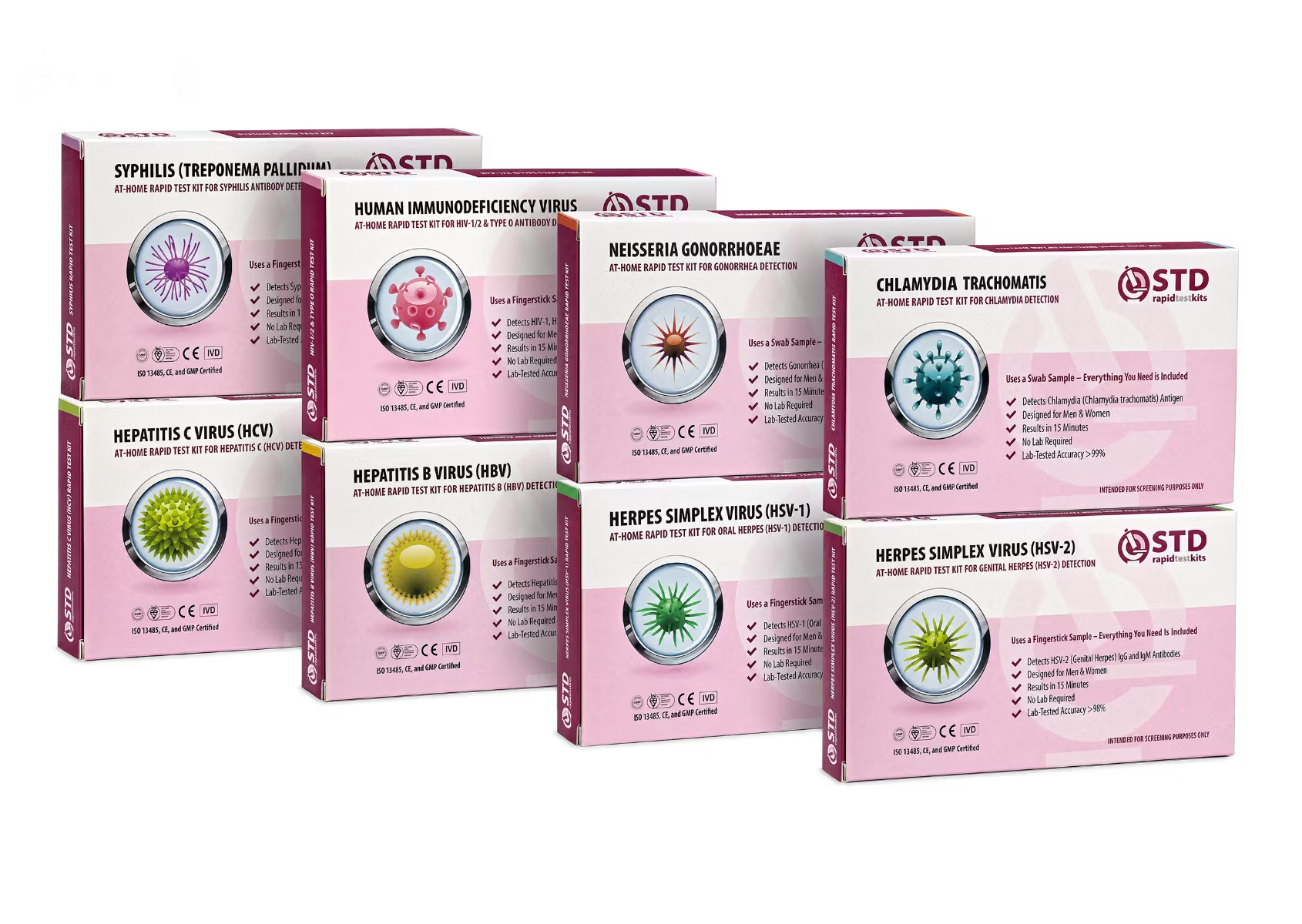
Today an at-home rapid kit ships in plain packaging, runs on a self-collected swab or a fingerstick, and returns results in roughly 15 minutes for the most common screening targets. Lab-processed mail-in panels exist as a parallel option. Neither requires a clinic visit, an insurance claim, or an explanation to anyone you don't choose to tell.
This isn't a replacement for clinical care. A positive at-home rapid result still warrants confirmatory laboratory testing through a clinician for the specific infection, in line with current CDC STI treatment guidelines. Some sample types, such as pharyngeal or rectal swabs and standard syphilis confirmatory titers, still require a clinic. What at-home rapid testing does well is lower the cost of the first question, 'do I currently have one of the most common STIs,' which is exactly the question most people stuck in stigma never get around to answering.
| Barrier | Before (pre-2010s, clinic-only) | Today (with at-home rapid testing) |
|---|---|---|
| Social stigma | High; testing felt like an admission | Lower; no in-person interaction required |
| Privacy | Low; visible clinic visit, paper records | High; plain shipping, no lab claim, results stay with you |
| Cost | Often required insurance or out-of-pocket clinic fee | Single-purchase kit, no recurring visit cost |
| Geographic access | Limited in rural and underserved areas | Nationwide shipping, same kit anywhere with an address |
| Information quality | Medicalized, hard to relate to | Combines kit instructions with relatable creator content |
Celebrity Confessions as Harm Reduction
Public-health researchers use the term 'harm reduction' to describe interventions that don't eliminate a behavior but make its consequences less damaging. Needle exchanges are harm reduction. Naloxone distribution is harm reduction. Public STI disclosures by celebrities are, in their own way, a form of cultural harm reduction too.
They don't prevent transmission. They don't substitute for screening or treatment. What they do is reduce the social conditions that cause downstream harm: the silence, the misinformation, the delay between exposure and testing, the breakup over a positive result, the partner who never got the heads-up because the conversation felt impossible. Magic Johnson's disclosure correlated with increased condom-use conversations in schools and faith communities throughout the 1990s. Charlie Sheen's correlated with the largest documented spike in HIV testing searches in the era of internet-tracked behavior. Nadya Okamoto's correlated with an explosion of peer-to-peer herpes-disclosure content on TikTok and Instagram.
None of those celebrities ran a perfect campaign. Imperfect, even reluctant, public visibility still produced measurable behavior shifts in the same week; in Sheen's case, public-health researchers writing in Prevention Science documented a roughly 95% jump in HIV-testing-related Google queries in the week following his Today show interview.
Why More People Aren't Talking (Yet)
If celebrity disclosures help so much, why are they still rare? The professional cost is still real. Agents quietly counsel clients to stay quiet. Publicists worry about endorsement deals. Producers and casting directors prefer talent without 'complications.' Production insurance sometimes asks questions. The redemption arc that followed Charlie Sheen's disclosure took years and involved real career losses he is still working back from.
What's shifting is the platform. Influencers, podcasters, TikTok creators, and Substack writers don't have the same gatekeepers as legacy stars. A creator with 200,000 followers and no studio contract can post about a herpes diagnosis on a Tuesday and still have their career intact on Wednesday. That's a structural change in who gets to talk publicly about STIs, and it explains why most of the most useful celebrity disclosures of the past five years have come from social-first creators rather than from movie stars or athletes.
We probably won't reach a world where every famous person feels safe disclosing. But we are getting closer to one where they're not ridiculed for it, and where the disclosure can do real public-health good without ending a career.
A studio-contract actor risks endorsement loss for a single tabloid sentence. A social-first creator with a few hundred thousand followers controls their own platform, publishes without a gatekeeper, and can disclose on a Tuesday without losing their audience by Wednesday. That structural difference is why most useful celebrity STI disclosures in recent years have come from creators rather than movie stars.
You're Not a Headline, You're a Human
If you've Googled 'STD symptoms' at midnight with a racing heart, you're not alone. If you've seen a celebrity confession and felt slightly less alone in your own diagnosis, that moment counted. Talking about sex is hard. Talking about what can happen after sex is harder. People with platforms have started cracking that silence, and the tools you need to act on the curiosity, or the worry, or the partner conversation, are far more accessible than they were a decade ago.
The most useful thing a reader can do with a celebrity disclosure is let it lower the activation energy on the next concrete step: book the test, ask the partner, read the screening guideline from the CDC's STI guidelines page, or order a home kit you can use without explaining yourself to anyone.
FAQs
- Do celebrities really get STDs, or is it usually rumor?
- Yes, they do. Fame doesn't grant immunity to bacteria or viruses. The only real difference is that when a public figure tests positive, the news travels in a way ordinary diagnoses don't. The underlying biology is identical to anyone else's.
- Is herpes something to be terrified of?
- No, though the fear is understandable. Most people with HSV-1 or HSV-2 have mild symptoms or none at all, and outbreaks can usually be managed with antiviral medication. The CDC describes it as a chronic condition rather than a dangerous one for most adults.
- Will anyone find out if I test positive at home?
- Only if you tell them. At-home rapid tests don't generate insurance claims, clinic records, or reportable lab results. The information stays with you, and disclosure to partners is your choice on your timeline.
- Why do some celebrities get praised for disclosing while others get trashed?
- Gender, race, and respectability bias all show up in the response. Male celebrities are often framed as brave; female celebrities are often framed as reckless or contaminating. Naming the asymmetry every time it happens is part of how the script slowly changes.
- Can I still date if I have an STI?
- Yes. People date with herpes, HPV, HIV, and other diagnoses every day. Disclosure is awkward at first, but it's also a strong filter for partners who can handle real conversations. Many people find their relationships are stronger for it.
- Are at-home rapid STI tests legitimate?
- Reputable at-home rapid tests use the same antigen and antibody detection chemistry that underpins many clinic-based screening tools. A positive result should be confirmed with a clinical lab test for the specific infection, especially for HIV and syphilis. Buy from established vendors that publish their sensitivity and specificity figures.
- What's the best way to tell a partner?
- Pick a calm moment before things get physical. Keep it direct and low-drama: 'I want you to know I have X. Here's how I manage it. I'm happy to answer questions.' The right partner will respect the conversation. The wrong one shows you something useful early.
- Will my insurance or my employer find out if I test at home?
- An at-home test you buy directly does not generate an insurance claim or an employer notification. Clinic visits may bill insurance, which can then appear in your explanation-of-benefits statement. If privacy is a priority, an at-home test is the lower-disclosure option.
How we sourced this article: We combined current public guidance from the CDC, WHO, and NIH with publicly reported facts about the celebrity disclosures discussed, and shaped it into plain-English context for readers making their own testing decisions. The article is written by a medical writer and reviewed for clinical accuracy by a licensed physician. It is not a substitute for individual medical advice.
- U.S. Centers for Disease Control and Prevention. About HIV. General overview of HIV transmission, prevention, and testing recommendations.
- U.S. Centers for Disease Control and Prevention. About Genital Herpes. Background on HSV-1 and HSV-2 prevalence, presentation, and management.
- U.S. Centers for Disease Control and Prevention. Sexually Transmitted Infections Treatment Guidelines, 2021. Authoritative U.S. clinical guidelines for STI screening, diagnosis, and treatment.
- World Health Organization. HIV. Global epidemiology and prevention overview for HIV.
- World Health Organization. Herpes simplex virus. Global prevalence figures for HSV-1 and HSV-2 and the public-health context.
- U.S. National Institutes of Health, HIVinfo. HIV and AIDS: The Basics. Plain-language fact sheet on HIV transmission, treatment, and testing.
