Published: July 2025 | Last updated: May 2026 | Editorial review and quality control: Martina N.
The dentist sees the inside of your mouth more often than any other healthcare provider. A six-month cleaning means a trained eye looks at your tonsils, palate, gumline, and the underside of your tongue twice a year, places you rarely inspect yourself.
That close-up access matters because several sexually transmitted infections leave their first visible mark in the mouth, sometimes weeks before any genital symptom appears. This article covers what dentists are trained to spot, what each finding could mean, and what to do next if something looks unusual. The goal is not to alarm you. Most mouth sores are harmless. But because oral STIs can be silent or short-lived, knowing the patterns helps you decide when a finding deserves a follow-up test.
Key Takeaways
- Dentists routinely examine areas where syphilis chancres, herpes lesions, HPV growths, and HIV-related findings first appear, but they cannot diagnose or test for STIs themselves.
- Most oral findings are harmless. The handful that are not (painless ulcers, white patches that do not wipe off, persistent unilateral sore throat, wart-like growths) need a referral or a home test, not self-diagnosis.
Why the mouth often shows STI signs first
The mouth has thin, vascular tissue that is easy to abrade during oral sex, kissing, or even vigorous tooth brushing. Mucous membranes also share many of the same cell types as genital tissue, which is why some STIs can colonize the throat or oral cavity as readily as the urethra or cervix.
Oral STI symptoms commonly mimic everyday problems. Patients usually mistake a painless tongue ulcer for a canker sore, a swollen tonsil for the early stage of strep throat, or a red patch on the soft palate for irritation after eating something too hot. Without context, these findings get dismissed.
Many oral STIs also stay symptomatic only briefly. A primary syphilis chancre on the lip can heal in three to six weeks even if untreated, while the underlying infection continues silently. Catching the visible window matters.
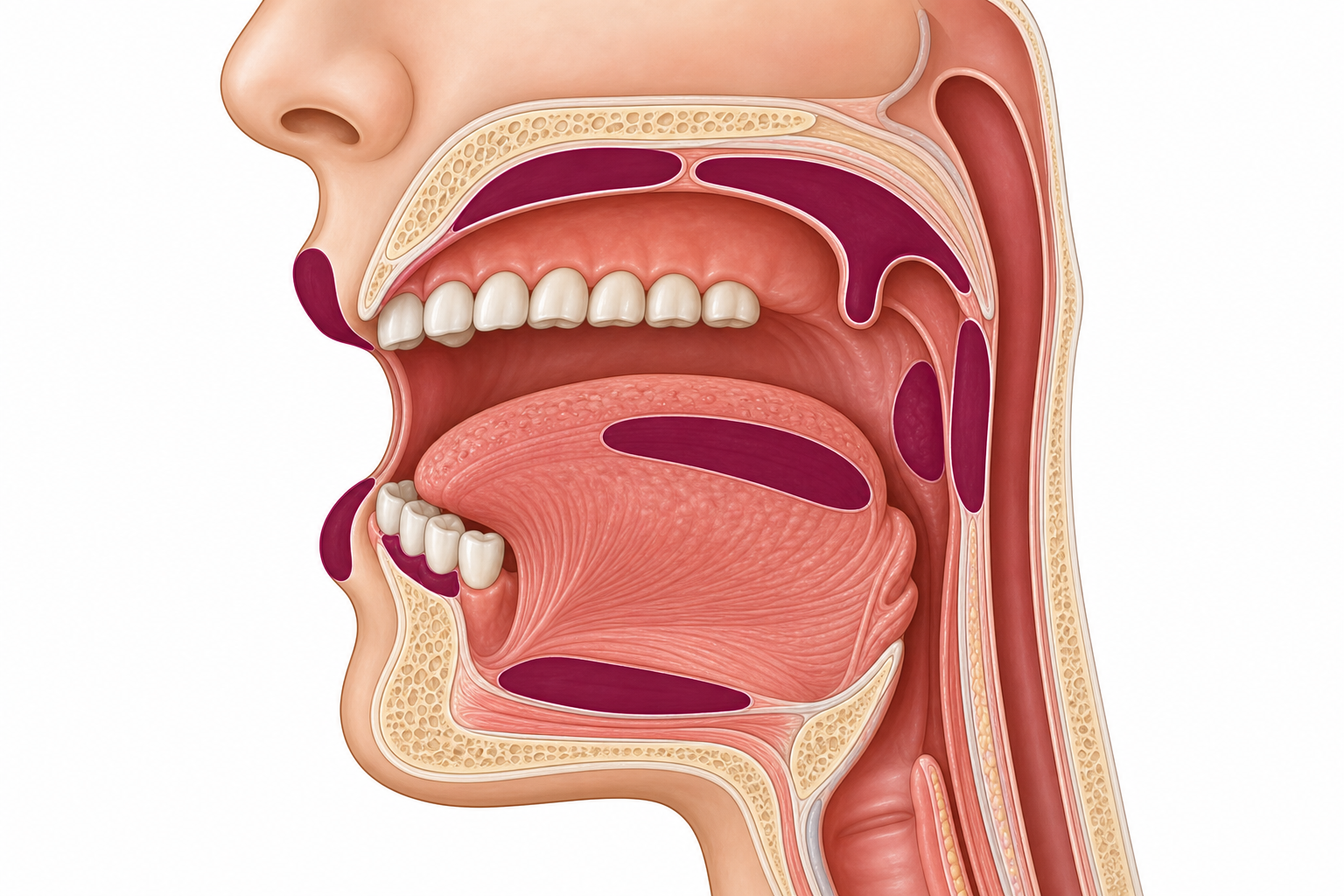
And dentists look at parts of the mouth most people never see. The back of the throat, behind the wisdom teeth, the floor of the mouth under the tongue, and the inside of the cheek are routinely inspected during cleanings. A patch or growth there can be hard to spot in a bathroom mirror.
Common oral regions a dentist or hygienist scans during a cleaning:
- Tonsillar pillars and the posterior pharyngeal wall
- Soft palate and the line between hard and soft palate
- Lateral tongue, where leukoplakia and other persistent white patches appear
- Floor of the mouth, under the tongue
- Buccal mucosa, the inside of the cheek
- Lip vermillion border, where the lip color meets the surrounding skin
- Gumline and the base of each tooth
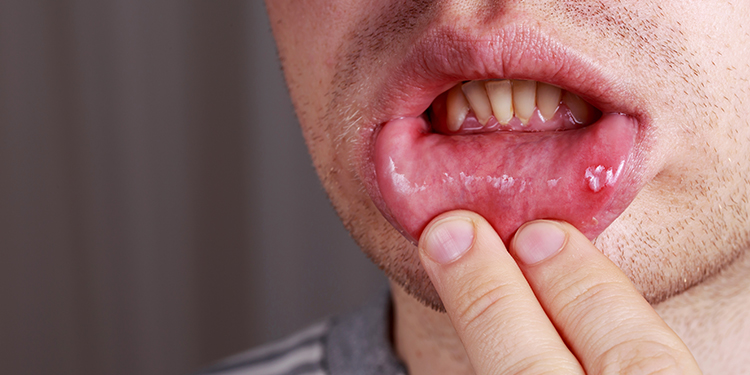
Cold sores and oral herpes: HSV-1 and HSV-2
Oral herpes is the most common STI sign dentists encounter. The World Health Organization estimates that roughly 64% of people under 50 worldwide carry HSV-1 (WHO herpes simplex virus fact sheet), most of them with only occasional cold-sore symptoms or none at all. HSV-2, the strain more often linked to genital herpes, can also cause oral lesions following oral-to-genital contact.
What a dentist might note:
- Clusters of small, fluid-filled vesicles on the lip vermillion border, typically grouped on one side
- Crusted, golden-yellow sores at the corners of the mouth that can resemble angular cheilitis
- Painful ulcers on the gums, hard palate, or inner cheek that recur in the same spot
- Tingling or burning at the lesion site preceding visible blisters by 24 to 48 hours
Most cold sores resolve in 7 to 14 days without specific treatment. The virus stays in the trigeminal ganglion (a nerve cluster near the temple that hosts HSV between outbreaks) for life, however, and can reactivate during illness, fever, sustained stress, or UV exposure. A dentist will not test for HSV but may suggest seeing a primary care provider or testing at home if you want to know which strain you carry.
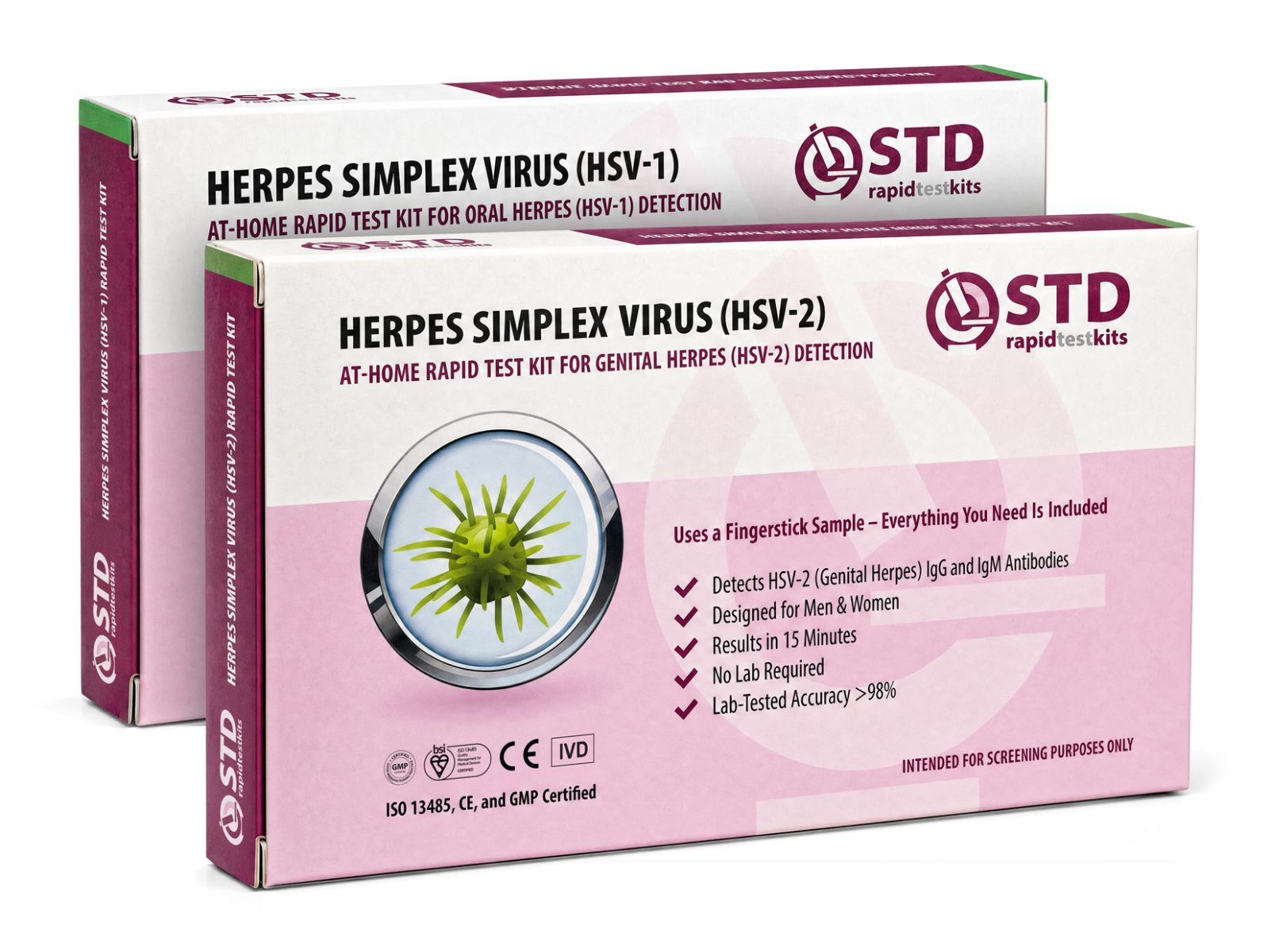
If your concern is whether you have been exposed, a fingerstick blood antibody test detects HSV-1 or HSV-2 antibodies after seroconversion, which usually completes 12 to 16 weeks after exposure. A blood antibody test confirms past exposure status, not whether a current oral lesion is herpes. To identify a specific lesion, a clinician needs to swab and culture or PCR-test the active sore.
Disclosure: stdrapidtestkits.com sells at-home STI tests, and the product links throughout this article go to our own catalog. We recommend products based on fit-for-purpose for your concern, not commercial benefit.
The painless syphilis chancre that disappears on its own
Syphilis is rising sharply in the United States, with rates climbing across nearly every demographic group (CDC sexually transmitted infections homepage). The first stage typically presents as a single firm, painless ulcer at the site of bacterial entry. When the entry point was the mouth, that ulcer can appear on the lip, the tongue, the soft palate, or a tonsil.
The classic primary chancre has these features:
- Round or oval, typically 5 to 15 mm across
- Firm, slightly raised border with a clean, sometimes glossy base
- Painless or barely tender, which is why patients often miss it
- Resolves in 3 to 6 weeks even without treatment
This creates a trap. Because the chancre disappears on its own, patients assume the issue resolved. The underlying Treponema pallidum infection (the bacterium that causes syphilis) moves into the secondary stage roughly 4 to 10 weeks later, often presenting as a non-itchy rash on the palms and soles, sometimes with white or grayish mucous patches inside the mouth. A dentist who sees an unusual painless ulcer may ask about recent sexual exposure or simply recommend a doctor visit for testing.
Syphilis is fully curable with a single dose of intramuscular benzathine penicillin G in early stages. Late-stage syphilis, by contrast, can affect the brain, heart, and nerves, making early detection valuable both for the patient and for any partners who would otherwise stay exposed.
Pharyngeal gonorrhea and chlamydia: throat infections you cannot feel
Gonorrhea and chlamydia can both colonize the pharynx after oral sex. The CDC notes that pharyngeal gonorrhea is largely asymptomatic, with most carriers reporting nothing at all (CDC STI guidance). Chlamydial pharyngitis is even quieter and is not routinely screened in most clinics.
When pharyngeal infection does cause symptoms, a dentist or hygienist might note:
- Bilateral tonsillar erythema (redness on both tonsils) with mild swelling
- Patchy white or yellow exudate on the tonsillar pillars
- Persistent sore throat lasting more than 7 to 10 days
- Tender cervical lymph nodes under the jaw
These findings overlap heavily with strep throat, viral pharyngitis, and tonsillitis. Pharyngeal gonorrhea sometimes gets missed because strep tests come back negative, antibiotics for strep do not work, and the patient ends up cycling through ENT visits without anyone running a pharyngeal swab for Neisseria gonorrhoeae (the bacterium that causes gonorrhea) specifically. If a sore throat persists for more than two weeks despite treatment for the obvious causes, throat-swab testing for STIs is worth raising with the prescribing clinician.
stdrapidtestkits.com sells genital swab tests for chlamydia and gonorrhea, not pharyngeal swabs. If your concern is throat infection specifically, ask your primary care provider or a sexual health clinic for a pharyngeal swab. Our home swab kits screen for genital infection, the more common presentation, but they are not validated for throat-only infections.
HPV and oropharyngeal cancer: the slow-growing risk
The CDC reports that the large majority of oropharyngeal cancers in the United States are linked to HPV, with high-risk strains, particularly HPV type 16, driving most of those cases (CDC cancer information). Cases have risen most quickly in men in middle age. The latency between HPV exposure and a clinically detectable cancer can run a decade or longer, which is why dental screening matters even when nothing else feels wrong.
What a dentist might flag:
- A persistent painless white or red patch on the tonsillar pillar, soft palate, or base of the tongue
- A firm lump or thickening felt during the soft-tissue exam
- Wart-like growths from low-risk HPV strains (HPV-6 or HPV-11) on the lip, tongue, or cheek
- A unilateral sore throat or sensation of “something stuck” lasting more than three weeks
- Unexplained ear pain on one side, sometimes referred from the throat
HPV vaccination is the single strongest preventive tool. The CDC's Advisory Committee on Immunization Practices recommends routine vaccination for everyone through age 26, and shared clinical decision-making with a provider for adults 27 through 45 (CDC vaccines information). The vaccine has been shown to reduce both genital and oral HPV infections.
If your dentist flags a persistent lesion, the next step is usually an ENT referral for visual exam and potentially a biopsy. Dentists do not diagnose oropharyngeal cancer; they refer.
HIV and the mouth: thrush, leukoplakia, and gum changes
Untreated HIV affects oral health in several characteristic ways. Many of these findings predate a formal HIV diagnosis because they appear when CD4 counts (a measure of immune-cell strength that drops as HIV progresses) begin to decline. The CDC lists oral candidiasis, oral hairy leukoplakia, and Kaposi sarcoma among common HIV-associated oral conditions (CDC HIV basics).
Oral signs that prompt HIV consideration:
- Oral thrush: creamy white plaques on the tongue or inner cheek that wipe off, leaving a red base. Common in immunocompromised states
- Oral hairy leukoplakia: thickened, ridged white patches on the lateral tongue that do not wipe off. Strongly associated with advanced HIV
- Necrotizing periodontal disease: rapid gum tissue loss disproportionate to plaque levels
- Persistent aphthous-like ulcers (recurring canker-sore-type lesions) that do not heal in the typical 7 to 14 days
None of these is exclusive to HIV. Oral thrush also occurs after antibiotic courses, in poorly controlled diabetes, and during chemotherapy. Hairy leukoplakia can appear in other immunocompromised states. What makes these findings significant is the combination plus the absence of an obvious explanation.
If your concern is transmission risk from a recent oral-sex exposure rather than oral signs of established infection, the per-act HIV transmission risk through oral sex is low but not zero (CDC HIV basics). Risk rises when the receptive partner has bleeding gums, active oral sores, or recent dental work, and when the giving partner has acute (recently acquired) HIV or a high viral load. A fourth-generation HIV antigen-antibody test detects most infections by about 18 to 45 days post-exposure, and an antibody-only home test is most reliable at 90 days. Any reactive home result needs lab confirmation before treatment decisions are made.
Should you worry if your dentist mentions a sore?
Most mouth sores have benign causes such as canker sores, hot-food burns, or mild trauma. The findings that warrant a follow-up test are: painless ulcers that heal on their own, white patches that will not wipe off, persistent unilateral sore throat over three weeks, and wart-like growths in the mouth. If your dentist suggests seeing a doctor, follow through. Following through on the referral is the only way to get real information rather than spiral into worst-case worry.
When to test, when to watch and wait
Not every dentist finding requires immediate testing. The decision tree depends on three factors: what was seen, where you are in your sexual history, and how long the finding has been present.
Reasonable to watch for 7 to 14 days:
- A single canker-sore-like ulcer that is painful and located at a recent dental trauma site, such as a bitten cheek
- Mild gum inflammation in an area of poor brushing access that responds to better hygiene
- A typical cold sore in someone with a known history of cold sores
Reasonable to test or seek follow-up now:
- Any painless ulcer that does not match a clear cause such as a bite, hot food, or dental trauma
- A white or red patch that has been present for more than 14 days
- Persistent sore throat for over three weeks, especially if antibiotics did not help
- Wart-like growths inside the mouth or at the lip border
- Recurring oral thrush with no recent antibiotic course
- Unusual cervical lymph node swelling under the jaw
Home rapid tests are useful for general STI screening, especially for HIV, syphilis, hepatitis B, hepatitis C, and HSV antibody status. They are not a substitute for clinical examination of a specific lesion. If a lesion is visible, a clinician needs to see it. The blood test tells you whether you carry the underlying infection systemically; the lesion exam tells you what is happening locally.
How to bring it up with your dentist without awkwardness
Many people delay mentioning oral findings because the conversation feels invasive. A dental chair is not the most comfortable place to discuss sexual history. A few neutral phrasings get the information across without forcing disclosure:
- “I noticed this sore about a week ago and it has not changed. Should I be concerned?”
- “What is your read on this patch?”
- “Could this be infectious?”
Dentists are bound by patient privacy rules and most are accustomed to flagging suspicious findings without requiring a full sexual history. If your dentist asks a sensitive question, an honest answer helps them direct the referral appropriately. If you would rather not discuss exposure history in the dental chair, follow up with your primary care provider or a sexual health clinic instead.
What a dentist will typically do:
- Document the finding with photographs or detailed notes in your chart
- Recommend a follow-up appointment in 2 to 4 weeks if the finding is borderline
- Refer to an oral surgeon, ENT, or primary care doctor for biopsy or testing if the finding is suspicious
- Suggest STI testing without naming a specific infection
In short, a dentist's job is to flag, document, and refer. Diagnosis happens elsewhere.
What to do if you find something between cleanings
Most people see a dentist every 6 months, sometimes annually. Mouth findings do not wait for appointment calendars. If you spot something concerning, start by documenting it: take a clear, well-lit photograph against a neutral background, note the date you first noticed it, and re-photograph in 7 days. Lesions that change rapidly or persist past 14 days deserve attention.
The right next step depends on what you are seeing:
- Painless ulcer or unexplained patch lasting over 2 weeks: see a doctor or sexual health clinic for examination
- Concerning cluster of symptoms (sores plus fever, lymph node swelling, fatigue): primary care visit within a few days
- Concerned about exposure status without a visible lesion: home rapid test, then clinic confirmation if positive
Avoid the temptation to self-diagnose by image search. Photographs of oral STI lesions look similar to many benign conditions and to one another. Visual self-diagnosis is unreliable, even for experienced clinicians, and it tends to spiral into worry. The pattern of when a lesion started, whether it hurts, and how it has changed is far more useful diagnostically than what it looks like in a photo (NHS guidance on sexually transmitted infections).
Whatever the suspected cause, a mouth sore that has not healed in 14 days deserves a clinician's eye. Painless persistence is a bigger red flag than pain.
Your dentist is part of your sexual health team
Dental visits are one of the most consistent forms of healthcare for adults. Annual or semi-annual cleanings keep a trained pair of eyes on tissue you cannot easily examine yourself. That pattern catches more than cavities. It catches early signs of infections that can be silent, fleeting, or easy to dismiss.
If your dentist flags something, the right response is calm and methodical. Take the referral seriously. Test if it is appropriate. Follow through with a doctor for diagnosis. Most findings turn out to be benign, and the few that are not are far more treatable when caught early.
Many sexually transmitted infections do not cause any symptoms. Routine screening based on age, sexual behavior, and other risk factors is the most reliable way to detect infections early.
FAQs
- Can my dentist diagnose an STI from a mouth sore?
- No. A dentist can flag a suspicious finding and recommend testing or referral, but the diagnosis itself comes from a doctor's exam, lab swab, blood test, or biopsy.
- Are cold sores always caused by herpes?
- Yes. Cold sores are caused by the herpes simplex virus, most often HSV-1 and sometimes HSV-2. Other lip lesions, such as canker sores, angular cheilitis, or sun-related crusting, are not herpes.
- How long does an oral syphilis chancre last?
- Roughly 3 to 6 weeks. The chancre can resolve on its own without treatment, but the underlying infection continues into later stages, so a vanishing sore is not the same as a cured infection.
- Can my dentist test for STIs?
- Most dentists do not run STI tests directly. They will recommend you see your primary care provider, visit a sexual health clinic, or order a home rapid test.
- What does pharyngeal gonorrhea look like?
- It can look like a mild sore throat with red, slightly swollen tonsils and patchy white or yellow exudate. Many people have no visible signs at all, which is why pharyngeal gonorrhea often goes undetected without targeted testing.
- Is oral thrush always a sign of HIV?
- Antibiotic use, poorly controlled diabetes, chemotherapy, and steroid inhaler use can all trigger oral thrush with no HIV involvement. The finding only points to HIV when those alternative causes are absent and other risk factors or signs are present.
- How do I know if a mouth sore needs follow-up?
- Two weeks without healing is the threshold. Pain level is a poor guide; a painless ulcer that lingers is more concerning than a sore that clears in a few days. Photograph the spot on day 1 and again at day 7, and if nothing has improved by day 14, book a clinical appointment.
- Are home STI tests useful when my concern started in the mouth?
- Home rapid tests are useful for confirming or ruling out the systemic infections (HIV, syphilis, hepatitis, HSV antibodies) that can cause oral signs. They are not a substitute for a clinician examining the lesion itself, especially for HPV-related growths or persistent ulcers.
- World Health Organization. Herpes simplex virus fact sheet, including global HSV-1 and HSV-2 prevalence and oral transmission patterns.
- U.S. Centers for Disease Control and Prevention. Sexually transmitted infections homepage, with current syphilis surveillance data, gonorrhea symptom guidance, and pharyngeal gonorrhea screening notes.
- U.S. Centers for Disease Control and Prevention. Cancer information hub, including HPV-associated oropharyngeal cancer attribution to high-risk strains, particularly HPV-16.
- U.S. Centers for Disease Control and Prevention. Vaccines information, including ACIP recommendations on routine HPV vaccination through age 26 with shared clinical decision-making through age 45.
- U.S. Centers for Disease Control and Prevention. HIV basics, including oral candidiasis, oral hairy leukoplakia, oral-sex transmission risk, and HIV testing window guidance.
- National Health Service. Sexually transmitted infections overview with patient-facing guidance on when to seek testing.
