
Published: October 2025 | Last updated: May 2026 | Editorial review and quality control: Martina N.
A positive herpes result lands hard. Even when the test was expected, the moment HSV-1 or HSV-2 appears in writing, the brain often skips past the medical facts and lands somewhere closer to identity, intimacy, and shame. This guide is the calm follow-up: what to do in the first 48 hours, how antiviral medications actually work, when retesting helps, and what living well with herpes looks like over the long run.
Herpes is a manageable lifelong viral infection, not a verdict on your future. About 520 million adults aged 15 to 49 carry HSV-2 and roughly 3.8 billion people under 50 carry HSV-1 according to WHO global estimates. The clinical pieces are well understood. The harder pieces are emotional and relational, and they deserve the same attention as the medication schedule.
Key Takeaways
- Antivirals like valacyclovir, acyclovir, and famciclovir do not cure herpes, but they shorten outbreaks, reduce viral shedding, and lower the risk of passing HSV-2 to a partner by roughly half when taken daily alongside condom use.
- Most people settle into a manageable rhythm within a year of diagnosis: shorter outbreaks, identified triggers, honest disclosure with partners, and treatment decisions that fit their life rather than a one-size-fits-all script.
The First 48 Hours After a Positive Test
The first two days after a herpes diagnosis are not the time to build a five-year plan. They are about starting medical care and giving the news enough room to settle into something workable.
If you are in the middle of an active outbreak, the immediate clinical priority is starting an antiviral. The 2021 CDC STI Treatment Guidelines (full text in the linked PDF index) lay out three first-episode options: acyclovir 400 mg three times daily, valacyclovir 1 g twice daily, or famciclovir 250 mg three times daily, each for 7 to 10 days. These antivirals slow viral replication, shorten the active episode, and reduce how long you can transmit the virus to someone else. They do not eliminate HSV from your nerve cells; the virus stays latent in nerve ganglia for life.
If your diagnosis came from a swab during a visible outbreak, the result is highly accurate. If it came from a blood antibody test without symptoms, especially an IgM panel, the picture is murkier and worth re-examining with a clinician. False positives are well documented with non-type-specific and IgM-based assays per CDC guidance. We cover retesting in detail below.
Emotionally, the first 48 hours can feel like the floor moved. That reaction is normal. Most people cycle through some combination of fear, grief, and self-blame in the first weeks. Naming the reaction is part of moving through it. None of it is evidence that your sex life, relationship potential, or self-worth have changed. They have not.
- Acyclovir: 400 mg, three times daily, for 7 to 10 days.
- Valacyclovir: 1 g, twice daily, for 7 to 10 days.
- Famciclovir: 250 mg, three times daily, for 7 to 10 days.
All three are roughly equivalent in shortening a first episode per the 2021 CDC STI Treatment Guidelines. Choice usually comes down to dosing convenience and cost.
Treatment Options: Episodic versus Suppressive Therapy
After the first outbreak, herpes treatment splits into two main paths. Episodic therapy means taking an antiviral only when you feel an outbreak starting. Suppressive therapy means a daily lower-dose antiviral, taken indefinitely or for a defined period, to reduce outbreak frequency and viral shedding.
Neither path is the universally correct one. The decision rests on how often outbreaks happen, how disruptive they are, whether your partner is HSV-negative, and your own preference around taking a daily medication. The table below summarizes the typical regimens.
| Treatment Type | How It Works | Typical Regimen | Best Fit For |
|---|---|---|---|
| Episodic | Antiviral taken at the first sign of an outbreak, usually 3 to 5 days, started during prodrome where possible | Valacyclovir 500 mg twice daily, or acyclovir 800 mg three times daily, or famciclovir 1 g twice daily for one day (per CDC guidelines) | People with mild, infrequent recurrences who prefer not to take daily medication |
| Suppressive | Daily antiviral that reduces outbreak frequency and asymptomatic viral shedding, taken indefinitely or for a set period | Valacyclovir 500 mg once daily (or 1 g for frequent outbreaks), acyclovir 400 mg twice daily, or famciclovir 250 mg twice daily | People with frequent or distressing outbreaks, HSV-negative sexual partners, late pregnancy, or strong preference for outbreak prevention |
What an Outbreak Looks and Feels Like
The first outbreak is usually the most intense. People describe painful clusters of small blisters that crust over within days, swollen tender lymph nodes in the groin, low fever or flu-like fatigue, and a burning sensation during urination when lesions sit near the urethra. Recurrences are typically shorter, with most healing within a week or so when antivirals are started early, per NHS genital herpes guidance.
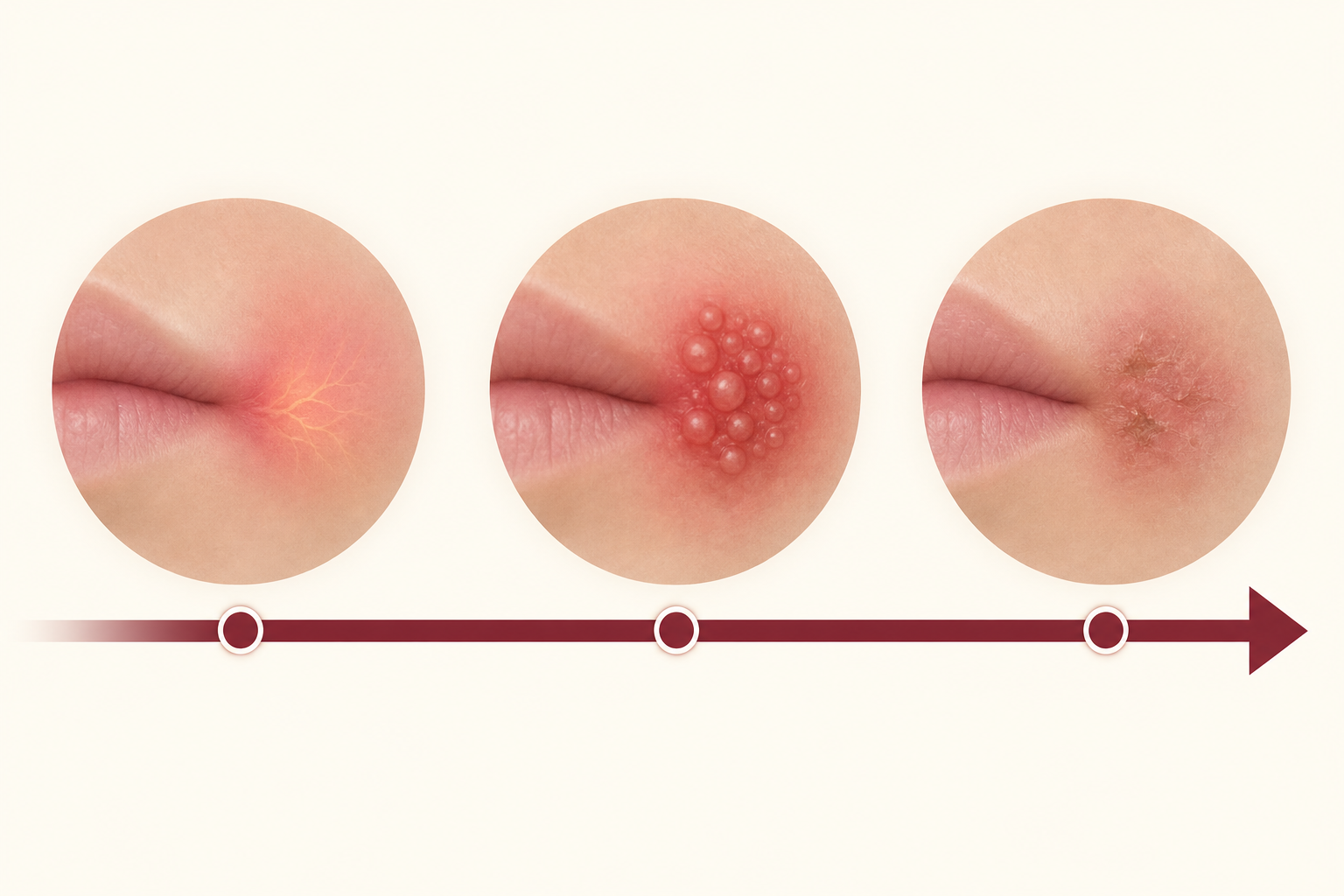
Many people develop a recognizable warning called the prodrome: a localized tingling, itching, or nerve-pain sensation that appears a day or two before any visible lesion. Recognizing your own prodrome is useful because starting an antiviral at that point can shorten the recurrence or sometimes prevent visible lesions from forming at all.
| Phase | Typical Duration | What You May Notice |
|---|---|---|
| Prodrome | 1 to 2 days before lesions | Tingling, itching, mild nerve pain, or burning in the area where lesions will appear |
| Active lesions | 2 to 10 days | Redness, small fluid-filled blisters, open sores, localized pain, sometimes swollen lymph nodes |
| Healing | 3 to 7 days | Scabbing, fading redness, reduced pain, return to normal skin texture |
Telling a Partner: Honesty Without Drama
Telling a sexual partner about your HSV status often feels like the single hardest thing about herpes. In practice, the conversation tends to go better than people expect, especially when it happens before sex and when the person sharing the news leads with facts and current management rather than apology.
A simple disclosure pattern works well: name the infection by type, say when you found out, describe what you do to manage it (suppressive medication if you take it, awareness of prodrome, barrier methods), and acknowledge that the other person needs space to ask questions or take time. You do not owe a detailed history or a confession. You do owe accurate information so they can make an informed decision about sexual contact.
Some people prefer to disclose in person; others find that a written message gives both sides time to react and reflect before the next conversation. Both are valid choices. The goal is informed consent before any sexual contact, not a particular delivery method or emotional script.
Persons with genital herpes should inform their sex partners that they have genital herpes and use condoms during all sexual encounters. Suppressive antiviral therapy reduces the risk of HSV-2 transmission to susceptible heterosexual partners.
When and Why to Retest After a Herpes Diagnosis
Retesting after a herpes diagnosis is more common than people realize, especially when the original test was a blood antibody panel without symptoms. The reason is straightforward: not all herpes tests are equally reliable, and the type of test you had affects how much weight to give the result.
Lesion swab tests using PCR are the most accurate option when an active sore is present. Type-specific IgG blood tests are useful at least 12 weeks after suspected exposure to detect antibody response (some assay labels extend this to 16 weeks for borderline results). IgM blood tests are not recommended for herpes diagnosis at all; per CDC guidance, they have a high false-positive rate and cannot distinguish recent from established infection.
If your diagnosis came from a non-type-specific blood test, or from an IgM panel, talk to a clinician about confirming the result with a type-specific IgG test at least 12 weeks after the suspected exposure. Typing matters because HSV-1 and HSV-2 behave differently in the genital area: genital HSV-1 recurs less often than genital HSV-2 and is less likely to be transmitted asymptomatically, which changes the long-term management conversation.
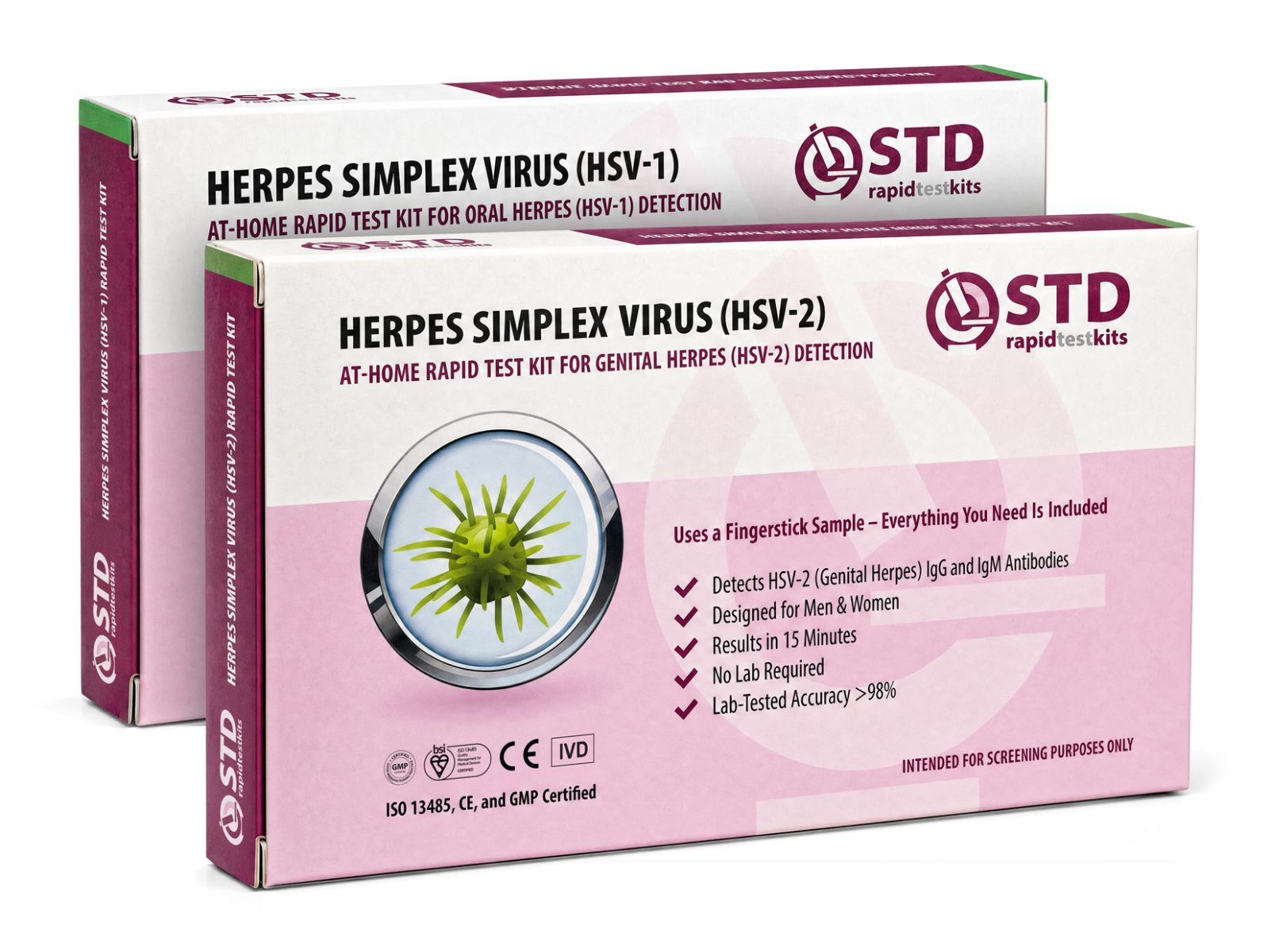
This article is published by stdrapidtestkits.com, which sells at-home rapid antibody tests for HSV and other STIs. The product banner below is suggested specifically for confirming an antibody result or clarifying HSV-1 versus HSV-2 status, not for diagnosing an active lesion. A clinician-collected PCR swab is the gold standard for an active outbreak.
| Test Type | What It Detects | Best Used When | Key Limitation |
|---|---|---|---|
| PCR lesion swab | Active viral DNA from a sore | An active blister or ulcer is present | Cannot detect HSV once lesions have healed |
| Type-specific IgG blood | Antibodies to HSV-1 or HSV-2 separately | 12 or more weeks after suspected exposure | Cannot tell whether infection is oral or genital; window period of about 12 weeks |
| IgM blood | Recent (unspecified) antibody response | Rarely recommended; legacy use only | High false-positive rate; not endorsed by CDC for HSV |
Preventing Outbreaks and Managing Triggers
Herpes does not have a cure, but the virus has a fairly predictable pattern in each person. Outbreaks are most often triggered by physical stress (illness, fever, surgery), emotional stress, friction from sex without enough lubrication, sunburn (especially for HSV-1 cold sores), menstruation, and immunosuppression. Identifying your own pattern, even with a simple notes-app log over a few months, is one of the most useful long-term care steps.
Daily suppressive therapy reduces recurrences substantially. The foundational randomized trial by Corey and colleagues (Corey L et al., N Engl J Med 2004;350:11-20) found that daily valacyclovir 500 mg cut symptomatic HSV-2 transmission to the susceptible partner by about 75% and overall HSV-2 acquisition by roughly half compared with placebo. Today's CDC genital herpes guidance still recommends daily suppressive antiviral therapy on that basis. Suppressive antiviral therapy combined with consistent condom use is the most protective everyday combination short of abstaining during outbreaks.
Outside of medication, smaller habits help. Adequate sleep and stress management lower outbreak frequency for many people. Wearing breathable cotton underwear and avoiding tight clothing during a recurrence reduces friction on healing skin. For HSV-1 cold sores, applying lip sunscreen during sun exposure cuts the single most common trigger for many people.
Mental Health After a Herpes Diagnosis
The clinical course of herpes is usually mild after the first outbreak. The psychological course is often heavier and longer. Research has documented elevated anxiety, depression, and reduced sexual self-esteem in the weeks and months after a new HSV diagnosis. None of those reactions are evidence of a defective personality; they are predictable responses to stigma rather than to the virus itself.
Three things tend to help most. Talking with people who have HSV themselves (moderated peer-support communities or private forums) breaks the isolation more reliably than reassurance from a clinician. Therapy with a sex-positive provider is useful when the diagnosis surfaces larger questions about identity, dating history, or past relationships. And factual recalibration matters: per WHO global estimates, roughly 3.8 billion people under 50 are living with HSV-1 and around 520 million aged 15 to 49 with HSV-2. Whatever a positive result feels like in private, the group it places you in is enormous and ordinary.
If a herpes diagnosis is destabilizing your daily functioning weeks after the news, a mental-health referral is as warranted as a follow-up appointment for a persistent physical symptom would be.
- American Sexual Health Association (ASHA): runs a confidential helpline and moderated patient resources at <a href="https://www.ashasexualhealth.org/" target="_blank" rel="noopener">ashasexualhealth.org</a>.
- Peer communities: moderated forums and private Facebook groups dedicated to HSV give first-hand perspective from people years past their diagnosis.
- Sex-positive therapy: licensed therapists who specialize in chronic conditions and sexual health are listed on directories such as Psychology Today's therapist finder, filterable by specialty and insurance.
Sex and Intimacy After Diagnosis
People with HSV have safe, fulfilling sex lives. The variables that change post-diagnosis are timing, communication, and risk awareness rather than whether sex is possible.
The active outbreak window is when transmission risk is highest, and it is the one period to avoid sexual contact in the affected area. Outside of that, condoms meaningfully reduce HSV-2 transmission risk, and consistent condom use combined with daily suppressive antivirals provides the best everyday protection per CDC and NHS guidance. Some couples also avoid contact during prodromal symptoms; others rely on the combination of medication and barrier methods even then. Both approaches are reasonable.
Oral sex deserves a specific note. Oral HSV-1 can transmit to the genitals during oral sex, and this is now a documented cause of new genital HSV-1 cases in many populations. Avoiding oral sex during a visible cold sore or prodrome reduces this risk meaningfully. Dental dams and external condoms during oral contact add a further layer when either partner has a recent or unclear HSV status.
Reduce-risk toolkit at a glance
- Avoid sexual contact in the affected area during prodrome and active outbreaks; this is the highest-risk window.
- Use external condoms or dental dams consistently for vaginal, anal, and oral contact.
- If your partner is HSV-negative, daily suppressive antiviral therapy adds a meaningful second layer of risk reduction.
- Disclose your status before sexual contact so the decision is consent-based, not reactive.
When to See a Clinician (and When You Don't Need To)
Most people with HSV settle into self-management within the first year, taking antivirals as needed or daily, and contact a clinician only for prescription renewals or unusual outbreaks. A handful of specific scenarios genuinely warrant a clinic visit.
Telehealth platforms have made prescription antivirals easier to access for routine HSV management. For most stable patients, an annual or semi-annual telehealth check-in is enough to keep prescriptions current and review whether the treatment plan still fits.
- Outbreaks are becoming more frequent or more severe over time, rather than less.
- You are pregnant or trying to become pregnant; HSV management changes in late pregnancy because of neonatal-herpes risk.
- You are starting immunosuppressive therapy or living with HIV.
- You develop atypical lesions, recurrent urinary symptoms, or severe localized pain.
- You want to reconsider episodic versus suppressive therapy because of a new relationship or life change.
Building a Life That Holds the Diagnosis Lightly
A herpes diagnosis is a chapter in your health history rather than a referendum on your future. Most people stabilize emotionally within months, settle into a treatment routine within a year, and find that herpes occupies far less mental space than they expected on day one. The pieces that look terrifying at the start (telling partners, recurring outbreaks, long-term identity) become manageable parts of normal life.
If a positive result has you reconsidering your full sexual-health picture, a same-day at-home panel covering HSV-1, HSV-2, and other common STIs can fill multiple gaps without scheduling a clinic visit, keeping the next step practical rather than abstract.
Frequently Asked Questions
- Does herpes ever go away on its own?
- No. HSV stays latent in nerve cells for life after the initial infection. What changes is the body's response: the immune system gets better at containing the virus, so recurrences typically become shorter and less intense over time. Some people have only one noticeable outbreak ever; others have several per year and benefit from daily suppressive medication.
- Is it safe to have oral sex if I have genital herpes?
- Generally yes, with two caveats. Avoid oral-genital contact during a visible outbreak or prodrome in the genital area, because that is when transmission risk to your partner's mouth is highest. Outside of outbreaks, daily suppressive antivirals plus condoms or dental dams substantially lower the risk. Disclosing your status to a partner first is the standard of care.
- Are HSV-1 and HSV-2 really just oral versus genital?
- Not anymore. HSV-1, traditionally associated with oral cold sores, is now a common cause of genital herpes transmitted through oral sex, especially in younger adults. HSV-2 still causes most recurrent genital herpes, but oral HSV-2 is unusual because it recurs poorly there. Type-specific testing matters because the two types have different recurrence patterns and transmission profiles.
- Can I have a healthy pregnancy with herpes?
- Yes. Most people with HSV have completely normal pregnancies and births. The clinical concern is neonatal herpes, which is rare but serious. Standard obstetric practice is suppressive antivirals starting around 36 weeks for anyone with a history of genital herpes, and a cesarean delivery if active genital lesions are present at the time of labor. Tell your obstetric team early so they can plan.
- Can I just use an over-the-counter cream?
- For genital herpes, no. Topical OTC products like docosanol may modestly shorten oral cold sores, but they do not treat genital HSV in any meaningful way. Prescription oral antivirals (acyclovir, valacyclovir, famciclovir) are the only therapies proven to shorten outbreaks and reduce viral shedding for genital herpes.
- Does having herpes increase my HIV risk?
- Yes, modestly, and the risk is highest during an active outbreak when open sores create a route for HIV to enter the bloodstream. Per CDC, suppressive antiviral therapy and condom use both reduce this risk. Regular HIV testing is sensible for anyone with HSV-2 who is sexually active with new or non-monogamous partners.
- I tested positive but I have never had any symptoms. Is that normal?
- Very common. A large share of people with HSV-2 are asymptomatic carriers, meaning they have the virus, shed it occasionally, and can transmit it, but never develop noticeable lesions. This is one reason why HSV-2 prevalence is so much higher than people expect. Asymptomatic infection does not mean you do not have HSV; it just means your immune response keeps it visually quiet.
- If I have HSV-1 and my partner has HSV-2, can we transmit the other type to each other?
- Yes, technically, although it is uncommon. Existing HSV-1 antibodies provide some partial protection against acquiring genital HSV-2, but not enough to count on. Many discordant couples manage this with suppressive therapy for the partner with HSV-2, plus condoms, and avoid contact during outbreaks. The risk is real but typically modest with consistent precautions.
- U.S. Centers for Disease Control and Prevention. Genital herpes resource hub, used for general clinical guidance, disclosure recommendations, and suppressive-therapy framing.
- U.S. Centers for Disease Control and Prevention. 2021 STI Treatment Guidelines index, the entry point for the first-episode and suppressive antiviral regimens cited in the treatment-options section (full dosing in the linked guideline PDF).
- World Health Organization. Herpes simplex virus fact sheet (updated May 2025), the source for the global prevalence estimates of roughly 3.8 billion HSV-1 carriers under 50 and 520 million HSV-2 carriers aged 15 to 49.
- NHS. Genital herpes patient-facing reference, used for the recurrence symptom course, prodrome description, condom guidance, and pregnancy considerations described in the article.
- Corey L, Wald A, Patel R, et al. Once-daily valacyclovir to reduce the risk of transmission of genital herpes. N Engl J Med 2004;350:11-20 (PubMed record). The randomized trial behind the ~50% transmission-reduction figure cited in the prevention section.
- American Sexual Health Association. Patient resources on herpes management, disclosure scripts, and the National Herpes Resource Center hotline referenced in the support callout.
