
Published: August 2025 | Last updated: May 2026 | Editorial review and quality control: Martina N.
Florida reported 4,541 new HIV diagnoses in 2023, per state surveillance data on the Florida Health CHARTS HIV diagnoses dashboard (figures finalized 6/30/2025). That places the state among the top three nationally in absolute case counts. Five counties (Miami-Dade, Broward, Palm Beach, Orange, and Hillsborough) carry most of the load, and that geographic concentration changes who gets tested, who gets diagnosed early, and who slips through.
This guide walks through the 2023 numbers, why Florida's burden runs above the national average, what at-home rapid HIV testing can and cannot do, and the prevention tools that have moved the needle in the last decade. The point is practical: clear numbers, clear next steps, no scare tactics.
Key takeaways
- Florida reported 4,541 new HIV diagnoses in 2023 (Florida Health CHARTS), with more than half concentrated in five counties. Late-stage diagnosis remains common across the South.
- FDA-cleared at-home rapid HIV tests are most reliable 23 to 90 days after exposure. They screen privately; positive results need lab confirmation.
The 2023 numbers, where they land
In 2023, Florida's count of 4,541 new HIV diagnoses placed the state among the top three nationally in absolute numbers, alongside Texas and California. That figure comes from Florida Health CHARTS, which finalizes each calendar year's data on June 30 of the following year. The most recent fully reconciled figure on the Florida Department of Health HIV/AIDS Section page references 4,606 diagnoses for 2022, with the 2023 update reflected in the CHARTS surveillance dashboard.
Miami-Dade leads the state in absolute counts, followed by Broward, Palm Beach, Orange, and Hillsborough. Together those five counties account for more than half of new statewide cases. State-level totals have slipped slightly from prior years, but the trend is not the full picture. Some counties have flat or rising rates even as the statewide line bends downward, and late-stage diagnoses (when HIV is found at or near AIDS) remain stubborn. Late diagnosis means more years of unknown transmission risk and more complex initial treatment. It is also the metric most sensitive to access: where testing is easy, late diagnoses fall.
Racial and ethnic disparities show up clearly in Florida's data. Black and Hispanic Floridians carry a disproportionate share of new diagnoses relative to population share, a pattern the CDC's HIV surveillance program consistently documents across the U.S. South. The drivers are structural, not biological: differences in healthcare access, insurance coverage, transportation, and the geographic concentration of clinics.
Why Florida's burden runs above the national average
Three forces stack on top of each other in Florida. First, dense urban corridors along the southeast coast and the Tampa Bay area concentrate population, sexual networks, and high tourism turnover. Concentrated networks mean a single new infection has more potential downstream contacts. Second, large parts of rural Florida sit far from sexual health clinics. North Florida counties like Baker, Union, Hamilton, and Liberty have limited public transit, and the nearest testing site can be a county away. Third, Florida is one of several states that did not adopt Medicaid expansion under the Affordable Care Act, which leaves a coverage gap that disproportionately affects working-age adults at higher HIV risk.
The result shows up in the data as two different Floridas. In Miami-Dade and Broward, testing volume is high, treatment is accessible, and viral suppression rates have climbed for years. In rural counties, testing is scarcer and diagnoses tend to come later. The implication for both is similar: home-based testing options and decentralized care can shorten the time between exposure and diagnosis when clinic visits are hard to arrange.

Early HIV is often invisible, and that is the point
Acute HIV infection, the first two to four weeks after exposure, can feel like a mild flu. Fever, sore throat, fatigue, swollen lymph nodes, sometimes a non-itchy rash. The World Health Organization's HIV fact sheet notes that many people have no symptoms at all during this phase. After acute infection, HIV can stay clinically silent for years while it gradually weakens the immune system. Many people experience no noticeable change in daily life and continue with normal routines while the infection progresses internally.
This is why symptom-based decisions about whether to test are unreliable. A normal-feeling person can have HIV. A person with a sore throat almost always has something other than HIV. Routine testing built into your life is more useful than waiting for a symptom that may never arrive. The CDC recommends every adult be tested at least once as part of routine care, with more frequent testing (every three to six months) for anyone with ongoing exposure risk.
This article is published by stdrapidtestkits.com, which sells at-home STI testing kits. We recommend products based on fit-for-purpose for the reader's concern, not commercial benefit. Statistical claims in this guide cite primary surveillance sources (Florida Department of Health, CDC, WHO).
What at-home rapid HIV tests can and cannot do
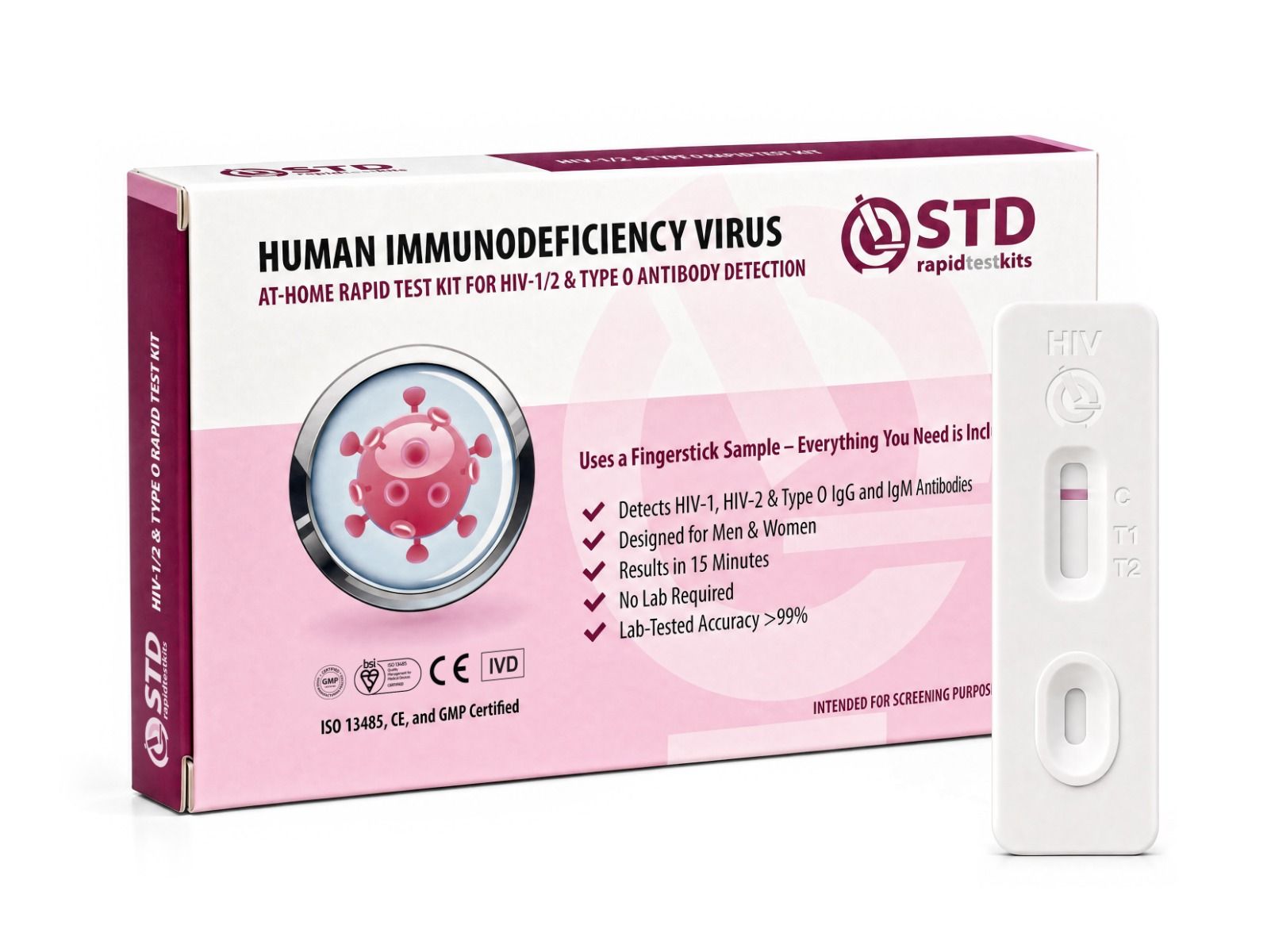
Home HIV tests use lateral-flow chemistry, the same strip-based technology used in pregnancy and COVID-19 home tests. A drop of fingerstick blood reacts with HIV antibodies on a test strip, and a control and test line appear within about 15 minutes. The window period (the time after exposure before a test can detect infection reliably) is typically 23 to 90 days for antibody-based rapid tests, per CDC HIV testing guidance. Newer fourth-generation lab assays narrow that window to roughly 18 to 45 days, but they require a clinic blood draw.
A positive at-home result needs confirmation with a lab test. False positives are uncommon but possible, and treatment decisions ride on confirmed status. A negative result outside the window period is reassuring. A negative result inside the window period is provisional: retest later. FDA-cleared kits sold in the U.S. publish their own sensitivity and specificity in the package insert; check that document when you buy.
Home tests do well at privacy, speed, and lowering the practical barrier of a clinic visit. They do not replace lab testing for confirmation, do not replace clinic care if you test positive, and do not eliminate the window period. Treat them as the first step in a screening workflow that ends, when needed, in lab-confirmed clinical care.
Antibody home rapid test: 23 to 90 days after exposure for reliable detection.
Fourth-generation lab antigen/antibody test: 18 to 45 days after exposure.
Nucleic acid (NAT) lab test: 10 to 33 days after exposure (used for high-risk recent exposure assessment).
If a negative home test falls inside your window period, plan a retest at the appropriate later interval before treating the result as definitive.
Prevention basics that have changed in the last decade
Three prevention tools matter, and most U.S. adults still under-use at least one of them.
PrEP (pre-exposure prophylaxis) is a daily pill, or an every-two-month injection in some formulations, that lowers HIV acquisition risk by roughly 99% when taken consistently for sex-related exposure, per CDC PrEP guidance on the CDC HIV resource pages. It is appropriate for anyone with ongoing risk: people in serodifferent partnerships, people with multiple partners, people whose partners have unknown status, people who use injection drugs, and others. PrEP requires a prescription, baseline labs, and follow-up every three months. Most insurance plans cover it, and several patient-assistance programs cover the medication for people without insurance or with high deductibles.
PEP (post-exposure prophylaxis) is a 28-day course of antiretrovirals started within 72 hours of a potential exposure. The earlier the start, the better the outcome. PEP is for emergencies: a condom break with an unknown-status partner, an assault, a needlestick, or a high-risk exposure where the source's HIV status was unknown and the risk was real. Most emergency departments in Florida can start PEP same-visit, and many urgent care clinics now do as well. If you are inside that 72-hour window, do not wait for symptoms or for a routine appointment.
Condoms and lubricant still work. They lower HIV transmission risk substantially and prevent other STIs at the same time, which PrEP does not. Layering condoms with PrEP gives the strongest protection, particularly for people with multiple partners or partners of unknown status.
Prevention quick reference
- PrEP: daily pill or every-two-month injection. Roughly 99% effective for sexual exposure when taken consistently. Requires prescription and quarterly follow-up.
- PEP: 28-day antiretroviral course. Must start within 72 hours of exposure. Available at most Florida emergency departments and many urgent care clinics.
- Condoms: substantial reduction in HIV transmission and protection against other STIs. Layer with PrEP for highest combined protection.
Treatment in 2026: undetectable equals untransmittable
The single biggest shift in HIV care over the last decade is captured in four letters: U=U. When a person living with HIV takes antiretroviral therapy consistently and the virus is suppressed to undetectable levels in blood, they cannot transmit HIV to a sexual partner. This is the consensus position of the CDC, the National Institutes of Health, and the WHO, based on multiple large prospective studies (PARTNER, PARTNER2, and Opposites Attract among them) that documented zero linked transmissions among undetectable participants over thousands of partner-years of follow-up.
Practically, that means a positive HIV test today is the start of a treatment plan that can return viral load to undetectable within months. Florida clinics and telehealth providers can begin antiretroviral therapy on the same day as diagnosis in many cases (called rapid start), and most patients reach undetectable status within 12 to 24 weeks. Modern regimens are often a single pill once a day with mild side effects, and long-acting injectable options exist for people who prefer them. Lifelong daily medication is the trade. The trade buys near-normal life expectancy and a sexual life without transmission risk.

How to actually use an at-home rapid test
The mechanics are simple. Read the instructions before you start. Wash hands. Use the included lancet to draw a small fingerstick blood drop. Transfer to the test cassette. Add the buffer drops listed in the insert. Set a timer. Read at the time window specified, usually 10 to 15 minutes, and not later than the upper time limit (a result read past the window can be unreliable).
If the result is negative and you are outside the 23 to 90 day window for your last possible exposure, you have a reliable screening result. If the result is negative and you are still inside the window, plan a retest at the recommended interval. If the result is positive, contact a clinic for a confirmatory lab test the same day. Same-day antiretroviral start is increasingly the standard of care for newly diagnosed HIV, and you do not need to wait.
Disposal: lancets and cassettes go in household waste sealed in a small bag unless your kit's instructions specify a sharps container. Do not flush.
Stigma still drives delayed diagnosis in the South
Decades of research, including studies summarized in the CDC's national HIV strategy, show that anticipated stigma reduces testing uptake. People who fear judgment, gossip, or being seen at a clinic delay testing, sometimes for years. The U.S. South carries the highest regional share of new HIV diagnoses, and structural drivers (clinic geography, insurance, religious and political climate) compound the social drivers.
Home-based testing models address one specific piece of that puzzle. Stigma persists even with home testing. The barrier home testing removes is visibility at a testing site: a kit arrives in a discreet envelope and you take it in your bathroom. Public health programs in Miami-Dade and Broward have integrated home test distribution into broader outreach for years, and the results show a consistent pattern: when access expands, earlier diagnosis follows.
What stigma does not change is the math. The earlier a positive diagnosis, the earlier treatment starts, the sooner viral load is suppressed, and the smaller the window for onward transmission. Reducing the friction of testing, in any form, contributes to that arithmetic.
Testing for HIV alongside other STIs
HIV testing is rarely the whole picture. The CDC's STI screening recommendations include co-screening for syphilis, gonorrhea, chlamydia, and hepatitis B and C alongside HIV for adults with any sexual risk in the past year. The same exposures that transmit HIV can transmit those infections, and the early symptoms overlap or look like nothing at all. Florida's rising syphilis rates over the last decade make this point concrete: a negative HIV test alongside an untreated syphilis infection is partial information, and untreated syphilis itself raises HIV acquisition risk.
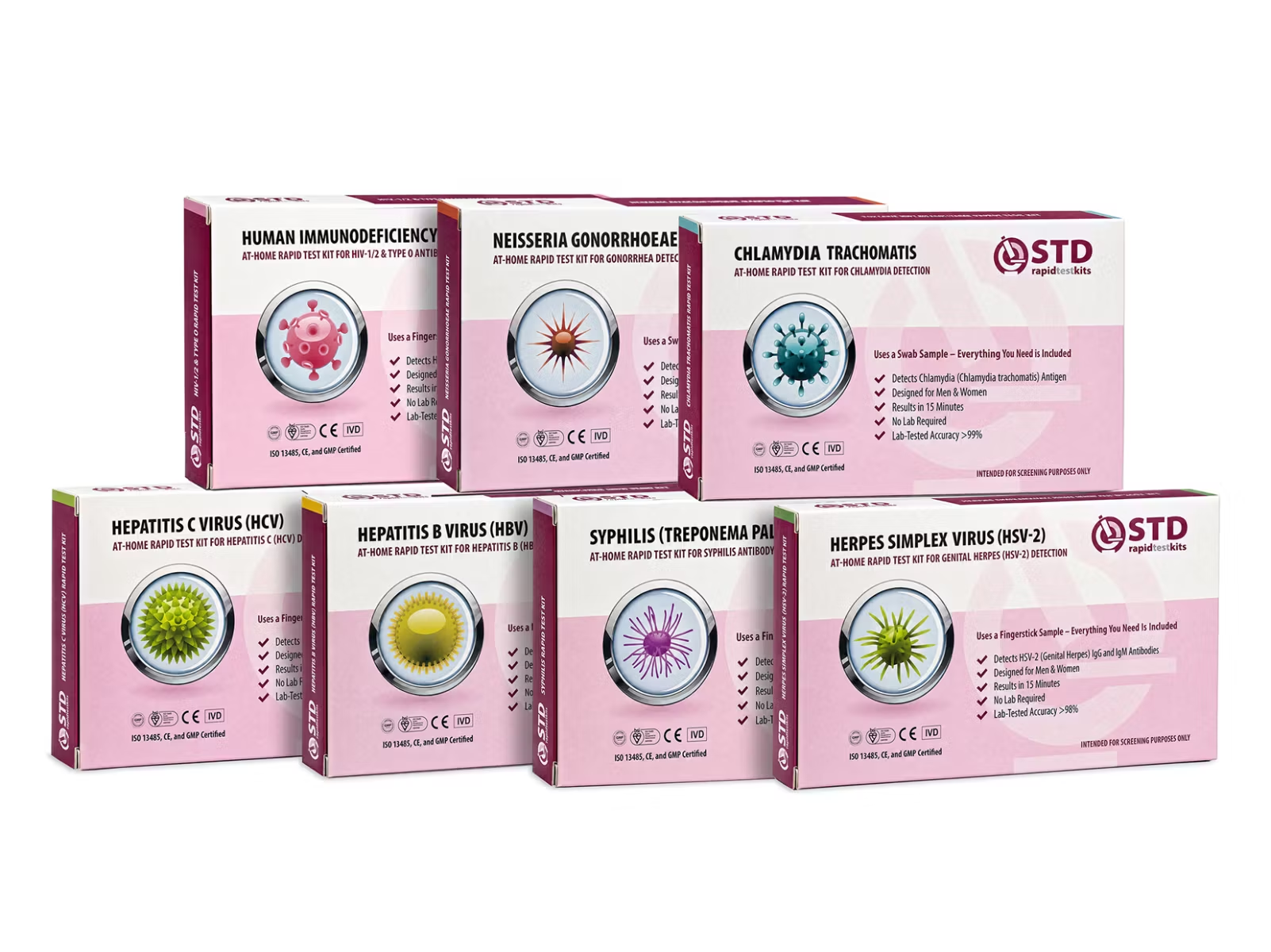
Multi-panel home kits exist for exactly this reason. They use the same fingerstick blood sample, and in some kits a self-collected swab for chlamydia and gonorrhea, to screen for several infections at once. That is faster than separate kits, less expensive than separate clinic visits, and reduces the friction of doing the comprehensive thing instead of just the urgent thing.
If your last full STI screening was more than a year ago, the comprehensive panel is the screening to schedule, not just an HIV-only test.
People with HIV who take HIV medicine as prescribed and get and keep an undetectable viral load have effectively no risk of sexually transmitting HIV to their HIV-negative partners.
What to do this week if you have not tested in a year
If your last HIV test was more than 12 months ago and you have had any sexual partners or shared injection equipment in that time, this is the week. Three options:
- Order an at-home rapid test. Result in about 15 minutes, no clinic, no waiting room. Plan a confirmatory step in advance if the result is positive.
- Walk into a county health department. Florida health departments offer free or low-cost confidential HIV testing, with same-day rapid results at most locations.
- Schedule with your primary care provider or a telehealth service. Lab-based fourth-generation testing narrows the window period and is appropriate if you had a recent exposure.
If you have ongoing risk factors, talk to a provider about PrEP at the same visit. If you had a possible exposure in the last 72 hours, an emergency department or urgent care can evaluate you for PEP today. Florida's HIV data is detailed enough to be useful and large enough to be alarming. State surveillance dashboards exist so individuals, partners, clinicians, and policymakers can see where the gaps are and act on them.
Frequently asked questions about HIV in Florida
- How many people in Florida have HIV?
- Per Florida Health CHARTS, 132,444 Floridians were living with diagnosed HIV as of 2024 (data finalized June 2025). The state recorded 4,541 new HIV diagnoses in 2023, with more than half concentrated in five counties: Miami-Dade, Broward, Palm Beach, Orange, and Hillsborough.
- Which Florida counties have the highest HIV rates?
- Miami-Dade has the highest absolute case count, followed by Broward, Palm Beach, Orange, and Hillsborough. Rates per 100,000 residents are highest in parts of Miami-Dade and Broward.
- How accurate is an at-home HIV test?
- FDA-cleared at-home rapid HIV tests typically report sensitivity in the 99% range and specificity above 99% when used after the recommended 23 to 90 day window period. A positive at-home result should be confirmed with a lab test before treatment decisions.
- When can I take an HIV test after a possible exposure?
- Antibody-based home rapid tests are most reliable from 23 to 90 days after exposure. Fourth-generation lab tests at clinics can detect HIV earlier, often around 18 to 45 days. If you tested inside the window and were negative, retest at the longer interval to be sure.
- Can you get HIV from kissing?
- No. HIV does not transmit through saliva or casual kissing. It transmits through blood, semen, pre-seminal fluid, vaginal and rectal fluids, and breast milk, generally during unprotected sex or shared injection equipment.
- What is PrEP and who should take it?
- PrEP is daily medication (or, in some formulations, an every-two-month injection) that lowers HIV acquisition risk by about 99% when taken consistently for sexual exposure. It is appropriate for anyone with ongoing risk: serodifferent partnerships, multiple partners, partners of unknown status, or injection drug use.
- What is PEP and how fast does it have to start?
- PEP is a 28-day course of antiretrovirals taken after a possible HIV exposure. It must start within 72 hours of exposure, and the earlier the better. Most emergency departments and many urgent care clinics in Florida can prescribe it.
- Does undetectable really mean untransmittable?
- Yes. Multiple large prospective studies confirmed by the CDC, NIH, and WHO show that people living with HIV who take effective antiretroviral therapy and maintain an undetectable viral load do not transmit HIV to sexual partners.
- Florida Health CHARTS, HIV Diagnoses dashboard. Source for the 4,541 new HIV diagnoses figure for Florida in 2023, finalized as of 6/30/2025.
- Florida Department of Health HIV/AIDS Section. State-level HIV surveillance summary, including the 4,606 figure for 2022 diagnoses.
- U.S. Centers for Disease Control and Prevention. HIV surveillance, PrEP and PEP guidance, racial-ethnic disparity reporting, and treatment-as-prevention (U=U) consensus.
- U.S. Centers for Disease Control and Prevention. HIV testing index covering window periods, test types (antibody, antigen/antibody, NAT), and self-test guidance.
- U.S. Centers for Disease Control and Prevention. STI screening recommendations including HIV co-screening for adults with recent sexual risk.
- World Health Organization. HIV fact sheet covering global epidemiology, transmission routes, symptoms of acute and chronic infection, and prevention strategies.
- National Institutes of Health, HIVinfo patient resources. Antiretroviral therapy regimens, side effects, and U=U clinical evidence.
