

Published: October 2025 | Last updated: April 2026 | Editorial review and quality control: Martina N.
A faint line on a herpes rapid test is one of the most stomach-dropping results you can get at home. The control line is bold. The test line is there, but barely. Maybe it's a shadow. Maybe it's real. The squinting starts. So does the spiraling.
Here is the short version, before the panic gets ahead of the facts. On almost every at-home herpes IgG antibody test sold in the United States, any visible line at the test position is read as positive. The shade of the line does not measure how much virus you carry, how contagious you are, or how recently you were exposed. It reflects how much antibody your immune system has produced so far. A faint line usually means antibodies are present at a low level. That is still a positive result, and it deserves a careful next step rather than a guess.
This article covers what the line actually tells you, why faint lines happen, when timing makes a result unreliable, how to retest, and what to do when symptoms and the test disagree. It draws on current guidance from the CDC, WHO, and MedlinePlus.
What does a faint line on a herpes home test mean?
On most at-home herpes IgG antibody tests, a faint line at the test (T) position counts as a positive result, even when it is far lighter than the control line. Most antibody assays reach reliable sensitivity by about 12 weeks per the <a href="https://medlineplus.gov/lab-tests/herpes-hsv-test/" target="_blank" rel="noopener">MedlinePlus herpes test entry</a>, but <a href="https://www.cdc.gov/herpes/testing/index.html" target="_blank" rel="noopener">CDC herpes testing guidance</a> notes that some current tests can take up to 16 weeks or more to detect infection. A faint line often signals early seroconversion or a low antibody titer. The right next step is usually to photograph the result during the official read window, retest a few weeks later, and confirm with a clinical laboratory test, especially if you have an active sore that can be PCR-swabbed.
Key Takeaways
- Any visible line at the test position is read as positive on virtually every at-home HSV IgG kit, regardless of how faint it looks compared with the control line.
- Antibody window periods run up to 12 to 16 weeks; faint or negative results before then are unreliable, and a clinic PCR swab is more accurate during an active outbreak.
How at-home herpes rapid tests actually work
Most at-home herpes kits, including the ones sold on this site, are lateral-flow immunoassays. You collect a small fingerstick blood sample, drop it into a sample well on a plastic cassette, add a buffer, and wait. Inside the cassette, your blood is pulled by capillary action across a strip lined with herpes-specific proteins. If your blood contains IgG antibodies to HSV-1 or HSV-2, those antibodies bind at the test (T) position and produce a colored line. A separate control (C) line confirms the test ran correctly.
Two things matter about this technology. First, the test detects antibodies, the immune system's late-stage response, rather than the virus itself. Antibodies take time to develop after a new infection, which is what people mean by the “window period.” Second, lateral-flow tests give a yes-or-no result by design. There is no number or titer, just a line that is present or absent. The shade of that line reflects how much antibody bound to the chemistry, not a precise quantity.
This is different from the laboratory tests a clinic might order. PCR (polymerase chain reaction) testing looks for the virus itself in a swab of an active sore and is the most accurate test during an outbreak. Type-specific IgG tests run in a lab use the same antibody chemistry but quantify the result, which can help when a home test is ambiguous.
Our at-home herpes kits are rapid lateral-flow blood antibody tests. They are useful for screening at home with privacy and a quick result. They are not equivalent to laboratory NAAT or PCR tests. A positive home result is worth confirming in a clinical lab, and an active lesion is best tested with a clinic-administered viral swab.
Reading the result with the cassette in front of you
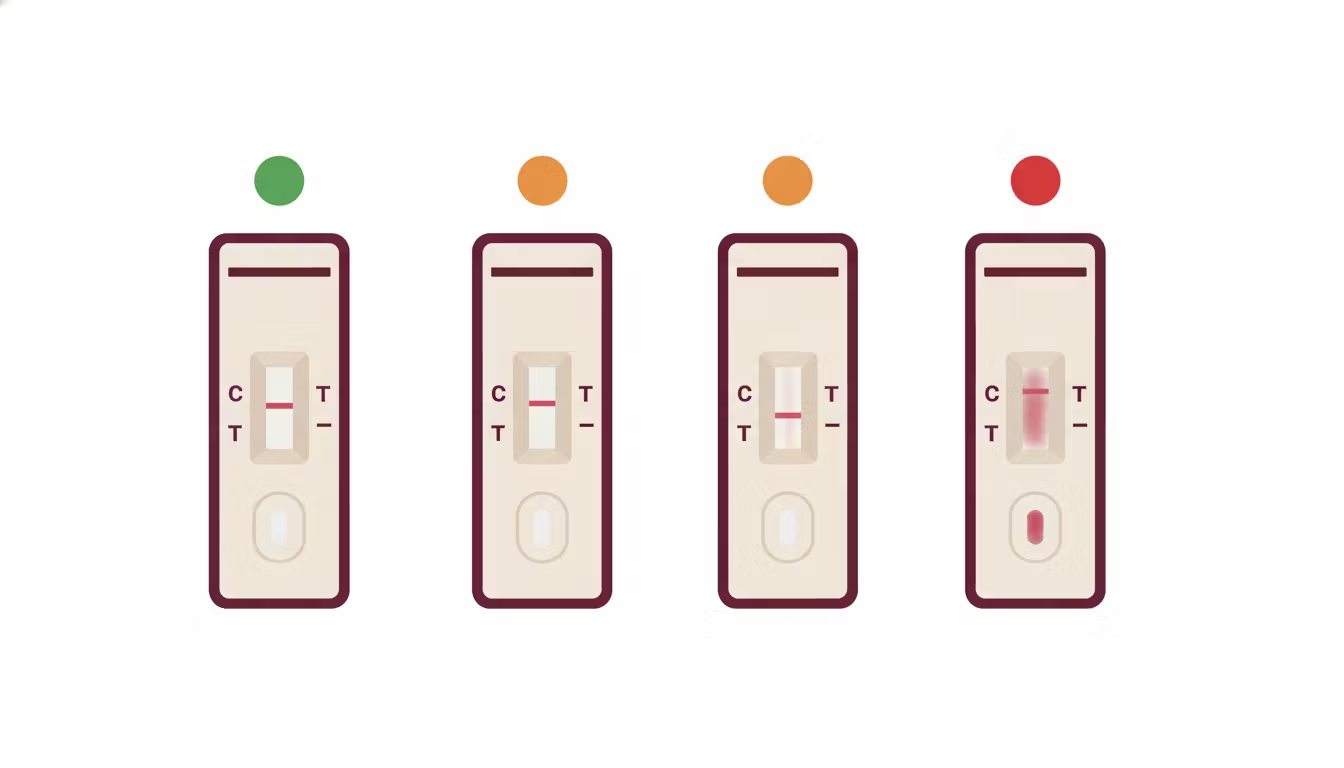
Pick up the cassette only after the timer says you are inside the read window, usually 10 to 15 minutes after the buffer drops. Look at the result window in good light. There are four outcomes you might see, and each one means something specific.
Strong line at C, no line at T. Negative. No HSV IgG antibodies were detected at a level the kit can read. If your possible exposure was within the last 12 to 16 weeks, this result is preliminary; antibodies may not have built up yet. Plan a retest at 6 weeks and again at 12 weeks if you want to be confident, and consider a final test at 16 weeks per CDC guidance for a conclusive negative.
Strong line at C, clear line at T. Positive. The kit detected HSV IgG antibodies. The result does not tell you when you were infected, only that your immune system has produced antibodies at some point.
Strong line at C, faint line at T. Still positive on most kits. Faintness usually reflects low antibody levels, often from a recent infection where seroconversion is still happening. It can also reflect an older infection with a steady, low-level antibody response.
No line at C. Invalid, regardless of what shows up at T. The test failed. Throw it out and run a new kit. Common causes are too little blood, jostled cassette, expired components, or buffer added in the wrong well.
Do not interpret the cassette an hour after the read window ends. Drying-artifact lines can appear as the strip dehydrates and they are not real. Photograph the result during the correct window so you have a record if you talk to a clinician later.
Why a faint line is usually still positive
The instinct “darker means more positive” is wrong for these tests. A lateral-flow assay is qualitative. It is set up to register a line whenever antibody binding crosses a chemistry threshold. Above that threshold, you get a line. Below it, you do not. The shade in between is not a sliding scale of how infected you are.
Several reasons your line might be faint rather than bold. Your immune system may have just begun producing IgG. In a new infection, antibodies appear in a trickle before they reach a steady level. The test catches the trickle as a faint mark. You may have a long-standing, asymptomatic infection where antibody levels run lower than average. Some people simply produce less IgG against HSV than others, and that has nothing to do with how contagious they are.
Faintness can also come from technical factors. A small blood sample, a slightly off ratio of buffer to blood, or a cassette that was jostled mid-development can produce a thinner line than the chemistry intended. The line is still real. It just means the line should be photographed and the result should be confirmed.
What faintness almost never means is “invalid.” The kit's instructions are explicit about this for a reason. If a faint line counted as nothing, people would dismiss real positives, miss the chance to start treatment, and unknowingly transmit the virus.
| Type of cause | What it looks like | What it means for you |
|---|---|---|
| Biological: early seroconversion | Faint T line on a kit run within weeks of a new exposure | Real but low antibody level. Expect the line to bolden if you retest a few weeks later. |
| Biological: long-standing low-titer infection | Consistent faint T line on repeat tests over time | Real and stable. A lab type-specific IgG test can quantify the response. |
| Technical: small or smeared blood sample | Faint or uneven T line, control line still bold | Chemistry threshold barely crossed. Retest with a fresh kit and a cleanly collected drop. |
| Technical: cassette jostled mid-development | Streaked or uneven T line, sometimes ghosting in the strip | Flow disruption. Discard, lay the next cassette flat, and do not touch it during the read window. |
What to do after a faint positive
If you are looking at a faint line right now, work through these steps in order.
Pause. A faint line is data, not a diagnosis. Most people who see one go on to confirm a stable, manageable infection or, sometimes, a false positive. Either way, your immediate next 24 hours are about gathering information, not making big decisions.
Photograph the cassette during the read window. Use a phone in good light, get the lot code and any printed identifiers in the frame if you can, and note the time. If you call a clinician later, the photo is more useful than a description.
Map your timeline. When was your most recent possible exposure? If it was within the last 2 to 3 weeks, you are in the early end of the antibody window and a faint line is consistent with early seroconversion. If it was longer ago, the line is more likely to reflect a lower-titer infection.
Plan a retest in 2 to 4 weeks. Antibody levels usually keep rising for several weeks after an infection. A second test at 4 to 6 weeks, then a follow-up at 12 weeks, and a final one at 16 weeks if any earlier reading was unclear, gives you the clearest picture. Use the same kit type so your readings are directly comparable.
If you have an active lesion, see a clinician now. An open sore is a much better sample than blood. Clinics swab the lesion and run PCR, which detects the virus directly and is far more accurate than any antibody test, home or lab. Acyclovir, valacyclovir, and famciclovir are most useful when started early in an outbreak.
Hold off on big relationship decisions. Use protection, do not have unprotected sex while the situation is unclear, and tell yourself you do not have to decide anything else today. A second test will give you better information than a worried evening of internet reading.
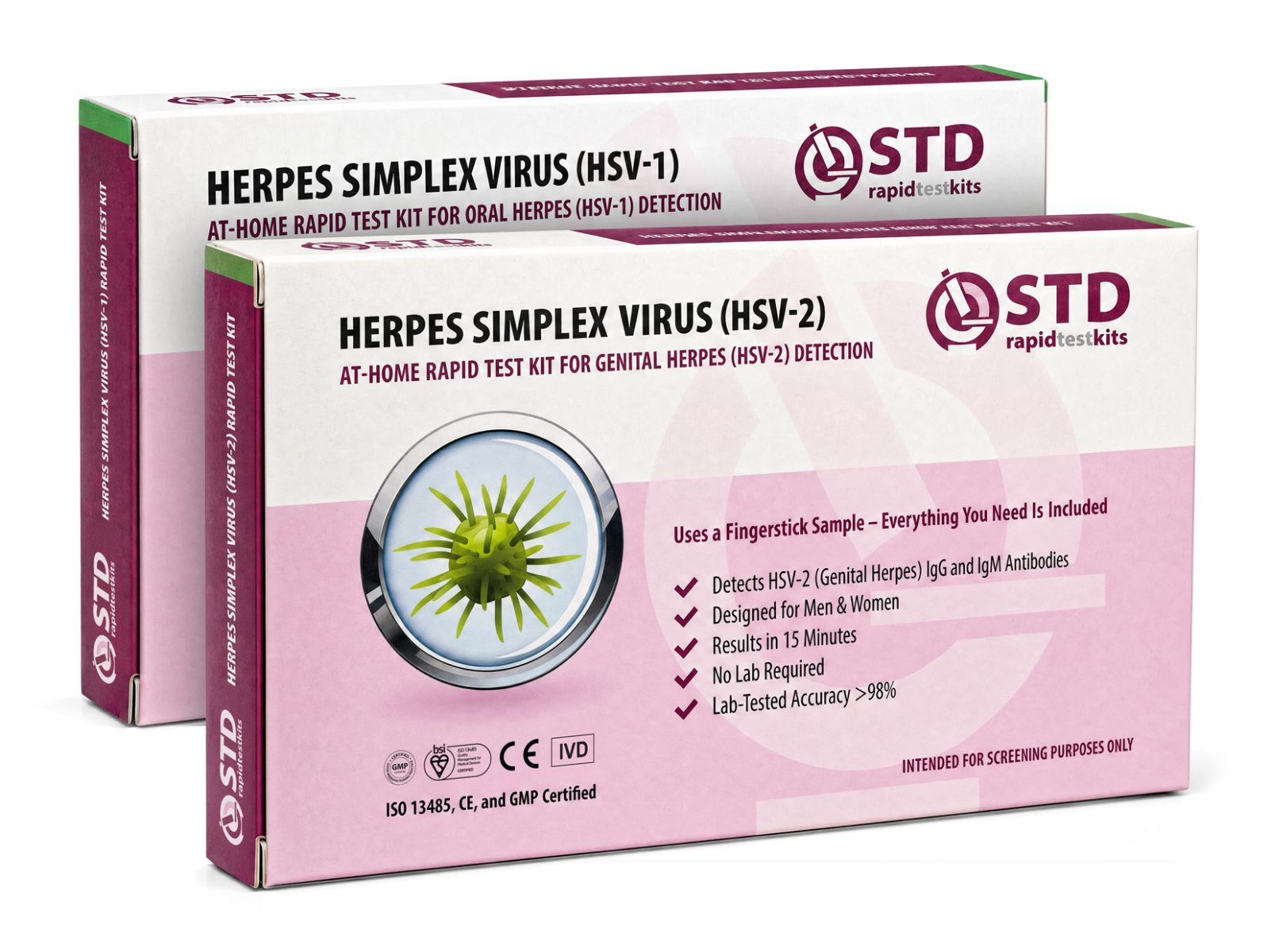
One disclosure before the kit recommendation below: we sell the at-home herpes antibody tests described in this article, and the picks that follow match the situations covered above.
The window period and when to retest
Herpes antibody production is not instant. The body takes time to recognize a new infection and produce IgG antibodies at the level a rapid test can detect. The MedlinePlus herpes test entry describes the antibody response as taking weeks to develop, and CDC herpes testing guidance notes that some current tests can take up to 16 weeks or more to detect infection. The practical implication is that an early negative is not a clean negative and an early faint positive is also worth re-checking later.
Use this rough timeline to read your own situation.
| Time since possible exposure | What a result means | Recommended action |
|---|---|---|
| Under 10 days | Antibodies almost certainly not yet detectable. Negative result has very low value. | Plan to retest at 4 to 6 weeks, again at 12 weeks, and at 16 weeks if any earlier reading is unclear. |
| 10 to 21 days | Some people start to seroconvert. A faint line can reflect early antibody production. | Retest in 2 to 4 weeks. Photograph the current result for comparison. |
| 4 to 6 weeks | Most infected people now have detectable antibodies. Results are more reliable. | A clear positive or negative is more trustworthy. Confirm a faint result in a lab. |
| 12 weeks | Practical reliable threshold for IgG antibody testing per MedlinePlus. | A negative here, with no symptoms, is reassuring. A positive is highly trustworthy. |
| 16 weeks or more | CDC notes some current tests can still take this long to detect infection. | If any earlier reading was negative or unclear and risk is real, confirm here for closure. |
Symptoms but a negative or faint test
People sometimes see a sore, a tingle, or a small cluster of bumps and then take a home test that comes back negative or barely positive. When symptoms appear but the home test reads negative or barely positive, a few things are usually at play.
You may still be in the window period. Your immune system has not produced enough IgG yet for a blood test to register clearly. The lesion can be present and infectious before the antibody response catches up. This is exactly the situation where a clinic PCR swab is far more useful than another blood test, because PCR detects the virus directly from the lesion regardless of antibody status.
The symptoms may not be herpes at all. Razor irritation, ingrown hairs, friction sores, contact dermatitis, yeast infections, and bacterial infections such as chlamydia can all produce signs that look at first glance like an HSV outbreak. A clinician can usually tell the difference on exam, and a swab confirms it. CDC's STI treatment guidelines for herpes describe the lesions as vesicular or ulcerative, and recommend laboratory confirmation rather than visual diagnosis alone.
A faint line plus active symptoms is a stronger signal than a faint line alone. Treat that combination as a likely positive and seek clinical confirmation. The clinic visit is the fastest path to a definitive answer and to antiviral medication if it is needed.
Go to a clinic for a PCR swab today. A blood antibody test cannot rule out herpes while a lesion is present. A clinic-administered PCR swab can, and it lets a clinician start antiviral treatment the same visit if needed.
Setup, blood draw, and avoiding invalid results
A surprising share of unclear or invalid home-test results come from setup mistakes rather than biology. Knowing the common failure modes is the easiest way to make your first test count.
Storage. Keep the kit at room temperature, away from direct sun and away from steamy bathrooms. Heat above about 30°C and humidity can degrade the cassette before you ever open it. Refrigeration is also wrong unless the instructions specifically say so.
Read the instructions before you prick yourself. Once the blood is flowing, you have a narrow window to drop it cleanly into the sample well. Different kits ask for different numbers of buffer drops, different sample volumes, and slightly different read windows. Skim the booklet from start to finish before you open anything else.
Warm your hands and prick the side of your fingertip. The side of the fingertip bleeds more easily than the pad and has fewer nerve endings, so it hurts less. Wash your hands in warm water for 30 to 60 seconds first to bring blood to the surface. Wipe away the first drop because it can contain tissue fluid that dilutes the sample.
Hold the dropper vertical. Tilting the capillary dropper introduces air bubbles that can block the blood from reaching the test strip cleanly. Squeeze a hanging drop from your finger and let it touch the dropper tip rather than smearing it on.
Set a timer and step away. Do not pick up the cassette to check on it. Vibrations and tilting interrupt the flow across the strip. The result is real only when read in the official window printed on the kit.
| What can go wrong | What it does to the result | How to avoid it |
|---|---|---|
| Kit stored in a hot car or steamy bathroom | Antibody chemistry degrades; can produce false negatives or invalid runs | Store at room temperature in a dry place; check the expiration date |
| Too little blood collected | Strip does not develop fully; control line may be missing | Warm your hands first; squeeze a hanging drop, do not smear |
| Buffer added to the wrong well or wrong number of drops | Result is invalid or misread | Read the instructions in full before opening the lancet |
| Cassette moved or tilted during development | Lines smear or do not appear; faint artifacts can form | Place on a flat surface, set a timer, do not touch |
| Result read after the official window | Drying artifacts may appear; line shading is unreliable | Read inside the printed window only; photograph during the window |
How accurate are at-home herpes antibody tests?
Accuracy is two numbers, not one. Sensitivity is how well a test catches people who actually have antibodies. Specificity is how well it ignores people who do not. Sensitivity and specificity vary by manufacturer and by the population the test was validated in, so the figure that matters is the one printed on your kit's package insert rather than a generic industry range.
Two real-world caveats matter for home tests. First, CDC herpes testing guidance does not recommend routine HSV serologic screening for all asymptomatic adults, partly because false positives in low-prevalence groups can do more harm than good. The right population for an antibody test is people with symptoms, a known exposure, or a partner with confirmed HSV. Second, lateral-flow rapid tests are screening tools, not laboratory NAAT. A positive home test is worth confirming with a type-specific IgG laboratory test or, when a lesion is present, a PCR swab. The Western blot is still considered the most specific confirmatory test in research settings.
If you are seeing a faint line and worried about a false positive, the right response is calm verification, not dismissal. Cross-reactivity with other herpesviruses is uncommon for type-specific kits but not impossible. A laboratory IgG with type-specific results, run a few weeks after your home test, settles most ambiguous cases.
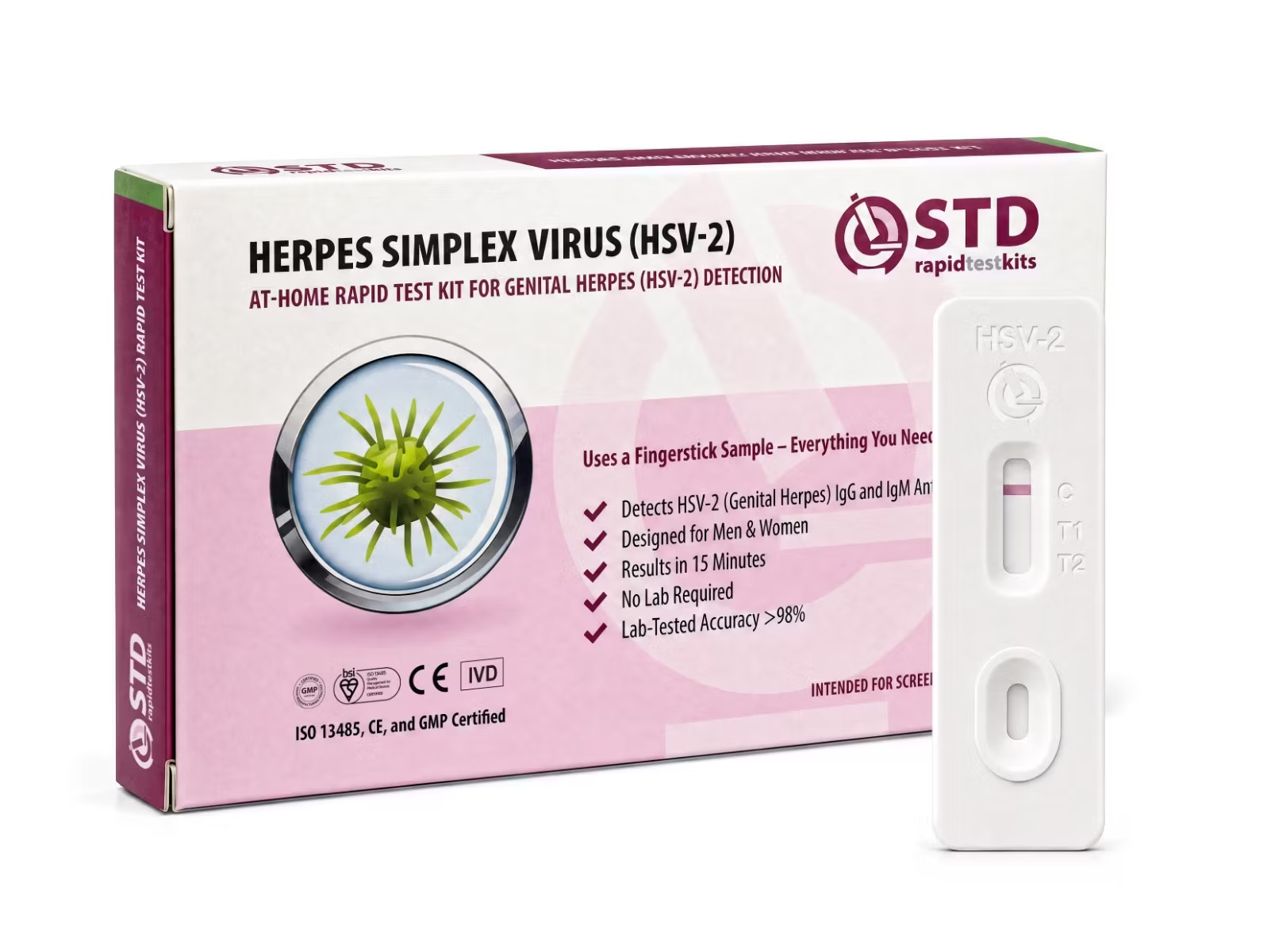
If your concern is genital herpes specifically rather than the combined HSV-1 plus HSV-2 picture, an HSV-2-only home kit may be a better match for you than the combined panel. The two products differ in what they detect, while sharing the same underlying lateral-flow chemistry.
CDC recommends herpes testing for people who have genital symptoms to confirm if they have it. CDC does not recommend herpes testing for people without symptoms in most situations.
Disposal, privacy, and disclosure
Once the test is read and photographed, dispose of the components carefully. The lancet should go inside its original wrapper or a folded tissue, then into the household trash. The cassette and buffer vial are safe for regular trash unless visibly contaminated with blood, in which case seal them in a small plastic bag first. Wash your hands thoroughly. Most kits include discreet packaging for added privacy if you share a household.
The harder part is talking about it. You do not have to do this today, and you certainly do not have to apologize. Herpes is one of the most common infections worldwide. WHO estimates that several billion people carry HSV-1 globally, and a few hundred million carry HSV-2. Most have no idea.
When you do tell a partner, lead with facts and keep it simple. Something like: “I took an at-home herpes antibody test and the result was a faint positive. I'm planning to retest in a few weeks and to confirm with my doctor. I wanted you to know.” You do not owe a medical history. You do not owe a story. You are sharing information that lets the other person make their own informed choice. If they react badly, that tells you something about them, not about you.
If the conversation feels unsafe or you are not in a stable enough relationship to disclose in person, anonymous partner notification services exist. They send a message on your behalf with the test result so the other person can get tested without learning your identity. Coverage and usability vary by service, so check the provider's site before using one.
If you currently have a sore, blister, ulcer, or cluster of small painful bumps in the area of concern, a clinic PCR swab is more accurate than any home antibody test. A blood antibody test cannot tell you whether the lesion in front of you is HSV. A PCR swab can, and it lets a clinician start antiviral treatment the same day if needed. Save the home test for confirming exposure history once the active outbreak has settled, or for routine screening between partners.
Putting it all together
A faint line on a herpes home test is your immune system speaking quietly rather than shouting. Treat it as a positive on first read, photograph it during the official window, and plan a clear next step: a retest in a few weeks, a clinic confirmation if symptoms are active, and a decision about disclosure on your own timeline. Use the result to decide your next step: retest in a few weeks, confirm in a clinic, or both.
Herpes is common, manageable with antiviral medication when needed, and compatible with a healthy sex life when partners are informed. The line on your cassette is the start of an honest conversation with your body and, if you choose, with the people in your life.
1. Photograph the cassette during the official read window so you have a record to compare against.
2. Retest in 2 to 4 weeks using the same kit type, with follow-up tests at 12 weeks and (if needed) 16 weeks for a conclusive read.
3. See a clinician for a PCR swab if you currently have an active sore. Blood antibody tests cannot rule out herpes while a lesion is present.
Frequently asked questions
- Is a faint line on a herpes test always positive?
- On almost every at-home HSV IgG kit, yes. The instructions explicitly state that any visible line at the test position is read as positive, no matter how faint. The shade does not measure how much virus you carry; it reflects antibody binding above the kit's detection threshold. Confirm a faint result with a retest in 2 to 4 weeks and a clinical laboratory test if needed.
- Can I test too early after a possible exposure?
- Yes. Most antibody assays reach reliable sensitivity by about 12 weeks per MedlinePlus, but CDC herpes testing guidance notes that some current tests can take up to 16 weeks or more to detect infection. A test in the first week or two often returns a negative or faint result regardless of the true status. Plan one test at 4 to 6 weeks, another at 12 weeks, and a final one at 16 weeks if any earlier reading was unclear.
- What does it mean if the control line did not appear?
- The test is invalid. The control line is the kit's self-check that the chemistry ran correctly. With no control line, you cannot trust anything in the test position, even if it looks like a clear line. Discard the cassette and run a fresh kit. Do not add more buffer or try to salvage it.
- Can a herpes home test tell me whether I have HSV-1 or HSV-2?
- It depends on the kit. Some at-home tests detect HSV-2 IgG specifically. Others use a combined HSV-1 plus HSV-2 strip. The combined kit will tell you that you have antibodies to one or both but not which one. If the type matters for your situation, a laboratory type-specific IgG test is the right tool.
- I have a sore but my home test is negative. What should I do?
- See a clinician for a PCR swab of the lesion. Blood antibody tests can read negative early in an infection while a sore is active and infectious. PCR detects the virus directly from the lesion and is the most accurate test in that situation. It also lets a clinician start antiviral medication promptly.
- How likely is a false positive on an at-home herpes test?
- False positives are uncommon but real, particularly in people with low actual prevalence and in early-window readings. CDC does not recommend routine herpes serologic screening for all asymptomatic adults partly for this reason. If your faint positive comes without any symptoms or known exposure, confirm with a type-specific laboratory IgG test or a Western blot before drawing conclusions.
- Can stress, my menstrual cycle, or another infection cause a faint positive?
- Stress and menstrual cycles do not create antibodies, so they cannot produce a faint positive on their own. They can trigger an outbreak in someone already infected, which makes a positive more likely to register clearly during a flare. Other STIs also do not cross-react with type-specific HSV antibody tests in any common way.
- Should I tell a partner before I retest?
- There is no single right answer, but honesty tends to build trust. A short, factual message such as “I had a faint positive on a home herpes test and I am planning to retest in a few weeks” is enough. You do not have to wait for a definitive lab confirmation to use protection in the meantime, and you do not have to decide everything at once.
- U.S. Centers for Disease Control and Prevention. About genital herpes: overview of HSV-1 and HSV-2, transmission routes, and symptom patterns.
- U.S. Centers for Disease Control and Prevention. Screening for genital herpes: current testing recommendations, antibody test limitations, and PCR for active lesions.
- U.S. Centers for Disease Control and Prevention. STI treatment guidelines for genital herpes: clinical management, antiviral options, and lesion description.
- World Health Organization. Herpes simplex virus fact sheet: global prevalence estimates for HSV-1 and HSV-2.
- MedlinePlus (U.S. National Library of Medicine). Herpes (HSV) test: what the test measures, sample types, and antibody window-period behavior.
- U.S. National Institutes of Health, NIH News in Health. Herpes can happen to anyone: public-facing summary of HSV epidemiology and asymptomatic transmission.
