Published: November 2025 | Last updated: May 2026 | Editorial review and quality control: Martina N.
Do I need an STI test after semen got in my eye?
Usually not the next morning. Rinse the eye with clean water or sterile saline for at least 60 seconds, then watch it for 72 hours. If redness, discharge, swelling, or pain develops, see a clinic in person for an eye swab. If your partner's status is unknown, plan blood antibody testing at 6 and 12 weeks.
Semen landed in or around your eye. Sometimes it stings for a moment, you blink it out, and that is the end of it. Sometimes it turns into a real eye infection a day or two later, with redness, discharge, and the kind of swelling that makes you cancel plans. Both reactions are within the realm of normal.
What separates one from the other is what was in the fluid, how thoroughly you rinsed, and what your eye looks like 24 to 72 hours later. The eye is a mucous membrane, not skin, so substances that land on the conjunctiva can carry irritants and microorganisms further in. Coverage of this scenario tends to swing between two extremes: nothing ever happens, or the next stop is corneal scarring. Neither framing is honest. Documented case reports describe conjunctivitis from ocular semen exposure for chlamydia, gonorrhea, and herpes simplex virus. The single-exposure risk is low, but it is not zero, and this guide focuses on that gap.
This article is published by stdrapidtestkits.com, which sells at-home rapid STI testing kits. We recommend products based on whether they fit your exposure, not whether they fit the article's topic.
Key Takeaways
- Eye-only semen exposure rarely transmits a systemic STI, but documented case reports describe chlamydial, gonococcal, and herpes conjunctivitis from ocular contact. The realistic complication is the eye infection, not HIV seroconversion.
- Rinse with clean water or sterile saline for at least 60 seconds, watch the eye for 24 to 72 hours, and see a clinician if redness, discharge, or pain develops. If partner status is unknown, plan blood antibody testing at 6 and 12 weeks rather than the morning after.
What actually happens when semen reaches the eye
The conjunctiva is the thin, moist tissue lining the inside of the eyelids and covering the white of the eye. It behaves like the mucous membranes of the mouth, urethra, vagina, and rectum: substances pass through it, including bacteria and viruses. A splash on the cheek and a splash in the eye are biologically different events. The cheek has skin that works as a barrier, while the conjunctiva absorbs fluid the way the lining of the mouth or genitals does.
The immediate sting most people feel is osmotic. Semen has a different pH and salt concentration than tear film, so the eye reacts the way it does to chlorinated pool water or sweat. Semen also contains irritant compounds (fructose, prostaglandins, citric acid, zinc) that can prolong the redness and watering for an hour or two. That sting and pinkness fade within minutes to a couple of hours and say nothing about whether an infection has started.
Whether something does start depends on a separate question: what was in the semen? Pink eye has several causes, including bacterial and viral infection, allergies, and irritants (MedlinePlus, Pink Eye). If the partner had a genital infection with Chlamydia trachomatis, Neisseria gonorrhoeae, or herpes simplex virus, those same organisms can colonize the conjunctiva through genital secretions. The infection process takes hours to days, so by the time symptoms appear, the bacteria or virus has already started replicating. The timing of symptom onset therefore matters more than the timing of the original sting. The exposure is also easy to miss in clinic: without a sexual history, a provider reasonably treats a red eye as routine pink eye, and the treatment for ordinary conjunctivitis is not the treatment for gonococcal conjunctivitis.
The vast majority of eye-splash exposures resolve with rinsing and no infection at all. The clinical literature on ocular STI transmission via semen is thin precisely because documented cases are uncommon. The reasonable response is calm cleanup, a symptom watch, and timed testing if partner status is unknown, not a 2am trip to the emergency room.
Normal sting or real infection? Symptoms to watch
A normal post-exposure response is simple: the eye stings briefly, waters, looks slightly pink for an hour or two, then returns to baseline. You blink it out, rinse, and forget about it. If that is the whole story, you are almost certainly fine.
The signs that warrant attention develop on a different timeline. They appear later, get worse instead of better, and tend to cluster together. Timing is itself a clue: gonococcal conjunctivitis escalates fast, within 24 to 72 hours, while chlamydial conjunctivitis is slower and milder, often 5 to 14 days out. Watch for the following over the next two weeks.
Symptoms that mean it is more than a sting
A brief sting, watering, and mild pinkness that fade within a couple of hours are normal. The signs below appear later and worsen. Profuse yellow-green discharge, an eye swollen shut, sharp pain, light sensitivity, blurred vision, or blisters on the lid mean same-day in-person clinic care.
- Redness that intensifies over hours instead of fading Common
- Yellow or green discharge that crusts the lashes shut overnight Common
- Gritty sensation or a swollen eyelid 12 to 72 hours after exposure Common
- Eyelid swelling that partially or fully closes the eye Less common
- Sharp pain rather than a gritty feeling Less common
- Sensitivity to light or blurred vision Less common
- Visible blisters or vesicles on the eyelid skin Rare
First aid in the first few minutes
The window for reducing infection risk is short. Most of the protective effect comes from rinsing well within the first few minutes; after that, the next 72 hours are about monitoring.
- Rinse for at least 60 seconds, ideally 10 to 15 minutes, with clean lukewarm water or sterile saline eyewash. Tilt your head so the affected eye is lower than the other one, hold the eyelid open, and let water flow gently across the eye rather than into it under pressure. Blink during the rinse to move fluid behind the lid.
- If you wear contact lenses, remove them before rinsing and discard the affected lens. Wear glasses for at least a week and replace the contact case too.
- Do not rub the eye. Rubbing can scratch the cornea and turn a passing irritation into a small abrasion that heals slowly and is more vulnerable to infection.
- Skip redness-relief drops (vasoconstrictors); they shrink surface blood vessels and mask the very symptom that would tell you whether conjunctivitis is developing. Avoid soap, hydrogen peroxide, and contact-lens solution as well. Plain water or sterile saline is what you want.
- Artificial-tear lubricating drops are fine over the next several hours and help wash residual irritant material out of the tear film.
- Do not start old antibiotic eye drops left over from a previous infection. The wrong treatment can mask gonococcal conjunctivitis without curing it, and that delay can be serious.
Go to a clinic, urgent care, or emergency department the same day if any of these appear: profuse yellow or green discharge, eyelid swelling that closes the eye, sharp pain rather than a gritty feeling, sensitivity to light, blurred vision, or visible blisters on the eyelid skin. Light sensitivity and blurred vision in particular can mean the cornea is involved, and corneal scarring from untreated gonococcal or herpetic infection is the worst-case outcome of this kind of exposure.
Eye conditions from semen exposure that are not STIs
Most eye complaints after a semen splash trace back to two ordinary causes rather than any sexually transmitted infection: bacterial conjunctivitis from common skin bacteria, and styes from blocked oil glands. Statistically, these are far more likely than an STI-related ocular infection.
Bacterial conjunctivitis (pink eye)
Healthy semen carries skin and mucosal bacteria, including Staphylococcus aureus, that are harmless on body surfaces but can cause conjunctivitis when they reach the eye. Symptoms usually appear 12 to 72 hours after exposure: a pink or red eye, a gritty feeling, a swollen eyelid, and mucus or pus discharge that often crusts the lashes overnight. Most cases clear within a week or two, and bacterial pink eye is treated with antibiotic eye drops or ointment from a clinician (NHS, Conjunctivitis). The NHS notes that STI-related conjunctivitis tends to take longer to clear than the routine bacterial or viral kind, which is part of why exposure history matters when a provider decides what to test for.
Hordeolum (stye)
A stye is a small, painful red bump on the eyelid margin from an infected oil gland, usually staphylococcal. Eye irritation followed by rubbing makes one more likely. Most resolve within a week with warm compresses for 10 minutes, three or four times a day. A stye that persists or worsens needs a clinician.
Why this matters
If you develop a red eye, swelling, discharge, or an eyelid bump in the days after exposure, your first stop is an in-person clinic (urgent care or an ophthalmologist), not an at-home STI test. The eye condition needs eye-specific diagnosis and topical treatment. STI testing runs on its own slower timeline, covered below.
A stye or routine bacterial pink eye that improves within a week with warm compresses or basic care, and that has no connection to a recent sexual fluid exposure, does not call for an STI workup. The combination that should send you for a clinic swab is a known ocular fluid exposure plus eye symptoms that persist or worsen rather than settle.
STIs that can transmit through eye contact, by infection
Five sexually transmitted infections come up in the literature on adult ocular infection from sexual exposure. They behave differently, look different, and are treated differently, which is why a clinic-administered swab beats guessing.
HIV
HIV transmission through an ocular semen splash is theoretical. No well-documented cases have been reported, and the CDC's overview of how HIV spreads lists the main routes as anal or vaginal sex, sharing injection equipment, and perinatal transmission; an eye splash is not among them (CDC, How HIV Spreads). The biological caveat is that a fresh corneal abrasion or active conjunctivitis at the moment of exposure could plausibly raise the risk above zero, but population data show no measurable signal. If your partner is known HIV-positive with a detectable viral load, post-exposure prophylaxis (PEP) within 72 hours is the conservative response and should be discussed with a clinician the same day.
Herpes simplex virus (HSV)
Ocular herpes is real and can cause keratitis (inflammation of the cornea) and visual disturbance. It tends to recur, and each recurrence can add scarring, which makes it a leading infectious cause of corneal blindness in high-income countries. Most ocular HSV is HSV-1, often spread from a person's own cold-sore virus. HSV-2 reaching the eye from a partner's genital secretions is uncommon but documented, mainly when the partner has an active genital lesion. Symptoms include pain out of proportion to how the eye looks, light sensitivity, redness, and watery discharge, usually within 2 to 12 days. Early antiviral treatment works well; untreated ocular HSV can scar the cornea permanently.
Chlamydia and gonorrhea
Both bacteria can cause adult inclusion conjunctivitis when genital secretions reach the eye. Chlamydial conjunctivitis is slower and milder, often 5 to 14 days from exposure, with a stringy mucoid discharge that drags on for weeks if untreated. Gonococcal conjunctivitis is hyperacute, escalating within 24 to 72 hours with profuse yellow-green pus and pronounced lid swelling; untreated, it can perforate the cornea within days, which is why ophthalmology treats it as a same-day emergency (CDC 2021 STI Treatment Guidelines). That same guidance directs treatment: intramuscular ceftriaxone for gonorrhea and oral azithromycin or doxycycline for chlamydia, plus topical care. For general background on each infection, see the CDC overviews of chlamydia and gonorrhea. Our at-home chlamydia and gonorrhea swab test is validated for self-collected genital swabs only, not eye swabs, so an eye-only exposure with conjunctivitis symptoms needs a clinic-administered eye swab.
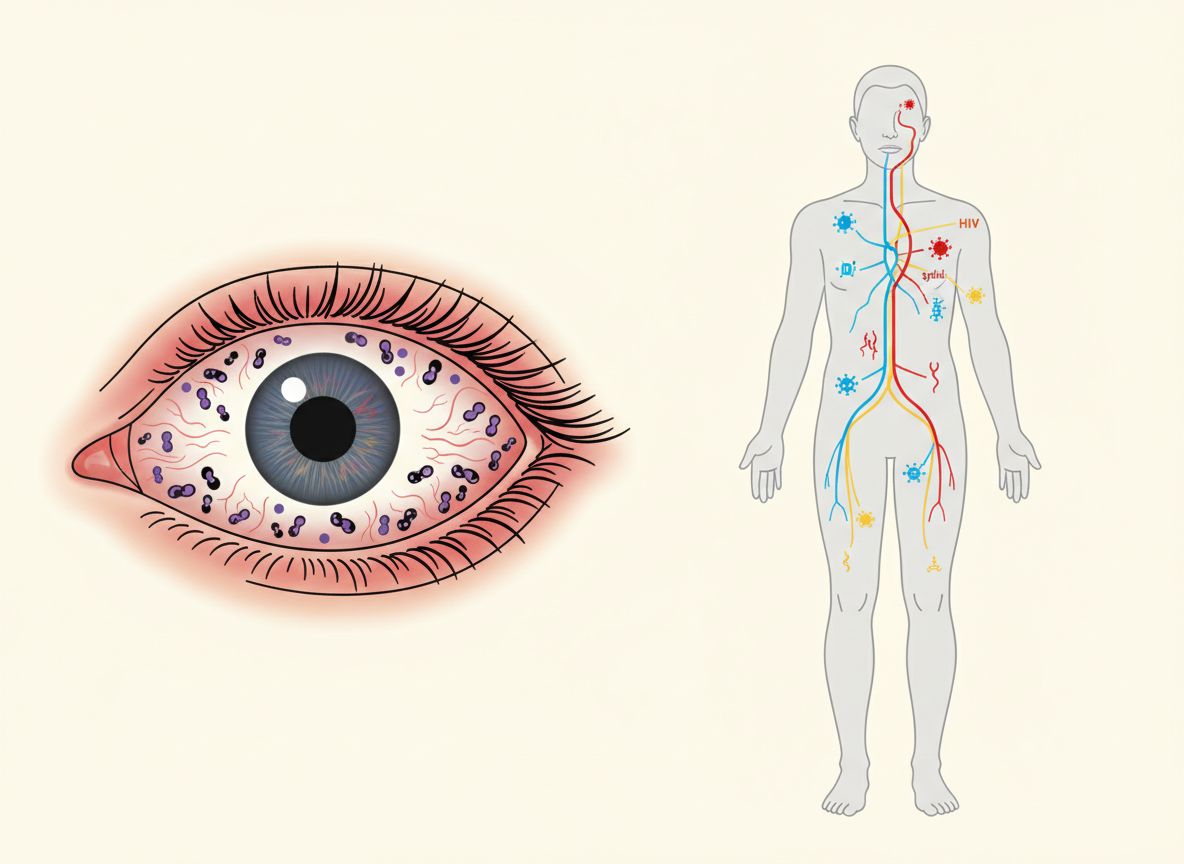
The reason the testing strategy splits between "clinic visit" and "at-home blood test" is that the two infection types behave differently. Chlamydia and gonorrhea inoculated into the conjunctiva produce a local infection you can see, which needs eye-specific topical treatment. HIV, syphilis, hepatitis, and HSV-2 antibodies, if they transmit at all, become systemic infections that show up only on blood antibody testing weeks later. The eye is just one possible entry point.
Syphilis and hepatitis from ocular exposure
Syphilis
Ocular syphilis is rare but serious. It usually shows up in the secondary or tertiary stage of an established systemic infection (as uveitis or chorioretinitis), not as a primary infection from an eye splash. The practical relevance: if your partner has untreated syphilis and the encounter also involved sexual contact, the systemic infection is the screenable outcome, detectable by blood antibody testing 3 to 6 weeks after exposure (CDC 2021 STI Treatment Guidelines).
Hepatitis B and C
Both viruses are mainly blood-borne. Hepatitis B can transmit through semen, but ocular transmission specifically is poorly documented and considered low risk for an isolated splash from a non-bleeding source. Hepatitis C through an ocular semen splash is essentially undocumented. If your partner is known to have hepatitis B and you are unvaccinated, post-exposure hepatitis B immunoglobulin plus the vaccine series is the right move, ideally within 24 hours.
| Infection | Realistic ocular risk from a splash | Right test if status is unknown | Earliest reliable testing window |
|---|---|---|---|
| HIV | Negligible per occupational-exposure surveillance; raised slightly by abrasion or active conjunctivitis | Blood antibody (rapid) or antigen/antibody (lab) | 23 to 90 days (rapid antibody); 18 to 45 days (lab) |
| HSV (HSV-1 or HSV-2) | Uncommon; possible if partner had an active genital lesion | Blood antibody for HSV-2; clinic swab or PCR for an active eye lesion | Symptoms 2 to 12 days; seroconversion 6 to 12 weeks (up to 16) |
| Chlamydia | Possible adult inclusion conjunctivitis (5 to 14 days) | Clinical eye swab and exam | Symptoms 5 to 14 days; clinic visit, not at-home |
| Gonorrhea | Hyperacute conjunctivitis (24 to 72 hours); can perforate the cornea | Clinical eye swab and exam, urgent | Same-day if symptomatic; urgent clinic visit |
| Syphilis | Primary ocular infection rare; secondary ocular syphilis from established systemic infection | Blood antibody (RPR or treponemal) | 3 to 6 weeks; up to 90 days |
| Hepatitis B | Low for an isolated splash; PEP relevant if partner is HBV-positive and you are unvaccinated | Blood (HBsAg) | 4 to 10 weeks |
| Hepatitis C | Essentially undocumented for an ocular semen splash | Blood antibody (anti-HCV) | 8 to 11 weeks; up to 6 months |
Should you get tested? A practical decision guide
Eye exposure on its own is not an automatic reason to test. What you do next depends on three things: whether your partner's status is known, whether your eye develops symptoms, and whether the same encounter involved other sexual contact. Work through the flow below, then read the testing-window section so you test on the day a result actually means something.
Should you test after semen in the eye?
Is your partner known HIV-positive or hepatitis B-positive (or strongly suspected), and not virally suppressed?
Yes: Call a clinic or emergency department within 72 hours about HIV PEP and hepatitis B post-exposure prophylaxis. These are time-sensitive, and an at-home test the next morning will read negative regardless because the markers are not detectable yet.
Has your eye developed redness, discharge, swelling, or pain within 7 days?
Yes: See a clinic, urgent care, or ophthalmology in person for an eye swab and exam. At-home blood tests do not diagnose the eye infection itself, and gonococcal conjunctivitis needs same-day treatment.
Is your partner's status unknown?
Yes: Plan blood antibody testing at 6 weeks and again at 12 weeks for HIV, syphilis, hepatitis B, and hepatitis C.
No: If your partner recently tested negative and has had no exposures since, watch the eye for conjunctivitis symptoms for two weeks. No test is needed unless symptoms develop.
Guidance only. A healthcare provider can advise based on your specific situation.
Testing windows: when results become reliable
The most common mistake after an exposure is testing too early. A negative result before the window period has passed does not mean you are uninfected; it only means antibodies have not had time to form. Plan around these timelines:
- HIV: rapid antibody tests usually detect infection 23 to 90 days after exposure, and laboratory antigen/antibody tests 18 to 45 days, per CDC HIV testing guidance. A negative result after the full window has passed is considered reliable.
- Syphilis: 3 to 6 weeks for antibody tests, occasionally extending to 90 days.
- Hepatitis B: the surface antigen (HBsAg) becomes detectable about 4 to 10 weeks after exposure.
- Hepatitis C: antibodies typically appear 8 to 11 weeks out, with some labs extending to 6 months for a definitive result.
- HSV-2: 6 to 12 weeks for antibody seroconversion in most people, occasionally as late as 16 weeks. A blood antibody test answers only the systemic seroconversion question; an active eye lesion needs a clinic-administered swab or PCR instead.
For an eye-splash exposure with an unknown partner, the practical sequence is to test once at 6 weeks (which catches HIV, syphilis, hepatitis B, and most HSV-2 seroconversions) and again at 12 weeks (which clears the longer windows). Those two rounds cover every infection above.
How to talk to a clinician without overexplaining
A provider cannot order the right test without knowing the route of exposure. A vague "I think I have pink eye" gets you treated for routine viral conjunctivitis, which is the wrong call if the cause is gonorrhea. One specific sentence changes the workup. Useful ones:
- "I had semen in my eye during sex on [date], and now my eye is [red, painful, discharging, swollen]."
- "My partner's status is [known positive / unknown / unvaccinated for hepatitis B]."
- "I want to ask about HIV PEP eligibility. The exposure was [time] ago."
Clinicians in sexual-health and urgent-care settings see ocular splash exposures regularly, so the visit will not surprise them. The workup typically includes a slit-lamp exam to check the cornea, a conjunctival swab for culture and PCR, and sometimes HSV PCR if a viral cause is suspected. If the discharge looks like gonorrhea, intramuscular ceftriaxone may start before the swab results return. If your usual clinic is not comfortable with this, a Planned Parenthood, an STI-specialty clinic, or an ophthalmology practice is a good alternative; telehealth is not, because the eye needs an in-person exam.
Open the visit with: "I had semen in my eye during sex on [date], and now my eye is [red, painful, discharging, swollen]." That one sentence prompts the right tests (a conjunctival swab for chlamydia, gonorrhea, and HSV) instead of empirical pink-eye drops. You do not owe any additional detail unless you want to share.
Prevention that does not change what kind of sex you have
Risk reduction here is a short list of habits that cut the eye-exposure risk without dictating the activity. The highest-yield habit is knowing partner status before fluid exposure. A clean panel within the last 4 to 6 weeks, with no exposures since, puts almost all of the conjunctivitis risk in this article close to zero. Regular STI screening is part of routine sexual health care for anyone with new or multiple partners; the WHO frames it as health maintenance, not an accusation (WHO, Sexually Transmitted Infections).
Practical mechanics when status is uncertain or new:
- Aim away from the eyes. The cheek, lips, and chest are skin, which acts as a barrier; the conjunctiva does not.
- If something lands near the eye, rinse within minutes rather than at the end of the scene.
- Keep a clean towel and a glass of room-temperature water nearby. Sterile saline solution meant for eye rinsing is even better.
- Use a separate towel per eye. Wiping both eyes with the same towel when only one was exposed can carry the infection from one side to the other.
- Closed-eye facials are a real option: eyes shut, head turned slightly, with a rinse afterward anyway, since the lashes catch most of it.
A negative HIV test result before the end of the window period does not rule out HIV infection. People should test again at the end of the window period to confirm a negative result.
What if the same encounter involved oral, vaginal, or anal contact?
The eye is only one possible entry point. If the same encounter also involved oral, vaginal, or anal sex, those exposures carry their own STI risk and their own testing windows, independent of the eye. An at-home panel that combines a self-collected genital swab with a fingerstick blood test covers what was exchanged during those contacts, in one shipment, on the 6-to-12-week schedule above. It will not diagnose the eye itself, but it answers the systemic and genital questions so an in-person visit can focus on the eye.

Bottom line
An eye-splash exposure is uncomfortable and usually causes more anxiety than infection. Rinse the eye for 60 seconds or longer within the first few minutes, watch for conjunctivitis symptoms over the next 72 hours and out to two weeks, and see a clinic in person if any develop. If your partner's status is unknown, plan a round of blood antibody testing at 6 weeks and a follow-up at 12 weeks. If your partner is known positive for HIV or hepatitis B, the most useful thing you can do today is call a clinic about PEP, not order an at-home test that will read negative for weeks.
Your next steps, in order
Did the splash happen in the last few minutes?
Yes: Remove any contact lens first, then rinse the affected eye with clean water or sterile saline for at least 60 seconds, and avoid rubbing it.
Over the next 72 hours, does the eye develop redness, discharge, swelling, or pain?
Yes: Book an in-person clinic, urgent care, or ophthalmology visit for an eye swab and exam, and say plainly that semen got in your eye. Do not use an at-home swab kit on the eye.
Is your partner's status unknown?
Yes: Plan a fingerstick blood panel at 6 weeks, which covers HIV, syphilis, hepatitis B, and most HSV-2 seroconversions, then a follow-up at 12 weeks to clear the longer windows.
No: If your partner recently tested negative with no exposures since, watch the eye for two weeks; no test is needed unless symptoms appear.
A short action flow for what to do now. A healthcare provider can advise based on your specific situation.
Frequently asked questions
- How long after the exposure should I wait before testing?
- Twelve weeks clears the window for every infection in this article. One test at 6 weeks covers HIV, syphilis, hepatitis B, and most HSV-2 seroconversions; a follow-up at 12 weeks catches the late end of the HIV and HSV-2 windows and clears the early end of the hepatitis C window. Testing the next morning produces a negative result for every infection, which is reassuring but not informative.
- How fast do STI eye infections show up?
- Seventy-two hours of clear eyes essentially rules out gonococcal conjunctivitis, the hyperacute and most urgent of the group. After that, the 5-to-14-day chlamydia window and the 2-to-12-day HSV window are still open, so keep monitoring for redness, discharge, light sensitivity, or pain through the full two weeks.
- Can a single facial actually give me an STI eye infection?
- It can, in rare cases. Documented case reports describe chlamydial, gonococcal, and herpes-related conjunctivitis from ocular semen exposure. The per-event probability depends on whether the partner has the infection in their genital tract; with an uninfected partner it is essentially zero, and even with an infected partner conjunctival transmission is possible but not guaranteed.
- Is HIV transmission through eye splash actually possible?
- It is theoretically possible because the conjunctiva is a mucous membrane, but no well-documented cases of HIV transmission via an ocular semen splash have been reported, and the CDC does not list an eye splash among its main transmission routes. The risk increases marginally with a fresh corneal abrasion or active conjunctivitis at the time of exposure.
- Should I take HIV PEP after an eye splash?
- PEP is generally reserved for higher-risk exposures (sexual, needlestick, or occupational with a known-positive source). For an isolated ocular splash with unknown source status, it is rarely indicated. If the source is known HIV-positive with a detectable viral load, call a clinic within 72 hours and let them assess. Do not delay that call.
- How do I tell STI conjunctivitis apart from regular pink eye?
- Often you cannot by appearance alone; the clue is exposure history. STI conjunctivitis tends to involve heavier purulent discharge (gonorrhea), a stubborn stringy discharge (chlamydia), or significant pain and light sensitivity (herpes). The reliable way to distinguish them is a clinic swab, so if you had a recent ocular fluid exposure, mention it and the provider can test for the right organisms.
- Can I use the at-home swab kit on my eye?
- No. The at-home chlamydia and gonorrhea swab kits are validated for self-collected genital swabs only, not eye swabs. Eye conjunctivitis needs a clinic-administered swab and exam plus prescription topical treatment. The at-home blood tests we sell address systemic infections (HIV, syphilis, hepatitis), not the eye condition itself.
- What if I wear contact lenses?
- Remove the lens immediately and discard the affected one. Do not reinsert it. Rinse the eye with saline or clean water for at least 60 seconds (10 to 15 minutes is better), then wait at least 24 hours and confirm the eye is symptom-free before wearing a fresh lens. Clean the lens case before storing the unaffected lens.
- U.S. Centers for Disease Control and Prevention. 2021 Sexually Transmitted Infections Treatment Guidelines, covering adult chlamydial and gonococcal conjunctivitis treatment, syphilis staging and antibody window, and HSV serologic testing.
- U.S. Centers for Disease Control and Prevention. About Chlamydia: symptoms, transmission through vaginal, anal, or oral sex, and treatment.
- U.S. Centers for Disease Control and Prevention. About Gonorrhea: symptoms by site, transmission, and the importance of completing treatment.
- U.S. Centers for Disease Control and Prevention. How HIV Spreads: the main transmission routes (anal or vaginal sex, sharing injection equipment, perinatal) and the body fluids that carry the virus.
- U.S. Centers for Disease Control and Prevention. HIV Testing: window-period guidance for rapid antibody (23 to 90 days) and laboratory antigen/antibody (18 to 45 days) assays.
- National Health Service (UK). Conjunctivitis: symptom recognition, home rinsing guidance, and the note that STI-related conjunctivitis takes longer to clear than the routine bacterial or viral kind.
- World Health Organization. Sexually Transmitted Infections (STIs) fact sheet: global guidance on STI transmission, screening as part of sexual health care, and prevention.
- MedlinePlus (U.S. National Library of Medicine, NIH). Pink Eye: bacterial, viral, allergic, and irritant causes of conjunctivitis and how it is treated.
