
Published: September 2025 | Last updated: May 2026 | Editorial review and quality control: Martina N.
Can you have an STD without any symptoms?
Yes. Many sexually transmitted infections cause no symptoms in most people who carry them. CDC guidance describes chlamydia as commonly asymptomatic, most pharyngeal and rectal gonorrhea as silent, and many genital herpes infections as unrecognised. Routine testing is the only reliable way to know your status.
Feeling fine is not the same as testing negative, and that gap is the reason a lot of common sexually transmitted infections quietly spread for months before anyone realizes they are there. Many sexually transmitted infections, including some of the most common ones, often produce no symptoms at all. You can carry chlamydia for months, gonorrhea for weeks, or HIV for years without your body waving a single warning flag. The only reliable way to find a silent infection is to test for it.
This guide is for the reader who feels fine and is wondering whether that 'fine' is accurate. We cover which STIs most often stay silent, why short-term symptom checks miss them, the difference between when symptoms might appear and when a test can actually detect infection, when to test after a possible exposure, and how to choose between an at-home kit, a mail-in lab, or a clinic visit. The goal is calm, specific information so you can decide whether testing makes sense for you, regardless of how you feel today.
Key Takeaways
- If you have ever been sexually active and have never tested, your status is genuinely unknown. Symptoms are not a reliable indicator for most common STIs.
- Most chlamydia, gonorrhea, herpes, HPV, and HIV infections produce no symptoms in most people, and all of them can still transmit during the silent phase.
Why Feeling Fine Is Not the Same as Being Clear
Most people use their body as a status check. No symptoms gets read as no problem. With sexually transmitted infections, this logic breaks down because most common STIs produce no symptoms in most people who carry them. The reason is biological. These pathogens are evolved for persistence inside the human body, and the local immune response they trigger is often mild enough that nothing is felt at the infection site.
Chlamydia trachomatis lives inside cells of the cervix, urethra, throat, or rectum and replicates slowly. The CDC's chlamydia overview describes the infection as commonly asymptomatic, with the majority of reported cases identified through screening rather than complaints. Neisseria gonorrhoeae behaves similarly, particularly when it colonizes the throat or rectum where there is little inflammation to feel. Herpes simplex virus establishes lifelong infection in nerve ganglia and sheds live virus from skin even when no sore is visible. HIV produces a mild fever-and-fatigue phase in some people two to four weeks after exposure, then settles into a chronic clinical-latency stage that can last years with no daily signs.
The risk of trusting symptoms goes beyond personal health. Asymptomatic carriers transmit infections to partners every day, often to people they care about, often without any way of knowing. The 'I would have known' instinct is built on how viral and bacterial sore throats, food poisoning, and most acute illnesses behave. Sexually transmitted infections frequently break that pattern.
The practical implication is to stop using symptoms as your primary screening tool and treat sexual-health testing the way you treat dental checkups: scheduled on the calendar, run routinely, and timed independently of how anything feels in any given week.
Most sexually transmitted infections are evolved for persistence inside the body, not for detection. The local immune response to chlamydia and gonorrhea is often mild enough that the body raises no obvious flag. A quiet body can still carry an active infection.
Which STDs Most Often Stay Silent
Some sexually transmitted infections announce themselves quickly. Symptomatic genital gonorrhea in men typically produces obvious discharge within days. Trichomoniasis sometimes causes irritation. The more common pattern, though, is silence, especially for the infections public-health authorities recommend routine screening for.
Chlamydia is the clearest example. CDC chlamydia guidance describes most reported cases as identified through screening rather than symptoms. In women, untreated chlamydia can ascend to the upper reproductive tract and cause pelvic inflammatory disease, which itself often produces vague symptoms easily attributed to other things. By the time a clear sign appears, fallopian-tube damage may have already happened.
Gonorrhea's silence depends on where it lives. Genital infections in women, and gonorrhea in the throat or rectum in any anatomy, are usually quiet. CDC screening guidance specifically flags pharyngeal and rectal gonorrhea as overwhelmingly asymptomatic, which is why current recommendations include site-specific testing for people with risk factors.
Herpes is widely undiagnosed. Many people with HSV-1 or HSV-2 never have a recognized outbreak, or have such a mild first episode they attribute it to something else. Viral shedding still occurs. The CDC's genital herpes overview notes that most people with genital herpes have no symptoms or have very mild symptoms, that many infections go unrecognised, and that transmission is possible during periods of asymptomatic shedding.
HIV shows two phases of quiet. Acute HIV infection sometimes produces a flu-like illness in the first few weeks, but the symptoms are non-specific and frequently dismissed. After that, untreated HIV can stay clinically silent for years even as it progresses.
HPV is the most asymptomatic of the common STIs. According to the CDC's HPV overview, most genital HPV infections clear on their own within two years and never produce visible signs. The high-risk strains quietly cause cellular changes detected only through cervical screening. The CDC's trichomoniasis overview reports that only about 30% of people with the infection develop any symptoms, leaving roughly 70% asymptomatic at any given time.
| Infection | Asymptomatic in... | Can transmit silently? | Often mistaken for |
|---|---|---|---|
| Chlamydia | Most cases, especially in women | Yes | Mild irritation, UTI, nothing |
| Gonorrhea (throat or rectum) | Mostly asymptomatic | Yes | Sore throat, mild irritation, nothing |
| Genital herpes (HSV-2) | Most cases unrecognised by carriers (CDC) | Yes (asymptomatic shedding) | Razor burn, ingrown hair |
| HIV | Quiet for months to years after acute phase | Yes | Brief flu, fatigue, nothing |
| HPV | Usually no symptoms; most clear within 1-2 years | Yes | Skin tags, nothing |
| Syphilis (primary) | Painless chancre easy to miss internally | Yes | Insect bite, ingrown hair |
| Trichomoniasis | About 70% of carriers (CDC) | Yes | Bacterial vaginosis, irritation |
How Silent Infections Quietly Damage the Body
Silent infections still do damage. The lack of an obvious signal often means the infection has more time to progress before someone notices a reason to test. Three patterns matter most.
The first is structural damage in the reproductive tract. Untreated chlamydia and gonorrhea ascending from the cervix into the uterus and fallopian tubes is the leading infectious cause of pelvic inflammatory disease (PID). PID can scar the fallopian tubes, increasing the risk of ectopic pregnancy and tubal-factor infertility. Many women diagnosed with PID never had any obvious infection symptoms beforehand. By the time pelvic pain or fever arrives, treatment is still possible, but reversing structural damage may not be. In men, untreated chlamydia and gonorrhea can cause epididymitis, an inflammation of the tube that carries sperm and can affect fertility, and prostatitis.
The second is cancer-precursor changes from HPV. Persistent infection with high-risk HPV strains is the precursor for nearly all cervical cancer and a substantial share of anal, penile, and oropharyngeal cancers per the CDC's HPV overview. These strains quietly cause cellular changes detected only through cervical screening. This is why cervical screening (Pap and HPV co-testing) finds abnormalities long before any visible problem.
The third is immune damage from HIV. Untreated HIV gradually depletes CD4 T cells, the immune system's coordinators. Untreated HIV progresses to AIDS over a typical span of 8 to 10 years, while modern antiretroviral therapy started early produces near-normal life expectancy and an undetectable viral load that prevents sexual transmission. Late diagnosis means starting treatment with much less immune reserve and a higher risk of complications.
Bacterial STIs (chlamydia, gonorrhea, syphilis, trichomoniasis) are usually curable with a short course of antibiotics if caught early; trichomoniasis specifically is cured with metronidazole. Viral STIs (herpes, HIV, hepatitis B, HPV) cannot be cured in the same way, though hepatitis C is now an exception: direct-acting antivirals cure most cases within 8 to 12 weeks. For the rest, early diagnosis lets treatment begin while it can still do the most.
Window Period vs Incubation: Two Different Clocks
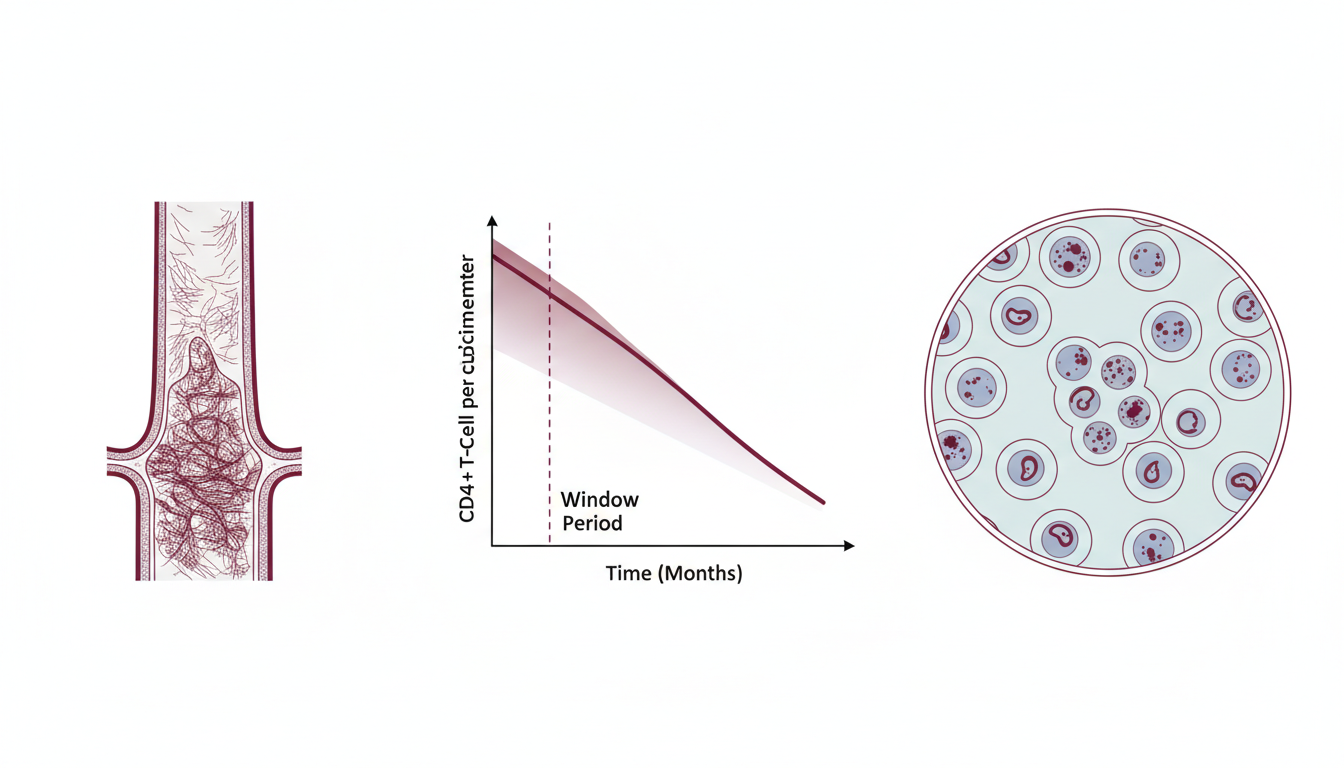
Two separate clocks govern every STI test, and conflating them is the most common source of a false-negative result. The incubation period is the time between exposure and the appearance of symptoms, if any ever appear. The window period is the time between exposure and when a test can reliably detect the infection. They are not the same number, and that gap is where false-negative results come from.
Imagine an exposure on a Friday night. A test taken Monday morning may return negative even though the infection is real. The test is working correctly; the body has simply not yet produced enough bacterial DNA, viral RNA, or antibodies to clear the assay's detection threshold. The detection has not caught up to the infection.
This distinction matters because a lot of people test too soon, get a negative result, and treat it as final. A reassuring early negative is reasonable as a starting point, but it does not close the question. Public-health guidance recommends a confirmatory retest after the relevant window has fully closed, especially for HIV, herpes, and syphilis, where antibody-based tests take longer to register a true positive.
Public-health modeling consistently finds that a large share of new chlamydia, gonorrhea, herpes, and HIV transmissions come from people who have no symptoms at the time of transmission. 'Looking healthy' is not a clinical signal anyone, including a sexual partner, can use to assess risk. Testing is.
When to Test After a Possible Exposure
The right time to test depends on the infection, the test technology, and your tolerance for an early-but-imperfect screen. Below is a general guide aligned with current CDC and WHO STI guidance. If you have any reason to test sooner (anxiety, an upcoming medical procedure, a partner who tested positive), an earlier test still has value as a starting point, with a follow-up test after the window closes.
Specific tests have specific labels, so always cross-check with the kit or lab you are using. The intervals below are central guidance, not single-study figures.
| Infection | Earliest meaningful test | Best accuracy | Confirmatory retest? |
|---|---|---|---|
| Chlamydia | About 7 days | 14+ days | Recommended if tested before day 14 |
| Gonorrhea (any site) | About 7 days | 14+ days | Sometimes |
| Trichomoniasis | About 5 days | 14 to 28 days | Optional |
| Syphilis (blood) | About 3 weeks | 6 to 12 weeks | Yes if exposure was recent |
| HIV (4th-generation lab) | About 18 days | 45 days | Optional unless high risk |
| HIV (rapid antibody) | About 3 weeks | Up to 90 days | Yes if tested early |
| Herpes HSV-2 (blood) | About 3 weeks | 6 to 12 weeks | Yes; up to 16 weeks for slow seroconverters |
| Hepatitis B (blood) | About 3 weeks | 8 to 12 weeks | Yes if tested early |
| Hepatitis C (blood) | About 4 weeks | 12 weeks | Yes if tested early |
At-Home, Mail-In, or Clinic: Picking the Right Method
As a supplier of at-home rapid test kits, we have a commercial interest in the products linked from this page. Each recommendation below matches a test format to a specific reader situation.
If you have skipped testing because clinics feel awkward, slow, or hard to fit into a schedule, the testing landscape has changed significantly. Three formats now coexist, and each fits a different reader.
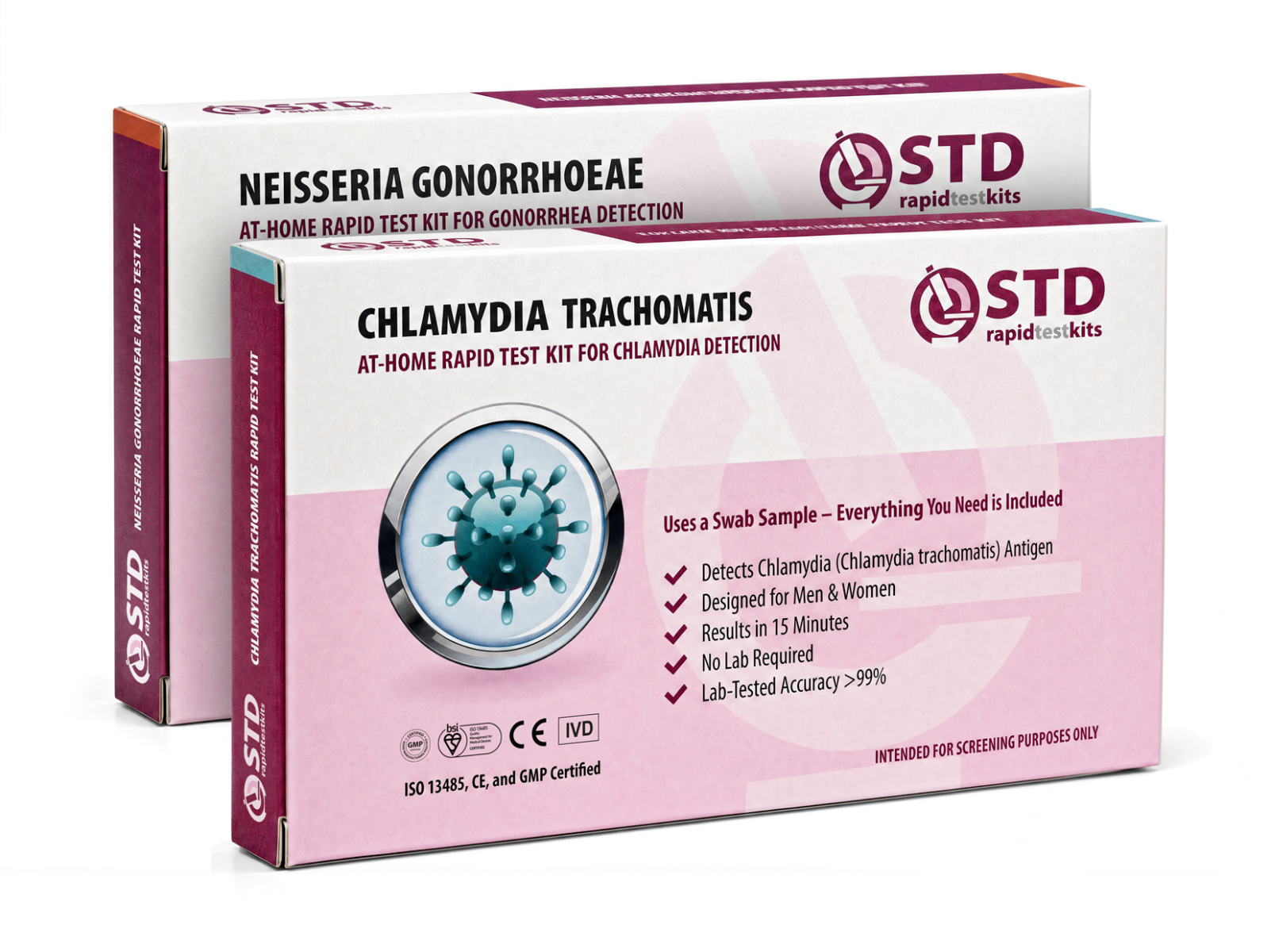
At-home rapid lateral-flow kits are the fastest. You collect a sample (fingerstick blood for HIV, syphilis, hepatitis, and herpes; vaginal or penile swab for chlamydia and gonorrhea; vaginal swab only for HPV and trichomoniasis, since our HPV and trich kits are validated for female anatomy and male readers needing either test should visit a sexual health clinic), run it on the cassette, and read the result in roughly 15 minutes. Sensitivity for the major sexually transmitted infections is high when the test is used after the window period closes, though lateral-flow chemistry is generally less analytically sensitive than laboratory NAAT or lab-based immunoassays. A positive home result should be confirmed at a lab. A properly timed negative result is usually reliable.
Mail-in lab tests use the same NAAT or lab-based immunoassay technology as a clinic lab. You collect a sample at home, mail it in, and get lab-grade results within a few days. Sensitivity matches in-clinic testing, with the tradeoff of waiting a few days for results and needing a working postal pickup.
Clinic visits remain the analytic reference standard, especially when symptoms are present, when treatment is needed alongside testing, or when you want a clinician's interpretation built into the visit.
| Method | Privacy | Speed | Sample technology | Best for |
|---|---|---|---|---|
| At-home rapid kit | Very high | About 15 minutes | Lateral-flow on swab or fingerstick blood | Asymptomatic screening, fast peace of mind |
| Mail-in lab kit | High | 2 to 5 days | Lab NAAT or lab-based immunoassay | Lab-grade accuracy without a clinic visit |
| Clinic visit | Moderate | Same day to several days | Lab NAAT or lab-based immunoassay | Symptoms present, treatment alongside testing, complex cases |
How Often Should You Test If Nothing Feels Wrong
There is no single answer because risk varies. The CDC, WHO, and NHS screening recommendations all focus on a few populations and intervals.
For HIV, the CDC recommends at least one screening for everyone aged 13 to 64, regardless of perceived risk per CDC HIV testing guidance. People with ongoing exposure factors (multiple partners, condomless sex outside a tested-monogamous relationship, injection drug use) should test more often, often every three to six months.
For chlamydia and gonorrhea, the CDC recommends annual screening for sexually active women under 25 and for women 25 and older with risk factors (new partner, multiple partners, partner with an STI). Men who have sex with men should be screened annually, and more often (every three to six months) if they have multiple or anonymous partners.
For syphilis, screening is recommended annually for men who have sex with men, people with HIV, and people with multiple partners. Pregnant people are screened during prenatal care. For HPV, screening for people with a cervix is built into cervical cancer screening (Pap and HPV co-testing) on a schedule set by age and prior results, typically every three to five years for people with normal results.
If your situation has changed (a new partner, a partner whose status is unknown, or simply a long gap since your last test), an interval-based recommendation is a floor rather than a ceiling, and testing in between is reasonable whenever the question 'Am I clear?' is taking up real space in your head.
CDC routine-screening intervals at a glance
- HIV: at least one screening for everyone aged 13 to 64, plus every 3 to 6 months for people with ongoing exposure factors.
- Chlamydia and gonorrhea: annual screening for sexually active women under 25 and for older women with risk factors. Men who have sex with men, annually or every 3 to 6 months with multiple partners.
- Syphilis: annually for men who have sex with men, people with HIV, and people with multiple partners. Routine during prenatal care.
- HPV: built into cervical cancer screening (Pap and HPV co-testing), typically every 3 to 5 years for people with normal results.
- After a positive chlamydia or gonorrhea diagnosis: retest at 3 months to check for reinfection from an untreated partner.

What to Do If You Test Positive While Feeling Fine
A positive result for an STI you weren't expecting can feel like the test got it wrong. The first instinct, especially when nothing hurts and nothing looks different, is to assume a false positive or a lab mix-up. Sometimes that turns out to be true. Most of the time it doesn't.
The right next step depends on the result and the test format. For an at-home rapid kit positive: schedule a confirmatory test through a clinic or lab. Bacterial infections (chlamydia, gonorrhea, syphilis, trichomoniasis) need confirmation primarily to rule out a false positive and to start the right antibiotic. Viral infections (HIV, herpes, hepatitis B and C) need confirmation through a different test format, since rapid tests look at antibodies and confirmatory tests often look at the virus itself or different antibody markers.
For a clinic or mail-in lab positive: the lab usually runs the confirmatory test as part of the result panel, and your provider can move directly to treatment. Most bacterial STIs need a single dose or a one-week antibiotic course. HIV is managed with daily antiretroviral therapy, which typically reaches an undetectable viral load within a few months. Herpes is managed with antivirals that suppress outbreaks and reduce transmission.
One specific follow-up matters: for chlamydia or gonorrhea, the CDC recommends a test of reinfection 3 months after treatment, because re-exposure from an untreated partner is the most common source of repeat positives. Notify recent sexual partners so they can test and treat in parallel. Many jurisdictions support anonymous partner notification through public-health departments if direct conversation is difficult.
1) Confirm the result through a clinic or lab using a different test format. 2) Notify recent sexual partners directly, or use anonymous public-health partner notification if direct conversation is too hard. 3) Start treatment promptly. Most bacterial STIs need a short antibiotic course, and antiviral therapy for HIV and herpes works best when started early.
Talking to a Partner About Testing Without Making It Awkward
The conversation isn't easy, but framing it as a mutual care exchange shifts the dynamic. A line that works for many couples: 'Most common STIs don't show symptoms, and I want to know we're both clear, not just guess. Want to test together?' That phrasing puts the request inside the relationship rather than across from it.
If a current partner just tested positive and is telling you, the same framing applies in reverse. Their telling you is a protective step that helps stop the infection from spreading further. Treating partner notification as caretaking rather than blame makes the conversation possible. Public-health departments in most regions can also notify partners on your behalf without naming you, if direct conversation feels too charged.
If the response to your suggestion is anger, defensiveness, or shaming, treat that response as useful information about the relationship rather than about testing.
STIs are often asymptomatic. When symptoms occur, they can be non-specific.
Your next steps
- Note when you last tested, or whether you have never tested for sexual-health infections.
- Count forward from your most recent possible exposure to the relevant window period in the testing-timing table above.
- Choose a test format that fits your situation: at-home rapid kit for a fast private result, mail-in lab for NAAT-level accuracy, or a clinic visit if symptoms are present or treatment alongside testing is needed.
- Confirm any reactive at-home result through a clinic or lab before starting treatment.
- Notify recent partners if a result is positive. Many regions offer anonymous public-health notification if direct conversation is not possible.
FAQs
- Can I really have an STD and feel completely fine?
- Yes. Most cases of chlamydia, the majority of pharyngeal and rectal gonorrhea, most HPV infections, and a high proportion of herpes and trichomoniasis carry no recognizable symptoms. The CDC notes that most people with genital herpes have no symptoms or only very mild symptoms, and that many infections go unrecognised. HIV produces a brief, non-specific illness in some people during acute infection, then often stays silent for years. CDC and WHO guidance ties screening intervals to time-since-last-test and risk factors rather than to how someone feels.
- How long can an STI stay silent?
- Months to years, depending on the infection. Chlamydia and gonorrhea can persist for many months without producing recognizable symptoms while ascending into the upper reproductive tract. HIV's clinical-latency phase typically lasts about 8 to 10 years untreated. HPV often produces no symptoms during the entire course of infection. Herpes is lifelong once established and can stay quiet between outbreaks indefinitely.
- How long after exposure should I wait before testing?
- It depends on the test. Chlamydia and gonorrhea testing is reliable from about 1 to 2 weeks. Syphilis serology is reliable from 3 to 6 weeks. HIV 4th-generation antigen-antibody is reliable from about 18 to 45 days; rapid antibody-only home tests can take up to 90 days. Herpes type-specific antibody reaches full sensitivity for most assays by 12 weeks, with up to 16 weeks for slow seroconverters. Testing earlier is fine for early reassurance, but plan a confirmatory retest at the right window.
- Is a negative test taken within a few days of exposure trustworthy?
- Not on its own. The result reflects what the test could detect at that moment, which inside the window period may be below threshold even when infection is real. A negative rapid test taken three days after exposure should be repeated at the proper window. Treat the early result as a starting reference, not a final answer.
- If my last test was negative, am I in the clear?
- A negative test means the test didn't detect infection in the sample collected at that point. If you have new exposures since then, a new test is warranted. If you tested very soon after a recent exposure, retest after the relevant window has closed: around 14 days for chlamydia and gonorrhea, 6 weeks for syphilis, and 12 weeks for antibody-based HIV or HSV-2 tests.
- Can I transmit an STI without symptoms?
- Yes. Asymptomatic transmission is the norm for most common STIs, including chlamydia, gonorrhea, herpes, and HIV. HSV in particular sheds infectious virus from skin without visible sores during asymptomatic shedding episodes. The reasoning that 'I would feel something if I were contagious' is not how these infections behave. Transmission frequently happens without either partner being aware.
- Are at-home rapid tests reliable when I have no symptoms?
- Yes, when used within the recommended window. Rapid lateral-flow kits use the same sample type as some lab methods and show high sensitivity when used correctly and on time. A positive result should still be confirmed at a lab, because rapid lateral-flow chemistry is screening-grade rather than diagnostic-grade. A properly timed negative is usually reliable, but cannot rule out an exposure that happened too recently.
- Should I test if I am in a long-term monogamous relationship?
- If neither of you tested before the relationship started, and one of you was sexually active before, then yes, even years in. Some infections (especially HPV and herpes) can persist for years from a previous partner. A baseline test for both partners replaces assumption with evidence and is recommended before stopping barrier methods in a new relationship.
- U.S. Centers for Disease Control and Prevention. About chlamydia. Source for the largely asymptomatic nature of chlamydia infection, screening recommendations, and the 3-month reinfection retest.
- U.S. Centers for Disease Control and Prevention. About genital herpes. Source for the statement that most people with genital herpes have no symptoms or have very mild symptoms, that many infections go unrecognised, and that transmission is possible during asymptomatic shedding.
- U.S. Centers for Disease Control and Prevention. About HPV. Source for the two-year clearance figure for most genital HPV infections and the link between persistent high-risk strains and cervical cancer.
- U.S. Centers for Disease Control and Prevention. About trichomoniasis. Source for the ~70% asymptomatic carriage figure used in the silent-STIs table.
- U.S. Centers for Disease Control and Prevention. HIV testing. Source for test types, window periods, and the 13-to-64 routine screening recommendation.
- World Health Organization. Sexually transmitted infections (STIs) fact sheet. Source for the statement that STIs are often asymptomatic and that, when symptoms occur, they can be non-specific.
- U.K. National Health Service. Sexually transmitted infections (STIs) overview. Source for the routine-screening framing and symptom variability across infections.
- Mayo Clinic. Pelvic inflammatory disease. Source for the structural-damage trajectory of untreated chlamydia and gonorrhea, including fallopian-tube scarring and ectopic-pregnancy risk.
