
Published: August 2025 | Last updated: May 2026 | Editorial review and quality control: Martina N.
If you are polyamorous and Googling whether your relationship style raises your odds of catching an STD, you have already done something most monogamous people skip: you have thought about it. That single act of attention turns out to be one of the strongest predictors of who ends up with an undiagnosed infection and who catches one early.
The cultural script is simple: more partners means more disease. The published research keeps complicating that math. When people in consensually non-monogamous (CNM) relationships are compared to monogamous people on the metrics that actually drive STI transmission, condom use, testing frequency, and disclosure to partners, the CNM group often comes out ahead. Behavior changes outcomes more than the relationship structure does.
This piece walks through what the data shows, why testing cadence matters more than partner count, and what to do if a symptom shows up. Plain English, current public-health guidance, no shame.
Key Takeaways
- People in consensually non-monogamous relationships use condoms more often and test for STIs more often than monogamous people, according to peer-reviewed research.
- Partner count alone is a weak predictor of STI risk. Testing cadence, barrier use, and honest disclosure matter much more.
Risk lives in behavior, not relationship structure
STDs do not recognize relationship status. Bacteria and viruses respond to body fluids, mucous membranes, and skin contact. They have no awareness of whether you have signed a monogamy agreement or scheduled tonight's date through Feeld.
The reason this matters for public-health risk is that infection patterns get measured against specific behaviors, not against vibes. Two questions explain most of the variance: did the people involved use barriers consistently for the kind of contact that transmits the relevant pathogen, and did they test recently enough to know their current status? Those questions are answerable. They produce data. And in that data, monogamous and polyamorous people do not fall where most assumptions put them.
The cultural script says monogamy equals safety because exposure stops at one partner. The biological reality is that exposure depends on what each partner has, what they share, and whether anyone in the network has had untested contact recently. A monogamous person whose partner is cheating without disclosure carries the same biological exposure as someone in an open network who tested last week. The first thinks they are safe; the second knows where they stand.
Across decades of public-health research, two behaviors carry most of the predictive weight for whether a person picks up or transmits an STI: consistent barrier use for the kind of contact that transmits the relevant pathogen, and recent testing that confirms current status. Partner count, relationship structure, age, and orientation all matter less than these two behaviors do.
What researchers have measured
The most-cited research on this question is Justin Lehmiller's 2015 comparison of sexual health between monogamous and consensually non-monogamous adults, published in The Journal of Sexual Medicine. The study found that people in CNM relationships were significantly more likely to use condoms with both primary and outside partners, more likely to have been tested recently, and no more likely to report a current STI than their monogamous peers (Lehmiller, 2015).
That last point bears repeating. Despite more partners on paper, the rate of self-reported active infection was statistically similar between the two groups. The mechanism is straightforward: behaviors that reduce per-act transmission, consistent barrier use, recent test confirmation, and honest disclosure, scale better than reducing partner count alone.
Despite more partners on paper, rates of self-reported active STI infection were statistically similar between consensually non-monogamous and monogamous groups.
Why the pattern holds across studies
Lehmiller's work is not an outlier. Subsequent surveys of CNM populations in the United States and Europe have repeatedly found higher rates of condom use with extra-dyadic partners and higher rates of routine STI testing compared to monogamous baselines. The pattern holds when researchers control for age, gender, and sexual orientation.
The picture for cheating in monogamous relationships looks different. By definition, infidelity inside a monogamous structure happens without the safety scaffolding of a disclosed agreement. Condoms are less likely to be used, because their presence could signal the affair. Testing is less likely to happen, because seeking a test could prompt questions from the primary partner. An infection that travels through that scenario reaches the unsuspecting partner faster and stays undetected longer than one that travels through an open network with regular check-ins.
Do polyamorous people get more STDs than monogamous people?
Not by relationship structure alone. Having more partners increases exposure points, but research consistently shows that people in consensually non-monogamous relationships use condoms more often and test more frequently than monogamous people, which leads to similar or even lower rates of undiagnosed infection. Risk follows specific behaviors (testing, barrier use, disclosure), not the number of partners.
Why testing cadence matters more than partner count
A new partner is not the same risk to your body as a new diagnosis. The body responds to what arrives, not to how many people you have been with. Two people who each slept with five new partners in the past year, one who tests every three months and one who last tested in 2022, do not carry the same risk profile, even if their behavior reads identical on a dating app.
The reason testing cadence carries so much weight is that most common STIs are silent in early stages. Most people with chlamydia have no symptoms at all, according to CDC chlamydia guidance. Gonorrhea is similarly stealthy, particularly when it lodges in the throat or rectum where it produces fewer noticeable symptoms. The CDC's STI screening guidance recommends routine annual testing even for people without symptoms, and more frequent testing for people with multiple or new partners.
HIV warrants specific attention for anyone in a multi-partner network, because it is the infection most readers worry about most. The CDC's HIV transmission guidance describes condoms and HIV-prevention medications as powerful tools, and notes that factors like viral load, other STIs, and substance use can change per-act risk significantly. Pre-exposure prophylaxis (PrEP) further reduces transmission risk when taken as prescribed; the CDC's PrEP guidance states that PrEP "greatly reduces your chance of getting HIV from sex" and reaches maximum protection within about 7 to 21 days of daily use depending on the type of exposure. Combined with quarterly HIV testing and consistent barrier use, those tools bring residual HIV risk in a typical poly network to a clinically manageable level, and a PrEP conversation with a primary care provider is a reasonable first step for anyone with multiple ongoing partners.
In polyamorous communities, that more-frequent cadence is often the cultural default. Every three months, sometimes every month, sometimes between each new partner. Many people in poly networks treat the schedule the way other people treat dental cleanings: it is part of maintaining the body, not a response to crisis. Infections get caught and treated before they spread further, even in networks with more partners overall.
This is also why two people with identical partner counts can have wildly different outbreak histories. The poly person who tests every quarter and treats positive results within a week of detection breaks the transmission chain quickly. The monogamous person who skipped testing for a year, then discovered an asymptomatic infection that had been present for months, has been silently exposing their partner the entire time.

How safer-sex agreements work in practice
Safer-sex agreements are the structural backbone of poly risk management. The term sounds clinical, but in practice it is an ongoing conversation: who uses barriers with whom, how often everyone tests, what gets disclosed and to whom, and what happens if someone steps outside the agreement.
A typical agreement in a poly network might look like: condoms with all partners outside the primary fluid-bond; full-panel testing every three to six months; immediate disclosure if a new partner reveals a positive result; and a 14-day pause on sex with the primary if a possible exposure happens, until a window-period test clears the concern.
The specifics vary, but the principle is consistent. Risk is acknowledged, discussed, and managed before it becomes a crisis. Compare that with the typical monogamous arrangement, where the agreement is implicit, condom use often stops after the relationship feels established, and testing happens only if something goes visibly wrong. The implicit version sounds simpler, and it offers no recovery plan when something does happen.
Where the explicit model becomes especially powerful is in handling the inevitable: people will sometimes act outside the agreement, condoms break, lab results take days, and partner networks grow over time. An explicit framework gives everyone involved a way to talk about those events without triggering a relationship collapse. Many poly networks anchor their testing schedule to a standing quarterly reminder, and the kit referenced below covers the full standard panel in one box.
Full disclosure: this site sells the rapid at-home kits referenced in this article. Details on what each kit covers and what it does not are in the callout further down.
When a symptom shows up, what to do
Most symptoms you will Google at 3 a.m. have several possible explanations. A sore throat after oral sex could be strep, viral pharyngitis, or post-sex throat irritation; in a small percentage of cases, it could be pharyngeal gonorrhea or HSV-1. A red patch on the inner thigh is more often folliculitis or contact dermatitis than syphilis. A bump near the genital region is more often an ingrown hair or a sebaceous cyst than a herpes lesion.
Worth acting on anyway. Most STIs are diagnosable with a quick lab or rapid test, and once you have a result, you have something concrete to work with. Knowing reduces the cognitive load even when the news is not what you hoped for.
The harder part is rarely the test itself. It is the moment between noticing the symptom and acting on it. That gap is where shame keeps people stuck. Within polyamorous communities, the cultural norm is to skip the shame step and treat testing as routine maintenance. The result is operational: infections get caught earlier and treated faster, and partners hear about exposures before more transmission happens.
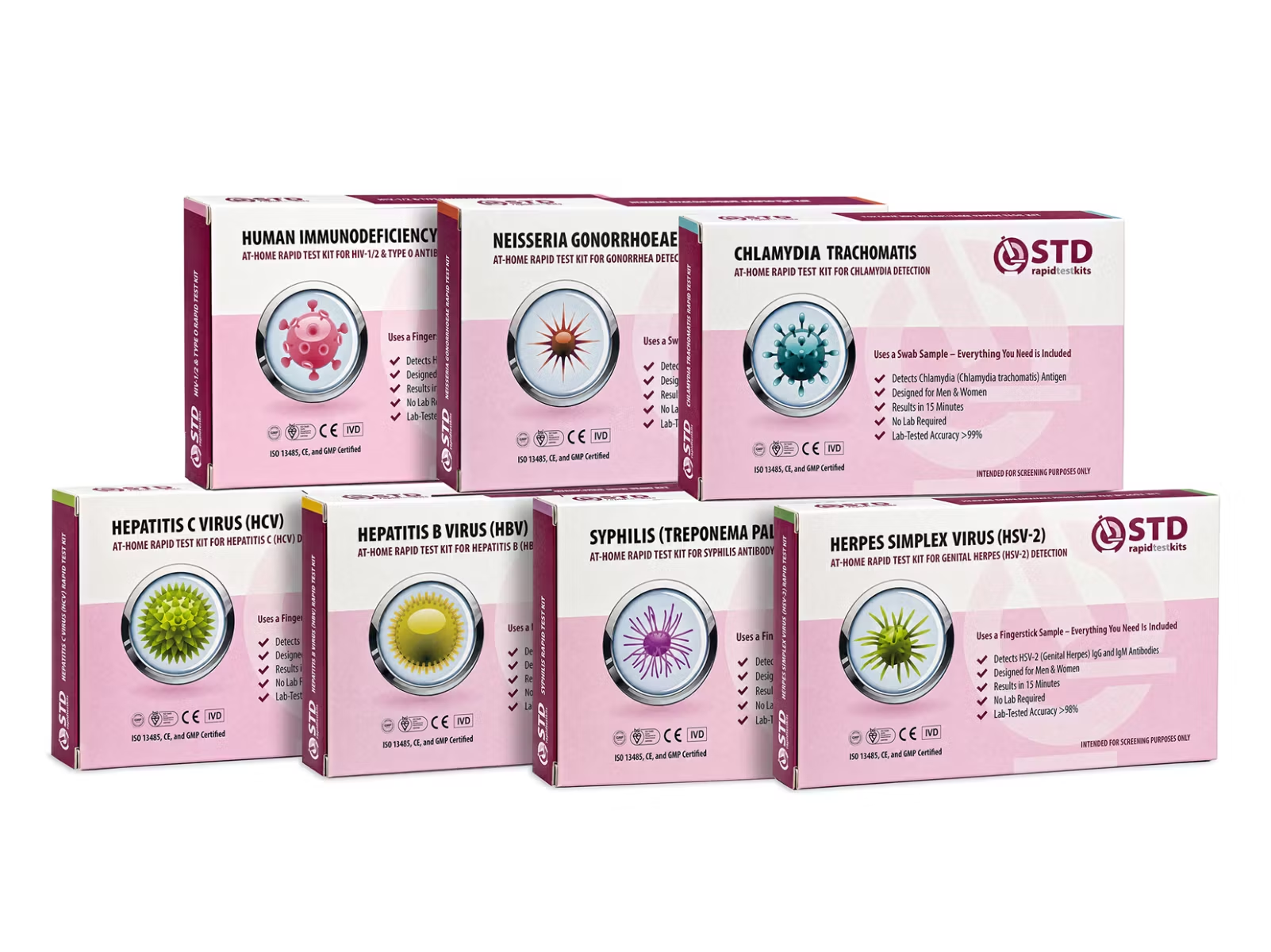
Our rapid at-home tests cover the most common genital and blood-based infections: HIV, syphilis, hepatitis B, hepatitis C, chlamydia, gonorrhea, HSV-1, HSV-2, HPV (vaginal swab) and trichomoniasis (vaginal swab). For specific sample types we do not sell, throat swabs after oral exposure, rectal swabs after anal exposure, and urine NAATs, a sexual health clinic is the right setting. Lab NAAT testing also has higher analytical sensitivity than rapid lateral-flow strips, which makes it the preferred follow-up for any positive rapid result.
How often should you test?
The CDC recommends at least annual testing for sexually active adults, with more frequent testing for people who have multiple partners, new partners, or partners whose status they do not know (CDC STI testing guidance). For people with multiple ongoing partners, every three to six months is a common cadence, and quarterly testing tends to align well with the window periods for the most common infections.
Specific timing matters because of how each pathogen presents. Chlamydia and gonorrhea typically become detectable within roughly one to two weeks of exposure per CDC STI treatment guidelines. Syphilis can take three to six weeks to show on a blood test. HIV antibody tests have a window of about 23 to 90 days depending on the assay generation (CDC HIV testing). For HSV-2, the CDC STI treatment guidelines on herpes recommend repeat type-specific antibody testing 12 weeks after a suspected acquisition, which sets the practical upper end of the seroconversion window. If you test the morning after a possible exposure, you may be testing too early to catch a recent infection; the result is meaningful but does not rule out an exposure that has not yet seroconverted (meaning the body has not yet produced detectable antibodies in response to the infection).
A practical pattern that works for most people in a multi-partner setting: a full panel every three to six months as a maintenance schedule, plus an extra test after any specific exposure you are worried about, timed to the window period for the pathogen you are most concerned about. Many poly communities run this on a shared calendar or spreadsheet, which sounds clinical but reduces the cognitive load of remembering individually.
For people whose risk profile is changing, a new partner who has not tested in a while, a one-time encounter outside the usual agreement, a condom failure, the right move is a window-period test scheduled specifically for that event, on top of the regular maintenance schedule.
Talking openly and honestly with your partner about your sexual history, getting tested for STIs, and using condoms consistently and correctly can lower your STI risk.
Disclosure as a public-health practice
Disclosure is the part of safer sex that no test result can replace. A test tells you what your body is carrying right now. Disclosure tells your partners what they need to factor into their own decisions, and lets them tell you the same.
In monogamous structures, disclosure is often implicit and one-time: you assume your partner's status equals your own, and the conversation rarely revisits unless something goes wrong. In poly structures, disclosure is recurring and explicit. New partners get a current status update before any higher-risk contact. Existing partners hear about it if a recent test changes the picture. Positive results get communicated to anyone who shared relevant exposure during the relevant window.
This is the part that monogamy culture rarely teaches. There is no rehearsal for telling someone you tested positive for chlamydia, herpes, or HIV, because the dominant cultural script assumes it will not happen. When it does, people panic, hide, or delay, and the infection continues moving through networks of people who do not know they need to test.
Poly communities have built disclosure scripts out of necessity. A typical message reads: "I tested positive for X today. I am being treated. We had relevant contact on Y date. You should test for it on Z date." Short, factual, no apology, no drama. The format works because everyone involved has agreed in advance that this is how the conversation goes.

What this means in practice
The honest answer to whether polyamorous people get more STDs is conditional. More partners statistically means more potential exposure points. The people most likely to catch an undiagnosed infection, though, are those who do not test, do not use barriers, and do not tell anyone when something happens. By those measures, polyamorous people often manage their risk better than their monogamous peers.
If you are in a poly relationship and worried right now, the move is the same one that works in any relationship structure: test, treat what shows up, tell the people who need to know. Stigma slows that process. Habits speed it up.
Three practical next steps
- Test on a regular schedule matched to your partner network. Every three to six months is a reasonable baseline for people with multiple ongoing partners.
- Treat positive results promptly. Most common STIs (chlamydia, gonorrhea, syphilis, trichomoniasis) are curable with antibiotics, and herpes and HIV are manageable long-term.
- Tell partners who shared exposure during the relevant window so they can test in time. A short, factual message is enough.
FAQs
- Do polyamorous people actually get more STDs than monogamous people?
- Research comparing monogamous and consensually non-monogamous adults, including Lehmiller's 2015 study in The Journal of Sexual Medicine, found similar rates of active STI diagnosis across both groups despite CNM participants having more partners on paper. The protective factor was behavioral: CNM participants used condoms more consistently and tested more frequently. Relationship structure is not the driver here; behavior is.
- How often should I get tested if I have multiple partners?
- The CDC recommends at least annual testing for sexually active adults, and more frequent testing for people with multiple or new partners. In practice, every three to six months is a common cadence in polyamorous networks, with an extra window-period test after any specific exposure you are concerned about.
- Can I get an STD from oral sex?
- Yes. Gonorrhea, chlamydia, herpes (HSV-1 and HSV-2), and syphilis can transmit through oral contact. Throat infections often produce mild or no symptoms, which is part of why routine testing matters. A sore throat after oral sex is usually viral, but pharyngeal gonorrhea is a clinical possibility, and a throat swab at a clinic is the right test to rule it out.
- What should I do if I test positive while in a poly relationship?
- Most STIs are treatable. Chlamydia, gonorrhea, syphilis, and trichomoniasis are cured with antibiotics. Herpes and HIV are managed long-term rather than cured. Start the treatment your provider recommends, notify any partner who shared relevant contact during the likely exposure window, and tell them what to test for and when. The disclosure script can be short and factual; the goal is to help your partners get tested before the infection spreads further.
- How do I ask a new partner about their testing status?
- Treat it as a routine question, not an accusation. A direct phrasing works: "When was your last full panel, and what was on it?" Be ready to share your own results in return. If a partner reacts defensively or refuses to discuss it, that is information about their general approach to risk, not a personal slight to you.
- Can I use an at-home test instead of a clinic visit?
- For most common infections, yes. Rapid lateral-flow at-home tests cover HIV, syphilis, hepatitis B, hepatitis C, chlamydia, gonorrhea, HSV-1, HSV-2, HPV (vaginal swab), and trichomoniasis (vaginal swab). Lab NAATs at a clinic have higher analytical sensitivity for asymptomatic infections, but for routine screening and maintenance, at-home tests are convenient and reliable. For throat or rectal swabs, see a clinic; those sample types are not available as at-home rapid tests.
- Does a closed polyfidelitous relationship still need regular testing?
- A baseline test at the start of the closed structure, plus a follow-up after the window periods of the relevant infections have passed, establishes the group's status. After that, testing frequency can drop, unless someone steps outside the agreement. The principle is the same as monogamy: closure works as a risk-reducer only when everyone in the structure stays inside it.
- What is the difference between a rapid at-home test and a clinic NAAT?
- Rapid at-home tests use lateral-flow immunoassay strips that detect antibodies or antigens, with results in roughly 15 to 30 minutes. Lab NAAT tests (nucleic acid amplification) detect the pathogen's DNA or RNA, with higher analytical sensitivity but a multi-day turnaround. Both are useful: rapid tests for routine screening and quick reassurance, NAAT for confirmation of positive results or for screening early in the window period.
- Lehmiller, J. J. (2015). A comparison of sexual health history and practices among monogamous and consensually nonmonogamous sexual partners. The Journal of Sexual Medicine. Used here for the comparison of condom use and STI testing rates across relationship structures.
- U.S. Centers for Disease Control and Prevention. Sexually transmitted infections overview, screening recommendations, and testing guidance for the U.S. population.
- U.S. Centers for Disease Control and Prevention. About chlamydia, including the statement that most people with chlamydia have no symptoms.
- U.S. Centers for Disease Control and Prevention. Causes of HIV, including how transmission risk varies with condom use, viral load, and co-occurring infections.
- U.S. Centers for Disease Control and Prevention. Pre-exposure prophylaxis (PrEP) guidance, including the statement that PrEP greatly reduces the chance of getting HIV from sex when taken as prescribed and timelines for reaching maximum protection.
- U.S. Centers for Disease Control and Prevention. STI treatment guidelines landing page; used for chlamydia and gonorrhea detection-window timing referenced in the body of the full 2021 guidelines linked from this page.
- U.S. Centers for Disease Control and Prevention. STI treatment guidelines on genital herpes, used for the recommendation to repeat type-specific HSV-2 antibody testing 12 weeks after suspected acquisition.
- U.S. Centers for Disease Control and Prevention. HIV testing overview, used for the antibody-test window period of approximately 23 to 90 days depending on assay generation.
