
Published: August 2025 | Last updated: May 2026 | Editorial review and quality control: Martina N.
You're three days into a trip somewhere new. The conversation with someone you met that afternoon has gone from casual to charged, and now you're alone with them and a decision you didn't quite plan for. You have an STI. Do you say something?
The honest answer sits at the intersection of three different questions: what the local law actually requires, what good ethics asks of you, and what feels safe given where you are and who you're with. Sometimes those three answers line up cleanly. Sometimes they don't. This guide walks through how to read each situation and have the conversation, including the parts no guidebook prepares you for.
Key Takeaways
- STI disclosure rules vary widely. Many U.S. states still have HIV-specific criminal exposure statutes, and several countries criminalize exposure to HIV, hepatitis, or herpes regardless of whether transmission occurs.
- Ethically, disclosure protects your partner's right to informed consent. Where honest disclosure puts your personal safety at risk, consistent barrier use plus avoiding the highest-risk activities is the harm-reduction floor, not a substitute for honesty when it's safe.
This article is published by stdrapidtestkits.com, which sells at-home STI testing kits. We recommend products only where they actually fit the reader's concern, not based on commercial benefit. We don't sell legal advice; laws change, and country-specific questions belong with a local attorney or public-health agency.
What the law says about STI disclosure abroad
Disclosure laws are not uniform anywhere. In the United States, many states still have HIV-specific criminal exposure statutes that predate modern treatment, and a few extend to hepatitis or other infections (the CDC's HIV pages include policy and law resources you can search for state-level detail). Canada's Supreme Court applies a more nuanced standard: disclosure is legally required when there is a 'realistic possibility' of transmission, which can exempt people with suppressed viral loads who consistently use condoms.
Several countries criminalize exposure regardless of whether transmission actually happens. Singapore, parts of Australia, and several Eastern European jurisdictions have broad public-health laws that can apply to HIV, hepatitis B, and in narrower cases other STIs. Penalties range from civil damages to multi-year prison sentences.
The practical takeaway: before you travel, look up the specific rules for your destination if you're managing a chronic STI. The CDC's traveler health pages and your destination's national public health agency are the most reliable starting points. If you can't get a clear answer in advance, assume the strictest interpretation. The cost of disclosing in a low-stigma country is at worst awkwardness. The cost of staying silent in a country with broad exposure laws can be prosecution.
| Region | Law type | Notes |
|---|---|---|
| United States | State-level criminal statute (HIV-focused, some include hepatitis) | Varies widely by state; a few states have modernized statutes that consider viral load and condom use. |
| Canada | Supreme Court 'realistic possibility' standard | Disclosure required where realistic transmission risk exists; suppressed viral load plus condom use can lower the bar. |
| European Union | Mostly civil liability; criminal statutes in a few member states | Public-health approach dominates; partner notification handled through clinics rather than criminal courts in most countries. |
| Singapore, parts of Australia, several Eastern European countries | Broad public-health criminal statute | Can apply to HIV, hepatitis B, and other STIs; exposure alone may be sufficient for prosecution in some cases. |
| No specific STI law | General assault or civil-damages framework | A partner who proves harm may still sue or press charges under general statutes. |
Ethics: why honesty matters beyond what's required
Even where the law is silent, disclosure protects something real: your partner's ability to make an informed choice about their body and their risk tolerance. Casual sex still involves consent, and consent that's missing critical information isn't fully informed.
There's a practical side too. Not telling a partner can lead to unintended transmission, partner anger or retaliation if they learn the truth later, and in some places civil claims for damages even where criminal disclosure laws don't apply. Many people who do disclose find their partners respond more calmly than expected; the version of the conversation playing in your head is usually worse than the one that actually unfolds.
More than 1 million curable sexually transmitted infections (STIs) are acquired every day worldwide in people 15–49 years old, the majority of which are asymptomatic.
Cultural context shapes how the conversation lands
Sexual health is openly discussed in some places and a near-total taboo in others. Many Northern and Western European countries treat STI status as a routine health topic; the UK's NHS publishes plain-language information freely, and Scandinavian public-health campaigns have normalized partner notification for decades. In much of Asia, the Middle East, and parts of Africa, premarital or non-monogamous sex carries stigma of its own, which compounds the difficulty of disclosing an STI on top of it.
This matters for two reasons. The same disclosure script that lands fine in Berlin might draw a fearful or hostile reaction in a more conservative setting. And language barriers add their own friction; condition names don't always translate directly, and 'herpes' or 'HPV' carry different weight in different cultures.
If you're managing a chronic STI and traveling somewhere with a different primary language, write the condition name and a one-sentence plain-language explanation in the local language before you leave. Condition names don't always translate directly, and having it on your phone removes language-barrier friction in the moment.
When and how to bring it up
Timing matters almost as much as content. Three patterns work for most travel hookups:
- Before you meet in person. If you connected on an app, mention it in messages once the conversation feels real. This takes pressure off the in-person moment and lets the other person opt out without face-to-face awkwardness.
- Early in the evening, before things move physical. Over a drink or during the walk to a quieter spot. The energy is still friendly rather than charged, and there's space for questions.
- At the moment things start escalating. A pause and a short, calm sentence. Less ideal than earlier disclosure but much better than no disclosure.
What doesn't work: bringing it up after sex has already happened, blurting it as an apology, or burying it in vague language that the other person has to decode. Be direct, be specific about the condition (or at minimum the relevant precautions), and give the other person a beat to respond. Five sentences and a question is enough. It doesn't need to be a whole sit-down.
Best: in the app or messaging stage, before you meet face-to-face. Workable: early in the evening, while things are still friendly. Last resort: a calm pause the moment things start escalating. Anything later than that, including after sex, is not disclosure; it's an apology.
Disclosure scripts that don't kill the mood
The lines below strip out apology and frame the conversation around shared decision-making. Pick whichever is closest to your style:
- 'Before we go further I want to tell you something. I have [STI]. I take care of it and I take precautions. Want me to walk you through what that looks like?'
- 'I'm really into this and I want to be honest with you. I have [STI]. We can absolutely still enjoy ourselves, just safely. What questions do you have?'
- 'Hey, quick health note before this goes further. I have [STI]. We're good with [barrier method or avoiding X]. Cool with you?'
All three scripts share the same shape: short, calm, informational, ending in a question rather than an apology.
1. Short. One or two sentences before the ask, not a paragraph. 2. Calm. Status of a flat, factual statement, not a confession. 3. Specific. Name the condition (or at minimum the relevant precaution) rather than gesturing vaguely. 4. A question at the end. Hand the decision back to your partner instead of asking them to absolve you.
Harm reduction when disclosure isn't safe
In some places and with some partners, honest disclosure carries real personal risk: violence, social ostracism inside a small expat or backpacker community, or in worst cases arrest. When that's the case, harm reduction becomes the floor below disclosure, not a substitute for it.
Concrete practices, aligned with Planned Parenthood's safer-sex guidance:
- Consistent and correct condom or dental dam use for every act of penetrative or oral sex.
- Avoiding the activities most likely to transmit your specific STI. For herpes, this means no contact during early warning signs (tingling, itching, or burning that often signal an outbreak is starting) or active lesions. For HIV, it means staying on treatment and ideally maintaining an undetectable viral load.
- Bringing your own barriers so you're never reliant on a partner having them.
- Choosing partners and settings where you can leave easily if the situation shifts.
| If you're managing... | Highest-impact harm-reduction step | Why |
|---|---|---|
| HIV | Stay on antiretroviral treatment; aim for undetectable viral load | An undetectable viral load means effectively untransmittable through sex (U=U). |
| Herpes (HSV-1 or HSV-2) | Avoid contact during early warning signs or visible lesions; consider daily suppressive antivirals | Most transmission happens during outbreaks and the symptom-onset window; barriers help but don't cover all skin-to-skin contact. |
| Hepatitis B | Confirm partner is vaccinated where possible; use condoms | Vaccination is highly protective and widely available; condoms reduce residual risk. |
| HPV | Condom use plus vaccination history check; routine cervical screening if applicable | Condoms reduce but don't eliminate transmission; vaccination prevents most high-risk strains. |
| Chlamydia, gonorrhea, syphilis | Treat to clearance before sex; retest after the appropriate window | These are curable with antibiotics; transmission risk drops to zero once treated and confirmed. |
Test before, during, and after travel
Testing builds the baseline that makes disclosure possible. If you don't know your current status, you don't have anything specific to disclose, which is a separate problem worth solving before you leave.
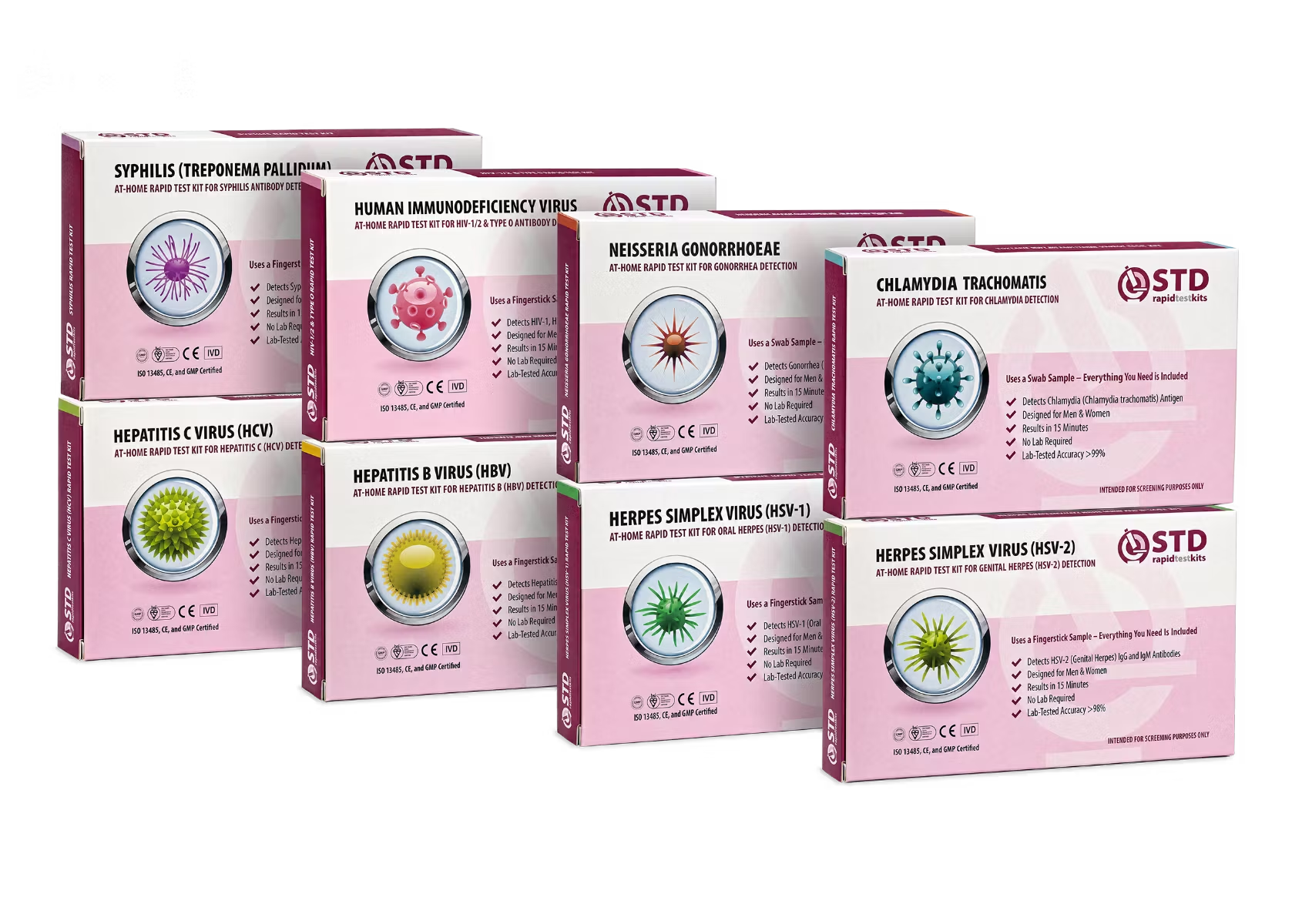
The pre-trip baseline should cover the common bacterial and viral infections: chlamydia, gonorrhea, syphilis, HIV, and hepatitis B at minimum. Add herpes testing if you've had symptoms or known exposure. A negative result before departure protects you legally and emotionally, and gives you a real answer when a partner asks when you were last tested.
Mid-trip testing makes sense on longer trips with multiple partners. Early infection is most transmissible, so catching a new infection within weeks rather than months reduces both your own complications and onward transmission.
Post-trip testing is the most-skipped step. Window periods matter: HIV antibody tests are most reliable about three months after exposure, and syphilis can take similar time to seroconvert. A clean test at four weeks isn't the final word for these infections (see CDC STI testing guidance for current window-period detail).
Travel STI myths worth correcting
A few persistent misconceptions show up in travel hookup contexts:
- 'Oral doesn't count.' Oral contact can transmit herpes, gonorrhea, syphilis, chlamydia, hepatitis B, and in rarer cases HIV. The risk is lower than penetrative sex but not zero, and disclosure obligations generally still apply.
- 'If I use a condom I don't need to disclose.' Condoms reduce transmission of most STIs but do not eliminate it, particularly for skin-contact infections like herpes and HPV. Most disclosure laws have no condom exemption.
- 'They look healthy, so I'm fine.' Most STIs are asymptomatic. The WHO estimates that the majority of new STI infections cause no visible symptoms in the person carrying them.
- 'It's a one-time thing, so no risk.' A single exposure is enough to transmit HIV, hepatitis, herpes, or any other STI. Frequency does not change biology.
Pharyngeal gonorrhea, oral herpes transmission, oropharyngeal HPV, and syphilis chancres of the mouth are all well-documented. Several U.S. states' HIV statutes specifically include oral sex as a covered act. Lower risk is not no risk, and lower risk is not a legal exemption.
Final thoughts: respect, honesty, and your own safety
Travel changes the context without changing the ethics. The same obligations apply across new languages, new laws, and partners you may never see again. The framework holds: where the law requires disclosure, follow it. Where it's silent, default to honesty because your partner deserves the information. Where honesty puts you in danger, harm-reduce and find a safer moment.
Above all, your worth isn't your status. Get tested before you go, know what you're carrying or not carrying, and travel with the same respect for your partners that you'd want extended to you.
FAQs
- Is it illegal to not tell a hookup I have an STI?
- Sometimes, depending on where you are and what you're managing. HIV is the most heavily criminalized worldwide; many U.S. states, parts of Canada and Australia, Singapore, and several Eastern European countries have specific HIV exposure statutes. Hepatitis B is covered in fewer places, and most other STIs sit in a civil-damages or 'general assault' framework. Look up your destination's rules before you travel if you're managing a chronic infection.
- What if I'm in a country where disclosure could put me in danger?
- Your personal safety comes first. Use consistent barrier protection, avoid the activities most likely to transmit your specific STI, and look for a safer setting before having the disclosure conversation. Harm reduction is the floor, not the ceiling.
- Does using a condom mean I don't need to disclose?
- Condoms reduce risk but don't transfer the decision to your partner. They still have a right to know what risk they're accepting, even with protection, and skin-contact infections like herpes and HPV can still transmit despite consistent condom use. Most jurisdictions with disclosure statutes have no condom exemption written into the law.
- Do I need to disclose for oral sex only?
- Yes, where the law applies. Oral contact can still transmit herpes, gonorrhea, syphilis, chlamydia, and hepatitis B. Some U.S. states' HIV statutes specifically include oral sex as a covered act.
- What if I only find out I had an STI after the trip?
- Notify any partner(s) you can reach so they can test and treat early if needed. Many public-health departments offer anonymous partner-notification services that contact partners on your behalf without naming you.
- When's the best time to bring it up?
- Before clothes come off, ideally before the in-person meeting if you connected on an app. The earlier the conversation, the more breathing room both people have to ask questions and make a real choice.
- Can alcohol affect disclosure conversations?
- Yes. Alcohol impairs judgment on both sides and makes it harder for a partner to absorb the information clearly enough to consent meaningfully. If you know a hookup is likely, having a sober line ready (and being sober enough to deliver it) protects both people.
- U.S. Centers for Disease Control and Prevention. STI overview, screening guidance, and window-period information.
- U.S. Centers for Disease Control and Prevention. HIV pages, including policy and law resources searchable for state-level disclosure statutes.
- World Health Organization. Sexually transmitted infections fact sheet, including global incidence figures for curable STIs and asymptomatic-prevalence data.
- U.K. National Health Service. Plain-language reference on common STIs and partner notification.
- U.S. Centers for Disease Control and Prevention Travelers' Health. Sexual-health considerations and testing guidance for international travel.
- Planned Parenthood. Safer-sex practices and barrier-method effectiveness summaries.
