
Published: November 2025 | Last updated: April 2026 | Editorial review and quality control: Martina N.
Buying an at-home STI test sits somewhere between common sense and a leap of faith. You want a clear answer fast, you want privacy, and you want to know whether the kit actually works for the situation you are worried about. This guide walks through what at-home rapid STI test kits do, when each test starts being reliable, which infections need a swab versus a fingerstick blood drop, and how to read your result without spiraling. The goal is not to push every reader toward a kit. Most exposures do not become infections, and many people who buy an STI test for peace of mind get the negative they hoped for. But if you do need to test, the right kit and the right timing make the difference between a meaningful answer and a result you cannot trust. (We publish this guide and sell at-home STI test kits; the recommendations below aim at reader fit, not commercial volume.)
Do at-home STI test kits work?
Yes, with caveats worth knowing. Lateral-flow rapid kits typically report 95 to 99% sensitivity and over 99% specificity once you test inside the recommended window period for that specific infection (manufacturer-reported ranges for commercially available lateral-flow kits; see individual product pages for per-kit figures). Window periods range from one to two weeks for chlamydia and gonorrhea up to twelve to sixteen weeks for HSV-2 antibody seroconversion. Test before the window closes and you risk a false negative. Test after, and a result is meaningful enough to act on, with any positive reasonably confirmed by a clinic NAAT or follow-up serology.
Key Takeaways
- Window periods range from one to two weeks for chlamydia and gonorrhea up to twelve to sixteen weeks for HSV-2 antibody. Test inside the wrong window and a negative result is not trustworthy.
- Our kits are at-home rapid lateral-flow read in about fifteen minutes. They are not lab-mailed NAAT panels; the technology is faster but slightly less sensitive at the very early end of the window.
What an at-home STI test actually does
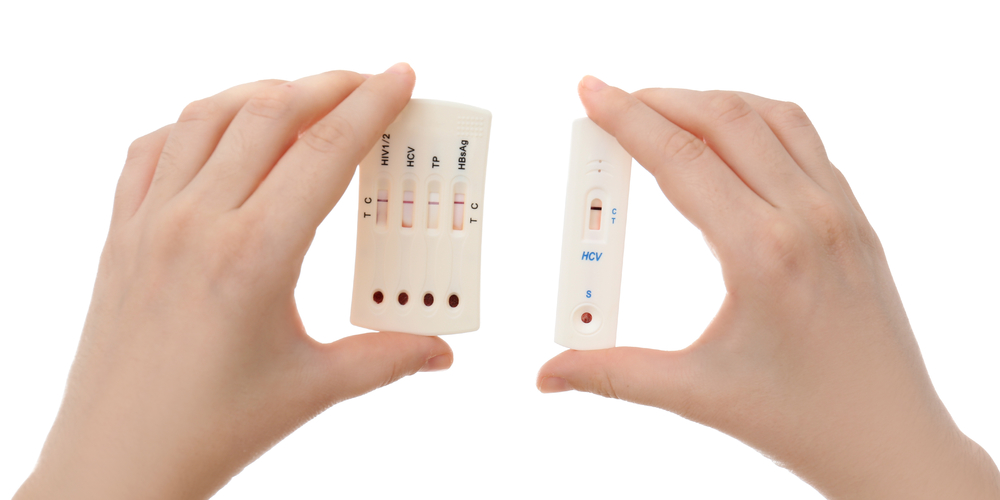
An at-home rapid STI test is a lateral-flow immunoassay. The same chemistry that powers home pregnancy tests and rapid COVID tests, applied to detect markers of a specific sexually transmitted infection. You collect a sample (a self-swab or a fingerstick blood drop), apply it to a cassette, wait roughly fifteen minutes, and read the result lines.
This is different from the lab-processed mail-in panels some other companies sell. Those kits collect a sample, ship it to a lab, run nucleic acid amplification testing (NAAT or PCR), and send you results in two to five business days. Lab NAAT has higher analytical sensitivity at the very early end of the window period. The trade-off is the wait, the lab logistics, and a higher price point.
Home lateral-flow tests trade some early-window sensitivity for speed and privacy. For most readers testing at the right point in the window period, manufacturer-reported sensitivity figures of 95 to 99% and specificity above 99% are typical for the major rapid kits, depending on the infection and the specific assay. Per-kit figures vary; check the individual product page for the test you are considering.
What home rapid tests are good for: confirming a screen result quickly, getting a meaningful answer when a clinic visit is hard to arrange, monitoring your status when you have multiple sexual partners, and resolving anxiety after a known exposure once you are inside the test's window. What they are not designed for: replacing diagnostic NAAT inside the first few days post-exposure, evaluating an active genital ulcer or lesion (that needs an in-clinic swab and visual exam), or routine cervical cancer screening (that follows a Pap and HPV co-test cadence on its own schedule).
Our home STI kits are lateral-flow immunoassays read on the cassette in about fifteen minutes. Clinics typically run NAAT or PCR in a laboratory, which has higher analytical sensitivity at the very early end of the window period. The two are complementary, not equivalent. A negative home test taken inside the recommended window is reliable for most readers. A positive home test is a strong signal worth confirming with a clinic NAAT before starting treatment.
When the window period closes
The window period is the gap between exposure and the moment a test reliably picks up the infection. Test before that gap closes and a negative result is not trustworthy: the infectious agent has not yet replicated to detectable levels (for antigen-based tests), or your immune system has not yet produced enough antibodies (for serology-based tests).
Each infection has its own window. Typical ranges are drawn from CDC and WHO disease-specific guidance for rapid antibody and antigen tests, with the late-end figure being the cautious choice for an asymptomatic exposure. The HIV 23 to 90 day antibody-test window is published in CDC HIV testing guidance; the other infection windows align with each pathogen's CDC fact sheet and the assay manufacturers' instructions for use.
Two practical rules: pick the longest window in the table for the infections you are concerned about, and add a follow-up retest at the long end if you tested early. If you had an exposure on day zero and tested on day fourteen for everything, a negative chlamydia or gonorrhea result is meaningful; a negative HIV antibody result on day fourteen is not, because day fourteen sits inside the HIV window.
Symptoms compress the timeline. If you have active symptoms (genital ulcers, painful urination, abnormal discharge), the test is more likely to be positive earlier because the pathogen load is higher. The windows below assume an asymptomatic exposure where you want the most reliable retest date.
Routine screening is different from exposure-driven testing. The CDC recommends annual screening for sexually active adults under age twenty-five and for higher-risk populations including men who have sex with men, people with multiple partners, and people in non-monogamous relationships. Routine screening does not require a known exposure event.
| Infection | Home test reliable from | Sample type |
|---|---|---|
| Chlamydia | 1 to 2 weeks post-exposure | Self-collected swab |
| Gonorrhea | 1 to 2 weeks post-exposure | Self-collected swab |
| Trichomoniasis | 1 to 4 weeks post-exposure | Vaginal swab (women only) |
| HIV (rapid antibody) | 23 to 90 days post-exposure | Fingerstick blood |
| Syphilis | 3 to 6 weeks post-exposure | Fingerstick blood |
| Hepatitis B | 4 to 12 weeks post-exposure | Fingerstick blood |
| Hepatitis C | 8 to 12 weeks post-exposure | Fingerstick blood |
| HSV-2 (antibody) | 12 weeks (most assays); up to 16 in some cases | Fingerstick blood |
| HPV | No exposure-based window | Vaginal swab (women only) |
| Note on HSV-2 | Most patients seroconvert by twelve weeks; a minority may require up to sixteen weeks (rarely as long as six months) for full antibody seroconversion. If your initial twelve-week test is negative and you remain concerned, a clinician can advise on retest timing. | Per assay manufacturer guidance |
Which sample type for which infection
The sample type is dictated by the biology of each infection, not by what feels convenient. Bacterial STIs that live on mucosal surfaces (the urethra, cervix, vagina) are best detected with a swab from those surfaces. Viral and bacterial infections that circulate systemically are detected through blood serology.
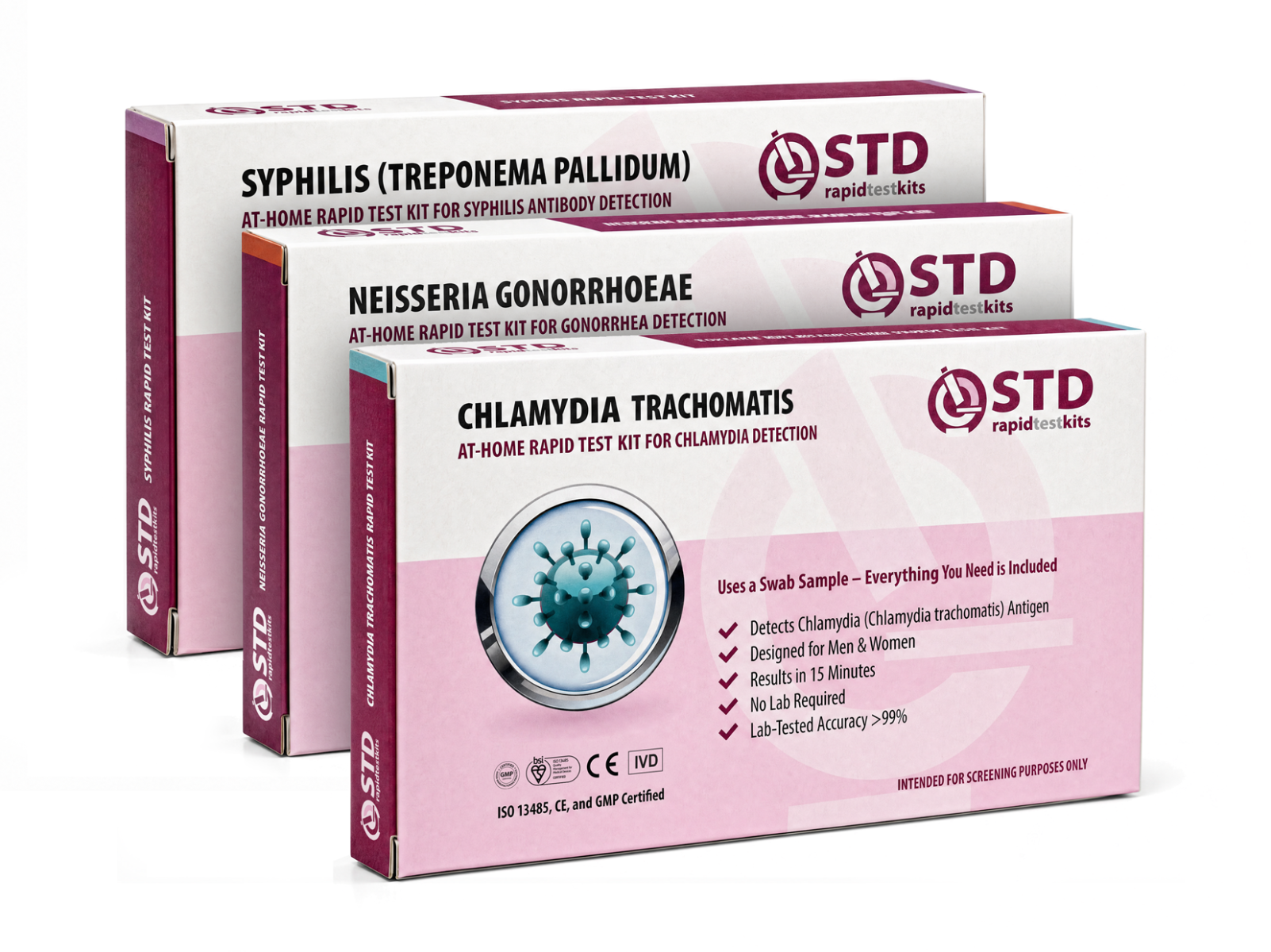
Self-collected genital swab. Used for chlamydia, gonorrhea, trichomoniasis, and HPV. You self-collect a vaginal swab (or a penile or urethral swab where the kit allows) and apply it to the cassette buffer. Important honesty: our trichomoniasis and HPV rapid kits are validated for vaginal self-swab only, so they are women-only home tests. Men with concerns about either infection should see a clinic for evaluation.
Fingerstick blood drop. Used for HIV, syphilis, hepatitis B, hepatitis C, and herpes (HSV-1 and HSV-2). A small lancet pricks the side of the fingertip; one or two drops of blood go onto the cassette buffer pad. These are antibody (or antigen-antibody combination) tests, not lesion swabs. The blood test detects systemic seroconversion, so a fingerstick HSV-2 antibody test cannot tell you whether a specific genital lesion is herpes; it only tells you whether your immune system has produced HSV-2 antibodies.
What we do not sell. Urine-sample tests, throat or pharyngeal swabs, rectal swabs, and lab-processed mail-in NAAT panels. If your concern is a throat exposure (oral sex with a partner who has gonorrhea or chlamydia), a clinic-administered pharyngeal swab is the right tool, not our genital swab kits. Same logic for rectal exposure. Honesty about scope matters; pretending one sample type substitutes for another would do you a disservice.
Swab vs blood at a glance
- Swab tests (self-collected genital swab): chlamydia, gonorrhea, trichomoniasis, HPV. Trich and HPV are women-only home tests.
- Fingerstick blood tests (lateral-flow antibody or antigen-antibody): HIV, syphilis, hepatitis B, hepatitis C, HSV-1, HSV-2.
- Not in our catalog: urine tests, pharyngeal (throat) swabs, rectal swabs, and lab-processed mail-in NAAT panels. For those sample types, see a clinic.
How to use a home test kit, end to end
Every kit ships with a printed instruction sheet specific to that test. The general flow is the same across the rapid lateral-flow kits we sell:
- Read the instructions all the way through before starting. Each kit has a specific incubation time and read window. Reading the result too early or too late produces an unreliable answer.
- Wash hands and lay out the components. Cassette, buffer vial, lancet (for blood tests), swab (for swab tests), and the alcohol prep wipe. Work on a clean dry surface.
- Collect the sample. For swab tests, follow the kit's collection technique exactly (rotation, depth, contact time). For blood tests, prick the side of the fingertip with the lancet, then milk one or two drops onto the buffer pad or capillary tube as instructed.
- Apply the sample to the cassette. Either drop the buffer-resuspended swab fluid into the cassette well, or transfer the blood drop directly per kit instructions. Add the buffer drops the kit specifies.
- Wait the full read time. Most kits read at fifteen minutes with a result-stable window of fifteen to twenty minutes. After the late end of that window, faint lines can appear that are not diagnostic.
- Read the lines. Two clear lines (one at the test marker, one at the control) is positive. One line at the control only is negative. No control line means an invalid run; repeat with a fresh kit.
If a step does not go as planned (under-collected swab, too little blood, the cassette was bumped during incubation), repeating with a fresh test cassette is the right move. Do not interpret an ambiguous result as a final answer.
Reading the result honestly
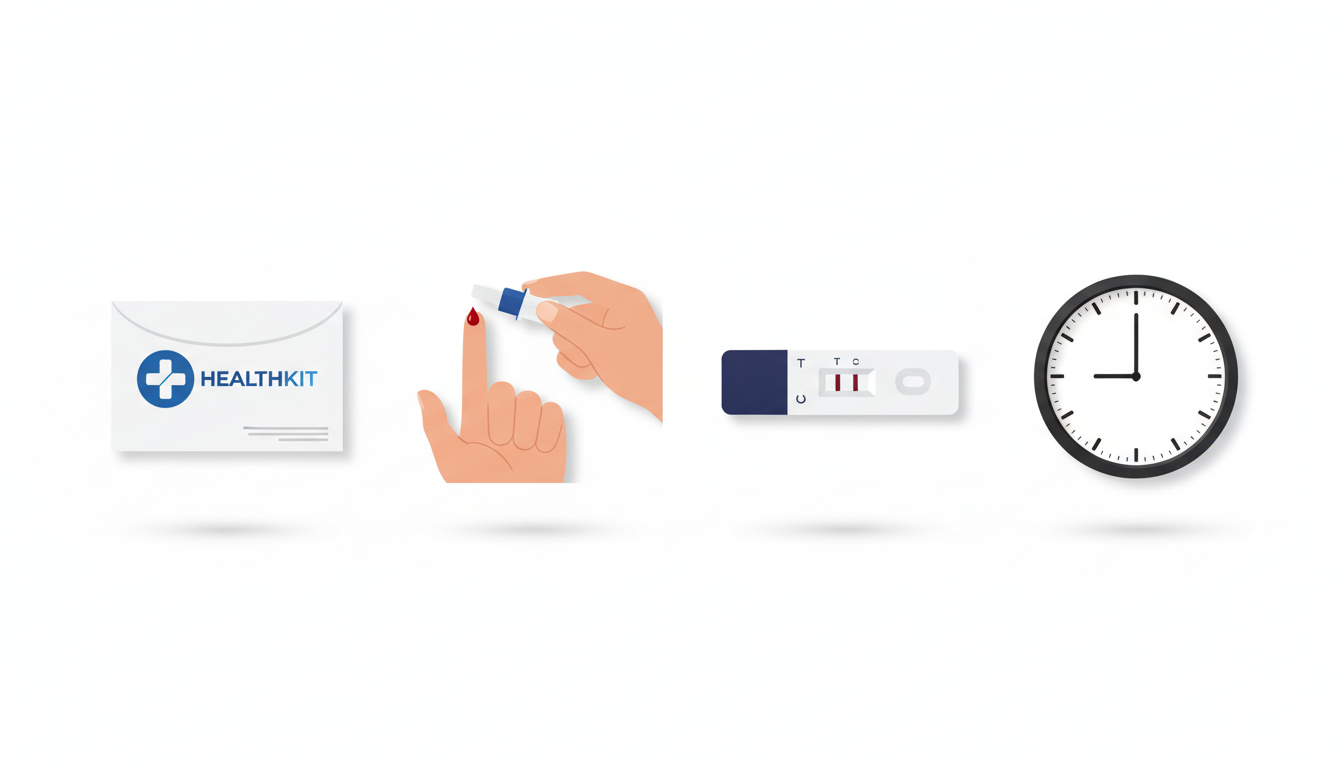
Lateral-flow result lines come in three states: clearly visible, faint, and absent. Clearly visible at both the test (T) line and the control (C) line is positive. Clearly visible at C only, with no T line at all, is negative. C absent regardless of T is invalid.
The trap is the faint test line. A faint line that appears within the read window is still a positive result, even if it is much fainter than the control. A line that appears only after the read window has closed is not diagnostic; that is a delayed crystallization artifact, not a real positive. Reading too early can also miss a real positive because the antigen-antibody complex has not yet accumulated enough at the test line to show.
If your result is invalid (no control line), the kit failed mechanically. Possible causes include too little sample, expired reagent, or buffer applied incorrectly. Repeating with a fresh kit is the answer; do not try to interpret around an invalid run.
If your result is negative and you tested inside the recommended window, that is a meaningful negative. If you tested early in the window, schedule a retest at the late end of the window for the infections you are concerned about. A negative is not a clean bill of health if it was taken at day three after a possible HIV exposure.
| What you see on the cassette | What it means | What to do next |
|---|---|---|
| Both T and C lines visible | Positive | Confirm with a clinic NAAT or follow-up serology before starting treatment. |
| C line only, no T line | Negative | Meaningful if you tested inside the window. Retest at the long end of the window if you tested early. |
| No C line (regardless of T) | Invalid | Repeat with a fresh kit. Do not try to interpret an invalid run. |
What to do if your home test reads positive
A positive on a rapid lateral-flow kit is a screening signal, not a final diagnosis. The next step depends on the infection but follows a similar shape: confirm, treat, notify partners, and retest at an appropriate interval.
Confirmation matters because lateral-flow tests have a small false-positive rate (the specificity figure published by the manufacturer is the tail end of that). Bacterial STIs (chlamydia, gonorrhea, syphilis) confirmed at a clinic with NAAT or treponemal serology give your treating clinician the diagnostic precision they need. HIV positives confirm with a fourth-generation antigen-antibody lab test plus an HIV-1/2 differentiation assay. HSV-2 antibody positives are best confirmed with a glycoprotein G-specific assay through a lab.
Treatment is well established for most STIs. Chlamydia and gonorrhea respond to short antibiotic courses (azithromycin, doxycycline, or ceftriaxone depending on the pathogen and current CDC guidance). Syphilis treats with benzathine penicillin G; the course length depends on the disease stage. Trichomoniasis responds to metronidazole or tinidazole. HIV is managed long-term with antiretroviral therapy that brings viral load to undetectable, transforming a previously fatal infection into a manageable chronic condition. Hepatitis C now has direct-acting antiviral cures with sustained virologic response rates above 95% in most patient populations, per current clinical guidance. Hepatitis B is managed with antivirals when needed and prevented by vaccine. Herpes is suppressed with daily antivirals such as valacyclovir or acyclovir.
Notifying recent partners is the public-health-and-personal-decency loop that breaks the transmission chain. Most U.S. states offer expedited partner therapy or anonymous-notification services through state and local health departments. Your clinician can route this for you.
Confirm with a clinic test before starting treatment. Lateral-flow rapid tests have a small false-positive rate; confirmation rules out an artifact and gives your clinician the data they need to choose treatment.
Treat fast. Bacterial STIs clear with appropriate antibiotics. HIV and viral hepatitis are managed long-term with antivirals. Most U.S. states offer same-day or next-day appointments at sexual-health clinics, and many are free or low-cost.
Notify recent partners. Most U.S. states offer expedited partner therapy or anonymous-notification services through local health departments. The CDC's partner-services pages detail what is available in each state.
Symptoms that mean test now (or see a clinician)
Most STIs are silent. The CDC's STI fact sheet notes that many people who have an STI have no symptoms, which is why screening is the only way to know. When symptoms do appear, the patterns below should not be ignored.
Genital or anal symptoms that warrant testing include unusual discharge from the penis, vagina, or anus; painful urination that is not explained by a urinary tract infection; itching or burning that does not resolve in a few days; sores, blisters, or ulcers anywhere on the genitals or perianal area; lumps, warts, or skin changes on the genitals; abnormal vaginal bleeding outside your normal cycle; pelvic pain that is not menstrual; testicular pain or swelling.
Systemic symptoms can also signal an STI. A spreading rash on the palms and soles is a classic syphilis hallmark and should be evaluated promptly. Persistent fever and swollen lymph nodes after a possible exposure can suggest acute HIV seroconversion (typically two to four weeks post-exposure). Unexplained jaundice or right-upper-quadrant abdominal pain warrants hepatitis testing.
If your symptom is an active genital ulcer or vesicle, the right test is a clinic-administered swab and PCR of the lesion, not a fingerstick HSV antibody test. Antibody tests measure systemic seroconversion rather than the active virus on a specific lesion, so a negative HSV-2 antibody does not rule out a herpes outbreak you can see on the skin. The two tests answer different questions.
Severe pelvic or testicular pain. Painful urination paired with fever. A spreading rash on the palms and soles (a syphilis hallmark). Genital ulcers that grow, weep, or come with swollen groin lymph nodes. Pregnancy plus any positive STI test. These patterns can signal complications that home rapid screening alone cannot manage.
Privacy, packaging, and the data trail
The packaging is built for privacy because most readers buying an at-home STI test want exactly that: an answer they can get without a waiting-room conversation. Kits ship in plain unmarked outer packaging without product names or visible sender details. The shipping label uses a generic merchant identifier rather than the test type or any clinical descriptor.
The result stays on your cassette and in your records. There is no automatic upload to a clinical record system, and there is no insurance billing trail because home rapid kits are paid for directly. If you choose to share the result with a clinician for treatment, you control that flow.
Anonymous customer support is available for ordering questions through the site's secure message portal. Clinical questions about result interpretation are not handled through customer support; for those, the right path is a brief telehealth visit or an in-person visit with a sexual-health clinic, where a clinician can review your result and recommend confirmation testing or treatment.
Plain outer packaging. No product names, no clinical descriptors, no return address that identifies a test kit company.
No clinical-record upload. Results stay on your cassette and in your account; nothing is automatically sent to your primary care provider or insurer.
No insurance billing trail. Home kits are paid for directly, so there is no claims paperwork that a household member might see.
The honest limits of home rapid testing
The reason a home rapid test exists is not because it is technically superior to clinic NAAT. It exists because it is fast, private, and accessible. Those values trade against some real limits worth knowing before you buy.
Early-window sensitivity is lower than clinic NAAT. If you are testing in the first few days after an exposure, a clinic NAAT can detect a chlamydia or gonorrhea infection that a home rapid test would miss. The trade-off is generally fine if you test inside the recommended window for each infection. Test outside the window and the difference matters.
Sample-type coverage is partial. Our kits cover genital-route exposures via swab and systemic infections via fingerstick blood. They do not cover throat (pharyngeal), rectal, or urethral-only sample types. For a known throat or rectal exposure, the right test is a clinic-administered swab of that anatomic site, not a genital swab from us.
Some infections need lab-only methods. HPV genotyping, hepatitis viral-load testing, HIV resistance testing, and any test where the clinical decision depends on a specific subtype or quantitative measure cannot be done with home rapid tests. These are inherently lab tests.
Counseling is not included. A positive home result without a follow-up clinical conversation can be hard to navigate alone. The CDC recommends that any positive STI result come with linkage to clinical care, partner-notification support, and a treatment plan. The home kit gives you the result; the clinical context comes from a clinician. We do not pretend the kit replaces that.
Many people who have an STI have no symptoms. Testing is the only way to know for sure if you have an STI.
Choosing the right kit for your situation
Three reader situations cover most of what brings someone to this page. Picking the kit that matches the situation matters more than picking the most expensive or the highest-test-count option.
Recent unprotected encounter, otherwise healthy, no symptoms yet. The chlamydia plus gonorrhea plus syphilis 3-in-1 covers the highest-prevalence bacterial STIs from a single exposure event. Test from week three onward to clear the syphilis window. If HIV is also a concern from the encounter, add the HIV single-test kit and retest HIV at the long end of its window (around twelve weeks for full reassurance).
Complete sexual-health snapshot before a new relationship. The 6-in-1 essential or 8-in-1 comprehensive kits cover the broad screen most clinicians would recommend at the start of a new relationship. Both partners testing in the same week and comparing results gives a good shared baseline.
One specific worry (HIV, herpes, hepatitis). A single-infection rapid kit gives you a focused answer. HIV and HSV-2 are common standalone concerns; the dedicated single-infection kits are typically less expensive than combo kits and easier to interpret because there is one cassette to read.
The math on combo kits is straightforward. If two or more single tests are on your list, the combo kit is usually cheaper than the sum of the parts. If just one test is needed, the single kit is the right choice. The 10-in-1 most-comprehensive option is currently validated for women only; a man wanting similar breadth uses the 8-in-1 instead. The two combo banners below sit at opposite ends of the comprehensive-screen spectrum.

FAQs
- How accurate are at-home STI tests really?
- When taken at the right point in the window period, most home lateral-flow kits report sensitivity above 95% and specificity above 99%, per individual manufacturer data sheets. The main accuracy risk is testing before the window closes, not the kit chemistry. Confirm any positive with a clinic NAAT before starting treatment.
- Can I test too early after exposure?
- Yes, and this is the most common reason a home test gives a false negative. Each infection has a window period before the test can detect it. Chlamydia and gonorrhea need about one to two weeks. HIV antibody tests need 23 to 90 days. HSV-2 antibody tests typically need twelve weeks, with some assays running up to sixteen. Testing inside the window risks a false negative; retesting at the long end of the window resolves the ambiguity.
- Do I need to mail my sample to a lab?
- No. The kits we sell are at-home rapid lateral-flow tests, read on the cassette in about fifteen minutes. They do not require mailing or lab processing. If you want a lab-processed NAAT panel, that is a separate service offered by clinics and some online lab-mail-in providers.
- What does the test look at: blood, urine, or a swab?
- Depends on the infection. Chlamydia, gonorrhea, trichomoniasis, and HPV use a self-collected genital swab. HIV, syphilis, hepatitis B, hepatitis C, and HSV use a fingerstick blood drop. We do not sell urine tests, throat swabs, or rectal swabs. For those sample types, see a clinic.
- Can men use the trichomoniasis or HPV home kit?
- No. Both kits are validated for vaginal self-swab only and are not suitable for male anatomy. Men needing trichomoniasis or HPV evaluation should see a clinic.
- How discreet is delivery?
- Kits ship in plain unmarked outer packaging with no product names or sender clinical details visible. The shipping label uses a generic merchant identifier rather than the test type.
- Should I retest after a positive result and treatment?
- For most bacterial STIs, retesting around three months after treatment confirms cure and catches reinfection. HIV and viral hepatitis follow longer-term monitoring schedules set by your clinician. Reinfection is common, so retesting is a normal part of post-treatment care, not a sign that anything went wrong.
- Are home rapid tests as good as clinic NAAT?
- Different technologies, different strengths. Clinic NAAT and PCR have higher analytical sensitivity, especially right at the start of the window period. Home rapid tests are faster, private, and reliable enough for most readers testing inside the recommended window. A positive home result is worth confirming at a clinic before treatment.
- U.S. Centers for Disease Control and Prevention. STI fact sheets, screening guidance, and patient education on sexually transmitted infection signs, symptoms, and testing.
- U.S. Centers for Disease Control and Prevention. HIV testing window periods for antibody, antigen-antibody, and rapid lateral-flow tests; recommended retest intervals.
- U.S. Centers for Disease Control and Prevention. Viral hepatitis B and hepatitis C topic hub with links to clinical guidance, testing recommendations, and follow-up care pathways.
- U.S. Centers for Disease Control and Prevention. Genital herpes (HSV-1 and HSV-2) overview, symptoms, diagnosis options, and patient guidance on transmission and treatment.
- World Health Organization. Sexually transmitted infections fact sheet covering global epidemiology, prevention, and screening recommendations.
- UK National Health Service. Sexually transmitted infections overview, symptom checker, and patient guidance on when to test.
