
Published: December 2025 | Last updated: May 2026 | Editorial review and quality control: Martina N.
Most people first notice discharge after sex when something looks different from what their body usually produces, and the rest of the day or week is then spent wondering whether it means something serious. Discharge after using a condom usually has a fairly mundane explanation: friction, lubricant residue, semen if there was any contact, or a normal pH-balancing response in the hours afterward. Sometimes it points to a yeast flare or a reaction to latex or spermicide. Less often, it can be the first sign of a sexually transmitted infection that the condom did not fully protect against.
This guide walks through what each pattern looks like, when to test at home, and when to see a clinician. The goal is calm, accurate information so you can match what your body is doing with what is most likely causing it.
Key Takeaways
- Discharge in the 24 to 48 hours after sex is usually normal cleanup, but new color, odor, itching, burning, or persistence beyond two days is the threshold for testing or a clinic visit.
- Condoms substantially reduce STI risk but do not cover every transmission route, so discharge with a condom in place can still warrant a screening for chlamydia, gonorrhea, trichomoniasis, or HSV.
What is actually happening when discharge shows up after sex
After penetrative sex, the vagina almost always produces extra fluid in the following 24 to 48 hours. This is part of how the body cleans itself, similar to how the eye produces extra tears after exposure to an irritant. The discharge may look slippery, stretchy, or creamy, and it can be mixed with natural lubricant, leftover residue from condom coatings, or, if there was any contact, traces of semen. According to Mayo Clinic guidance on vaginal discharge, normal discharge is typically clear or whitish, mild or odorless, and resolves on its own.
What sets normal discharge apart is what is missing: no foul or fishy smell, no itching, no burning, no pelvic pain, and no unusual color change. If you notice fluid the morning after sex that resolves on its own within a day or two and nothing else feels off, that is almost always your body doing routine housekeeping.
The pattern shifts when discharge becomes thicker and white like cottage cheese, turns yellow, green, or gray, develops a strong odor, or comes with itching, burning during urination, or bleeding outside your cycle. Those are the signs that something needs closer attention. The hard part is that early STI symptoms can look like irritation, and irritation can look like an infection, so timing and accompanying symptoms matter more than appearance alone.
Bodies respond to physical stimulation, foreign materials, and shifts in pH in real time. Watch the fluid over the next 24 to 48 hours: if it fades on its own and nothing new appears, no further action is needed; if it stays or worsens, that is the moment to test.
Normal: clear or whitish fluid, no strong odor, no itching or burning, resolves within 24 to 48 hours.
Seek testing: yellow, green, gray, or pus-like color; strong fishy or foul odor; itching, burning, or pelvic pain; bleeding outside your cycle; or any of the above persisting beyond two days.
Latex, lube, and spermicide: the common irritation triggers
The condom itself can be the cause of discharge changes. Latex is the most common condom material, and a share of the general population has a latex sensitivity that can cause irritation in mucous membranes. Genuine latex allergy and lower-grade contact irritation from condom materials can both show up as redness, swelling, or increased watery discharge within hours of exposure, which is why latex-free options exist and are widely available.
Spermicides are a second common trigger. Nonoxynol-9, the active ingredient in most spermicidal coatings, is known to cause irritation in some users and has been associated with disruption of the vaginal microbiome with frequent use. If you keep noticing burning or discharge after one specific condom brand and not others, the spermicide coating is a likely suspect.
Lubricants matter too. Warming gels, flavored coatings, glycerin-heavy lubes, and "numbing" formulations can all affect vaginal tissue. Glycerin, in particular, can raise the local pH and feed yeast in people who are prone to recurrent yeast infections. The fluid you see the next day may be a mix of lube residue, sloughed irritated cells, and the body's defensive secretions.
Mechanical friction is often overlooked. Even with adequate lubrication, repeated friction can create microscopic tears in the vaginal lining. Those tiny abrasions trigger a local inflammatory response, which can mean more discharge for a day or two. Adding more water-based lubricant or shortening sessions tends to resolve this without further intervention.
Sorting an allergy from a spermicide reaction from a yeast flare is rarely possible by symptoms alone. A useful first step is to switch to a non-latex, spermicide-free condom with a simple water-based lubricant for the next few uses and see whether the pattern stops. If it does, the condom or its coating was the culprit. If it persists, testing is the next step.
| Condom Type | Material | Risk of Allergy or Irritation | Best For |
|---|---|---|---|
| Standard Latex | Natural rubber latex | Higher for people with latex sensitivity | General use unless allergic |
| Polyurethane | Plastic polymer | Low | People with latex allergies; thinner feel |
| Polyisoprene | Synthetic latex | Low to moderate | Latex-sensitive users wanting more stretch than polyurethane |
| Lambskin | Natural membrane | Low allergy risk, no STI protection | Pregnancy prevention only; does not block viruses |
Yeast, bacterial vaginosis, and other non-STI causes
Two common non-STI causes of post-sex discharge are vulvovaginal candidiasis, commonly called yeast infection, and bacterial vaginosis, or BV. Both are extremely common, both can be triggered by changes that happen during sex, and both are routinely mistaken for STIs.
Yeast infections produce a thick, white discharge that is often described as cottage-cheese-like. The hallmark symptom is intense itching, sometimes with redness and burning, and the discharge itself usually does not have a strong odor. Per Mayo Clinic's overview of vaginitis, yeast overgrowth often follows a change in the vaginal environment: a new lubricant, antibiotic use, hormonal shifts, or trapped moisture. Sex itself rarely triggers a yeast infection on its own, though it can tip the balance for people who are already prone to them.
Bacterial vaginosis presents differently. The discharge tends to be thin and grayish, and it carries a distinct fishy odor that often becomes more noticeable after sex. According to Mayo Clinic guidance on BV, semen and certain hygiene practices can shift the vaginal pH enough to let anaerobic bacteria overgrow, even when a condom is used. BV sits in a gray zone: consistently linked to sexual activity in research, and prone to recurrence after each episode, yet not formally classified as an STI.
Other non-STI causes worth knowing about include atrophic vaginitis in people who are postmenopausal or on certain hormonal contraception, retained tampons or other foreign objects, and reactions to scented hygiene products. Douches and intimate sprays are particularly disruptive to the vaginal flora.
The clinical reality is that yeast and BV often co-exist or alternate, especially in people who have repeated episodes. Over-the-counter yeast treatments only work for yeast, and BV needs prescription antibiotics or, in some cases, repeat treatment with different agents. If a course of treatment does not resolve symptoms, retesting is reasonable rather than assuming the original diagnosis was right.
| Cause | Typical Discharge | Timing After Sex | Other Clues |
|---|---|---|---|
| Latex or material allergy | Watery or clear, often with redness | Within hours | Itching, swelling, or rash around the genitals |
| Lube or spermicide reaction | Thin, slippery, or tacky | Same day or next morning | Mild burning, discomfort with urination |
| Yeast infection (Candida) | Thick, white, clumpy like cottage cheese | 1 to 3 days after | Intense itching, redness, usually odorless |
| Bacterial vaginosis (BV) | Grayish, thin, fishy odor | 2 to 5 days after | Strong smell, often no itching |
| STI (chlamydia, gonorrhea, trich) | Yellow, greenish, or pus-like | 5 to 14 days post-exposure, varies | Pelvic pain, bleeding, sometimes fever |
When discharge could still mean an STI, even with a condom in place
Condoms are a strong protective tool, though they are not a complete shield against every infection. CDC condom-use guidance is clear that consistent and correct use of latex condoms greatly reduces transmission of HIV and many bacterial STIs, including chlamydia and gonorrhea. The protection is strong without being absolute. Real-world use involves slippage, breakage, late application after genital contact, and partial coverage of regions where some pathogens spread.
Herpes simplex virus and human papillomavirus, in particular, spread through skin-to-skin contact in regions that a condom may not cover, such as the labia, scrotum, perineum, and inner thigh. Syphilis chancres can sit on the same uncovered skin. For those infections, a condom reduces transmission risk without eliminating it.
Oral sex is the other commonly underestimated route. Pharyngeal gonorrhea, oral chlamydia, and oral herpes can all be acquired or transmitted during oral contact when the genital condom is in place but no barrier is used for oral exposure. Symptoms in the receiving partner may show up in the genital tract days later, even though the condom seemed to do its job during vaginal intercourse.
Chlamydia and gonorrhea are the two bacterial STIs most likely to present with abnormal discharge in the days after exposure. Both can also be asymptomatic for long stretches, especially in women. Trichomoniasis is another common cause of post-sex discharge that is often missed; it tends to produce a frothy, yellow-green discharge with irritation. Each of these is treatable, and each is more harmful when left undiagnosed than when caught early.
That last point matters more than most people realize. Per CDC chlamydia guidance, untreated chlamydia and gonorrhea are among the leading preventable causes of pelvic inflammatory disease, scar tissue in the fallopian tubes, and tubal-factor infertility. Both infections often produce no symptoms for weeks or months, which is precisely why a prompt test after potential exposure does more for long-term fertility than waiting for symptoms to worsen. The good news: both respond quickly to a short course of antibiotics when caught early, with no lasting reproductive impact in most cases.
The practical takeaway is that condom use lowers the odds while not removing the case for testing if discharge is new, persistent, or paired with itching, odor, pelvic pain, or bleeding. A test is a routine input to a clear next step, never a verdict on the relationship.
Disclosure: this article is published by stdrapidtestkits.com, which sells rapid at-home STI tests. Product mentions in this article reflect what fits the reader's concern, not commercial benefit.
How vaginal pH fits into the picture
The vagina maintains a slightly acidic pH, typically between 3.8 and 4.5, kept stable by lactobacilli that produce lactic acid. That environment is hostile to many pathogens and supports the cells lining the vaginal wall. Sex can disturb this balance even when a condom is used.
Semen has a basic pH near 7.2 to 8.0. Any direct contact with semen, including small amounts from incomplete condom coverage or post-sex handling, raises vaginal pH temporarily. Lubricants vary widely in pH, with some flavored and warming lubes well above the vaginal range. Spermicides, even at dilute concentrations, can disrupt the lactobacilli population and let other bacteria grow.
When the pH shifts upward, the protective lactobacilli decline and species like Gardnerella vaginalis can take over, which is the mechanism behind bacterial vaginosis. Yeast infections often follow a related pattern, in which the same disruption lets Candida overgrow.
This is also why frequent douching, harsh soaps, and scented intimate products show up repeatedly in BV recurrence research. The vaginal lining does not need to be cleaned with anything beyond water; the system is largely self-regulating when left alone.
Practically, small product choices add up. A lubricant with a pH near 4.5 and minimal additives is the most consistent way to reduce disruption, alongside picking a condom without spermicide and avoiding internal washing.
Men can have discharge after protected sex too
This guide focuses on vaginal discharge because it is the most-searched form of the question, though men can also experience discharge after protected sex. Penile discharge is less common as a normal occurrence; it usually points either to irritation from lube and latex or to a urethral infection like chlamydia or gonorrhea.
The discharge profile in men is typically a small amount of milky, yellow, or cloudy fluid from the tip of the penis, sometimes first noticed in the morning or with the first urination of the day. Burning during urination, pain at the tip of the penis, or testicular discomfort are warning signs that often accompany an infection.
Latex or lube irritation in men can produce mild redness, itching, and a thin watery discharge for a day or so after sex, then resolve on its own. As with vaginal irritation, switching to a non-latex, spermicide-free condom is the quickest way to test whether the condom material was the trigger.
The other reality worth naming is that many STIs are asymptomatic in male anatomy, or present only briefly. A man may transmit chlamydia or gonorrhea without ever noticing discharge himself, and only learn about it when a partner tests positive. For that reason, joint testing in any new sexual relationship before discontinuing barrier methods is a more reliable safeguard than relying on visible symptoms alone.
If discharge from the penis lasts more than 24 hours, has a strong color, or comes with burning, testing is the right next step rather than waiting for it to clear.

When to test, and when to see a clinician
The decision between an at-home test and a clinic visit depends on what symptoms you have, how long they have lasted, and your access to care. As a general guide, at-home rapid tests are well-suited to screening when symptoms are mild or absent and you want a private answer quickly. Clinic visits are better when symptoms are severe, when bleeding or significant pain is involved, or when prescription treatment is likely needed regardless of the test result.
The CDC's treatment guidelines on vaginal discharge syndromes walk through which infections fit which symptom patterns, but most readers do not need to navigate clinical algorithms to decide. A simpler test of when to act:
If discharge resolves in 24 to 48 hours and nothing else is off, no further action is usually needed. If discharge persists beyond two days, develops a strong odor, becomes painful, or comes with bleeding, testing or a clinician visit is the right move. If there has been a known exposure to a partner with a confirmed STI, test even if you have no symptoms, and time the test to the appropriate window period for that specific infection.
Window periods matter. Chlamydia and gonorrhea are typically detectable about one to two weeks after exposure. Syphilis blood tests can take three to six weeks to turn reliably positive. HIV antibody tests vary by generation, with fourth-generation antigen-antibody combination tests typically reliable by about six weeks. Testing too early can give a false negative and false reassurance.
At-home rapid tests are lateral-flow immunoassays. They are useful screening tools, and a positive result is generally worth confirming with a lab-grade test for STIs that carry significant consequence. A negative test in someone with persistent symptoms also warrants follow-up testing or clinical evaluation rather than dismissing the symptoms.
| STI | Condom Reduces Risk? | Risk With Correct Condom Use | Discharge as a Possible Symptom |
|---|---|---|---|
| Chlamydia | Yes, substantially | Low if used correctly and consistently | Yes |
| Gonorrhea | Yes, substantially | Low if no breakage or slippage | Yes |
| Trichomoniasis | Partially | Moderate; condom helps without being full coverage | Yes, often frothy and yellow-green |
| Herpes (HSV-1 / HSV-2) | Partially | Moderate; depends on outbreak location | Sometimes, especially with primary outbreak |
| HPV | Partially | Moderate; skin contact outside the condom matters | Not usually; some lesions can affect cervical discharge |
Choosing condoms less likely to cause discharge changes
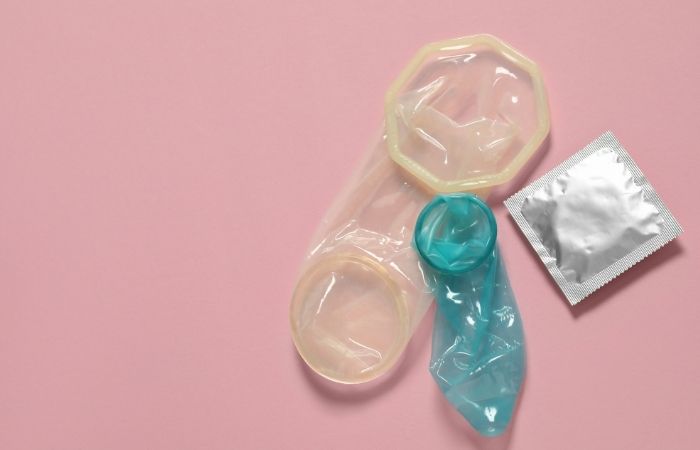
Several condom choices reduce the chance of irritation-driven discharge. Polyisoprene and polyurethane condoms avoid latex entirely and are appropriate for people with latex sensitivity. Avoiding spermicidal coatings, especially those containing nonoxynol-9, removes a known irritant for sensitive users. Choosing a simple water-based lubricant without added warming, flavoring, or numbing agents reduces the chemical load on the vaginal lining.
Pre-lubricated condoms with minimal additives are generally well-tolerated. Reading the box for "spermicide-free," "no parabens," and "no glycerin" is a useful filter if you have noticed reactions before. People who prefer extra lubrication can apply a clean water-based lubricant separately rather than relying on coatings.
Storage and expiration matter as well. A condom kept in a wallet or hot car for months can degrade and shed irritating particulate. Use a fresh condom, and pay attention to the expiration date on the foil.
For pregnancy prevention without STI protection, lambskin condoms are an option, though they do not block viruses because the pores in the natural membrane are large enough to let viral particles through. Anyone relying on barrier protection for STI risk needs a latex or synthetic equivalent.
Finally, condom fit is often overlooked. A condom that is too tight can cause friction and microtears; one that is too loose can slip and cause partial exposure. A correctly sized condom reduces both the irritation profile and the breakage rate.
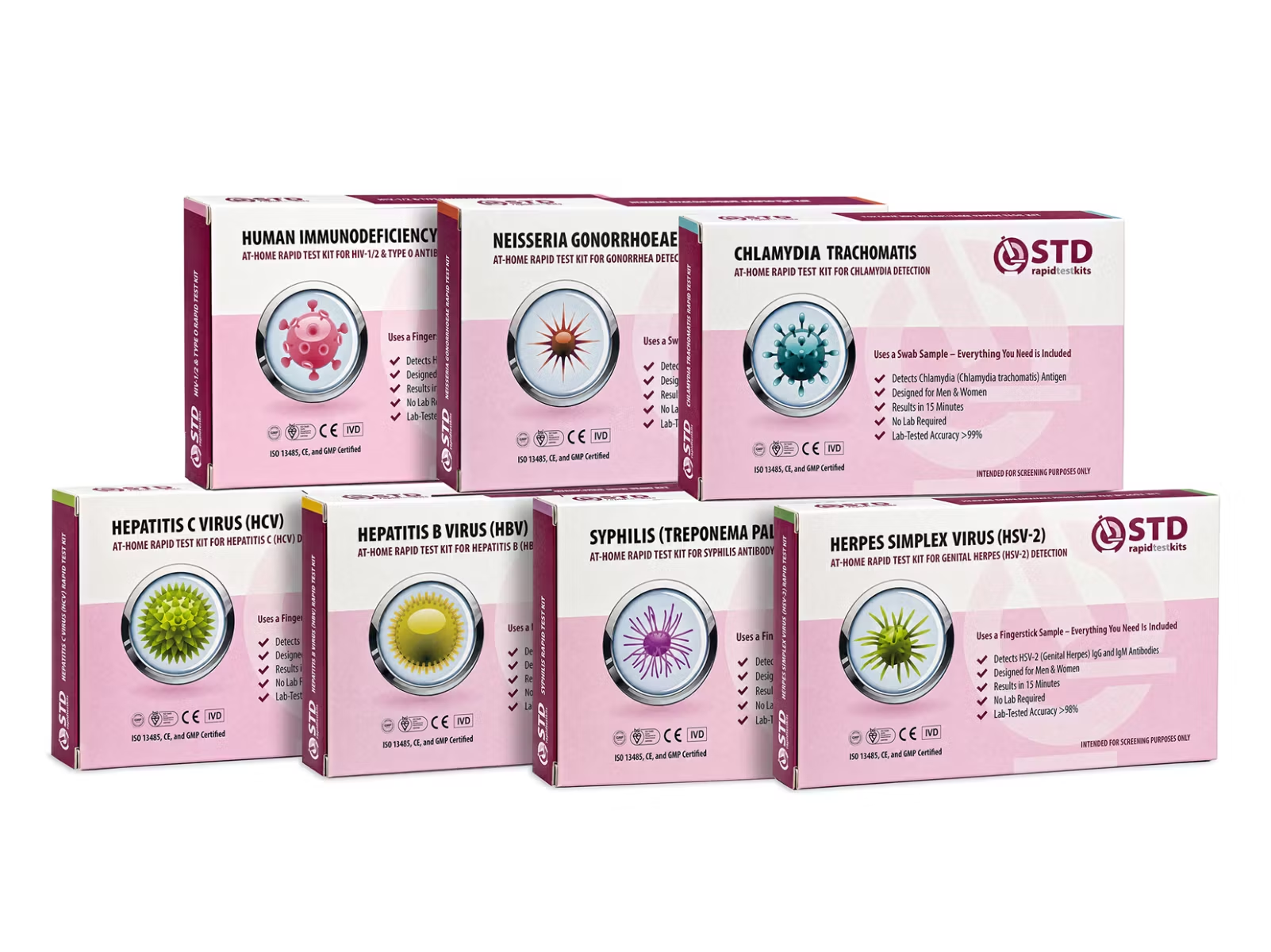
If you have switched products and discharge still persists, the next step is testing rather than continuing to swap brands. A six-infection screening kit covers the most common discharge-producing STIs in one session and removes the guesswork that keeps people in a worry loop.
Frequently Asked Questions
- Is some discharge after using a condom normal?
- Most post-sex discharge is gone within two days. Clear or whitish fluid with no odor and no itching is routine cleanup. Color, odor, or persistence past 48 hours is the threshold for testing or a clinic visit.
- How do I tell a latex allergy from an STI?
- A latex or material reaction tends to start within hours of sex and resolves quickly once the irritant is gone, often with itching or local swelling. STI-related discharge typically appears days later, can be yellow or green, and is more likely to come with burning during urination, pelvic pain, or a persistent odor. If switching to a non-latex condom does not stop the pattern, testing is the next step.
- Can a condom actually cause a yeast infection?
- Indirectly, yes. What drives Candida overgrowth is the chemistry on the condom (spermicidal coatings, glycerin-heavy lubricants, or warming additives) or the resulting pH shift, rather than the condom material itself. Spermicidal coatings, glycerin-heavy lubricants, and warming or flavored additives can disrupt the vaginal microbiome enough to let Candida overgrow.
- Why does discharge after sex sometimes smell different?
- Semen has a higher pH than the vagina, and even small amounts of contact can temporarily shift the vaginal environment. That can briefly change the smell of discharge in the next day or two. A persistent strong, fishy, or foul smell points more toward bacterial vaginosis or a bacterial STI, both of which deserve testing or a clinician visit.
- How long after exposure should I wait to test?
- Chlamydia and gonorrhea are typically detectable about one to two weeks after exposure. Syphilis blood tests can take three to six weeks to turn positive reliably. HIV fourth-generation antigen-antibody combination tests are usually reliable by about six weeks. Testing too early can produce a false negative, so timing matters as much as the test choice.
- Do men get discharge from condoms too?
- They can. A small amount of post-sex fluid in men is usually normal. Milky, yellow, or cloudy discharge from the tip of the penis, especially in the morning or with first urination, is not. That pattern is more consistent with chlamydia or gonorrhea, and testing is the right response rather than waiting it out.
- Can a condom break without me noticing, and could that explain new discharge?
- Yes. Slippage, late application, or a small break can occur without obvious notice. If discharge appears in the days after sex and you have any reason to suspect breakage or partial exposure, treat the encounter as unprotected for testing purposes and time a screening to the appropriate window period.
- What if I switched condom brands and the discharge stops?
- That is useful information. It suggests the condom material, spermicide coating, or lubricant in the original brand was the trigger. Keep using the brand that does not cause symptoms, and consider testing once at baseline so you have a confirmed negative starting point before relying on the new product.
How we sourced this article: We combined current guidance from leading public-health and medical organizations, including the CDC and Mayo Clinic, with peer-reviewed clinical content. The goal is plain-English explanations for at-home health decisions, not personal clinical advice. For symptoms that concern you, see a licensed clinician.
- U.S. Centers for Disease Control and Prevention. Condom Use overview, including STI-prevention effectiveness and limitations.
- U.S. Centers for Disease Control and Prevention. STI Treatment Guidelines: vaginal discharge syndromes, including BV, trichomoniasis, and candidiasis.
- U.S. Centers for Disease Control and Prevention. Chlamydia: untreated infection consequences including PID, fallopian-tube scarring, and tubal-factor infertility.
- Mayo Clinic. Vaginal discharge: definition of normal versus abnormal patterns, possible causes, and when to see a clinician.
- Mayo Clinic. Bacterial vaginosis: symptoms, causes, and the role of vaginal pH disruption.
- Mayo Clinic. Vaginitis: types of vaginal inflammation including candidiasis and irritant or allergic vaginitis.
