Published: August 2025 | Last updated: May 2026 | Editorial review and quality control: Martina N.
Does showering after sex prevent trichomoniasis?
No. Showering, douching, and washing cannot prevent trichomoniasis, because the parasite attaches to mucosal tissue beyond where soap reaches. Real prevention is consistent condom use, which substantially cuts risk but not to zero, both partners treated at the same time after a positive result, and NAAT testing starting about a week after exposure.
If someone has told you to shower after sex to avoid trichomoniasis, that advice does not work, and neither does douching. The parasite the shower is supposed to stop has already moved past the surface where soap can reach. Trichomoniasis is the most common curable sexually transmitted infection in the world; the World Health Organization estimated approximately 156 million new infections in 2020 among people aged 15 to 49. Most people who carry the parasite that causes it, Trichomonas vaginalis, never develop symptoms; the small share who do get itching, burning, unusual discharge, or pain during sex.
Almost everyone has heard at least one piece of bad advice about how to avoid it. Soap will not reach the parasite. Douching disrupts the natural defenses that actually help. Toilet seats are not the route most cases take. The things that genuinely reduce risk are simple, well-evidenced, and almost never the things people try first: barrier protection during every sexual encounter (knowing exactly where its coverage ends), simultaneous treatment for both partners after a positive result, and testing when symptoms or recent partners give you any reason to wonder.
Key takeaways
- About 70% of people with trichomoniasis have no symptoms, per the CDC, so a partner who feels fine can still be carrying and transmitting the parasite.
- Condoms cut trichomoniasis transmission sharply but not to zero, because the parasite can also sit on external surfaces a condom doesn't cover. Soap, water, and douching do nothing.
Why a shower can't stop trichomoniasis
Trichomonas vaginalis is a single-celled protozoan parasite. It transmits through direct genital-mucosa contact during vaginal sex and through the exchange of infected genital fluids. According to the U.S. Centers for Disease Control and Prevention, the most common sites of infection are the lower genital tract in women (vulva, vagina, cervix, urethra) and the urethra in men. Once the parasite has reached that tissue, it has already moved beyond what an external rinse can affect.
The parasite needs a warm, moist environment to survive. It does not transfer meaningfully through casual contact, shared towels, swimming pools, or toilet seats. It needs direct genital-to-genital contact, ideally with some fluid exchange, to move from one person to another. In people with vaginas, the carriage sites are the vagina, cervix, and urethra, plus the vulva and perineum at the external edge. In people with penises, the parasite lives mostly inside the urethra, sometimes briefly on the foreskin or adjacent skin.
That is the part most prevention myths miss. The skin you can wash sits well outside the tissue where the parasite has moved. Within minutes of contact, T. vaginalis attaches to the epithelial lining of the genital tract, then begins to replicate and provoke the inflammatory response that causes symptoms in the small fraction of people who notice anything at all. A shower at this point addresses the external surface only.
The same logic applies to scrubbing, post-sex urination, antibacterial soaps, vinegar rinses, and every variation people invent. None of these routines prevents trichomoniasis. The CDC, NHS, and WHO are all explicit on this point: the only effective prevention is preventing the contact in the first place.
None of this is a moral judgment. Trichomoniasis is common because it travels easily, often silently, between partners who do not know they have it. The next sections walk through how each of the three working levers (barriers, partner treatment, and testing) plays out in practice, starting with what condoms can and cannot do for this particular parasite.
What condoms do, and what they don't
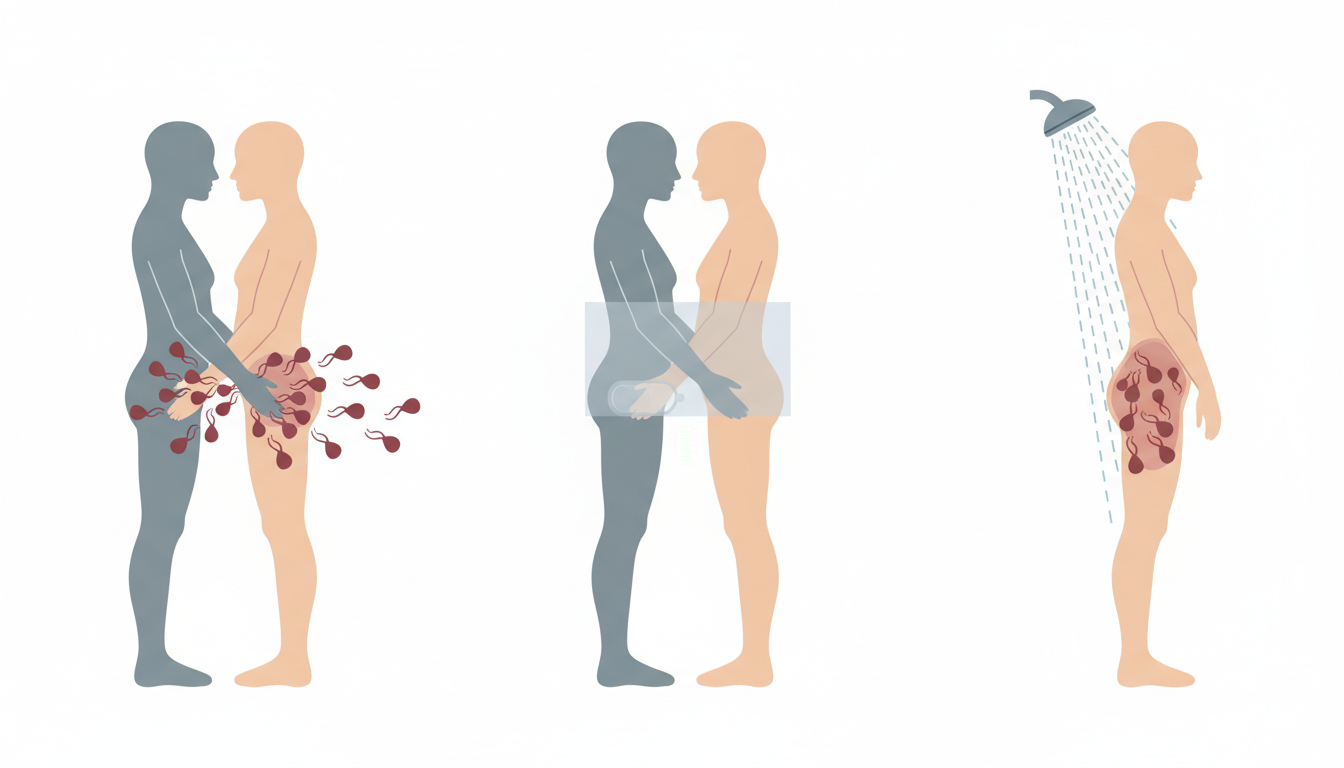
External (male) and internal (female) condoms are the most reliable barrier method against trichomoniasis when used correctly during every sexual encounter. They work by preventing the exchange of genital fluids and reducing direct mucosa-to-mucosa contact, the two routes the parasite uses to move between people. The CDC lists consistent and correct condom use as one of the cornerstones of trichomoniasis prevention.
Two qualifiers matter, because they are where condom-based prevention quietly breaks down for most people.
First, condoms only protect the area they cover. A standard external condom covers the shaft of the penis from base to tip, which handles the main mechanical route of fluid contact during vaginal penetration. The areas where its coverage ends (the base of the penis, the scrotum, and the outer vulva or perineum on a partner's body) are exactly where the parasite can also sit and shed. For trichomoniasis specifically, that residual pathway is narrower than for skin-contact infections like genital herpes or HPV, and most transmission still happens through fluid contact that a condom blocks. But the residual is not zero.
Several real-world scenarios shave off more of the protection than the textbook number suggests. Late application is the most common: if the condom goes on after some genital-to-genital contact during foreplay, even brief, fluid contact has already happened. Slippage and breakage during correct use are less common but do occur in a small fraction of acts, per CDC condom-use guidance. Condoms can also drift a few millimeters during longer or more dynamic sex, briefly exposing skin that was covered a moment earlier. And sequential acts of sex without changing condoms (alternating between vaginal and anal sex, or between partners in one encounter) can transport the parasite from site to site even with a barrier in place at each act. Use a fresh condom each time the type of sex changes.
Second, every time means every time. The biggest predictor of condom failure as a prevention tool is intermittent use. Skipping the first few minutes, going without on a low-risk night, or stopping mid-encounter all create exactly the kind of contact that transmits trichomoniasis. People often drop condoms in long-term relationships once they feel emotionally settled, well before both partners have been screened, which is where most surprise positives come from.
Internal condoms (sometimes called female condoms) are an option for the receptive partner and offer similar protection when used correctly. The outer ring extends beyond the vaginal opening to cover part of the surrounding vulva, which can give marginally better coverage at the external edges than an external condom alone. The NHS notes both external and internal condoms as effective tools.
Where condom protection breaks down
- Coverage area: condoms cover the main fluid-contact surfaces that matter for trichomoniasis, but the base of the penis, the scrotum, and the outer vulva sit outside the rim.
- Late application: putting the condom on after some genital-to-genital contact during foreplay creates a fluid-contact window before the barrier is in place.
- Consistency: intermittent use cancels most of the protection. The kind of contact that transmits the parasite happens in the first few minutes as readily as later in the encounter.
- Long-term-relationship gap: the most common pattern behind a surprise positive is dropping condoms before both partners have been tested.
How condom protection stacks up across STIs
One useful way to size up condom protection against trichomoniasis is to compare it to protection against other STIs. The short version: condoms are stronger barriers against fluid-borne infections (chlamydia, gonorrhea, HIV) than against skin-contact infections (genital herpes, HPV). Trichomoniasis sits between those extremes, because it transmits primarily through fluid contact but has a small skin-contact component at the edges of barrier coverage.
| STI | Condom protection level | Primary transmission route |
|---|---|---|
| Chlamydia | High | Genital fluids (blocked by barrier) |
| Gonorrhea | High | Genital fluids (blocked by barrier) |
| HIV | Very high | Blood and genital fluids (blocked by barrier) |
| Syphilis | Partial to high | Sores and fluids (depends on sore location) |
| Trichomoniasis | Moderate to high | Fluids plus adjacent mucosal contact |
| Genital herpes (HSV) | Partial | Skin-to-skin, including uncovered areas |
| HPV | Partial | Skin-to-skin, including uncovered areas |
The reinfection trap most people fall into
The single most common reason trichomoniasis keeps circulating is also the easiest to fix: only one partner gets treated. The cycle works like this. Person A tests positive, takes antibiotics, finishes the course, feels better. They have sex with Person B, who never got tested or treated because they had no symptoms. The parasite is still there, and now Person A has trichomoniasis again.
The CDC's STI treatment guidelines are explicit: all current sexual partners of someone who tests positive for trichomoniasis should be treated at the same time, regardless of whether they have symptoms. The CDC also recommends abstaining from sex until both partners have completed treatment and any symptoms have resolved.
This part trips people up because the asymmetry feels unfair. The partner with no symptoms feels healthy and may resist treatment. But about 70 percent of trichomoniasis infections are asymptomatic, and the lack of symptoms says nothing about whether the parasite is present. A partner who insists they cannot have it because they feel fine is the most common transmission route in long-term couples.
Retesting after treatment is a useful safety net. The CDC recommends rescreening women within three months of initial treatment because reinfection is common. If both partners completed treatment and one tests positive again at that follow-up, the explanation is almost always a third party in the picture or a missed treatment dose, not antibiotic failure.
| What actually prevents trichomoniasis | What does not prevent trichomoniasis |
|---|---|
| External or internal condoms used every time, from the start of contact | Showering, scrubbing, or post-sex hygiene routines |
| Both current partners treated simultaneously after a positive test | Douching, which can disrupt natural defenses and raise risk |
| Testing after a new partner or when any symptoms appear | Avoiding so-called risky toilet seats or shared towels |
| Honest conversation with new partners about recent testing | Assuming no symptoms means no infection |
| Completing the full prescribed course of metronidazole or tinidazole | Stopping treatment early because symptoms resolved |
How douching backfires
Douching is the prevention myth most likely to backfire. Several decades of studies have linked vaginal douching to increased risk of bacterial vaginosis, pelvic inflammatory disease, and trichomoniasis itself, not lower risk. The mechanism is straightforward: the vagina has its own self-regulating microbial environment, and flushing it with soap, vinegar, or commercial preparations strips the lactobacilli that keep pH low and crowd out invaders.
That disruption matters because Trichomonas vaginalis prefers a less acidic environment. The same low-pH lactobacilli that protect against bacterial vaginosis also create conditions in which the parasite struggles to establish. Wiping out that protection with a douche removes a meaningful piece of the body's natural defense.
Most modern public-health guidance recommends against douching as a hygiene practice. The vagina cleans itself through normal mucus turnover and does not benefit from being flushed. The fresh or clean feeling that scented douches market is cosmetic; the cost is a less hostile environment for the exact infections people are trying to avoid.
This is one place where the prevention advice is genuinely simple. If you are douching out of habit, stop. If you have been told it lowers your STI risk, the evidence says the opposite. Soap and water externally are fine; nothing needs to go inside.
Multiple studies have linked vaginal douching to higher rates of trichomoniasis, bacterial vaginosis, and pelvic inflammatory disease. The mechanism is microbial: douching strips the lactobacilli that maintain the vagina's protective acidity, leaving conditions in which Trichomonas vaginalis establishes more easily. If you have been told douching is hygienic or protective, the evidence runs the other way.
Toilet seats, wet towels, and swimming pools
The myth that you can catch trichomoniasis from a toilet seat or a shared towel is the one people most want to be true, because it shifts the explanation away from sex. The science is mixed on whether non-sexual transmission is technically possible, and clear on whether it accounts for any meaningful share of cases.
Trichomonas vaginalis can survive briefly outside the body in moist, warm conditions. Laboratory studies have shown the parasite can stay viable for hours on damp surfaces, which is the kernel of truth behind the toilet-seat story. What the same studies and the broader epidemiological data make clear is that brief surface viability rarely translates into actual person-to-person infection. To infect a new host, the parasite has to reach the right tissue at viable concentration, which requires direct genital contact with a contaminated source within a narrow time window. That sequence of events almost never happens through casual surface contact.
The CDC and WHO both classify trichomoniasis as a sexually transmitted infection because, in clinical practice, virtually every documented case traces back to sexual contact with an infected partner. When public-health agencies track new trichomoniasis cases, the routes captured in the data are essentially all sexual.
Laboratory studies have shown Trichomonas vaginalis can stay viable for a few hours on damp surfaces under specific temperature and humidity conditions. Outside those narrow conditions, viability drops quickly. Documented cases of non-sexual transmission are rare enough that the CDC and WHO continue to classify trichomoniasis as a sexually transmitted infection.
Most trichomoniasis infections are silent
About 70 percent of people with trichomoniasis have no symptoms at all, according to the CDC. When symptoms do appear, they usually show up within 5 to 28 days of infection, per MedlinePlus, and they are often mild enough to be mistaken for a yeast infection, a urinary tract infection, or generic irritation. In people with vaginas they include itching, burning, unusual discharge (often described as thin, frothy, and yellow-green), pain or discomfort during sex, and post-sex spotting from inflamed cervical tissue. The discharge pattern is part of what separates trichomoniasis from a yeast infection, where discharge is usually thick and white, and from bacterial vaginosis, where it tends to be thin and grayish without the same itching. In people with penises, symptoms look like a mild urethritis: a slight burning with urination, occasional clear urethral discharge, or low-grade irritation that is hard to pin down.
The implications of a 70 percent silent rate are practical and uncomfortable. It means that assuming you would know if you had something is a poor reason to skip testing. It also means the people most likely to transmit trichomoniasis are not the people who feel sick; they are the ones who feel fine and have no reason to seek a diagnosis.
Asymptomatic carriage is more common in men than in women, which adds another wrinkle to partner notification. A male partner who insists nothing is wrong is statistically the more likely carrier in a heterosexual couple where the woman tested positive. The clinical implication is that partner treatment should not be conditional on the partner having symptoms.
Symptoms can also fade on their own as the body's inflammatory response fluctuates, even while the parasite persists and continues to spread for months or years, remaining transmissible throughout.
Trichomoniasis is the most common non-viral sexually transmitted infection worldwide, with an estimated 156 million new infections recorded in 2020 among people aged 15 to 49, yet most people who are infected do not know they have it.
The HIV connection people miss
One of the most underdiscussed facts about trichomoniasis is that having it raises the likelihood of acquiring or transmitting HIV. The WHO reports that trichomoniasis is linked to a 1.5 times increased risk of HIV acquisition. The mechanism involves the genital inflammation and small mucosal abrasions the parasite causes, which give the virus easier access to the bloodstream during exposure.
This is the sentence that makes people start treating trichomoniasis seriously. The cure is a single course of oral antibiotics. The symptoms when they appear are uncomfortable, not dangerous. But untreated trichomoniasis is a co-factor that meaningfully shifts the risk profile of every other exposure that follows. In settings with higher HIV prevalence, this co-factor effect is part of why public-health agencies prioritize trichomoniasis screening even when symptoms are mild.
Pregnancy adds another layer. Untreated trichomoniasis during pregnancy is associated with preterm delivery, low birth weight, and premature rupture of membranes, per CDC clinical guidance. Pregnant people who test positive should be treated, and partner treatment is part of preventing reinfection during the remaining months of pregnancy.
For people with HIV, the CDC recommends annual trichomoniasis screening alongside other routine STI tests.
The WHO and CDC both list trichomoniasis as a recognized co-factor for HIV acquisition and transmission. The genital inflammation and small mucosal abrasions caused by the parasite give HIV easier access to the bloodstream during exposure. For people with HIV, the CDC recommends annual trichomoniasis screening alongside other routine STI tests; for people without HIV, treating a positive trich result promptly removes one of the modifiable factors that raises HIV risk during future exposures.
How testing fits into prevention
Prevention and testing get framed as separate categories, but for trichomoniasis they are part of the same loop. Because most infections are silent, testing is often the first signal that prevention has not held. Catching a positive result early stops the silent transmission chain to future partners and starts the partner-treatment process before reinfection cycles set in. If you finished sex with a condom on and still feel a flicker of uncertainty, that instinct is reasonable rather than paranoid; the useful response is to plan instead of spiral. Work out whether any fluid contact happened at the edges of coverage, schedule testing at the right window rather than the next morning, and have a calm, blame-free conversation with the partner so you both test on the same timeline.
The CDC recommends trichomoniasis screening for women with new or multiple partners, women in settings with high background prevalence, and any person presenting with symptoms consistent with the infection. Routine annual screening is recommended for women with HIV. The CDC does not currently recommend routine asymptomatic screening of men in the general population, although male partners of positive women should be tested or empirically treated as part of partner management.
Lab testing for trichomoniasis is most accurate using nucleic acid amplification tests (NAATs), which are processed in a clinical laboratory and detect the parasite's genetic material directly. Older laboratory methods such as wet-mount microscopy and culture are less sensitive, so a negative wet-mount does not rule the infection out, especially in low-level or asymptomatic cases; if a provider ran only a wet-mount and your symptoms persist, it is reasonable to ask whether a NAAT is available. NAATs typically become reliable about a week after exposure, which is faster than the window for most other STIs. By comparison, chlamydia and gonorrhea NAATs reach reliability around 14 days, syphilis blood tests around six weeks, and HIV fourth-generation antigen-antibody testing detects most infections by six weeks and almost all by 12 weeks, per CDC screening guidance. If you are testing after a single defined exposure, the practical pattern is to test once at the trich window (about a week) and again at the broader STI window (around four to six weeks) so you cover everything you might have been exposed to.
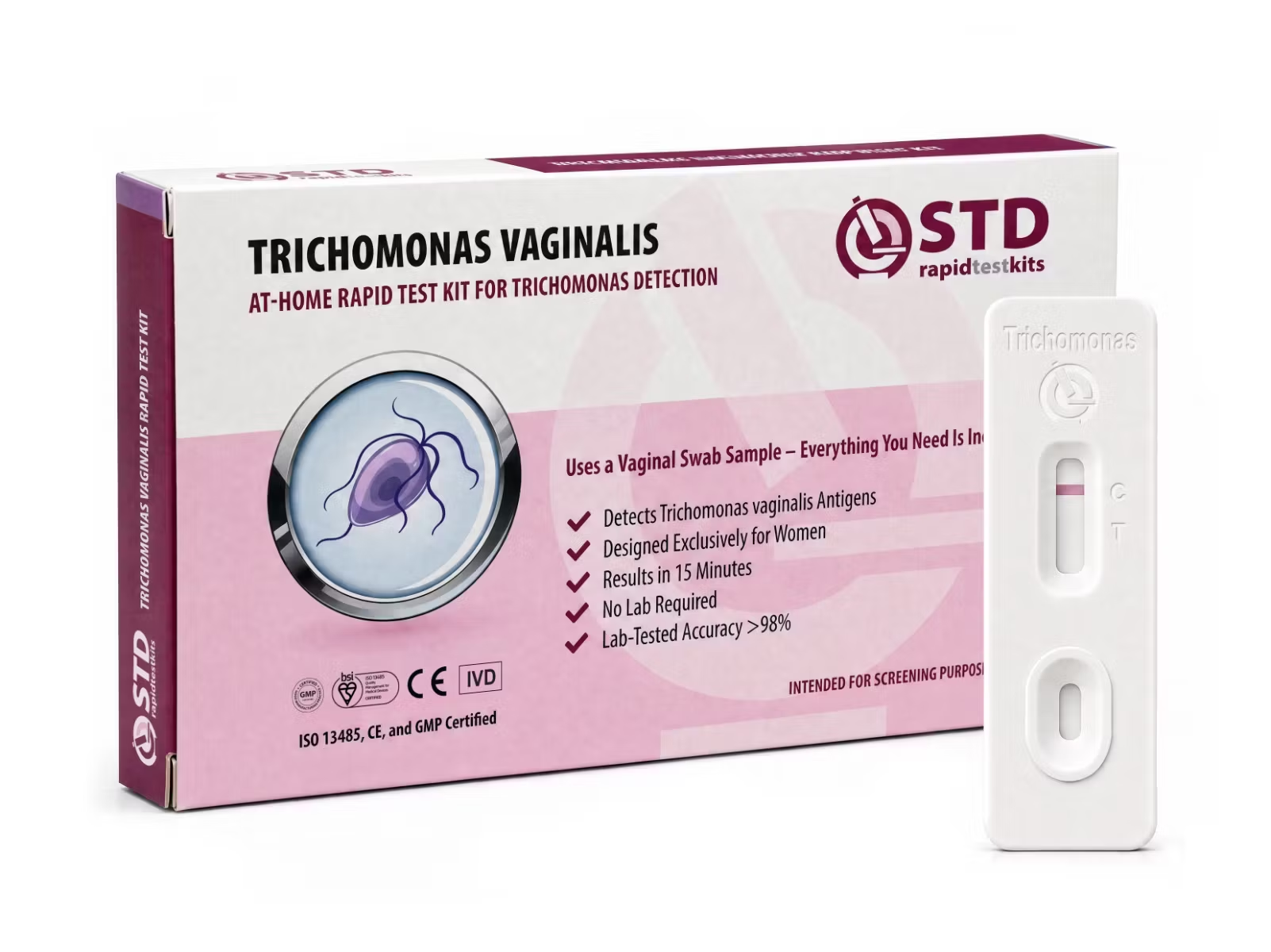
At-home rapid lateral-flow tests are a screening tool: faster, more private, and useful when clinic access is limited or anxiety is the barrier to testing at all. They are immunoassays that look for parasite antigens, not molecular tests, so a positive at-home result is worth confirming with a clinician for prescription treatment. A negative result before the one-week window has passed is inconclusive rather than reassuring. Follow-up clinic NAAT testing is the right step if symptoms persist or exposure is recent.
The callout below covers the scope of our at-home rapid trich kit so you can decide whether it fits your situation before you order one. This site sells at-home STI testing kits; we recommend products based on fit-for-purpose for the reader's concern, not commercial benefit, and we say so plainly when the right answer is a clinic visit instead.
Our at-home rapid trichomoniasis test is validated for self-collected vaginal swab samples and is therefore appropriate for people with female anatomy. There is currently no FDA-cleared at-home rapid test for trichomoniasis in male anatomy. Male partners of someone who tests positive should be evaluated at a clinic, where urethral swab or first-catch urine NAAT testing is available, or treated empirically per CDC partner-management guidance.
If you or a partner tests positive: what to do next
A positive trichomoniasis result is treatable, and the steps are well-defined. The CDC's recommended first-line treatment is a multi-day course of oral metronidazole for women, and a single oral dose of metronidazole or tinidazole as one of the regimen options for men. Tinidazole is an alternative when there is metronidazole intolerance. Treatment is highly effective when both partners take it at the same time and abstain from sex through the relevant treatment window.
- Treat all current partners simultaneously, regardless of whether they have symptoms. The CDC's expedited partner-therapy guidance allows some clinicians to write a prescription for an untested partner in jurisdictions where this is permitted.
- Abstain from sex until both partners have completed treatment and any symptoms have resolved. For single-dose regimens like tinidazole or single-dose metronidazole, the CDC adds a seven-day post-dose abstention window. For the multi-day metronidazole course, abstain through the course and until symptoms clear.
- Get retested at three months if you are a woman, because reinfection is common and a follow-up test is the only way to verify the loop has actually closed. Men do not have a routine follow-up recommendation but should retest if any new symptoms appear.
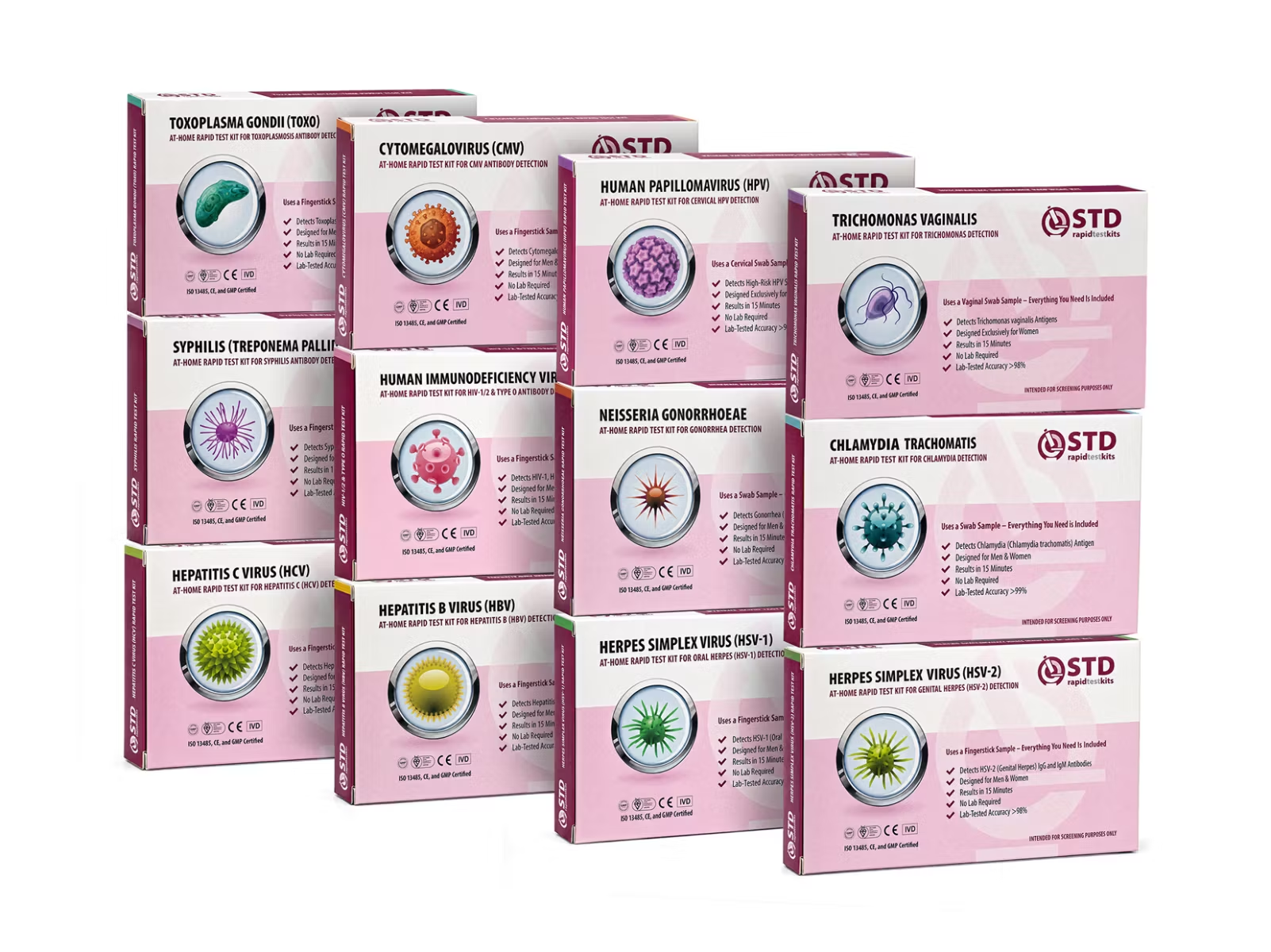
For people who want comprehensive screening alongside trichomoniasis (especially after a recent exposure that could have included multiple infections at once) an at-home multi-STI panel is the logical next step. Co-infection between trichomoniasis, chlamydia, and gonorrhea is common enough that screening for all three is standard practice in many clinical settings.
Leaving the myths in the shower
Trichomoniasis prevention frustrates people because the methods that reduce risk are unglamorous, while the methods that feel intuitive (showers, douches, blaming a towel) do nothing. Showering after sex feels like control, and blaming a towel feels like absolution. Neither does anything to the parasite.
The working answers are smaller and more specific. Use a condom every time, from the start of the encounter, regardless of how settled the relationship feels, and accept that even consistent use leaves a small residual at the edges of coverage. Treat current partners at the same time after a positive result, even when they feel fine. Test when you have any reason to wonder, and once a year as routine if you are sexually active with new or multiple partners.
Save the shower for hygiene, and put your prevention energy where the evidence points: barriers, partner treatment, and timely testing.
The three working levers
- Barriers: use a condom every time, from the start of the encounter. Coverage is substantial though not absolute, and consistent correct use still delivers the biggest single risk reduction available against trichomoniasis.
- Partner treatment: when a result comes back positive, current partners need treatment on the same timeline, regardless of whether they have symptoms.
- Timed testing: NAAT testing becomes reliable about a week after a single defined exposure for trichomoniasis, with the broader STI window at four to six weeks.
What to do after a possible exposure
Do you have symptoms like unusual discharge, itching, or burning, or did a recent partner test positive?
Yes: Test promptly and contact a clinician. A trichomoniasis NAAT is reliable about a week after exposure, and an at-home vaginal-swab screen can give a faster, private answer to confirm with a clinic.
Has it been less than about a week since the encounter?
Yes: Wait until roughly one week post-exposure so a trichomoniasis test is reliable, then test; retest at four to six weeks to cover chlamydia, gonorrhea, syphilis, and HIV.
No: If you are sexually active with new or multiple partners, test now as routine screening and repeat at least once a year.
Guidance only. A clinician can advise based on your specific situation.
Frequently asked questions
- Does showering or washing after sex prevent trichomoniasis?
- No. Trichomonas vaginalis attaches to the lining of the genital tract within minutes of contact, where soap and water cannot reach it. Showering is fine for hygiene, but it does not reduce STI risk. The CDC, NHS, and WHO all classify barrier methods, partner treatment, and testing as the only effective prevention tools.
- How well do condoms prevent trichomoniasis?
- Substantially, but not completely. Trichomoniasis transmits primarily through genital-fluid exchange and direct mucosa-to-mucosa contact, both of which an external or internal condom blocks at the main interface of penetrative sex. A small residual pathway remains because the parasite can sit on external areas a condom doesn't cover (the base of the penis, the scrotum, the outer vulva). Used correctly every time, condoms are still one of the strongest available prevention tools.
- I used a condom and now something feels off. Should I be worried?
- Aware is a fairer word than worried. Mild changes like slight irritation or a small shift in discharge can come from friction, a pH change, or something unrelated to any infection. If the feeling lingers more than a couple of days or gets worse, treat that as your cue to test rather than guess. For trichomoniasis, a NAAT becomes reliable about a week after the encounter, so plan the test for that window instead of testing the next morning.
- How long should I wait before testing after possible exposure?
- For trichomoniasis, NAAT testing becomes reliable about a week after exposure, which is faster than most other STI windows. Chlamydia and gonorrhea reach NAAT reliability around 14 days, syphilis blood tests around six weeks, and HIV fourth-generation tests detect most infections by six weeks with a confirmatory retest at 12 weeks per CDC guidance. After a defined exposure, schedule one test at the trich window and another at the broader STI window.
- Why does trichomoniasis keep coming back after I take antibiotics?
- Almost certainly because a current partner did not also get treated. Most carriers feel fine, so a partner with no symptoms can still be infected and pass the parasite back as soon as you resume sex. Treat together, finish the full course on the same timeline, and abstain until both of you complete it. True antibiotic failure is uncommon; reinfection is the usual culprit.
- Is douching after sex helpful or harmful?
- Harmful, not helpful. Douching disrupts the protective lactobacilli that maintain the vagina's normal acidic pH, and several studies link douching to higher rates of trichomoniasis, bacterial vaginosis, and pelvic inflammatory disease. The vagina is self-regulating; modern public-health guidance specifically recommends against douching.
- Is there a reliable at-home trich test for men?
- Not currently. At-home rapid trichomoniasis tests are validated for self-collected vaginal swab samples and are therefore appropriate for female anatomy only. Male partners of someone who tests positive should be evaluated at a clinic for urethral swab or first-catch urine NAAT testing, or treated empirically per CDC partner-management guidance.
- How does trichomoniasis raise HIV risk?
- Trichomoniasis causes genital inflammation and small mucosal abrasions, which can give HIV easier access during exposure. The WHO lists this co-factor effect as one reason untreated trich is a public-health priority even when its direct symptoms are mild. Treating trichomoniasis promptly is part of broader HIV-risk management.
- World Health Organization. Trichomoniasis fact sheet, including the estimate of approximately 156 million new T. vaginalis infections among people aged 15 to 49 in 2020, and the 1.5 times increased HIV acquisition risk associated with trichomoniasis.
- U.S. Centers for Disease Control and Prevention. About Trichomoniasis. Confirms trich is the most common curable STI and that about 70% of people with the infection have no signs or symptoms; covers sites of infection and prevention guidance.
- U.S. Centers for Disease Control and Prevention. Sexually Transmitted Infections Treatment Guidelines, trichomoniasis section. Multi-day metronidazole regimen, concurrent partner treatment, abstaining until therapy is complete, NAAT as the recommended diagnostic, and three-month rescreening for women.
- U.S. Centers for Disease Control and Prevention. STI prevention strategies hub covering condom-effectiveness guidance, mechanical failure rates, and screening recommendations.
- UK National Health Service. Trichomoniasis overview: symptoms, transmission, condom use, and treatment.
- MedlinePlus (U.S. National Library of Medicine, NIH). Trichomoniasis. Symptom patterns by anatomy, the 5-to-28-day symptom-onset window, and the high share of asymptomatic infections.
