Chlamydia in MSM: Why Standard Urine Tests Miss Rectal and Throat Cases
Chlamydia is the most common reportable bacterial STI in the world, and its rates among men who have sex with men keep climbing. Most rectal and pharyngeal infections produce no symptoms and are missed entirely by the urine sample most clinics default to. Here is what current CDC and WHO guidance says about screening cadence, the window period, treatment, and where the at-home rapid swab fits.




- Rectal and pharyngeal chlamydia infections in MSM are usually symptom-free, and a urine-only test will not detect them. Adding rectal and throat swabs at the clinic is the only way to catch them.
- The CDC's preferred treatment is doxycycline 100 mg twice daily for seven days, with a microbiologic cure rate of 100 percent at rectal sites compared with 74 percent for single-dose azithromycin.
Published: August 2025 | Last updated: May 2026 | Editorial review and quality control: Martina N.
Why do standard chlamydia tests miss so many MSM infections?
Standard urine NAATs detect only urethral chlamydia. The rectum and throat carry most MSM cases and require site-specific swabs the CDC recommends at every exposure site, every 3 to 6 months for higher-risk men. Preferred treatment is doxycycline 100 mg twice daily for 7 days.
Chlamydia is the most commonly reported bacterial sexually transmitted infection on the planet. The World Health Organization estimated roughly 128.5 million new infections globally among adults aged 15 to 49 in 2020, with global prevalence around 4.0 percent in women and 2.5 percent in men (WHO chlamydia fact sheet). Those numbers reflect predominantly urogenital screening, which undercounts infection in populations where rectal and pharyngeal sites carry the majority of cases.
You can also test negative for chlamydia and still carry it. Standard sexual-health screening at most clinics uses a urine sample, which works well for urethral infection but cannot reach chlamydia that has settled in the rectum or throat. For men who have sex with men, the rectum and throat are exactly where exposure most often happens, so urine-only testing routinely leaves a large share of infections undetected. The CDC's 2021 treatment guidelines for MSM are explicit about the gap: focusing only on urogenital screening can miss roughly 70 percent of infections at extragenital sites in this population (CDC 2021 STI Treatment Guidelines for MSM).
This article walks through where chlamydia actually lives in MSM, why standard tests miss it, when to test after an exposure, what current public-health guidance recommends for screening cadence and treatment, and where the at-home rapid chlamydia swab fits versus where a clinic is the right call. We will stay close to what the CDC, WHO, and NHS pages currently say, rather than to viral statistics that float around without sources.
Key takeaways
- Rectal and pharyngeal chlamydia infections in MSM are usually symptom-free, and a urine-only test will not detect them. Adding rectal and throat swabs at the clinic is the only way to catch them.
- The CDC's preferred treatment is doxycycline 100 mg twice daily for seven days, with a microbiologic cure rate of 100 percent at rectal sites compared with 74 percent for single-dose azithromycin.
Where chlamydia lives in MSM, and why urine tests miss it
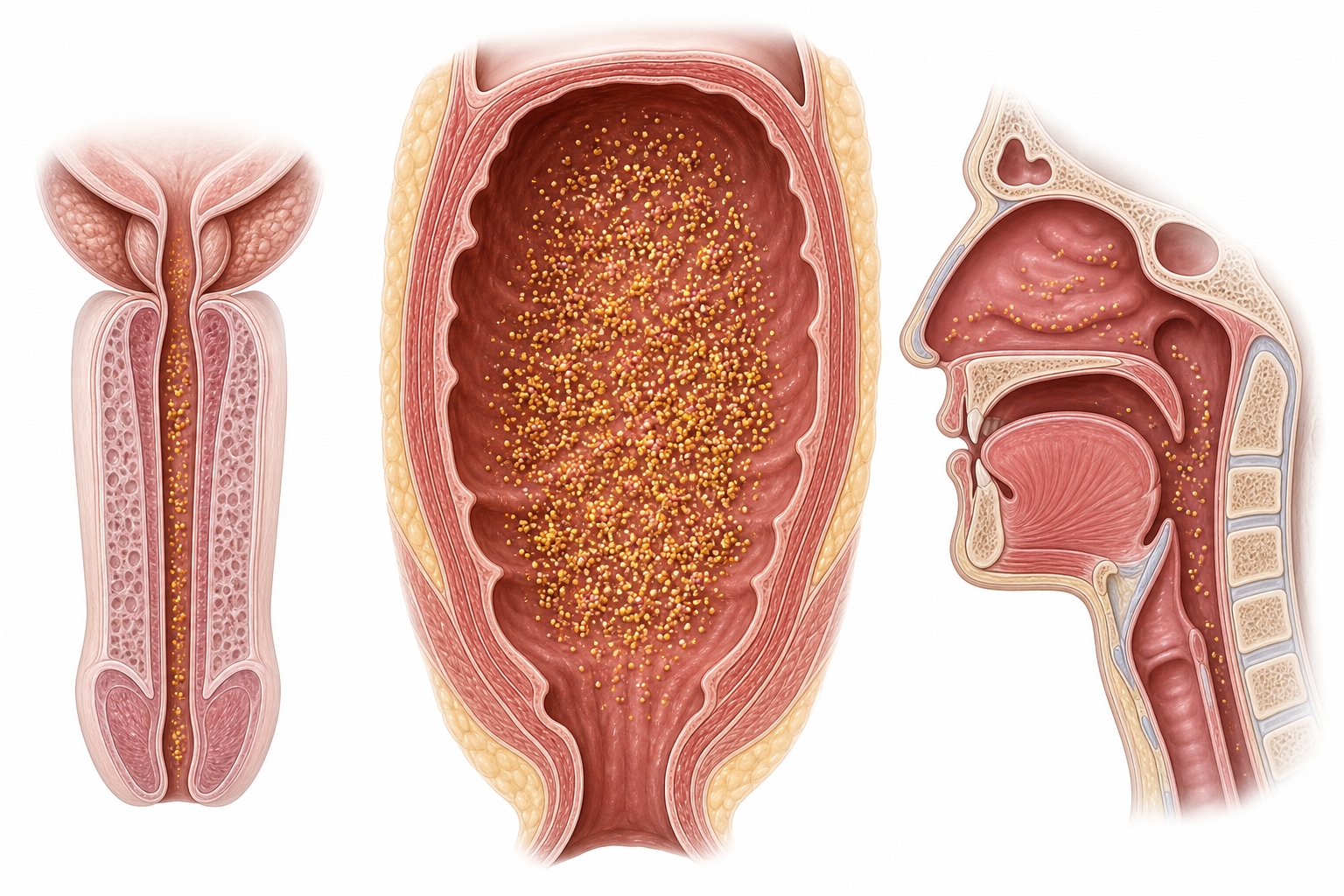
Chlamydia is a site-specific infection. Chlamydia trachomatis colonizes the columnar epithelial cells of whichever mucosal surface was exposed during sex: urethra, rectum, or pharynx. A urine sample carries cells shed from the urethra and only the urethra. If exposure happened during receptive anal sex, the infection sits in rectal tissue and never reaches urine. If exposure happened during oral sex, the infection sits in the pharynx and again never reaches urine.
This is why the CDC's 2021 STI Treatment Guidelines for MSM call out the gap directly and recommend that clinics serving higher-risk MSM offer routine extragenital screening (rectal and pharyngeal swabs) alongside urogenital testing. Focusing on urogenital screening alone misses approximately 70 percent of extragenital infections in this population (CDC).
The gap between guideline and clinic practice is wide. A "full STD panel" at a walk-in clinic often means urine NAAT plus an HIV and syphilis blood draw, which leaves out rectal and pharyngeal chlamydia entirely. A patient who does not specifically disclose oral or receptive anal exposure rarely gets those extra swabs ordered. The result is a structural blind spot. A reader who has had receptive anal or oral sex and whose last screening was urine-only does not have a clean test result for chlamydia. They have a clean result for one of three plausible sites. The single most useful question on the visit is direct: does the panel include a rectal swab and a throat swab?
This article is published by stdrapidtestkits.com, which sells at-home STI testing kits. We recommend products based on fit-for-purpose for the reader's concern, not commercial benefit. Where the right test is a clinic-administered rectal or pharyngeal swab, we say so plainly.
Why MSM chlamydia rates keep climbing
Three structural factors push chlamydia rates higher in MSM populations, and none of them is about individual recklessness.
Anatomy and exposure routes. Receptive anal sex creates direct contact between rectal mucosa and bacteria that thrives in those tissues. Receptive oral sex creates a route to pharyngeal infection that condom use is rarely applied to in practice; most adults do not use barriers during oral sex with regular partners.
Screening shortfalls. Annual urine-only screening captures urethral infection but misses the more common rectal site for MSM. Even patients who test diligently can carry an undetected infection for months because their negative urine result feels reassuring. The CDC currently recommends that higher-risk MSM, including those on PrEP and those with HIV, screen at 3- to 6-month intervals rather than annually (CDC). Annual screening remains the floor for sexually active MSM and is no longer enough for the higher-risk subgroup.
PrEP-related shifts in condom use. Pre-exposure prophylaxis effectively prevents HIV transmission, and uptake among MSM has been a public-health success. A consequence is that some users reduce condom use, which is rational from an HIV-only standpoint while raising exposure for bacterial STIs that PrEP does not cover. Multiple cohort studies have documented elevated chlamydia and gonorrhea rates among PrEP users compared with non-users, attributable to behavioral change rather than to PrEP itself.
Untreated chlamydia also raises the local risk of HIV acquisition. Mucosal inflammation from active infection makes it easier for HIV to establish during exposure, which is why CDC HIV-prevention guidance treats STI control as part of HIV prevention.
Symptoms when they appear, which is rarely
Most rectal and pharyngeal chlamydia infections in MSM produce no symptoms at all. That is the central problem. An infected person feels normal, has confident-looking sex, and unknowingly transmits the infection to partners over weeks or months. Roughly half of urethral chlamydia cases also stay asymptomatic, which is why screening rather than symptom-watching is the cornerstone of the public-health response (MedlinePlus chlamydia overview).
When symptoms do show up at a urethral site, they typically include penile discharge (clear or cloudy), burning during urination, and testicular pain or swelling (CDC chlamydia overview). Onset is usually within a few weeks of exposure, though some people develop symptoms later or not at all.
At a rectal site, symptoms when present include vague pressure, mild mucus, abnormal discharge, mild pain during a bowel movement, or bleeding. These can be mistaken for everyday irritation, hemorrhoids, or a one-off bowel issue. Most rectal chlamydia infections do not reach the symptomatic threshold at all, which is why screening rather than symptom-watching is the only reliable approach for sexually active MSM.
Pharyngeal infections rarely produce noticeable symptoms. A mild, persistent sore throat that does not improve over a week or two is the most a patient might notice, and most cases pass without any flag at all. Pharyngeal chlamydia generally clears spontaneously over months while remaining transmissible during that time.
Reactive arthritis (joint inflammation triggered by chlamydia exposure) and epididymitis (painful swelling of the epididymis behind the testicle) are recognized complications when untreated chlamydia spreads beyond the initial site. They are uncommon, and they are part of why timely treatment matters even for asymptomatic infection.
| Site | Typical symptoms in MSM | How to detect |
|---|---|---|
| Urethra (penis) | Burning during urination, clear or cloudy penile discharge in some cases; about half of urethral cases stay asymptomatic | Urine sample processed by NAAT |
| Rectum | Usually none. Sometimes mild mucus, pressure, abnormal discharge, or bleeding on a bowel movement | Clinician- or self-collected rectal swab processed by NAAT |
| Throat (pharynx) | Usually none. Sometimes a mild scratchy throat that does not improve over a week or two | Clinician- or self-collected pharyngeal swab processed by NAAT |
When to test: the window period matters more than you think
Testing the day after a hookup feels productive. It usually is not. Chlamydia has a window period, the interval between exposure and when a test can reliably detect the infection. During that window the bacterium is establishing itself in mucosal tissue but has not yet reached a bacterial load that a nucleic-acid amplification test (NAAT) can pick up. A test run too early returns a false negative, which is arguably worse than no test at all because it creates false confidence.
Most providers consider a urethral NAAT meaningful within the first week after exposure, with peak detection at about 2 weeks. For rectal and pharyngeal infection the bacterial load builds more slowly and unevenly, so testing becomes most reliable at 2 weeks post-exposure or later. The screening cadence the CDC recommends for higher-risk MSM in its 2021 STI Treatment Guidelines is built around these realities (CDC 2021 STI Treatment Guidelines for MSM).
The practical timeline is straightforward. If you test within the first few days after a hookup and the result is negative, treat it as inconclusive rather than reassuring. Retest at 2 weeks. If you have symptoms at any point during the window, test or see a clinician immediately, regardless of timing. And if your partner tests positive, you should be evaluated and treated even if your own result has been negative so far.
| Test type | Earliest reliable window | Peak detection |
|---|---|---|
| Urethral urine NAAT | Within the first week | About 2 weeks post-exposure |
| Rectal swab NAAT | Approaching 2 weeks | 2 weeks or later |
| Pharyngeal swab NAAT | Approaching 2 weeks | 2 weeks or later |
When you test negative but your partner tested positive
This is the most common confusing pattern in real-world MSM transmission. Someone has a hookup, feels fine afterward, takes a urine-only test a few days later, gets a negative result, and moves on. A week or two later the partner contacts them with a positive result. The first reader is now confused, sometimes ashamed, and almost always still infected, because the urine test never sampled the rectum or throat.
Three things tend to be happening at once when this pattern plays out. First, the wrong sample type was collected. If exposure was receptive anal sex, only a rectal swab would have found the infection. Second, the test was probably too early. A urine NAAT taken in the first few days after exposure can return a false negative even for a urethral infection. Third, the negative result was treated as a final answer when it should have been treated as a snapshot.
The lesson is practical. The exposure site dictates the sample: a rectal swab for receptive anal sex, a pharyngeal swab for receptive oral sex with a partner of uncertain status, and urine or a urethral swab for insertive exposure. The test needs to be timed correctly too, ideally 2 weeks out, with a repeat if symptoms appear later. None of this requires extra anxiety. It requires asking your provider, or your home-test kit, the right questions before you collect a sample.
Wrong sample type. Urine cannot detect rectal or pharyngeal infection. The bacterium colonizes the tissue at the exposure site and never reaches urine.
Wrong timing. A NAAT run in the first few days after exposure can miss a real infection because bacterial load has not built up yet.
Wrong framing. Treating a single negative result as the final answer when it is only a snapshot inside the bacterium's window period.
How to screen correctly, and where the at-home swab fits
Screening cadence for sexually active MSM under current CDC guidance:
- At minimum, annual screening for urethral chlamydia and gonorrhea (CDC).
- For MSM with multiple or anonymous partners, those on PrEP, or those with HIV: every 3 to 6 months (CDC 2021 STI Treatment Guidelines for MSM).
- If receptive anal sex is part of your history: rectal swab in addition to urine, regardless of condom use.
- If receptive oral sex is part of your history: pharyngeal swab in addition to urine, regardless of condom use.
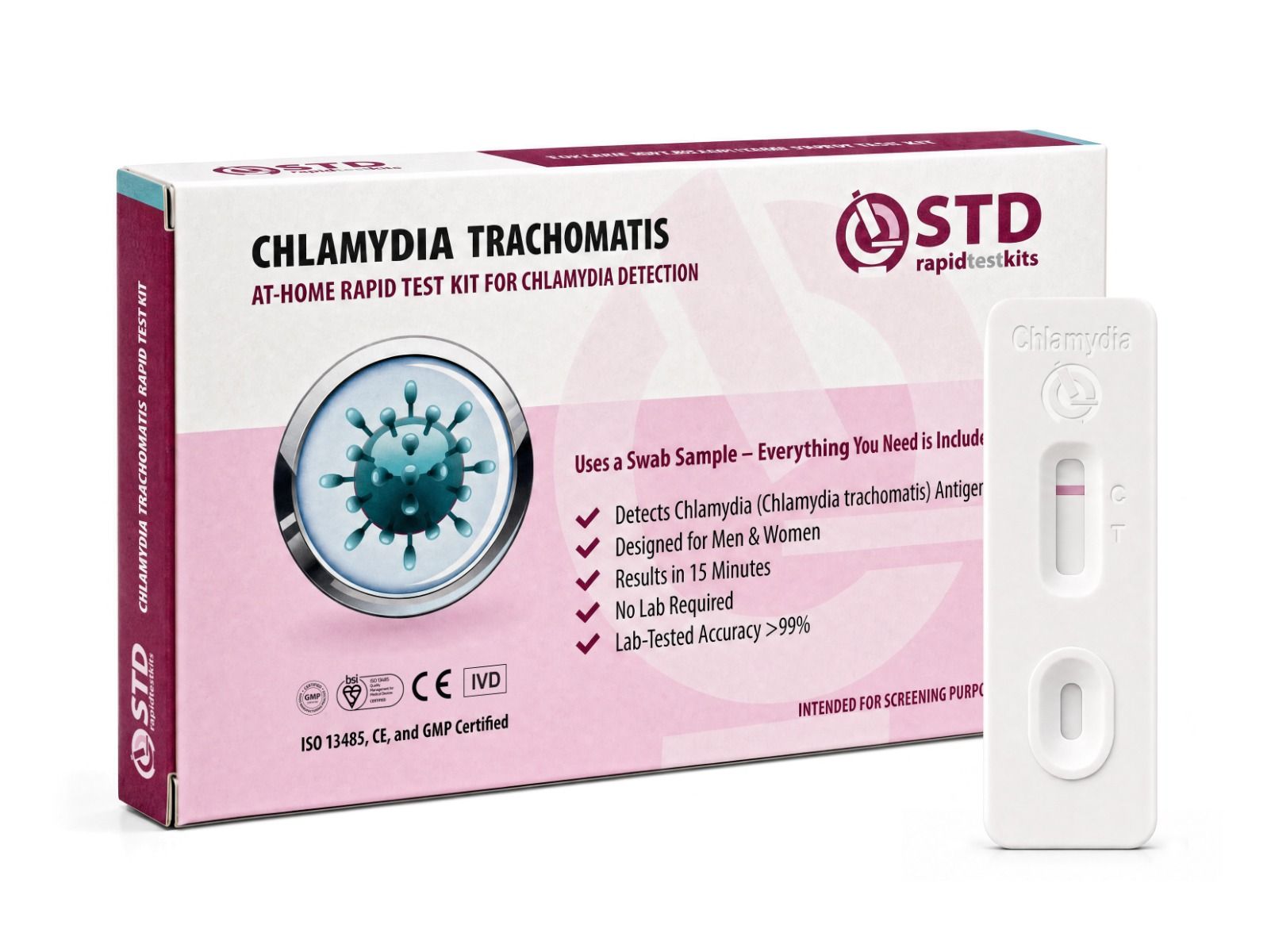
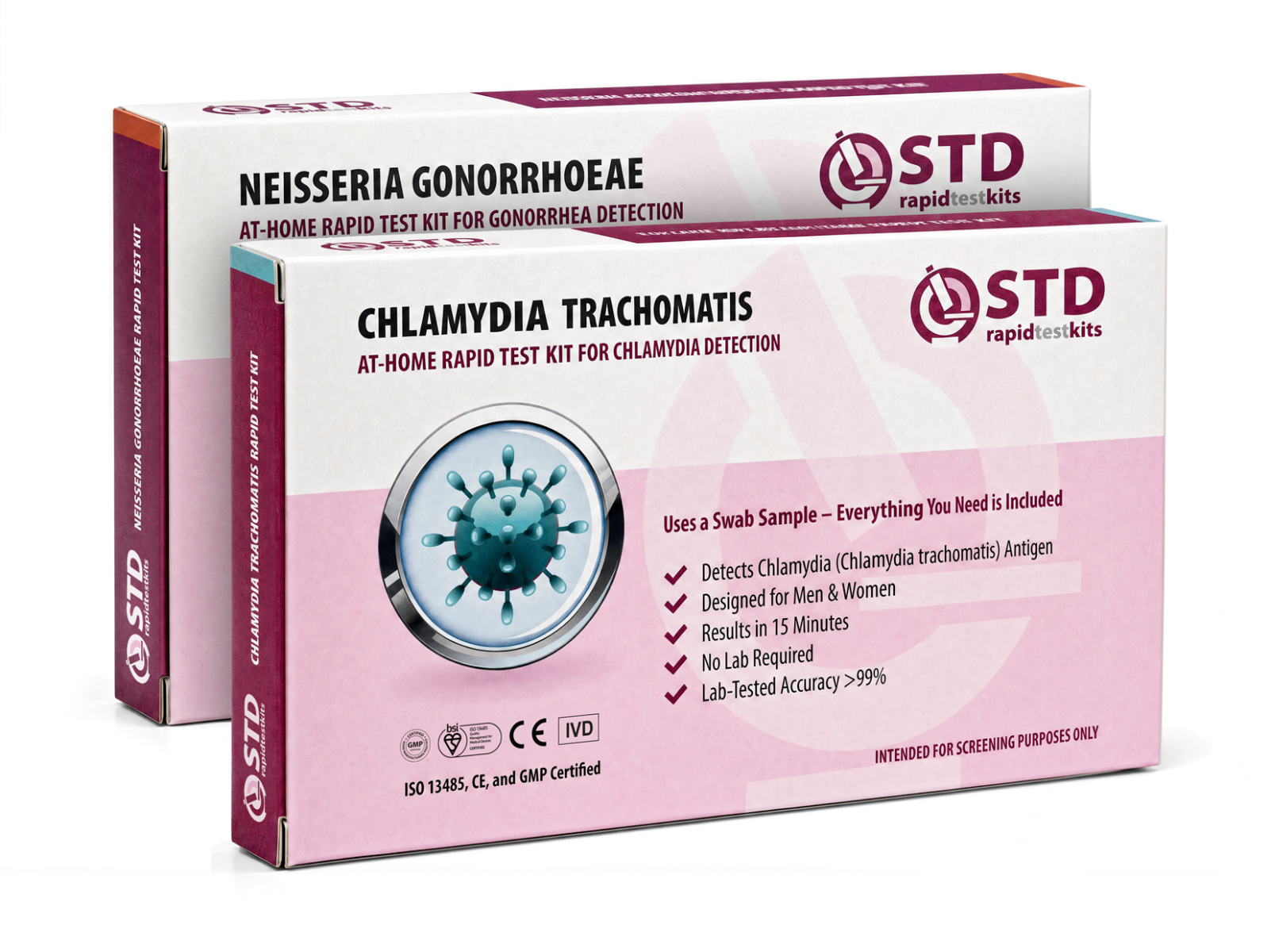
Where our at-home rapid swab fits. Our chlamydia rapid test uses a self-collected urethral or vaginal swab and runs as a lateral-flow cassette at home with a result in about 15 minutes. It is a useful screening tool for genital chlamydia between clinic visits, especially for people who want fast privacy after a recent encounter or who want to confirm a clear result before resuming sex. Lab NAAT testing remains the gold standard for analytical sensitivity; the at-home rapid is designed for rapid screening, and a positive result is worth confirming with NAAT when you can.
Where it does not fit, and where a clinic is the right call. Our home kits do not test rectal or pharyngeal sites. We do not currently sell a self-collected rectal or throat swab. If your last exposure was receptive anal or oral and that is the site you are worried about, the right test is a clinic-administered rectal or pharyngeal swab processed by NAAT, or a mail-in NAAT kit that explicitly includes those vials. Using a urethral swab kit at home does not substitute for that. Be specific with the clinician about exposure routes; many clinics default to urine unless you ask for the additional swabs by name.
Treatment: what current CDC guidance recommends
Chlamydia is curable with antibiotics, and the CDC's 2021 treatment guidelines are specific about the preferred regimen. The recommended first-line treatment is doxycycline 100 mg orally twice daily for 7 days (CDC chlamydia treatment guidelines).
Why doxycycline rather than the older single-dose azithromycin? At rectal sites, doxycycline performs substantially better. The CDC summarizes a clinical trial finding microbiologic cure of 100 percent with doxycycline compared with 74 percent for azithromycin in rectal chlamydia among MSM (CDC). Because doxycycline is preferred across urogenital, rectal, and oropharyngeal sites, it has become the default regimen for chlamydia treatment generally.
Alternative regimens listed in the guidelines include azithromycin 1 g orally as a single dose and levofloxacin 500 mg orally once daily for 7 days. Single-dose azithromycin is sometimes used when adherence to a 7-day course is a concern, and it requires post-treatment evaluation for rectal infection because of the lower cure rate.
Practical points the CDC emphasizes:
- Avoid sexual contact (oral, anal, or otherwise) for at least 7 days after starting treatment, and until any sexual partners have also completed their own course, to break the reinfection cycle.
- All recent sexual partners should be evaluated and treated. The CDC supports expedited partner therapy where state law allows it.
- Retest at about 3 months after treatment to catch reinfection from new or previously untreated partners. The doxycycline course is expected to clear the original infection; this retest screens for fresh exposure rather than confirming the original cure.
- Test-of-cure 4 weeks after treatment is recommended for pharyngeal infection treated with azithromycin and during pregnancy.
| Regimen | Dose | Rectal-site cure rate |
|---|---|---|
| Doxycycline (preferred) | 100 mg orally twice daily, 7 days | 100% |
| Azithromycin (alternative) | 1 g orally, single dose | 74% |
Smart prevention strategy for sexually active MSM
Prevention here is less about a single intervention and more about layering several reasonable habits.
Use barriers more often than you currently do, especially for anal sex. Condoms remain one of the most effective single interventions for chlamydia, gonorrhea, and syphilis. Consistent use materially lowers transmission probability per encounter, especially during anal sex where mucosal transmission is most efficient. Water- or silicone-based lubricant for any anal sex also reduces mucosal microtears that raise both transmission and acquisition risk for chlamydia and HIV.
Cover the routes condoms don't. Dental dams reduce throat-to-genital transmission during oral-genital contact and reduce risk during rimming (oral-to-anal contact), where rectal pathogens can travel to the throat. Shared sex toys can transfer chlamydia between partners or between anatomic sites; clean toys between uses and re-cover them with a fresh condom when passing them between people or between body sites. These are quietly effective tools that most prevention messaging skips.
Keep PrEP in perspective. PrEP is a substantial advance for HIV prevention and the public-health benefit is real. It does not protect against bacterial STIs. Some people on PrEP add a doxycycline post-exposure prophylaxis (doxy-PEP) regimen that the CDC has acknowledged in updated guidance for selected MSM populations, though this is a clinician-led decision based on risk profile rather than a do-it-yourself fix.
Make screening routine, not reactive. Quarterly testing for higher-risk MSM matches the current CDC recommendation; it applies to ordinary higher-risk profiles, including being on PrEP or having multiple partners. The pattern that gets people in trouble is testing only after a scare, finding a positive, and then learning that the partner from a hookup 3 months back was probably the source.
Be specific with your clinician. A urine result covers only the urethral site. Rectal and pharyngeal infections need their own swabs, requested by name at the clinic. Direct language works: "I have had receptive anal sex in the past year and I would like a rectal chlamydia and gonorrhea swab today." The CDC recommendation gives you the cover to insist; clinicians who screen MSM regularly will not push back. If your provider does push back, a sexual-health clinic or LGBTQ+ health center will run the swabs without friction.
Consider combination home screening between clinic visits. After a higher-risk exposure event where multiple infections are on your radar, some readers prefer to combine genital screening for chlamydia and gonorrhea in a single test rather than running individual home tests in sequence. The CDC-recommended pairing for MSM is chlamydia plus gonorrhea at every site of exposure; a 2-in-1 home swab covers the genital side of that pair, with rectal and pharyngeal swabs still requiring a clinic visit.
Prevention at a glance
These habits stack. None of them is a single fix; together they meaningfully lower exposure between screening cycles and shorten any window in which an undetected infection can spread.
Layered protection
- Condoms for the act they fit, particularly anal penetration, per the partner agreement you have set.
- Water- or silicone-based lubricant for any anal sex to reduce mucosal microtears that raise transmission and acquisition risk.
- Dental dams for oral-genital and oral-anal contact, and a fresh condom on any shared sex toy passing between partners or anatomic sites.
- A direct partner-status conversation that asks when they last tested and at which sites, not just whether they tested.
- A personal screening cadence (annual minimum, every 3 to 6 months for new or multiple partners) calibrated to actual sexual activity.
Reinfection is the rule, not the exception
Reinfection within the year after a chlamydia diagnosis is genuinely common. This is not because immunity fails (the body does not build durable immunity to chlamydia) but because sexual networks overlap. A partner whose result you never confirmed, a new partner with an undetected infection of their own, a hookup three months down the line: any of these can return chlamydia to a person who has just finished treatment.
The CDC's recommendation for MSM with a recent chlamydia diagnosis is straightforward: retest at three months, regardless of whether your partners were treated. Beyond that single retest, routine cadence depends on lifestyle. Readers with new or multiple partners are advised to screen at least annually with full site coverage (urine plus rectal swab plus throat swab), and every 3 to 6 months if partners are anonymous or numerous.
For readers who travel during Pride season, attend sex parties, or use apps for regular casual hookups, a quarterly cadence is reasonable. For readers in monogamous arrangements with a partner whose recent results are known, annual is fine. The point is to decide ahead of time, not to test only when fear arrives.
The CDC recommends retesting at about 3 months after treatment regardless of whether you believe your partners were treated. The doxycycline course almost always clears the original infection; the 3-month retest catches reinfection from a new or previously untreated partner, which is the more common path to a second chlamydia diagnosis within a year (<a href="https://www.cdc.gov/std/treatment-guidelines/chlamydia.htm" target="_blank" rel="noopener noreferrer">CDC chlamydia treatment guidelines</a>).
Telling partners: a short script that works
Partner notification is the part of a positive result that feels heaviest, and it is almost always more straightforward than the anticipation suggests. You do not owe anyone a sexual history, an explanation, or a justification. You owe them a short factual heads-up so they can get tested and treated. Reinfection through an untreated partner is the most common reason for a second chlamydia diagnosis within a year, so this conversation also protects you.
A workable script for current or recent partners reads: "Hey, I tested positive for chlamydia. I am being treated. Wanted to let you know so you can get checked too. It is treatable with antibiotics, and most cases are symptomless." That is enough. Send it by text if conversation feels unsafe, by phone or in person if the relationship can support that. Either way the content is the same and your part is done.
For partners you cannot easily contact, or where direct notification would not be safe, most state and city health departments run anonymous partner-notification services. You give the service the contact information, the service alerts the partner without identifying you, and the partner is pointed toward testing resources. Several digital tools offer the same anonymous-notification feature outside of public-health channels. In states where law allows it, your clinician can also use expedited partner therapy to prescribe treatment to a partner without a separate visit.
More frequent STI screening at 3- to 6-month intervals is indicated for MSM, including those taking PrEP and those with HIV infection, if risk behaviors persist or if they or their sexual partners have multiple partners.
Common myths about chlamydia in MSM
Myth 1: No symptoms means no infection
Most rectal and pharyngeal chlamydia infections in MSM never produce symptoms. Feeling normal is not informative. Screening is the only way to know.
Myth 2: A standard urine test covers everything
A urine test detects urethral chlamydia. It cannot detect rectal or pharyngeal infection. Adding rectal and throat swabs at the clinic is the only way to screen those sites, and the CDC recommends doing so for sexually active MSM with corresponding exposure routes (CDC).
Myth 3: Oral sex without ejaculation is risk-free for chlamydia
Pharyngeal chlamydia transmits through mucosal contact during oral sex, with or without ejaculation, and can move in either direction (throat-to-genital or genital-to-throat). The CDC and WHO list oral sex as a recognized chlamydia transmission route alongside vaginal and anal contact (WHO).
Myth 4: PrEP protects against everything
PrEP prevents HIV. It has no effect on chlamydia, gonorrhea, syphilis, or any other bacterial STI. Studies of MSM on PrEP show higher rates of bacterial STIs than non-PrEP MSM, primarily because of behavioral changes around condom use.
Myth 5: One antibiotic dose and you are done
The CDC's preferred regimen is doxycycline 100 mg twice daily for 7 days; single-dose azithromycin is an alternative and underperforms at rectal sites (CDC). Sexual contact should pause for at least 7 days after starting treatment, partners need treatment too, and a retest at 3 months catches reinfection.
Myth 6: Chlamydia in men cannot affect fertility
It can. Untreated chlamydia in men can cause epididymitis, and recurrent or chronic infection has been associated with reduced fertility, though the effect size is smaller than the well-documented impact in women. Fertility is also a concern for partners; for any female partner, untreated chlamydia is a recognized cause of pelvic inflammatory disease and infertility (NHS).
Two beliefs cause more missed MSM chlamydia infections than the other four combined: assuming that no symptoms means no infection, and assuming that a standard urine panel covers every site. Rectal and pharyngeal infections are usually silent, and urine cannot reach either site. If you have had receptive anal or oral sex, a urine-only negative is not a clean result; it is a partial one.
What to do next, depending on where you are
If you are sexually active and have not been screened in the last 6 months, that is the action item. The shortest path is a clinic visit with rectal and pharyngeal swabs added if your exposures call for them, or a mail-in NAAT kit that explicitly includes those vials. The home rapid swab is a useful supplement for genital screening between clinic visits, particularly when speed and privacy matter.
If you have specific symptoms (penile discharge, burning urination, rectal pain or discharge, persistent unexplained sore throat), do not wait for a screening cycle. Symptoms in a sexually active MSM merit a clinic visit promptly, and the clinician will collect the appropriate swab from the symptomatic site and run NAAT.
If you had a recent exposure and no symptoms, wait until 2 weeks post-exposure for the most reliable single result. A negative at day 3 to 5 is inconclusive; retest at day 14 before relying on it. If your partner has already tested positive, see a clinician now regardless of timing.
If you have already tested positive, complete the full doxycycline course, pause sexual contact for at least 7 days, notify recent partners, and plan a retest at about 3 months. Reinfection within a year is common when partners go untreated, and routine retesting is what catches it before another chain forms.
None of this requires panic. Chlamydia is curable, and consistent screening on the cadence the CDC recommends is what catches it before an untreated infection becomes a transmission chain spanning months.
Your next move, mapped to your situation
Do you have specific symptoms right now (penile discharge, burning urination, rectal pain or discharge, or a persistent unexplained sore throat)?
Yes: See a clinician promptly. Ask for a swab from the symptomatic site processed by NAAT, and add rectal and pharyngeal swabs if your exposure history calls for them. Do not wait for a routine screening cycle.
Has a recent sexual partner tested positive for chlamydia?
Yes: See a clinician now regardless of time since exposure or any prior negative result of your own. The CDC recommends evaluation and treatment in this scenario even when you feel fine.
Did you have a recent exposure but feel fine, with no partner positive yet?
Yes: Wait until 2 weeks post-exposure for the most reliable single result. A negative inside the first few days is inconclusive; retest at 14 days before relying on it.
No: If you have not been screened in the last 6 months, book a clinic visit with rectal and pharyngeal swabs added if your exposure history calls for them, or order a mail-in NAAT kit that explicitly includes those vials. The at-home rapid swab covers genital screening between fuller clinic visits.
Guidance only; a clinician can advise based on your specific situation.
Frequently asked questions
- Can I get chlamydia from oral sex?
- Yes. Pharyngeal chlamydia transmits through mucosal contact during oral sex with or without ejaculation, in either direction (throat-to-genital or genital-to-throat). Throat infections are usually asymptomatic, and standard urine STI tests do not detect them. A clinician needs to run a pharyngeal swab to screen for chlamydia in the throat.
- Does a standard urine STI test catch rectal chlamydia?
- No. A urine test detects urethral chlamydia only. Rectal infection requires a clinic-administered rectal swab processed by NAAT. The CDC's 2021 STI Treatment Guidelines for MSM specifically recommend extragenital (rectal and pharyngeal) screening for higher-risk MSM, because urine-only testing misses about 70 percent of infections in this population. The honest check on any 'full panel' is to ask whether the panel included rectal and throat swabs; if the answer is no or unclear, you have a urethral-only result.
- How long after a hookup should I wait to test?
- Two weeks is the single most reliable time point for all three sites. A negative result inside the first few days is inconclusive, so retest at 14 days before relying on it. If a partner has already tested positive, skip the window and see a clinician now.
- How often should sexually active MSM get tested?
- At a minimum annually. For higher-risk MSM (multiple or anonymous partners, those on PrEP, those with HIV, or anyone whose partner has those risk factors), the CDC recommends every 3 to 6 months. Pharyngeal and rectal swabs should be added at the clinic when corresponding exposure routes are part of your history.
- Can your at-home test detect rectal or throat chlamydia?
- No. Our at-home rapid swab is validated for self-collected urethral or vaginal sampling and tests for genital chlamydia. We do not currently sell a self-collected rectal or pharyngeal swab kit. For those sites, the right test is a clinic-administered swab processed by NAAT, or a mail-in NAAT kit that explicitly includes rectal and throat swab vials.
- What does the CDC recommend for treatment?
- The 2021 CDC chlamydia treatment guidelines recommend doxycycline 100 mg orally twice daily for 7 days as the first-line regimen across urogenital, rectal, and oropharyngeal sites. Single-dose azithromycin 1 g is an alternative, and it underperforms at rectal sites (microbiologic cure of 74 percent for azithromycin compared with 100 percent for doxycycline in one trial cited by the CDC).
- Does PrEP protect against chlamydia?
- No. PrEP prevents HIV and has no effect on bacterial STIs including chlamydia, gonorrhea, and syphilis. Several studies show MSM on PrEP carry higher chlamydia rates than non-PrEP MSM, primarily because of reduced condom use rather than any direct PrEP effect. Doxy-PEP is a separate clinician-led regimen for selected MSM populations and does not replace site-specific screening.
- If I test positive, when can I have sex again?
- The CDC recommends pausing sexual contact for at least 7 days after starting treatment, and until any sexual partners have completed their own course of treatment. Resuming sex before partners are treated is the most common cause of reinfection. A retest at about 3 months is recommended to catch reinfection from new or previously untreated partners.
- U.S. Centers for Disease Control and Prevention. About Chlamydia: symptoms, screening recommendations, and complications.
- U.S. Centers for Disease Control and Prevention. 2021 STI Treatment Guidelines, Special Populations: Men Who Have Sex with Men. Source for the extragenital screening recommendation, the 3- to 6-month cadence for higher-risk MSM, and the ~70 percent extragenital miss rate with urine-only testing.
- U.S. Centers for Disease Control and Prevention. 2021 STI Treatment Guidelines, Chlamydia. Source for the doxycycline 100 mg twice daily for 7 days regimen and the rectal-site cure-rate comparison between doxycycline (100 percent) and azithromycin (74 percent).
- World Health Organization. Chlamydia fact sheet. Source for the global 2020 incidence estimate (~128.5 million new infections, adults 15 to 49) and the 4.0 percent / 2.5 percent prevalence figures.
- MedlinePlus (U.S. National Library of Medicine). Chlamydia Infections: general overview, symptoms by anatomic site, and asymptomatic infection patterns.
- U.K. National Health Service. Chlamydia: symptoms, transmission, complications, and treatment overview.