
Published: July 2025 | Last updated: May 2026 | Editorial review and quality control: Martina N.
Can you get an STD from hugging someone?
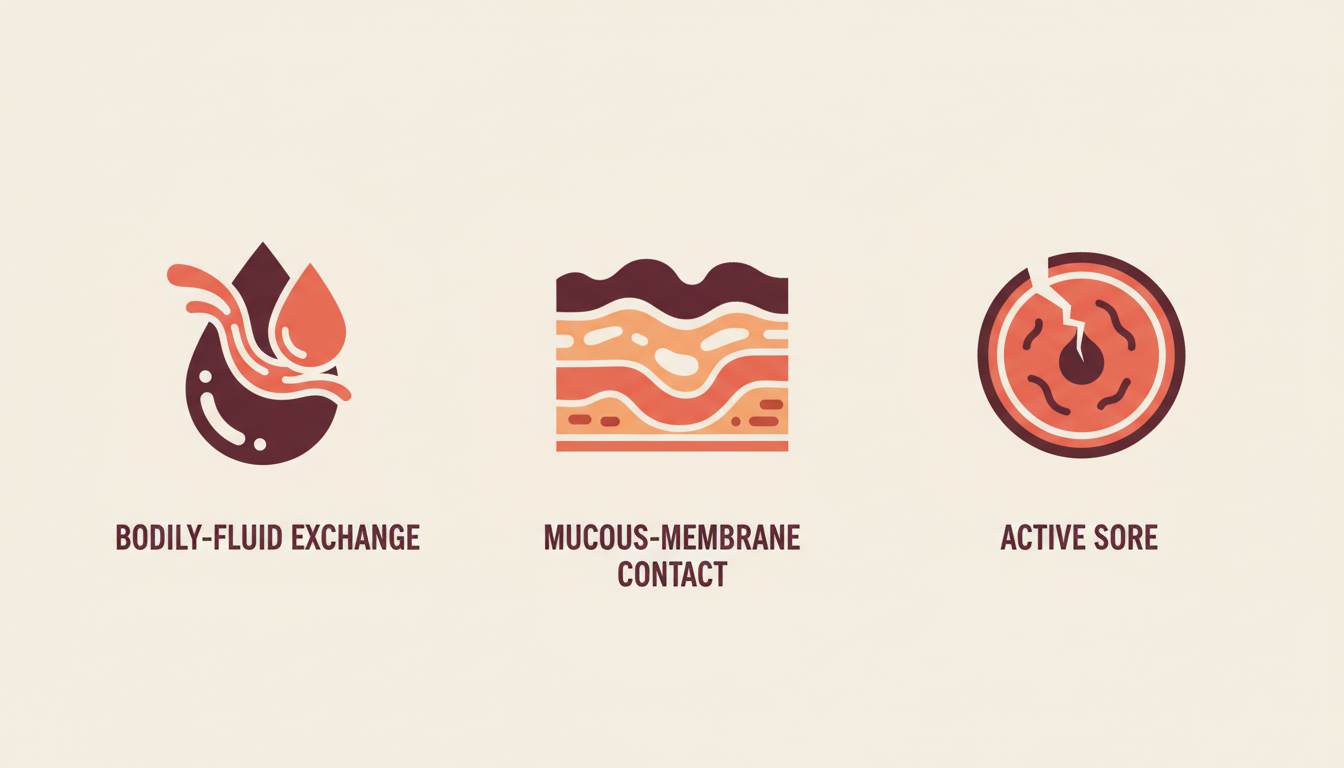
No. Every common STI requires bodily-fluid exchange, mucous-membrane contact, or direct contact with an active sore, conditions a hug never provides. The CDC has documented zero cases of any sexually transmitted infection spreading through hugging, handshakes, shared dishes, or other casual contact across decades of surveillance.
A hug with a friend who just disclosed they have genital herpes, a shared glass with a coworker who later mentions an HIV diagnosis, a public toilet seat after waiting in a long line, or a toddler's kiss on an HIV-positive grandparent's cheek: these are the moments that lodge in the back of your mind for weeks. Did I just expose myself to something? Could I have exposed my child?
The reassuring answer is no. Sexually transmitted infections do not pass through hugging, shared cups, shared toilet seats, casual touch, shared bathwater, or affectionate kisses on the cheek. They need very specific biological conditions to move from one person to another, and casual contact does not provide them.
This guide walks through how STIs transmit, why most pathogens cannot survive on dry surfaces, the small handful of shared-item exposures that genuinely do carry risk (hint: hepatitis and shared razors), and when an exposure event actually warrants a test.
Key takeaways
- There are zero documented cases of any STI transmitting through hugging, handshakes, shared toilet seats, or shared dishes. Every common STI requires fluid exchange, mucous-membrane contact, or sustained contact with an active sore, and casual contact provides none of those.
- The genuine casual-contact risks are narrow and bloodborne. Hepatitis B virus can stay infectious on surfaces for at least 7 days, and hepatitis C survives for several days, which is why shared razors, blood-contaminated toothbrushes, and shared injection equipment are the casual-contact exposures worth taking seriously.
How sexually transmitted infections spread
To understand why hugging is not a transmission risk, it helps to look at what STIs actually need to move between people. According to the U.S. Centers for Disease Control and Prevention, every common STI relies on one of three biological pathways: bodily-fluid exchange, mucous-membrane contact, or direct contact with an active sore (CDC sexually transmitted infections overview; Mayo Clinic STI overview).
Bodily-fluid exchange covers HIV, hepatitis B, hepatitis C, gonorrhea, chlamydia, trichomoniasis, and syphilis. The fluids involved are semen, pre-seminal fluid, vaginal secretions, rectal mucus, blood, and (for some pathogens) breast milk. None of these are exchanged during a hug, even a long, affectionate one.
Mucous-membrane contact covers infections that spread when mucosal tissue from one person touches mucosal tissue from another. The mucous membranes of the genitals, mouth, anus, and rectum are the relevant sites. A hug touches outer skin, usually through clothing.
Direct contact with an active sore is the route that causes the most public confusion, because it can sound like 'any skin contact'. It is not. Herpes simplex virus and primary syphilis both produce localized sores or chancres that shed virus or bacteria. Transmission requires sustained, direct contact between an active lesion and a receptive surface, typically the genitals, mouth, or rectum of a partner. A hug does not bring those tissues into contact.
What 'casual contact' actually means
The phrase 'casual contact' carries a lot of weight in public-health language. It means everyday social interactions that do not involve sexual activity, blood exchange, or prolonged skin-to-skin contact with broken or mucosal surfaces. The CDC and WHO use it for situations like shaking hands, hugging, sitting next to someone, sharing dishes or cups, using the same toilet, swimming in the same pool, or kissing someone on the cheek.
What does not count as casual contact: unprotected vaginal, anal, or oral sex; sharing needles or any item that draws blood; deep mouth-to-mouth kissing with someone who has active oral lesions; long skin-to-skin contact with active visible lesions; or a needlestick injury. Those are direct exposure events with very different math behind them.
The distinction matters because of how readers usually use the phrase. When someone worries about 'casual contact,' they almost always mean the first list. The biology of how STIs transmit is built around the second list. Those two lists do not overlap in any meaningful way.
Casual contact (no STI transmission risk): hugging, shaking hands, shared dishes or cups, same toilet seat, swimming in the same pool, cheek kisses, sharing a non-bloody towel.
Direct exposure (real STI transmission risk): unprotected vaginal, anal, or oral sex; sharing needles or any item that draws blood; deep mouth-to-mouth kissing with someone who has active oral lesions; sustained skin-to-skin contact with active visible lesions; a needlestick injury.
Why most pathogens cannot survive outside the body
The bacterial STIs are remarkably fragile organisms. They evolved to live inside warm, moist mucous membranes. Dry them out, cool them down, or expose them to air for more than a few minutes, and they die. Chlamydia trachomatis survives only briefly on inanimate surfaces. Neisseria gonorrhoeae, the bacterium behind gonorrhea, is even more delicate; laboratory studies show it dies within minutes of drying. Treponema pallidum, the bacterium behind syphilis, similarly cannot survive outside the body for any meaningful duration. Trichomonas vaginalis, a protozoan, can survive up to about 45 minutes on damp surfaces but rapidly dies once dry.
HIV is also remarkably fragile outside the body. The CDC's position has been consistent for decades: HIV cannot survive long once exposed to air, and there has never been a documented case of HIV transmission through casual contact like shared dishes, towels, toilet seats, or insect bites (CDC HIV information). Once HIV-bearing fluid dries on a surface, the virus is essentially gone.
These pathogens evolved as obligate parasites of the human reproductive or circulatory tract. That is exactly why they cannot survive outside that closed system. They are wildly successful at jumping between warm, moist, living environments during sexual contact and correspondingly terrible at surviving the cold, dry, oxygen-rich environment outside it. Survival times by pathogen:
| Pathogen | Survival outside the body | Casual-contact risk |
|---|---|---|
| HIV | Minutes to hours once dried; rapidly inactivated by air | Effectively zero |
| Chlamydia trachomatis | Minutes to hours on damp surfaces | Effectively zero |
| Neisseria gonorrhoeae | Dies within minutes of drying | Effectively zero |
| Treponema pallidum (syphilis) | Minutes on dry surfaces | Effectively zero |
| Trichomonas vaginalis | Up to about 45 minutes on damp surfaces | Very low |
| HSV-1 / HSV-2 | Hours on warm, moist surfaces | Low; HSV-1 via saliva possible |
| Hepatitis B virus | At least 7 days on environmental surfaces | Real when blood is shared |
| Hepatitis C virus | Days on environmental surfaces under typical conditions | Real when blood is shared |
| Pubic lice / scabies mites | 1 to 3 days off the human body | Low but real with shared bedding |
HIV cannot transmit through casual contact
Of all the STIs, HIV is the one most weighed down by old misinformation. The myths that emerged in the 1980s, such as catching HIV from a toilet seat, a shared cup, a sneeze, or a hug, have outlived the science that disproved them.
Here is what the CDC and World Health Organization both confirm. HIV transmits through five specific body fluids: blood, semen, pre-seminal fluid, rectal and vaginal fluids, and breast milk. The primary routes are unprotected sex, sharing injection equipment, and mother-to-child transmission during pregnancy, birth, or breastfeeding (CDC HIV information; WHO STI fact sheet).
Per CDC risk estimates, even the highest-risk sexual exposures carry per-act transmission risks that surprise most readers: well under a couple of percent for receptive anal intercourse without a condom, and a fraction of a percent for a single needlestick injury involving HIV-positive blood. The risk from a shared coffee cup is, in epidemiological terms, zero.
The CDC's transmission page is explicit on what does not transmit HIV: saliva, sweat, tears, urine, hugging, shaking hands, sharing toilets, sharing dishes, sharing utensils, mosquito bites, and closed-mouth kissing. There are no documented cases of HIV being transmitted through any of these.
Modern HIV treatment also matters here. People living with HIV who take antiretroviral therapy and reach an undetectable viral load cannot transmit the virus sexually. The scientific consensus is summarized as 'undetectable equals untransmittable', or U=U. A friend or family member living with HIV who is on treatment poses no transmission risk to you in any context, let alone a hug.
HIV is not transmitted through saliva, tears, sweat, hugging, shaking hands, sharing toilets, sharing dishes, or closed-mouth or 'social' kissing with someone who has HIV.
Why HSV and HPV create the most confusion
Herpes and HPV are the infections most likely to come up when someone asks 'but doesn't this spread through skin?' The short answer is yes, both are skin-to-skin infections. The longer answer is that 'skin-to-skin' in clinical terms means something far more specific than 'two people touching'.
For herpes simplex virus (HSV), transmission requires direct contact with an active or recently-active lesion, or with the localized area where viral shedding is happening (CDC genital herpes resources). HSV-1 is overwhelmingly oral and spreads through kissing or oral contact with a cold sore. HSV-2 is overwhelmingly genital and spreads through genital contact during sex. The virus does not survive long on outer skin away from the lesion site, and it does not jump across clothing.
For HPV, the route is genital, oral, or anal mucosal contact during sexual activity (CDC HPV information page). The CDC's transmission information explicitly describes intimate sexual contact as the route. Holding hands, hugging, and sharing toilet seats are not how HPV spreads. The infection lives in mucosal tissue, not on hands or arms. Vaccination against HPV (routinely recommended through age 26, with shared clinical decision-making available through age 45) prevents the strains responsible for most cervical cancers and genital warts.
When clinicians call HSV and HPV 'skin-to-skin' infections, they mean direct contact between mucosal tissue or an active lesion and a receptive surface (typically the genitals, mouth, or anus). They do not mean hand-to-hand, arm-to-arm, or back-to-back contact. The phrase is medical shorthand, not a literal description of any touch counting as a risk.
What about kissing?
Kissing sits in an uncomfortable space between 'casual contact' and 'intimate contact', so it is worth its own section. The biology breaks cleanly by infection type. HIV is not transmitted through kissing under any normal circumstance; the CDC explicitly lists closed-mouth and social kissing as zero-risk. Chlamydia, gonorrhea, syphilis, and trichomoniasis are not realistically transmitted through kissing either. Hepatitis B and C are not typically transmitted by kissing unless both parties have substantial bleeding gums or oral wounds at the same time.
The exceptions where kissing genuinely transmits something: HSV-1 through saliva and contact with active oral lesions, oral gonorrhea or syphilis very rarely through deep mouth-to-mouth kissing with someone who has a pharyngeal infection, and Epstein-Barr virus (the cause of mononucleosis, often called 'the kissing disease') through saliva exchange. Of those, HSV-1 is the most likely encounter, and most adults already carry it.
For most readers asking about a single kiss with someone whose STI status is uncertain, the realistic risk profile is very low. If you are concerned about an oral exposure to pharyngeal gonorrhea or syphilis from deep kissing with a partner who has just disclosed that diagnosis, see a clinic for a pharyngeal swab; that specific sample type is clinic-administered and not something we sell at home.
The CDC has stated for decades that HIV is not transmitted through closed-mouth or social kissing. No documented case of HIV transmission from routine kissing exists in the surveillance literature. Even deep mouth-to-mouth kissing only carries a theoretical risk if both parties have actively bleeding gums or open mouth sores at the same time, which is why the CDC describes that scenario as exceptionally rare rather than impossible.
Hepatitis B and C are the surface-stable exceptions
Hepatitis B virus (HBV) is the survival outlier among STIs. Per the World Health Organization's hepatitis B fact sheet, HBV can survive on environmental surfaces for at least 7 days and remain infectious during that time (WHO hepatitis B fact sheet). That changes the math for any object that might carry dried blood: razors, toothbrushes (when gums bleed), nail clippers, glucose-monitoring lancets, tattoo or piercing equipment, and injection-drug paraphernalia. HBV is also substantially more transmissible than HIV in needlestick-exposure scenarios per CDC occupational-exposure data, which is why a single sharps injury involving HBV-positive blood carries a notably higher transmission probability than the equivalent HIV exposure.
Hepatitis C virus (HCV) is the close cousin in this category. HCV can survive on environmental surfaces for days under typical room conditions, and longer under more favorable laboratory conditions. HCV transmission outside of a healthcare setting almost always involves shared injection equipment, but contact with dried blood on shared personal items can also be a route (CDC hepatitis C overview).
The good news with hepatitis B is that an effective, durable vaccine exists. Current CDC guidance recommends universal HBV vaccination for all adults aged 19 through 59, and for adults 60 and older with risk factors. If you live with or are close to someone with chronic HBV, that conversation with a provider is your single highest-impact preventive step. No vaccine exists for hepatitis C, which is why a one-time HCV antibody screen is now recommended for all adults aged 18 and older, regardless of risk history.
Razors, toothbrushes, nail clippers, finger-stick lancets, syringes, and tattoo or piercing equipment can all carry trace amounts of dried blood that retain infectious hepatitis B or C virus for days or longer. The risk is small per single exposure but is the one casual-contact route where transmission is genuinely possible. Substitute with disposable or individually owned items in shared bathrooms.
Pubic lice and scabies: the item-sharing exception
This is the one category where shared items occasionally do transmit. Pubic lice (sometimes called 'crabs') are tiny insects that live in coarse body hair and feed on blood. They can survive 1 to 2 days off the human body, which means shared bedding, towels, or clothing with an actively infested person can transmit pubic lice. The more common transmission route is still direct sexual or close personal contact, but item-sharing is a documented secondary route.
Scabies is caused by a microscopic mite that burrows into the skin. The mite can survive two to three days off a human host. Most scabies transmission happens during prolonged skin-to-skin contact, but in households where one person has untreated scabies, sharing bedding, clothing, or towels can transmit the mite. The standard public-health response when one person is diagnosed is to treat all household members concurrently and wash recently used bedding and clothing in hot water (over 50°C, or about 122°F).
Neither pubic lice nor scabies are typically lumped into the 'STI' mental category despite being on the official list. They are uncomfortable but highly treatable with over-the-counter or prescription topical agents. If you noticed itching after staying somewhere unfamiliar, see a clinician for a quick visual exam rather than guessing.
Treat every household member at the same time, not only the diagnosed person. The mite spreads through shared bedding and prolonged close contact before symptoms appear, so treating one person while leaving others untreated leads to immediate reinfestation. Wash recently used bedding, towels, and clothing in hot water (over 50°C, or about 122°F) and dry on high heat. Items that cannot be washed can be sealed in a plastic bag for 72 hours, which exceeds the mite's survival window off a human host.
The casual-contact myths that persist
The fear of catching an STI from non-sexual contact is older than the modern understanding of how these infections work. Misconceptions about casual transmission remain stubbornly common, even decades after public-health campaigns addressed them. The information has been available the whole time, repeated in public-health campaigns across four decades, yet the fear has outlasted every correction.
Below is a quick reference comparing the most persistent casual-contact myths against what public health authorities state.
| Myth | What the evidence shows |
|---|---|
| You can catch HIV from a toilet seat. | HIV does not survive on dry surfaces in any infectious quantity. The CDC has documented zero cases of toilet-seat transmission across decades of surveillance. |
| Herpes can spread through hugging. | HSV transmits through contact with an active sore or shedding mucosal tissue, not through arm-to-arm or back-to-back contact. |
| STIs survive on clothing or shared towels. | Bacterial and viral STIs require warm, moist conditions to remain viable. They do not persist on dry fabric long enough to transmit. The exceptions are pubic lice and scabies. |
| HPV spreads through handshakes. | HPV transmits through mucosal contact during sexual activity. Hands and skin outside the genital, oral, or anal area are not transmission sites. |
| Mosquito bites can spread HIV. | HIV does not replicate in mosquitoes and is not transmitted through their bites. The WHO and CDC have confirmed this since the 1980s. |
| Sharing utensils transmits hepatitis B or C. | Hepatitis B and C transmit through blood and (for hepatitis B) sexual fluids. Sharing eating utensils with an infected person is not a transmission route per CDC guidance. |
| You can get STIs from a swimming pool or hot tub. | Chlorinated water rapidly inactivates STI pathogens, and shared water does not provide the mucous-membrane exposure needed for transmission. |
Why the hugging myth is more harmful than people realize
It is tempting to dismiss the hugging myth as a harmless misunderstanding. It is not. The cost of the myth lands hardest on the people already managing a diagnosis, and on their loved ones.
Research on HIV-positive parents has documented cases of parents avoiding physical affection with their own children, despite knowing rationally that the casual-contact risk was zero. The internal panic about an imaginary risk was strong enough to override what those parents had been told by their own clinicians, and to keep a parent from embracing their own child.
The myth also damages friendships. Sexual-health clinicians describe patients who lose friends, roommates, or family connections after a diagnosis disclosure. The risk was never real. The people around the patient simply did not know what was and was not safe. The diagnosis itself is rarely the most painful part of the experience for these patients. The retreat of people they love is often what they describe as the hardest part of a new diagnosis.
There is a third cost that gets less attention. When the public believes STIs spread through casual contact, two things happen at once: people who do have a sexual exposure event delay testing because of generalized shame, and people who have no realistic exposure overestimate their risk and clog clinics with worry-driven testing.
This article is published by stdrapidtestkits.com, which sells at-home STI testing kits. We recommend products based on fit-for-purpose for the reader's concern, not commercial benefit. Hugging is not an exposure event and does not warrant testing. The product recommendations later in this article are for readers who do have a sexual-exposure concern or a shared-blood-item concern (razor, toothbrush with blood, lancet, injection equipment) and want a private, rapid baseline test.
When STD testing genuinely makes sense
If a hug does not warrant a test, what does? Sexual-exposure events and shared-blood exposures are the actual decision points for testing. The CDC's screening guidance focuses on three broad situations (CDC STI screening recommendations).
The first is a known or suspected sexual exposure to an STI: unprotected vaginal, anal, or oral sex with a partner whose status you do not know, or sex with a partner who has since disclosed an STI diagnosis. In this case, testing should follow the appropriate window period for each infection, since most STIs are not detectable the same day exposure happens. A separate decision point is a shared-blood exposure (razor, toothbrush with visible blood, finger-stick lancet, injection equipment), where hepatitis B and C screening is the priority.
The second is symptom onset. Unusual genital discharge, painful urination, genital sores or warts, unexplained fever after a sexual exposure, or pelvic pain in women all warrant a test. So do mouth or throat sores after oral exposure.
The third is routine screening. The CDC recommends sexually active women under 25 test annually for chlamydia and gonorrhea, that all adults aged 13 to 64 test for HIV at least once in their lifetime, that all adults aged 18 and older have a one-time hepatitis C antibody screen, and that pregnant women test for HIV, syphilis, hepatitis B, and chlamydia early in pregnancy.
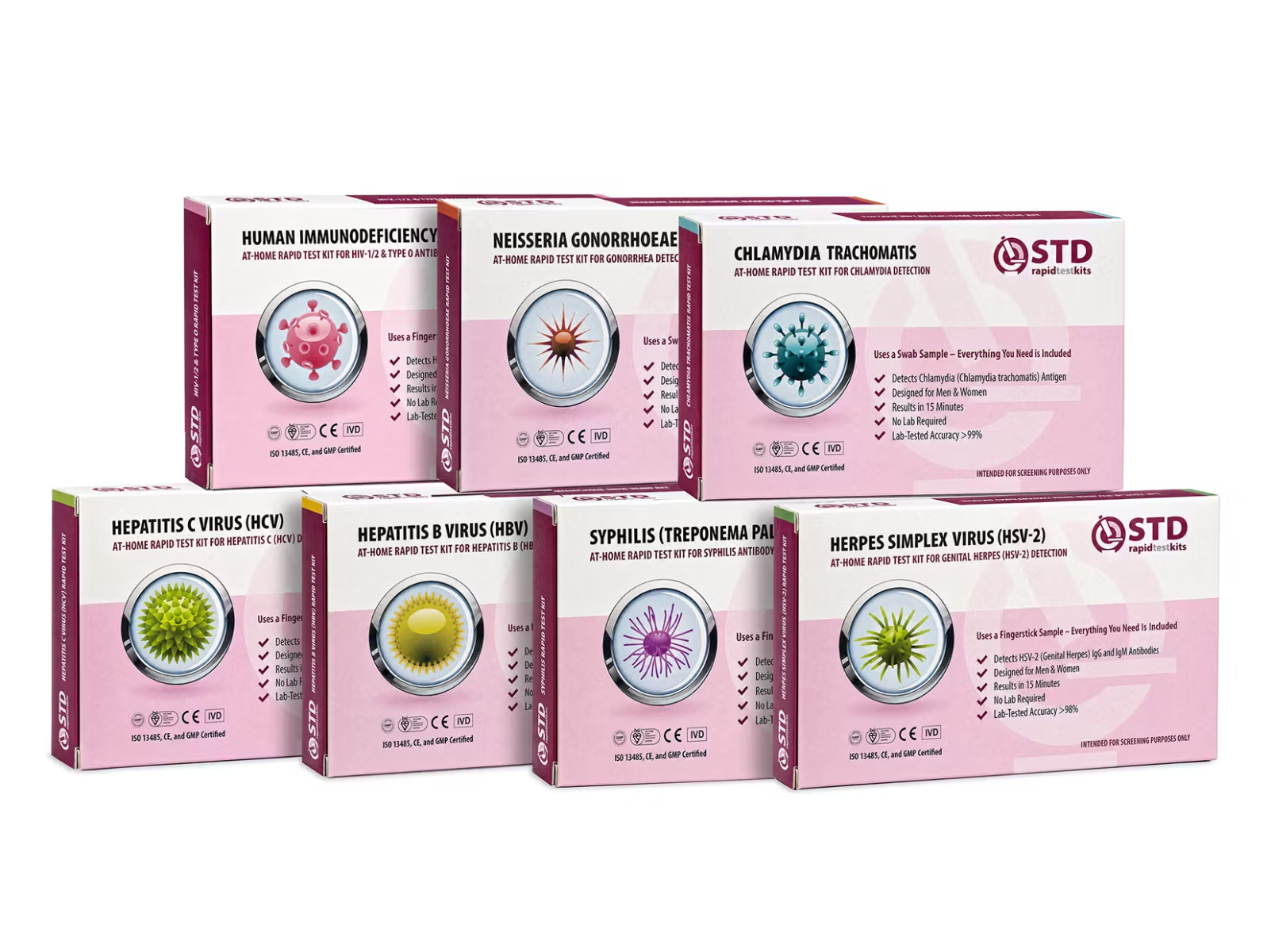
For at-home testing, the most common first kit is a multi-infection panel that covers the most prevalent STIs in one sitting. Single-infection kits are useful when you have a specific reason to suspect one infection, such as a partner's disclosure of a particular diagnosis. At-home rapid tests use lateral-flow chemistry rather than the laboratory NAAT methods clinics use; the two are complementary, with at-home kits providing fast private screening and lab tests offering higher analytical sensitivity for confirmation.
Window periods at a glance
- HIV: about 45 days post-exposure for fourth-generation antigen/antibody lab tests; up to 12 weeks for antibody-only rapid tests to reach reliable sensitivity.
- Hepatitis B and C: 4 to 10 weeks for antibody tests to reliably detect infection.
- Chlamydia and gonorrhea: 1 to 2 weeks after exposure for NAAT or swab-based tests.
- Syphilis: typically 3 to 6 weeks for antibody tests to turn positive.
Supporting friends and family who have an STI
If someone in your life discloses an STI diagnosis to you, the single most useful thing you can do is treat the conversation as you would any other medical disclosure. They are not contagious through casual contact. You can hug them, share a meal, sit on the same couch, share a bathroom, and continue your friendship without modification.
What people with new STI diagnoses report wanting most is normalcy. The disclosure is often the hardest part for them. They have likely already done the catastrophizing you might be tempted to do on their behalf. Asking respectful questions about how they are feeling, what their treatment plan is, or whether they want to talk about it is far more useful than physical distancing.
For sexual partners of someone newly diagnosed, the right next step is usually testing yourself. Most STIs have window periods, so a test taken too soon after exposure can produce a false negative. Many clinicians recommend a baseline test plus a repeat test after the appropriate window has passed (NHS guidance on STI testing).
To be treated normally. That includes hugs, shared meals, and the same friendship that existed before the disclosure. For most patients, distance from loved ones after a diagnosis hurts more than the diagnosis itself.
A practical prevention checklist
To pull this together into actions you can take:
- Do not share razors, toothbrushes, nail clippers, lancets, or needles with anyone, regardless of their known infection status. This is the single highest-yield preventive habit for hepatitis B and C.
- Get vaccinated against hepatitis B and HPV. Both vaccines provide durable, evidence-backed protection. HBV vaccination is recommended for all adults aged 19 through 59 per current CDC guidance, and HPV vaccination is routine through age 26 with shared clinical decision-making through age 45.
- Use condoms during sex. Latex or polyurethane condoms substantially reduce transmission of HIV, chlamydia, gonorrhea, hepatitis B, and trichomoniasis. Coverage for HSV and HPV is partial because both can affect skin outside the condom's coverage area, but condoms still reduce transmission of both.
- Get screened on a routine cadence if you are sexually active. Annual chlamydia and gonorrhea screening is recommended for sexually active women under 25 and for men who have sex with men. HIV and syphilis testing every 3 to 12 months is recommended for higher-risk groups. A one-time HCV antibody screen is recommended for all adults aged 18 and older.
- Do not test in panic. A casual-contact exposure that does not involve blood, broken skin, or sexual contact does not need a test. Save testing for situations that actually warrant it.
Talking to children and teenagers about STD myths
Children and teenagers absorb fear about STIs from the same flawed sources adults do, often earlier and with less context. A child who hears a passing comment about an aunt being 'sick from kissing' or a grandparent 'catching something' will turn that fragment into a worldview unless someone corrects it.
The honest message for younger children is simple. STIs are infections that grown-ups can pass to each other during specific sexual activities, and there are good treatments for most of them. They cannot be passed by hugs, kisses on the cheek, sharing food, or playing together. People with STIs are not dangerous to be around in everyday life, and they are not bad or shameful. They have an infection, the same way someone might have a chest infection or a cold sore.
For teenagers, the conversation can go further. The reality of how STIs transmit, the importance of using condoms during sexual activity, the role of testing, and the existence of effective treatments are all things they will benefit from hearing from a trusted adult before they hear distorted versions from peers or online sources. The same teen who asks if you can catch HIV from a hug is likely two or three years away from making decisions about their own sexual health. Investing in the accurate version now means they are less likely to panic, stigmatize a partner, or make decisions based on misinformation when the question becomes personal.
The original concern this article was first written to address, whether children can transmit STDs to their parents (or vice versa) through hugging, deserves a direct answer. They cannot. STIs are not transmitted through normal parental or familial physical affection in either direction.
Age-appropriate messaging at a glance
- Younger children: STIs are infections that grown-ups can pass to each other in specific situations. They cannot pass through hugs, cheek kisses, sharing food, or play. People with STIs are not dangerous to be around in everyday life.
- Teenagers: how STIs transmit, why condoms matter during sexual activity, when to test, and that effective treatments exist. Hearing the accurate version from a trusted adult before peers is worth the conversation.
- Across all ages: name the real transmission routes plainly. Vague messaging breeds fear; specific messaging builds calibrated judgment.
Where to go from here
Did you have a sexual exposure event (unprotected vaginal, anal, or oral sex with a partner whose status you do not know, or with a partner who has since disclosed an STI)?
Yes: Test after the appropriate window period for each infection. A multi-infection panel like the 6-test or 7-test kits above is the typical first move.
No: Continue to the next question.
Did you share a razor, finger-stick lancet, blood-contaminated toothbrush, or injection equipment with someone whose hepatitis status is unknown?
Yes: See a provider about hepatitis B and C screening. Antibody tests are reliable from 4 to 10 weeks post-exposure. If you are not vaccinated against hepatitis B, ask about catch-up vaccination.
No: Continue to the next question.
Are you supporting a friend or family member with a new STI diagnosis, with no sexual exposure of your own?
Yes: No changes to casual contact are needed. Hugs, shared meals, and shared bathrooms are safe. Consider testing only if you were a sexual partner.
No: If none of these match, talk to a clinician for tailored guidance.
Guidance only. A healthcare provider can advise based on your specific situation.
Frequently asked questions
- Can you get an STD from hugging someone?
- Hugging is not a transmission route for any STI. The pathogens that cause HIV, herpes, chlamydia, gonorrhea, syphilis, HPV, and hepatitis all require conditions (fluid exchange, mucous-membrane contact, or contact with an active sore) that are absent in a hug. The CDC has documented zero cases of any STI spreading through hugging or other casual contact.
- Is it safe to hug someone with HIV?
- Yes. HIV cannot transmit through casual physical contact. The CDC's transmission information confirms that hugging, shaking hands, sharing utensils, sharing toilets, and closed-mouth kissing do not transmit HIV. People living with HIV on antiretroviral treatment with an undetectable viral load also cannot sexually transmit the virus, a finding summarized as 'undetectable equals untransmittable'.
- Can you get HIV from a toilet seat?
- No. HIV is rapidly inactivated outside the body and has never been documented to transmit through toilet seats, shared dishes, or any other casual-contact route. CDC surveillance covering millions of person-years of contact between HIV-positive and HIV-negative people has not produced a single documented casual-contact transmission.
- Can you catch an STI from a swimming pool or hot tub?
- STI transmission through pools or hot tubs is not a documented route. Chlorinated water rapidly inactivates the pathogens involved, and sitting in shared water does not provide the mucous-membrane exposure these infections require. Pools and hot tubs have other water-quality concerns (recreational water illnesses, hot-tub folliculitis from Pseudomonas), but STIs are not among them.
- What about sharing a drink or utensil with someone who has an STI?
- For chlamydia, gonorrhea, syphilis, trichomoniasis, HIV, hepatitis B, and hepatitis C, the answer is no. None of these transmit through saliva or shared cups in normal social conditions. The realistic exception is HSV-1 (cold sores): if the other person has an active visible oral lesion and shares a glass with you while the sore is still wet, transmission is plausible but still uncommon. Most adults already carry HSV-1, often acquired in childhood from routine family contact.
- Can you get HPV from shared towels?
- The evidence does not support meaningful transmission of HPV through shared towels, swimming pools, or toilet seats. HPV transmits through direct skin-to-skin contact with infected genital, oral, or anal tissue. While the virus has been recovered from environmental surfaces in laboratory settings, real-world transmission through inanimate objects is not a documented public-health concern.
- Is it safe to share a razor or toothbrush with a partner?
- No. This is one of the genuine casual-contact risks. Razors can carry microscopic amounts of blood, and toothbrushes can pick up blood from bleeding gums. Hepatitis B virus can remain infectious on surfaces for at least 7 days, and hepatitis C for days. Public-health guidance is to use individual razors and toothbrushes, even in close family households. Disposable or separately stored personal items are the easy fix.
- Can children spread STDs to their parents through hugging?
- No. STIs do not transmit through normal parent-child affection. The transmission routes for STIs are not present in family hugs, cheek kisses, holding hands, or shared bathing of young children. The same is true in the other direction: a parent living with an STI cannot pass it to their child through everyday physical affection.
- Should I test for hepatitis after sharing items with someone who has it?
- If you have shared a razor, a toothbrush with visible blood, nail clippers, or injection equipment with someone known to have hepatitis B or C, talk to a provider about testing. The CDC recommends HBV testing for all close household contacts of someone with chronic HBV. A one-time HCV antibody screen is also recommended for all adults aged 18 and older regardless of exposure history. Antibody-test window periods typically require 4 to 10 weeks post-exposure for reliable detection.
- When should I get tested if I had a sexual exposure (not a hug)?
- Testing depends on the infection. Chlamydia and gonorrhea can usually be tested 1 to 2 weeks after exposure. Syphilis takes 3 to 6 weeks to appear on a test. Hepatitis B and C antibody tests are reliable from 4 to 10 weeks. HIV antibody tests reach reliable accuracy by 12 weeks after exposure, although newer fourth-generation antigen/antibody lab tests detect most infections by around 45 days. If symptoms appear at any point, test immediately regardless of window.
- U.S. Centers for Disease Control and Prevention. HIV Basics: transmission routes, prevention, and the list of casual-contact exposures that do not transmit HIV (saliva, sweat, shared dishes, toilet seats, hugging, closed-mouth kissing, insect bites).
- U.S. Centers for Disease Control and Prevention. Sexually transmitted infections: overview, screening recommendations, and treatment guidelines.
- U.S. Centers for Disease Control and Prevention. Hepatitis C information, including environmental survival of HCV and the one-time adult-population antibody-screening recommendation for adults aged 18 and older.
- World Health Organization. Hepatitis B fact sheet, including the statement that hepatitis B virus can survive outside the body for at least 7 days and remain infectious during that time.
- World Health Organization. Sexually transmitted infections fact sheet: global epidemiology, transmission routes, and prevention guidance.
- Mayo Clinic. Sexually transmitted diseases (STDs) overview: symptoms, causes, and transmission routes for the most common infections.
