

Published: October 2025 | Last updated: April 2026 | Editorial review and quality control: Martina N.
Most at-home STD kits do not include a throat swab, and that gap matters more than the box copy suggests. If you came here wondering whether the home test you bought (or are about to buy) actually checks your mouth or throat after oral sex, the short answer is usually no, with one meaningful exception: systemic infections like HIV, syphilis, and herpes show up in blood regardless of where they entered the body, and those you can screen for at home.
The rest is more nuanced. Pharyngeal (throat) gonorrhea and chlamydia, the two most common oral-only STIs, require a clinic-collected swab processed by lab NAAT. There is no FDA-cleared at-home version sold in the U.S. We don't sell that test either, so we'll be straight with you about when to skip the home kit and walk into a clinic instead.
Can you test for oral STDs at home?
Partly. Pharyngeal gonorrhea and chlamydia (the throat-specific bacterial infections most often passed through oral sex) require a clinic-collected throat swab processed by lab NAAT. That test is not currently sold for at-home use in the U.S. However, systemic STIs that can also result from oral exposure (HIV, syphilis, hepatitis B, hepatitis C, and herpes antibodies) can be screened at home with a fingerstick blood test once you are past each test's window period. The right move depends on what specifically you are worried about.
Key takeaways
- Throat-specific gonorrhea and chlamydia testing requires a pharyngeal swab processed by a lab; no at-home version exists in the U.S., so a clinic visit is the right call.
- After oral exposure you can still meaningfully screen at home for HIV, syphilis, hepatitis, and herpes antibodies via fingerstick blood, once you are past each test's window period.
This site sells at-home rapid lateral-flow test kits that use either fingerstick blood (for systemic infections) or a self-collected genital swab (for genital chlamydia, gonorrhea, trichomoniasis, and HPV). We do not sell pharyngeal (throat) swab kits, and we do not sell oral-fluid HIV tests for home use. If your specific concern is throat gonorrhea or throat chlamydia, the right move is a clinic visit for a pharyngeal swab. Our home kits below cover the systemic infections (HIV, syphilis, hepatitis, herpes antibodies) that can also result from oral exposure.
How oral exposure actually transmits STIs
The mouth is a mucous membrane surface, just like the genital tract or rectum. When it contacts another mucous membrane carrying an infection, or comes into contact with infectious fluid, the same transmission biology applies. The reason oral sex feels like a "safer" option (and why public-health messaging once nudged that way) is that the risk per act for some infections is genuinely lower; HIV transmission through oral sex sits well below the per-act risk of receptive anal or vaginal sex (CDC: About STI Risk and Oral Sex). Lower is not zero, and for some bacteria the risk is roughly comparable to genital exposure.
Three details people commonly miss:
- Asymptomatic shedding is normal. A partner with no visible sores, no discharge, and no pain can still transmit chlamydia, gonorrhea, syphilis, HSV-1, HSV-2, and HIV. Studies of pharyngeal gonorrhea consistently find the majority of throat infections are symptom-free.
- Oral micro-abrasions raise the risk. Recent dental work, brushing or flossing right before sex, gum disease, ulcers, or even a cheek bite all open small breaks in the lining that bacteria and viruses pass through more easily.
- Direction matters. Performing oral sex (giving) carries a different risk profile than receiving it. Performing oral on a partner with genital gonorrhea is the most efficient route to a pharyngeal infection. Receiving oral when your partner has oral HSV-1 is the most efficient route to picking up genital HSV-1.
None of this is meant to alarm. It is meant to clarify why a urine-only or genital-swab-only home kit cannot rule out an infection that lives in the throat. If a test does not sample the site where the bacteria actually live, the result cannot speak to that site, which is why a fingerstick or urine kit is not enough on its own after oral exposure.
Many STIs and other infections are spread through oral sex. Anyone exposed to an infected partner can get an STI in the mouth, throat, genitals, or rectum.
Which STIs can establish in the mouth or throat
Not every STI behaves the same way at the oral site. Some live primarily in the throat after oral exposure (gonorrhea, chlamydia). Some land at the point of contact and produce a local lesion (syphilis chancre, HSV cold sore). Some establish a systemic infection that the throat is not really part of (HIV, hepatitis), even though the exposure happened orally.
The short version of who lives where:
- Gonorrhea (Neisseria gonorrhoeae): thrives in the back of the throat, especially the tonsillar crypts. Many cases are silent. Treatment is straightforward antibiotics, but emerging antibiotic resistance is a real concern (CDC STI Treatment Guidelines: Gonococcal Infections).
- Chlamydia (Chlamydia trachomatis): less common pharyngeally than gonorrhea, but documented and often asymptomatic (CDC STI Treatment Guidelines: Chlamydial Infections).
- Syphilis (Treponema pallidum): a primary chancre can appear inside the mouth, on the lip, or on the tongue. It is typically painless, lasts three to six weeks, and heals on its own (which is why people miss it). The bacteria are still in the body after the chancre clears.
- Herpes simplex virus type 1 (HSV-1): the usual cause of oral cold sores. Roughly two-thirds of people under age 50 globally have HSV-1, often acquired in childhood without sexual contact (WHO Herpes simplex virus fact sheet).
- Herpes simplex virus type 2 (HSV-2): typically genital, but can establish orally with oral-genital contact. Oral HSV-2 outbreaks tend to be less frequent than oral HSV-1.
- HIV: systemic, not local to the throat, but oral exposure is one possible (lower-probability) transmission route.
- HPV: oral HPV infection links to oropharyngeal cancers years later. There is no clinical at-home or in-clinic screening test for asymptomatic oral HPV; vaccination is the primary prevention strategy. The HPV vaccine is most effective when given before first sexual exposure; per ACIP guidance the CDC recommends routine vaccination through age 26 for all genders, with shared clinical decision-making for ages 27 to 45. Oropharyngeal cancer rates have risen over the past two decades, largely linked to HPV transmission, which makes vaccination the most meaningful long-term risk-reduction tool currently available.
| Infection | Lives orally? | Most common oral pattern | Symptom likelihood |
|---|---|---|---|
| Gonorrhea | Yes (pharyngeal) | Throat colonization, often silent | Most cases asymptomatic |
| Chlamydia | Yes (less common) | Throat colonization, mild or no symptoms | Most cases asymptomatic |
| Syphilis | Yes (primary stage) | Painless ulcer in mouth, on lip, or on tongue | Often missed because painless |
| HSV-1 | Yes (very common) | Cold sores on lips or in mouth | Common with first outbreak; recurrences vary |
| HSV-2 | Yes (less common) | Cold-sore-like lesions, less frequent recurrence | Variable, often subtle |
| HIV | Systemic, not local | Acute flu-like illness 2 to 4 weeks post-exposure | Acute symptoms common but easy to mistake for flu |
| HPV | Yes (asymptomatic) | No visible signs; long-term cancer risk | Almost always symptom-free at the oral site |
Why most home kits miss throat infections
An at-home test does one thing: it samples a specific body site and either runs the assay on the spot (rapid lateral-flow) or ships the sample to a lab. The site has to match the infection. That is the whole reason for the gap.
Standard at-home STI kits sample one of three things:
- Urine: detects bacteria shed into the urinary tract. Useful for genital chlamydia and gonorrhea. Useless for throat or rectal infections.
- Fingerstick blood: detects systemic infections (HIV, syphilis, hepatitis B, hepatitis C, and antibody-based herpes screens). Cannot localize a bacterial infection to the throat versus the genitals.
- Genital swab (vaginal or penile): detects bacterial infections at the genital site. Cannot detect a throat colonization.
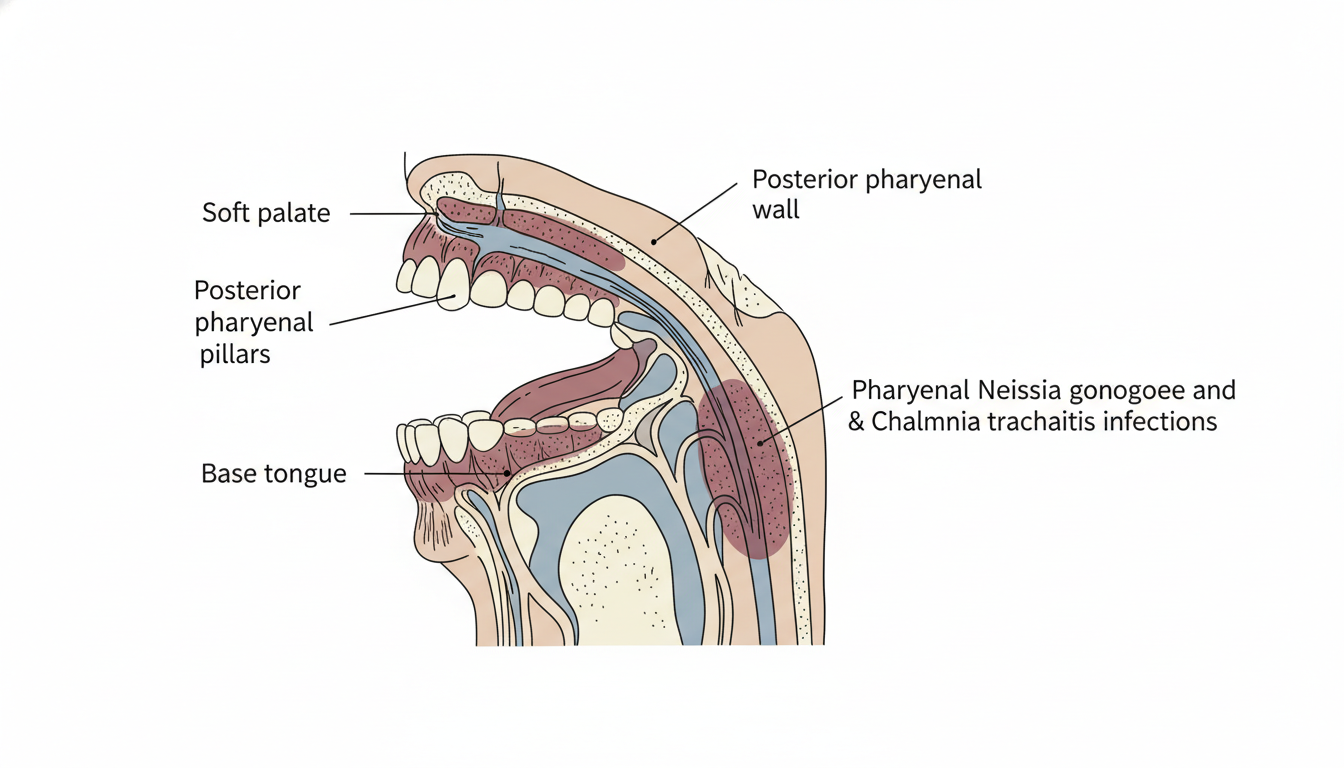
To detect pharyngeal gonorrhea or chlamydia, a clinician swabs the back of the throat (the tonsils and posterior pharyngeal wall) and sends the swab to a lab for nucleic acid amplification testing (NAAT). The CDC's testing guidance advises people who have receptive oral sex to discuss throat testing options with their provider (CDC: Getting Tested for STIs), and the agency's gonorrhea treatment guidelines specifically describe pharyngeal NAAT as the appropriate test for that site.
Why hasn't this become a home product? A few reasons. NAAT chemistry needs a lab. Self-collected throat swabs have validation hurdles (the FDA has approved self-collected vaginal NAAT but not yet a self-collected pharyngeal NAAT for direct-to-consumer use). And the sample handling chain (refrigeration, transit time) is harder for a swab than for dried blood.
The bottom line: if you want a throat swab, see a clinic. Most sexual-health clinics, urgent cares, and many primary-care offices can do it the same day, often with three-site testing (throat, genital, rectal) packaged together at low or no cost.
What at-home tests can reliably tell you after oral exposure
Even though pharyngeal gonorrhea and chlamydia need a clinic, a home blood test still does meaningful work after an oral exposure. Here is what each home-testable infection picks up and what it doesn't.
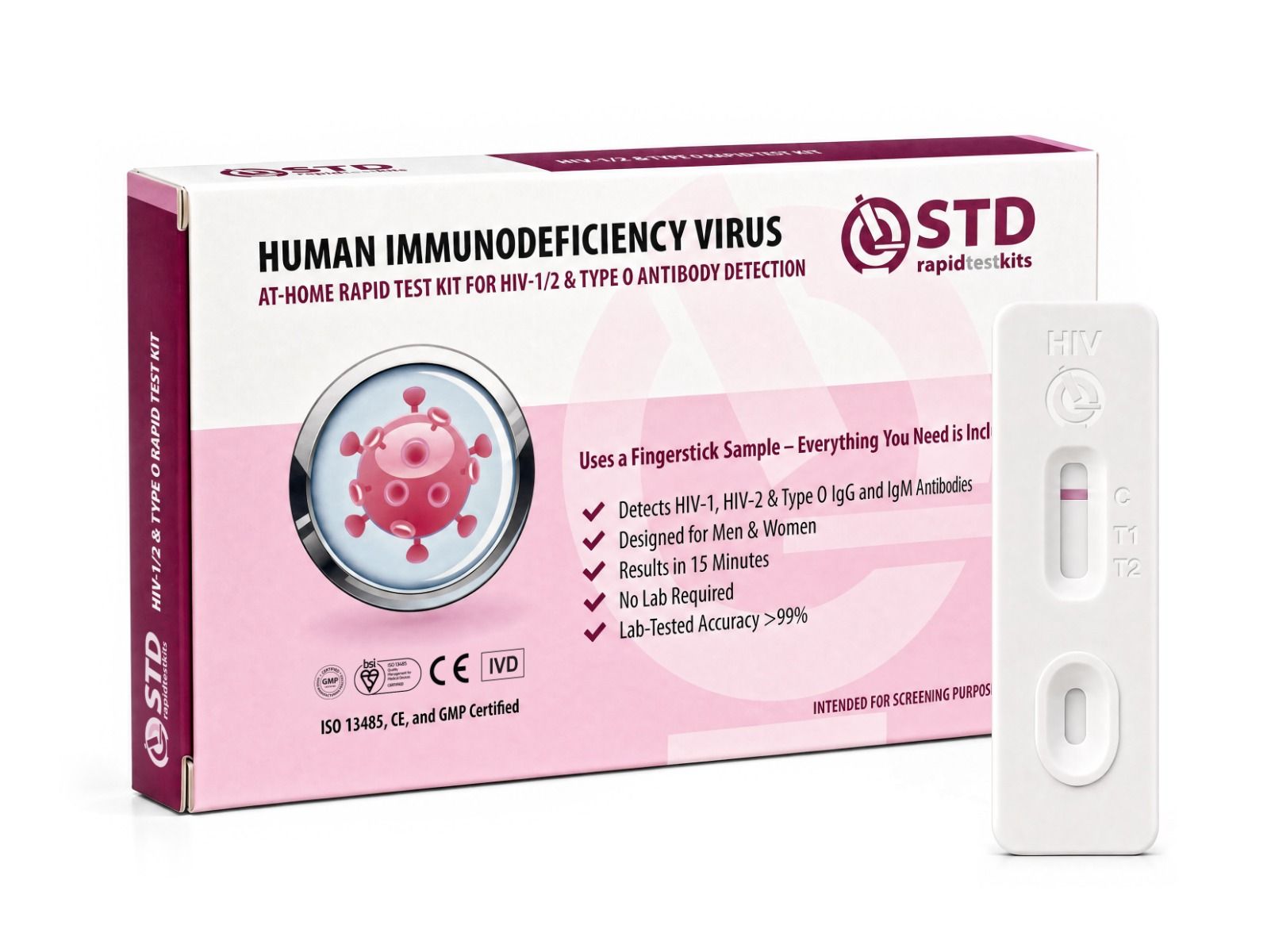
HIV (fingerstick rapid antigen/antibody blood test): detects HIV regardless of where the virus entered. A fingerstick rapid antigen/antibody test can detect HIV from about 18 to 90 days post-exposure in most people, with a 90-day retest recommended for definitive ruling-out (CDC HIV Testing). The lab antigen/antibody test from a vein draw has a shorter window (about 18 to 45 days), so a clean fingerstick result close to the early end of the window is worth confirming with either a lab draw or a 90-day retest.
Syphilis (fingerstick treponemal antibody test): detects antibodies to Treponema pallidum, again regardless of inoculation site. Reliable from about three to six weeks post-exposure. A positive home result needs clinical follow-up for confirmation and staging.
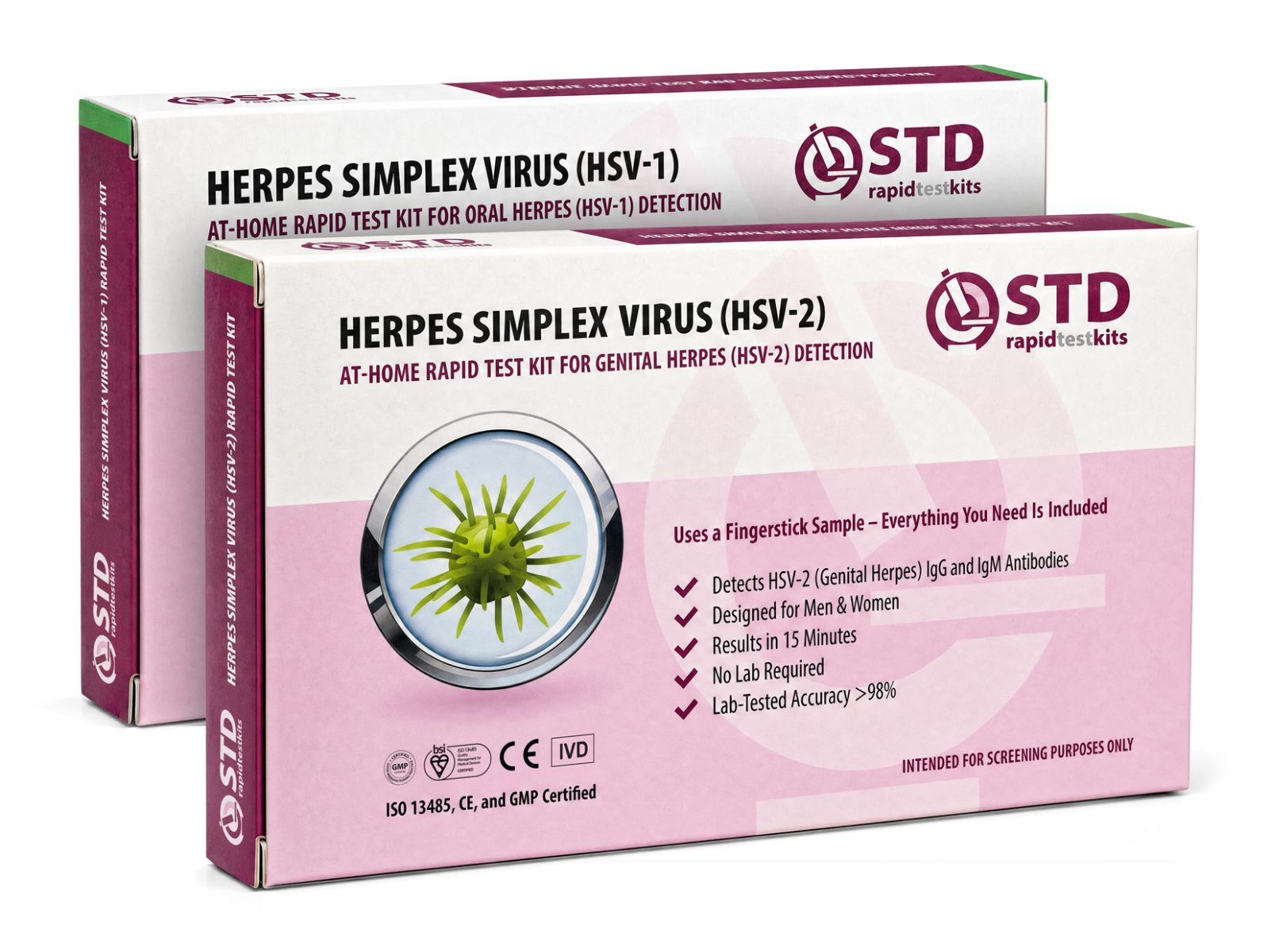
Herpes (fingerstick HSV-1 / HSV-2 antibody test): detects systemic seroconversion. Most useful 12 weeks or more after a known exposure. A blood antibody test cannot tell you whether a current cold sore on your lip is HSV-1 or HSV-2 (a swab of the active lesion sent for PCR does that), but it can tell you whether you have ever been exposed and seroconverted.
Hepatitis B and C (fingerstick blood): less commonly transmitted through oral sex than HIV, but possible. Both have well-established window periods (4 to 10 weeks for hepatitis B surface antigen, 4 to 12 weeks for hepatitis C antibody).
What none of these can do: rule out pharyngeal gonorrhea or chlamydia. If you have throat symptoms after oral exposure, a clean home blood panel is not the same as a clean throat swab. The two answer different questions.
Window periods: when to test for what
Testing too early is the second-most-common reason a home result misses something (the first is sampling the wrong site). Each infection has a window period, the time between exposure and when the test can reliably detect it. The window is shorter for bacterial infections that the body fights with active replication, and longer for antibody-based tests because seroconversion takes time.
The practical rule: if your exposure was less than a week ago, most blood tests will be negative regardless of true status. Wait, retest, and use the table below to plan your timing.
| Infection | Earliest reliable detection (after exposure) | Sample type | Where to test |
|---|---|---|---|
| HIV (fingerstick rapid antigen/antibody) | About 18 to 90 days | Fingerstick blood | Home; retest at 90 days for confirmation |
| Syphilis (treponemal antibody) | About 3 to 6 weeks | Fingerstick blood | Home; clinical follow-up if positive |
| Herpes HSV-1 / HSV-2 (antibody) | About 4 to 12 weeks | Fingerstick blood | Home; 12-week test is most reliable |
| Hepatitis B (surface antigen) | About 4 to 10 weeks | Fingerstick blood | Home |
| Hepatitis C (antibody) | About 4 to 12 weeks | Fingerstick blood | Home |
| Pharyngeal gonorrhea | About 5 to 14 days | Throat swab (lab NAAT) | Clinic only |
| Pharyngeal chlamydia | About 7 to 14 days | Throat swab (lab NAAT) | Clinic only |
How to read symptoms after oral exposure
Sore throats are usually viral. The cold sores most adults get reactivate from a long-standing HSV-1 infection rather than a fresh sexual exposure. Aphthous ulcers, trauma, and unrelated causes account for the bulk of mouth sores readers worry about, not STIs.
Timing, lesion character, and recurrence pattern are the most useful signals to sort likely STI from likely coincidence. A sore throat that appears within 2 to 7 days of a new oral-sex exposure is on the pharyngeal gonorrhea differential; one that starts six weeks later almost certainly is not. A painless oral ulcer that lingers past a week, particularly one that genuinely does not hurt to bite or eat near, is the opposite of a typical canker sore and warrants a clinic visit. Cold sores that return to roughly the same spot around stress or illness are almost always HSV-1 reactivation; a blood test confirms antibody status, but the recurrence pattern itself is informative.
| Concern | Common oral signs (when present) | What also looks like this |
|---|---|---|
| Pharyngeal gonorrhea | Sore throat, redness, white spots on tonsils, swollen neck nodes; many cases asymptomatic | Strep, viral pharyngitis, post-nasal drip |
| Pharyngeal chlamydia | Mild sore throat or no symptoms | Allergies, dry indoor air, mild cold |
| Oral HSV (HSV-1 most often) | Cold sore on lip, tingling before lesion, fever with first outbreak | Canker sores, trauma, viral stomatitis |
| Primary oral syphilis | Single painless ulcer that lasts 3 to 6 weeks then heals on its own | Canker sore, traumatic ulcer, oral cancer (rare) |
| Acute HIV | Fever, sore throat, fatigue, body rash, swollen lymph nodes 2 to 4 weeks post-exposure | Mono, flu, viral pharyngitis |
When to skip the home test and go straight to a clinic
A home blood panel is a good first move for screening systemic infections. It is not the right move when the question on the table is specifically a throat infection. Here are the situations where the right answer is a clinic visit, not a kit.
- A partner just disclosed pharyngeal gonorrhea or chlamydia. You need a throat swab. A home blood test will not tell you whether the bacteria are in your throat.
- Throat symptoms persist past a week with no other obvious explanation, especially after oral sex with a new or multiple partners. Strep is easy to rule in or out at urgent care; pharyngeal gonorrhea NAAT can be added to the same visit.
- A painless oral ulcer that has lasted more than a week. Primary syphilis is the leading sexually transmitted differential. A clinic can swab and send for darkfield or PCR, and draw blood the same visit.
- You are immunocompromised, pregnant, or on PrEP. Sexual-health clinicians integrate testing strategy with your meds and your history in ways a home kit cannot.
- You want three-site testing (throat, genital, rectal) bundled. Sexual-health clinics, federally qualified health centers, and many urgent cares do this routinely. The test itself is usually inexpensive or free at sliding-scale clinics.
None of this is a knock on home testing. Home testing pulls people into the testing system who would never walk into a clinic, and that is a public-health win on its own. The point is simply that the kit and the clinic answer different questions, so you want the right tool for what you are actually worried about.
A primary syphilis chancre is classically painless and heals on its own in three to six weeks, even without treatment. The chancre healing is not the infection clearing; the bacteria are still in your body and the disease progresses to the secondary stage. If you have a painless mouth ulcer that has lasted more than a week, see a clinic for examination and a syphilis blood test, even if it has started to fade.

Retesting, partner notification, and treatment access
One negative result rarely closes the book. The CDC recommends a few retest milestones after a known or suspected exposure:
- HIV: retest at 90 days from a fingerstick rapid antigen/antibody home test if the first test was within the early window or if you remain at ongoing risk.
- Syphilis: retest at 12 weeks if the first negative was inside the 3-to-6-week window.
- Herpes antibody: retest at 12 to 16 weeks if the first negative was earlier than that, especially if the exposure was recent.
- Pharyngeal gonorrhea or chlamydia: clinic-based retest at three months after treatment is the CDC standard, because reinfection from an untreated partner is common.
Partner notification is awkward but matters. Most jurisdictions offer anonymous partner notification through their public-health department; you don't have to be the one delivering the news. For ongoing partners, the conversation is harder but more useful: shared decisions about retesting, treatment, and risk reduction work better when both people have the same information.
Treatment, finally, is usually straightforward. Pharyngeal gonorrhea and chlamydia are treated with antibiotics; HSV is managed (not cured) with antivirals; HIV is managed long-term with antiretroviral therapy that, when adherent, brings viral load to undetectable and effectively eliminates sexual transmission. Access to treatment, not access to testing, is the larger barrier for many readers, so factor that in: a clinic visit for testing also unlocks the prescription pathway in one stop.
Retest milestones at a glance
- HIV: retest at 90 days from a fingerstick rapid antigen/antibody home test for definitive ruling-out.
- Syphilis: retest at 12 weeks if the first negative was inside the 3-to-6-week window.
- Herpes antibody: retest at 12 to 16 weeks for the most reliable seroconversion result.
- Pharyngeal gonorrhea or chlamydia: clinic retest at 3 months after treatment, because partner reinfection is common.
Frequently asked questions
- Can I test for oral gonorrhea at home?
- Not currently. Pharyngeal gonorrhea is diagnosed with a throat swab processed by lab NAAT, and there is no FDA-cleared at-home version sold in the U.S. as of this writing. The most reliable move is a sexual-health clinic, urgent care, or primary-care visit for a same-day pharyngeal NAAT. The visit is typically 15 to 20 minutes, and many clinics package it with genital and rectal swabs in a three-site test.
- What can home tests actually detect from an oral exposure?
- Systemic infections that show up in the blood: HIV, syphilis, hepatitis B, hepatitis C, and herpes antibodies. A fingerstick rapid blood panel screens all of these once you are past each test's window period. What home tests cannot do is tell you whether bacteria are localized in your throat (gonorrhea, chlamydia) or whether a current lip sore is HSV-1 versus HSV-2 (a swab from the active lesion does that).
- Are oral cold sores caused by HSV-1 or HSV-2?
- Most are HSV-1 (about 90 percent of oral herpes), but HSV-2 oral cases do happen, especially in people whose first exposure was through oral sex with a partner carrying HSV-2 genitally. The visual presentation is identical. A blood antibody test will tell you whether you have antibodies to HSV-1, HSV-2, both, or neither, but it cannot identify which strain is causing a particular lesion. A swab from an active lesion sent for PCR can.
- How long should I wait before testing after an oral exposure?
- It depends on what you are testing for. For HIV via a fingerstick rapid antigen/antibody home test, the CDC's reliable detection window is about 18 to 90 days, with a 90-day retest for definitive ruling-out. For syphilis, six weeks. For herpes antibody, 12 weeks. For pharyngeal gonorrhea or chlamydia (clinic only), 5 to 14 days. Testing earlier than these windows can produce a false-negative; the infection is there, but the body has not generated enough antibodies (or shed enough antigen) yet for the test to detect it.
- I have a sore throat after oral sex. Is it definitely an STI?
- Almost certainly something else. Most sore throats are viral, and a much smaller share are strep. Pharyngeal gonorrhea is on the differential when the sore throat starts 2 to 7 days after a new oral-sex partner and lingers past a week, especially if there are white spots on the tonsils or swollen neck lymph nodes. A clinic can rule it in or out with a same-visit throat swab; you don't have to guess.
- Can I get HIV from giving oral sex?
- Yes, but the per-act risk is low compared with receptive vaginal or anal sex. Risk goes up when the giving partner has open mouth sores, gum disease, recent dental work, or another untreated STI; when the receiving partner has a high (untreated) viral load; and when there is contact with blood. The CDC's oral-sex risk fact sheet has the per-act probability ranges. A fingerstick HIV test from about 18 days post-exposure, with a 90-day retest for definitive ruling-out, is the right home-screening approach if you are concerned.
- If my home blood test is negative, can I rule out an oral STI?
- A negative blood panel rules out HIV, syphilis, hepatitis B, hepatitis C, and herpes seroconversion (subject to each test's window period). It says nothing about whether gonorrhea or chlamydia are present in your throat, because blood tests do not sample the pharynx. If throat gonorrhea or chlamydia is what you are specifically worried about, a negative home blood panel is not the signal you need; only a clinic throat swab answers that question.
- My partner tested positive for pharyngeal gonorrhea. Do I need to test, even if I feel fine?
- Yes. Pharyngeal gonorrhea is asymptomatic in most cases, so feeling fine is not a useful signal. Get a throat swab at a clinic. While you are there, ask about a full STI panel, including blood tests for HIV and syphilis (CDC standard practice when one bacterial STI is detected), and consider home blood retesting at 12 weeks for the longer-window infections.
- U.S. Centers for Disease Control and Prevention. About STI Risk and Oral Sex (transmission probability and route-specific guidance).
- U.S. Centers for Disease Control and Prevention. Getting Tested for STIs (recommended sample sites, including throat testing options for receptive oral sex).
- U.S. Centers for Disease Control and Prevention. STI Treatment Guidelines: Gonococcal Infections (pharyngeal sampling, treatment, retest at 3 months).
- U.S. Centers for Disease Control and Prevention. STI Treatment Guidelines: Chlamydial Infections (pharyngeal chlamydia, asymptomatic prevalence).
- World Health Organization. Herpes simplex virus fact sheet (HSV-1 global prevalence, transmission routes, oral and genital presentation).
- U.S. Centers for Disease Control and Prevention. HIV Testing (window periods for fingerstick rapid antigen/antibody and lab antigen/antibody assays).
- U.S. Centers for Disease Control and Prevention. About Syphilis (primary chancre presentation, painless oral ulcer, staging through latent and tertiary phases).
