Can You Get an STD From Oral Sex? 6 Infections to Know
Oral sex feels safer than penetrative sex, and statistically the per-act risk for most infections is lower. Lower is not zero. Six common STIs travel from mouth to genitals and back again, often without symptoms. Here is what each one actually does, what to watch for, and how to test sensibly.




- Six STIs are reliably documented to spread through oral sex: gonorrhea, chlamydia, syphilis, herpes, HPV, and HIV. Most oral-site infections cause no symptoms.
- Pharyngeal swabs for throat gonorrhea or chlamydia are clinic-only. At-home rapid blood tests cover HIV, syphilis, and herpes regardless of which body site was exposed.
Published: July 2025 | Last updated: April 2026 | Editorial review and quality control: Martina N.
Oral sex sits in a strange middle ground in sexual-health conversations. Most people treat it as low-stakes compared with vaginal or anal sex, and from a transmission-math standpoint that is mostly true. The per-act risk for HIV, for example, drops by roughly an order of magnitude. The catch is that lower risk is not no risk, and several of the bacterial infections common in genital sex transmit through oral contact at rates closer to penetrative sex, not far below it.
What follows is a calm walk through six infections that are well documented to spread through oral sex. For each one you will see how transmission works, what symptoms look like (when they show up at all), and what testing options are realistic both at home and at a clinic. The aim is honest information, not alarm. Most readers worried after a recent oral encounter are fine. The minority who are not deserve a clear path to confirm and treat.
Which STDs can you actually catch from oral sex?
Six common ones spread through mouth-to-genital contact: gonorrhea, chlamydia, syphilis, herpes (HSV-1 and HSV-2), HPV, and HIV. Risk per act is lower than for vaginal or anal sex, but transmission is well documented for all six. Most oral infections cause no symptoms, which is exactly why testing matters even when you feel fine.
Key takeaways
- Six STIs are reliably documented to spread through oral sex: gonorrhea, chlamydia, syphilis, herpes, HPV, and HIV. Most oral-site infections cause no symptoms.
- Pharyngeal swabs for throat gonorrhea or chlamydia are clinic-only. At-home rapid blood tests cover HIV, syphilis, and herpes regardless of which body site was exposed.
How oral sex actually transmits STIs
Most transmission happens through direct contact between infected mucosa and the partner's mouth or throat tissue. Bacteria like Neisseria gonorrhoeae and viruses like herpes simplex transfer this way without needing visible sores or fluid exchange. The other route involves contact between infected fluids (semen, pre-ejaculate, vaginal secretions, blood from gum disease or recent dental work) and any mucosal surface or break in the lining of the mouth, throat, or genitals.
The throat tolerates infection unusually well, so pharyngeal gonorrhea and chlamydia rarely cause the discharge or burning that would prompt someone to test at the genital site. Routine STI panels also tend to skip throat swabs unless you ask specifically. A standard urine panel from a primary-care visit will miss every oral infection on this list except HIV, syphilis, and herpes, the three picked up by a blood test.
Prevalence is the other relevant point. Oral sex is statistically common: surveys of U.S. adults aged 18 to 44 find that the large majority have given or received it at some point. That is not a value judgment, just the denominator. Common behavior with a non-trivial per-act risk produces a meaningful population-level case load even when individual encounters are low-risk.
Gonorrhea: the most common throat infection
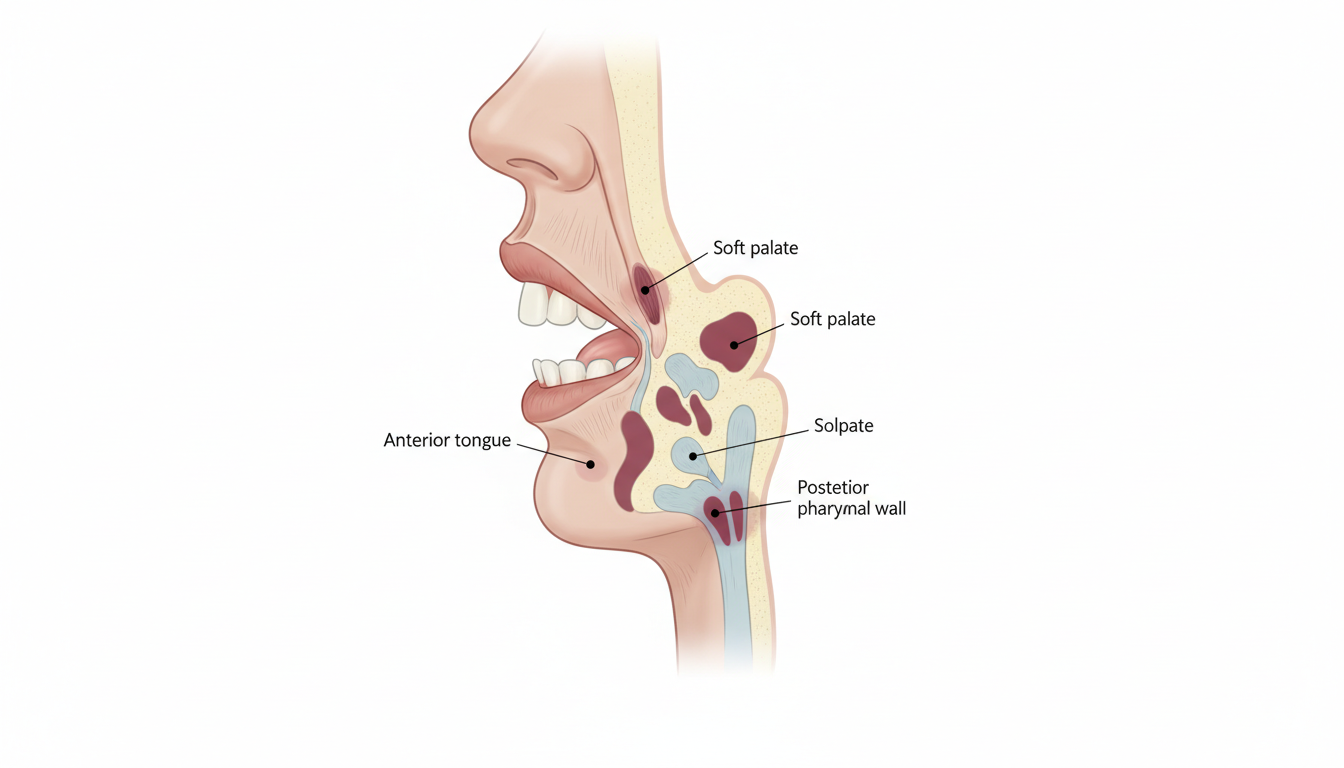
Gonorrhea is the bacterial STI most likely to colonize the throat after oral sex. The U.S. CDC treats pharyngeal gonorrhea as a meaningful clinical category in its STI guidelines and recommends throat swabs for anyone reporting receptive oral contact with a partner who has tested positive. Studies of high-prevalence screening cohorts have documented pharyngeal carriage rates above 5 percent in some populations.
The catch is asymptomatic carriage. Most pharyngeal gonorrhea infections cause nothing, or a mild scratchiness easily mistaken for the start of a cold. When symptoms do show up, expect:
- A persistent sore throat that does not resolve with rest or fluids
- Mild swelling of cervical (neck) lymph nodes
- Redness or patchy irritation visible on the back of the throat or tonsils
- Occasionally, yellowish exudate on the tonsillar pillars, easy to mistake for strep throat
What makes this matter beyond its mild presentation: antibiotic-resistant strains are rising, and pharyngeal sites are notoriously harder to clear than genital ones. The CDC has revised gonorrhea treatment guidelines repeatedly since 2010 in response. Asymptomatic throat carriage also acts as a transmission reservoir back to genital partners, which is part of why population-level rates have been climbing.
Pharyngeal swabs require a healthcare provider for collection and lab processing. We do not sell an at-home throat-swab kit and no FDA-cleared rapid version exists for self-collection. If you have a clear oral exposure and any throat symptom that lingers more than a week, schedule a clinic visit and ask specifically for a pharyngeal swab. The genital-site rapid test covers a different question: if your partner has gonorrhea, you may want to confirm your own genital status independently.
Chlamydia: usually silent in the throat
Pharyngeal chlamydia is less common than pharyngeal gonorrhea but still well documented. Studies of clinic populations consistently find a small but non-trivial percentage of throat samples positive for Chlamydia trachomatis, with most infections producing no symptoms at all.
When chlamydia does cause throat symptoms, they look almost identical to mild viral pharyngitis: scratchiness, tonsillar enlargement without high fever, occasional swollen lymph nodes. Most people recover the feeling of "a sore throat that came and went" without ever connecting it to a sexual exposure. The infection can clear on its own in some cases, but it can also persist for months and transmit to new partners during that time.
What makes throat chlamydia worth testing for, despite its mildness, is the same logic as gonorrhea: an undiagnosed oral infection in one partner is the missing piece in genital-site reinfection cycles. Couples who keep testing positive for genital chlamydia despite treatment sometimes find the answer in untreated pharyngeal carriage.
As with gonorrhea, the throat-swab test for chlamydia is clinic-administered. Our at-home rapid swab is validated for vaginal or penile self-collection only and pairs naturally with a clinic throat swab when you want full coverage after a higher-risk oral encounter.
Syphilis: painless oral chancres are easy to miss
Syphilis transmits through direct contact with an active sore (a chancre) or through mucosal contact during the secondary stage. An oral chancre can appear on the lip, the tip or side of the tongue, the soft palate, or the tonsil after performing oral sex on an infected partner. The lesion is round, firm, and almost always painless. People notice it the way they notice a small canker sore, then forget about it when it heals two to six weeks later. The infection does not heal with the chancre. It progresses silently into the secondary and latent stages.
The U.S. has seen syphilis case counts climb sharply since 2015, and pharyngeal presentations are part of that picture. The clinical guidance is unambiguous: any painless oral ulcer that lasts more than a few days, especially after recent oral sex with a new partner, warrants serologic testing.
Because syphilis seroconverts (becomes detectable on a blood antibody test) within roughly three to six weeks after exposure, it is one of the few infections on this list that an at-home rapid blood test can confirm regardless of which body site was exposed. The window period is the limiting factor: a negative test less than three weeks after a known exposure does not rule the infection out. Retesting at six to twelve weeks is the standard guidance.
Untreated syphilis is curable with a single course of penicillin in the early stages, but can cause cardiovascular and neurological damage decades later if missed. Early detection is genuinely the difference between a routine antibiotic course and a life-altering complication.
A rapid blood antibody test can detect syphilis from about three weeks after exposure, which is earlier than the windows for HIV (roughly 18 to 45 days for fourth-generation antigen-antibody, around three months for antibody-only) or herpes (about twelve weeks). If a recent oral encounter has you worried about syphilis specifically, you can test sooner than for the other two.
Herpes: HSV-1, HSV-2, and the cold-sore boundary
Herpes simplex virus comes in two types that have largely (but not entirely) split between oral and genital sites. HSV-1 traditionally causes oral cold sores, HSV-2 traditionally causes genital herpes. Oral sex is the main route by which the two cross over.
The transmission patterns matter:
- Giving oral sex when you have an active HSV-1 cold sore can transmit HSV-1 to a partner's genitals, where it produces genital herpes outbreaks (usually milder and less frequent than HSV-2 genital herpes, but the same diagnosis on a chart).
- Receiving oral sex from a partner with genital HSV-2 can transmit HSV-2 to your mouth, though oral HSV-2 outbreaks are typically infrequent and mild because the virus prefers genital nerve ganglia.
- Asymptomatic viral shedding (the virus on the skin without a visible sore) accounts for a meaningful share of transmission. People who have never had a cold sore can still carry HSV-1 and transmit during shedding.
Most adults already carry HSV-1 from childhood non-sexual contact (sharing utensils, kisses from family). Roughly half of U.S. adults carry HSV-1 per CDC estimates, and about 1 in 8 carry HSV-2. These numbers tell you something important: a positive HSV antibody result is common and does not by itself tell you when, where, or how you acquired the virus.
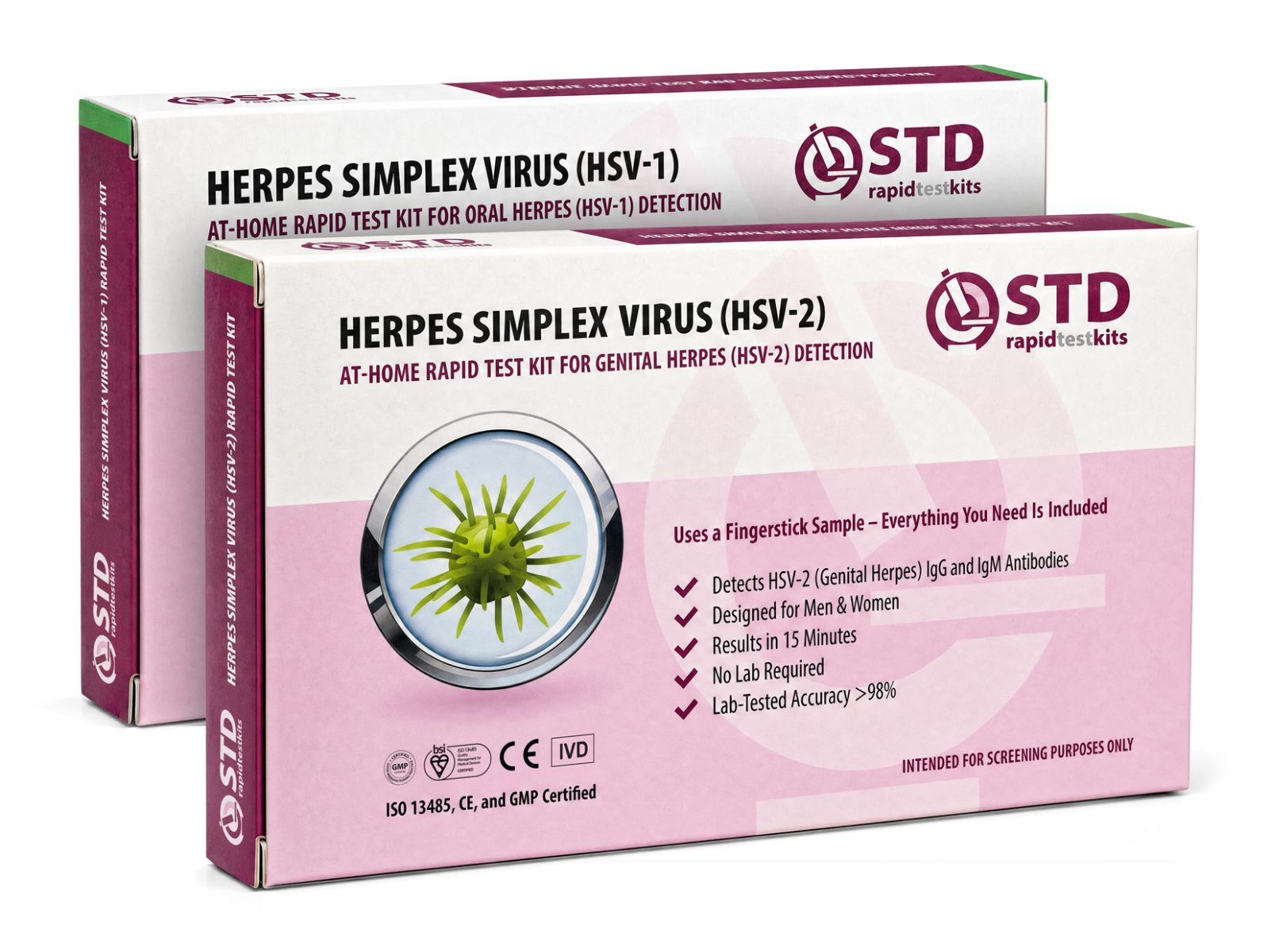
Symptoms during a primary outbreak can include painful blisters or shallow ulcers in the mouth or on the genitals, swollen regional lymph nodes, fever, and muscle aches. Recurrences are usually milder and shorter. Antiviral suppression therapy (daily acyclovir, valacyclovir, or famciclovir) reduces both outbreak frequency and asymptomatic shedding, and is one of the most effective levers a known-positive person has to protect partners.
The tests this site sells, listed below, are described with their actual sample types and window periods. We recommend products by fit for the reader's concern, not by commercial benefit.
HPV: silent, slow, and the leading cause of oropharyngeal cancer
Human papillomavirus is the most common sexually transmitted infection in the world. Most strains clear on their own within one to two years and never cause anything noticeable. A small subset of high-risk strains (most notably HPV-16) can persist in mucosal tissue and, after years to decades, drive cancer at the infection site.
HPV-16-associated oropharyngeal cancer is now the leading HPV-related cancer in the United States, having overtaken cervical cancer in incidence according to CDC surveillance. The cancers typically arise in the base of the tongue or in the tonsillar crypts, and present with persistent sore throat, difficulty swallowing, ear pain that does not resolve, or a painless lump in the neck. By the time these symptoms appear, the underlying infection has usually been present for ten to twenty years.
For readers worried about oral HPV exposure, the picture is different from the genital side:
- There is no validated routine test for oral HPV in healthy adults. The cervical Pap-and-HPV swab does not have an equivalent for asymptomatic throats. Our at-home HPV swab is a vaginal-site test validated for women only and does not detect oral infection.
- The HPV vaccine (Gardasil 9) covers the strains responsible for the great majority of HPV-related cancers, including oropharyngeal cancer. Per ACIP guidance, routine vaccination is recommended through age 26, with shared clinical decision-making available through age 45.
Barrier methods (condoms or dental dams during oral sex) reduce but do not eliminate HPV transmission, since the virus can live on skin not covered by the barrier. The vaccine is the substantially more effective prevention tool, and worth raising with your provider even if you missed the teen window. Routine dental and ENT exams can also catch unusual oral lesions before they progress, which is the closest thing to surveillance currently available.
Per ACIP guidance, routine HPV vaccination is recommended through age 26. Catch-up vaccination is available through age 45 under shared clinical decision-making with a provider. If you missed the teen window and have ongoing exposure to new partners, the conversation is worth having even in your 30s or early 40s.
HIV: low risk per act, but not zero
The CDC and most public-health authorities classify oral sex as low-risk for HIV transmission. Per-act estimates are typically cited as roughly 1 in 20,000 or lower for receptive oral with ejaculation, dropping to negligible for receptive oral without ejaculation and for insertive oral. Documented cases of HIV transmission attributable solely to oral sex exist but are uncommon.
Several factors raise the risk above the baseline:
- Bleeding gums, recent dental work, or active oral ulcers in the partner performing oral sex
- An untreated partner with high viral load, especially during acute (early) HIV infection when viral loads peak
- Co-existing oral STIs, especially active syphilis or herpes outbreaks, that disrupt the mucosal barrier
- Ejaculation in the mouth versus withdrawal before ejaculation
A partner on effective antiretroviral treatment with sustained undetectable viral load does not transmit HIV sexually, including via oral sex. This is the U=U (undetectable equals untransmittable) consensus, which the CDC and WHO both endorse. PrEP (pre-exposure prophylaxis) is also highly effective for partners at higher cumulative risk.
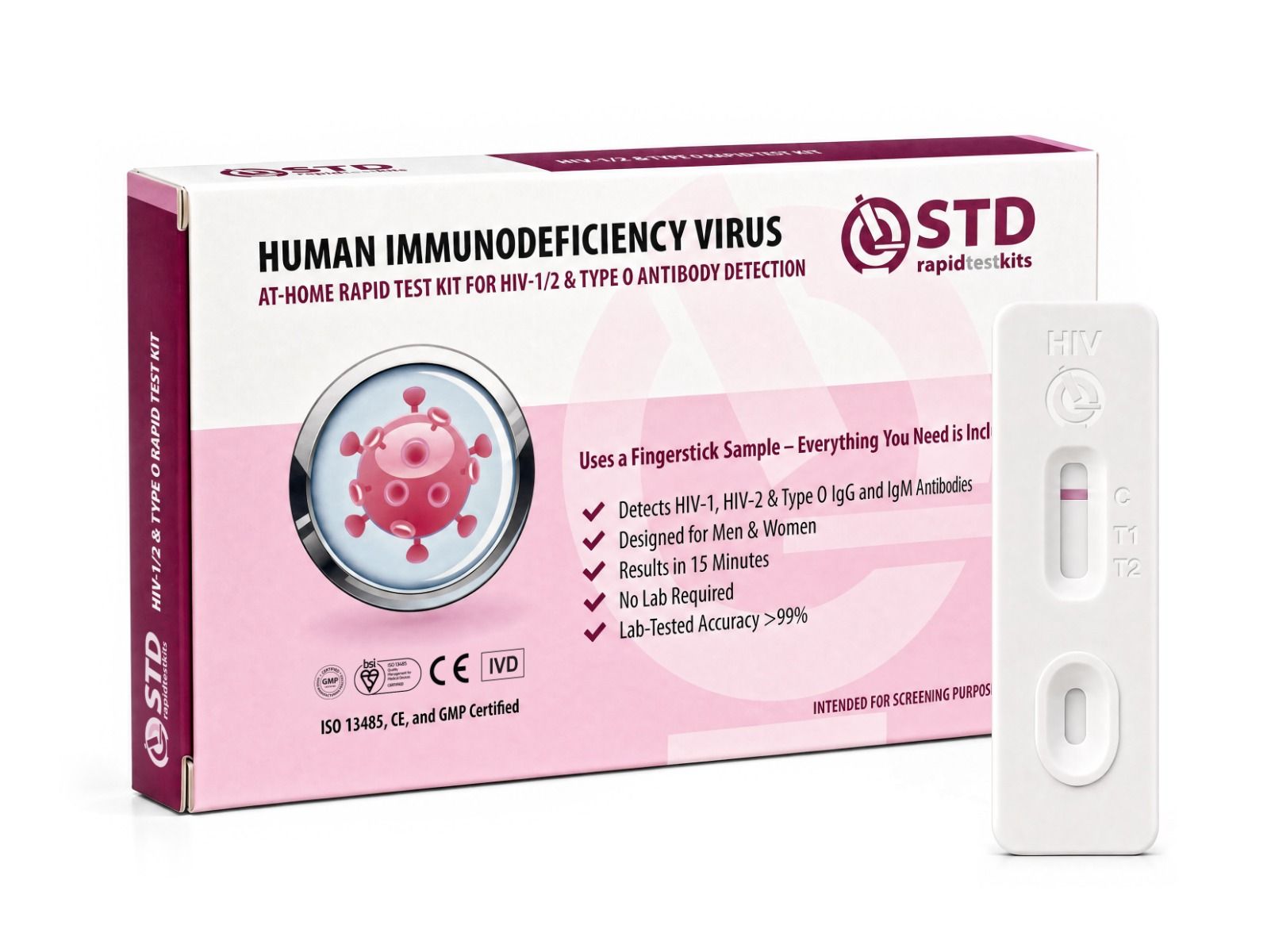
If you are worried after a specific oral encounter with a partner of unknown status, the testing window for fourth-generation antigen-antibody HIV tests is roughly 18 to 45 days after exposure for most people, with confirmatory retesting at three months for definitive ruling-out. Rapid at-home antibody-only tests have a slightly longer window of around three months. PEP (post-exposure prophylaxis) is a 28-day antiretroviral course that meaningfully reduces transmission risk if started within 72 hours of a higher-risk exposure, and is something to ask an emergency department or sexual-health clinic about in genuinely high-risk cases.
What about plain kissing?
Casual kissing transmits very few STIs. The two real exceptions are HSV-1 (cold-sore herpes), which spreads readily mouth-to-mouth especially during active outbreaks, and rarely syphilis if a partner has an active oral chancre or mucous patch. HIV is not transmitted by kissing in any meaningful clinical sense, even with bleeding gums on both sides, because saliva contains enzymes that inactivate the virus and the viral concentration in saliva is far too low.
Deep or prolonged kissing carries slightly higher theoretical risk than a peck, mostly because of the larger area of mucosal contact and the higher likelihood of small abrasions. In practice, the only routine precaution worth taking is avoiding kissing when either partner has an active cold sore. The risk of HPV via deep kissing has been raised in some studies but remains small compared with oral-genital transmission.
Although the chance an HIV-negative person will get HIV from oral sex with an HIV-positive partner is extremely low, it is hard to know the exact risk because many people who have oral sex also have anal or vaginal sex.
Testing options: what works at home and what needs a clinic
At-home rapid tests cover some but not all of the infections discussed above. Here is the practical breakdown by sample type.
What at-home rapid tests can do:
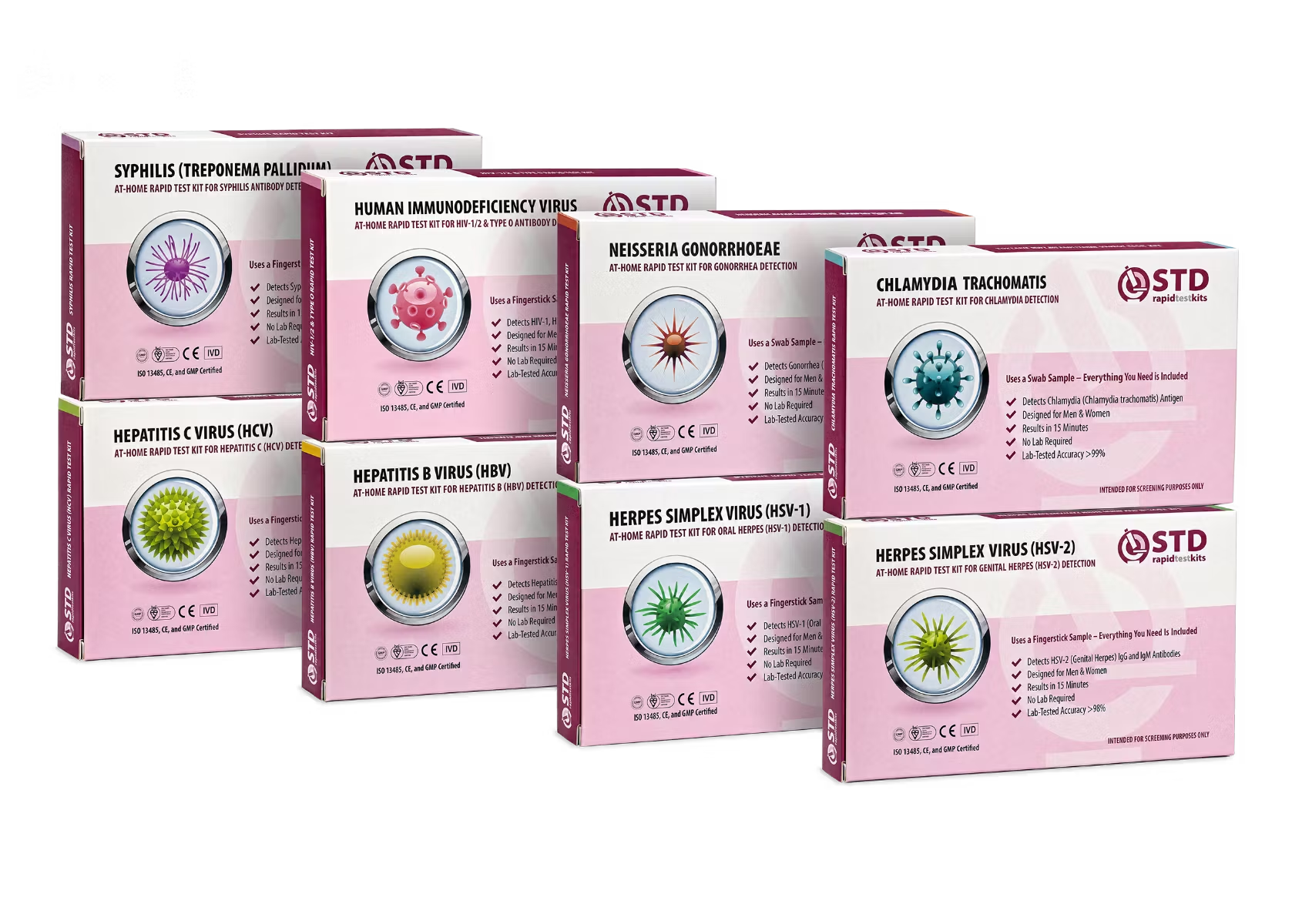
- Blood-antibody panels for HIV, syphilis, and herpes (HSV-1, HSV-2, or both) work regardless of which body site was exposed. They detect systemic seroconversion, not local infection. Window periods range from about three weeks (syphilis) to about three months (HIV antibody-only and HSV).
- Genital swab tests for chlamydia and gonorrhea (vaginal or penile self-collected swab) detect infection at the genital site only. Useful if your partner had a confirmed oral or genital infection and you want to confirm your own genital status independently.
- Combination panels bundle several of the above tests into a single kit for broader coverage from one purchase, which is usually the most cost-effective option after a higher-risk encounter.
What at-home tests cannot do:
- Pharyngeal (throat) swabs for chlamydia, gonorrhea, or HPV are clinic-administered. We do not sell an at-home throat-swab kit. If you need throat testing specifically, schedule a sexual-health clinic visit and ask for a pharyngeal swab by name; some clinics will not include it unless you request it explicitly.
- Oral HPV screening in healthy adults is not a validated test. Symptom-driven evaluation by a dentist or ENT is the current standard of care.
If you were the receptive partner during oral sex and are worried about throat infection, your two-step path is: a clinic pharyngeal swab for gonorrhea and chlamydia (the two infections most likely to colonize the throat without symptoms), plus the at-home blood-based panel for HIV, syphilis, and herpes seroconversion at the appropriate window. The two together cover the realistic risk surface of a single oral encounter.
One technology note worth understanding. Our at-home rapid tests are lateral-flow immunoassays. Laboratory NAAT or PCR testing is a different chemistry with higher analytical sensitivity, especially in early or asymptomatic infections. The two are complementary, not equivalent. A positive at-home result is worth confirming with a lab test, and a negative result close to the edge of the window period is worth retesting later.
Reducing oral-sex risk without ruining the moment
The realistic risk-reduction levers fall into four categories: barriers, timing, vaccination, and disclosure.
Barriers. External condoms during fellatio reduce HIV, gonorrhea, chlamydia, syphilis, and HPV transmission meaningfully. Flavored varieties exist for taste reasons and are functionally identical to standard latex. Dental dams (or a condom cut open lengthwise) cover the vulva or anus during cunnilingus or rimming. Use is rarer than it should be, partly because dams are harder to find at retail; ordering a small box online once a year solves the supply problem.
Timing. Avoid giving or receiving oral sex when either partner has an active cold sore, a recent dental procedure, bleeding gums, or any visible mouth or genital ulcer. The single biggest step-up in risk for almost every infection on this list is broken mucosa. Waiting until a sore has fully healed cuts transmission risk dramatically.
Vaccination. The HPV vaccine substantially reduces the lifetime risk of oropharyngeal cancer. Hepatitis B vaccination is universally recommended in the U.S. and covers an STI that can transmit through oral routes when bleeding is involved.
Disclosure and testing. Knowing your own status, and your partner's, shifts the conversation from worst-case speculation to actual risk math. Routine testing every three to six months is reasonable for anyone with multiple partners or new partners; once a year is sensible even for monogamous adults who have not tested in a while. Conversations about testing are easier when both partners have already tested recently and can swap actual results, rather than relying on assumptions.
Frequently asked questions
- Can you actually get an STD from giving oral sex?
- Yes. Performing oral sex on a partner with genital gonorrhea, chlamydia, syphilis, herpes, HPV, or HIV can transmit the infection to the mouth or throat. Performing oral with an active cold sore can transmit HSV-1 to a partner's genitals. The per-act risk is generally lower than for vaginal or anal sex but is well above zero, and most resulting throat infections cause no symptoms.
- What does an oral STI feel like?
- Most oral STIs cause nothing detectable. When symptoms do appear, the most common are a sore throat that lingers more than a week, swollen neck lymph nodes, mouth or lip ulcers (painful for herpes, painless for syphilis), or persistent throat irritation. Any of these after a recent oral encounter is reason to test.
- Can HPV from oral sex cause throat cancer?
- Yes, persistent infection with high-risk HPV strains (most often HPV-16) is now the leading cause of HPV-related cancers in the United States, ahead of cervical cancer. The cancers usually arise in the base of the tongue or the tonsillar crypts and develop ten to twenty years after the original infection. The HPV vaccine (Gardasil 9) covers the strains responsible for the great majority of these cases.
- Do condoms work for oral sex?
- Yes. External condoms during fellatio meaningfully reduce HIV, gonorrhea, chlamydia, syphilis, and HPV transmission. Dental dams (or a condom cut open lengthwise) cover the vulva or anus during cunnilingus and rimming. Both are imperfect because not all skin is covered, but they are substantially better than no barrier.
- How likely is HIV transmission from oral sex?
- The per-act risk for receptive oral with ejaculation is roughly 1 in 20,000 or lower, and effectively negligible without ejaculation. The most important risk-reduction variable when a partner is known HIV-positive is treatment status: a partner with sustained undetectable viral load on antiretroviral therapy does not transmit HIV sexually. That is the U=U consensus the CDC and WHO both endorse.
- Is there a home test for throat STIs?
- Not for chlamydia, gonorrhea, or HPV. Pharyngeal swabs are clinic-administered. At-home rapid blood tests do cover HIV, syphilis, and herpes regardless of which body site was exposed, because those tests detect systemic antibodies, not local infection.
- How long after oral sex should I wait to test?
- Window periods vary by infection. Gonorrhea and chlamydia (clinic throat swab) are typically detectable by one to two weeks post-exposure. Syphilis blood testing is reliable by three to six weeks. HIV fourth-generation antigen-antibody testing is reliable by 18 to 45 days, with three-month retest for definitive ruling-out. Herpes antibody testing reaches reliable sensitivity by about 12 weeks. Test too early and a negative result does not rule the infection out.
- Can kissing transmit STDs?
- Casual kissing transmits very few STIs. The real exceptions are HSV-1 cold-sore herpes (transmits readily mouth-to-mouth, especially during active outbreaks) and rarely syphilis from contact with an active oral chancre or mucous patch. HIV is not transmitted by kissing in any meaningful clinical sense.
- U.S. Centers for Disease Control and Prevention. STIs that can be passed through oral sex, including pharyngeal gonorrhea, chlamydia, syphilis, herpes, HPV, and HIV.
- U.S. Centers for Disease Control and Prevention. Sexually transmitted infections homepage covering treatment guidelines, screening recommendations, and pharyngeal-site guidance.
- U.S. Centers for Disease Control and Prevention. HIV transmission basics, per-act risk estimates, U=U messaging, and PEP / PrEP guidance.
- World Health Organization. Sexually transmitted infections fact sheet covering global burden, transmission routes, and prevention principles.
- U.S. Centers for Disease Control and Prevention. HPV-associated cancer surveillance, oropharyngeal-cancer trends, and Gardasil 9 vaccination recommendations.
- U.S. Centers for Disease Control and Prevention. Genital herpes (HSV-1 and HSV-2) overview, transmission, suppressive therapy, and adult seroprevalence.
- U.K. National Health Service. STI overview, oral sex risk, and clinic-based testing pathways including pharyngeal-swab availability.