Published: October 2025 | Last updated: April 2026 | Editorial review and quality control: Martina N.
The short answer is yes. Chlamydia trachomatis, the bacterium behind one of the most reported sexually transmitted infections in the United States, can settle in the throat after oral sex. Most pharyngeal infections (infections of the throat) cause no symptoms, which is why they spread quietly between partners and often get missed by routine testing. This guide walks through how the bacterium reaches the throat, what symptoms look like when they appear, when and how to test, what at-home rapid tests can actually do, and how to handle a positive result without panic.
Can you get chlamydia from oral sex?
Yes. Giving oral sex to a partner with genital chlamydia can leave the bacterium in your throat (the pharyngeal area), where it usually causes no symptoms. When symptoms do appear, expect a sore throat that won't quit, mild swollen lymph nodes, or vague flu-like irritation. The only reliable confirmation is a throat swab tested by NAAT (nucleic acid amplification test) at a lab, and most clinicians recommend waiting at least 14 days after exposure for the most accurate result.
Key takeaways
- Most pharyngeal chlamydia cases have no symptoms, so testing after a known oral-sex exposure is the only reliable way to know.
- Standard STI panels rarely include a throat swab unless you specifically request one.
How chlamydia gets to the throat
The bacterium spreads through direct contact between mucous membranes and infected fluids. During oral sex, the partner giving oral can pick up the infection if their partner's genital area carries chlamydia. Pre-ejaculate and vaginal fluid both can transmit the bacterium, so ejaculation is not required for it to reach throat tissue.
Three main transmission routes apply:
- Mouth-to-penis contact with someone who has urethral chlamydia
- Mouth-to-vulva or mouth-to-vagina contact with someone who has cervical or vaginal chlamydia
- Mouth-to-anus contact with someone who has rectal chlamydia (less common but documented)
The reverse direction, throat-to-genital transmission, is less efficient but also possible. Someone with pharyngeal chlamydia can pass the bacterium to a partner's genitals during oral sex, especially with mucous-membrane contact at the urethral opening or cervical surface.
Casual contact does not spread chlamydia. Kissing, sharing utensils, sharing a glass, or breathing the same air carry essentially no risk; the bacterium needs direct contact between mucous membranes and infected fluids to establish itself (CDC chlamydia overview).
What matters here is exposure type, not how "sex-like" the encounter felt. A brief unprotected oral encounter with someone who has untreated genital chlamydia is enough. Pre-ejaculate carries enough bacterial load to infect the throat, and the throat is lined with mucous membrane that supports chlamydial growth. Surface contact is sufficient; the bacterium does not need to be swallowed for infection to take hold.
This is one of the reasons oral-route transmission goes underdetected. People mentally classify oral sex as lower-risk, skip protection more often, and don't request throat-specific testing afterward.
| Activity | Direction | Transmission risk | Notes |
|---|---|---|---|
| Giving oral sex to a partner with genital chlamydia | Genitals to throat | Moderate | Most common oral-route exposure |
| Receiving oral sex from a partner with pharyngeal chlamydia | Throat to genitals | Low to moderate | Less efficient direction but documented |
| Kissing or saliva exchange alone | Mouth to mouth | Very low | Not a known route for chlamydia |
| Oral sex with a condom or dental dam | Either | Very low | Barrier reduces risk substantially |
What oral chlamydia feels like (when it shows up at all)
Most people with pharyngeal chlamydia (chlamydia in the throat) notice nothing. Surveillance summaries from the CDC describe asymptomatic infection as common, which is why screening matters more than waiting for symptoms (CDC chlamydia overview).
When symptoms do appear, they are usually mild and non-specific:
- A sore throat that lingers more than a week
- Mild redness in the back of the throat or on the tonsils
- Swollen, tender lymph nodes in the neck or under the jaw
- A scratchy or irritated sensation when swallowing
- Occasional low-grade fever (uncommon)
These overlap heavily with strep throat, viral pharyngitis, post-nasal drip, and seasonal allergies. Clinicians without sexual history context typically reach for a strep test, prescribe antibiotics for empirical strep coverage, or send the patient home with allergy advice. None of those pathways will catch chlamydia.
A useful rule of thumb: a sore throat that does not follow the normal cold or flu trajectory, especially after recent unprotected oral sex, deserves a throat swab specifically for STI testing. The same applies to a sore throat that returns after a course of antibiotics targeted at strep. Strep responds to standard penicillin-class drugs; pharyngeal chlamydia does not.
Cough and runny nose suggest a viral infection. High fever with white tonsillar exudate and rapid onset suggests strep, especially in winter. Itchy eyes and clear nasal drip suggest allergies. If the sore throat lacks those typical features and follows recent unprotected oral sex, the differential should include pharyngeal chlamydia and pharyngeal gonorrhea, which often co-occur.
How common is throat chlamydia?
Chlamydia consistently ranks as the most reported bacterial sexually transmitted infection in the United States (CDC chlamydia overview). Most reported cases reflect genital infections diagnosed through urine or urogenital swab testing; pharyngeal cases are routinely undercounted because so few clinicians swab the throat.
Clinic-based screening programs that do include throat swabs find pharyngeal chlamydia in a small but meaningful share of asymptomatic people who report oral sex. The exact rate varies by population, screening frequency, partner number, and whether barrier protection was used. What this adds up to is a low baseline rate that becomes meaningful when applied to large populations. Even at low percentages, an undetected throat reservoir can drive ongoing transmission, especially in dense sexual networks where partner notification is patchy and most providers do not think to swab the throat.
The CDC's STI risk and oral sex resource confirms that oral sex transmits chlamydia, gonorrhea, and syphilis, and recommends screening based on sexual practices rather than gender alone (CDC STI risk and oral sex).
Testing: what to ask for and when to do it
The right test for suspected oral chlamydia is a throat swab analyzed by NAAT, the nucleic acid amplification test that detects chlamydial DNA. Lab-based NAAT is the gold standard the CDC recommends across all anatomical sites (CDC STI treatment guidelines).
Most standard STI panels do not automatically include a throat swab. Urine-only or genital-swab-only screening misses pharyngeal infection entirely. To get the right test, you usually have to:
- Tell the clinician you had unprotected oral sex
- Specifically ask for a pharyngeal swab for chlamydia and gonorrhea
- Request that the sample be sent to a lab that runs NAAT
Some sexual health clinics and Planned Parenthood locations include extragenital swabs (throat and rectum) by default for patients who report receptive oral or anal exposure. Many primary care offices and urgent care centers do not.
Timing matters. The bacterium needs time to replicate in throat tissue before a NAAT can detect it. Testing too soon after exposure can miss an early infection. If you have severe or persistent symptoms before day 7, a clinician may still test you and treat empirically. Otherwise, day 14 onwards gives the most reliable result.
| Days since exposure | Test reliability | What to do |
|---|---|---|
| 0 to 5 days | Too early | Wait, watch for symptoms, plan to test later |
| 6 to 13 days | Moderate, false negatives possible | Test if symptomatic, plan to retest after day 14 |
| 14 days or more | High reliability for NAAT | Best window for an accurate result |
| 21 days or more | Very high reliability | Recommended if first test was early or borderline |
What at-home rapid tests can and cannot do
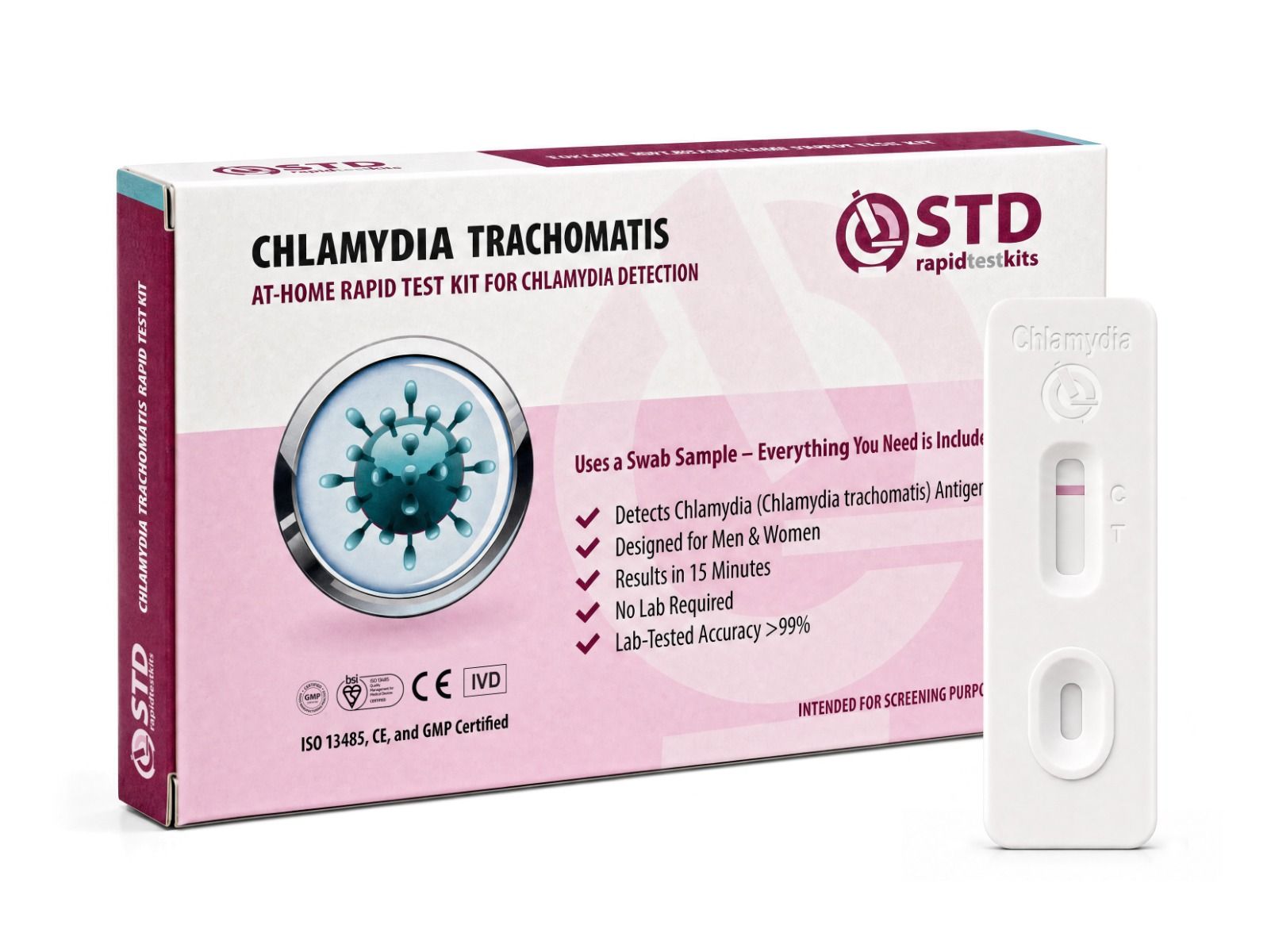
Our at-home chlamydia rapid test is a lateral-flow immunoassay validated for self-collected genital swab samples. It detects chlamydial antigen on a strip in about 15 minutes. It is a useful first-line tool when you had unprotected genital exposure (vaginal or penile), when you want a quick screen before scheduling lab follow-up, or when privacy or clinic access is limited.
Our kit is not validated for pharyngeal (throat) swab samples. If your only exposure was oral and you specifically need to test the throat, the right path is a lab-based NAAT throat swab, available through sexual health clinics, Planned Parenthood, and many urgent-care providers. We do not sell a pharyngeal-swab home test, and we will not pretend otherwise.
What our home test does cover well: genital chlamydia screening for the same exposure event. If you gave or received oral sex, there is a meaningful chance of co-occurring genital exposure (kissing during foreplay, manual contact, partial penetration), and a genital screen is still useful even when oral was the primary concern.
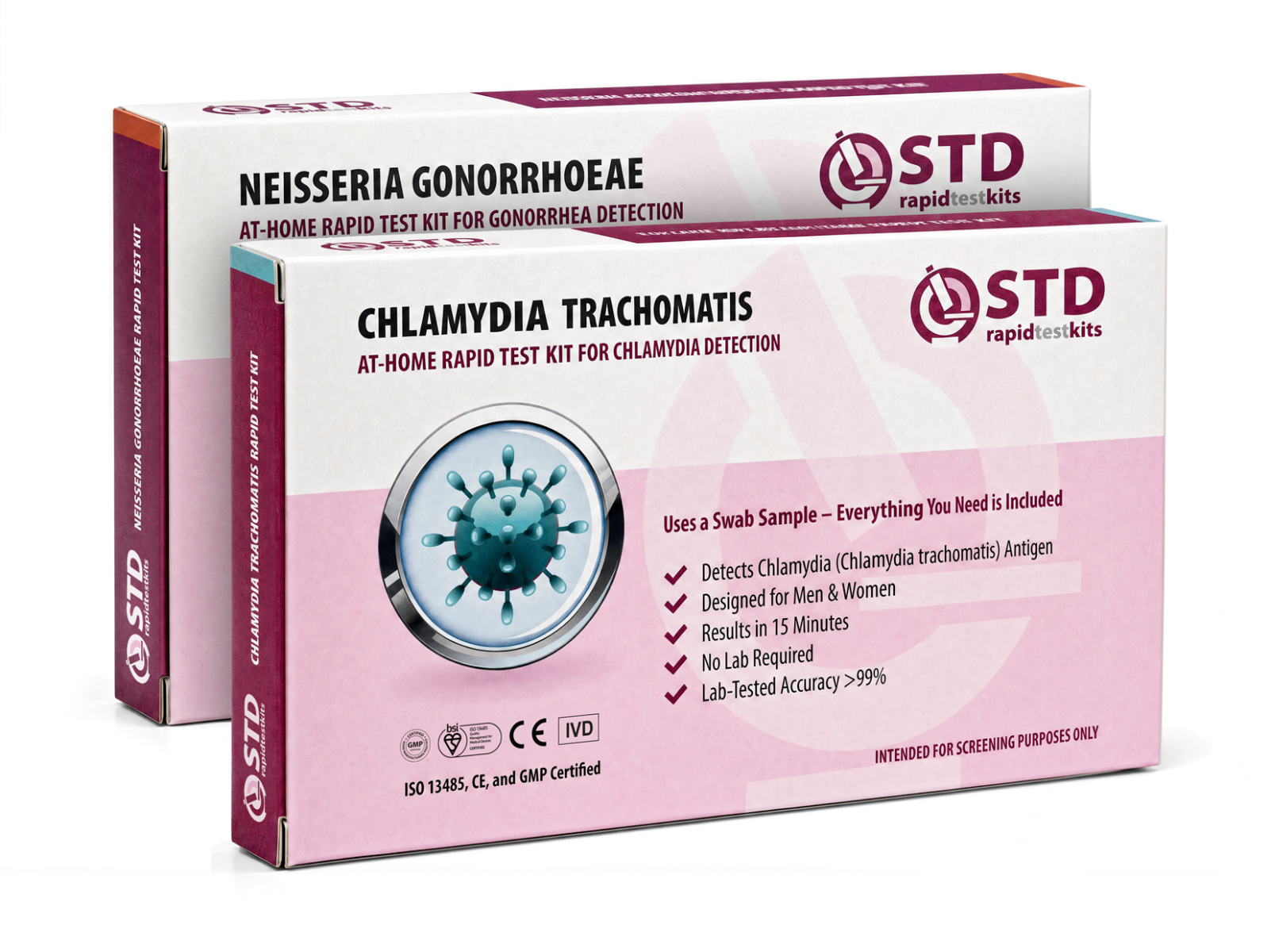
For broader coverage of the same exposure event, our combination kits screen for chlamydia, gonorrhea, and other common bacterial and bloodborne STIs together. These are lateral-flow rapid tests, not lab NAATs, so a positive result is best confirmed at a clinic. The screening kit covers the genital and bloodwork parts of the picture, not the throat.
If your test is positive: treatment
A positive chlamydia test means the bacterium is present and treatable. Standard treatment for chlamydia, whether genital or pharyngeal, is doxycycline 100 mg twice daily for seven days, per current CDC STI treatment guidelines (CDC STI treatment guidelines). The prior single-dose azithromycin regimen has been deprioritized for genital infections and shows reduced efficacy in pharyngeal cases, so doxycycline is the preferred first-line choice for throat infections.
What treatment looks like in practice:
- A clinician confirms the positive result and rules out medication contraindications (pregnancy, allergies)
- A seven-day doxycycline course is prescribed, typically through a pharmacy
- Sexual contact (oral, vaginal, anal) is avoided for at least seven days after treatment ends
- Recent partners are notified so they can test and treat too
Most pharyngeal infections clear with this regimen. The treatment is the same antibiotic, the same dose, and the same duration as for genital chlamydia, with one caveat: doxycycline is preferred for throat infections because of better tissue penetration in pharyngeal tissue.
If symptoms persist after the seven-day course, that does not necessarily mean treatment failure. Residual irritation can linger, and a sore throat unrelated to chlamydia can coexist with the cleared infection. A test of cure (a follow-up swab three to four weeks after finishing antibiotics) confirms whether the bacterium is gone. This is more often recommended for pharyngeal cases than for uncomplicated genital ones because clearance can be slower in throat tissue.
Over-the-counter remedies, gargling, and "natural" antibacterial supplements do not clear chlamydia. Only the prescribed antibiotic course works.
Doxycycline 100 mg twice daily for 7 days. No sexual contact (oral, vaginal, or anal) for 7 days after the course ends. Both partners must be treated at the same time to break the reinfection loop.
Retesting, partner care, and breaking the reinfection loop
Reinfection is more common than people expect, mostly because partner notification gets skipped or partial. The CDC recommends retesting roughly three months after treatment, regardless of whether you have symptoms (CDC chlamydia overview). Three months is long enough for a fresh infection from an untreated partner to show up clearly on a NAAT.
Two distinct retests serve different purposes:
- Test of cure (3 to 4 weeks post-treatment): confirms the original infection cleared. More often used for pharyngeal cases.
- Retest at 3 months: catches reinfection from untreated partners or new exposures.
Partner notification is the single most effective way to break the reinfection cycle. The conversation does not need to be dramatic or apologetic. A short, factual message works:
"Hey, I tested positive for chlamydia. The clinic recommended I let recent partners know so they can test too. It's treatable with a week of antibiotics. No drama, just wanted you to have the info."
Anonymous partner notification services exist in most U.S. states and through some clinics, where you can send a text or email without revealing your identity. Public health departments use these tools routinely and they reduce transmission rates measurably.
Expedited partner therapy (EPT) is another option in many states: a clinician treating one partner can prescribe antibiotics for the other partner without requiring a separate visit. It is not available everywhere, but it is worth asking about when you go in for treatment.
The reinfection loop usually starts when one partner gets treated and the other does not. Untreated genital chlamydia in one partner can reinfect the throat of the treated partner during the next oral encounter. Treating both partners at the same time, with abstinence during treatment, breaks the loop. For the 3-month reinfection check, an at-home genital rapid swab test is a convenient first screen before scheduling a lab visit.
Prevention without panic
Realistic prevention for oral sex sits between two extremes: ignoring risk entirely and avoiding intimacy out of fear. Practical options include:
- Barrier methods: condoms for fellatio, dental dams for cunnilingus and anilingus. These are the only methods that meaningfully reduce transmission risk during oral sex. Most people do not use them; using them reduces risk substantially.
- Regular screening: every 3 to 6 months for sexually active people with new or multiple partners. Includes a throat swab if oral exposure is part of your sexual practice.
- Honest partner conversations: testing status, last test date, and what was tested. "Clean" can mean a urine-only test from six months ago, which does not say much about pharyngeal status.
- Vaccination adjacent to STI risk: HPV vaccination (per ACIP, routine through age 26 with shared clinical decision-making through age 45) reduces oral HPV risk and adds a layer of overall sexual-health protection.
Mouthwash, brushing immediately before or after oral sex, and gargling do not prevent chlamydia. Vigorous brushing right before oral sex can actually increase risk by causing micro-tears in gum tissue.
Three highest-impact prevention actions
- Use a condom for fellatio and a dental dam for cunnilingus or anilingus, especially with new or untested partners.
- Screen every 3 to 6 months if you have new or multiple partners, and request a throat swab when oral exposure is part of your practice.
- Have a specific pre-sex conversation about what was tested and when. "Clean" without specifics often means a urine test that did not screen the throat.
Five myths that keep people from testing
Myth 1: "It was just oral, so I'm fine."
Oral sex can transmit chlamydia, gonorrhea, syphilis, and herpes. Penetration is not required for any of these infections to spread. What matters is contact between mucous membranes and infected fluids, regardless of how the encounter is labeled.
Myth 2: "If I had it, I'd feel something."
Most pharyngeal chlamydia is asymptomatic. The symptoms it does cause overlap with cold and allergy patterns. Feeling fine and being uninfected are not the same thing.
Myth 3: "My last STI test was clean, so I'm covered."
A urine test or genital swab does not screen the throat. Unless your last test specifically included a pharyngeal swab, throat infection was not assessed.
Myth 4: "Chlamydia goes away on its own."
Untreated chlamydia can persist for weeks or months and continues to be transmissible. Some infections do clear without treatment, but the timeline is unpredictable, and ongoing transmission risk during that period is real. Untreated genital chlamydia raises the risk of pelvic inflammatory disease and tubal-factor infertility in people with female reproductive anatomy (NHS chlamydia).
Myth 5: "Mouthwash kills the bacteria."
Mouthwash does not eliminate chlamydia. Some lab studies suggest certain antiseptic mouthwashes may reduce gonorrhea bacterial load briefly; the evidence for chlamydia is weaker, and no clinician recommends mouthwash as a preventive strategy.
Chlamydia is the most frequently reported bacterial sexually transmitted infection in the United States, and it can be transmitted through oral, vaginal, or anal sex.
Frequently asked questions
- Can I get chlamydia from kissing?
- Casual kissing does not transmit chlamydia. The bacterium needs direct mucous-membrane contact with infected fluids, and saliva alone does not carry enough bacterial load to establish infection. Deep kissing immediately after oral sex on an infected partner is the rare exception, and even then the risk is low.
- Can I get oral chlamydia from a partner who has no symptoms?
- Yes. Most chlamydia infections, both genital and pharyngeal, are asymptomatic. A partner without symptoms can still carry and transmit the bacterium during oral sex.
- How long after oral sex should I test?
- Wait at least 14 days from the exposure for the most reliable NAAT result. If you have severe symptoms before then, a clinician may test sooner with a plan to retest later if the first result is negative.
- Will a regular STI panel catch oral chlamydia?
- Usually not. Most standard panels test urine or genital swabs only. You need to specifically request a pharyngeal (throat) swab and confirm the sample is being sent for NAAT testing.
- Is oral chlamydia treated the same way as genital chlamydia?
- Yes. Doxycycline 100 mg twice daily for seven days is the current CDC-recommended first-line treatment for both genital and pharyngeal chlamydia. Doxycycline is preferred over azithromycin for throat infections because of better tissue penetration.
- Can I keep getting reinfected with chlamydia?
- Yes. Reinfection happens when partners are not treated together or when new exposures occur. The CDC recommends retesting three months after treatment to catch this. Treating both partners at the same time, with abstinence during the treatment course, breaks the reinfection loop.
- Does your at-home test work for throat samples?
- No. Our at-home rapid test is validated for self-collected genital swab samples. For pharyngeal testing, lab-based NAAT through a clinic is the right path. We do not sell a pharyngeal-swab home test, and our kit covers the genital part of the same exposure event well.
- Should I tell partners if I test positive?
- Yes. Partner notification breaks the transmission and reinfection cycle. A short factual message is enough; anonymous notification services exist in most states if direct conversation is not safe or feasible. Some states also offer expedited partner therapy, where a clinician can prescribe treatment for a partner without requiring a separate visit.

- U.S. Centers for Disease Control and Prevention. About Chlamydia, including transmission, screening guidance, symptom presentation, and the ranking of chlamydia as the most reported bacterial STI.
- U.S. Centers for Disease Control and Prevention. About STI Risk and Oral Sex, the source for oral-route transmission of chlamydia, gonorrhea, and syphilis.
- U.S. Centers for Disease Control and Prevention. STI Treatment Guidelines: Chlamydial Infections, including the doxycycline 100 mg twice daily for 7 days first-line regimen.
- World Health Organization. Chlamydia fact sheet covering global epidemiology, transmission, and treatment principles.
- U.K. National Health Service. Chlamydia overview, including symptom presentation and the long-term complications of untreated infection.
