Published: July 2025 | Last updated: May 2026 | Editorial review and quality control: Martina N.
Hepatitis C is a bloodborne virus first, and a sexually transmitted infection only in certain situations. That gap between the textbook answer and the way the question gets asked online is where most of the confusion lives. Public-health agencies including the U.S. Centers for Disease Control and Prevention and the World Health Organization describe HCV primarily as a virus spread through blood-to-blood contact, with sexual transmission listed as uncommon overall but meaningfully higher inside specific networks and behaviors.
If you are reading this because you slept with someone who has hepatitis C, started dating a partner who disclosed an HCV diagnosis, or saw a worrying headline about rising rates of sexually transmitted HCV in some communities, you are asking the right questions. The honest answer sits between the two extremes you have probably seen online, which range from “it is not an STI at all” to “you should panic.” All of it grounded in current CDC, WHO, and NHS guidance, not personal clinical experience.
Key Takeaways
- Hepatitis C is bloodborne first. Sexual transmission is uncommon in monogamous heterosexual couples, but rises with anal sex, HIV co-infection, rough sex that causes bleeding, and exposures across MSM networks (CDC).
- Hep C is curable in most cases. Direct-acting antiviral treatment cures about 95% of people, and a cured person cannot pass the virus on through any route (WHO fact sheet).
Is hepatitis C technically a sexually transmitted infection?
Hepatitis C is classified by the CDC and WHO as a bloodborne virus. That classification matters because it tells you how the virus actually moves: through blood entering blood. The most common transmission routes in the United States, according to CDC surveillance, are sharing injection-drug equipment, exposure to unsterile tattoo or piercing tools, and (historically) blood transfusions before reliable screening began in 1992.
Sex is not on the top of that list. The CDC's plain-language framing is that HCV “is not commonly spread through sexual contact,” but it is also explicit that sexual transmission can happen, especially in specific contexts. Both things are true at the same time. The textbook category and the real-world risk are talking about different audiences.
The right way to read this is by behavior, not by label. A monogamous heterosexual couple where neither partner has HIV and sex does not involve bleeding has a sexual-transmission risk that is, in CDC's own language, very low. The same is not true of HIV-positive men who have sex with men engaging in condomless anal sex, where outbreaks of sexually acquired HCV have been documented in several major cities since the mid-2000s.
HCV is a bloodborne virus and the most common modes of infection are through exposure to small quantities of blood. This may happen through injecting drug use, unsafe injection practices, unsafe health care, transfusion of unscreened blood and blood products, and sexual practices that lead to exposure to blood.
How sex actually transmits hepatitis C
The biology is straightforward. HCV needs to get from one bloodstream into another. Sex transmits the virus when intercourse causes microscopic breaks in tissue and infected blood (or fluids containing visible blood) makes contact with that broken tissue or a partner's bloodstream.
What does not transmit it: typical, condom-protected vaginal sex without bleeding between two HIV-negative partners. The CDC and the UK NHS both describe the risk in that scenario as very low, low enough that monogamous heterosexual couples are generally advised they do not need to change their sex life because one partner has hepatitis C. Routine condom use in that situation is offered as a choice, not a clinical mandate.
Risk rises with:
- Anal sex: the rectal lining is thinner and more prone to small tears than vaginal tissue, which makes blood exposure more likely.
- Rough or prolonged sex: anything that produces tissue trauma, bleeding gums, or open sores creates entry points.
- Sex while bleeding: menstruation, postpartum bleeding, or sex during or after an STI flare that causes ulcers all increase the chance of blood-to-blood contact.
Most readers searching this question are in a low-risk situation: one new partner, condom-protected vaginal sex, no visible bleeding, no HIV. If that describes you, the realistic chance you contracted hepatitis C from one sexual encounter is small. Testing is still reasonable for peace of mind and to rule out any other STIs that might have been on the table.
What about oral sex?
The short version is that oral sex on its own is a very inefficient route for HCV transmission. Saliva does not transmit hepatitis C. The CDC's hepatitis C FAQ explicitly addresses this, and the agency's plain-language guidance places oral sex in the same uncommon-transmission bucket as kissing.
Even when one of the conditions below is present, a single oral-sex exposure does not commonly produce infection. Without any of them, the realistic risk is very low. The stronger case for using a barrier (condom or dental dam) during oral sex is reducing cumulative risk over time when you have multiple partners or unknown partner status, plus protection against other STIs that transmit more efficiently orally, including gonorrhea, chlamydia, and syphilis. The scenarios where HCV transmission via oral sex becomes plausible at all are:
- Bleeding gums, a recent dental procedure, mouth ulcers, or active gum disease in the receiving partner.
- Performing oral sex on a partner who is menstruating, has visible genital injuries, or has an active genital sore that is bleeding.
- An untreated coexisting STI in either partner that has caused ulcers or open lesions, which the receiving mouth can come into contact with.
Can you get hepatitis C from kissing?
No, in any realistic everyday sense. The CDC's hepatitis C information explicitly states that the virus is not spread through saliva, and routine social contact (kissing, sharing food, sharing utensils, hugging) is not a transmission route. The exception that exists only on paper is a scenario where both partners have actively bleeding mouth sores or oral injuries at the moment of contact, which is the kind of edge case that public-health guidance includes for completeness rather than as a real-world risk people need to act on.
If you are in a relationship with someone who has hepatitis C, you do not need to avoid kissing them. The NHS guidance is direct on this: HCV is not passed through everyday close contact, and there is no reason to treat a partner with hepatitis C as contagious in daily life.
You cannot get hepatitis C by hugging, kissing, or sharing food or drink with someone who has it. Everyday close contact is not a transmission route.
Where sexual transmission risk actually goes up
The honest picture, drawn from CDC and peer-reviewed surveillance data, is that sexual transmission of HCV is concentrated in specific populations and behaviors rather than spread evenly across everyone who has sex. Two clusters drive most of the reported sexual-transmission cases.
Men who have sex with men, particularly when HIV-positive. Since the mid-2000s, public-health agencies in the United States, Europe, and the United Kingdom have documented rising rates of sexually acquired HCV in HIV-positive MSM networks. The driving factors are condomless anal sex, group sex, chemsex (sex while using stimulant drugs), and sharing equipment for snorting or injecting drugs in sexualized settings. HIV co-infection plays a real biological role: HIV increases the amount of HCV present in genital secretions, which raises the per-act transmission probability.
Sex involving blood. Anal sex with bleeding, sex during heavy menstrual bleeding, fisting (which has been linked to HCV outbreaks specifically because it produces blood exposure), and sex following recent piercings or genital trauma all push the risk meaningfully higher. The mechanism is the same one that makes injection-drug-equipment sharing the dominant HCV transmission route: blood-to-blood contact, with sex as the delivery system rather than the cause.
This is not a moral assessment of any sexual practice; it is a description of what the surveillance data shows. Someone in either of these higher-risk groups deserves accurate, non-judgmental testing access and clear information about how often to test. The CDC currently recommends HCV testing at least once for all adults aged 18 and over, and more frequently for people whose ongoing exposures put them at higher risk.
| Higher-risk cluster | What drives the risk |
|---|---|
| HIV-positive MSM networks | Condomless anal sex, group sex, chemsex; HIV co-infection raises HCV viral load in genital secretions. |
| Sex involving blood | Anal sex with bleeding, heavy-menstruation sex, fisting, sex after recent piercings or genital trauma. |
Dating or partnered with someone who has hepatitis C
An HCV diagnosis in your partner is not a reason to end the relationship, abstain, or treat the situation as a crisis. It is a reason to have an informed conversation and to think about a few specific behaviors. CDC and NHS guidance consistently describe the annual transmission risk for monogamous heterosexual couples as very low, well under 1% per year in studies spanning multiple years (CDC hepatitis C overview, NHS hepatitis C).
What does not help: avoiding kissing, sharing meals, sharing a bed, or hugging. The 24/7 caution model that some online forums recommend is not supported by CDC or NHS guidance. This site sells at-home rapid hepatitis C antibody tests, listed in the banner further down. Practical adjustments that do help, in rough order of impact:
- Treat the infection. Modern direct-acting antiviral therapy cures approximately 95% of people with hepatitis C in 8 to 12 weeks of oral medication, per <a href="https://www.who.int/news-room/fact-sheets/detail/hepatitis-c" target="_blank" rel="noopener">WHO guidance</a>. A cured partner cannot transmit the virus to you through any route, including sex.
- Get baseline tested. Knowing both partners' status removes ambiguity and gives the negative partner a starting point for any future retest.
- Use barriers for anal sex and for sex during menstruation. These are the situations where the per-act risk is highest, and a condom is highly effective at preventing exposure.
- Skip sharing personal items that can carry blood: razors, toothbrushes, nail clippers. These are documented household-route exposures, not sex, but they are worth handling correctly in any HCV-affected household.
- If either partner has HIV, talk to a clinician about more frequent HCV retesting for the negative partner, even with condom use.
If you are the partner with hepatitis C
Living with hepatitis C does not change your worth as a partner, and it does not turn you into a biohazard. It does mean carrying some specific information that the negative partner may not have, and deciding how and when to share it. Disclosure is genuinely your choice, but it tends to make sex life and treatment decisions easier when it happens early in a relationship rather than later.
A few things worth being clear on:
- Treatment is curative for most people. Per WHO, direct-acting antivirals achieve sustained viral response (the technical name for cure) in about 95% of treated patients. Once cured, the virus is gone and cannot be transmitted.
- Undetectable does not yet have the same formal status for HCV as it does for HIV. With HIV, an undetectable viral load is established to be untransmittable. For hepatitis C, the closest equivalent is full sustained viral response after treatment, which functions the same way: no detectable virus means no transmission.
- You can be reinfected after cure. Successful treatment does not give you lifetime immunity. If your ongoing exposures place you at risk, retesting at the intervals your clinician recommends is reasonable.
Why language around testing matters
One small editorial point that has real public-health weight: the word “clean,” when applied to people, makes everyone else by implication “dirty.” Asking a new partner whether they are clean reframes a routine medical question as a moral one, and it makes people with any STI history (including a curable, treated infection like hepatitis C) less likely to disclose. Public-health communicators and clinicians have moved away from this language for that reason.
There is also a practical reason to ask about hepatitis C specifically. It is often not included in standard STI screening panels at sexual-health clinics, because the panel logic is built around bacterial STIs and HIV. If you want to know your HCV status, you may need to ask for it by name. The CDC's universal screening recommendation (test all adults at least once) is intended in part to close this gap.
Better phrasings that ask for the same information without the stigma:
- “When was your last full STI screen?”
- “Are there any infections I should know about so we can talk about protection?”
- “Have you been tested for hepatitis C? It is not part of every standard panel.”
How to stay safer without overhauling your sex life
For most people, “safer sex with hepatitis C in mind” looks the same as safer sex in general. The specific tools that meaningfully lower HCV transmission risk are already on most people's list for unrelated reasons.
- Condoms for anal sex and for sex with new or higher-risk partners. The same product that lowers HIV and bacterial STI transmission lowers HCV risk too, particularly for the higher-risk anal route.
- Avoid sex while bleeding when you can. Pausing sex during heavy menstrual flow, after recent piercings or dental work, or during an active STI flare is a meaningful risk reducer with little practical cost.
- Test on a schedule that matches your life. Once for everyone over 18, per CDC. More often if you have multiple partners, inject drugs at any frequency, are in an HIV-positive MSM sexual network, or are otherwise in an ongoing higher-risk situation.
- Ask better questions when partners change. Replacing “are you clean” with “when did you last get tested” opens the door to honest answers.
- Treat coexisting STIs promptly. An untreated bacterial STI that causes ulcers or inflammation raises HCV exposure risk for both partners.
If you think you have been exposed
The exposure-to-test pathway for hepatitis C has two key time points. Knowing both prevents the common trap of testing too early and getting a falsely reassuring negative.
HCV antibody test. This is the first step. The antibody is what your immune system makes in response to hepatitis C exposure. CDC guidance indicates that most people develop HCV antibodies within 8 to 11 weeks of exposure, with some published rapid-kit instructions reporting a 4 to 10 week window (CDC hepatitis C overview). If a specific exposure is what brought you here, the conservative position is to retest at 6 months after the exposure for full confidence.
A positive antibody result means your body has encountered HCV. It does not by itself confirm an active infection, because about one in four people clear the virus on their own without treatment.
HCV RNA test. This is the confirmatory step done through a clinician after a positive antibody. It looks for the virus itself in your blood. A positive RNA result confirms active infection and is the prompt for treatment planning. A negative RNA result after a positive antibody means past exposure with spontaneous clearance, which is the outcome roughly one quarter of people have.
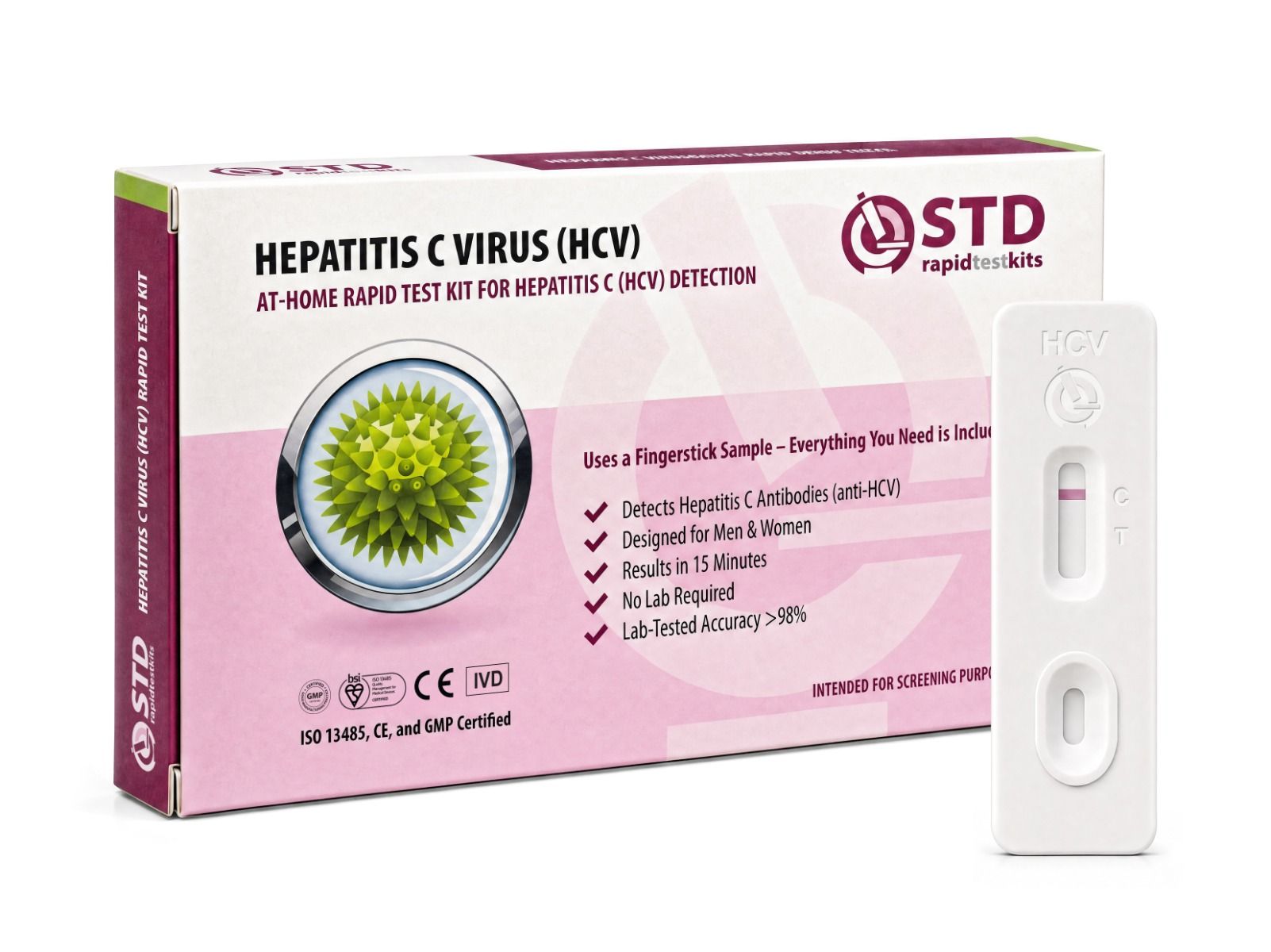
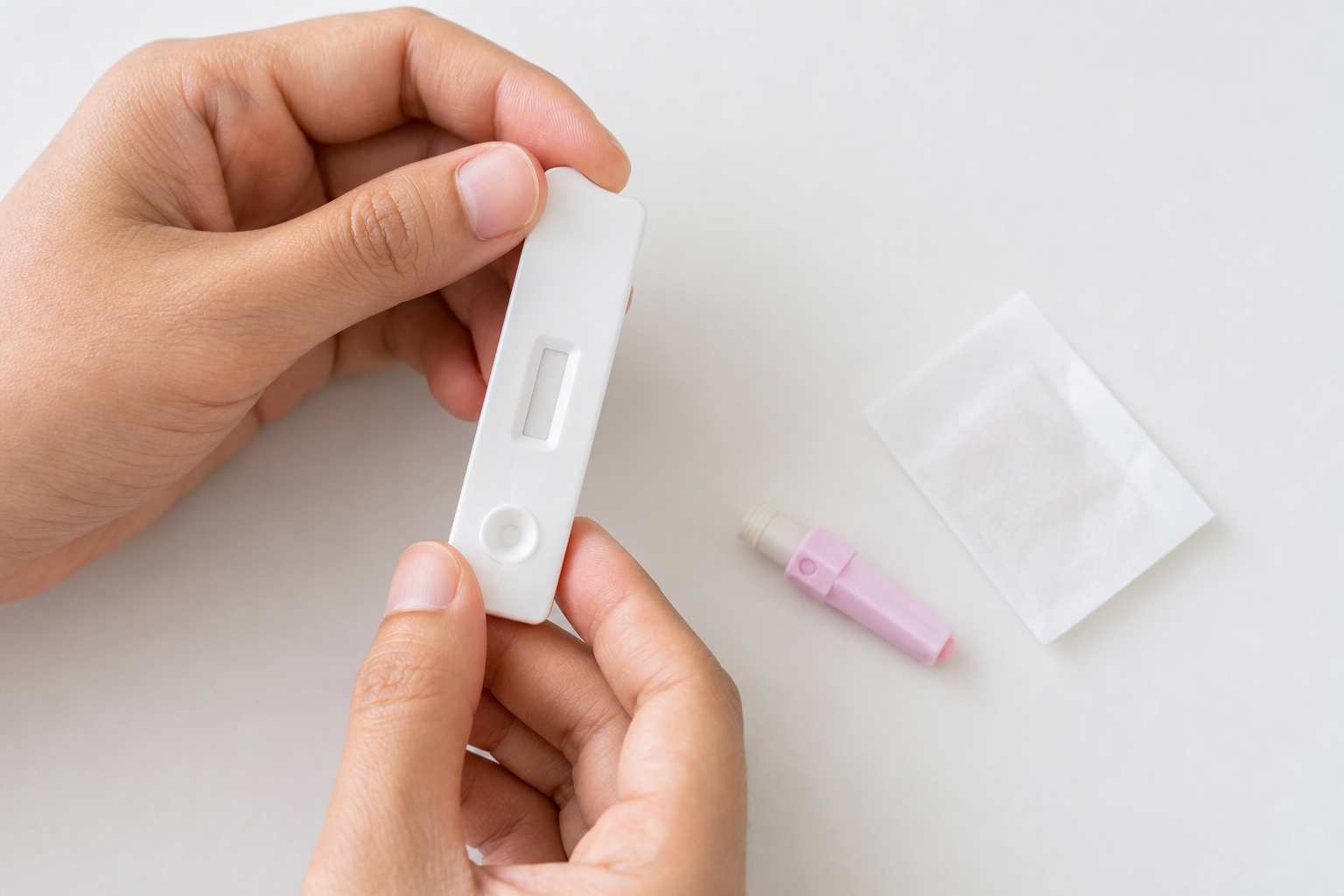
If you are using an at-home rapid antibody kit as a screening starting point, treat a positive result as a reason to see a clinician for the RNA confirmation and to discuss treatment, not as a final diagnosis on its own. Treat a negative result from a kit used within the window period the same way you would treat any STI screen taken too early: retest after the window has fully closed.
Testing pathway at a glance
- Step 1: HCV antibody test, typically 8 to 11 weeks after exposure for most people.
- Step 2: If antibody is reactive, follow with an HCV RNA test through a clinician to confirm active infection.
- Step 3: Negative result after a recent or higher-risk exposure? Retest at 6 months for full confidence.
Common myths about hepatitis C and sex
A short pass through the claims that come up most often online, with the CDC and WHO answer next to each.
Myth: “You cannot get hep C from sex.” Not quite. Sexual transmission is uncommon overall, especially in heterosexual monogamous couples, but it is documented in higher-risk contexts including anal sex, HIV co-infection, and MSM networks where outbreaks have been tracked.
Myth: “Oral sex is completely safe.” Mostly, but not unconditionally. The realistic-risk situations are oral sex when there is visible blood, mouth ulcers, recent dental work, or active genital injury. Without those conditions, the risk is very low.
Myth: “If I have no symptoms, I am not contagious.” False. Most people with hepatitis C are asymptomatic for years, and that does not change their ability to transmit the virus through blood-to-blood exposure. Asymptomatic carriage is in fact the dominant reason CDC recommends universal one-time adult screening.
Myth: “Only people with HIV need to worry about hep C.” HIV co-infection raises sexual-transmission risk, but anyone exposed to infectious blood through any route can acquire HCV. The largest single transmission route in the US is shared injection-drug equipment, which affects people regardless of HIV status.
Myth: “Once you have hep C, you have it for life.” Outdated. Direct-acting antivirals introduced in the 2010s changed the picture entirely. Cure is the realistic expected outcome for most people who start treatment, in 8 to 12 weeks of oral pills.
“Once you have hep C, you have it for life.” Outdated since the mid-2010s. Direct-acting antivirals cure about 95% of people in 8 to 12 weeks of oral pills, with no injections and few side effects. A cured person cannot transmit the virus.
Why testing matters even when you feel fine
Hepatitis C is the textbook example of a slow infection. Most people who have it feel nothing for years or decades. The damage it does to the liver, when it does damage, happens silently in the background while everything on the outside feels normal. By the time symptoms appear, the underlying disease is often advanced.
The damage is not abstract. Untreated chronic HCV can progress over 10 to 30 years to cirrhosis (scarring of the liver) and, in a minority of cases, to hepatocellular carcinoma (the most common form of primary liver cancer). That progression is largely preventable. The direct-acting antivirals that cure the infection stop the inflammation that drives it, and the earlier in the disease the cure happens, the lower the residual risk to the liver.
That is the reason the CDC moved in 2020 from risk-based screening to a universal recommendation: every adult tested at least once, every pregnant person tested in every pregnancy. The change reflected a realization that asking who is at risk misses the asymptomatic people who do not think of themselves as high-risk but who acquired the virus years earlier through routes they may have forgotten.
The other reason testing matters is that it now opens the door to a cure. Twenty years ago, a positive HCV diagnosis meant a long, side-effect-heavy treatment with a modest cure rate. Today it means a short course of oral pills with a 95% cure rate, per WHO. Knowing your status sooner makes that outcome more likely.
Direct-acting antiviral medicines can cure more than 95% of persons with hepatitis C infection, reducing the risk of death from cirrhosis and liver cancer.
Frequently asked questions
- Can hepatitis C be passed through vaginal sex?
- Yes, but uncommonly. In monogamous heterosexual couples without HIV, the per-year transmission rate has been estimated at well below 1%. Risk rises with anal sex, sex during menstruation, sex with visible blood, and HIV co-infection.
- Is hepatitis C officially classified as an STI?
- Hepatitis C is classified as a bloodborne virus rather than primarily as an STI. Public-health agencies acknowledge sexual transmission as a recognized but uncommon route, with specific higher-risk contexts.
- Can you get hepatitis C from oral sex?
- Very rarely. Saliva does not transmit hepatitis C. The realistic risk situations involve blood: bleeding gums, mouth ulcers, recent dental work, or oral contact with a partner who is menstruating or has open genital injuries.
- Can you get hepatitis C from kissing?
- No. Saliva does not carry HCV, and the CDC is explicit on this point. Routine daily contact (kissing, shared food, hugging) does not transmit hepatitis C.
- Should I get tested after a single one-night stand?
- If the encounter involved condomless anal sex, visible bleeding, or a higher-risk partner profile, yes. For typical condom-protected vaginal sex with no bleeding, the realistic risk is small, but a baseline screen is reasonable for peace of mind and covers other STIs.
- How long after a possible exposure should I test?
- CDC guidance indicates most people develop HCV antibodies within 8 to 11 weeks of exposure. For full confidence after a specific concerning exposure, retest at 6 months. A reactive antibody result needs an HCV RNA test for confirmation.
- Can I still have sex after I have been cured of hepatitis C?
- Yes. A person cured by direct-acting antiviral treatment no longer carries the virus and cannot transmit it. Reinfection through new exposures is possible, so the same safer-sex practices that applied before continue to apply.
- Does hepatitis C affect fertility or pregnancy?
- Hepatitis C does not directly affect fertility. The virus can be passed to a baby during delivery, with a transmission rate per CDC of roughly 6%, higher with HIV co-infection. Treating hepatitis C before pregnancy eliminates that risk.
- U.S. Centers for Disease Control and Prevention. Hepatitis C topic landing page, transmission routes, testing recommendations, and universal screening guidance.
- World Health Organization. Hepatitis C fact sheet, including transmission routes, treatment cure rates with direct-acting antivirals, and global epidemiology.
- UK National Health Service. Hepatitis C overview, with guidance on sexual transmission risk and household precautions.
- U.S. Centers for Disease Control and Prevention. Viral hepatitis statistics and surveillance, including hepatitis C transmission-route data for the United States.
- U.S. National Library of Medicine, MedlinePlus. Hepatitis C consumer-health overview, including testing and treatment.
- U.S. Centers for Disease Control and Prevention. 2020 universal hepatitis C screening recommendation for adults aged 18 and over (MMWR Recommendations and Reports).
