
Published: September 2025 | Last updated: April 2026 | Editorial review and quality control: Martina N.
Can you really get an STD in your eye?
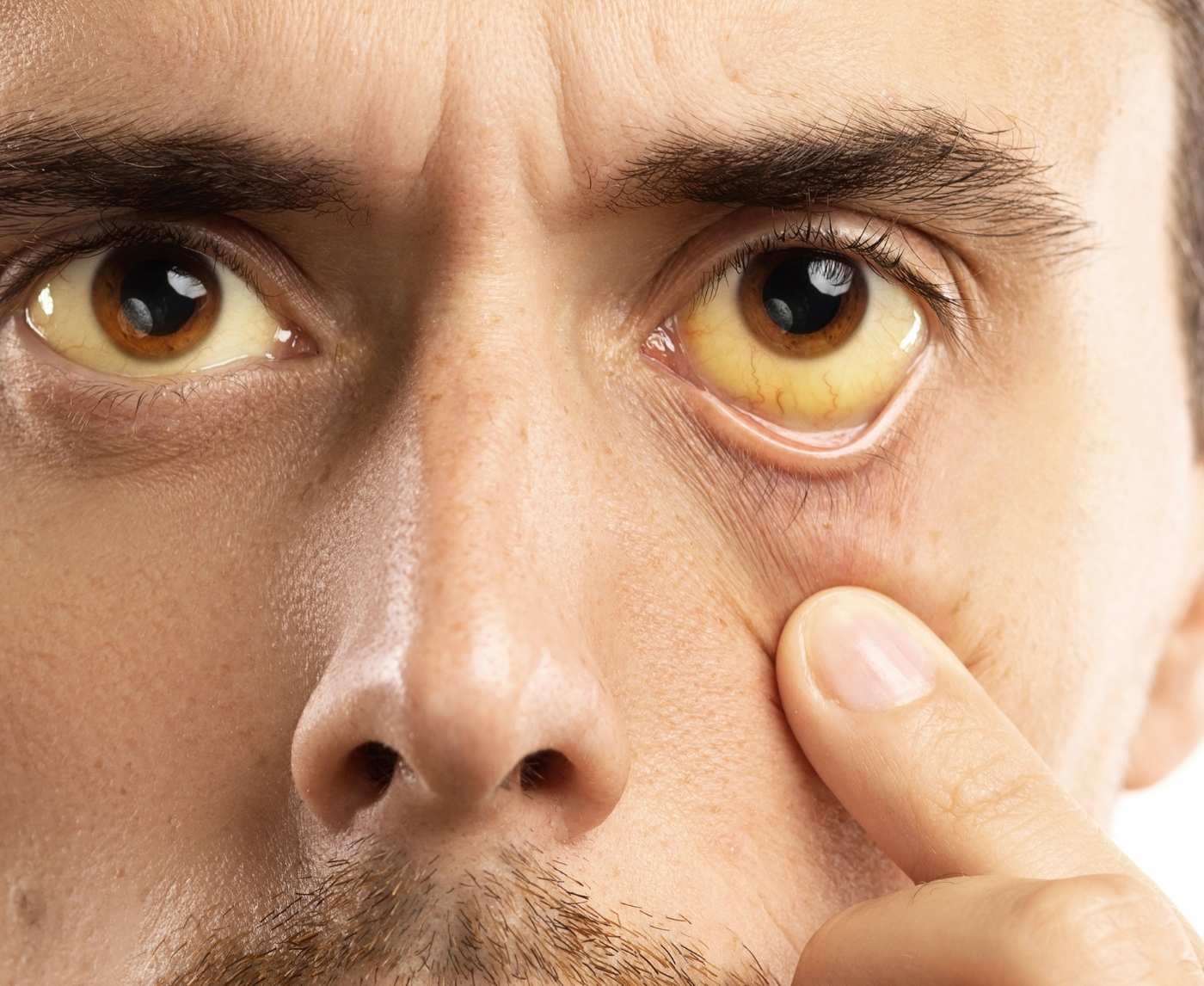
Yes. Herpes simplex virus (HSV-1 and HSV-2), gonorrhea, chlamydia, and less commonly syphilis can all infect the eye when infected fluids reach the eye's mucous membrane, often via hands after kissing, oral sex, or genital contact. Symptoms usually start 2 to 14 days after exposure and can mimic ordinary pink eye, though they tend to be more painful, persistent, or one-sided. Fast care matters; ocular gonorrhea in particular can damage the cornea within days when untreated.
Key Takeaways
- Most pink eye is not sexually transmitted, but ocular HSV, chlamydia, and gonorrhea are real and routinely missed by urgent-care providers who do not ask about recent intimate contact.
- If your eye started hurting within two weeks of a kiss, oral sex, or close intimate contact, especially with thick discharge, sharp pain, or light sensitivity, that pattern earns a same-day medical evaluation.
A red, weeping, or oddly painful eye that shows up a few days after a hookup, a make-out session, or oral sex pulls a very specific kind of dread out of people. Half the brain says the words "it's just allergies". The other half is mid-spiral on a 2 a.m. search bar. Both can be true at once. Most red eyes really are nothing serious. Sexually transmitted infections in the eye, called ocular STIs (or sometimes ocular STDs), are real, underdiagnosed, and worth understanding.
This guide walks through which infections reach the eye, how the symptoms differ from ordinary pink eye, what testing looks like in real life, and when an irritated eye is a reason to skip the forums and go straight to in-person care. The aim is clarity, not catastrophe.
How does an STD end up in your eye?
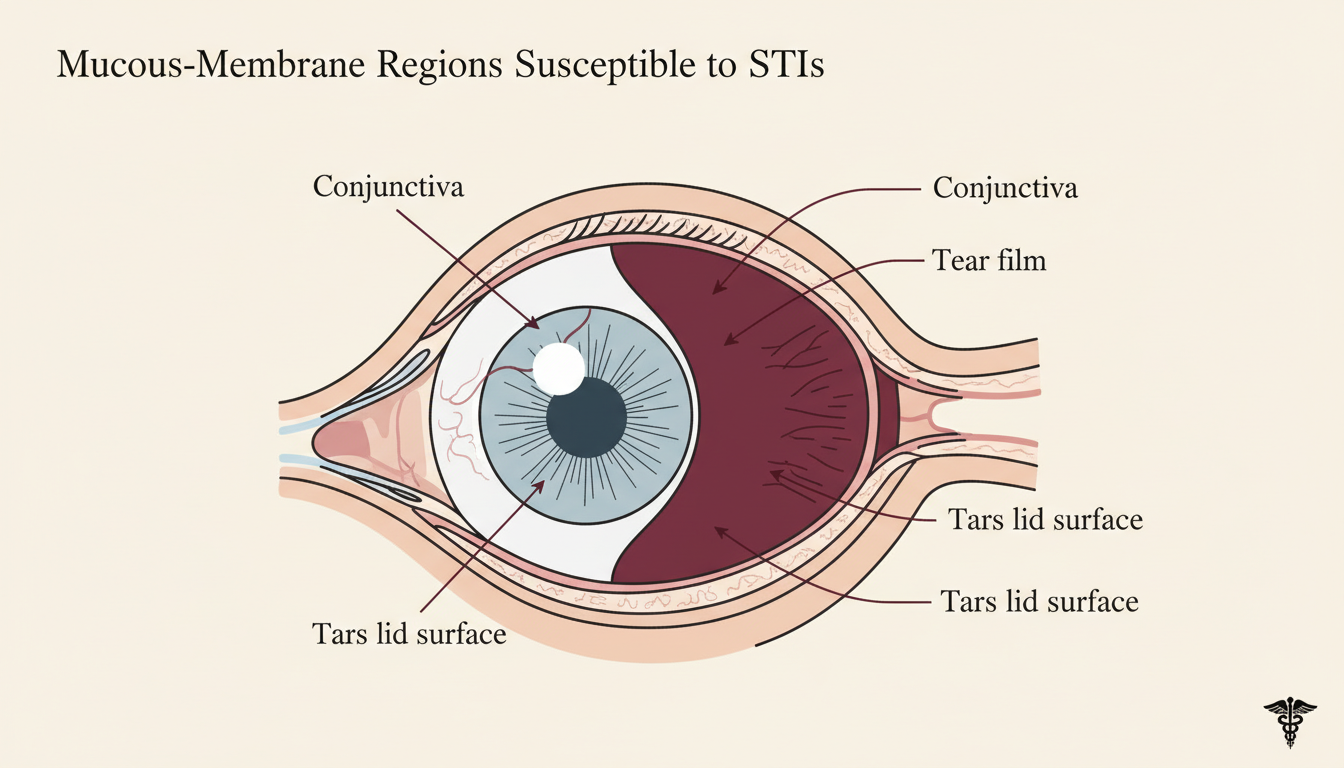
The eye's surface is a mucous membrane, similar in tissue type to the lining of the mouth, urethra, and cervix. That means it can pick up the same bacteria and viruses that infect those sites. You do not need penetrative sex for this to happen. You do not even need direct genital contact. What you need is enough infectious material in the right place at the right time.
The common transmission paths look mundane:
- Receiving oral sex from a partner who is shedding HSV-1 from the mouth, often without a visible cold sore.
- Touching a partner's genitals or fluids, then rubbing your eye before washing your hands.
- Direct splash of semen or vaginal fluid into the eye during intimacy.
- Sharing a towel, washcloth, eye makeup, or contact-lens case with someone who has an active infection.
Asymptomatic shedding is the part that catches people off guard. Per the CDC's herpes treatment guidance, people carrying HSV can transmit the virus when they have no visible sores at all. The myth that "you would know if your partner had herpes" does not match how the virus behaves in real life.
Which STIs can infect the eye, and what do they feel like?
Four sexually transmitted infections account for nearly all ocular cases. Each has its own timing, symptom pattern, and urgency level. Knowing the differences helps you decide whether you need urgent care now, testing this week, or whether the timing makes an STI unlikely.
Gonorrhea is the one that makes clinicians move fastest. Heavy yellow-green discharge, dramatic eyelid swelling, and severe pain can develop within days. The CDC's STI treatment guidelines, in the gonococcal infections chapter, describe gonococcal conjunctivitis in adults as a medical emergency because the bacteria can erode the cornea quickly when untreated.
Chlamydia tends to be the slower, sneakier version. Adult chlamydial conjunctivitis (also called adult inclusion conjunctivitis) often lingers for weeks with mild redness and watery or mucous discharge that does not fully clear with standard antibiotic eye drops. Many cases are diagnosed only after a partner tests positive, prompting a second look at the eye.
Ocular herpes (most often HSV-1, occasionally HSV-2) is usually one-sided and disproportionately painful. People describe sharp scratchy pain, a foreign-body sensation, light sensitivity that makes normal indoor lighting unbearable, and sometimes a few small blisters near the eyelid. The American Academy of Ophthalmology's overview of herpes keratitis notes that recurrences are common, especially during illness or stress.
Ocular syphilis is the rarest of the four and the easiest to miss because it can show up months after the initial exposure, often as blurred vision, floaters, or eye pain rather than redness. The CDC's STI treatment guidelines emphasize that any sign of vision change in someone with possible syphilis exposure deserves prompt evaluation.
The four ocular STIs at a glance
- Gonorrhea is the fastest-moving and most urgent; thick discharge and severe pain can develop within days.
- Chlamydia is slower and more persistent; mild redness can drag on for weeks when untreated.
- Ocular herpes is usually one-sided, sharply painful, and tends to recur during stress or illness.
- Ocular syphilis is the rarest and most easily missed; vision changes can appear months after exposure.
STD eye infection vs. regular pink eye: how to tell the difference
Here is the awkward truth: most pink eye is not sexually transmitted. Routine viral and bacterial conjunctivitis is far more common, and so are seasonal allergies and irritation from contact lenses or makeup. According to AAO patient guidance on conjunctivitis, viral pink eye is by far the most frequent cause in adults.
That is exactly why people second-guess themselves into delay. Am I overreacting? Did I get soap in my eye? Is it allergies? The pattern below helps separate everyday irritation from something worth testing for, without nudging anyone toward panic.
STI-related eye infections often differ from routine pink eye in three ways. They tend to track an exposure window (symptoms started days, not hours, after intimate contact). They tend to involve only one eye, at least at first. And the pain or light sensitivity is typically out of proportion to how red the eye actually looks. Routine viral or allergic conjunctivitis usually affects both eyes within a day or two, brings watery rather than thick discharge, and improves on its own within a week.
Three signals tilt the odds toward a sexually transmitted cause: (1) symptoms started 2 to 14 days after a kiss, oral sex, or hands-and-genitals contact, (2) only one eye is affected, (3) pain or light sensitivity feels worse than the redness looks. Two or more of those, and STI testing belongs on the list, even if the discharge is mild.
Can semen or saliva really cause pink eye?
This is the question people type into a search bar at 2 a.m. with one eye half closed. Semen and vaginal fluids are not inherently dangerous to the eye on their own. They become a transmission risk when the source partner has an active sexually transmitted infection, especially gonorrhea or chlamydia. Without an active infection in those fluids, contact with them does not cause an STI in the eye.
Saliva carries its own caveat. HSV-1 lives in the mouth even in people who have never had a noticeable cold sore, and asymptomatic shedding is well documented. If oral sex involves close facial contact and your partner is shedding the virus, then a hand brushing the eye afterward can move enough virus to start an infection. Statistically uncommon. Biologically real.
The practical takeaway is small and unglamorous: wash your hands after sexual contact before touching your face, and avoid rubbing your eye for a while afterward. A single exposure does not equal automatic infection. Most people who do all the supposedly "wrong" things still do not develop an ocular STI. If symptoms appear, the exposure history is what tells your doctor where to look.
How long after exposure do eye STD symptoms start?
Timing is the clearest clue most people have. Bacterial infections usually move faster than viral ones, and certain pathogens have characteristic onset windows.
The CDC's STI treatment guidelines, in the gonococcal infections chapter, describe gonococcal conjunctivitis appearing roughly 2 to 7 days after exposure, sometimes faster in adults. Adult chlamydial inclusion conjunctivitis takes longer; symptoms typically appear days to about two weeks after exposure. Ocular herpes most often shows up within 2 to 12 days for a primary infection, and can recur years later under stress, illness, or sun exposure. Ocular syphilis can appear months after the initial exposure, which is part of why it gets missed.
The four pathogens differ enough that a side-by-side view helps:
| Infection | Common eye symptoms | Typical onset after exposure | Urgency |
|---|---|---|---|
| Gonorrhea (gonococcal conjunctivitis) | Thick yellow or green discharge, intense redness, marked swelling, sharp pain | 2 to 7 days | Very high; can damage cornea within days |
| Chlamydia (adult inclusion conjunctivitis) | Persistent redness, watery or mucous discharge, mild swelling, gritty feeling | Days to about two weeks | Moderate; lingers for weeks if untreated |
| Ocular herpes (HSV-1 or HSV-2) | Sharp pain, light sensitivity, tearing, possible eyelid blisters, often one-sided | 2 to 12 days for primary; recurrences possible | High; needs antiviral therapy |
| Ocular syphilis (including uveitis) | Blurred vision, eye pain, floaters, light sensitivity, vision changes | Weeks to months after primary exposure | High; requires medical evaluation and IV penicillin |
Testing for an eye STI: what helps
stdrapidtestkits.com publishes this article and sells the at-home STI tests discussed below; they are screening tools, not diagnostic eye exams. With that disclosure in place, here is where things get practical. Testing for ocular STIs sounds intimidating until you realize that the first useful clue often comes from a standard STI screen, not from anything done to your eye directly. If you test positive for chlamydia, gonorrhea, or herpes from a urine, throat, blood, or genital sample, and you also have eye symptoms, the picture usually clicks into place.
In a clinic, the gold-standard lab test for chlamydia and gonorrhea is a nucleic acid amplification test (NAAT, sometimes called PCR). NAATs detect the pathogen's DNA or RNA directly and are the preferred laboratory method per the CDC's STI treatment guidelines. For ocular involvement, an ophthalmologist or emergency-department clinician may also do an eye-specific swab of the lower lid (gentler than it sounds), or a fluorescein corneal stain to check for the dendritic ulcer pattern characteristic of herpes keratitis.
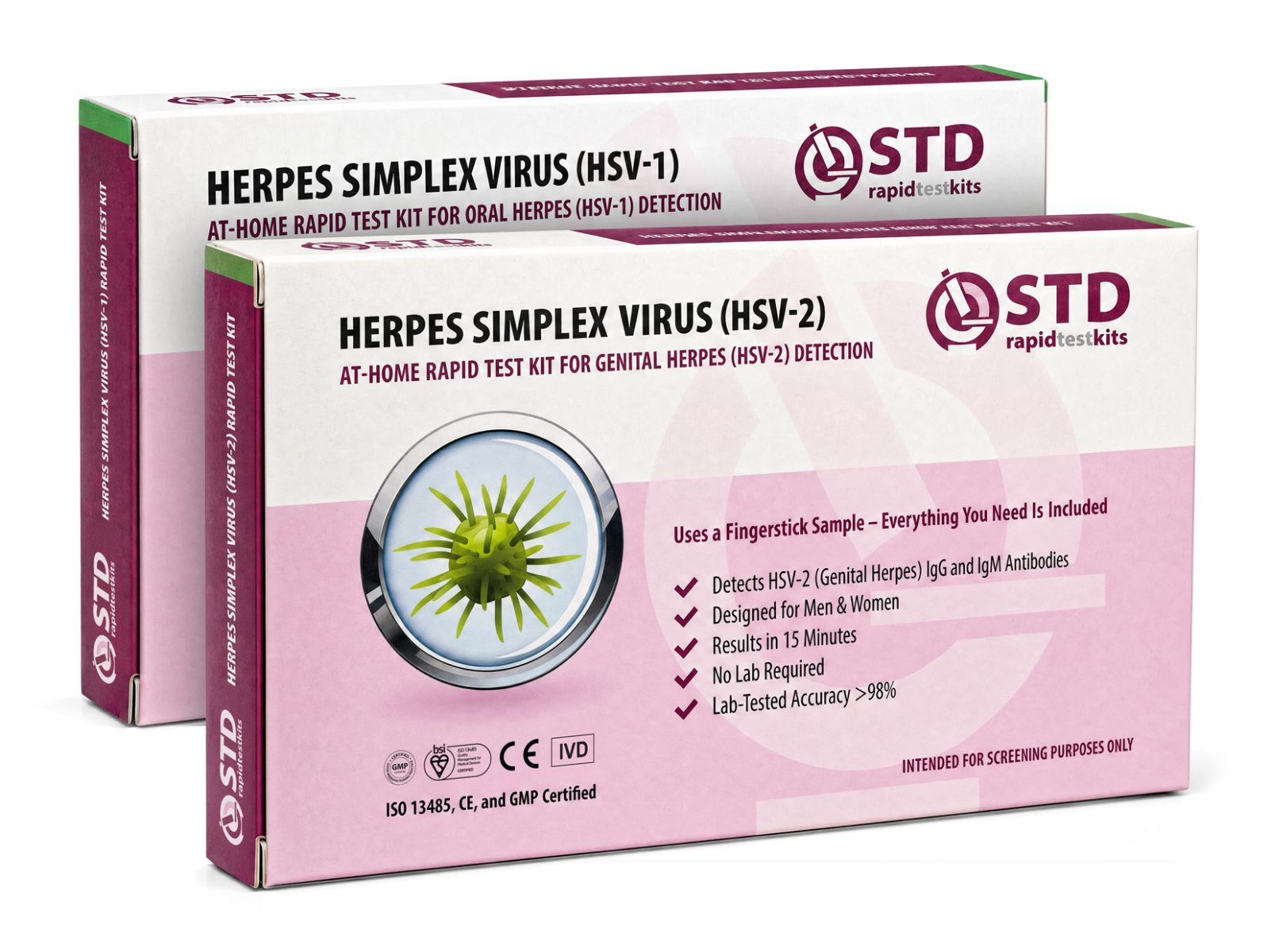
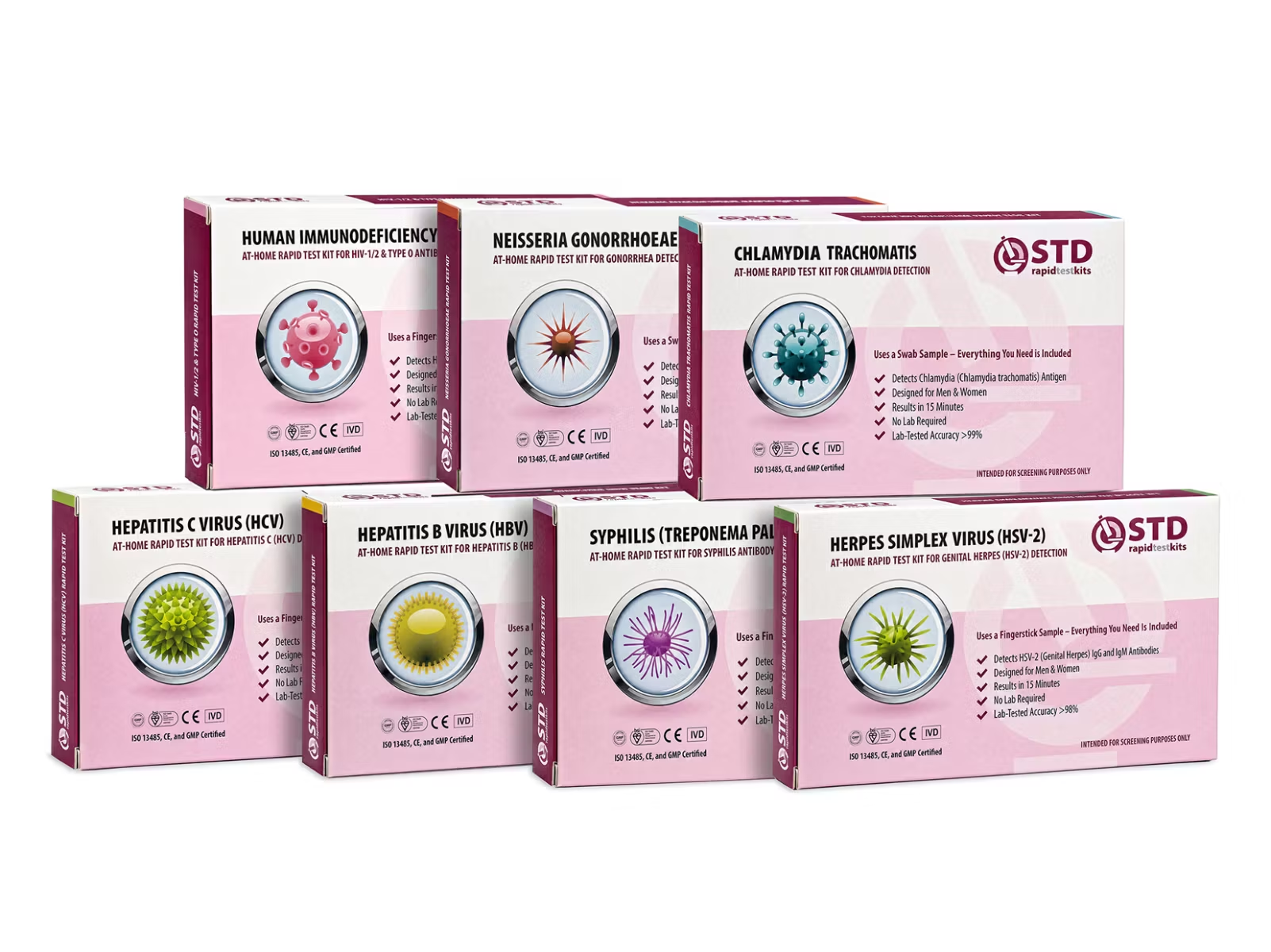
Where home testing fits into the picture: our at-home rapid kits are lateral-flow immunoassays, not laboratory NAATs or PCR. They use the same swab or fingerstick blood sample type as their lab counterparts, and they screen for the underlying systemic infection rather than the eye specifically. We do not sell an at-home eye-swab test. Do not try to substitute one of our screening kits for a clinical eye exam if your symptoms are severe. What our tests can answer well is the upstream question: do I have HSV, chlamydia, gonorrhea, or syphilis anywhere in my body, and is that the likely source of my eye irritation?
If the answer turns out to be yes, you arrive at the ophthalmologist with information instead of guesses, and you skip the round-and-round of being prescribed standard antibiotic eye drops that may not match the underlying cause.
Can answer: whether HSV-1, HSV-2, chlamydia, gonorrhea, hepatitis B/C, syphilis, or HIV are present systemically, using a lateral-flow swab or fingerstick blood test, with results in roughly 15 minutes at home.
Cannot answer: whether your eye specifically is currently infected. That requires an in-person eye exam, sometimes a corneal stain or eye swab, and is performed by an ophthalmologist, optometrist, or emergency-department clinician. If your eye is severely painful, swollen shut, producing thick discharge, or your vision is changing, go in person now. Home testing is for the upstream question, not the acute one.
When eye symptoms need urgent in-person care
Some symptoms are not worth waiting on. The pattern below is the clinical short list that an ophthalmology textbook would mark as same-day or emergency-department evaluation:
- Severe eye pain that is out of proportion to the redness.
- Thick yellow-green discharge that re-collects within hours of cleaning.
- An eye that feels glued shut on waking.
- Light sensitivity so intense that normal indoor lighting hurts.
- Any change in vision, including blur, floaters, or a dark patch.
- Marked eyelid swelling, especially with fever.
These signs can occur with severe gonococcal conjunctivitis, herpes keratitis with corneal involvement, or ocular syphilis. They are not the moment to start with an at-home test. Per AAO conjunctivitis guidance, any conjunctivitis with vision change, severe pain, or photophobia warrants prompt in-person evaluation, regardless of suspected cause.
If you are dealing with severe pain, thick yellow-green discharge that returns within hours of wiping the eye, light sensitivity that hurts under normal indoor lighting, marked eyelid swelling, or any vision change, head to urgent care or an emergency department today. An at-home test does not answer the acute question; an in-person eye exam does.
If your test comes back positive: what happens next
Most ocular STIs are treatable, often quickly. Bacterial infections such as gonorrhea and chlamydia respond well to a course of antibiotics, with eye symptoms usually starting to ease within a few days of starting therapy. Per the CDC's STI treatment guidelines, the gonococcal infections chapter recommends intramuscular ceftriaxone alongside saline irrigation and close ophthalmologic monitoring for adult gonococcal conjunctivitis. The chlamydial infections chapter recommends oral doxycycline or azithromycin, with improvement over 1 to 2 weeks.
Herpes is different. The virus stays in the body permanently. Antiviral therapy (oral acyclovir, valacyclovir, or famciclovir) shortens outbreaks and reduces the risk of recurrence and corneal scarring. People with frequent recurrent ocular HSV may be placed on daily suppressive antivirals. Steroid eye drops, which are sometimes given for routine pink eye, can make herpes keratitis dramatically worse and should not be used until herpes has been ruled out.
Ocular syphilis is treated as neurosyphilis: intravenous penicillin, usually 10 to 14 days inpatient or via outpatient infusion. Response is generally excellent when treatment starts before optic-nerve damage has occurred.
If your eye infection is confirmed as sexually transmitted, the systemic infection almost always exists at another site too. Comprehensive screening (throat, genital, blood, depending on history) ensures the source is treated, not just the eye. Partner notification is part of standard care, and it is treated as health information, not blame.
Reducing risk without eliminating pleasure
The goal here is not abstinence, and it is not paranoia. It is a small set of habits that meaningfully reduce ocular transmission without changing how anyone has sex.
- Wash hands after sexual contact, before touching your face or eyes. This is the single most useful habit and the easiest to skip.
- Use barrier methods when reasonable. Condoms and dental dams reduce direct contact with infected fluids and lower throat infection rates, which is where many silent reservoirs live.
- Do not share towels, washcloths, eye makeup, or contact-lens cases with a partner who has an active outbreak of any kind.
- Test regularly if you have multiple partners. Throat infections often cause no symptoms, so a periodic comprehensive STI screen catches what the body keeps quiet.
- If a partner has an active oral or genital herpes lesion, skip kissing and oral contact until the lesion has fully crusted and healed. Virus can shed from saliva even after the obvious sore looks better, so the conservative wait is worth the discomfort.
These habits take seconds, not effort, and they protect more than just your eyes.
Conjunctivitis that does not respond to standard antibacterial therapy in a sexually active adult should prompt evaluation for chlamydial or gonococcal infection.
FAQs
- Can you really get an STD in your eye from oral sex?
- Yes, though it is uncommon. If your partner has an active oral or genital infection (HSV, gonorrhea, chlamydia), and infected fluid reaches your eye directly or via your hands, transmission is possible. The eye is a mucous membrane and supports the same pathogens that infect the mouth, urethra, and cervix.
- If I woke up with red eyes the day after a hookup, is that too fast for an STI?
- Usually yes. Bacterial STIs typically take at least 2 days to cause eye symptoms, and viral ones often a bit longer. Symptoms appearing within 24 hours are more likely to be mechanical irritation, allergies, or routine viral conjunctivitis. If redness worsens over the next several days, especially with thick discharge or pain, that is when timing becomes meaningful.
- What does gonorrhea in the eye actually look like?
- The clearest sign is discharge that re-collects within an hour or two of wiping the eye, paired with eyelid swelling that feels heavy or hot. CDC guidance treats this presentation as a medical emergency for good reason; cornea damage can occur within days without prompt antibiotic therapy.
- How do I know if it is herpes in the eye and not just regular pink eye?
- Ocular herpes tends to be one-sided, sharply painful, and disproportionately sensitive to light. Some people see small blisters near the eyelid. The pain often feels worse than the redness looks. Recurrence is also a clue: if your "pink eye" keeps coming back in the same eye, it deserves evaluation for HSV, since recurrent ocular HSV is a recognized clinical pattern.
- Can a regular STI test tell me if my eye is infected?
- Not directly, but it usually answers the most useful upstream question. A standard STI screen (urine, blood, or swab) tells you whether you are carrying chlamydia, gonorrhea, herpes, or syphilis at all. If you are, and you also have eye symptoms, that strongly suggests the eye is involved and gives an ophthalmologist a starting point. A dedicated eye swab is performed in person.
- Can I go blind from an STD in the eye?
- Permanent vision loss is rare with prompt treatment. The risk is highest with untreated gonococcal conjunctivitis (corneal damage within days), recurrent ocular herpes (corneal scarring over time), and ocular syphilis (optic-nerve damage). The reassuring fact is that most cases caught early resolve fully. Acting quickly when symptoms appear is what protects long-term vision.
- What if I already used antibiotic drops and nothing changed?
- That is a common pattern with viral causes (including ocular HSV) and with chlamydia, since standard pink-eye drops do not always cover those pathogens. Go back, and explicitly ask whether HSV or chlamydial conjunctivitis has been ruled out. Steroid drops in particular should not be used until herpes is excluded; they can worsen herpes keratitis significantly.
- Should my partner get tested too if my eye is the only thing affected?
- Yes. An ocular STI is rarely truly isolated; the same infection usually exists at another site (throat, genital, or urinary). Partner testing protects them from a missed infection and prevents reinfection of you after treatment. Standard partner-notification language is direct and non-judgmental: "I tested positive for X and you may want to be tested too."
- U.S. Centers for Disease Control and Prevention. Sexually Transmitted Infections Treatment Guidelines, including the Gonococcal Infections, Chlamydial Infections, and Genital Herpes chapters cited inline.
- U.S. Centers for Disease Control and Prevention. Genital herpes treatment guidelines, including asymptomatic shedding, antiviral therapy, and suppressive regimens.
- American Academy of Ophthalmology. Patient education on conjunctivitis (pink eye), causes, and when to seek care.
- American Academy of Ophthalmology. Patient education on herpes keratitis, including symptoms, recurrence, and treatment principles.
- NHS. Conjunctivitis (pink eye) overview, including causes, symptoms, and when to seek care.
- Mayo Clinic. Pink eye (conjunctivitis): symptoms, causes, and when to see a doctor.
- World Health Organization. Sexually transmitted infections (STIs) fact sheet, including transmission, prevention, and global burden.
